Update Schedule

This blog updates irregularly.

Wednesday, December 16, 2009

Call Ripley! A little bit of Holiday Honesty, for a change.

I totally stole this from the Atheiskeptihumanist forums (so extra-special thanks to UberPest!). My "penance" is to tell you all to go register there! It's a pretty simple portmanteau, you can bookmark it if you can't spell it, and the community needs more members - which means that the earlier you get there, the more relevant you'll be! And while you're at it, you should also check out Atheist Nexus, too. It's like the Facebook of atheism. On to the news!

Boss Creations is dedicated to putting Christ back into Christmas. Don't laugh, this is Serious Business. OK, laugh because it's stupid and nobody with half a brain gives a shit. Also, laugh because they're literally jamming their symbol of medieval torture into a pagan symbol of a pagan holiday in a desperate bid for cultural relevance, just like the church did in metaphor when they tried to co-opt the holiday all those years ago. You see, the church can't torture people into believing any longer, so now they just bludgeon us all with symbolism - as Boss' front page says, "It's not just a tree - it's a movement!"
What. The. Fuck.

So I'm kind of alarmed by this whole thing, but I find their misguided attempt at cultural dominance to be cutely honest. I'd like to see Jesus up there, myself, beaten bloody with a little INRI above his head, maybe a banner wrapped around his naughty bits saying something like, "Blood Sacrifice is Just Awesome! Fuck Yeah!" Oh, for a fun time, ask any Christian away from the internet what INRI stands for - ten bucks says they won't know, but we need a statistically relevant sample, and I guarantee I'll come out on top across, say, a couple hundred randomized trials.

I also wish these nutters were somehow forced to accept the historical fact that Christmas was co-opted from pagan solstice celebrations. Seriously, the evergreen decked out with shiny baubles and fairy lights, the gift-giving, mistletoe, all that crap - pagan, pagan, pagan! The real killer, though? Christmas trees are against the Bible, for serious! Someone needs to inform Marsha Boggs, Boss Creations' owner-slash-crazy-ho-bag-in-residence, who apparently hates inclusion because it doesn't show her particular sect the special deference it does not deserve at all. I'd love to see the look on her face when Jeremiah 10:2-4 is read to her.

Of course, she'd probably do the Christian thing and ignore reason. She knows what she believes, don't confuse her with the facts. Christianity is whatever she says it is, godammit, and there's no way the Bible could be against her because... wait, there is no because, that's just a fact. Right, guys?

Tuesday, December 15, 2009

Outrages Are Outrageous!

Thanks to Rhodopsin for tipping me off to this tidbit: last Tuesday (12/8), the Canadian sci-fi writer Peter Watts got a little out of line with border patrol, and was brutalized out of all proportion for it. (other sources)

Now, I don't know if anyone told this guy, but the police run on authoritarian dick-waving. That goes double for border patrol, who imagine themselves the defenders of Our Glorious Nation against foreign threats. Sci-fi writers aren't exactly high up on the list, as foreign threats go, but creative types in general tend to have a problem with bowing to authority for its own sake, especially of the dick-waving variety. But the people who pursue power tend to be the people who want it, and provoking such types is usually risky business as they are wont to exercise said power at the slightest provocation - such as a foreign writer asking police why they're searching his vehicle.

What we have here, you see, is a misunderstanding: Watts, reasonably enough, didn't seem to understand that when an officer of the law wants to search your vehicle, the officer gets what the officer wants whether you like it or not. This makes no sense, but it's how things work. Watts also didn't seem to understand that disobeying a direct order from a police officer, such as "return to your vehicle immediately," is a crime. Could he have been justifiably cuffed and hauled in to station, at great embarrassment and perhaps some minor financial expense? Sure.

Should he have been beaten, maced, and then dumped over the border after posting bail with no coat or vehicle during the first major storm of the season, only to be charged with felony assault by his assailants? Hell fuck no!

OK, so now the tables have turned and it's border patrol who's out of line. In order to do things like not lose all of his everything and send the message that This Shit Won't Fly, Watts needs about three metric boat-loads of cash. He has maybe a quarter of a metric boat-load of cash at present, being the critically acclaimed but not really all that popular author that he is. So if you have some extra scratch lying around, you can make a PayPal payment to donate@rifters.com, or send a check in the mail to Peter Watts. He's made his books free on the internet, so you could download them and donate the money you'd save.

Actually, I remember being intrigued by his Rifters books ever since I read Anatomy of a Rifter some years ago... I think I'll toss a twenty his way with a Christmas download and finally take a look at what he's got to say. Rhodopsin, remind me if I forget, because this is important to me.

Monday, December 14, 2009

Bus Crazies Gone Wild!

So I was riding the bus to work this morning when I overheard a man talking to another man about teh innernet. These were Serious Men, who do things like Talk Shop, so I can understand the instinct to appear knowledgeable. For my part, well, I don't know - I'm not a doctor. But I have friends in high places - people who occasionally take the time to explain things to me, like how a computer works at the transistor level (it's a physical logic gate - so cool!) and stuff like that. Computers are still magic to me, at some ambiguous level - it's along the way from "transistor be logic gate" to "game go on screen" - but it's magic that I can at least listen to intelligently. And now I'm hyphenating too much - back to the story about making fun of posturing idiots.

So this guy says he couldn't do the research he needs to do because "they blocked all the social networking" and now he can't even "get on IM." He tried to Google what he needed, apparently, but it "brought up something else all on its own," and so he was all like, "delete delete delete!" Because it was, you see, "an adult, umm, it was a porn site." Well, fuckin' surprise. Apparently nobody ever told him that that's what the internet is for. I thought to myself, briefly, "Who does this yahoo think he's trying to fool?" But then I looked around on the bus and answered my own question. And now I think my elitism is showing. Oops!

So I started talking to Typhinius about this, because it was hilarious, and he courteously explained to me that if spam clogs all the tubes, then that will slow down my pixels. I countered that the law of supply and demand has created a preponderance of lesbian porn, and that if nobody watches it, then it's just going to pile up and start spilling out to all the other sites. We'd better get cracking! Keeping on top of internet porn is Serious Business!

Fast forward to work, and I'm talking video games with one of the tech guys, when one of the people who does actual work walks in and starts asking him for help with her home computer. She was using terms like "computer box" and "the button by the volume knob" (I'm not making this up, I swears it!), so I knew what I had to do. I practiced at poker face for a while, then when there was a lull in the conversation, I asked her, "Are you sure your spam filter is working properly? If too much spam clogs your tubes, then that could cause your pixels to slow down."

She looked at me and nodded - knowingly. Part of me died a little.

But then tech guy came to her rescue, and said with perfect sincerity, "Don't listen to D," as if I weren't even there! Whatever, he did the right thing, and I cracked up because I could no longer keep a straight face.

Speaking of non sequiturs, this reminds me rather of Our Lord Jebus. You see, the tubes are our brains, and the pixels are our thoughts, and Jebus is the spam. When spam clogs the tubes, your pixels slow down, they get all fuzzy, and it's hard to see what's going on. But this is OK, really, because thinking is hard. You don't want to bother with all that tough work, do you? So let Jebus clog your brain tubes with his blood or spam or whatever, and blur out all those sharp-edged pixels. It's the stupid man's anti-aliasing.

Or you could install Skepticism brand spam filters, and keep your tubes clear and flowing properly. Sure, you might not like some of the things that pop up on your screen now, but those things were there anyway - you just couldn't see them before because of all the Jebus spam! And then you'll know that when other people talk about lesbian porn overflowing onto other sites, they're talking out their asses, so you don't need to worry about that stupid apocalyptic crap. And then you can start worrying about things that actually need to be worried about, like misogyny and homophobia and hunger and poverty and disease. You know, real problems, not the made-up problems that the Jebusites are constantly fretting about.

Friday, December 11, 2009

My Photoshop skills are not what they used to be...

But I guess that's what happens when you only do MS Paint diagrams for... uhh... years. Yeah, years. Jeez.

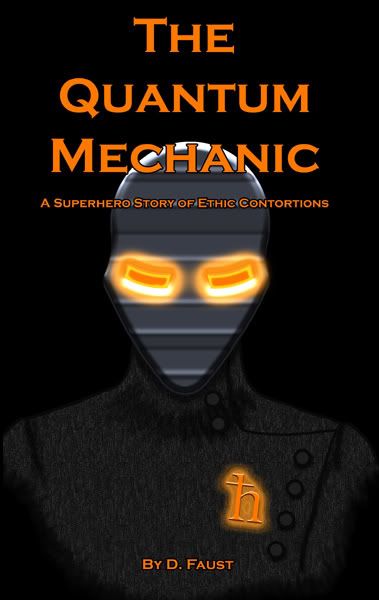
Anyway, I'm upset with a few elements of the cover. OK, four. Mainly the metal face bits, because I can't even follow a polykarbon tutorial right any more. But it's not total crap, and it will work as a cover for the proof copy so I can at least make sure I did the magic right on submitting things. Here, have a look-see:
I also decided, oh, about forty-five minutes ago that I wanted to do something besides plain black for the background - but I had accidentally made the background part of the layer I was working in, so I totally fucked myself. After that, it was mainly just saying, "Fuck it," and wrapping up so I could just get my damn proof copy already. So if anyone has awesome Photoshop skills - or any kind of awesome art skills, really - and feels like whipping up a 5x8" cover at 300dpi, it will probably be better than mine. And you'll get credit in the book, too! It's win-win, I promise!

Anyway, I guess that's what I get for trying to rush everything at the last minute and not sleeping since... umm... shit. I woke up on Wednesday morning and have been going ever since. Is it Friday already? I have shopping to do! Good thing I'm off work today.

Thursday, December 10, 2009

What is this "sleep" of which you speak?

Everything is in order, continuity is established, and like three typos were fixed. Seriously, I scoured the whole thing in the last like twelve hours and it's all good. Now I just have to register at Create Space and upload! Oh, and the cover, too. And dedication, acknowledgments, about the author, etc.

Friday, for serious.

Tuesday, December 8, 2009

Update!

So I didn't hear anything from the NaNoWriMo people about what I got for winning this year. But then Rhodopsin picked up Borderlands (which is a sweet game, despite the fact that it's side-by-side split screen and Modern Warfare 2 controls - and you can't fucking change either of those things! Dammit!), and Silver Garou & I have been working on getting the achievements to unlock the ODST armor for our internet avatars (because unlocking sweet gear for your internet persona by playing games is like the best marketing gimmick EVAR). What does this mean? It means that D becomes very lazy. I managed to write enough to cover the Riley Williams segment just in case I wound up wanting to remove it, but other than that, I haven't worked on The Quantum Mechanic since the 30th.

But then I got an e-mail at like 9 pm last night stating that we winners do get a free proof copy, and since I want to get this ready in time for Christmas shipping, everything else is on hold until I've got that all ready. Just so y'all know.

By the way, "in time for Christmas shipping" means Friday. Like, this Friday. So I'ma get crackin'!

Saturday, December 5, 2009

101 Interesting Things, part thirty-six: Cordyceps, scourge of the jungle!

Cordyceps is one of my favorite kinds of parasite: a zombie parasite! That is, a biological zombie parasite, not a memetic zombie parasite (religion, nationalism, etc.). What do I mean by "zombie parasite?" I mean a parasite that overwhelmingly alters the behavior of the host, like rabies (which makes its host restless, vicious, and thirsty), in a way that makes it dramatically more likely to cause the parasite to spread. The common cold, influenza, ebola, these just straight up kill you (or get killed) and it's a pretty boring fight. But zombie parasites make you do things that you could imagine the parasite straight up asking you to do, and you say "Yes." Just like religion!

Check this out:
Footage from Planet Earth.
Cordyceps is a real monster, albeit a beautiful one. It can make floor-dwelling ants, which would normally spend their entire lives on or beneath the ground, climb. And it looks cool, too! Check out some of these sweet photos:
Seriously: so awesome. But don't ever mutate! You can click on any of those "source" links for bigger (and more!) images, and you can also go here for even more shots. Great stuff!

Wednesday, December 2, 2009

Cross-Post: The Man with the Bag

My mom was fretting about there not being enough money this year for all the Christmas miracles she'd like to have happen. I tried to comfort her, so I asked what made Christmas magical in her youth, expecting that she'd reflect on things like family togetherness, a few nice surprises, and the hoopla of celebration; instead, she looked me in the eye and sadly said, "Santa," as if it were the most obvious thing in the world. My first thought was, "You child," but then I realized that calling her out on this would do no good, so I tried to constructively point out what really made Christmases good for her: the actual good things.

Anyway, the Santa Claus lie (and misinformation with intent to deceive is lying, no matter what your intentions are) is still being perpetrated upon my youngest siblings, so here's this.
Sometimes I feel like I'm the only one in my family who doesn't think it's OK to believe something false because it makes you happy. There are only two situations where we do this: the "Bunny, Tooth and Claus" trinity, and religion. My parents have asked me to keep mum once again about Santa Claus, insisting on perpetuating the myth in young E’s mind. I assured them that I would maintain my position of evasive neutrality – really, it would only do more harm than good at this point, and he’ll soon figure it out for himself, anyway. Plus, he’s not even my kid. After that, C’s practically in the bag. Next on the hit list: the Easter Bunny, and then the Tooth Fairy!

I want to take a minute to clarify something, though, lest it go misunderstood: I love winter festivities. Sure, a few people turn into raging dick-bags when discussing the proper etiquette of how to greet someone, and fuck the haters (I say “Happy Holidays” a lot because I don’t really identify with the religious reasons behind any of them and therefore don’t really wish well for any holy day in particular, but if someone wishes me Merry Christmas or Happy Chanukkah, I’m content to interpret that as a wish that I have a good time throughout the season), but by and large, most people get a whole lot nicer. Also, winter is awesome and gift-giving is one of my favorite traditions. On the one hand, yay free stuff; on the other, it helps you get to know someone and keep them in mind when you’re shopping for something you think they’ll enjoy. I also think that the history of the Santa Claus myth is a fascinating case study in memetic evolution; however, as with any other work of fiction, I think the myth is valuable as a myth and only as such.

A lot of people are willing to get on one’s case about such things (like my parents), and I find it puzzling that they treat this with such idiosyncratic uniqueness. One of the more idiotic attacks that I hear is that if I don’t endorse the systematic teaching of the Santa Claus myth to young children as fact, then I must hate fun. It should be obvious that one can enjoy an end without approving of every single means available to achieve it (disapproving of rape doesn’t mean that someone hates sex). Similarly, I don’t have to hate Christmas to harbor qualms about one or two aspects of certain groups’ celebration of it – for example, the over-commercialization of the season, of which many people of varying creeds disapprove.

A more subtle approach is to say that I’m simply being no fun on this one subject, in this one respect – I take it too seriously and am making a mountain out of a molehill. I can actually respect that position, so long as I’m afforded the opportunity to defend my own, which is my goal in this entry (and this isn’t really directed at anyone who’s likely to read it, it’s mainly shit I would tell my parents if I thought it would do any good). First and foremost, Santa Claus is a symbol, and symbols are important: they shape the way we think, teach us lessons, and often serve as paradigm cases upon which we may base more pragmatic beliefs or courses of action. As a symbol, I think Santa Claus is actually a good thing; it’s the treatment of this symbol – the teaching of it as literal fact to young children, the reasons for doing so, and the attitudes with which this practice is commonly regarded – to which I take exception.

I also want to take a moment to head off any accusations that this is a thinly-veiled rant against religion. I don’t want there to be any veil at all, really, but this isn’t about religion specifically - it’s about the perpetuation of a tradition which I think is both totally unnecessary and harmful to a certain degree, yet paradoxically enjoys what I think is an undue amount of respect in mainstream culture. It just so happens that this is the same kind of problem I have with religion. These two issues share a huge amount of overlap, I make no bones about this. However, I wish to confine the discussion here strictly to Santa Claus. Once again, this is a beef I have with parents in general, and mine in particular.

As I said, I like the Santa Claus symbol, because it appeals to the naïve intellect of children but also bears out on a more mature reading. He’s a magical man who lives beyond the reach of human civilization and gives gifts to people in accordance with their conduct by means impossible to us mere mortals. To the child, this translates as, “Behave well and get stuff you want.” And, really, I think that characterizes the experience of children in most decent households: good behavior is rewarded, bad behavior is reprimanded. Good symbol. Us adults know, however, that sometimes a severely unethical course of action, when rigorously pursued, can still net a positive result for the agent (for example, the Enron fiasco, wherein corporate pirates robbed a lot of innocent people of money they deserved and – injustice of injustices! – were only lightly reprimanded for it - the punishment in no way fit the crime).

Good behavior, on the other hand, often goes unrewarded for a very long time, and sometimes is never rewarded at all. Obviously, the karmic reciprocity embodied by Santa Claus holds little sway over real life, but I think that the symbol here serves not as a lesson, but as an example: should we not strive to make our society such that the good are recognized and rewarded, and the wicked are chastised? This is not a mechanism by which the world works, but rather an embodiment of values which I think many of us share. Reap what you sow, and all of that.

Additionally, I think there actually is a much deeper lesson that is instructive (as in the children’s example), rather than exemplary (for the grown-ups): you can cheat other people, but there’s no cheating reality. If you do a good job at something, then that will be reflected in the product of your labor; if not, then it’s garbage in, garbage out. There are exceptions to this, of course, but this is the general rule. OK, maybe this last one’s a stretch, but still.

The problems arise when we consider the teaching of this myth not as a symbol, but as a literal fact. In the first place, it’s a lie: misinformation with intent to deceive, plain and simple. This, on its own, is not much – it’s the context and the consequences of actions that determine their moral content, not their mere descriptions, but I think this should serve as a warning sign. Lies generally turn out bad. And let’s not forget the enormous, conspiratorial scale on which the Santa Claus myth is foisted upon young children.

When taken as literal fact rather than fable, the “be good, get stuff” ethic can be disheartening to children when compared to how things actually play out: if Santa Claus is really magical, and satisfies the wishes of children based on their behavior, shouldn’t you be able to get anything you want if you’re just good enough? And if you don’t get what you want, then doesn’t that mean you’ve been a bad child (or not good enough)? And how come Tommy, that spoiled brat next door, got what he wanted from Santa, but you didn’t? What’s this guy up to, anyway?

Of course, this isn’t the way it always goes down, but my point is simply that Santa isn’t all sunshine and rainbows. There’s also the fact that a lot of kids, upon learning that Santa isn’t real, are heartbroken: obviously, this is a cherished belief, since they’re not saying, “Huh, I thought there was something strange about that whole story, I’m kind of relieved to learn it was all hooey.” This effect has a double-edge, I believe – on the one hand, it provides evidence that belief in Santa is a good thing while that belief is maintained (and that’s the killer); on the other hand, the more cherished the belief, the harder it is to let go of it.

So yeah, Santa’s got his up-side, sure, but there’s also a down-side which I think a lot of people underrepresent. It’s kind of a wash, though, as most of this business goes down at an age that many don’t very clearly remember, so who cares? Let’s look at the ostensive reasons behind Santa, then; or, just what this myth is used for. “Be good, or Santa’s gonna give you a lump of coal in your stocking.” That’s a threat, right there. A fairly innocuous one, to be sure, and almost always empty. However, what strikes me as sleazy is that the source of the threat is externalized from the threatener: Mommy or Daddy is threatening to do something you don’t like, but under the guise that it’s a threat from someone else, an all-seeing and implacable judge of right and wrong who – wait, I said I wasn’t going to talk about religion.

The other side of that coin is that when the kid gets stuff they really like, who gets the praise? Not the people who did the actual work to make the Christmas Miracle happen, but the unseen benefactor in the sky – err, I mean, at the North Pole. Dunno what I was thinking there, innocent grin is me! (Look, I find it tremendously ironic that Santa’s like training wheels for a monotheistic deity, but so few outgrow the latter as they outgrow the former. No further comment on that, I promise.) In all seriousness, though, I do honestly think that the substitution of a false and magical justification for good behavior, in lieu of a rational and Earthly one, is a bad thing – both for the fact that it’s empty and wrong, and for the precedent it sets at such an impressionable age.

Look, one may say, all of this is small potatoes. The whole point of Saint Nick is that it’s an entertaining fantasy that’s fun for kids to believe while the magic of childhood lasts. Right? Still bad, says I. The fact that it makes you feel good to think something is true does not mean you actually ought to think it’s true. Take romance, for instance. Say one of your coworkers fancies another: do you think it would be good to make that person believe the feeling was mutual, knowing that that’s false? Of course not, you’re simply setting them up for disappointment – either quickly, when they start to act on those affections and get embarrassed, or gradually, as they wait for the other person to act on affections which are simply not there.

The same principle applies, and the same thing happens, with jolly old Kris Kringle. Perpetuating the illusion just adds to the let-down. And the whole “magic of childhood” tack kind of rubs me the wrong way, too. The message, as best I can tell, is that “magic is fun, reality is boring” (or “childhood is fun, adulthood is boring”). I find that false, and frustratingly so. If magic were real, then it would be like any other part of reality: discoverable, usable, investigable. There would be nothing special about it, just like there’s nothing special about computers (which, to my mind, are a kind of magic). As far as I can tell, what’s exciting about magic is not that it’s magic, but that it’s different. Kids who know there’s no such thing as Batman can still have fun playing Batman with their friends, or Hell, playing Cowboys and Indians when they know that they are not in fact cowboys or Indians. I did. Shit, I still do this stuff whenever I roleplay.

“Something Different,” every now and again, is exciting. It breaks up the routine. And you don’t need to think it’s true to have fun, you just have to pretend and have a functional imagination. Plus, reality is fucking exciting, too – you just have to know where to look. Boredom sets into the boring mind, and all that good stuff. Plus, the “magic” of childhood never really has to die, anyway. I find that, as an adult, I have more access to the stuff I liked doing as a kid, and now that the responsibilities are my own (which, to be sure, carries its own price – a price I pay gladly, by the way), I can determine when and how I do those things to a much greater extent than I could as a child. Being a grown-up fucking rules (and screw you, Mom, cake is a breakfast food!).

The point with all this is that I don’t have a problem with Santa decorations, or Santa floats in parades, or any of that nonsense. Go nuts. Really. Please, just, do whatever you like – I like the Santa myth, and adults know what’s up, so it’s all in good fun (for real). But when it comes to treating it like fact in a misguided attempt to "magic up" your kid’s childhood, I mean, nothing good comes of that which can’t be had by more wholesome means, and the bad stuff could all be rather neatly avoided by treating it like a superhero comic and telling your kid that it’s not true, it’s just a fun story. That’s really the source of my confusion: why the Hell isn’t Santa Claus treated just like Batman or Spider-Man?

Tuesday, December 1, 2009

101 Interesting Things, part thirty-five: Ye Olde Science Repository

I saw on Pharyngula today that the Royal Society is putting up a bunch of their oldest stuff online!
One of the world's oldest scientific institutions is marking the start of its 350th year by putting 60 of its most memorable research papers online.
They've got this super sweet timeline browser that takes you through the history with pretty pictures, and the papers touch on everything: meteorology, optics, medicine, anatomy, geometry, astronomy, everything! It's awesome!

OK, so this is really like sixty interesting things in one, but still: looking at the world to figure things out about it? Best. Idea. Evar! But enough out of me, go and learn!

Monday, November 30, 2009

The Quantum Mechanic: Un-Deleted Scenes!

I've got all these handy navigation links in the chapters, but none for the Un-Deleted Scenes, so I've added that here (as well as a link from the Epilogue that points to this page). Here you go:
Rock most hard. Have a great one, everybody!

Dear The Internet: I Win!

Look, see? I also donated some money and have a halo because of it. Oh, and I have a winner's badge thinger over on the right, too. Hopefully I can get that back in sales, if the CreateSpace deal is still going.

So yeah, I'm still not done writing, I just crossed the finish line. But I will post what I have when I finish this last un-deleted scene, and then it's time to arrange all the parts together for publishing. I want my hardcopy before Christmas!

More later, as I finish this last vignette.

EDIT: Finished! Final wordcount is 50,475. Moved this bit so it's "after" the last un-deleted scene (which should appear right below this, if I've done my math right). Hooray! Enjoy!

The Quantum Mechanic: Un-Deleted Scene Six

UN-DELETED SCENE 6: Victor playtests the device.

On a rocky planet circling the Sun at odd angles, a battle has just ended. Victor puts his weapons away, eats his fill, and then resumes his journey. The destination is not so important as how he gets there, but at the moment, he needs to make up some time. He visualizes wheels in his mind, designs a simple but effective drive train, then goes down to all fours while the device goes to work.

Hard rubber forms into tires around cartilaginous wheels. The discs calcify, and Victor's hands and feet are fused over the axles. His knees lift up from the ground, and callused pads nudge the wheels into motion. He's off. Victors leg bones are re-shaped, pulled out of joint, and arranged into pistons to more effectively drive his body. Along his spine, improvised neural architecture translates his thoughts into the proper motions, and then suddenly, being a motorcycle comes as naturally to Victor as walking.

The road is in a state of severe disrepair. Chunks of pavement jut out at odd angles, potholes threaten to jar him out of his smooth and calculated motions, and the odd tree and crater disrupt the road entirely at points. Victor presses on, his weight shifting to pull wheelies, bunny hops, and occasional leaps and bounds. His path of travel weaves through and around the encroaching wilderness, leaving only the occasional squirt of lubricating saturated fat. But it is enough for a quick and clever observer to follow.

Something approaches from the horizon, vaguely behind him. It moves with frightening speed, faster than sound. Victor decides to make his stand on a nearby overpass. His pistons disengage, and he gradually decelerates as muscles weave themselves into braided coils. Multipronged chitinous hooks form at the ends, and launch themselves at the overpass as Victor rolls underneath. Victor pulls his weight back, tightens his cords, and lifts off the ground. One of his hooks loses grip, and he loses balance - the device compensates by using the gyroscopic inertia of the still-spinning wheels to correct his pitch. Coming down from his arc now, the wheels disengage and Victor curls up to roll to a stop on the raised concrete. New arms and legs have formed before his tendrils have completely retracted, and now the metals he has been carrying with him are put to use: tiny bits of acid-cut shrapnel are chemically welded to each wheel, and as a rocket launches, Victor's eyes plot an interception course. The rocket is fast, but stupid, and the weaponized wheel is a small price to pay to take the explosive out of the picture. Victor hurls it with great power and accuracy, then winds up for his pitch at the jet itself.

At this height and range, the jet cannot change course quickly enough to dodge the incoming projectile. Instead, it launches a guided missile upon its target's position. The wheel tears through a wing, then the jet veers off before jerking toward the ground for a crash that shall be drawn out over several miles. As it nears its quarry, the digital pilot notes that Victor is tricking the missile's guidance algorithms into striking the concrete of the overpass - the man will be damaged, but not for long. The pilot's last thoughts before impact concern transmitting vital data on the new talents displayed by the target back to central intelligence.

Victor comes to rest after being thrown by the blast, watches the dying aircraft sail off into the distance. He notices a couple of nearby abandoned vehicles, checks them for any remaining gasoline. Two have had their caps removed, all unspent fuel either siphoned off or evaporated. The third one has about a quarter tank left; he drinks up the fuel, metabolizes it into more stable compounds, then heads off to search the wreckage of the plane, snatching up vegetation in passing to add to his biomass. By the time he reaches the first scraps of metal, he is a hulking colossus, picking up the twisted wreckage one piece at a time and arranging them as spines upon his back. They will be useful later, but there is nothing for him to do with them now.

After following the trail left by the felled hunter, Victor finally comes upon his prize: the remains of the cockpit. He is in luck, for the computer failed to wipe its mind before dying. Victor analyzes what is left of the machine, divining its home from the clues left in the dead slab of its brain. Nearby is a mostly intact fuel tank, too; this will be handy in time. Victor places what is left of the plane's nose upon his head, a mocking mask of his erstwhile pursuer, then forms himself into a great snake and sets about slithering across the plain at great speed.

After some time, Victor nears a deep forest. There are eyes everywhere: in the sky, under the ground, and especially in the trees. Without losing speed, Victor shifts his true brain to the rear of his body, letting his leading body act as a decoy. He writes subprocesses to handle navigational problems, then watches as his body courses through the thickening wood before him. Soon, he hears a buzzing from uncomfortably close; a swarm of stinging metal insects is upon him, injecting all manner of deadly substances into his body: corrosive acids, neurotoxins, engineered bacteriophages, retroviral scramblers. With his true brain at the rear, Victor is able to quarantine the infections as they attack his body at the mechanical, nervous, cellular, and chemical level, attempting to screw him up and shut him down from every angle all at once. He sheds the infected portions, sprays a few weapons of his own into the air, watches the swarm crumple and fall. He is wounded, but not mortally so. He presses on.

Near to the ocean now, he must find a way to cross. Flight is dangerous, for he is slow in the air; swimming upon the surface leaves him open to attack from all angles; the sea floor is slowest, but safest. Victor decides to take the low road, pitches down the seaside cliff, sticky tendrils shooting out to grasp the cliff face and control his descent. Into the salty surf now, he hugs the rocky bottom, thousands of tiny finned appendages guiding his tremendous length at every step of the way. He has far to go, and not much to help him along the way. The jet fuel is metabolized a little at a time to fuel electrolysis which Victor uses to separate oxygen out from the water; the remaining hydrogen is also spent as fuel, in stages and stages. A trail of bubbles and tracks in the sand is all that Victor leaves behind.

But after a time, with quite a ways left to go, Victor is consuming his own biomass just to keep moving. High above, he hears a broadcast signal: he is being watched. His position has been pinpointed. It is only an eye, no threat to him and not worth pursuing, but his position has been compromised. He keeps moving, makes an estimate of the time that is left to him. Soon, he comes across a hydrothermic vent in the inky blackness of the deep. Velvet tubeworms and albino crabs are both a meal and a textbook to him, as he adds their biomass to his own and learns their metabolic processes. He refines them, streamlining the chemical act of eating to something more suitable to his ideas of efficiency, then digs into the sea floor as muscular cords weave themselves into a large, stretchy bladder. Victor improvises valves to suck the vents into himself, and when he is of a suitable buoyancy, he releases his grip upon the earth and shoots up to the light.

Higher and higher, he virtually screams past all manner of ecosystems layered between the surface and the depths, bursting from the water in a plume of salty spray. He rises into the clouds, slowing down now as he forms his body into a large airfoil. Flattening himself, waving through the air like a magic carpet, Victor finally lets his breath out and forces the gas out behind him. Let them look at the sea floor; he has risen above that and now surfs among the clouds. He sacrifices altitude for speed, descending into a flattening path of travel as he achieves an ever more aerodynamic shape, arranging his various metal fragments to cut through the air as precisely and usefully as possible. Gravity has a great deal of work to do for him, and he squeezes the inexorable attractant to the very last drop, even at the expense of his last bits of extra biomass.

The coast is in sight now, and off in the distance a gleaming tower looms. As Victor descends back to sea level, gliding upon leathery flaps, he loses sight of his enemy's citadel but remembers its location. Plunging into the sandy beach, he grinds down his most useful-looking chunks of metal into deadly blades, then sheds the excess as he goes off in search of food. He is able to photosynthesize fuel from starlight, but it is a slow process and he cannot maintain his speed for very long with light alone.

There is a flash in the distance, and a bullet tears into Victor's head before he even hears the shot. He has learned to hide his true brain away from all of the obvious places, so the injury is but a minor inconvenience. However, his sensory apparatus has been damaged, and so he is not able to anticipate the next several bullets to tear through his body. Pain soon gives control to instinct, and Victor flattens himself against the ground, weaving around the thin grass to avoid betraying his presence. Safe, invisible, motionless, Victor then sorts out the damage to determine the general directions of these newest assailants. Winged automatons descend from the sky, flaming swords in hand, ready to cut their quarry down at the first sign of motion.

Victor waits for the right time to strike. He is invisible, colored and textured as his surroundings, inviting his would-be killers to tread upon him. One soon does, and he works his way inside, inflating a viciously bladed dummy body to be cut down by his own hand as he infiltrates the neural architecture of his host. He then mimics the expected chatter for a downed enemy report, sees into the whole communication network that tracks the progress and elimination of his partners in this game. He is inside the machine now, and by the looks of it, the first to infiltrate the network undetected. In his hidden mind, he reflects briefly upon the difficulty of determining whether another player has infiltrated the network as stealthily as he has. He sees the snipers now, knows their precise positions, but they are no longer a threat to him. He is dead to the system, a cypher born anew into this subverted soldier. No other devices have made it this close to the citadel, so the cadre of clockwork angels is ordered to return to the gleaming city on the hill.

Victor flies into the air in his new body, slipping easily into formation with his companions as they make their way home. He sees the glorious city in all its splendor as they approach, all of the din and furor surrounding the ivory tower at its center. He realizes with glee as they approach that that is their destination: he has infiltrated the honor guard of the central processor, the guardian angels of that angry machine trying to destroy him and his fellow players. Victor analyzes the memories of his host, determines the power structure of the central processor. There are failsafes upon failsafes, and he cannot simply cut one cord to bring down the entire house.

But he can destroy the building.

As Victor's host and companions take up their positions, roosting around the very top parapets of the ivory tower, he waits. They settle into their hibernation routines, and then Victor springs into action. He pitches forward, dives down along the face of the edifice, and lights his flaming sword as he nears the foundation. At nigh-supersonic speed, he corkscrews through the walls and supports, cutting the outer wall and inner structure to ribbons. Before gravity can take its toll, he is out and free, the fleeing traitor with a glittering tail of pursuers as the central processor for the whole city comes crashing down behind him. They are on to him, but it is too late by far. Machines wither, crash, and die as their centralized brain has all its supports torn out from under it, crushed beneath its own weight. The world skips a beat, resets, and Victor stands before a gunmetal gray automaton crackling with orange lightning.

"Congratulations, Victor. You win. Again."

"Why, thank you," he responds. "It gets easier every time."

"Still," the Quantum Mechanic responds, "I would have expected another to surpass you by now, as you have surpassed others in your own time." Victor blushes, flattered by the game master. "So, how do you feel?"

"I feel great! Triumphant. It is good to defeat an enemy, if only an invented one."

"What do you mean?" The Quantum Mechanic's face is inscrutable as ever, but its shift in posture indicates confusion.

"Well, you know, the central processor is only an enemy because we call it an enemy, and it acts like one. In reality, it's just a part of the bigger picture. Playtesting and all that. It's a honing implement, not a true enemy."

"Well, on that analysis, all enmity is invented." Victor pauses for thought.

"You know," he says after a few moments, "That's right."