We thought the internet would enable people to educate themselves, put an end to disinformation by making fact-checking easily available to all, bring the world closer together through open communication, and radically open up artistic collaboration.
Uhh... instead, we enabled people to look at cats (and porn), gave superpowers to disinformers, balkanized the world with micro-communities that enable all kinds of awfulness from pedos to Nazis, and... wait. We actually radically opened up artistic collaboration. One outta four... is an F minus minus. But at least it's not an F minus minus minus!
Today, I want to talk about some of my favorite cover bands that I only found out about because of YouTube. There are cover bands older than YouTube, of course, such as Me First and the Gimme Gimmes. But YouTube makes it possible to check out their sound and then... do whatever? I guess you could participate in the crowdfunding, but even if you don't, there's still the ad revenue they get.
Ew, that means I like something a corporation did. Le sigh. I can't be all-commie all the time, I guess.
Showing posts with label 101 interesting things. Show all posts
Showing posts with label 101 interesting things. Show all posts
Tuesday, November 19, 2019


Sunday, June 2, 2019
101 Interesting Things, part fifty-eight: The Horror of Georgia Tann
I'm back! (In accordance with the prophecy.) Thankfully, everyone I know and love is fine for the time being, and things have settled back down - but it did take a human sacrifice. Well, a partial one. I had to have my gall bladder out: turns out, I don't just have a sour stomach, and I've had gallstones for fifteen or twenty years! Also, these events are totally causally related, and not at all coincidentally timed.
Today's entry comes to you courtesy of the podcast, Criminal. I'll be writing about a real-life supervillain: born and raised in privilege, she was denied one fuckin' thing she wanted, and began a domino cascade that resulted in thousands of people suffering entirely deliberate but completely unnecessary tragedies.

Be warned: today's 101IT comes with child abuse, murder, miscarriage of justice on a nigh-industrial scale, no happy ending, and post hoc moral waffling by people who really ought to know better. So buckle up, Buttercup; we're in for a bumpy ride.
Today's entry comes to you courtesy of the podcast, Criminal. I'll be writing about a real-life supervillain: born and raised in privilege, she was denied one fuckin' thing she wanted, and began a domino cascade that resulted in thousands of people suffering entirely deliberate but completely unnecessary tragedies.

I am, of course, talking about this bitch. (Image found at
FindAGrave.com, because you're damn right I'm happy she's dead.)
Be warned: today's 101IT comes with child abuse, murder, miscarriage of justice on a nigh-industrial scale, no happy ending, and post hoc moral waffling by people who really ought to know better. So buckle up, Buttercup; we're in for a bumpy ride.
Saturday, November 3, 2018
101 Interesting Things, part fifty-seven: Color Vision
A long-standing question in philosophy is whether the red I see is the same as the red you see. The engineer's answer is that of course it's the same wavelength, and in accordance with the tradition of engineer answers, this is technically accurate but supremely unhelpful. However, there is an answer, and that answer is clearly not, sometimes.

For one thing, some people are colorblind. But it gets so much cooler, and so today I'm writing about color perception!
You may have heard of the rods & cones in our eyes, and the short version is that rods help us detect brightness while cones help us detect color. Rods are older, evolutionarily speaking, and much more responsive insofar as they take fewer photons to activate. But cones, in helping us see color, allow us to distinguish predators among busy backgrounds and detect the ripeness of fruits.

Most human beings are "trichromatic," having three kinds of cones: red, blue, and green. These respond, logically enough, to those corresponding colors of light. This means that the only reason the RGB breakdown works is because it corresponds to our machinery, not because that's how anything "really" is. But in some people, one of those sets of cones doesn't work, and they can't distinguish colors so well. And there is of course more to it than that, but most people know about colorblind folks and it gets way more interesting than this so we are rolling right along!
On the opposite end of the spectrum (so far) are tetrachromats, people who have four kinds of cones in their eyes and can see not 33% more colors (as one might expect), but many times more colors than us measly trichromats. This is because tetrachromacy doesn't "just" tack on another "kind" of color, but adds another dimension of color. So on top of all the R values that can be mixed with all the G and B values, there's a fourth set of values that can be mixed with all of the previous. But there's still more interesting to go!
The mantis shrimp sees our two to four color receptors, and raises: they've got twelve to sixteen color receptors, on top of each eye being trinocular and thus independently depth perceptive. Moreover, they can tune some of these receptors at will, and I don't even know how to imagine that twist on this thing I already can't imagine. The mantis shrimp's eyes are truly a thing to behold, and I really wanna know what it's like to have them, and The Oatmeal made an amazing comic about it so just go read. But even the mantis shrimp has to take a backseat to the very most interesting bit about color vision, and how we know sure as dammit that some people's red isn't the same as other people's red.
Color perception is also influenced by culture. Yeah, yeah, talk about the wine-dark sea and hair being compared to blue stones in Ancient Greek literature all you want, but this is some present-day go out and check now science. Sadly, the video is now down, but it was explained in a BBC program and the episode was entitled "Do You See What I See?" (because of course it fucking was). So some scientists found a tribe called the Himba and investigated their color terms and then devised a test: show twelve swatches of color in a circle, eleven of which are identical, but one of which is different by a small but measurable RGB value. We'll circle back after a brief tangent.
Us Westerners, with our internet and fashion industry, have pretty regular color terms (among present-day Western cultures, that is); this leads us into the trap of thinking they're objectively real and universal. Our science of color perception has noted that cultures first develop terms for black and white, then red, then yellow (just like the TooL song), and so on; this leads us into the further trap of thinking that other cultures' color terms are deficient or primitive when they differ from ours. But it turns out that other cultures can have color terms just as nuanced as ours but still different. We can test this because we can make objectively different RGB values and then interrogate people for their subjective color distinctions. I don't mean like Randall Munroe's color survey where clearly different colors are given the same name, I mean when actually different colors are perceived by us as the same color.


Getting back to aforementioned test: the image on the right has one swatch that's slightly more blue than the others, and the image on the left has one swatch that's slightly more yellow than the others*. I bet you, being an Internet Person, are able to quickly & easily distinguish the odd one out on the right, but not on the left. However, the Himba people of Namibia are the reverse from us: they are able to distinguish the left set just as quickly & reliably as we can the right set, but they guess on the right set just as unreliably as we guess on the left set. This is because the Himba distinguish more greens/yellows than us, but we distinguish more greens/blues.
Go ahead and take another look at those circles above, if you haven't already checked out the note below. If you can't tell which one is different, SPOILER ALERT it's the same position in both circles. /SPOILER If you try real hard, you might be able to see the difference, now that you know - but would you really bother to single out that one square if asked whether they were all the same or if one was different? If someone told you that the squares on the right looked all the same to them, would you say OK or would you call them colorblind? In a way, this should be no more surprising than the fact that fashion industry professionals distinguish more colors in general than most of us (how many shades of grey do you really need, without a professional reason for training yourself to distinguish them?). But the fact that the Himba so easily distinguish the left circle while having such difficulty with the right tells us, for sure, that what we see as blue they see as green as the rest of the circles - and vice versa for the circle on the left.
Age-Old Philosophical Problem: solved! We don't all see the same colors, it's influenced by a lot of things, from biology to culture.
* - SPOILERS IF YOU'RE TRYING TO SOLVE IT YOURSELF! I went & tested the RGB values, and it's a little disappointing because the "basic" green swatches are all 78/186/12, the blue one is 36/194/233, and the yellowish one (same position on the left) is 96/192/4. Calculating the differences between them, the blue one is considerably more different than the others are from each other. I went and made one that was "bluish" by the same numeric amounts as the yellowish one, and it didn't look very much different (and I also knew which one it was in advance, making the difference more noticeable to me). But I was also able to distinguish the yellowish one, because I looked at the one on the right and then on the left and thought it was in the same position, but then I thought maybe it was just an after-image, so I looked at the one on the right and then turned the screen and looked at the left one, and the same one (now in a different position) looked different, so I figured I was right. Then I tested them and I was vindicated, Hooray The End.

Pictured: BULLSHIT. (Not really. Image found at Quora.)
For one thing, some people are colorblind. But it gets so much cooler, and so today I'm writing about color perception!
You may have heard of the rods & cones in our eyes, and the short version is that rods help us detect brightness while cones help us detect color. Rods are older, evolutionarily speaking, and much more responsive insofar as they take fewer photons to activate. But cones, in helping us see color, allow us to distinguish predators among busy backgrounds and detect the ripeness of fruits.

Also found on Quora, but for a totally different conversation.
Interesting Miscellanies which You Prolly Know but Maybe Not
Most human beings are "trichromatic," having three kinds of cones: red, blue, and green. These respond, logically enough, to those corresponding colors of light. This means that the only reason the RGB breakdown works is because it corresponds to our machinery, not because that's how anything "really" is. But in some people, one of those sets of cones doesn't work, and they can't distinguish colors so well. And there is of course more to it than that, but most people know about colorblind folks and it gets way more interesting than this so we are rolling right along!
On the opposite end of the spectrum (so far) are tetrachromats, people who have four kinds of cones in their eyes and can see not 33% more colors (as one might expect), but many times more colors than us measly trichromats. This is because tetrachromacy doesn't "just" tack on another "kind" of color, but adds another dimension of color. So on top of all the R values that can be mixed with all the G and B values, there's a fourth set of values that can be mixed with all of the previous. But there's still more interesting to go!
The mantis shrimp sees our two to four color receptors, and raises: they've got twelve to sixteen color receptors, on top of each eye being trinocular and thus independently depth perceptive. Moreover, they can tune some of these receptors at will, and I don't even know how to imagine that twist on this thing I already can't imagine. The mantis shrimp's eyes are truly a thing to behold, and I really wanna know what it's like to have them, and The Oatmeal made an amazing comic about it so just go read. But even the mantis shrimp has to take a backseat to the very most interesting bit about color vision, and how we know sure as dammit that some people's red isn't the same as other people's red.
The Most Interesting Part of All!
Color perception is also influenced by culture. Yeah, yeah, talk about the wine-dark sea and hair being compared to blue stones in Ancient Greek literature all you want, but this is some present-day go out and check now science. Sadly, the video is now down, but it was explained in a BBC program and the episode was entitled "Do You See What I See?" (because of course it fucking was). So some scientists found a tribe called the Himba and investigated their color terms and then devised a test: show twelve swatches of color in a circle, eleven of which are identical, but one of which is different by a small but measurable RGB value. We'll circle back after a brief tangent.
Us Westerners, with our internet and fashion industry, have pretty regular color terms (among present-day Western cultures, that is); this leads us into the trap of thinking they're objectively real and universal. Our science of color perception has noted that cultures first develop terms for black and white, then red, then yellow (just like the TooL song), and so on; this leads us into the further trap of thinking that other cultures' color terms are deficient or primitive when they differ from ours. But it turns out that other cultures can have color terms just as nuanced as ours but still different. We can test this because we can make objectively different RGB values and then interrogate people for their subjective color distinctions. I don't mean like Randall Munroe's color survey where clearly different colors are given the same name, I mean when actually different colors are perceived by us as the same color.

Not this, in other words. But this:

(Top image from xkcd, bottom from PetaPixel's write-up of the documentary.)
Getting back to aforementioned test: the image on the right has one swatch that's slightly more blue than the others, and the image on the left has one swatch that's slightly more yellow than the others*. I bet you, being an Internet Person, are able to quickly & easily distinguish the odd one out on the right, but not on the left. However, the Himba people of Namibia are the reverse from us: they are able to distinguish the left set just as quickly & reliably as we can the right set, but they guess on the right set just as unreliably as we guess on the left set. This is because the Himba distinguish more greens/yellows than us, but we distinguish more greens/blues.
Go ahead and take another look at those circles above, if you haven't already checked out the note below. If you can't tell which one is different, SPOILER ALERT it's the same position in both circles. /SPOILER If you try real hard, you might be able to see the difference, now that you know - but would you really bother to single out that one square if asked whether they were all the same or if one was different? If someone told you that the squares on the right looked all the same to them, would you say OK or would you call them colorblind? In a way, this should be no more surprising than the fact that fashion industry professionals distinguish more colors in general than most of us (how many shades of grey do you really need, without a professional reason for training yourself to distinguish them?). But the fact that the Himba so easily distinguish the left circle while having such difficulty with the right tells us, for sure, that what we see as blue they see as green as the rest of the circles - and vice versa for the circle on the left.
Age-Old Philosophical Problem: solved! We don't all see the same colors, it's influenced by a lot of things, from biology to culture.
Notes:
* - SPOILERS IF YOU'RE TRYING TO SOLVE IT YOURSELF! I went & tested the RGB values, and it's a little disappointing because the "basic" green swatches are all 78/186/12, the blue one is 36/194/233, and the yellowish one (same position on the left) is 96/192/4. Calculating the differences between them, the blue one is considerably more different than the others are from each other. I went and made one that was "bluish" by the same numeric amounts as the yellowish one, and it didn't look very much different (and I also knew which one it was in advance, making the difference more noticeable to me). But I was also able to distinguish the yellowish one, because I looked at the one on the right and then on the left and thought it was in the same position, but then I thought maybe it was just an after-image, so I looked at the one on the right and then turned the screen and looked at the left one, and the same one (now in a different position) looked different, so I figured I was right. Then I tested them and I was vindicated, Hooray The End.
Saturday, October 20, 2018
101 Interesting Things, part fifty-six: Periodicity
The periodic table of elements is something I was aware of in grade school, but I didn't realize why it was called that until high school chemistry class.

My chemistry class was basically a college class, though - like, to the point that in actual college chemistry class, I didn't buy the textbook, own a calculator, or go to half the lectures (my buddy & I signed each other in because we're the fucking worst), and I got the highest grade on the first exam after being the first one done. This is not to toot my own horn, I'm saying that's how much stuck despite my slacker habits because my high school chemistry teacher was awesome. So I don't know what a "normal" high school education in chemistry is like, but I think this is interesting, so I'ma riff on it today.

I thought I had a joke lined up for here, but I'm not sure, because
I periodically forget them. (Image taken from Wikipedia.)
My chemistry class was basically a college class, though - like, to the point that in actual college chemistry class, I didn't buy the textbook, own a calculator, or go to half the lectures (my buddy & I signed each other in because we're the fucking worst), and I got the highest grade on the first exam after being the first one done. This is not to toot my own horn, I'm saying that's how much stuck despite my slacker habits because my high school chemistry teacher was awesome. So I don't know what a "normal" high school education in chemistry is like, but I think this is interesting, so I'ma riff on it today.
Tuesday, September 25, 2018
101 Interesting Things, part fifty-five: CRISPR
I don't have much by way of an intro for this one, so let's just say that CRISPR (pronounced "crisper," like the veggie drawer in your fridge) is the shit. If you wanna watch a video, here's Kurzgesagt (whose channel I of course recommend for a million things) on genetic engineering, with a substantial segment on CRISPR:
John Oliver also did a show recently about CRISPR that reminded me how cool it is & how much I wanted to write about it. His segment is really quite informative about the social context of it, but today I'm gonna bite into the nuts & bolts a bit.
Don't let the cutesy animation fool you, these guys rock the house.
John Oliver also did a show recently about CRISPR that reminded me how cool it is & how much I wanted to write about it. His segment is really quite informative about the social context of it, but today I'm gonna bite into the nuts & bolts a bit.
Sunday, September 23, 2018
101 Interesting Things, part fifty-four (b): The WizKID Epistemic Framework - Theory & Practice
Last time, I introduced the information science department's WizKID epistemic framework and listed a few advantages it has over the philosophy department's JTB model of knowledge. Today I'll be talking for a somewhat long time about some theoretical weirdness that comes up from the structure of the framework, and then for a considerably shorter time about some practical consequences and what they mean for our own knowledge construction.
Saturday, September 22, 2018
101 Interesting Things, part fifty-four (a): The WizKID Epistemic Framework - Intro & Advantages
Philosophers as a discipline are still stuck on the Justified True Belief (JTB) model of knowledge, even though Gettier showed pretty effectively where that breaks down. But even better, information scientists have made a replacement model that works, is quantifiable, and more accurately reflects how we construct and use knowledge in real life. I hope that one day philosophers manage to bring this better model over to their side, but I'm not interested in doing that because I'd have to fight against the tide and I'd really rather just do my own productive work.
But if you wanna know how knowledge really works, and get in on the ground floor of cutting-edge epistemology, then have I got something for you!
Saturday, February 16, 2013
101 Interesting Things, part fifty-three: Resettable locks!
Yesterday at work, I had an interesting and exciting opportunity come up. During my downtime, I read trade magazines and practice picking locks (by the way, I think it's so cool that I get to play around picking locks when we have no customers!), and one of the articles in this month's Locksmith Ledger (or whatever the magazine was called) was on opening & servicing safe deposit locks. It included instructions and pictures on various kinds of safe deposit locks, including resettable locks, which I didn't know existed.
Lo and behold, just a couple hours later that day, a customer brought in a lock that he had no key for. It turned out to be a Sargent & Greenleaf resettable safe deposit lock (though it only had the one keyway). So, because I'm all excited about that now, I'm going to give y'all a crash course on locks (using information that is freely available elsewhere on the internet, just so's I know I'm not giving away any trade secrets).
Lo and behold, just a couple hours later that day, a customer brought in a lock that he had no key for. It turned out to be a Sargent & Greenleaf resettable safe deposit lock (though it only had the one keyway). So, because I'm all excited about that now, I'm going to give y'all a crash course on locks (using information that is freely available elsewhere on the internet, just so's I know I'm not giving away any trade secrets).
Thursday, November 15, 2012
101 Interesting Things, part fifty-two: Klein bottles
Uh-oh. Two days between posts? Par. Three days? Acceptable. Four days? Sliiiippiiiing...
I've been wanting to power my way through this article, where humanity and humousity interact with each other "on their own terms," but it keeps slipping away from me. So fuggit, I will read it on my own time when I am bored (one magical, starry night, when there is nowhere to be and nothing to do, perhaps in another world or another life). So, to get marginally back on track, I will riff on something with which I am very familiar: four-dimensional single-surfaced super-edgeless objects.

Today we talk about Klein bottles! I've even included an artsy-craftsy step-by-step, for the four-dimensionally impaired. But seriously, if you don't know how this works, or have trouble visualizing four-dimensional surfaces (or even uncommon two- and three-dimensional ones), you can follow along with a piece of paper and a pair of scissors to achieve geometrical enlightenment. You will also need either of: A) scotch tape and two different-colored crayons, B) masking tape and two different-colored pencils, or C) a stapler and two different-colored crayons or pencils. A felt-tipped marker will help in any case.
I've been wanting to power my way through this article, where humanity and humousity interact with each other "on their own terms," but it keeps slipping away from me. So fuggit, I will read it on my own time when I am bored (one magical, starry night, when there is nowhere to be and nothing to do, perhaps in another world or another life). So, to get marginally back on track, I will riff on something with which I am very familiar: four-dimensional single-surfaced super-edgeless objects.
Today we talk about Klein bottles! I've even included an artsy-craftsy step-by-step, for the four-dimensionally impaired. But seriously, if you don't know how this works, or have trouble visualizing four-dimensional surfaces (or even uncommon two- and three-dimensional ones), you can follow along with a piece of paper and a pair of scissors to achieve geometrical enlightenment. You will also need either of: A) scotch tape and two different-colored crayons, B) masking tape and two different-colored pencils, or C) a stapler and two different-colored crayons or pencils. A felt-tipped marker will help in any case.
Sunday, November 11, 2012
101 Interesting Things, part fifty-one: Blood rain and fire rainbows!
Today we have a twofer, since these are both kinda short, and it's part fifty-one, which officially puts this project over the halfway mark (fifty behind, fifty ahead, and a double-dipper in the middle). Hooray! Today also marks the first time I've had occasion to use a "meteorology" tag. Double-hooray!
Our theme today is weird weather, and we open with blood rain. No, not the Slayer song that single-handedly stopped me from beating Guitar Hero 3 on Hard Mode.
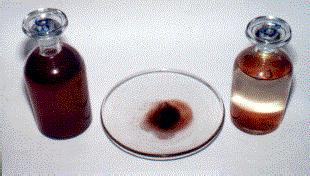
In ancient times, people wrote of blood falling from the sky as a bad omen, and while the whole "omen" part was hokum, the red rain itself was real. It wasn't blood, of course, but - well, look at this:
Our theme today is weird weather, and we open with blood rain. No, not the Slayer song that single-handedly stopped me from beating Guitar Hero 3 on Hard Mode.
It's not even a good song. At least your reward for The
Number of the Beast was rocking your own face off.
In ancient times, people wrote of blood falling from the sky as a bad omen, and while the whole "omen" part was hokum, the red rain itself was real. It wasn't blood, of course, but - well, look at this:
Thursday, November 8, 2012
101 Interesting Things, part fifty: Time travel, for real!
OK, so you've heard of vacuum fluctuation, right? A particle and antiparticle are spontaneously generated, and most of the time, they come back together and annihilate. When that happens, they haven't interacted with anything else, and so they're called "virtual" particles. But because both the particle and its antiparticle appear, nothing "actually" happens; it's just an interesting nothing.
Now that I put it like that, I suppose it seems really weird if you're uninitiated. But hold on to your butts - it's about to get a whole lot weirder. First, though, we need to talk about symmetry. I promise, though: by the time we get to the end of this, minds will be blown.
Now that I put it like that, I suppose it seems really weird if you're uninitiated. But hold on to your butts - it's about to get a whole lot weirder. First, though, we need to talk about symmetry. I promise, though: by the time we get to the end of this, minds will be blown.
Saturday, September 15, 2012
101 Interesting Things, part forty-nine: Silk
I have an endless fascination with macroscopic properties that are explicable in terms of microscopic properties, dating back to high school when I learned why the structure of water makes it a universal solvent, why the alignment of iron can result in magnetic fields, and where pH comes from. (When I asked my chemistry teacher, "What does pH mean, though - like, what's the thing that number's based on," she responded in a monotone, "Negative log of the hydronium ion concentration." After about ten seconds of goggle-eyed musing, I understood exactly what that meant and have never forgotten it.) It's also what caused electricity to be irreducibly magical to me, until I came to see voltage as a kind of "electrical pressure" - then, like, a million phenomena and failed experiments all clicked into place and I felt like a dummy... but an enlightened dummy!
So it should come as no surprise that one of my favorite books of all time is Napoleon's Buttons: 17 Molecules that Changed History, by Penny LeCouteur and Jay Burreson (well here's an interesting tidbit: my copy has this cover design, but that subtitle). The sixth chapter is on silk and nylon, nylon being developed for the purpose of being an artificial silk. Other interesting tidbit: in technical chemistry terms, "artificial" and "synthetic" mean two different things; "synthetic" means "laboratory-produced but chemically identical," whereas "artificial" means "not the same thing but has the desired properties" regardless of its method of production. So "artificial sweeteners" are "fake sugar"; they're not really sugar, they just do the thing we want sugar for; whereas "synthetic vitamin C" is the genuine article, real ascorbic acid that happens to have been synthesized in a lab instead of being derived from a plant. (This difference is articulated somewhere in the book, but at least four of the seventeen chapters deal with the difference and I refuse to track it down. I've been procrastinating long enough and only need some pictures, anyway, because the rest of the important information is just in my head.)
Anyway.
So it should come as no surprise that one of my favorite books of all time is Napoleon's Buttons: 17 Molecules that Changed History, by Penny LeCouteur and Jay Burreson (well here's an interesting tidbit: my copy has this cover design, but that subtitle). The sixth chapter is on silk and nylon, nylon being developed for the purpose of being an artificial silk. Other interesting tidbit: in technical chemistry terms, "artificial" and "synthetic" mean two different things; "synthetic" means "laboratory-produced but chemically identical," whereas "artificial" means "not the same thing but has the desired properties" regardless of its method of production. So "artificial sweeteners" are "fake sugar"; they're not really sugar, they just do the thing we want sugar for; whereas "synthetic vitamin C" is the genuine article, real ascorbic acid that happens to have been synthesized in a lab instead of being derived from a plant. (This difference is articulated somewhere in the book, but at least four of the seventeen chapters deal with the difference and I refuse to track it down. I've been procrastinating long enough and only need some pictures, anyway, because the rest of the important information is just in my head.)
Anyway.
Tuesday, July 31, 2012
101 Interesting Things, part forty-eight: Pyura chilensis
Let's have ourselves a little climb up the family tree. In the kingdom Animalia, phylum Chordata, you'll find the class Ascidiacea. Ascidians are the sea squirts, immobile filter feeders who sit in one place and just process whatever floats by. You know your sea squirts, right?


Tuesday, July 17, 2012
101 Interesting Things, part forty-seven: It's "-jutsu," dammit!
I've been reading The Wise Man's Fear, sequel to The Name of the Wind in Patrick Rothfuss' Kingkiller Chronicle. I can't put it down, and there's quite a long bit in the middle where the hero lives and trains among people who are essentially ninjas. The way their language is described, more suggestive than explicit, is analogous to Japanese; the way they move and fight, with subtle grace and economy, is clearly meant to evoke Earth's own "shadow warriors." So, naturally, I have ninjas on the brain.
In the twelfth century, a samurai named Daisuke Nishina suffered a crushing military defeat. Rather than face his death like a man (pfft!), he fled into the mountains, and that's where things get hazy. Some say he met a wise man from India, some say he met a monk from China, some say he met a tengu - but in the following years, a new breed of warrior arose in Japan. Unbound by the principles of bushido, these unconventional warriors eventually came to be known as ninja. They fought uncommonly well, but "dirty" (to the samurai), using techniques that exploited principles of leverage and body mechanics without relying so much on strength or speed. They also engaged in psychological warfare as their legend grew, cultivating their own myth to their advantage and pressing it against their superstitious opponents. And, of course, they used stealth - skulking about in the dark, striking from the shadows, disguising themselves, and various other "dishonorable" tactics that would be unthinkable for a samurai.
In the twelfth century, a samurai named Daisuke Nishina suffered a crushing military defeat. Rather than face his death like a man (pfft!), he fled into the mountains, and that's where things get hazy. Some say he met a wise man from India, some say he met a monk from China, some say he met a tengu - but in the following years, a new breed of warrior arose in Japan. Unbound by the principles of bushido, these unconventional warriors eventually came to be known as ninja. They fought uncommonly well, but "dirty" (to the samurai), using techniques that exploited principles of leverage and body mechanics without relying so much on strength or speed. They also engaged in psychological warfare as their legend grew, cultivating their own myth to their advantage and pressing it against their superstitious opponents. And, of course, they used stealth - skulking about in the dark, striking from the shadows, disguising themselves, and various other "dishonorable" tactics that would be unthinkable for a samurai.
Sunday, July 1, 2012
101 Interesting Things, part forty-six: Overtones
Enough of blood. I mean, I'll probably wrap it up at some point, since the immune system is just so cool. But enough of blood for now, I want to talk about other things.
So those Pentatonix guys I linked last time, that guy at (your) lower-right? His name is Avi Kaplan, and he can do something called "overtone singing," and I can almost guarantee that you know what it sounds like even if you don't know what it's called. Here he is:
So those Pentatonix guys I linked last time, that guy at (your) lower-right? His name is Avi Kaplan, and he can do something called "overtone singing," and I can almost guarantee that you know what it sounds like even if you don't know what it's called. Here he is:
See? You know that sound, right?
Sunday, August 1, 2010
101 Interesting Things, part forty-five (b): Blood - Hemoglobin and Homeostasis
"Hemoglobin is the key to a healthy heartbeat."
- Placebo, Haemoglobin
Blood - vertebrate* blood, at any rate - is red because the erythrocytes that float in plasma are red. The erythrocytes, in turn, are red because of all the hemoglobin in their cytoplasm. It's chock-full of the stuff. In the diagram below, the four green wire-frame looking bits (as opposed to the red and blue ribbon-looking bits) are the ferrous heme groups that bind up the oxygen you breathe into your lungs:
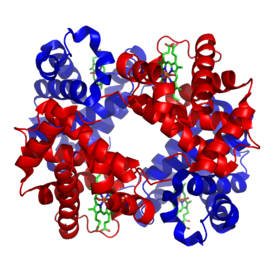

Oxygen diffuses into your red blood cells through the alveoli of the lungs, where each of those heme groups grabs an oxygen molecule. It's easy to do, since oxygen is fairly plentiful in the air we breathe. That may not seem like a whole lot, but it increases the amount of oxygen your blood can absorb by about seventy times, since otherwise oxygen could only dissolve into your plasma as a gas. Then, as your blood courses through your body, the lack of oxygen causes the iron atom in each heme group to lose its grip on the oxygen molecule it's holding, and the oxygen diffuses into nearby cells where it fuels the chemical reactions that drive you. That's... really all it is! Just pressure. Lots of chemical reactions, it turns out, are more like making soup than they are like building a machine, and the body's urgent need for oxygen in every cell means that a quick and dirty solution like this is all it takes (no fancy-pants calcium ion pumps or anything).
Of course, hemoglobin isn't the only solution to this problem. Molluscs and arthropods use cuprous hemocyanin, which does the same thing but has way cooler color-change action. See, deoxygenated blood is dark burgundy in color, whereas oxygenated blood is a more vibrant red. When hemocyanin is deoxygenated, it's colorless - but when oxygenated, it's blue. Look at this crab:
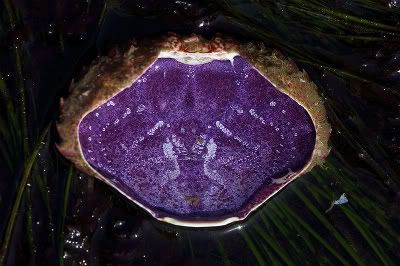

To be fair, hemocyanin bonds a little stronger to oxygen, which is what makes it so good for the invertebrates that use it, because they often inhabit oxygen-poor environments. On a related note, carbon monoxide bonds much stronger to the heme groups, rendering them useless because it never leaves, and this is why CO is such a deadly poison. Other solutions to the "Gee, I need oxygen in my blood" problem include hemerythrin, which is pink when oxygenated and colorless when deoxygenated, and the Christmas-themed chlorocruorin, which is red when oxygenated but green when deoxygenated.
OK, enough about other kinds of blood, back to your blood! After your erythrocytes have dumped their truckload of oxygen into your hungry hungry cells, they pick up the carbon dioxide to carry it to the lungs for exhalation. This is done in three ways: about 7% of your waste CO2 is dissolved directly into plasma, 23% combines with hemoglobin, and a whopping 70% is transformed by carbonic anhydrase (which is in your erythrocytes' cytoplasm) into carbonic acid. The Alert Reader who is passing familiar with chemistry will notice that carbonic acid dissolves in water by separating into a negatively charged bicarbonate ion and a positively charged hydrogen ion (or, as physicists are wont to call it, a proton). The Alert Reader who is passing familiar with chemistry will also notice that free-floating protons in water tend to result in hydronium ions, and the negative log of the hydronium ion content is what is measured when we refer to "pH". Here is a chart showing what happens when your blood pH gets outside the narrow range of 7.35-7.45 that I mentioned when we spoke last:
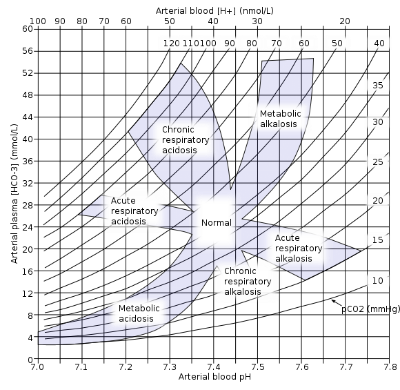

The Alert Reader who is passing familiar with Greek will notice that everything outside of Normal ends in "-osis", which means problem (loosely translated). So how does your body fastidiously avoid such problems? Well, in the first place, it's not like all your cells take in oxygen at once and then pass off carbon dioxide all at once. That would just be silly. But your body is always metabolizing, all the time always until you're dead, and so it needs to keep a tight rein on your blood pH as you go through your varying levels of activity.
Blood is slightly alkaline, and your bones are basically load-bearing mineral deposits, so that helps at least a little bit (Fun Fact: consuming too much animal protein in relation to vegetable protein has been implicated in bone mass loss in females!). Short term pH imbalance can be corrected by altering respiration: expelling more CO2 will increase the proportion of CO2 dissolved in blood (less carbonic acid means more alkaline blood), and holding on to more CO2 will increase the proportion held as carbonic acid (or H+ and HCO3-) and increase acidity. In the long term, your kidneys respond by excreting the leftover acid or base that builds up in your bloodstream, and also regulating the amount of buffering ammonia in your blood.
Your blood also helps regulate your body temperature through the clever application of plumbing. Heat is generated in various organs such as the liver and the brain (even thinking is exothermic!), and blood acts as a coolant to help you avoid overheating by absorbing some of the heat and bringing it to the heat sink that is your skin. In addition to sweating, your body sheds excess heat by expanding its arterial walls, increasing blood flow to the capillaries near the surface of the skin where the heat escapes into the atmosphere, or at least into your sweat (if the surrounding air temperature is higher than your body temperature). When you need to conserve heat, your arteries constrict, reducing blood flow to the skin and extremities to conserve heat and thus maintain core body temperature. This is why the cold will often make you numb and pale: your thoracic cavity needs all the heat it can hold on to, and the rest of you is somewhat more expendable. Note that this is distinct from frostbite, which results from ice crystals puncturing cellular membranes and causing cell death (this is why frostbitten tissues are kinda gelatinous when thawed, and one of the key hurdles for cryonics to overcome in the quest for legitimacy).
OK, oxygen transport, acid-base homeostasis, and thermoregulation - check! Tune in next Wednesday when I chatter on about the army of your immune system!
* - There just had to be an exception, didn't there?! The crocodile icefish does not use hemoglobin, and is the only vertebrate known not to do so. It lives in sub-zero seawater where it can absorb all the oxygen it needs right through it's goddamned skin. Fuckin' icefishes have it so stupid easy.
Sunday, July 25, 2010
101 Interesting Things, part forty-five (a): Blood - An Overview
Leviticus 17:11 says, in part, "the life of the flesh is in the blood". This is one of those things where the Bible actually gets it right, but they really had no idea how right they were. It doesn't take any great leap of creativity to notice that draining the blood from an organism is, by and large, fatal to said organism: massive blood loss is so consistently fatal because blood does so goddamned much for us in the first place.
Blood carries oxygen, food, and water to living tissues; it carries waste to the kidneys, liver, and lungs; it maintains the police presence of the immune system and carries vital hormonal signals all throughout the body; it even has pressurized hydraulics and helps regulate body temperature, all within a narrow range of pH values (a tenth of a point, between 7.35 & 7.45). Your body is basically a sac for your blood, the universal fluid that ties every part and function together. They Might Be Giants explain it in broad strokes and easy language in The Bloodmobile:
In many ways, your life revolves around your blood: your bones make erythrocytes in their marrow, and your tendons (which technically aren't vascularized) hold your bones together in ways that (usually) don't impinge upon the flow of your circulatory system; your circulatory system, in turn, carries blood to the various organs you use to maintain the fuel supply within your blood, including the brain and heart with their minute-to-minute demand for oxygen; your digestive tract is a tube within a tube, busting up what you eat at the molecular level to harvest the aforementioned fuel before dispensing with the unnecessary bits; and your skin holds it all in and keeps unwelcome elements out.
Blood carries oxygen, food, and water to living tissues; it carries waste to the kidneys, liver, and lungs; it maintains the police presence of the immune system and carries vital hormonal signals all throughout the body; it even has pressurized hydraulics and helps regulate body temperature, all within a narrow range of pH values (a tenth of a point, between 7.35 & 7.45). Your body is basically a sac for your blood, the universal fluid that ties every part and function together. They Might Be Giants explain it in broad strokes and easy language in The Bloodmobile:
In many ways, your life revolves around your blood: your bones make erythrocytes in their marrow, and your tendons (which technically aren't vascularized) hold your bones together in ways that (usually) don't impinge upon the flow of your circulatory system; your circulatory system, in turn, carries blood to the various organs you use to maintain the fuel supply within your blood, including the brain and heart with their minute-to-minute demand for oxygen; your digestive tract is a tube within a tube, busting up what you eat at the molecular level to harvest the aforementioned fuel before dispensing with the unnecessary bits; and your skin holds it all in and keeps unwelcome elements out.
Blood's very ubiquity made this an unusually research-intensive entry, and there's so much interesting stuff that I want to take it by parts. This weekend - and since I'm not spending all my time reading about blood, I'll actually have time to write about it, so it will actually be this weekend - I'll write about blood's role in respiration and homeostasis, ferrying oxygen and carbon dioxide hither & yon, and regulating pH levels & body temperature. Next Wednesday, I'll write about the immune system, which I would normally give its very own entry except for the fact that it all kind of takes place within the blood. And the following weekend, I'll talk about blood technologies and diseases, because they are also fascinating. Stay tuned!
Tuesday, July 20, 2010
101 Interesting Things, part forty-four: The Death Star Galaxy
The Death Star Galaxy is easy to remember in two different ways: first, it's called the Death Star Galaxy, and second, its designation is 3C 321. The mnemonics practically write themselves!
OK, so what's so crazy about formation 3C 321, and what makes it deserving of the title "Death Star Galaxy"? Well, for starters, the supermassive black hole at the center of this galaxy is blasting apart a nearby orbiting galaxy. Here's an artist's conception, so you can see the sort of thing we're talking about:

Just so we're clear, here's a breakdown of the situation. There's a supermassive black hole at the center of a galaxy, but no ordinary supermassive black hole: this one is emitting a jet of incredibly intense EM radiation. How intense? Intense enough to move stars. While jet emissions from black holes and other stellar formations are not rare, what is rare is to see one firing point-blank into a nearby celestial formation. Like, these galaxies are only about as far from each other as we are from the center of the Milky Way.
Heroes in lab coats are still trying to figure out what exactly causes these kinds of jets - I suspect the right hand rule, but the Devil's in the details. One strong possibility, though, is that the very process of blasting apart the neighboring galaxy will cause it to be re-formed around the area where the jet peters out. That is, assuming that the galaxies don't collide first. Dammit, why can't I live for billions of years so I can watch this sort of scene play out?
Here's a really cool animation showing how this plays out and giving a sense of scale to the operation: it starts by the event horizon of the supermassive black hole, then zooms out until you can see the whole scene. Check it out!
Saturday, May 8, 2010
101 Interesting Things, part forty-two: Musical Roads
So you know how when you're driving along the highway doing a hundred and ten miles an hour at two in the morning on maybe ninety minutes of sleep after drinking all weekend, and you nod off for a second and you're probably going to run off the road, but then you hear this obnoxious BZZRRRT sound as you cross into the shoulder? You can relate to that, right? No?
Well, OK, you'll just have to trust me that that's how it works. They're called "rumble strips," and some guy figured out that closer grooves in the pavement produce higher pitches and farther grooves produce lower pitches. Pick your speed, and you can make music:
It's called a musical road, and they've got 'em in Denmark, Japan, South Korea, and the USA. Here's another:
So yeah. There's not a whole lot to this, except that roads can be used as musical instruments. Which is awesome, don't get me wrong - I'm just saying, once you've explained the principle, there's not really a whole lot more you can say about it. I could get into the human angle, but I'm more fond of robots. So here's a robot playing a violin, which I think is also way cool:
Sunday, April 18, 2010
101 Interesting Things, part forty-one: Real-Life Ghost Ships!
I was reading Dino Comics at work the other day - which I highly recommend, by the way (Dino Comics, that is, not wasting time at work with pixellated fun in Courier font - I must not have fun. Fun is the time-killer.) - when...
Wait. Let me start over.
This Dino Comics strip taught me about the Baychimo, allegedly the very best of boats. After looking into the matter, I agree. But I also found out about a bunch of other crazy ghost ship stories in the process, and today I am going to share them with you. We'll start with the Baychimo.
In 1931, Baychimo became trapped in ice, and shed her crew because they were holding her back. She broke free in two days, only to be boarded again by her once-and-future taskmasters, and so she got stuck again within the week (a little passive-aggressive for a boat, don't you think?). Most of the crew gave up and went home in planes, their flighty temperaments no match for Baychimo's determination. The fifteen who remained lasted about a month longer, at which point Baychimo - I'm not making this up - escaped under cover of blizzard. You go, boat!
Baychimo was spotted days later and boarded for the purpose of taking her most valuable cargo, then abandoned in the frigid sea to presumably die of exposure. But after seventeen bitter years of servitude to the Hudson's Bay Company, Baychimo decided to make the most of her newfound freedom and roamed the seas for thirty-eight years, despite repeated boardings from unprepared yahoos who didn't know what to do with her (or didn't have the equipment even if they did, anyhow). Techinically, that should be "thirty-eight years and counting," since she is only presumed sunk. I prefer to think that she drifted all the way to the Moon and is now renovating the abandoned dinosaur cities on its dark side. If you don't believe me, you're welcome to check, just let me know when you're going so I can also buy a ticket.
Next, we go back in time to 1872 to discuss the Mary Celeste. On the night of November 4th, Captain Benjamin Briggs (of the Mary Celeste) met with his friend Captain David Morehouse (of the Dei Gratia) for dinner with their wives in New York. Both ships were headed for the Mediterranean, as it turned out, though Morehouse didn't leave for another week. But on December 4th, the Dei Gratia spotted Mary Celeste about six hundred miles West of Portugal. Nobody was on deck, there was no distres signal. After two hours of staring at the empty ship, she was boarded and explored, with perplexing results:
Finally, we conclude our journey through ghost ship history in 2007 with the Kaz II, a catamaran which bore three men to mysterious watery doom. On April 18th, Kaz II was spotted drifting by a chopper near the Great Barrier Reef. Once boarded, the Queensland Emergency Management Office found everything to be perfectly normal: the equipment was all intact (save one torn sail), the engine was running, a laptop was on, no life jackets had been used, and food was set out on the table (spooky!). There were just no people. Footage recovered from the ship, timestamped the morning of the ship's departure, showed a 360-degree view of surrounding scenery which allowed investigators to pinpoint Kaz II's location, as well as various other details which had been altered by the time of the ship's discovery, aiding efforts to piece together the story. The official report is, to my mind, a good piece of reasoning which incorporates all the evidence:
Wait. Let me start over.
This Dino Comics strip taught me about the Baychimo, allegedly the very best of boats. After looking into the matter, I agree. But I also found out about a bunch of other crazy ghost ship stories in the process, and today I am going to share them with you. We'll start with the Baychimo.
In 1931, Baychimo became trapped in ice, and shed her crew because they were holding her back. She broke free in two days, only to be boarded again by her once-and-future taskmasters, and so she got stuck again within the week (a little passive-aggressive for a boat, don't you think?). Most of the crew gave up and went home in planes, their flighty temperaments no match for Baychimo's determination. The fifteen who remained lasted about a month longer, at which point Baychimo - I'm not making this up - escaped under cover of blizzard. You go, boat!
Baychimo was spotted days later and boarded for the purpose of taking her most valuable cargo, then abandoned in the frigid sea to presumably die of exposure. But after seventeen bitter years of servitude to the Hudson's Bay Company, Baychimo decided to make the most of her newfound freedom and roamed the seas for thirty-eight years, despite repeated boardings from unprepared yahoos who didn't know what to do with her (or didn't have the equipment even if they did, anyhow). Techinically, that should be "thirty-eight years and counting," since she is only presumed sunk. I prefer to think that she drifted all the way to the Moon and is now renovating the abandoned dinosaur cities on its dark side. If you don't believe me, you're welcome to check, just let me know when you're going so I can also buy a ticket.
Next, we go back in time to 1872 to discuss the Mary Celeste. On the night of November 4th, Captain Benjamin Briggs (of the Mary Celeste) met with his friend Captain David Morehouse (of the Dei Gratia) for dinner with their wives in New York. Both ships were headed for the Mediterranean, as it turned out, though Morehouse didn't leave for another week. But on December 4th, the Dei Gratia spotted Mary Celeste about six hundred miles West of Portugal. Nobody was on deck, there was no distres signal. After two hours of staring at the empty ship, she was boarded and explored, with perplexing results:
Oliver Deveau, chief mate of the Dei Gratia, boarded the Mary Celeste. He reported he did not find anyone on board, and said that "the whole ship was a thoroughly wet mess". There was only one operational pump, two apparently having been disassembled, with a lot of water between decks and three and a half feet (1.1 m) of water in the hold. However, the ship was not sinking and was still seaworthy.Piracy, foul play on the part of Dei Gratia's crew, mutiny, and insurance fraud are all silly explanations, as many very valuable things were left intact, the captains of both ships were good friends, there was no sign of any kind of struggle, and the insurance payoff wouldn't have been worth the planning. Likely of importance was Mary Celeste's cargo: 1,701 barrels of commercial alcohol. Briggs was not a fan of such dangerous cargo, and the possibility of an explosion may have motivated him to evacuate the ship with his wife, daughter, and crew at a sign of trouble. A brief fire from alcoholic fumes might not have left any scorch marks on the ship, and could explain the hasty evacuation. If Mary Celeste ran into a waterspout (tornadoes of the sea!), "Lower air pressure resulting from a waterspout might have thrown off measurements of how deep the water level was in the ship's hull. A dipstick-like device was used to monitor water levels in the bilge. Low pressure could pull water up the tube around the stick, creating the impression of a sinking vessel." (Wikipedia again.) In either case, it's likely that the evacuating crew tied their lifeboat to the rope that was found frayed and trailing the ship.
All of the ship's papers were missing, except for the captain's logbook. The forehatch and the lazarette were both open, athough the main hatch was sealed. The ship's clock was not functioning, and the compass was destroyed; the sextant and marine chronometer were missing. The only lifeboat on the Mary Celeste, a yawl located above the main hatch, was also missing. The peak halyard, used to hoist the main sail, had disappeared. A rope, perhaps the peak halyard, was found tied to the ship very strongly and the other end, very frayed, was trailing in the water behind the ship.
- Wikipedia on the Mary Celeste
Finally, we conclude our journey through ghost ship history in 2007 with the Kaz II, a catamaran which bore three men to mysterious watery doom. On April 18th, Kaz II was spotted drifting by a chopper near the Great Barrier Reef. Once boarded, the Queensland Emergency Management Office found everything to be perfectly normal: the equipment was all intact (save one torn sail), the engine was running, a laptop was on, no life jackets had been used, and food was set out on the table (spooky!). There were just no people. Footage recovered from the ship, timestamped the morning of the ship's departure, showed a 360-degree view of surrounding scenery which allowed investigators to pinpoint Kaz II's location, as well as various other details which had been altered by the time of the ship's discovery, aiding efforts to piece together the story. The official report is, to my mind, a good piece of reasoning which incorporates all the evidence:
"On Sunday, April 15, 2007, at 10:05 A.M., the Kaz II was sailing in the vicinity of George Point. Up to that moment everything was going as planned but, in the following hour, their situation changed dramatically. The men hauled in the white rope that was trailing behind the boat and bundled it up on the foredeck, possibly to dry, next to the locker it was normally kept in. For unknown reasons, James Tunstead then took off his T-shirt and glasses and placed them on the backseat. The report says that since the men's fishing lure was found entangled in the ship's port side rudder, an obvious explanation would be that one of them tried to free the lure and fell overboard while doing so. Standing on the boat's 'sugar scoop' platform (a platform at the back of the ship close to the waterline) while the boat is moving is perilous and falling in the water is easy, but getting back aboard almost impossible. One of the other men then came to the rescue of his friend, while Batten, still on board, started the motor and realized he had to drop the sails before he could go back for his friends."But perhaps spookiest of all, the comic strip which started this all cannot be found! No, seriously, I'm glad I e-mailed myself the link, because searching for ghost ship or Baychimo with OhNoRobot doesn't turn it up (try it!). Oooh. Poor ghost ships, they wouldn't be so lonely if they weren't so hard to find...
As he left the helm to drop the sails, a deviation of the ship's course or wind direction could have easily caused a jibe, swinging the boom across the deck and knocking Batten overboard. This could even have happened before Batten was able to untie and throw out the life ring to his friends. A blue coffee mug found near the life ring may support this. Since the boat was travelling before wind and at a speed of 15 knots, it would be out of reach of the men within seconds. The report states: "From that point, the end would have been swift. None of them was a good swimmer, the seas were choppy; the men would have quickly become exhausted and sunk beneath the waves."
Subscribe to:
Posts (Atom)