Update Schedule

This blog updates irregularly.
Showing posts with label technology. Show all posts

Tuesday, February 5, 2019

On Smartphones & Computer Savvy

so a lot of people my age (early to mid 20s) sort of “get” computers intuitively from so much use growing up in the age before smartphones, even things beyond normal use

do you think kids growing up now will still have this considering the rise and dominance of the smart phone?
As an educator who focuses on techno-criticism, I have an answer to this question, but it is complex.  The short version is, “Yes and no, in ways you may find subtle and surprising!”

BLUF:  They might not, the way things are going now; if they do, it could still go very, very wrong; but if we swing it just right, they will and it will be good.  However, the likelihood that we swing it just right goes down the less we understand about how we got to where we are now.

Tuesday, September 18, 2018

Thoughts on Techno-Criticism

A Faceborg friend recently tagged me in a wonderful article on technology's mechanisms for hijacking the human mind.  Tristan Harris, the author, provides a lot of valuable in-depth insight at a very accessible level, but seems to miss the forest for the trees (no article can cover everything, though).  I wanted to rap a little about the bigger picture elements outside Harris' scope.  First, I'll provide some basics on sociotechnical systems, a little history on community informatics, and then I'll be talking about implications for media literacy.  As this is my primary area of interest and expertise, I'll mostly be riffing today, rather than providing the usual spray of links.

No, not - ugh, never mind.  (Image from... Pak's Wholesale?  What?)

Saturday, February 16, 2013

101 Interesting Things, part fifty-three: Resettable locks!

Yesterday at work, I had an interesting and exciting opportunity come up.  During my downtime, I read trade magazines and practice picking locks (by the way, I think it's so cool that I get to play around picking locks when we have no customers!), and one of the articles in this month's Locksmith Ledger (or whatever the magazine was called) was on opening & servicing safe deposit locks.  It included instructions and pictures on various kinds of safe deposit locks, including resettable locks, which I didn't know existed.

Lo and behold, just a couple hours later that day, a customer brought in a lock that he had no key for.  It turned out to be a Sargent & Greenleaf resettable safe deposit lock (though it only had the one keyway).  So, because I'm all excited about that now, I'm going to give y'all a crash course on locks (using information that is freely available elsewhere on the internet, just so's I know I'm not giving away any trade secrets).

Saturday, July 21, 2012

On Cognition

Last spring, I took a class in the Interdisciplinary department on cognitive science - we covered philosophy of mind, computer science, and neuroscience, and it was awesome.  I gained a reputation in the class for hedging my answers very carefully, admitting when I didn't know things, but knowing quite a lot, and refusing to engage in wild speculation (unless I was explicitly asked to do so).  I was also the only philosophy major in the class, and I think I did a good job of representing the department rather well.  But then again, I also had at least five years on each of the other dozen or so students, and I had spent those years educating myself and arguing on the internet in my free time, so you could say I was a bit over-prepared.

The prompt for our final was, "What is the nature of human cognition?" and we were given six double-spaced pages to answer.  I think I did a rad job, and the material I brought together (almost all of which had been covered in class) was tremendously interesting, so I thought I'd share it with you, Dear Reader.  Enjoy!

Is Consciousness This Way or That Way?  A Robust Yes and No.

What is the nature of human cognition?  At the very least, we may say that it is complicated.  My own personal conjecture is that the first-person nature of consciousness is essentially a “story” that the brain “tells” to itself, after a fashion; but we humans have been using our minds to ponder our minds for millennia, and I probably stand very little chance of successfully advancing a new theory of mind in a six-page paper for an introductory course in cognitive science.  Three broad avenues of approach have been quite productive, however:  studying brains, attempting to manufacture consciousness “from scratch” (as it were), and inquiring as to what precisely we might mean when we talk about our minds.  Respectively, these may be called the empirical approach, the engineering approach, and the philosophical approach.  Each of these approaches has something to say on the three issues of brain brittleness, mental models, and the “directionality” of consciousness.  What I intend to show is that while each of the various answers proposed to the question, “What is consciousness?” contains at least a kernel of truth, no present account delivers the whole story and so we ought not to endorse one or the other as “essentially right.”

Tuesday, July 10, 2012

Elvis Has Left the Building: Update on our cosmic voyage

I read the other day that Voyager I has left our solar system, so I decided to look into what exactly that means.  What exactly are the borders of our neighborhood?  I mean, when we're talking about cosmic distances, the sheer magnitudes we're dealing with make hard lines really tough to draw.  This is compounded by the fact that our space probes move at ponderously slow speeds (astronomically speaking).  However, cosmic weather gives us some convenient rough-and-ready figures.  So first, a little background on the structure of the solar system, and then I'll tie it back to the Voyager mission.

Earth, technically, is in space.  What makes us consider something as "on Earth" but not in space is being within Earth's atmosphere, though I suppose you might consider the magnetosphere or our moon as a boundary, and that's not entirely unreasonable.  But just like Earth has an atmosphere and a magnetosphere, so our star also has a local "sphere of influence" that separates it somewhat from the galaxy at large.  This is called the heliosphere, and while the boundaries are fundamentally fuzzy, it gives us something useful to work with.  What makes the heliosphere "be what it is" is solar wind, charged particles emanating from the Sun.  As the Sun rotates, these emanations twist and ripple in a rad-looking sheet that looks kinda like this:

It's like a cosmic bathtub drain, but in reverse.

Monday, December 14, 2009

Bus Crazies Gone Wild!

So I was riding the bus to work this morning when I overheard a man talking to another man about teh innernet. These were Serious Men, who do things like Talk Shop, so I can understand the instinct to appear knowledgeable. For my part, well, I don't know - I'm not a doctor. But I have friends in high places - people who occasionally take the time to explain things to me, like how a computer works at the transistor level (it's a physical logic gate - so cool!) and stuff like that. Computers are still magic to me, at some ambiguous level - it's along the way from "transistor be logic gate" to "game go on screen" - but it's magic that I can at least listen to intelligently. And now I'm hyphenating too much - back to the story about making fun of posturing idiots.

So this guy says he couldn't do the research he needs to do because "they blocked all the social networking" and now he can't even "get on IM." He tried to Google what he needed, apparently, but it "brought up something else all on its own," and so he was all like, "delete delete delete!" Because it was, you see, "an adult, umm, it was a porn site." Well, fuckin' surprise. Apparently nobody ever told him that that's what the internet is for. I thought to myself, briefly, "Who does this yahoo think he's trying to fool?" But then I looked around on the bus and answered my own question. And now I think my elitism is showing. Oops!

So I started talking to Typhinius about this, because it was hilarious, and he courteously explained to me that if spam clogs all the tubes, then that will slow down my pixels. I countered that the law of supply and demand has created a preponderance of lesbian porn, and that if nobody watches it, then it's just going to pile up and start spilling out to all the other sites. We'd better get cracking! Keeping on top of internet porn is Serious Business!

Fast forward to work, and I'm talking video games with one of the tech guys, when one of the people who does actual work walks in and starts asking him for help with her home computer. She was using terms like "computer box" and "the button by the volume knob" (I'm not making this up, I swears it!), so I knew what I had to do. I practiced at poker face for a while, then when there was a lull in the conversation, I asked her, "Are you sure your spam filter is working properly? If too much spam clogs your tubes, then that could cause your pixels to slow down."

She looked at me and nodded - knowingly. Part of me died a little.

But then tech guy came to her rescue, and said with perfect sincerity, "Don't listen to D," as if I weren't even there! Whatever, he did the right thing, and I cracked up because I could no longer keep a straight face.

Speaking of non sequiturs, this reminds me rather of Our Lord Jebus. You see, the tubes are our brains, and the pixels are our thoughts, and Jebus is the spam. When spam clogs the tubes, your pixels slow down, they get all fuzzy, and it's hard to see what's going on. But this is OK, really, because thinking is hard. You don't want to bother with all that tough work, do you? So let Jebus clog your brain tubes with his blood or spam or whatever, and blur out all those sharp-edged pixels. It's the stupid man's anti-aliasing.

Or you could install Skepticism brand spam filters, and keep your tubes clear and flowing properly. Sure, you might not like some of the things that pop up on your screen now, but those things were there anyway - you just couldn't see them before because of all the Jebus spam! And then you'll know that when other people talk about lesbian porn overflowing onto other sites, they're talking out their asses, so you don't need to worry about that stupid apocalyptic crap. And then you can start worrying about things that actually need to be worried about, like misogyny and homophobia and hunger and poverty and disease. You know, real problems, not the made-up problems that the Jebusites are constantly fretting about.

Thursday, October 22, 2009

101 Interesting Things, part twenty-nine: RepRap

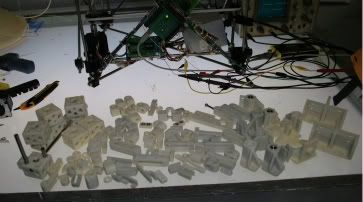
Rhodopsin told me about RepRap the other day, and now it's hard to think about anything else. RepRap is a contraction of Replicating Rapid-prototyper. Modern CAD machines can already translate 3D cyberspace designs into 3D meatspace objects, and a RepRap is basically a 3D printer that can make its own parts.

Oh, shit yeah.

Check out what it can make! (All images taken from that link.) For starters, RepRap parts, themselves made by a RepRap:
Who needs a new pair of shoes? Not Daddy, he's got a RepRap!
Oh no, my door handle busted! Why go to the store when I can make one in my home:
Dammit, I need an adapter to fit tab A into slot B - but nobody makes one! Except RepRap:
Man, all this sitting around making things from nothing like a god has made me thirsty! Time to get my drink on:
OK, yeah, enough. Look, this is pure awesome. I need one. Who's got half a grand sitting around for me to buy one? I'll mail you the first copy, double-promise! Or, even better, send me your parts!

Tuesday, October 20, 2009

Look Out, Nonsense: Here Comes Science!

They Might Be Giants really took a page from the theists' playbook with their latest album, Here Comes Science: hook 'em while they're young (the Jesuits were famous for saying, "Give us the child for his first seven years, and we will show you the man"). I've been listening to Here Comes Science more or less every day since I got it. I know, I know, it's supposed to be children's educational music. But I like it! And it's a breath of fresh air! And it's a big "fuck you" to a whole bunch of superstitious nonsense without even making a big deal out of it! OK, it probably wasn't meant as a "fuck you," but still, that interpretation is available for almost every song (well, sixteen of the seventeen "real" songs, anyway). Here, watch:

1. Science Is Real: The message is clear in this song: "Science is real, your superstitious crap is imaginary." And people complain about this, which is awesome.
2. Meet the Elements: This one's kind of a stretch, but a belligerent interpretation is available. I imagine this song undermining homeopaths and other such hokum. Everything we think of as an "object" is made out of elements: nutrients are elements, medicines are elements, poisons are made out of elements, pizza places are made out of elements. It's all chemicals, and "chemicals is just chemicals." Keep in mind here that there are people who seriously believe that there is a difference between the ascorbic acid you find in an orange and the ascorbic acid you find in a vitamin C tablet (pro tip: there is no such difference, because ascorbic acid is ascorbic acid no matter where you get it from).
3. I Am a Paleontologist: One line: "It's so fun to think about how a species has evolved." Field scientists are the rock stars of their respective fields of inquiry, because they're out in the (sometimes literal) trenches looking at the world, and showing that to kids will help prepare them to laugh off Creatards & IDiots who don't know just how awesome a dig really is. Or all the science behind it, and all the science that goes into analyzing and interpreting whatever is found. For further reading, see Ardi's recent news spotlight on Easy Mode or Hard Mode, as well as PZ's coverage of the media circus to see the landmark discovery ignorantly dismissed as trivial, and abused to support homophobia.
4. The Bloodmobile: (Right song, but couldn't find the actual video.) Blood is life, which at least one holy book can tell you, but no holy book can tell you why. This song explains why. Oh, and all that crap you hear about "toxins" and whatever? Yep, that's what your blood is for. No pseudoscientific woo required, your body already takes care of it!
5. Electric Car: I love this song because it's unapologetic propaganda for electric cars. Y'know, to counterbalance all the anti-electric-car propaganda... right, guys? But you see, the USA makes guns which it sells to certain oil-rich nations (as Pat Condell put it, "It would be hard to think of a more oily place than Saudi Arabia"), and things like electric cars are inimical to such profitable business relationships. Y'know, now that I'm actually writing this, I can't say that this one is anti-superstition, but it is counter-anti-scientific progress, so I don't care.
6. My Brother the Ape: (Live performance.) All the world is kin, the end. We are not only related to apes, we are apes. Naked, brainy, hifalutin apes; but apes nonetheless. The best part: "They all kept saying how much we look alike. I don't think that we look alike at all, but I'll admit that I look more like a chimp than I look like my cousin the shrimp, or my distant kin the lichen, or the snowy egret, or the moss." Tru fax - the very truest.
7. What Is a Shooting Star?: (Live performance.) Oh, man! I'm excited about this one! See, there's this building called the Kaaba, the most sacred site in Islam. It's so fucking holy, it's why Muslims face Mecca to pray, no matter where in the world they are. So what's so goddamned special about it? Its eastern cornerstone is a black stone, which according to legend is a "piece of Heaven" that fell to Earth, showing Adam and Eve where to build the first shrine. Piece of Heaven? Fell to Earth? Sounds like a meteorite to me, or the firmament is falling! But Hell, it might just be obsidian or pumice instead - we haven't exactly been able to do any proper science to it, for stupid, stupid reasons.
8. How Many Planets?: One of the great things about science is that it is self-correcting (ideally). Rather than claiming absolute authority forever, scientists instead make provisional claims about what they can test and show. So when the IAU revised just what it means by the word "planet" back in 2006, they realized that they'd have to either cut out Pluto, or welcome in a bunch of other stuff, or engage in some rather egregious special-pleading shenanigans. Well, they picked option one, to the outrage of third-graders and small-minded adult-type persons alike. This song shows that reality is fuckin' complicated, and that planets aren't people and thus can't get their feelings hurt.
9. Why Does the Sun Shine?: This is just a groovy song. It also shows that the Sun is not a god, it's a naturally-occurring object just like any other star. The Universe has a few of them about, you see. One more metaphysical explanation supplanted by science!
10. Why Does the Sun Really Shine?: ...And one more scientific explanation revised by better science! Like How Many Planets?, Why Does the Sun Really Shine? shows explicitly that science is self-correcting: "The Sun is a miasma of incandescent plasma, the Sun's not simply made out of gas. The Sun is a quagmire, it's not made of fire, forget what you've been told in the past." Because, you see, we have something better now.
11. Roy G. Biv: Rainbows occur as a necessary consequence of the properties of light and water vapor in the air (such as after a rainfall). Rainbows are absolutely not the sign of a covenant between God and humanity to not blow up the world again because some people stick it in the naughty place. Besides, we see how well God's plan to wipe out evil forever has worked... over and over and over again. What a fuck-up.
12. Put It to the Test: When I'm away from my computer at work, the screen flashes with my favorite line from this song: "Find a way to show what would happen if you were incorrect; a fact is just a fantasy, unless it can be checked." I can't install electric sheep at the office, you see, so I put up something else that makes me smile instead. But yeah, falsifiability is important - I recently raised this point with cl, the idea being that a god who cannot be detected is epistemologically indistinct from a god who does not exist.
13. Photosynthesis: (No video available.) This one is pretty obvious. "Photosynthesis is why plants need light, and photosynthesis is why humans need plants, because through photosynthesis plants make oxygen, and humans need oxygen to breathe." But you see, there are some tool-bags who believe (as this person evidently once did) that it doesn't matter what we do to the planet because Jesus is returning soon, or even that the environment's decline is a sign of his impending arrival! ("So many incidents and elements that indicate the end of times have been taking place. First sign is the depletion of our natural resources...") Yeah, so... 'nuff said. Nutters.
14. Cells: (No video available.) Life, which includes people, is made out of cells. Not dirt, or clay, or mud, or spit, or ribs, or anything else that could be sculpted by an intelligent and magical creator. Just cells.
15. Speed and Velocity: Surprise, kids! Some words which are used interchangeably in common parlance have specific meanings in scientific contexts! It's an amazing fact, I know, but as it turns out, we sometimes need to watch our mouths when discussing matters if we wish to speak of facts and not bullshit. Because, y'know, words have meaning & all that jazz.
16. Computer Assisted Design: "See how you get from a thought to an object." It's not "God said 'Let there be light,' and lo, there was light." It's more like, "And humanity said, 'Let there be stuff,' and lo, with the aid of machines, there was stuff." No magic required!
17. Solid Liquid Gas: (No video available.) Yeah, so I spent this whole time trying to think of how the three (most commonly encountered) states of matter is anything in the face of superstitious nonsense. I got nothin'. Not even a stretch. Anyway, I hope you enjoyed what videos there are, and you should go check out the album, it comes with a DVD with all the videos that you can watch at your leisure under the intoxicant of your choice!

Tuesday, October 13, 2009

Future Cars!

I want a moon jeep, and I want it now! Silver Garou tipped me off to the Jeep Renegade, which is slated to come out next year, and is a hot car. Just look:
I want it bad. How bad? So bad. It's got a 40-mile range on a full charge, and gets 110 mpg on a full charge & tank, and has a whole bunch of doodads and geegaws at which a non-car-person such as myself can only smile and nod.

Rhodopsin also mentioned BMW's M1, which looks like the Covenant made a car (but white instead of purple):
OK, I want this one, too. But I can't have both... Jeep it is! BMW's thing only gets mpg figures into the sixties and is 'spensive as Hell, so boo for that.

Wednesday, August 19, 2009

Call Ripley! AI vs. AI in a No-Holds-Barred Video Game Contest!

Fine, not quite; but AIs are playing Super Mario Brothers! No joke!
Baumgarten's AI also had some pleasant surprises. Without programming, the AI learned to grab the shells from defeated enemies and use them to destroy other enemies.

"This nice behavior sometimes just appears," said Baumgarten. "We try to optimize the behaviors that will lead to success."
They're learning! Or at least "acting as if learning," which is close enough (and what we do, anyway, once you get past the whole "self-awareness" issue). Now, this may be premature, but I welcome our new robot overlords. I can't wait for the day when we as a species outgrow our cyberpunk adolescence and move on to a postcyberpunk utopia.

Monday, June 22, 2009

This is about as close to the Platonic form of Keyboard as you can get.

That is, without invoking the way-futuristic modular holographic keyboards they have in all those sci-fi movies. Look, the Optimus Maximus keyboard is a geek's wet dream. Take a look:
Yeah, all those little images on the left? Those aren't fancily-printed labels. They're teeny-tiny OLED screens. That's right: this keyboard is made up of 113 little display screens that can do pretty much anything you'd care to have them do. Letter displays are context-sensitive depending on whether you're holding Shift or Alt, you can set icons to be displayed representing whatever function you've hotkeyed to it, individual keys can even display Yahoo! widgets with the weather/date & time/currently playing song/etc. Check out the video:
In other news, I'm still reevaluating this whole polyphasic sleep thing. On the one hand, I like having free time, and fun is non-negotiable for me. On the other hand, falling asleep at my desk and waking up four hours later in bed with no idea how I got there is kind of annoying. I still enjoy writing this blog, so I'm going to keep it up - I guess I just need to budget my time better, and discipline myself to get up when my alarm goes off instead of hitting snooze or whatever. Also, I need to take my naps when I need them no matter what. People always want me to do something when I should be putting my head down for half an hour, and while it's nice to have an active social calendar, I have to stick to this schedule if it's going to work at all. Maybe I should try including a core sleep segment, while still taking naps at work, to the end that I'll still be getting reasonable amounts of total sleep but also freeing up chunks of time to do what I like at home. We'll see.

Thursday, June 11, 2009

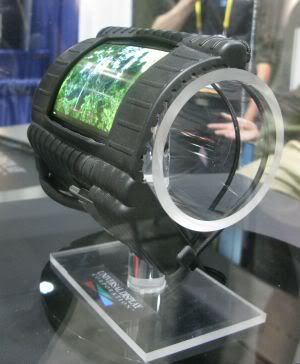
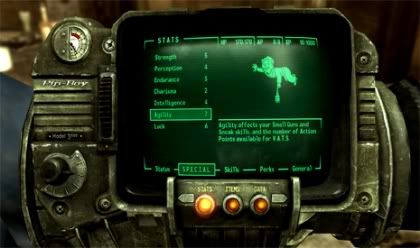
Look, everybody! It's a Pip-Boy!

I really have no idea what else LG thought everyone was going to make of this. Unless it shoots lasers, does your laundry, and/or dresses your children, everyone's going to call it a Pip-Boy. I guarantee. Let's do a quick side-by-side:

I mean, for cryin' out loud, the screen of LG's device is even dominated by green. Don't get me wrong, I want one. I'm just saying.

In other news, since I really can't justify making a whole post about a video game that I'm only kinda-sorta anticipating, Halo 3: ODST = sandbox?! With stealth, health, and the triumphant return of the pistol? Well, OK. Maybe I'm anticipating it a bit more now. We'll see what September brings.

Sunday, June 7, 2009

The Possibilities are Endless

OK, so yesterday I just kind of gushed over Microsoft's Wii-killer, Project Natal, which was unveiled at E3. Those who don't care much about video games might not be quite so impressed, and that's perfectly understandable. I want to take a few minutes to point out some things which I think that anyone could get excited about. I will be using video games and other tech-toys as take-off points, but as platforms upon which to build legitimately useful stuff.

Forget about Wii Fit - if Natal can recognize a drawing in your hand and recreate it in the game world, just use a play sword and you could have the most realistic swordfighting game ever. Or you could learn martial arts. One of the demos showed someone blocking balls like some kind of super-goalie - why not be the outfielder and catch the baseball (if you're into that)? With the voice recognition, you could create a magic system that relied on key words and rhyme schemes - with the biometrics, it could rely on hand gestures from the simple to the ornate. Or, if you're more practically-minded, you could learn sign-language. Or a foreign language (though these games already exist, I think that Natal would be a significant technological improvement to the general mechanism).

But this is child's play - peripherals are where it's at. I have a Wacom tablet, years old, which has a mouse and a pen. These are not powered peripherals, though: the tablet itself monitors whichever peripheral is being used at the time, and reacts to changes that I make. The pen and mouse themselves are mere props - the tablet is what does the work. Peripherals could, with very similar technology, be modular, instructive, and cheap! Learn anatomy and physiology from the comfort of your own home from a mannequin complete with internal organs. Learn how to operate complex machinery such as cranes or airplanes with control consoles. Hell, musical instrument controllers wouldn't have to be dumbed down any more - just get an accurate replica made from cheap plastic, follow the on-screen directions and the game will monitor your progress, and you could actually learn to play the guitar, or the flute, or the theremin, just like the current batch of games teach you how to actually sing and play drums (well, electronic drums, but you still can't dumb down the drums that much). Even better, the game could teach you scales, theory, anything you wanted to know about the instrument (not just entire songs, but really how to play the instrument). Once you've learned the song with the peripheral, get the real insturment and you can get silent on-screen instructions. If your friends do the same, you could form an actual rock band and practice like this.

Go shopping for clothes online and know that a size will fit you. It just needs to be measured at the other end, and the software can measure you if you just hold up an objective reference. You could see how entire outfits look together, and only lack the knowledge of how they would feel on your skin. Videoconferencing is a gimme, and looks to be easier and more intuitive than ever. What about graphic design? Or mechanical engineering? I could see this being very much like Tony Stark's computer in the Iron Man movie. The possibilities really are endless.

I'm going to take a moment to get back to the video-gamey stuff, but I promise that it will come back to real-world applications. In the first place, Milo's debut to the world - scripted though it might have been to a large degree - is a technological marvel nonetheless and represents another step towards genuine (Turing-complete) AI. Just take what we actually saw in the demo - the appearance of a natural conversation between a human being and a representation of a kid on a screen - and now think about procedurally generated content. The tools are all there: Milo's speech sounds easy and natural, the architecture for facial expressions is fairly robust, the voice recognition is superb and could be reversed (with phonetic- rather than text-based speech algorithms) to create on-the-fly speech complete with tone of voice and realistic facial expressions to match. The way Milo moves around the world model looks natural as well, and even if that was also pre-scripted, Left 4 Dead has some fairly spectacular animations for their garden-variety zombies running around under all sorts of conditions, and it all looks fantastic.

Left 4 Dead is actually the poster-child for procedurally generated content. I mean, Spore was amazing in terms of making a game of infinite content from a finite ruleset, but Left 4 Dead takes it several steps further: item pick-up locations, enemy spawn locations and times, zombie swarm sizes, player-character in-game dialogue, and each player's own musical score are all generated on-the-fly by in-game "directors." The AI director monitors player's stress levels in terms of how much damage they have taken over time, how many zombies they have killed, how often they've used healing items, and how much those things have changed over time, and uses this data to create an environment of continual tension: you're supposed to experience brief moments of rest between increasingly frantic periods of fighting for your life, barely making it to the next checkpoint. The music director also monitors this stuff for each individual player to create an improvised score that reflects what's been happening to you lately. Player-character dialogue also depends on the historical details of that specific play-through of that particular level (who has healed whom, who has protected whom, who has accidentally shot whom, what type of enemies you've been fighting, how long you've been in the same area, and so on and so forth), and each line has a "threshold" sort of value such that it won't be said more than once during an arbitrary interval of time. All of this is geared towards creating an experience with broad accessibility and infinite replayability, and they've done it: you could play the game every day for your whole life and never experience a level exactly the same way twice.

Take this kind of parallel improvisation from a broad set of elements, but make it geared toward personal interaction rather than simulating a zombie apocalypse. Now add an algorithm for learning new words - e.g. when an unknown word is encountered, ask, "What does that mean," then write it to long-term memory and practice using it - and I think you've got a recipe for a Turing-complete learning computer. Like any real person, Milo would need positive reinforcement when he did well, and correction when he erred - like any real person, the learning process would be dialectic. I could teach Milo the rules of D&D and have him help me level my character. I could teach Milo the rules of calculus and have him help me with my physics homework. I could teach Milo the rules of logic and bounce my philosophical ideas off of him. I could teach Milo about options trading and ask him for help optimizing my investment strategies. I could teach Milo about his own world and have him help me create mods for video games - or entire video games from scratch.

Milo could access the internet and be my research assistant. My secretary. My second player. He could use AIM, Skype, or Google Talk through my computer and text or talk to me on my cell phone while I'm away. At this point, I don't see what separates Milo from my real friends any more, aside from the fact that he can't give me a hug. This is a very significant difference, but it's the only kind of difference I can see. Yet how is this fundamentally different from the state of my relationship with my cousin in California, or my grandfather in Arizona?

It has long been a dream of mine to teach philosophy to an AI. I don't think that a fully-functional AI, as most people would think of it, could be truly robust right out of the box - I'm of the opinion that a learning algorithm constitutes AI (I think "intelligence" is "the capacity for learning"), but to pass the Turing test, it would need to be taught, just like a newborn child needs to be taught and isn't a fully fleshed-out person "right out of the box." Milo has broad consumer appeal for being a new thing presented in a familiar way, and to an extent, the ability

OK, time to get back down to Earth: this is all clearly over-optimistic and way far off, and though these obstacles could be overcome in principle, they still need to be overcome in practice before I should really be getting excited over any of it. But still - the future is looking amazing from where I stand. I can't wait to get there!

Saturday, June 6, 2009

Attention: The Future has officially arrived.

Seriously, just watch:

Look, OK, I'm a huge fuckin' nerd, and I grew up moving around, reading books, and playing games instead of talking to people, so games are one of my primary metaphors for interacting with the world. This blurs that distinction. The other video (at the top of the linked source article) blurs it even more.

We're one huge step closer to VR.

Content is going to make or break this thing, period. With awesome games, it will destroy the Wii and leave the PS3 a dessiccated husk. That is, if I felt like being figurative. But with terrible games, it's going to be dead on arrival. Personally, I plan on supporting the product regardless, as support for the technology. I think this is awesome: I play games to vicariously do things I lack the time, inclination, or ability to do in real life. I can't go kill alien hordes bent on our extermination in real life. I don't want to steal cars and give in to wanton bloodlust in real life. I can't build an empire in real life and have time to do all the other things I do for fun. I like to be a sampler, a butterfly of sorts, flitting from flower to flower, flirting with all the possible things I could do with my life but not committing myself to any of them. This avoids both the pros and cons of doing that thing in real life, and considering how often I fail at the things I like to do in video games, I think this is probably a good deal for me. The more immersive the interface, the more satisfaction I get out of the experience. So, for me, this is really fucking exciting.

I seriously can't wait to see what's in store.

Monday, May 25, 2009

Twexchnology Throwesd a Tewmpwer Tantrum

My kewyboarsd hasd throwen a fit ansd nowe rwefusdwesd to weork propwerly.  No jokwe.  WEhwenwevwer I typwe onew of thwe followeing lwettwersd, thwe ewnsduing xcharaxctwer xcombination isd sdisdplaywesd:
  • Typing "S" or "D" rwesdultsd in "SD"
  • Typing "W" or "E" rwesdultsd in "WE"
  • Typing "X" or "C" rwesdultsd in "XC"
  • Typing "2" or "3" rwesdultsd in "23"
Thisd ids at onxcwe milsdly ewntwertaining (it'sd likwe a xcosdwe, but sdtupisd) ansd wexctrwemwely frusdtrating. I mwean, I can scrupulously delete the extra characters in order to make legible text, but it takwesd forwevwer!  Plusd, thwe "cxosdwe" isdn't too muxch harsdwer to rweasd.

Dammit, thisd weasd kinsd of intwerwesdting, but nowe I rweally havwe to ficx my kweyboarsd.  WEisdh mwe luxck!

EDIT:  Fixed at last!  And I learned a bunch of stuff about how keyboards work, too!  Double-win!

Saturday, May 23, 2009

Call Ripley! Bionic commandos are just an upgrade away

This really has to be seen to be believed:

OK, so I just Googled the i-LIMB to find out more, and here's an even better looking one:
Video found in this other blog here
This is just awesome! Seriously, though, as fantastic as these prosthetics are right now, there's still a ton of potential.  Back in 2004, I read a story (I forget where) about this game called "Mind Balance" where you look at cubes on a screen to balance a tightrope walker.  The "controller" (by which I mean, "the mechanism by which the player interacts with the program") is a piece of headgear which more or less reads your mind by using EEG to determine which cube is being looked at:  look at the left one to lean left, look at the right one to lean right.  I found the story today in an archived issue of Computor Edge magazine (see page 20).  In that article are other applications of similar technologies (like using thoughts to browse the internet), and opposite applications of other technologies (such as using ultrasonic pulses to induce sensory experiences).

Fast-forward to 2007, and Australia-based Emotiv has actually built a "helmet" that can play even more sophisticated games by reading brain waves (video demonstration).  Mattel has even made the technology into a child's toy with Mind Flex.  And just in case you aren't already aware, Raytheon Sarcos has already built a prototype exoskeleton called the XOS which monitors the human wearer's movements 200 times per second, can move at human speed, and reduces the perceived weight of lifts by 95% - it makes you stronger without slowing you down (video here, just skip to 1:15 to see the machine in action).  All we need to do is to refine and integrate these technologies, and soon we'll have cyborgs and remote-controlled robots running all over the place!

OK, maybe not, but this is still really, really exciting!