Update Schedule

This blog updates irregularly.
Showing posts with label astronomy. Show all posts

Tuesday, July 10, 2012

Elvis Has Left the Building: Update on our cosmic voyage

I read the other day that Voyager I has left our solar system, so I decided to look into what exactly that means.  What exactly are the borders of our neighborhood?  I mean, when we're talking about cosmic distances, the sheer magnitudes we're dealing with make hard lines really tough to draw.  This is compounded by the fact that our space probes move at ponderously slow speeds (astronomically speaking).  However, cosmic weather gives us some convenient rough-and-ready figures.  So first, a little background on the structure of the solar system, and then I'll tie it back to the Voyager mission.

Earth, technically, is in space.  What makes us consider something as "on Earth" but not in space is being within Earth's atmosphere, though I suppose you might consider the magnetosphere or our moon as a boundary, and that's not entirely unreasonable.  But just like Earth has an atmosphere and a magnetosphere, so our star also has a local "sphere of influence" that separates it somewhat from the galaxy at large.  This is called the heliosphere, and while the boundaries are fundamentally fuzzy, it gives us something useful to work with.  What makes the heliosphere "be what it is" is solar wind, charged particles emanating from the Sun.  As the Sun rotates, these emanations twist and ripple in a rad-looking sheet that looks kinda like this:

It's like a cosmic bathtub drain, but in reverse.

Friday, June 29, 2012

We can burn brighter than the Sun!

One of my high school history teachers was fond of quoting Mark Twain as saying, "There are lies, there are damned lies, and then there are statistics."  But Clemens attributed it to Benjamin Disraeli - which also turns out to have been wrong (in all likelihood).  It just goes to show, you can't always trust a citation.

Seems legit.

Tuesday, July 20, 2010

101 Interesting Things, part forty-four: The Death Star Galaxy

The Death Star Galaxy is easy to remember in two different ways: first, it's called the Death Star Galaxy, and second, its designation is 3C 321. The mnemonics practically write themselves!

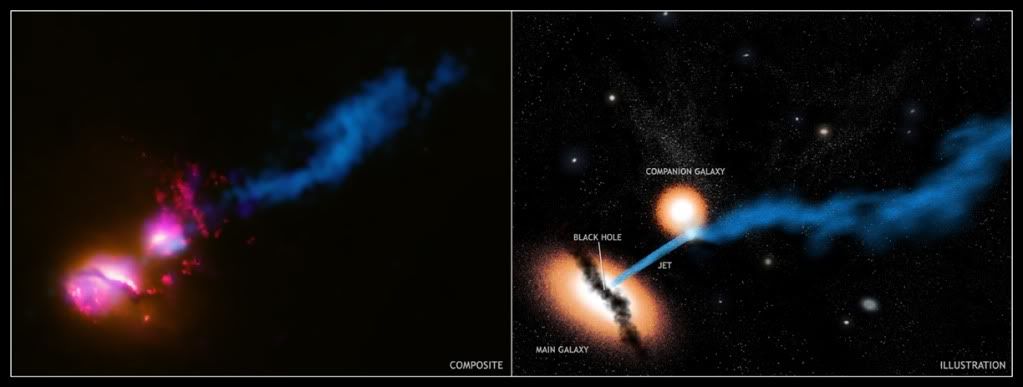
OK, so what's so crazy about formation 3C 321, and what makes it deserving of the title "Death Star Galaxy"? Well, for starters, the supermassive black hole at the center of this galaxy is blasting apart a nearby orbiting galaxy. Here's an artist's conception, so you can see the sort of thing we're talking about:
Just so we're clear, here's a breakdown of the situation. There's a supermassive black hole at the center of a galaxy, but no ordinary supermassive black hole: this one is emitting a jet of incredibly intense EM radiation. How intense? Intense enough to move stars. While jet emissions from black holes and other stellar formations are not rare, what is rare is to see one firing point-blank into a nearby celestial formation. Like, these galaxies are only about as far from each other as we are from the center of the Milky Way.

Heroes in lab coats are still trying to figure out what exactly causes these kinds of jets - I suspect the right hand rule, but the Devil's in the details. One strong possibility, though, is that the very process of blasting apart the neighboring galaxy will cause it to be re-formed around the area where the jet peters out. That is, assuming that the galaxies don't collide first. Dammit, why can't I live for billions of years so I can watch this sort of scene play out?

Here's a really cool animation showing how this plays out and giving a sense of scale to the operation: it starts by the event horizon of the supermassive black hole, then zooms out until you can see the whole scene. Check it out!

Tuesday, October 20, 2009

Look Out, Nonsense: Here Comes Science!

They Might Be Giants really took a page from the theists' playbook with their latest album, Here Comes Science: hook 'em while they're young (the Jesuits were famous for saying, "Give us the child for his first seven years, and we will show you the man"). I've been listening to Here Comes Science more or less every day since I got it. I know, I know, it's supposed to be children's educational music. But I like it! And it's a breath of fresh air! And it's a big "fuck you" to a whole bunch of superstitious nonsense without even making a big deal out of it! OK, it probably wasn't meant as a "fuck you," but still, that interpretation is available for almost every song (well, sixteen of the seventeen "real" songs, anyway). Here, watch:

1. Science Is Real: The message is clear in this song: "Science is real, your superstitious crap is imaginary." And people complain about this, which is awesome.
2. Meet the Elements: This one's kind of a stretch, but a belligerent interpretation is available. I imagine this song undermining homeopaths and other such hokum. Everything we think of as an "object" is made out of elements: nutrients are elements, medicines are elements, poisons are made out of elements, pizza places are made out of elements. It's all chemicals, and "chemicals is just chemicals." Keep in mind here that there are people who seriously believe that there is a difference between the ascorbic acid you find in an orange and the ascorbic acid you find in a vitamin C tablet (pro tip: there is no such difference, because ascorbic acid is ascorbic acid no matter where you get it from).
3. I Am a Paleontologist: One line: "It's so fun to think about how a species has evolved." Field scientists are the rock stars of their respective fields of inquiry, because they're out in the (sometimes literal) trenches looking at the world, and showing that to kids will help prepare them to laugh off Creatards & IDiots who don't know just how awesome a dig really is. Or all the science behind it, and all the science that goes into analyzing and interpreting whatever is found. For further reading, see Ardi's recent news spotlight on Easy Mode or Hard Mode, as well as PZ's coverage of the media circus to see the landmark discovery ignorantly dismissed as trivial, and abused to support homophobia.
4. The Bloodmobile: (Right song, but couldn't find the actual video.) Blood is life, which at least one holy book can tell you, but no holy book can tell you why. This song explains why. Oh, and all that crap you hear about "toxins" and whatever? Yep, that's what your blood is for. No pseudoscientific woo required, your body already takes care of it!
5. Electric Car: I love this song because it's unapologetic propaganda for electric cars. Y'know, to counterbalance all the anti-electric-car propaganda... right, guys? But you see, the USA makes guns which it sells to certain oil-rich nations (as Pat Condell put it, "It would be hard to think of a more oily place than Saudi Arabia"), and things like electric cars are inimical to such profitable business relationships. Y'know, now that I'm actually writing this, I can't say that this one is anti-superstition, but it is counter-anti-scientific progress, so I don't care.
6. My Brother the Ape: (Live performance.) All the world is kin, the end. We are not only related to apes, we are apes. Naked, brainy, hifalutin apes; but apes nonetheless. The best part: "They all kept saying how much we look alike. I don't think that we look alike at all, but I'll admit that I look more like a chimp than I look like my cousin the shrimp, or my distant kin the lichen, or the snowy egret, or the moss." Tru fax - the very truest.
7. What Is a Shooting Star?: (Live performance.) Oh, man! I'm excited about this one! See, there's this building called the Kaaba, the most sacred site in Islam. It's so fucking holy, it's why Muslims face Mecca to pray, no matter where in the world they are. So what's so goddamned special about it? Its eastern cornerstone is a black stone, which according to legend is a "piece of Heaven" that fell to Earth, showing Adam and Eve where to build the first shrine. Piece of Heaven? Fell to Earth? Sounds like a meteorite to me, or the firmament is falling! But Hell, it might just be obsidian or pumice instead - we haven't exactly been able to do any proper science to it, for stupid, stupid reasons.
8. How Many Planets?: One of the great things about science is that it is self-correcting (ideally). Rather than claiming absolute authority forever, scientists instead make provisional claims about what they can test and show. So when the IAU revised just what it means by the word "planet" back in 2006, they realized that they'd have to either cut out Pluto, or welcome in a bunch of other stuff, or engage in some rather egregious special-pleading shenanigans. Well, they picked option one, to the outrage of third-graders and small-minded adult-type persons alike. This song shows that reality is fuckin' complicated, and that planets aren't people and thus can't get their feelings hurt.
9. Why Does the Sun Shine?: This is just a groovy song. It also shows that the Sun is not a god, it's a naturally-occurring object just like any other star. The Universe has a few of them about, you see. One more metaphysical explanation supplanted by science!
10. Why Does the Sun Really Shine?: ...And one more scientific explanation revised by better science! Like How Many Planets?, Why Does the Sun Really Shine? shows explicitly that science is self-correcting: "The Sun is a miasma of incandescent plasma, the Sun's not simply made out of gas. The Sun is a quagmire, it's not made of fire, forget what you've been told in the past." Because, you see, we have something better now.
11. Roy G. Biv: Rainbows occur as a necessary consequence of the properties of light and water vapor in the air (such as after a rainfall). Rainbows are absolutely not the sign of a covenant between God and humanity to not blow up the world again because some people stick it in the naughty place. Besides, we see how well God's plan to wipe out evil forever has worked... over and over and over again. What a fuck-up.
12. Put It to the Test: When I'm away from my computer at work, the screen flashes with my favorite line from this song: "Find a way to show what would happen if you were incorrect; a fact is just a fantasy, unless it can be checked." I can't install electric sheep at the office, you see, so I put up something else that makes me smile instead. But yeah, falsifiability is important - I recently raised this point with cl, the idea being that a god who cannot be detected is epistemologically indistinct from a god who does not exist.
13. Photosynthesis: (No video available.) This one is pretty obvious. "Photosynthesis is why plants need light, and photosynthesis is why humans need plants, because through photosynthesis plants make oxygen, and humans need oxygen to breathe." But you see, there are some tool-bags who believe (as this person evidently once did) that it doesn't matter what we do to the planet because Jesus is returning soon, or even that the environment's decline is a sign of his impending arrival! ("So many incidents and elements that indicate the end of times have been taking place. First sign is the depletion of our natural resources...") Yeah, so... 'nuff said. Nutters.
14. Cells: (No video available.) Life, which includes people, is made out of cells. Not dirt, or clay, or mud, or spit, or ribs, or anything else that could be sculpted by an intelligent and magical creator. Just cells.
15. Speed and Velocity: Surprise, kids! Some words which are used interchangeably in common parlance have specific meanings in scientific contexts! It's an amazing fact, I know, but as it turns out, we sometimes need to watch our mouths when discussing matters if we wish to speak of facts and not bullshit. Because, y'know, words have meaning & all that jazz.
16. Computer Assisted Design: "See how you get from a thought to an object." It's not "God said 'Let there be light,' and lo, there was light." It's more like, "And humanity said, 'Let there be stuff,' and lo, with the aid of machines, there was stuff." No magic required!
17. Solid Liquid Gas: (No video available.) Yeah, so I spent this whole time trying to think of how the three (most commonly encountered) states of matter is anything in the face of superstitious nonsense. I got nothin'. Not even a stretch. Anyway, I hope you enjoyed what videos there are, and you should go check out the album, it comes with a DVD with all the videos that you can watch at your leisure under the intoxicant of your choice!

Monday, August 17, 2009

101 Interesting Things, part one double follow-up!

Damn, this just keeps getting better and better!

OK, so first I went on about how the Antenna Galaxies are awesome. And then I was all like, "Hey, here's some other cool stuff just like that!" And now, thanks to the internet (more specifically, thanks to the internet bringing me PZ Myers), there's this other really cool thing:
Oh, man! Galaxies in 3D?! I'm so there!

Monday, June 8, 2009

101 Interesting Things, part one follow-up

My initial post on 101 Interesting Things dealt with the Antenna Galaxies. I saw an image today that tells another interesting story about space: the Earth is a very small place in a very large Universe.

The Earth is shown, to scale, first next to other bodies in our solar system. Then the Earth vanishes to invisibility as our Sun is compared to other stars, and the Sun then vanishes itself as yet larger stars are shown. Finally, the Sun is shown as a pale cluster of pixels, to scale, next to the largest star known. To still have the Sun register, only about twenty-five degrees of arc length of the larger star can be displayed.

Next, the Hubble deep field image is explained. For those who may not be savvy, the Hubble deep field image is a picture that was assembled from very small, very sensitive images taken over a period of ten days by the Hubble telescope, gathering every single photon it could from a very, very small section of the night sky. About the width of a dime, held at seventy-five feet (or, if you're metrically-inclined, a 65-mm tennis ball held at 100m). Nobody thought we would see much of anything in there, but almost unbelievably, this oh-so-tiny section of sky held galaxies beyond counting, many over 13 billion light years away. Some of them are so far away, the light that is now reaching our eyes was formed by stellar fusion when the Universe was only 800 million years old, and has travelled for almost the entire Universe's lifetime just to reach us. After so long a time, there is precious little evidence of what was going on at the time, and extracting that from amid all the noise surrounding our planet is painstaking - but what we are able to find in even that is rich.

The fact that we are able to do this tells me something both very simple, and very important: the Universe is truly amazing. There are those who think that atheism - a purely scientific world view insofar as it asserts only that we must learn from the Universe by looking at it - lacks vitality, inspiration, or wonder. I know that some of them think this, and I once thought it myself; yet I can't help but ask in response to that, "Isn't reality enough?"

Friday, March 20, 2009

101 Interesting Things, part ten: Other Moons, Other Worlds

I'm waiting on a response to an e-mail before I can finish my follow-up to my last post, I'm trying to track down a specific research study.  It's about the effects of heroin on chimpanzees.  Basically, a mother chimpanzee was put into a room with her child on the other side of a glass partition.  The mother had two buttons:  one of which would dispense a meal-sized portion of food to her child, the other of which would dispense a small amount of heroin into the mother's system.  Here's the catch:  she could only press one of the two buttons at five-minute intervals (or something like that).  I'm guessing you can tell where I'm going with this.

At any rate, if anyone's heard of the study, or has any information that could help me track it down (my Google-fu is weak here), I would greatly appreciate it.  In the meantime, I should probably post some more content, eh?

Which brings me to the next installment in 101 Intersting Things.  I want to mention up front that nearly all the following information (with the exception of some details on Enceladus, and a source for ocean-floor vents as a possibility for the ultimate origin of Earthly life) can be gotten from the video series below - it's actually really well-done, so if you've got an hour to watch it, you should do that.  If you have less time than that, though, then this post is for you!

Neptune's Triton is at -400° F (a mere 33° K), making it the coldest place in the Solar System (aside from empty space in the shadow of a planet, of course).  But Triton's internal heat is enough to melt ice into water, which creates ice volcanoes and nitrogen geysers.  The water volcanoes are neat enough - the environment is so extremely cold that water is able to perform the geological functions of magma - but the nitrogen geysers are truly amazing.  Ten times faster than Earthly geysers, Triton's geysers can create plumes taller than Mount Everest!  Next door, Uranus' Miranda is home to cliffs nearly eight miles high, or eight times the depth of Grand Canyon.

Jupiter's Io is, quite simply, Hell - fire Hell and ice Hell.  Sporting three-hundred some-odd volcanoes, Io produces enough lava to cover every continent on Earth every year.  How?  Jupiter's tidal forces literally tear it apart on the inside, and all that grinding and shifting creates the internal heat to fuel such spectacular vulcanism.  But away from the continuously flowing lava, temperatures drop precipitously, resulting in multicolored sulfurous snow.  The temperature shear where these extremes meet sends plumes of gas up to 250 miles into space.  Even if you managed to get a space-suit that could stand both temperature extremes, you'd still need to worry about the constant radiation bath from Jupiter - radiation strong enough to turn the SO2 gas vented by the volcanoes into giant neon lights, an aurora to rival our own on Earth.  Europa, an ice moon with a liquid interior (also brought to you by Jupiter's tidal forces), is probably the most likely place for us to find extraterrestrial life.  The same tidal forces that liquefy Europa's core also create massive fissures in the surface, some over a thousand miles long, which can propagate at up to three miles an hour - about human walking speed.  The inside of Europa is the largest ocean we know of, more voluminous than all Earthly oceans combined, and so represents one of our most likely shots for finding life off of Earth.  After all, recent research suggests that life on Earth may have started at the bottom of the ocean, clustered around hydrothermic vents, and we have also found living bacteria in ice 20° F below zero.

Phobos, one of Mars' two moons, would be a likely waystation between Earth and the Red Planet - a natural space station for at least the next 11 million years.  It's only about the size of Houston, and shaped vaguely like a potato - it's so irregularly shaped and so close to Mars, that surface gravities vary over 450%.  Humans on Phobos would weigh about as much as mice on Earth, and so could perform some pretty extreme stunts:  pitchers could throw baseballs into orbit, power-lifters could move masses equivalent to a fully-loaded jumbo jet, a gymnast could perform 3,000 revolutions during a 25-minute jump, and a high-jumper could achieve escape velocity if he wasn't too careful (or jump into orbit around Mars, if he was extremely careful).  But be careful not to kick up the three-foot dust layer when you land!  And don't forget to visit the Stickney crater, a seven-mile pock-mark that nearly destroyed Phobos in its formation.

Our moon is also discussed, covering much of the information I discussed in my post on Theia.  It's also incredibly fun to watch astronauts at play, giddy with excitement on the moon.  Gene Cernan himself also makes an appearance for the program, which is pretty damn cool all by itself.

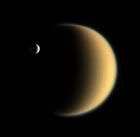
Enceladus shown "next to" Titan - Titan is actually some 1.2 million km (746,000 mi) farther than its vastly smaller sibling satellite. (source)

Tiny Enceladus, with a surface area of only 800,00 km2 (around 309,000 miles2, or 15% larger than Texas), is Saturn's second-smallest spherical satellite - all satellites smaller than it, with the lone exception of Mimas, are irregular in shape.  Also home to ice volcanoes, Enceladus is probably the best site for snowboarding within 7 billion miles of us.  The largest of Saturn's moons, Titan, is home to lakes of liquid natural gas. At one-seventh the gravity of Earth, humans could swim like dolphins, leaping bodily out of the water.  Titan is the second-largest moon in the solar system, out-massed only by Jupiter's Ganymede, and larger than the planet Mercury.  It is massive enough to sport an oxygen-free atmosphere so dense that humans could fly through it aided only by strap-on wings - just like in the cartoons.


So check it out!  Enjoy!

Saturday, February 14, 2009

101 Interesting Things, part seven: Theia

Theia is a hypothetical planetary body approximately the size of Mars, thought to have travelled about the Sun billions of years ago, in the Earth's infancy. Theia's orbit and Earth's gradually converged upon each other until, the theory goes, they crashed into each other a little under 4.4 billion years ago. This is how the Moon was born.

OK, that's a gross oversimplification, but it really does appear to be the case that Earth's single moon was forged from the remnants of a planetary collision. Billions of years ago, Earth was sterile and toxic to any would-be life forms, well on its way to an unremarkable future. But then this cataclysmic collision occurred, drastically altering the face of the planet - as well as its angular velocity and composition. The debris ejected by this global merger coalesced into another rocky body itself, which currently hangs in a somewhat stable orbit and lights up our night sky with its cold, cratered face.

Some of the clues which lead to such an interesting conclusion are themselves rather striking. The Moon is covered in a layer of dust, but beneath that are some of the oldest rocks that have ever been found, which helps us date the collision. These rocks are also completely dry. And in some places, there is orange volcanic soil beneath the dust. What these clues tell us is that, since the oldest rocks on the Moon are about as old as some of the oldest rocks from Earth, these rocks probably cooled at about the same time. The total absence of moisture in these rocks indicates that the Moon was very hot at some point, even having volcanoes of its own.

So, at this point, the most likely explanation seems to be that Theia, this planetary body about the size of Mars, collided with the Earth and all the hot matter ejected into space from that collision coalesced into a volcanic satellite, which cooled over time into the moon of today.

Here's a bit from the History Channel on the giant impact hypothesis:

Wednesday, January 7, 2009

101 Interesting Things, part 1: The Antenna Galaxies

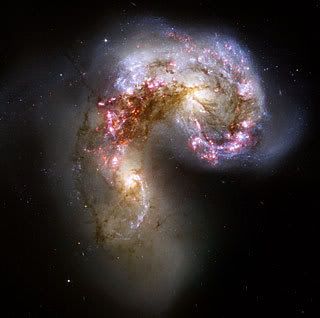
The Antenna Galaxies are a reminder that, in the grander scheme of things, we ain't shit. I mean, if you think you've got a dust problem behind your couch, you should see the dust clouds kicked up by a galactic collision.

Seriously.

These two galaxies have been colliding for hundreds of millions of years, orders of magnitude longer than all of recorded human history. They will continue to collide for hundreds of millions more years, in all likelihood well after we have died out and all traces of our civilization have disappeared wholly from the cosmos.

During this time, the scale of which is far beyond the human mind to truly grasp, events have been transpiring which are orders of magnitude grander than anything that could possibly happen on Earth - the reason is nothing to do with Earth or its inhabitants, but the simple fact that these events would destroy our world utterly.

These inconceivably epic collisions between all manner of celestial body have been happening always and everywhere on a stage far grander than any our species has ever known. If every single event of every history book of every nation were to be reenacted simultaneously, each upon a separate life-sized stage of its very own, all of these areas together would not even register on the above image, which is itself but a single moment in time that took forty-five million years just to reach our eyes.

In short, we can't even understand how much greater this is than even our ability to understand things in the first place.

The Antenna Galaxies are, in every conceivable way, utterly beyond our comprehension. We simply never deal directly with anything on a scale even remotely close to this size - not time, not distance, not force, not anything. If there existed a god, then surely this would be a prime candidate for the focus of divine attention: the magnificent story of two galactic formations swimming inexorably towards each other through the inky blackness, pulled by nothing but the universal force of attraction into a celestial mating dance of truly epic proportions.

Compared to this, all of humanity is but the blink of an eye upon a speck of dust in the next room over. We think we're hot stuff, all right, but even our invented gods were so petty and parochial as to be utterly ignorant of this truly grandiose phenomenon. Not one holy book mentions the antenna galaxies - one would think that a god would take notice, or at least want to show off its handiwork.

At any rate, I think it can safely be said that the Antenna Galaxies are well and truly interesting. To find out more, check out the Wikipedia page or my source for the above image.

This post was featured in the 31st Humanist Symposium.