Update Schedule

This blog updates irregularly.
Showing posts with label dialogue with cl. Show all posts

Sunday, November 22, 2009

Participating in the Internet: I'm on a [Blog]Roll!

Hi, the internet! D here. I just jumped onto another bandwagon, Mojoey's Atheist Blogroll. It is big and huge and awesome, and you need to check it out!

I've added the blogroll to my sidebar, and also made a few updates, too: I added my Why oh Why? bit to my introductory section, as well as linking to my Symbolism piece under the Big Red A over there, too, and re-ordered all the bits in vague order of increasing size and decreasing relevance.

Also, as many of you may or may not have been aware, I've recently been arguing on the internet with some interesting folks (I don't think Gideon has a blog, so there's a nice introduction to him there). The idea behind this was about half pure iconoclasm, half social experiment, and half research for The Quantum Mechanic (it was a big idea, OK?).

The iconoclasm was mainly because I saw some flame wars and I decided, "Screw this, I'm gonna make some new friends." Well, that seems to have gone well enough, so goal accomplished! The social experiment tied in to this last, but went beyond it, in that I wanted to see just how serious things could get if I actually put my beliefs on the table. Well, I did, but there seems to have been a communication breakdown because I keep asking these folks for reasons to believe, and they keep saying, "I won't even tell you about my evidence because I'm worried I'll get sand in my vagina if it doesn't convince you, and you can't get the evidence you want because I say you can't." Seriously, I keep asking, "Why should I buy any of this," and they keep changing the subject or trying to shame me into believing by telling me what I already know: I can't justify absolute certainty in my beliefs. Well, fuckin' duh.

What I don't think these well-intentioned but ill-informed men realize is that I really and truly walk in doubt. I continuously revise my beliefs in light of the evidence I'm able to find and the experiments I'm able to perform. I doubt everything at first, and only endorse something with my belief when I can get some kind of proof (and when I get better disproof, then I abandon the belief post-haste). And yes, this means that I am a very bookish person, but that's the price you pay for, y'know, learning things. My worldview is a continuous work in progress, and they just don't seem to get that. Oh, well. I've repeatedly offered to clarify my justifications for anything I believe in (I've never been taken up on the offer), but I'm met at every turn with straw-men being hurled at me, being told what I believe instead of asked, and so on and so forth. Anyway, you become what you behold, and this is turning into one of cl's bullshit martyrdom rants on how wronged he's been by everyone else (and I'm sure that the shit flies both ways here, it's just that nobody on the other side seems to give a shit about his thoroughness except me - I find it a perverse kind of admirable, but then again, I also think that bondage porn stars are classy ladies for realz - seriously, not joking here), so I'm moving on.

The third half of my abnormally large idea, as I mentioned earlier, was research for The Quantum Mechanic. I needed to expose myself to some dialogue with theists so that I could give a fair shake to some of the people on the losing side of the story, and they helped me set the tone. So, thanks are in order for that (the main plot is over, all I have to do now is dash off a few vignettes to cross the 50K mark - click "NaNo Stats" to check my progress - and flesh out some unclear plot points). Also, they'll probably disagree, but I don't really give a shit at this point. I'm bored with those guys, and moving on to something else more fun, now that I got what I really needed (even though I didn't get what I asked for - a reason to believe in their shit and nobody else's shit).

Anyway, I'm taking another day off to do some meta-writing, sorting out just how I want to present some of my next vignettes. I still plan on crossing the 50K mark before I leave for The Frigid Northlands this Thursday, so that way I can just move things around in the more-or-less-finished document and still, y'know, have fun with teh fambly. Have a great one, everybody!

Friday, October 23, 2009

Arguing on the Internet: Machina Ex Deus, part two (cl)

I left off yesterday vaguely gesturing at my transition from fundagelical Christianity to non-denominational Christianity. I didn't know whether I could trust the Bible or not, and the Bible itself is no help here (if I doubt a book, then I clearly can't take the book's word that I shouldn't doubt it!). I want to clarify right up front that my problem with God thus far isn't that I don't want to believe in him - after all, if there is in fact a Heaven which is the Best Thing Ever, then I certainly want to go there! - it's that I want to believe sensible things and I can't make God make sense to my mind. God could make it make sense to me, though, if he wanted (because he knows what I mean by "sense," and he knows that I want to believe in what makes sense).

But wait... even if I get to Heaven, is there still a Hell? If so, then if I'm in Heaven and know about Hell, it's gonna make me fuckin' miserable! I barely manage to get by as is, knowing that people starve to death every fucking day; how much worse would this be if I knew that people were being tortured forever?! I came to the conclusion that this could go three ways: either there is no Hell, or God needs to give me an empathy-ectomy at the Pearly Gates, or I need to forget about Hell. If there is no Hell, then... no problem! I don't even need to worry about it myself! But if there is, and God gives me an empathy-ectomy or makes me forget a rather key fact of reality, I don't really see what makes such a being worthy of worship. Not being dismissive, I just don't see anything good in a being that says with its actions, "Forget about those losers, they don't count; come hang out with us cool kids."

I don't know what it is, but all my role models, all my favorite superheroes, everyone I admire and even myself, we all have one thing in common: we are unable to stand idly by and watch others suffer. How is it that God is able to do such a thing, but still call himself good? I looked into the literature and found a whole lot of stupid bullshit.

Theodicies, in my experience, are categorically failures, more or less because I buy into Epicurus' dilemma: "Is God willing to prevent evil, but not able? Then he is impotent. Is he able, but not willing? Then he is malevolent. Is he both willing and able? Then whence cometh evil? Is he neither able nor willing? Then why call him God?" Who gives a flying fuck about our precious free will? Not God - he hardened Pharaoh's heart several times, he chose Moses and Saul of Tarsus despite their wills, and when Jonah flew the coop, God wouldn't take "no" for an answer. No, abiding evil when you don't have to, compromising with it when you have the advantage, allowing it when you could do otherwise, this strikes me as "knowing better but doing worse." This is a long-respected definition of "evil."

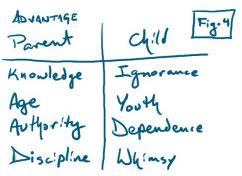
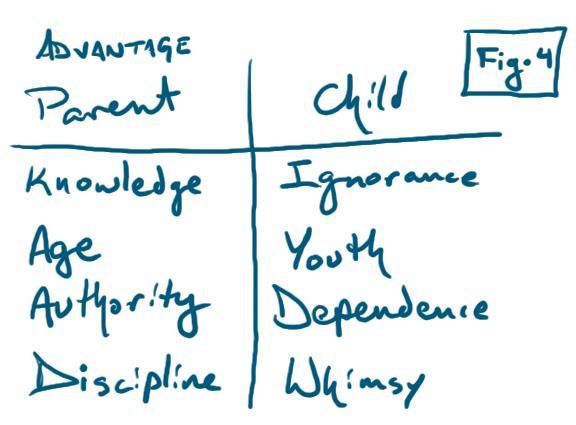
Let's briefly switch gears and talk about relationships, starting with figure 4:
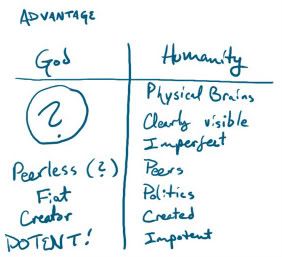
In a parent/child relationship (and I mean a minor child, not a grown one), the parent has the child at a disadvantage. The parent is older, wiser, and possessing of more self-control than the child is (usually). This makes the relationship asymmetrical, and it places responsibility for the child directly on the parent because the child can't take care of itself. Ideally, the parent raises the child to be a peer, another adult among many, capable of making intelligent and mature decisions autonomously. This is done with one-on-one interaction, an adult teaching a child step-by-step to become an adult itself. And this is done, at least in part, because the parent loves the child and cares for its well-being. Now consider the relationship between God and humanity:
It's a similar relationship - again, God has the advantage, and again, he damn well ought to be older, wiser, etc. than we are. How has God contributed to raising me as his child? Am I to reason from his lack of in-my-face involvement that he cares less about me than my own parents do? As far as I can tell, he wrote a letter and walked out before I was born - the letter is the Bible, walking out is Jesus' ascension into Heaven. To the best of my ability to tell, any moral shortcomings on humanity's part are the direct result of God's total failure to either make us right or raise us right, both as individuals and as a species.

Once I saw that, I couldn't un-see it. Good parents don't let their children do whatever the Hell they please; good parents make themselves a known presence in their childrens' lives, they raise their children by hand and guide them into becoming better people. Good parents do whatever the Hell it takes to protect their children and raise them to be the best people they can be. Any parent who allows her child to upset her has failed to control her temper; any parent who strikes a child in anger is at fault for not remaining in control of the situation. Why? Because children don't know what the fuck they're doing. I would know: I was a child once and I did some really embarrassing shit!

The parallels don't stop there. Households have rules, and parents are their authors; similarly, reality has rules (yay physics!), and God is their author. Why didn't God include any of these rules in his instruction manual? People understood math long before the Hebrews put quill to scroll, so why does the Bible have precisely zero interesting math in it (with the exception of a botched calculation of pi)? Moreover, why a holy book, instead of something more impressive? Every religion has holy books, but no religion has a holy organism that sings the holy text aloud and has no natural predators. Or how about a holy computer, a machine from God that can answer all our questions and also preserve God's language? The machine could also self-replicate and self-assemble, like a glorified RepRap machine. And a million other things, too - in short, why is God so boring?! Why did God do nothing to distinguish the one true religion from every other religion? Why is Yahwism, to all appearances, the same stuff in a similar package? I just don't get it.

But most importantly, if God exists, then why is he hiding from me? Silver Garou came up with what I think is an excellent argument on exactly this point, and it proceeds as follows:
1. God is omnipotent and omniscient, and therefore cannot be stymied in his efforts (or at least not by humans).
2. Since I myself know what would convince me of God's existence, God too must also know that thing.
3. Thus, God knows what would convince me of his existence. (from 2)
4. God has not convinced me of his existence (my mother did, once, but that wore off).
5. "Being hidden" does not necessarily imply the intention of "is hiding," since ruins can "be hidden" in the forest but obviously have no intentions of hiding. Yet until they are actually found, they do in fact remain hidden.
6. An entity that chooses whether to remain hidden or not, and has this as its option, does so with intent insofar as it is intelligent.
7. God is intelligent.
8. Thus God cannot remain hidden unless he also intends to be hidden and therefore "is hiding." (from 1, 6, 7)
C: Since God has not yet convinced me of his existence, then he is either hiding while waiting, or hiding forever, or does not actually exist as such (as omnipotent and omniscient, or at least enough of those things to actually convince me). Or he just doesn't want me to believe in him, which I guess is cool, too, except that it tells me he wants me to go to Hell (if there is one). (from 1, 4, 8)
God knows where I'm at, and God knows what it would take to make another Saul, Thomas, Jonah, or Pharaoh out of me. I can think of many reasons for him to do so, but none at all for him to wait or not do so at all.

OK, whew! That's it from me on why I don't believe... in this discussion... so far... today. It's been a little rough, but that is the gist of why theism makes no sense to me. So that's enough out of me: what do you think, cl? Where do you disagree with me, or at least diverge, and why? I'll make the assumption that you've still got what you think is a better way, and I'm curious to know what it is that you think is a good justification for theism, and why I should endorse it. Or, if it's a matter of personal revelation, then I'm curious as to how you can comfortably and honestly distinguish that revelation from insanity - no joke, this is an honest question on my part here.

I've pretty much said my piece and will wait to write anything as substantial as this until either I'm asked a direct question, or something else piques me. Ball's in your court!

Wednesday, October 21, 2009

Arguing on the Internet: Machina Ex Deus, part one (cl)

The Story So Far: cl and I are arguing on the internet! I outlined some metaphysics and epistemology in my last installment, and cl commented.

I used to be a theist; specifically, I was a fundagelical Christian. I saw God's hand in all things, I saw the Goddamned Devil at work in the world, I had promised my soul to Jesus several times and in several ways (I needed frequent fixes of God-smack), and I lamented that there should ever be anyone to not hear the glorious Word of God. I tried to be hopped up on God-smack as often as I could, and I'm not saying that to be pejorative: I thought the God-smack was good stuff at the time, and I thought that I was at my moral best when I was on it (full of Christ's love, in awe of the Maker's creation, etc.). Today I'm going to outline what changed - this is something of an autobiographical parable, inasmuch as I intend to gesture at my philosophical development while more or less ignoring everything else that was going on in my life and the world at large at the time.

Like all good parables, this one sets its tone with a metaphor. As I pointed out before, reality is ambiguous - or, rather, the relationship between reality and our perceptions is fundamentally unknowable because we are not omniscient, and therefore any perception of reality we might have is intrinsically ambiguous. So if I wake up with a headache and want to know what caused it and how to get rid of it, I have to do some brief testing: did I drink last night? I might have a hangover. Did I fight last night? I might have a bump on my head. And a million other things, too. Let's suppose for the moment that I don't remember what I did last night, but the two best competing explanations are that I either have a bump on my head, or I am hung over, or both (hooray for the inclusive "or").

A fairly direct method of testing whether I have a bump on my head is to feel around for one. But it might be the normal shape on my head, so it probably ought to be painful; that pain, in turn, could also be explained by a special sensitivity in that area for entirely bumpless reasons (for example, all people might have sensitive bumps in that spot on their heads - I don't know yet). To directly test whether I have a hangover, I could in principle do some bloodwork to check my BAC or look for metabolites or something, but that would be a pain, so I may just drink lots of water and see if the headache goes away. I could also take hangover medicine and see if it goes away. But in any event, if I take some action and then my headache clears up, I cannot tell for sure whether those two things are related at all; I can only make an "inference to the best explanation," or IBE.

Metaphor over, parable is go! Some years ago, I had an existential headache, and the two best explanations I could come up with were that I either had a sinful hangover, or a theistic bump on my head. I'm not sure quite what I did, but the headache went away. I realize that I may have merely taken a metaphysically naturalistic pill to mask the symptoms of my sinful hangover, which by rights I damn well ought to be feeling right now. That's a possibility. But the IBE I'm going with for now is that I had a theistic bump on my head from repeated doses of the fundagelical medicine stick. I stopped dosing, the bump went away, and my existential headache disappeared with it. So... what is my existential headache a metaphor for?

My existential headache consisted of an inability to reconcile any coherent idea of God with the observable facts of reality, to the best of my ability to interpret them.

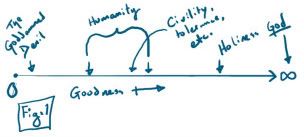
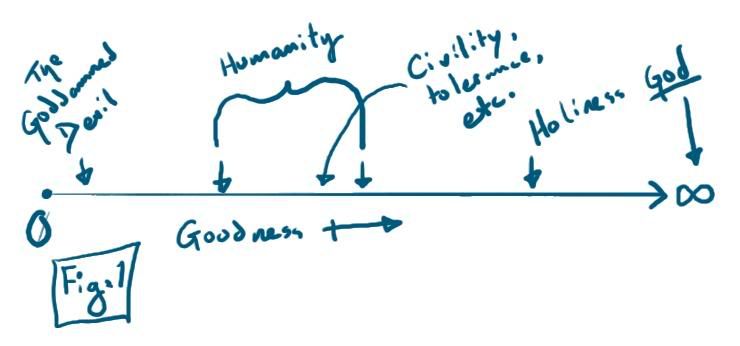
One of my first understandings of morality was that "good" is a continuum, where a "lack of good" constitutes "evil," and a maximum of good would be perfection. Something like figure 1 here:
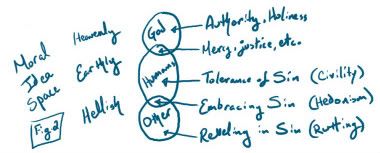
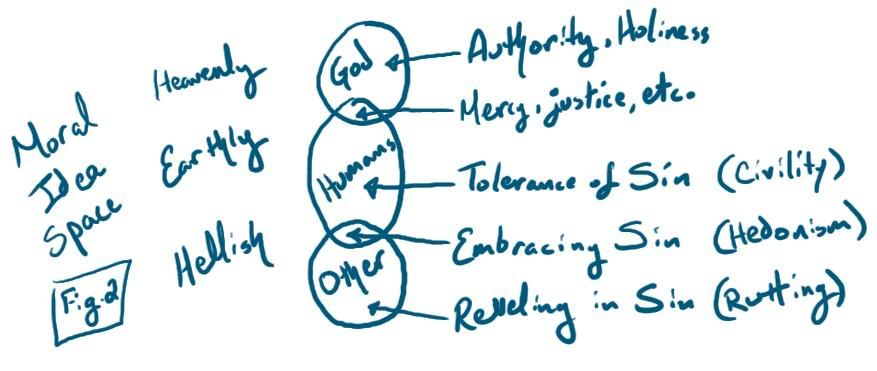
I now consider this a rather naive understanding of morality, mainly because it's grossly oversimplified, but it's not entirely without its merits. However, what I noticed is that if tolerance is within the "goodness range" of which humans are capable, then why can God not tolerate sin? Humans are able to live with each other's iniquities, to forgive those who trespass against us even if they keep doing it. I mean, hurting each other without meaning to do so is part of being human, and we can get over that, so why can't God tolerate sin in Heaven as he does on Earth? Well, I was told that it doesn't work like that, and rather something more like figure 2:
Here we see that there is God, who is Heavenly, and "other," which is Hellish. In between, overlapping with each but also having things all their own, is humanity. God is holy, and for that reason cannot abide sin in his presence, and so has withdrawn from the world until his final return. Humanity, being made in God's image, is able to understand some holy goods, such as mercy, justice, and compassion; but we are also capable of tolerating sin only because we ourselves are sinful. After all, if we dealt with each transgression as God says we should in the Bible, civilization would rather quickly collapse as we put to death everyone who violated pretty much any rule at all.

This explains why God tolerates sin on Earth, but not in Heaven, and by extension why we are on Earth and not in Heaven yet (because we still sin). But... wait... what exactly do we mean by sin? Definitionally, sin is that which God abhors, but why does God abhor it? Because he is holy? Then what is holiness? If it is mere godliness, then we have defined ourselves into a circle: whatever God does is holy because God's doing it, and whatever God abhors is sinful because God's abhorring it, and so to say that God is good is merely to say that God does as he pleases. I had not yet learned of the Euthyphro dilemma, but this is more or less how I arrived at it.

I realized at this point that there must be something about a particular thing which is sinful or holy, regardless of what God thinks of it; God's opinions, then, are the result of an interaction between his perfect perceptions of reality and its nature as sinful or holy, as the sinful or holy nature of the thing itself causes God to experience pleasure or disgust because of facts about God's personality. After drawing up tables and tables of sinful and holy things, however, I was unable to find any rhyme or reason behind the particular things that God told us were holy and sinful. It honestly looked to me like the Biblical deity was like a child with a sandbox, laying down arbitrary rules because he made everything, and wrecking our shit when he got upset with what we did just because he could. I see such a being as unworthy of worship, and if this is what God's like - an authoritarian dick-waver who thinks that merely being causally responsible for us (all by itself) gives him the right to tell us how to live - then I think we should all try to gang up on him Tower of Babel style. This is the behavior of a tyrant child, not of the rightful king of all existence.

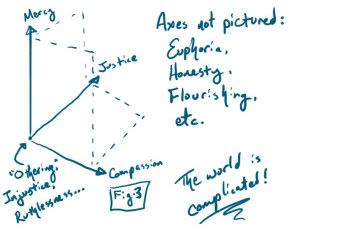
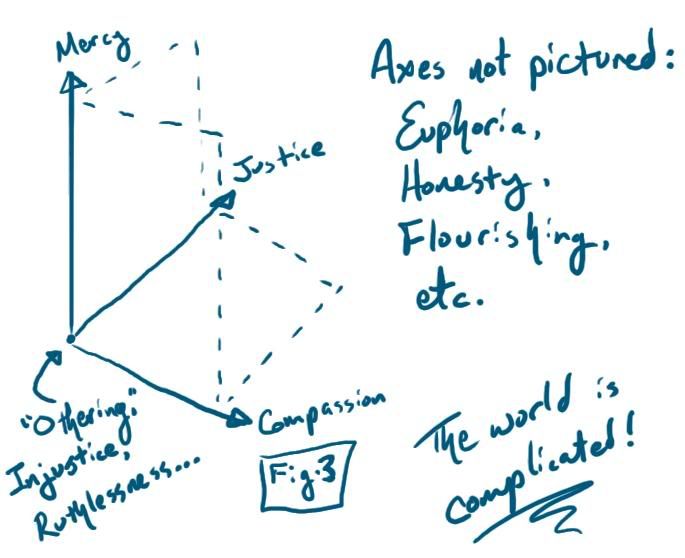
How do I know this? Because if morality is fundamentally arbitrary and God's at the helm, then all he has to do to eliminate evil and suffering is get over his bad self and change his own mind. Moses did it (Exodus 32:9-14). Anyway, my own personal ethics has evolved somewhat, moving from a moral idea space to a "morally-charged" multidimensional idea space, as seen in figure 3:
Between then and now, my understanding for the best of all possible Gods morphed from any religious type of deity to something like Nick Ifkovits' idea as laid out in his novel, Cloud Drops (he's a friend of my mom's): in this story, God is more or less a laid-back hippie who really only cares about people being good to each other. You do that, you get to go to Heaven and have crazy orgies all day long; don't, and you are a lost spirit, destined to stick around on Earth stewing in your own existential angst. I believe that in the story, those who die without becoming either good or evil are "recycled" after a fashion, but don't quote me on that (I haven't read it in a while). But religious faith is absolutely meaningless to this deity, it truly is works alone that get one into Heaven on this view; you don't even need to be a theist! So if this is the real deal, then I've already got it made and thus have nothing to be saved from. Even if I didn't get to Heaven, I've striven to eliminate angst from my life, so I think that hanging around on Earth as a specter wouldn't really be all that bad.

Yet it seems almost too obvious that I might be wrong on this one, and I might need to believe this or that particular thing, even if I don't buy the whole kit & caboodle. For instance, it might be the case that I really do need to accept Jesus into my heart to get into Heaven; but the rest of the Bible might be pure hogwash!

This is where things get really complicated; part two on Friday.

Monday, October 19, 2009

Arguing on the Internet: Epistemology and Truth (cl)

So yeah, cl and I are arguing on the internet. This will come as no surprise to anyone who knows me personally, but I am ruled by my passions: I do almost anything that I do in fits and starts. Arguing with cl is now, like, near the top of my list, right beneath "Don't get fired" and "Don't starve or dehydrate." But "Maintain an interesting blog" is up there, too, and I know that this will not be of interest to everyone. To that end, I shall post arguments with cl no more than once every other day, and I'll make sure to have anything else up in between - but still, that means if I post every day, this blog will be half-cl for quite some time (hopefully).

The story so far: cl wrote a post that really piqued me (in the good way), so I responded and then things got hairy. Today I will be addressing what are, to me, the three most interesting things about cl's last salvo - knowability, a response to his argument from probability, and rhetorical gamesmanship. I'll close with a bit on truth, which I offer up as another direction in which the discussion might proceed.

First, a bit about knowability, which will touch on epistemology, the study of the nature and content of knowledge. cl posted an interesting logical argument involving this, and then clarified his meaning in a comment at my request (thanks for that, cl!). From what I can gather, cl and I agree in at least a vague way that the "awesomeness" of a claim has something to do with its grounding in experience: in his own words, "That which can be verified by experience is knowable; that which cannot be verified by experience is not." Or, as I say, "Knowledge must be grounded in empirical observation." However, cl then goes on to say,
We can make inferences about that which cannot be verified by direct experience - for example the claim that life exists in some other corner of the universe, or that George Washington was the first president of the United States - but that's it. Does this mean we can't "know" the planets revolve around the sun? In a sense, yes...
Well, I actually agree with this as stated. However, we must also infer that our direct experiences as we remember them are valid in any way at all - and they in fact might not be. For instance, I may hear a voice and believe it is God, but it might also be the Goddamned Devil, or a person in another room, or my own internal narrator, or butt-puckering insanity - and at first blush, it seems awful hard to tell how some of these possibilities might be sorted out. This puts us in an interesting position with respect to truth (see below), but for now I shall simply say that not even direct experiences are immune to the leap of inference at which cl so precisely gestures, so long as those experiences are in the past (since all experiences not currently being had are in fact remembered - or misremembered, sometimes). It is self-evident, after all, that we do in fact have experiences, and anyone may verify this with the briefest of introspection - however, the content of those experiences, and their bearing on reality, are always subject to question. This is because, in short, we cannot directly perceive causality itself and may only infer it from the constant conjunction we perceive between suspected causes and their alleged effects (thanks, Hume!).

There is no getting around this. Thinkers of all stripes have tried, and failed, and whined about it (even me!); but we must all live with this doubt as our constant companion. As I said earlier, echoing Descartes: de omnibus dubitandum. So, if even direct experience is subject to question, what are we left with? I go with testability, which moves the goalposts for knowability quite a bit.

I realize that when I encounter an argument, or even a proposition, I do not decide whether to endorse it as logical or dismiss it as ridiculous right away - I first perceive either agreement or disagreement. It took me a while to get over this, but the instantaneous reaction I have of either "OK" or "No way" is itself a matterer of perception, at least in my own mind. Hell, others might be different. At any rate, if I have trouble determining whether I am perceiving thoughts of "OK" or thoughts of "No way," that's when I start to think about the claim itself. And I have agreed too readily to a great many things which I have later gone on to regret, ranging from trivial mathematical mistakes to the embarrassing thought that my mother must hate me for feeding me vegetables (I love vegetables now, and feel like an absolute twat for ever being a child, pretty much). But if, when I think about a proposition and then have difficulty trying to sort out just why I am perceiving agreement or disagreement with it, I then feel an urge to check. In the past, I felt the urge merely to decide.

Checking is important because then I can tell whether I am remembering something correctly or incorrectly. After all, I have mis-remembered in the past. So if I have trouble justifying a particular belief I hold, and can't remember what it was that made me think that in the first place, I then go see what I can check. And if I can't check to my satisfaction, I tend to withhold belief and write it off as unimportant - after all, that which leaves no effects to check is mighty difficult to call "relevant" on several well-respected definitions. This is more or less how I live my life, with respect to epistemology, anyway - more on this when we get to truth.

Whether or not you agree with cl's argument that it is more reasonable to believe that consciousness persists after death, I see a real gem of wisdom in there, which is a matter of perspective: cl's argument shows that, depending on how we define our terms, we can get to some surprisingly different conclusions about how we ought to form our beliefs. A great many people seem to form their beliefs - or at least a great many of them - in something resembling a binary truth table: X is true, Y is false, Z is true if A is not, B is true if and only if C is also true, and so on. Whether or not any particular person does, I cannot say, but this is in keeping with the overwhelming majority of my experience among humanity. When we say, "I don't know," most people usually mean, "I haven't thought about it," or, "I haven't decided."

Not me. My truth table has "true," "false," "not applicable," "I don't know," and "it depends." Other people might include "maybe," "probably," and "not if I have anything to say about it!" When I drop my hackey-sack, it falls to the ground: true. Two plus two equals five, for extremely large values of two: false (but funny!). This statement is a lie: not applicable (or "nonsense"). There is non-Earthly life in the solar system: I don't know. The Earth goes around the Sun: it depends on your frame of reference - if we define Earth's core as the center of our solar system, then of course the Sun goes around it, but then the rest of the planets and other stuff get a bunch of weird epicycles which we can rather handily avoid by adopting a heliocentric perspective instead. God exists: I don't know. God doesn't exist: I don't know.

Buh? Yeah. I don't know whether any sort of supernatural critter exists. I really don't. However, if some kind of supernatural critter did exist, then it would be this-or-that way, and not thus-and-such. In other words, it might be Thor-like, or Yahweh-like, or leprechaun-like, or FSM-like, or unicorn-like; and if it's one of those, then I sure don't want to pick the wrong one! But what if it's none of the ones that humans have come up with, and something totally different? What if it's aggravated by people believing in false gods, but has no "actual" religion of its own for followers to believe? What if it wrote no holy text, but instead tricked people into writing false ones? What if Richard Carrier's End of Pascal's Wager actually is the case?

I don't know.

I don't know, and so I withhold belief. In all of them, and in consciousness after death, and in live on other planets, and in parallel universes, and in any particular version of the maybe-even-not-approaching Singularity, and in a great many other things. Even if there is a supernatural critter, which there may well be, I do not believe in any particular one - and so I am not a theist. Since I am not a theist, that makes me an atheist. I am also an agnostic, because I don't know either way for sure, and so in that way I am an agnostic atheist; moreover, I'm skeptical of anyone who does think they have "all the answers" (or even a great many of them!), and so I am a skeptical agnostic atheist; and I'm a humanist, and a homo sapiens, and a house-renting-type person, and all sorts of other designations. But I am not a theist, for lack of evidence alone. I just don't know which way to go, so I don't go any way on that question. As for ethics, relationships, economics, and so on, well, my views get more complex and my "titles" keep on stacking up. But I am only an atheist because I am not a theist, I am not an atheist because I think I've "disproved God." Nobody can, that's just silly. I just won't believe until I can poke my fingers through some holes like the apostle Thomas.

A quick note on rhetorical gamesmanship before we get to truth. First, some may have noticed that I called cl a rhetorician and described his blogger's statement as platitudinous. I did each of these things for exactly one reason each: I called him a rhetorician because I thought I had discovered that the central motivating factor in his internet activity was honing his argumentative skill, and I called his blogger's statement "platitudinous" because some of his most interesting sentences sounded like platitudes to me. In the first place, I did not mean "rhetorician" as an insult, as I explained to cl in an e-mail; I think it is no bad thing to be concerned with how persuasive one is as a first priority, I think it is only bad if one then does bad things with such a skill. I mean, I want to be persuasive, for cryin' out loud, and so I too am a rhetorician. And in the second place, I was mistaken on the meaning of platitude! I thought "platitudes" were just simple-sounding phrases, more or less, some of which are trite and meaningless and some of which lend quite easily to deep wisdom. But I actually checked just now, and as it turns out, "platitude" only means the former thing (trite and meaningless), whereas I had honestly meant to indicate the latter thing (lending quite easily to deep wisdom). So yeah, foot-in-mouth for the win. Mea culpa!

So yeah, finally, on truth: there are two prevailing theories of truth in philosophical circles, the correspondence theory of truth and the coherence theory of truth. To steal Scotlyn's turn of phrase and boil a whole lot of argy-bargy down to one sentence, "correspondence" means "is the case in reality," and "coherence" means "is consistent with the greater body of true propositions." I couldn't tell you why this is a serious debate if you put a gun to my head, because both are important to me: true things ought to correspond to reality, I think, and true things also ought to cohere with one another. I think if either one of those is lacking, then you don't have truth; and if you can only get one but not both, then any claims to truth are suspect. So when I check to see if something is or is not the case, I'm satisfying the correspondence quotient; when I integrate that bit of knowledge with the rest of my knowledge, I'm roughly checking for coherence. They both matter.

So when I define "knowledge" as "justified true belief," understand that "true" means both "corresponds to reality" and "coheres with other true propositions." So for a claim to be "knowable," to me, means that I have to be able to get a justified true belief out of it. If I don't believe it, I can't be said to know it; if it's not true, then I can think I know it without actually knowing it (and even justify that thought process); and if it's not justified, then I merely believe a true thing without knowing it. That last one's sketchy, so here's a quick example: I've believed that the Earth is round as long as I can remember, but I also remember that I was told so by my teachers and parents. As I began to question my teachers and parents, I found that they were not always right on things (such as math teachers insisting that the French word macabre is pronounced "MACK-uh-bray" and not "muh-KAHB," despite the correction of a seventh-grader such as I was at the time). Yet I never stopped believing that the world was round, even after losing my justification; instead, I learned how Eratosthenes calculated the Earth's circumference while trying to check whether it was round or flat, and so found a better justification.

Sometimes I have had to revise my beliefs based on observations so that they cohere with others, as alluded to above on why "checking" is important. As an easy (and real) example, I used to have many fears and superstitions as a child, some of them based on things I was told by others. I heard from my mom that ending microwave oven cook times in zero (such as 1:30, 2:00, etc.) would result in your food getting burned, so you needed to end cook times in non-zeroes. I don't know why I ever listened, but one day I actually checked by seeing how long cookies took to burn in a microwave, and I found two interesting facts: first, that cookies burn within a few seconds of the same general time, no matter what digit is last when the machine starts cooking; second, that my mom was wrong on this matter. So I wrote off what I thought was a whole bunch of superstitious hogwash along with that, and now we fast-forward to last year when my then-roommate, Amy, tells me that cool water boils faster than warm water, and warm water freezes faster than cool water. I called bullshit, because I had tested many of the superstitious claims I'd gotten from my mom, but then I went and checked: turns out, the Mpemba effect is real!

Sometimes, bullshit-sounding claims are actually true. But you can never know for sure until you check, and you shouldn't believe if you can't check yet.

Saturday, October 17, 2009

Arguing on the Internet: A public response to a public challenge.

cl over at the warfare is mental recently issued a public challenge. I, uh, replied, and then he replied back, and then it got a little long so I figured I'd at least put the big main part on my own soapbox. For some rather more immediate background, I said, "If the King of the Universe decided to try to trick me into thinking he doesn't exist, then I quit." cl replied, "I don't believe that our lack of God's manifest presence entails God trying to trick us." But... that doesn't quite address my issue. It's not just that there's no super-obvious manifest presence of God, it's that there seems to be no way at all we can check for God's existence that doesn't amount to us merely deciding to believe it anyway. And wouldn't you know it, but the same would seem to be true of unicorns and Mother Goose.

cl, I'm not at all interested in suspending my disbelief doubt, just as you're obviously not interested in suspending your own central tenet of whatever holds your own worldview together. For me, it's doubt: doubt is how I understand the universe, doubt is how I come to science, doubt is how I go about forming my beliefs. I echo Descartes, "de omnibus dubitandum." I'm just saying, any scientific idea I believe, I would relish the opportunity to prove to your satisfaction that I am right, should you call bullshit. I should hope that you, too, would enjoy demonstrating in some manner why I ought to believe this or that thing you propose to me? I mean, in the marketplace of ideas at large, this is why I'm not interested in stuff I can't check out: I can't think of a way to tell it from total nonsense. If you think you have a good idea, then please show me why it's a good idea, because I very much want to collect good ideas! (While at the same time keeping nonsense out of my collection.) What exactly is just plain awesome, either epistemologically, or morally, or metaphysically, or even scientifically, that you can show me about your belief system? I want you to teach me something new.

Oh, wait a second. I'm not switching gears here, this is live argumentative progress. cl, you've been accused of being a sophist; what I've just now realized is that you are a rhetorician. You want to find the best arguments so that you can tear them apart, honing your skills in the process (and if your opponent du jour doesn't "get that," well, it's their loss! There's plenty of opponents about!). You just happen to also believe in some supernatural critters, and so in the sense that you don't buy what you see as our own version of dogma ("Yay metaphysical naturalism! Boo supernaturalism of all kinds!"), you call yourself a freethinking theist. You don't even appear to have much of a creed at all, at least not that you've laid out in non-platitudinal language. Have I got it so far?

OK, so with that in mind, I understand the rhetorical move you're making in the OP. You offered to convince me why I shouldn't believe God exists, despite my own hypothetical best evidence. This can be done for any such evidence besides second-order knowledge (which I believe is impossible, and so I cannot honestly employ it in my defense). What this would accomplish rhetorically would be to show me that my own position is silly since you would be showing how a principled application of it will lead me to a contradiction. What this involves, though, whether by chance or design, is the promise to tell me why I should not trust the results of an empirical test of my own design, should it be performed. Yet you just asked me what results of an empirical test would I in fact trust? You'll set the very best of my very own argumentation against itself, hoisting me by my own petard as soon as I've done the hard work of putting my actual belief on the line for you. And you know what? You'll always win that rhetorical game against people like me, because every individual experience is subject to doubt, so we maintain. No empirical test proves anything once and for all, and God is no exception - there is always some argument or thing that could happen to undermine my God test. What makes me vulnerable to this attack is not a flaw in my position, however, but rather the simple fact that I deny myself the pseudo-justification, "just 'cuz." Every belief system that doesn't rely at some level on "just 'cuz" must perforce be subject to this kind of rhetorical maneuver, including yours, whether you admit it or not (unless you actually believe that saying "just 'cuz" is a legitimate justification). So... do I explain what would convince me, only to watch as my own argument disembowels itself? Or do I try to patiently explain that of course I can never "really" prove God with science, because science is fundamentally provisional?

Oh, double-wait. You asked me what would "prove God" to me, and that's a subjective question. Now you're going to explain why you think I shouldn't be convinced by it, and the only way you can do that is to show some way that I might be wrong. Which, yeah, simply is correct: at any given moment, I might be wrong. This is what honest skepticism is all about, buddy. But can you show me that I'm actually wrong on this or that thing I believe? If I got evidence for God and you didn't buy it, how would you convince me that your decision not to accept it is a legitimate one and not mere stubborn obstinacy? Is there something that makes it stand out as more worthy of further scrutiny than ideas upon which we might agree? After all, I'm not saying that this or that evidence should convince everyone of God, I'm simply saying what I think would probably convince me, which is itself a testable claim because I can be presented with such evidence and thus can in principle determine whether I put my ontological money where my epistemological mouth is. Any counterargument changes the situation, so the old prediction no longer properly applies and I need to come up with a new one. And so, I hope you see, I try to believe only things which I can check, so that we can sort out which is right and which is wrong. And so, if we disagreed on an interpretation of this or that evidence, we can also devise a test as I briefly outlined back in your sandbox.

But we already agree that I, personally, might be wrong in any given case. I know that already. This doesn't advance our discussion in any way, ever, because it's always true. It's true of you, too, for that matter, which is why I haven't bothered pointing it out before now; I thought we were taking this bit for granted. What I'm interested in is working from where we agree, to things on which we disagree, and you showing me where things I believe are actually wrong, and not just the status quo of possibly wrong.

That's a truly slick move, though: you just about got it past me, you almost baited me into choking on my own argumentative tail. Bravo! One problem. Unlike others, I'm not just going to call you a sophist and bug out; I want to run with this rhetoric deal, and so I say, "Now what," and the ball's in your court. You can either start poking your fingers into holes of doubt which already exist in everything that I believe I know, which will get us right the Hell back here every time; or you could effectively ask me to start poking holes in something you believe by proposing to convince me of it. Eventually, you're going to tell me that I as a skeptic ought to be skeptic even of my own positions. I'm just saying, "You're preaching to the choir, buddy; now let's cut to the chase."

So now you've got me intrigued. I want to know what's "double next," now that I've conceded your rhetorical point and, for good measure, all legitimate permutations of it. Now spill: what is that all for? I know all about the flaws and shortcomings I've got, and learning to live with them has been a wonderful journey so far, so what more have you got for me? What more can your brand of freethought do for me, which I cannot do for myself with my own brand of freethought? I'm honestly asking you what you have to teach me, because I'm expecting an opportunity to learn here. Hit me with your best shot.

Full Disclosure: Ultimately, the question I'm getting at is, "What does theism do for you that you cannot get from your freethought sans theism, and how can I get that, too?" Or, "Why do you believe things that I don't, and is there any reason at all why I should believe them, too?" Or, "Can I have freethinking theism, too? And how?" And if you can't explain why I should believe what you believe, then I'm awfully curious as to why you do in fact believe what you now believe, and not something else - or are there beliefs of yours to which you do not apply the beautiful freethinking rhetoric which you just now so clearly displayed? I just gotta know, now that you've convinced me that you truly understand why I can't protect my idea of God from an all-pervasive doubt, how you do that thing. Or is your own medicine not for you here? And if not, then how come?

Or, more plainly: What's the lesson you ultimately want me to learn from that rhetorical game of yours? How does this play help us in our work as freethinkers? What's the point of this if we already assume you win that first part?