Uh-oh. Two days between posts? Par. Three days? Acceptable. Four days? Sliiiippiiiing...
I've been wanting to power my way through this article, where humanity and humousity interact with each other "on their own terms," but it keeps slipping away from me. So fuggit, I will read it on my own time when I am bored (one magical, starry night, when there is nowhere to be and nothing to do, perhaps in another world or another life). So, to get marginally back on track, I will riff on something with which I am very familiar: four-dimensional single-surfaced super-edgeless objects.
Today we talk about Klein bottles! I've even included an artsy-craftsy step-by-step, for the four-dimensionally impaired. But seriously, if you don't know how this works, or have trouble visualizing four-dimensional surfaces (or even uncommon two- and three-dimensional ones), you can follow along with a piece of paper and a pair of scissors to achieve geometrical enlightenment. You will also need either of: A) scotch tape and two different-colored crayons, B) masking tape and two different-colored pencils, or C) a stapler and two different-colored crayons or pencils. A felt-tipped marker will help in any case.
Update Schedule
This blog updates irregularly.
Showing posts with label mathematics. Show all posts
Thursday, November 15, 2012
Thursday, August 23, 2012
How to Imagine a Billion
Carp on a tarp, who would've thought a book about how we know things could be so research-intensive to write? The problem I'm running into now is that every time I'm like, "Wait a minute, I should look this up," I end up going on a wiki walk where I kinda-sorta get my question answered but find way more interesting things along the way. So, OK, now I know how ejection seats work, and I have a reasonable guess as to where the USS Eisenhower was in the spring of 2000, but I'm also finding out all kinds of things I don't really need like stuff about the new robot we put on Mars and how plots of various movies could have been solved in minutes (or would have been solved if the main characters did nothing).
Anyway.
I was talking about space & stuff with a friend, and we were going on and on about how so many people have a really poor grasp of just how astronomically large astronomical distances are. At one point, it was alleged that humans can't even conceive of a million, let alone the billions and trillions required to understand space. I thought about that for a while, and as it turns out, yes I can so too imagine a billion - and so can you! Here, let me teach you how.
First, a teaching tool. Did you ever use these little yellow blocks to count when you were in gradeschool? I did, at least in the fifth and sixth grades (I went to different schools every year before that, so I don't know how far back they use these).
Anyway.
I was talking about space & stuff with a friend, and we were going on and on about how so many people have a really poor grasp of just how astronomically large astronomical distances are. At one point, it was alleged that humans can't even conceive of a million, let alone the billions and trillions required to understand space. I thought about that for a while, and as it turns out, yes I can so too imagine a billion - and so can you! Here, let me teach you how.
First, a teaching tool. Did you ever use these little yellow blocks to count when you were in gradeschool? I did, at least in the fifth and sixth grades (I went to different schools every year before that, so I don't know how far back they use these).
Wait, you mean tiny yellow cubes a centimeter on a side are chokeable?
Friday, June 29, 2012
We can burn brighter than the Sun!
One of my high school history teachers was fond of quoting Mark Twain as saying, "There are lies, there are damned lies, and then there are statistics." But Clemens attributed it to Benjamin Disraeli - which also turns out to have been wrong (in all likelihood). It just goes to show, you can't always trust a citation.
Seems legit.
Sunday, June 13, 2010
Cross-Post: How Many Books are in the Library of Babel?
I remembered at some point in my cogitations upon qualitative wrongitude that I had actually covered something even wronger back on my Playskool blog. Here it is. I mixed up a couple things, like math at one point, and Borges actually lays out some of his figures in the story and I didn't take this into account. Research fail. But I wanted to mainly highlight that Garou is wronger here than the Creationists are in, well, any context I could think of, but he still manages to change his mind. Good on him! The difference, of course, is that Garou was willing to listen to reason and concede defeat instead of dogmatically defending his misconceptions. Anyway. Enjoy!
Jack and I were talking in Borders the other day about a short story by Jorge Luis Borges called The Library of Babel (Wikipedia page here - I've skimmed parts of it, and there are some differences between it and what we had talked about). In this story, according to Jack (and that's what I'm working with here, since this was the frame for the original disagreement), Borges describes a library containing a series of books, all 450 pages in length, and each book is one of all the possible combinations of characters that can be placed in 450 pages of space. Jack went into the details of the story, and then we started talking about just how many books that would be. After ruminating on all the possible combinations of Hamlet with any number of typos (including moving the word "fuck" one space to the right in successive iterations, as well as multiple repetitions of Hamlet and variations thereof, such as Hamlet-Tom Clancy Novel-Hamlet, or Backwards-Hamlet with or without the character of Hamlet being named "Backwards Hamlet"), Jack decided that it was more books than there are atoms in the Universe. I readily agreed.
I related the conversation to Silver Garou, who expressed extreme skepticism that there were more books in that Universe than atoms in ours. In fact, I believe his exact words were, "There's no way there's more books in that library than atoms in our Universe!" Or something to that effect. So today, I decided to do some math. By some standard measurements, there are 250 words per page, and a "word" - for publishing purposes - means six letters. Working with 450-page books, that gives us:
250 words/page x 6 letters/word x 450 pages/book = 675,000 letters/book
As for how many books this is, we can think of each book as a number - a long number in a strangely high base. For instance, if we were looking at all the "books" we could have using only the numbers zero through nine, and each "book" is only two characters long, that leaves us with 100 books - 00 thru 99 - or 1x10² books. Each of our Babel books is simply a number that is 675,000 characters long, and for each number in that series, we have a single book. In base ten, this would be every combination from 675,000 zeroes in a row to 675,000 nines in a row, for a total of 1x10675,000 books. So... what's our base? That's determined by how many characters are in our total alphabet, as each one of those can be a digit in our number:
52 alpha characters (26x2 - for caps)
30 accented characters (tilde, both ways accents, umlaut, carrot, horizontal line - 6 accents over each of 5 vowels)
48 greek characters (again with the caps)
10 numbers
32 additional characters on a keyboard
2 more for the cedilla (that fuckin' French C with the curlicue beneath it, caps & lower)
1 space
TOTAL: 175 characters
So we're looking at 1x10675,000 books - in base 175. So we're clear, this is a severe lower-bound number, as I'm excluding Egyptian/Chinese/Arabic/etc. characters. Mainly because I don't know how many characters there are in those languages. But anyway, imagine that you had to count to a number, but your first digit had to get up to 175 before you got to "10," and you had to get to 175 175's before you got to "100" (ten tens), and you had to keep counting until the number was 675,000 digits long, and then exhaust all of those possibilities (you get to stop counting right before the next number in sequence would make your number 675,001 digits long).
We would have 1x175675,000 books in our Library of Babel. At least.
A "base" determines how high you can count on one digit before you need to go back to zero and count with the next number, or when they all go back to zero you add another digit: base two (binary) counts 1, 10, 11, 100, 101, 110, 111, 1,000, etc. The pattern is that you get one number (zero doesn't count because it's 0, 00, 000, and so on), then have to increase the digit count to count higher, then you get two numbers, then increase the digit count, then get four numbers, and increase the digit count. Base three (ternary) counts 1, 2, 10, 11, 12, 20, 21, 22, 100, 101, 102, 110, 111, 112, 120, 121, 122, 200, 201, 202, 210, 211, 212, 220, 221, 222, 1,000, etc. The pattern now is that you get two numbers and then have to increase the digit count, then you get six numbers and increase digit count, then get eighteen numbers and increase digit count, and so on. In base ten, we humans count 1-9, 10-99, 100-999, and so on. The pattern here is that you get nine digits and increase, then 90, then 900. Here's the magic: 1, 2, 4; 2, 6, 18; 9, 90, 900; are all series of the same composition, namely (x-1)x10x(n-1), where x is your base (and n is your step in the series). Looks an awful lot like scientific notation, doesn't it?
I think this might be some universal language among base number systems, or just an easily-convertible method of notating numbers (which is useless for anything else). I don't know, I kind of discovered this on my own while trying to figure out the answer to this problem. There's probably a name for this, and math majors probably know it. I don't (but I know the math works). Whatever, the point is that you can convert numbers from one base to another by "exporting" that base like I've done - I just left some labels out. I started with the figure "1x10675,000," but I should have notated it as "110x1010675,00010," or "One, base ten, times ten, base ten, to the power of six-hundred-seventy-five-thousand, base ten." For an example of how this works, the number 365 (days in the year) can be represented as:
3.6510x1010210
This gives us 3.65 (in base ten) times ten (in base ten) to the power of two (in base ten). The first number (3.65) gives you the first few digits of the number, the second number (10) tells you your base, and the third number (2) tells you how long your number is (102 means that two zeroes come after the one).
Now, I want to find out how big a number is if it's a one (in base ten) with six-hundred-seventy-five-thousand (in base ten) zeroes after it, in base one-hundred-seventy-five. I could shortcut this as (1x10675,000)175, but this is useless; I want my answer to be in base ten. So how do I do this? Well, using base ten throughout, 1x10[anything] will give me that many tens, all "times" each other - 1 is just ten, 2 is "ten times ten," 3 is "ten times (ten times ten)," 4 is "ten times (ten times (ten times ten))," and so on. Just replace every time I said "ten" with "one-hundred-seventy-five," and even King Douchebag of Fuckhead Hill (don't ask) - who says he's shitty at math (I tested this on him) - can understand that this is like counting in base 175, converted to base ten. So, the number I want to find is 110x10175675,00010, or "one, base ten, times ten, base one-hundred-seventy-five, to the power of six-hundred-seventy-five-thousand, base ten." I replace 10175 with its decimal equivalent, 17510 (just like 102=210=23, or 1012=123=510 if you like advanced stuff), and do the math: 175650,000, and put it back in scientific notation. Ka-pow, finished!
The trick, of course, is keeping your bases straight and knowing when to do the math and when not to. That done, it's a piece of cake, I swear!
175675,000=1756.75105
This can also be written as (1756.75)100,000, and 1756.75=3.8x10¹⁴. And, as everyone knows, (3.8x10¹⁴)100,000=3.8x101,400,000. That many books. (EDIT: I fucked up. In my original calculations, I had somehow substituted 650K for 675K, and I did a double-plus un-good math when I decided that 175^(6.75x10^5)=175^(6.75^(10^5)), and that puts me at the same roadblock I'm at in the next problem (outlined below), so results are pending the math professor's review. I'd given an outline of the problem to King Douchebag of Fuckhead Hill with instructions to the math professor to show work, but he never came through. Hoo-ha! Edit over.)
Now our question is, how many atoms are there in the Universe? There are several answers to this question. I'm going to go with Wikipedia's calculations on matter content of the observable Universe, which yields two figures: a lower bound of 3x1079, and an upper bound of 7x1079. All the other figures I was able to find either corroborate these data, or are dramatically lower. The lower boundary is a rough-and-ready approximation of the number of atoms in all the stars, were they broken down to hydrogen atoms (so one helium atom is just two hydrogen atoms), and stars account for well over 90% of the mass in their systems. The upper boundary figure is based on the mean density of the whole observable Universe and its volume. Both of these figures account for all 80 billion galaxies, with the 3 to 7 x 10²² stars therein (in sum, not each). Even supposing that we counted all mass, not just normal atoms, it would come to about 1.75x1081 hydrogen atoms (were all mass converted into hydrogen). Keep in mind that though this is based on the "observable Universe," and there may be very much that we haven't observed, "the observable Universe" is every fucking thing we've seen, ever. Silver Garou suspects that these figures are "hugely off," but I don't think so - these numbers are still mind-bogglingly huge, just not quite on the order of the hugeness of those 450-page books.
Still, let's work in some margins of error. The orders of magnitude of difference here are, themselves, on the order of orders of further magnitude. Like, Creationists think the Universe is 6-12,000 years old when it's more like 15 billion; Bill Gates thought nobody could ever need more than 64K hard disk space and we've got terabytes; and then there's this (to be fair, Garou has simply supposed that there are far more atoms in the Universe than we can even get close to verifying, and by orders of magnitude, but on scales which it is beyond the capacity of the human mind to comprehend - he is not an expert in the field making a terrible prediction, or an asshole trying to shoehorn observed facts into taken-for-granted belief systems). Let's take this supposed number of atoms in the Universe and assume that it's off by the order of magnitude of itself, so:
(1.75x1081)1.75x1081
...keeping in mind that 100100 is 100 times itself, 100 times, this is like taking every atom in the observed Universe and splitting it into a number of atoms equal to the number of atoms in the observed Universe, and repeating the process a number of times equal to the number of atoms in the observed Universe.
Dammit. This also overflowed any calculator into which I put it, but it can't handle powers of more than two digits. But I have a sneaking suspicion it will still be short. I gave the problem to King Douchebag of Fuckhead Hill, and he's going to show it to some math professors tomorrow. We'll see how that goes. (EDIT AGAIN: That still didn't happen. But if anyone wants to correct my mistakes, or explain how to do the steps I'm missing, or even just link me to a page explaining how to do so, then I will happily correct it all!)

Wednesday, May 19, 2010
The Wrongest of Wrongnesses in the History of Wrongitude
Editor's Note: Do I count as my own editor? I mean, I edit my own stuff, but... nevermind. Look. My last post was a little vapid, pontificating as I was on an overnight webcomic kerfuffle that ended up being wiped off the face of the internet anyhow. I feel kinda bad about it. So I'm breaking my "weekends-only" rule to say something of a little more substance. This is also the third post in recent memory where I have used the word "kerfuffle" for lack of a better term. Should I consult a doctor? Or just a thesaurus?
PZ's summary and the news coverage make for fascinating reading - really, you should check it out - but I'm going to jump right to the number at the end and play around with it. That number is 1:102,680 against. So, sure, the common proteins shared by all modern organisms could have come about by some other means than common descent, but the odds are real fuckin' long against it. How long? So long. Like, it's hard to think of a way to be wronger, mathematically speaking - these guys are wronger than anyone has ever been wrong in the history of wrongitude (sounds like "longitude").
I have a phrase I use to describe "as sure as I get," and that is, "As sure as I am that the Sun's coming up tomorrow." This is meant to convey pretty fuckin' sure but not quite 100% certain (because I'm not 100% certain of anything, other than the fact that I am now having some kind of experience, and that I've always got room for doubt). Sure, something could happen so that the Sun doesn't rise tomorrow, but the data so far suggest extremely otherwise. Just how much otherwise? Well, let's take every day in Earth's 4.54-billion-year history as a data point.*
Hmm... that leaves us a shit-pot of orders of magnitude to make up. But yeah, it's settled: we're surer of common descent than we are that the Sun will rise tomorrow!4,540,000,000 x 365.25 = 1,658,235,000,000(1.66 trillion, or 1.66 x 10¹²)
"But wait," comes the Creatard rebuttal, "You can't just count the days up like that, you have to take into account how many of us there are! After all, a large enough number of rabid IDiots can't be wrong!" Well, OK. It doesn't work that way, but we'll humor you. Let's just say that all 6.8-billion of us are Christians, and we have been since the Earth was formed. Not only is this over-generous to the literalists in giving them the actual age of the Earth rather than their Reader's Digest Condensed Books version, giving them all of the current population throughout all of Earth's history, and giving a decidedly democratic bent to our epistemology, it doesn't even come close.
"But... but... twenty-two isn't nearly close enough to two-thousand-six-hundred-eighty," replies the anti-science crusader. "And I believe that your numbers are wrong with every fiber of my being." You know what? That's still not good enough. I'll give you a data point for every nucleotide base pair inside of every single cell of every person now living on the planet for every day throughout all of Earth's history - and you know what that nets us? Take a look:(1.66 x 1012) x (6.8 x 109) = 1.13 x 10²²
Fuck! That's still not enough! OK, but what if every atom in the observable universe, itself a number beyond ordinary human comprehension, spawned a Universe with a special Earth with seven billion humans believing in Creation with every fiber of their being? Yeah, what then?! This is what:(3.1647 x 10⁹ base pairs) x (1 x 10¹⁴ cells) x (1.13 x 10²²) = 3.58 x 1045
Just to recap, we've given a data point in favor of the Sun rising tomorrow for each of 3-billion-odd nucleotide base pairs inside of all hundred trillion cells in the bodies of six to seven billion people observing a sunrise for every single day (including leap years!) across Earth's four-and-a-half billion year history, repeated for every atom in the observable Universe. And given all of that, we're still surer that all life is related by common descent than we are that the Sun will rise tomorrow.(1.5 x 1082 atoms in the observable Universe) x (3.58 x 1045) = 5.37 x 10127
Suck on those numbers! Tomorrow's a dark day for creationism, epistemologically speaking. Yeah, I'd say the future prospects for monotheistic creation myths are looking pretty dim. We should just turn the light out on intelligent design, and leave the real science to light our path into the future.
OK, I'm done now, for real. Man, playing around with degrees of certainty is fun!
* - Yes, OK, to calculate the actual odds of the Sun not coming up tomorrow, I would have to calculate the odds of something happening which would prevent the Sun coming up. Fine. Not the point, and that's why this entry gets the "humor" tag. I'm just going to treat it as a chance event and assume the Sun doesn't rise tomorrow, making it 1 failure out of 1.6 trillion successes. I need to keep this back-of-the-envelope compatible, after all.
Tuesday, November 3, 2009
101 Interesting Things, part thirty-two: Proof by Contradiction
Contradictions do not exist. Paradoxes exist, usually expressed in clever-sounding phrases such as, "If you want peace, then prepare for war," or, "The tree of liberty must be refreshed from time to time with the blood of patriots and tyrants." These are mere conceits of what we call "common sense," though, and all they show is that reality doesn't always conform to our expectations of "what makes sense." But a bona fide contradiction is of the form, "X both is the case and is not the case, at exactly the same time and in exactly the same respect," and such statements are categorically false. We can establish this with good old fashioned deductive logic - specifically, with implication.
A statement of implication is a conditional, an "if-then" statement, and may be phrased as, "A implies C," or "If A, then C," where A is the Antecedent and C is the Consequent. These in their turn are propositional clauses, statements which may be taken on their own and determined to be either true or false (but not both - at least not at the same time and in the same respect). The whole implication may be taken itself as a proposition, and itself has truth value. To illustrate this point, let us consider the implication, "If I encounter a pile of babies, then I will wish for a fork and knife," because I've got A Modest Proposal on the brain.
"If I encounter a pile of babies, then I will wish for a fork and knife," may be written several different ways; in addition to the foregoing, we may also write, "D encountering a pile of babies implies that D will wish for a fork and knife," or "A implies C, where A is 'D encounters a pile of babies' and C is 'D wishes for a fork and knife'." I'll spare the symbolic logic, because if you know what that stuff means then you don't need me to tell you all of this. At any rate, our A and C may each be true or false independently, and the implication as a whole may be true or false as follows:
I'm really writing this to get at the proof that the square root of two is an irrational number, which is to my mind one of the greatest-ever marriages of mathematics and logic (aside from, oh, the entire field of geometry). We start by assuming that the square root of two is rational and seeing where things go from there. If the square root of two is rational, then it can be written as the proportion of two integers a and b (such that a/b is an irreducible fraction). This implication is true, because any rational number may be so described. So we start with:
Since we have an equivalence, we can square both sides:
Now cut out that middle part and multiply both sides by b2:
Interesting! Because b2 can be doubled to make a2, we know that a2 is a multiple of two; and since a is an integer, and even integers have even squares while odd integers have odd squares, we also know that a itself must be a multiple of two. So let's say that a=2x, where x is an integer, because of all of the foregoing and the fact that even integers may be halved to create yet more integers. Going back to the start, this gives us:
Lather, rinse, and repeat as before:
Multiply both sides by b2 as before:
Wait, what?! This means that b is also an even number! Which means that a and b can both be divided by two! Which means that a/b is not an irreducible fraction, and we have thus reached a contradiction. Because our initial implication is true, the antecedent (viz. "the square root of 2 is a rational number") must perforce be false for the contradiction to be resolved. Quod erat demonstrandum, motherfucker!
You can also do a little mutatis mutandis to prove that the square root of 3, if written as the fraction a/b, can never be made irreducible because a and b will always both be divisible by 3 (which is impossible, thus the contradiction, thus the square root of 3 is irrational). This also works for five, and seven, and every prime number, and every non-square integer. We may even generalize this proof for any prime number p as follows, with but one quick detour:
OK, math class is over, now go outside and play!
A statement of implication is a conditional, an "if-then" statement, and may be phrased as, "A implies C," or "If A, then C," where A is the Antecedent and C is the Consequent. These in their turn are propositional clauses, statements which may be taken on their own and determined to be either true or false (but not both - at least not at the same time and in the same respect). The whole implication may be taken itself as a proposition, and itself has truth value. To illustrate this point, let us consider the implication, "If I encounter a pile of babies, then I will wish for a fork and knife," because I've got A Modest Proposal on the brain.
"If I encounter a pile of babies, then I will wish for a fork and knife," may be written several different ways; in addition to the foregoing, we may also write, "D encountering a pile of babies implies that D will wish for a fork and knife," or "A implies C, where A is 'D encounters a pile of babies' and C is 'D wishes for a fork and knife'." I'll spare the symbolic logic, because if you know what that stuff means then you don't need me to tell you all of this. At any rate, our A and C may each be true or false independently, and the implication as a whole may be true or false as follows:
This is one of the weirdest consequences of logical implication: a false antecedent validly implies any consequent. This is also why David Lewis likes modal realism, because it justifies the weirdness of implication in his mind. I just want to punch him in the face. Moving on! A professor was once asked to show how "2=1" implies that he is the pope, and according to legend, he responded as follows: "2=1, and there are the two entities 'myself' and 'the pope'; since 2=1, we two entities are in fact one and the same entity, and thus I am the pope." As I have illustrated before, this makes first premises very dangerous, because a false premise validly implies absolutely anything. As it happens, only a false premise implies absolutely anything, so if you wind up implying anything and everything, then you know you've got a false premise somewhere (common-sense version: a statement that could mean anything, in fact means nothing). But I'm getting ahead of myself here.
- If I do in fact encounter a pile of babies, then A is true.
- If I do in fact then wish for a fork and knife, then C is also true and the implication is true as a whole.
- If I do not in fact then wish for a fork and knife, then C is not true and the implication is false as a whole. This is the only way for an implication to be false as a whole proposition (if A is true and C is false).
- If I do not in fact encounter a pile of babies, then A is false.
- If A is false, then it does not matter whether C is true or false, because I never actually do the antecedent thing; the implication is thus true as a whole.
I'm really writing this to get at the proof that the square root of two is an irrational number, which is to my mind one of the greatest-ever marriages of mathematics and logic (aside from, oh, the entire field of geometry). We start by assuming that the square root of two is rational and seeing where things go from there. If the square root of two is rational, then it can be written as the proportion of two integers a and b (such that a/b is an irreducible fraction). This implication is true, because any rational number may be so described. So we start with:
√2=a/b
2=(a/b)2=a2/b2
2b2=a2
√2=2x/b
2=(2x/b)2=4x2/b2
2b2=4x2, and divide by 2 for b2=2x2
You can also do a little mutatis mutandis to prove that the square root of 3, if written as the fraction a/b, can never be made irreducible because a and b will always both be divisible by 3 (which is impossible, thus the contradiction, thus the square root of 3 is irrational). This also works for five, and seven, and every prime number, and every non-square integer. We may even generalize this proof for any prime number p as follows, with but one quick detour:
√p=a/bp=(a/b)2=a2/b2
Since p is an integer, a2/b2 is also an integer because it is p. No non-integer may be multiplied unto itself to create an integer (try it, I dare you!), thus a/b must also be an integer. But if a/b is an integer, and can be multiplied unto itself to make p, then p must not be prime after all and so we contradict ourselves: if the square root of a number p is rational, then p is not prime. Since we stipulated at the start that p is in fact prime, we have thus shown that every prime number has an irrational square root. Hey, presto!
OK, math class is over, now go outside and play!
Wednesday, October 28, 2009
101 Interesting Things, part thirty: The Sieve of Eratosthenes
I frequently get bored at work, because being a quality consultant is not an interesting job to me on a day-to-day basis - it's new problems and challenges that I find interesting, and everything else is grunt-work. So when I've got absolutely nothing to do (much less anything new), I sit around and give myself problems to solve, such as finding a way to recognize a prime number generator if I saw it (and thus, by extension, how to design a prime number generator and also what that prime number generator would be). I sometimes find it useful to attack a problem visually, so I started writing numbers to see if any pattern jumped out at me once I had all the primes through 200 isolated in a picture.
I realized that, since prime numbers have no factors which are also integers, I could eliminate all the non-primes by crossing out all multiples of two (except two itself), then all the multiples of three (except three itself), and then things get interesting. You see, I don't need to cross off multiples of four, since I've already done that by crossing off multiples of two. Five is another prime number, so cross off every number ending in five or zero (except five itself), but six has already been taken care of, thanks to the joint efforts of two and three. Whoah.
I realized at some point that if you cross off all the multiples of a prime number from a list, it will eliminate all non-prime numbers until the square of the next prime (which will have been isolated by this very method in the immediately previous step). Crossing off multiples of two eliminates all primes until 32, and crossing off multiples of three (starting with 9) eliminates all remaining non-primes up until 52, and crossing off all multiples of 5 (starting at 25) eliminates all remaining non-primes up until 72, and so on and so forth. I then despaired because I was looking for a pattern that would use a non-eliminative method to determine what numbers don't fit any pattern; I was trying to describe a pattern of patternlessness as a pattern itself. Uh-oh.
The next day, I despaired some more, because I was walking through one of the campus buildings and saw a poster on the wall describing the sieve of Eratosthenes (easy mode). Shits! I mean, I could have sworn that there used to be a poster there showing how to make 3D hearts and smiley faces with mathematical equations, and decidedly not stealing this great idea I had and taking it back through time to ancient Greece! But no matter... I might have seen it the day before and forgotten about it, or learned it in my misspent youth and forgotten it, or merely come up with a good idea independently. Doesn't matter, the sieve is awesome and I know it. Now you know it, too - and knowing is half the battle.
I realized that, since prime numbers have no factors which are also integers, I could eliminate all the non-primes by crossing out all multiples of two (except two itself), then all the multiples of three (except three itself), and then things get interesting. You see, I don't need to cross off multiples of four, since I've already done that by crossing off multiples of two. Five is another prime number, so cross off every number ending in five or zero (except five itself), but six has already been taken care of, thanks to the joint efforts of two and three. Whoah.
I realized at some point that if you cross off all the multiples of a prime number from a list, it will eliminate all non-prime numbers until the square of the next prime (which will have been isolated by this very method in the immediately previous step). Crossing off multiples of two eliminates all primes until 32, and crossing off multiples of three (starting with 9) eliminates all remaining non-primes up until 52, and crossing off all multiples of 5 (starting at 25) eliminates all remaining non-primes up until 72, and so on and so forth. I then despaired because I was looking for a pattern that would use a non-eliminative method to determine what numbers don't fit any pattern; I was trying to describe a pattern of patternlessness as a pattern itself. Uh-oh.
The next day, I despaired some more, because I was walking through one of the campus buildings and saw a poster on the wall describing the sieve of Eratosthenes (easy mode). Shits! I mean, I could have sworn that there used to be a poster there showing how to make 3D hearts and smiley faces with mathematical equations, and decidedly not stealing this great idea I had and taking it back through time to ancient Greece! But no matter... I might have seen it the day before and forgotten about it, or learned it in my misspent youth and forgotten it, or merely come up with a good idea independently. Doesn't matter, the sieve is awesome and I know it. Now you know it, too - and knowing is half the battle.
Friday, October 16, 2009
101 Interesting Things, part twenty-seven: Kaprekar's constant
Hi, everybody! D here, with a magic trick just for you! I'm only half-joking, I promise.
Today's 101 Interesting Things is brought to you by Rhodopsin. It's also interactive, and all you need is a pencil and paper, or a calculator, or a head for numbers. Let's get started! Pick a four-digit number, any four-digit number, as long as all four digits aren't the same (you can't pick 0000, 1111, 2222, 3333, 4444, 5555, 6666, 7777, 8888, or 9999). Numbers with leading zeroes, such as 0103, or even 0001, are perfectly fine.
Got it yet? OK, now arrange the digits in ascending and descending order. For example, if you picked 4092, you would write 0249 and 9420. Still with me? Now calculate their difference. With our sample, 9420-0249=9171.
Lather, rinse, and repeat:
9711-1179=85328532-2358=61747641-1467=6174
OH SHIT, SON! Look at that! Now here's the magic part: I bet you can't find a number that will take more than seven steps to get to 6174. You know why? Because 6174 is Kaprekar's constant. Or, rather, it's called Kaprekar's constant because an Indian mathematician named Kaprekar discovered this rather interesting property of what I would have thought was just a regular old number. Now, quick! Go and pull this trick on anyone you can, and find a way to take their money with it!
EDIT: An anonymous contributor has mentioned, below, a sourceforge.net page which lists several interesting consequents of the Kaprekar constant. It's not all quite as interesting as perhaps the Kaprekar constant might be in everyday life, but it's still way more interesting than your life is in comparison to... umm... any historical figure. That is, assuming I'm not addressing any historical figures at the moment... anyway, it's November now, which means that it's National Novel Writing Month, which means that I'm devoting most of my time to novelling and less of it to blogging. Point is, if you like math, you should check out Anonymous' contribution.
Saturday, August 29, 2009
101 Interesting Things, part twenty-two: The Coastline Paradox
So I've been in e-mail contact with island, who commented on my second Abusive Cosmology post. I had previously known that Earth is a rare specimen, but I have since gained a much greater appreciation for just how rare our circumstances are here on this pale blue dot.
Earth occupies what is known as a "Goldilocks Zone," a whimsical yet apt term which amounts to walking a knife-edge between competing runaway forces. Uninhabitable extremes characterize the overwhelming majority of the Universe and prevent life from cropping up almost everywhere. However, these opposed runaway forces of extreme heat and cold, crushing gravity and hungry vacuum, as well as others, occasionally strike a balance between them that makes it possible for life as we know it to arise and thrive.
Now, we can imagine Goldilocks Zones for any phenomenon we'd care to dream up, be it life, molten metal, solar flares, factories, or whatever. The simple fact of the matter is that there are just about always more ways for any given thing to not exist than there are ways for it to exist. What's interesting is that these Goldilocks Zones have relevant features at all levels of reality. In terms of life, there is a Goldilocks Zone between Earth's mantle and its ionosphere into which all life has shoe-horned itself. Locally, every organism has its niche, and there are plenty of places on the planet where any organism you'd care to name simply could not survive: no species can survive absolutely anywhere on Earth.
Earth itself is in a Goldilocks Zone relative to our star, Sol: too close and we burn, too far and we freeze. Our solar system itself is a roll of the die that came up "life-friendly," with gas giants sweeping up the riff-raff of cosmic debris (which would otherwise pelt every small rocky world into oblivion), and without so much eccentricity in their orbits as to screw with the inner rocky planets. And the position we occupy in the galaxy is far enough out from the gene-scrambling radiation of the galactic core, but not so far out as to lack the heavier elements needed for more complex life. With respect to time, life cannot come about during the initial or final phases of a planet, star, galaxy, or Universe (at least, not a Universe that starts with a Big Bang and ends with either a Big Crunch or heat death). And with respect to physical laws, they have to be such a way as to allow life to be possible anywhere at all (though whether they could be otherwise is at present an open question).
This preponderance of interesting features reminds me of the Coastline Paradox, which refers to the difficulty of determining the "exact" perimeter of a coastline. You see, coastlines have relevant features at all levels of detail, and these change on all timescales. From biggest to smallest, coastlines have features observable from space that change in geologic time, and features on the more human-appropriate scale of meters that change daily with the tides, and features on the atomic scale that change rapidly all along the progression and recession of every single wave.
So what's the "true" length of a coastline? Ain't none. We can arbitrarily decide which features are important and which are not (the Wikipedia page mentions the appropriately useful tactic of omitting features significantly less than the unit in which the measurement is being made), but no output from any such method has a privileged status over any other. Trying to find the true or exact length of a coastline, even in a snapshot of time, is like trying to find exactly how many grains of sand constitute "a heap."
Earth occupies what is known as a "Goldilocks Zone," a whimsical yet apt term which amounts to walking a knife-edge between competing runaway forces. Uninhabitable extremes characterize the overwhelming majority of the Universe and prevent life from cropping up almost everywhere. However, these opposed runaway forces of extreme heat and cold, crushing gravity and hungry vacuum, as well as others, occasionally strike a balance between them that makes it possible for life as we know it to arise and thrive.
Now, we can imagine Goldilocks Zones for any phenomenon we'd care to dream up, be it life, molten metal, solar flares, factories, or whatever. The simple fact of the matter is that there are just about always more ways for any given thing to not exist than there are ways for it to exist. What's interesting is that these Goldilocks Zones have relevant features at all levels of reality. In terms of life, there is a Goldilocks Zone between Earth's mantle and its ionosphere into which all life has shoe-horned itself. Locally, every organism has its niche, and there are plenty of places on the planet where any organism you'd care to name simply could not survive: no species can survive absolutely anywhere on Earth.
Earth itself is in a Goldilocks Zone relative to our star, Sol: too close and we burn, too far and we freeze. Our solar system itself is a roll of the die that came up "life-friendly," with gas giants sweeping up the riff-raff of cosmic debris (which would otherwise pelt every small rocky world into oblivion), and without so much eccentricity in their orbits as to screw with the inner rocky planets. And the position we occupy in the galaxy is far enough out from the gene-scrambling radiation of the galactic core, but not so far out as to lack the heavier elements needed for more complex life. With respect to time, life cannot come about during the initial or final phases of a planet, star, galaxy, or Universe (at least, not a Universe that starts with a Big Bang and ends with either a Big Crunch or heat death). And with respect to physical laws, they have to be such a way as to allow life to be possible anywhere at all (though whether they could be otherwise is at present an open question).
This preponderance of interesting features reminds me of the Coastline Paradox, which refers to the difficulty of determining the "exact" perimeter of a coastline. You see, coastlines have relevant features at all levels of detail, and these change on all timescales. From biggest to smallest, coastlines have features observable from space that change in geologic time, and features on the more human-appropriate scale of meters that change daily with the tides, and features on the atomic scale that change rapidly all along the progression and recession of every single wave.
So what's the "true" length of a coastline? Ain't none. We can arbitrarily decide which features are important and which are not (the Wikipedia page mentions the appropriately useful tactic of omitting features significantly less than the unit in which the measurement is being made), but no output from any such method has a privileged status over any other. Trying to find the true or exact length of a coastline, even in a snapshot of time, is like trying to find exactly how many grains of sand constitute "a heap."
Monday, August 10, 2009
101 Interesting Things, part twenty: The Pythagorean Theorem
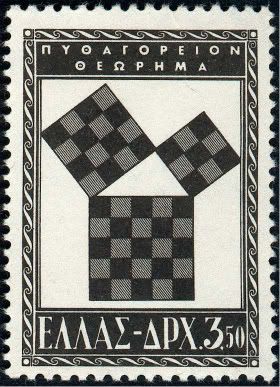
Did you go to high school? Have you heard of geometry? Ever study fifth-century BCE Greek history? If you answered "yes" to any of the foregoing, then you've almost assuredly heard of Pythagoras, or at least his famous theorem. Perhaps the simplest version of the theorem is presented on this stamp:


In and of itself, well, it may be unimpressive. Fine. Mathematics, after all, is nothing if not the study of tautologies (interesting tautologies, if you ask me). But then there's this page, which has a whopping eighty-one proofs! They range from simple to "Damn it, I need to take more math courses" in complexity.
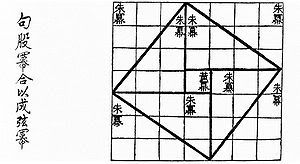
What I find so cool about this is that so many cultures have arrived at the conclusion independently. As geometry is simply formal logic about numbers and their relations, I think it could be used as a rough measure of intellectual sophistication (give or take a whole bunch of whatever, of course). Consider, for example, the following image:

I can't read that. It's fuckin' Chinese to me, man. But I sure as Hell know what it means! Mathematics, truly, is the Universal language - and geometric proofs are perhaps the only ideas that could in any sense at all be flawlessly translated between languages.
Friday, June 26, 2009
101 Interesting Things, part nineteen: The Monty Hall problem
So a while ago, someone in my space game brought up the Monty Hall problem in corporate e-mail. There was some argumentation, but I remembered that it had just recently been discussed at Philosophy Club (recently in terms of meetings, not days) as an example of our intuitions leading us astray. I thought I'd bring it up here as one of my hundred-and-one interesting things.
The Wikipedia page (linked above) goes into great detail about how it's one of the most misunderstood problems in history. As cognitive psychologist Massimo Piatelli-Palmarini says, "...no other statistical puzzle comes so close to fooling all the people all the time... even Nobel physicists systematically give the wrong answer, and ... insist on it, and they are ready to berate in print those who propose the right answer." This is a prime example of an extremely common failure to reason correctly, and a lesson that I think anyone could stand to learn from. Hell, I got it wrong at first, and was very resistant to having my mind changed until it was shown in excruciating detail just where I went wrong.
So, to the point! For those who did not click the link or don't know about Monty Hall, the problem is: you're on a game show and have advanced to the final round. Before you are three doors, behind one of which is a car, and behind the other two of which are goats. You pick a door, and before opening it, the host stops and opens one of the remaining doors, revealing a goat. He then asks, "Do you want to keep what you've got behind door x? Or risk it all to see what's behind door y?" What should you do to maximize your chance of winning the car? Should you stand pat? Should you switch? Does it even matter?
Most people think it doesn't matter - a goat has been eliminated, meaning that of the two doors left, one has the car, the other has a goat, so it's 50/50. It will not make a difference whether you stand pat or switch, they say. This is incorrect, and in a big way. In truth, standing (as a strategy) will only win you the car 1/3 of the time, whereas switching will win you the car 2/3 of the time. Exploiting this common failure to reason correctly, and exacerbating the problem with some suggestive phrasing, Monty Hall saved his show a lot of money by handing out a lot fewer prizes than they otherwise might have.
The reason it is this way is that when you make your initial choice, you only have a 1/3 chance of selecting the car (the "right" door), and this probability does not change when one of your choices is eliminated. Standing, as a strategy, stakes your bet on picking the right door of three. Since there is a 2/3 chance that you picked the wrong door, there's a 2/3 chance that the car is behind a door you did not pick, and thus Monty actually does you a favor by eliminating a goat - which ought to make your choice all the more obvious.
Another way of looking at it is that there's (statistically) a 1/3 chance behind each door, and when you make your choice, you eliminate that door from the "opening pool," fixing its probability (since Monty will never open the door you pick). Since Monty will also never eliminate the car, but there's a 2/3 chance that it's behind the group of un-picked doors, eliminating one door "consolidates" the odds behind the un-picked and unopened door.
One of our corporation members proposed an apt re-phrasing of the problem which I will outright steal (with a little change). Suppose there are a billion doors (and still only one car), so picking the right one off the bat is only a one-in-a-billion chance. You pick one anyway, and then Monty opens all the remaining doors but one, showing goats behind all of them. The odds are overwhelmingly likely that you picked a wrong door, and the car is behind one of the other nine-hundred ninety-nine million, nine-hundred ninety-nine thousand, nine-hundred ninety-nine doors (the number is more impressive when written out, I promise). When you are given your second chance, it's obvious you should switch, since Monty's done most of the work for you. The same reasoning applies to the three-door scenario, it's just scaled down a bit and thus not so obvious, since only one door is picked by you and only one door is opened by Monty.
As an interesting side note, a less-obvious rephrasing could be that he eliminates one of the remaining doors instead of all but one, which just so happens to pan out as an identical behavior in the three-door scenario. Let's say there are four doors, so you have a 25% chance of picking correctly right off the bat. The remaining 75% is distributed evenly among the other three doors, until one is opened, at which point it's distributed among the two unopened and un-picked doors. Since we have no means by which to distinguish them, they're even, and both get half of the opened door's quarter, putting them at 37.5% each, so you should still switch. A five-door scenario, by these rules, yields a 20% chance for standing, and 26.7% behind each of three doors. As the number of doors rises, the margin of advantage to switching shrinks, but it's still non-zero and higher, thus making it always better to switch. The trend happens to have its peak in the three-door scenario.
I feel like this should be wrapped up somehow, but now all I can think of is other interesting problems in game theory, which is like the coolest thing ever.
The Wikipedia page (linked above) goes into great detail about how it's one of the most misunderstood problems in history. As cognitive psychologist Massimo Piatelli-Palmarini says, "...no other statistical puzzle comes so close to fooling all the people all the time... even Nobel physicists systematically give the wrong answer, and ... insist on it, and they are ready to berate in print those who propose the right answer." This is a prime example of an extremely common failure to reason correctly, and a lesson that I think anyone could stand to learn from. Hell, I got it wrong at first, and was very resistant to having my mind changed until it was shown in excruciating detail just where I went wrong.
So, to the point! For those who did not click the link or don't know about Monty Hall, the problem is: you're on a game show and have advanced to the final round. Before you are three doors, behind one of which is a car, and behind the other two of which are goats. You pick a door, and before opening it, the host stops and opens one of the remaining doors, revealing a goat. He then asks, "Do you want to keep what you've got behind door x? Or risk it all to see what's behind door y?" What should you do to maximize your chance of winning the car? Should you stand pat? Should you switch? Does it even matter?
Most people think it doesn't matter - a goat has been eliminated, meaning that of the two doors left, one has the car, the other has a goat, so it's 50/50. It will not make a difference whether you stand pat or switch, they say. This is incorrect, and in a big way. In truth, standing (as a strategy) will only win you the car 1/3 of the time, whereas switching will win you the car 2/3 of the time. Exploiting this common failure to reason correctly, and exacerbating the problem with some suggestive phrasing, Monty Hall saved his show a lot of money by handing out a lot fewer prizes than they otherwise might have.
The reason it is this way is that when you make your initial choice, you only have a 1/3 chance of selecting the car (the "right" door), and this probability does not change when one of your choices is eliminated. Standing, as a strategy, stakes your bet on picking the right door of three. Since there is a 2/3 chance that you picked the wrong door, there's a 2/3 chance that the car is behind a door you did not pick, and thus Monty actually does you a favor by eliminating a goat - which ought to make your choice all the more obvious.
Another way of looking at it is that there's (statistically) a 1/3 chance behind each door, and when you make your choice, you eliminate that door from the "opening pool," fixing its probability (since Monty will never open the door you pick). Since Monty will also never eliminate the car, but there's a 2/3 chance that it's behind the group of un-picked doors, eliminating one door "consolidates" the odds behind the un-picked and unopened door.
One of our corporation members proposed an apt re-phrasing of the problem which I will outright steal (with a little change). Suppose there are a billion doors (and still only one car), so picking the right one off the bat is only a one-in-a-billion chance. You pick one anyway, and then Monty opens all the remaining doors but one, showing goats behind all of them. The odds are overwhelmingly likely that you picked a wrong door, and the car is behind one of the other nine-hundred ninety-nine million, nine-hundred ninety-nine thousand, nine-hundred ninety-nine doors (the number is more impressive when written out, I promise). When you are given your second chance, it's obvious you should switch, since Monty's done most of the work for you. The same reasoning applies to the three-door scenario, it's just scaled down a bit and thus not so obvious, since only one door is picked by you and only one door is opened by Monty.
As an interesting side note, a less-obvious rephrasing could be that he eliminates one of the remaining doors instead of all but one, which just so happens to pan out as an identical behavior in the three-door scenario. Let's say there are four doors, so you have a 25% chance of picking correctly right off the bat. The remaining 75% is distributed evenly among the other three doors, until one is opened, at which point it's distributed among the two unopened and un-picked doors. Since we have no means by which to distinguish them, they're even, and both get half of the opened door's quarter, putting them at 37.5% each, so you should still switch. A five-door scenario, by these rules, yields a 20% chance for standing, and 26.7% behind each of three doors. As the number of doors rises, the margin of advantage to switching shrinks, but it's still non-zero and higher, thus making it always better to switch. The trend happens to have its peak in the three-door scenario.
I feel like this should be wrapped up somehow, but now all I can think of is other interesting problems in game theory, which is like the coolest thing ever.
Thursday, June 25, 2009
101 Interesting Things, part eighteen: Hailstone Sequences
The field of mathematics is chock-full of interesting things, but most of these are only of interest to physicists and mathematicians as they involve concepts or methods well beyond the education of most. Some examples of these include the Riemann hypothesis, which involves the distribution of prime numbers in a way that almost requires higher education to even understand, and is really only interesting to cryptographers; or Goldbach's conjecture, unsolved since the 1700s and seemingly demanding of a simple solution, which states merely that every even number may be expressed as the sum of two prime numbers. Sure, it's simple - but you try proving it! Any aspiring mathematicians who want to have their dreams crushed are welcome to peruse the CMI Millennium Prize problems - open problems in mathematics which have collectively stymied the experts for probably a million man-years.
At the other end of the spectrum are problems within every layman's grasp, such as the Monty Hall problem (which shall get its own post in short order, now that I've thought of it). The one I want to talk about today is the problem of hailstone sequences. As the linked page explains, these are called "hailstone sequences" because the sequences generated by the following algorithm go up and down like a hailstone in a cloud. Take any number - for the sake of the cited article, we'll call it n - and follow these steps:
1a. If n is even, divide it by two. n/2=n'1b. If n is odd, multiply it by three and add one. 3n+1=n'2. Repeat step 1 with n'. Lather, rinse, repeat ad infinitum.
OK, now eventually, your sequence is going to end up repeating at 4, 2, 1, 4, 2, 1... Go ahead, try it. I've got time. There's even a little applet on the page linked above.
All right, satisfied? Now I've got two propositions that I'm just going to lay out there:
1. Every number put through these steps will end up repeating at 4, 2, 1, 4, 2, 1...2. There is at least one number that does not end up at 4, 2, 1, 4, 2, 1...
Nobody - not one single person - has been able to prove either of these contradictory propositions. But one of them must be true! The common-sense approach is that any time you end up at a power of two (2, 4, 8, 16, 32, 64, 128, 256, 512, 1024, etc.), it's Game Over, and you're eventually going to hit on a power of two, so there. This is also true of powers of two multiplied by any power of ten, since it will end up at a power of ten which all fall into the same old trap (though for slightly more subtle reasons). In fact, you could conceivably show that all non-prime numbers end up at 4, 2, 1, etc., though I'm a bit fuzzy on the how of the matter. You'd probably want to start by showing that all multiples of three will do it, then all multiples of five, then six, seven, eight, nine, etc. (1, 2, and 4 are skipped for what should be obvious reasons), until you identified a general solution. But that still leaves the problem of primes, and prime numbers are ipso facto numbers that don't fit any pattern - the sieve of Eratosthenes (which eliminates all non-prime or "composite" numbers until the square of the next prime) demonstrates this by eliminating all numbers generated by regular patterns, leaving you what's left: the primes. Because of this, a general solution to prove proposition 1 (above) may well be impossible.
Frustratingly, it may be an insoluble problem - proposition 1 may be true but unprovable, meaning that proposition 2 can never be proven and the question shall always remain open. This possibility could itself be proven by showing that proposition 1 can never be verified in a way that neither confirms nor refutes proposition 2. Whether this can even be done is also an open question, though.
So scratch your head in wonder at this interesting emergent property of numbers, and then have a beer. I'm sure going to!
Saturday, March 21, 2009
101 Interesting Things, part eleven: The Lorentz Factor
Like any young physicist, I spent my high-school years desperately attempting to break the very laws I was studying: perpetual motion machines, FTL drives, doomsday devices that swallowed universes, cold fusion reactors, the works. Because I failed to break any of the laws I learned, I imagine this would be like a DEA agent trying desperately to score some pot, but being totally unable to do so. Somehow. I don't know, maybe he was wearing his badge or something. Every scientific principle I learned was either a catapult to becoming a Nobel laureate, or the roadblock I would inevitably hear about from my physics teachers later that day.

One of the earliest of these endeavors involved faster-than-light (FTL) travel. You see, back in the Pleistocene, before the internet had infected everyone's house and I had to go halfway across town to an actual library to look something up (holy crap, do I feel old), I would take my designs to the physics department and ask the teachers why they wouldn't work. I actually succeeded in stumping a few of them once or twice, but I would inevitably be shot down by some bit of trivia like Lenz's law (which is basically electromagnetic friction). Right after we learned about vectors, we jumped into the application of actual forces (which was followed throughout the semester by figuring out those forces, roughly in order of ascending complexity and/or descending magnitude), where I learned the mighty F=ma. For the uninitiated, or those who simply don't remember high school science (don't feel bad, I don't remember anything else), F is force, m is mass, and a is acceleration.
What this means is that if you know the mass of an object, as well as its current acceleration, you can calculate the force acting upon it. Conversely, if you have some mass and want it to accelerate at a certain rate, then you can calculate the force that must be applied to do so. Actually, as long as you know any two of those terms, you can calculate what the third one must be. I reasoned that as long as we kept applying force, we could accelerate to any velocity we could choose.
So one day I asked my teacher why we couldn't go faster than the speed of light. I was told that as we accelerated towards the speed of light, the forces involved in our acceleration would crush us. Obviously, the more a mass accelerates, the greater the force acting upon it - but what if we accelerated really, really slowly? It would take some time, but it should work, shouldn't it? And, to jump ahead just a bit, subjective time "slows down" as one approaches the speed of light, so shouldn't the passengers experience the trip as a relatively quick one?
There were two things that I hadn't taken into account. First, that modern spacecraft accelerate by casting off mass: by throwing something in the opposite direction that you want to go, you move yourself in the direction you want to go, because for every action there is an equal and opposite reaction. Spacecraft don't need fuel for a trip like cars do, because cars need fuel to travel a certain distance, but spacecraft only need the fuel required to accelerate to the desired travel speed; then they wait, and then maybe decelerate when they're about to arrive. But the speed of light is really, really fast, and accelerating anything to such a speed would require a lot of mass to be cast off, which would in turn require a very massive craft which would in turn require a lot of fuel to take off in the first place. I think you can see where this is going.
But that was merely a technical limitation, a problem for the engineers to work out. The second thing I had not taken into account was the Lorentz factor, which actually makes accelerating to the speed of light impossible - for any living thing, anyway. You see, as it turns out, F=ma isn't the whole story. The whole story is F=γma, where γ (gamma) represents the Lorentz factor. γ itself is defined as the inverse of the square root of the quantity one minus the square of the ratio of velocity to the speed of light. Huh? Yeah, I'm not very good with words, either. Here it is mathematically (v is velocity, c is the speed of light):

OK, so there are a couple of important things with this new insight. The above is γ, and since F=γma, we can do some juggling to yield γ=F/(ma). Since F is precisely equal to m*a in most Earthly applications, it seems reasonable to assume that γ=1 most of the time. Fortunately, this is true! Looking at the above equation, v/c is really tiny when velocity isn't close to the speed of light, because c is huge and v is not huge. This means that (v/c)2 is going to be even tinier, so that 1-(v/c)2 is going to be really close to 1 (but just a tiny bit more). The square root of this will also be close to 1, and 1 divided by something really close to 1 is also really, really, really close to 1. This means that γ doesn't make much of a difference in our day-to-day lives, because we don't go anywhere near the speed of light.
But what if we did? If v was equal to c, then v/c would equal 1, and 1-12 is zero, and... OK, now we're dividing by zero, which isn't allowed. OK, let's say that v is really close to c instead. With v being close to c (but not equal to it), v/c is going to be close to one, but just a little bit less. Squaring something close to one will make it only a little bit less than one than it is right now, and so 1-(v/c)2 is going to be a tiny, tiny number. The square root of a tiny, tiny number (that is less than one but ever so slightly more than zero) is also a tiny, tiny number - it's only a bit bigger. And one divided by a tiny, tiny number is a really, really big number.
Moral of the story: as v approaches c, γ becomes huge. And when γ is huge enough, even a tiny m & a will make for a huge F. What this means for our travelers is that, as they cast off a little bit of mass at a time, for them to accelerate to the speed of light is going to require increasing amounts of force. Furthermore, the opposite side of that coin is that the travelers will also experience this force, and tiny bits of acceleration will result in huge amounts of force, to the point where just the margins of error in even our most precisely controlled accelerations could be deadly. So, no, we mortals will probably never get appreciably close to the speed of light.
Tuesday, March 10, 2009
101 Interesting Things, part eight: Gabriel's Horn
Gabriel's Horn is one of those interesting mathematical paradoxes which is fun to think about, but really doesn't mean anything in the "real world," kind of like Zeno's paradoxes. No matter how much you talk about Achilles never passing a tortoise, Achilles would in fact pass the tortoise if such a race were ever run. This is why it's funny to define "zenophobia" as "the fear of convergent sums."

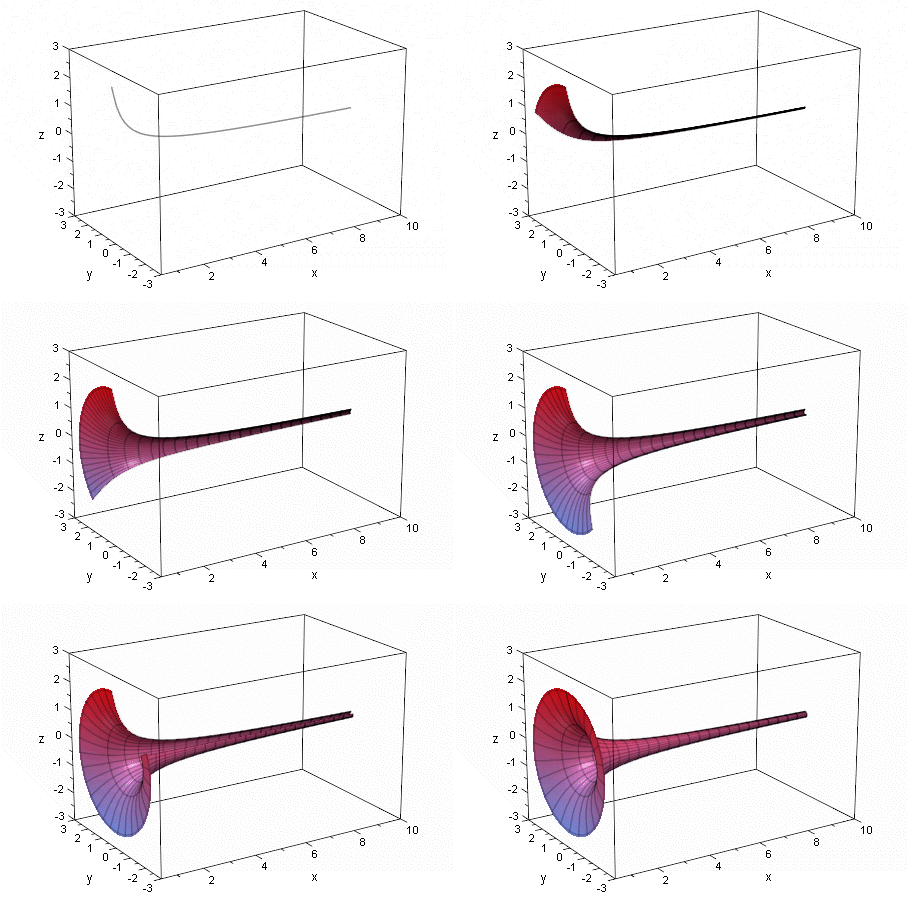
Gabriel's Horn is formed simply by graphing out y=1/x, for x>1 (because you can't divide by zero, and this removes some asymptotic nonsense). The idea is that you rotate the curve about the x axis to make a shape looking like one of those old-timey horns, with the mouthpiece being at the end of infinity. Observe!

What's interesting about this particular shape, though, is that the volume of the shape as you go out along the x axis is always decreasing but never gets to zero, and the sum of all the volume converges on π. In other words, the cumulative volume of the horn as you approach the mouthpiece is always getting closer to π ("π units of volume," to be precise), but never quite reaches it. If you added it up all the way to infinity, it would reach π units of volume (pro tip: this is impossible).
OK, so what's so interesting about this? Well, if you checked out the Wikipedia page linked above, then you might have seen the painter's paradox. Because the curve goes on to infinity but the volume it expresses is convergent on π, you could fill such an object with π volume of paint - gallons, liters, whatever system of measure you're working with (I don't feel like doing math right now, just talking about it). However, if you were to try to paint the outside of the horn, it would take an infinite amount of paint. But... wait a minute: it has finite volume, but infinite surface area? Yep, that's the paradox.
Of course, such an object could never actually be constructed, let alone painted. Actual horns are made up of matter, which has mass and takes up space, so once you get to the point where the horn needs to be less than a hydrogen atom wide, you're kind of boned because there's nothing for you to build it with. Even if you found Euclidean horn-stuff, which I just invented (it isn't made up of discrete components and is infinitely divisible), the constraints of real-world paint present you with a distracting pseudo-solution to the paradox. Paint is made of molecules, and no matter how infinitesimally small the horn gets, you'll always need a minimum number of molecules to "cover" the horn. Because the horn goes on forever, the cumulative volume of paint required to cover the outside to a length x diverges to infinity as x approaches infinity. Filling the inside with real paint would still require a finite amount because eventually, the horn would get so narrow that not even one molecule of the paint could squeeze in (even if we ignore surface tension), and you could never actually fill it all the way to infinity. But this is irrelevant to the point that the volume of the horn is a convergent sum while its surface area diverges - even with Euclidean paint, the inside of the horn would still be filled by a finite 3D volume, though the 2D surface area is still infinite.
Ultimately, the paradox arises because it is counterintuitive to most people that something could be finite in terms of volume, but infinite in terms of surface area. By ignoring the limitations of the real world, we can show with math that this is actually possible (possible to express without contradiction, that is), but it still grates against our intuitions and causes lots of people to scratch their heads and go, "What?" Neat trick, isn't it?
Subscribe to:
Posts (Atom)