Update Schedule

This blog updates irregularly.
Showing posts with label literature. Show all posts

Tuesday, June 4, 2019

Transgender Tuesday: Reviewing "Sovereign" by April Daniels

I was hooked by Dreadnought, and after reading some overwhelmingly positive reviews, I read the sequel, Sovereign.  BLUF:  It's really good, though there are some triggerific parts and definitely a few low points; but as a whole, Sovereign takes what was great about Dreadnought (comic-book-esque storytelling style, compelling heroics, and villains I really like to argue with in my head) and kicks it all up a notch.

Even the cover is better!  (Image swiped from Goodreads.)

I'm not arguing against a specific position like last time, making this review considerably shorter.  However, while I'll try to avoid them as much as possible, BEWARE SPOILERS!

Tuesday, March 26, 2019

Transgender Tuesday: Reviewing "Dreadnought" by April Daniels


I just discovered Smart Bitches, Trashy Books, which is like my new favorite website.  Naturally, I’m going to immediately complain about it, starting with the review of my new favorite book, Dreadnought by April Daniels.


Also I love the low-key trans pride colors in the
background! (Image swiped from GoodReads).


Dreadnought is an #OwnVoices story about Danny, a transgender teen who stumbles into superpowers - one aspect of which instantaneously gives her a body she thinks of as ideal (yes, that’s problematic; yes, that’s addressed; yes, it’s handled tastefully and not overdone).  She then encounters a bunch of bullshit as a result of this immediate transition, as well as a bunch of more “mundane” problems (i.e. problems not resulting from her transness) clustered around taking on the mantle of the superhero Dreadnought whose powers she has inherited.  SBTB reviewed Dreadnought and found it lacking, but I found the review to be lacking, so that’s what I’m writing about today.  I’ll be taking a Good/Bad/Ugly approach, and also citing textual evidence for my arguments, so:  SPOILERS AHOY!


The Good:
Merits of the SBTB Review

I’ll start with what’s good about the review:  the author, Carrie S, cites textual evidence for her best claims and picks up on some subtle themes, as well as making appropriate concessions for cultural necessity vis-a-vis her second-to-last paragraph on how Some Anvils Need To Be Dropped.  She acknowledges that Danny’s trans-related issues are faced by real-life trans folks, and deserve to be brought to light.  She also demonstrates genre savvy by expressing desire for themes and events that are developed in the second book, Sovereign, which is available now (Daniels is currently writing the third book).  She openly accepts that some of the bad decision-making on the protagonists’ part is due to their adolescence, and lets it go at that, finding it believable.

Moreover, Carrie correctly points out that the support from Calamity and Doctor Impossible does more for Danny’s character development than her actual superpowers.  This is a nod to the thoroughgoing realism (despite being a superhero comic in literary form) reflecting that we are social creatures who need love and support to flourish, as much as we need proper nutrition.  It also alludes to the fait accompli motif, only mentioned twice in the book but implicitly elaborated all over, that Danny suddenly looks female and everyone else just has to deal with it - which they often do in ugly ways, which again with the realism.  Having one’s transition over in a snap is, for lots of trans folks, the ideal fantasy: “Transitioning is hard, and if I could just snap my fingers and wake up in the right body, my life would be so much better.”  But Daniels shows that this instant transition absolutely does not solve any problems aside from the need to transition and the difficulty of transitioning:  most of trans people’s problems, it turns out, are caused by living in a society with strong undercurrents and dense pockets of transphobia, despite our growing acceptance.  While Carrie doesn’t discuss this motif as much as I’d like, neither does she flat-out ignore it.

The bottom line for me is this:  I wish her concessions, understanding, and savvy were brought to bear in her treatment of the trans-related issues as experienced by Danny in the book.  They are not, and what’s more, Carrie straight-up ignores a good deal of textual evidence, to the point that she makes claims in her review that are demonstrably untrue.

The Bad:
Dreadnought’s Flaws

I don’t want to give the impression that Dreadnought is flawless, or even that I think it is flawless.  I am obviously and understandably ecstatic at having a superhero story about someone who’s trans just like me, but that does not blind me to the book’s flaws, which exist and shall be enumerated by me presently (perfect segue!).

In the first place, this book is praised on the jacket copy as having “the most exciting new superheroes in decades,” and it simply does not.  There are four interesting superpowered characters: Dreadnought herself, Calamity, Doctor Impossible, and Utopia. I’ll briefly outline each of their interestingnesses before getting into why the rest of the superpowered characters are boring:

  • Dreadnought is trans and her mundane struggles are frontlined, but as a superhero per se, she’s a more interesting Superman.  She has the Flying Brick powers, but with limitations that are creatively explored through “the lattice,” which I very much liked because it’s similar to (but much more limited than) my own superhero’s power over (and perception of) quantum probabilities.
  • Calamity has Captain America’s powers, but a mirrored backstory:  she is a person of color born into both her powers and poverty, whose grandfather was a Captain America of color who was discarded after he outlived his usefulness - but far from superheroes of color being a progressive element in this world, the super-serum has a 50% mortality rate, and so PoC were used unwillingly, explicitly for their “disposability” to the dominant culture.  This gives Calamity perspective and motivations that are realistically portrayed and make her a much more nuanced character than The Other Boy Scout.  Additionally, caping at such a young age has given her visible PTSD, which affects both her personality and her relationships.
  • Doctor Impossible is a mad scientist (and un-stretchy Reed Richards), the gynoid daughter of Malice/Utopia, whose struggle with her own nature provides funhouse-mirror juxtapository insight into Danny’s own struggle with her transness.  To make herself “more human,” she chooses flaws for herself:  an addiction to nicotine and to only use one of her three available bodies at a time.  To me, this reads as a very believably robotic “Check, Done!” way of “humanizing” herself, and this oversimplification has consequences on both her emotions and her effectiveness that she then has to deal with.  Excellent showing as opposed to telling!
  • Utopia is a half-reformed Dr. Doom, having once been Malice, the first major supervillain and the greatest-ever in history.  Her defeat caused self-reflection that resulted in an actual change to her approach, though she’s still trying to be Prime Intellect (and in fairness, Prime Intellect also thought it was doing the right thing).  But she is driven by a threat that only she takes seriously at this point in the story, which gives her a very humanizing motivation and makes her actions more understandable (though still misguided).

That done, let’s look at the others, in no particular order:  Magma is just The Incredible Hulk minus Bruce Banner; Bosco is a non-metamorphic Colossus; Chlorophyll is gay male Poison Ivy, and his sister Aloe is original flavor but also a reformed villain; Carapace is Iron Man (or possibly War Machine); Valkyrja is Thor (though that changes in Sovereign); Red Steel is Superman in Red Son; The Artificer is Forge; Charlie is an apprentice mage who plays the plot role of Magical Negro (though this is fixed in Sovereign); and Graywytch, while a more developed character, is Scarlet Witch and/or Raven.  The Legion Pacifica (Magma, Chlorophyll, Valkyrja, Graywytch, Carapace, and Dr. Impossible) is basically just The Avengers (with some key Avengers West Coast elements), and the Five Man Band of antagonists in the penultimate battle are more or less incels but about powers instead of sex.  That’s ten derivative superpowered folks (six of whom make up a highly-derivative team) to four interesting and developed superpowered folks.

I’m going to immediately waffle and say this is both a good thing and useful to the plot, because the similarity of the side and bit characters acts as convenient shorthand:  these are Expy characters, so savvy readers can immediately identify them without further ado.  Making the characters more original would have taken more time and detracted from the short-and-punchy format, which is a major selling point to me:  this and the highly-visual storytelling make it more like a comic, and easier for cis readers to pick up for its short length. My point is that anyone calling these “the most exciting new superheroes in decades” simply isn’t that familiar with the past several decades of superheroes.

On a lore note, I would have liked to see the two superheroing manuals given to Danny by the Legion explained more.  We really only get a couple points of each, and only in the very moment that it’s relevant to the plot - but Danny is a good student and superhero fangirl, so this is a missed opportunity for significant worldbuilding and foreshadowing.

Danny’s struggle with insecurity is also poorly handled in some ways.  The best portrayal is how she makes some progress when she’s away from her father, gaining conviction and confidence, only to immediately backslide with just a look or a breath from her abuser - then the cycle repeats, with her regaining the conviction and confidence from another angle, only to immediately lose it again.  Having some abuse trauma of my own, I can say firsthand that this is an accurate portrayal: I can’t count the number of times I resolved something in private, only to immediately fold when confronted by my abuser.  But what’s missing from this picture is the scaffolded experimentation and growth: I also did try things in order to hold on to that progress I had made, and even though I lost the little battles, I felt like I was still gaining experience and making progress, which culminated in me finally winning the war.  We don’t really see any of this with Danny, she just comes bravely and abruptly out of the closet at the very end of the book - which is a fantastic and powerful beat, but she’s more or less cornered into it so that she can stay ahead of the media.  I would rather have seen it be the culmination of various failed attempts to stand up to her father (whereas she doesn’t even really properly attempt it except for two times). To be concrete, if two more of Danny’s immediate folds were turned into successive approximations of standing up for herself, then I’d feel much better about how the struggle was handled.

The Ugly:
Fisking the SBTB Review

This will be the longest section because I’m going to go through Carrie’s claims point by point, more or less in order.  She characterizes Danny’s trans-centric arc as a “parade of wretchedness,” which I think is a complaint but I’m not certain; so I’ll simply mention that it’s Truth in Television and leave it at that.

Her next complaint is more serious:  that Danny doesn’t avail herself of any QUILTBAG-friendly organizations.  This is thoroughly justified, however, because Danny is still in the closet until the very last page - every nudge out she gets is forced upon her, and the shame and self-loathing she has internalized (from both her father’s abuse and society’s transphobia) prevent her from reaching out for more support than she gets from her ally friends.  She even feels unworthy of that much, at points! Attending a support group, therefore, would be unthinkable - perhaps this could have been lampshaded, but I find it supremely believable without even a mention.

Carrie states explicitly that “Danny doesn’t have any hobbies or interests beyond being transgender until she is forced to add being a superhero to her list of interests.”  This is plain wrong: Danny is a responsible student who plays online games with her friend David and is an avid reader and superhero fangirl. She doesn’t have any social meatspace hobbies that bring her face-to-face with others, but this is entirely believable due to her closetedness - which she also hobbifies, vis-a-vis painting her toenails when she can find the time and space to do so.  I had a whole pile of hobbies in high school, but I wasn’t a responsible student for most of my life; when I finally became one, I only had time to read the occasional online article in my downtime and play games with my friends a few hours a week.  My interests and hobbies had to be sidelined because of how much time it takes to be a responsible student, and I see this realistically portrayed in Danny’s life.  To say that she has no interests or hobbies is to ignore textual evidence throughout the book; we don’t see her spend a lot of time on these interests and hobbies, but who cares?  That is definitely The Most Boring Thing in her life right now, so leaving them with an occasional mention is perfectly in order for keeping the book short & punchy.

Carrie also complains that Danny’s parents are flat characters, and while I can see this criticism more than the last, it is also demonstrably false and with an in-Universe justification for appearing to be so.  Again, speaking from firsthand experience, abusers tend to flatten both themselves and everyone around them: they flatten their own perceptions in the eyes of others, and they flatten the victims who they turn into doormats.  As Dreadnought is told from Danny’s first-person perspective (and not by a Fly on the Wall that happens to mostly follow her around), the apparent flatness is completely justified:  her father’s abusive nature dominates her perception of him, and minimizes the authentic interactions between Danny and her mother.  But even with this justification, an entire flattening is still thoroughly averted: we see, through Danny’s eyes, that her dad has been going through some hard job times and is taking it out on his family.  Both the job situation and having an “effeminate son” are emasculating to his toxic masculine personality, which oozes through even the positive interactions like his efforts to “care” for Danny’s “problem” and the “man hugs” he gives her, and also completely explains why he is doubling down on the toxic masculinity.  And at several points, such as the doctor visits and the Bad Guy Bar, we see him struggle to come to terms with reality and square that with his toxic masculinity:  while he starts and ends as an abusive transphobe, he still changes and develops during the story, just not in the ways we want.  His arc is tragic, as every action he takes causes (or at least is followed by) things getting even worse (from his perspective):  this is change and development, though it’s a blend of tragic/toxic/bad, and while it’s a little bit one-note, this is also in keeping with how toxic masculinity flattens actual men in real life to one-note Dudebros (making it Truth in Television once again).

Danny’s mom is similarly nuanced, which we see explicitly in Danny’s observations of her, but also implicitly in the events as described but on which Danny does not comment.  Yes, she is a doormat who has been pounded flat by her abusive husband, but she also tries to be supportive to Danny in whatever way she can. This starts with shopping, but that becomes twisted into apologetic bribes, poisoning their relationship.  Her arc is also tragic: when faced with the choice to side with her daughter and stand up to the abuser, or double down on trying to preserve or restore a hopeless status quo, she chooses the latter.  Notably, this is after a long period of fence-riding which makes things even worse, and she is forced to make a choice - she chooses wrong, but she still develops and makes a choice, working within the narrow range of agency she has as a result of her internalized victimhood.  As a child of a violently abusive mother and codependent doormat father (don’t worry, it got loads better), I can attest to the verisimilitude of this portrayal.  It’s nuanced and implicit, but it’s there, and Carrie either doesn’t notice it or flat-out ignores it - and as with the aforementioned discount superheroes, I don’t think that frontlining this theme would have improved the story.  It simply would have been so much dwelling on the nature of trauma and abuse, whereas I think the story is more effective for showing the trauma and its effects instead of taking more time and losing more pacing to tell us explicitly about them.

Carrie also calls Graywytch “almost a parody” figure because “her only characteristic is her transphobia.”  This one is not plain false, just mostly false, and is justified in-Universe (to the extent that it’s true at all) with more Truth in Television.  Danny is outed to Graywytch before they even meet, and Graywytch is a TERF (or gendercrit, if you prefer) - while Carapace and Chlorophyll harbor some amount of transphobia, Carapace is trying to sweep the issue under the rug and Chlorophyll is blatantly pro-trans-inclusion.  Add to this the fact that Magma, Doctor Impossible, and Valkyrja are all clearly pro-trans, and Graywytch is outnumbered. But she behaves in true TERF fashion and vehemently stands her ground, unwilling or unable to capitulate or compromise in the slightest degree. This is the only way in which she is willing to engage with or about Danny:  first and foremost, she is driven to establish that Danny is not female, and she is unable to move on to any other matter without getting her way on this.  While she does go on one rant at the confrontation outside Danny’s home, the rant consists entirely of real-life TERF rhetoric, not some silly strawman.  Graywytch says what TERFs actually believe, with the possible exception of the bit on how the priests killed the Goddess - which I kinda wanna see more developed, because it’s an in-Universe justification for her hatred, but I really wanna know what happened and see if she’s misinterpreting something or if some part of this world’s history legitimates the TERF perspective.  And because of her hatred, she is absolutely opposed to seeing the mantle of Dreadnought be carried by a trans woman, as she thinks this would taint his legacy: a perfectly reasonable position justified by a premise that is simply false. Graywytch’s behavior, in short, is entirely representative of and in keeping with the real-world people who she represents. Many times, I found myself wanting to argue back with her, wanting another character to step in and tell her what’s what, wanting her to be proven wrong; this is a sign of good writing in fiction, because Danny is a teenager and the others aren’t super-educated on trans issues, so while Graywytch is wrong on these issues, she’s still the most prepared to speak on and about them, which creates tension.

I need to quote Carrie here, because I can’t paraphrase her, because I’m not sure what it is she’s trying to say with this:  “Without nuance, the book sometimes reads less like a well-developed story and more like a Very Special Episode About How Transphobia Is Bad. Transphobia is bad, but when all the transphobia is presented in such extreme terms it’s no challenge to the reader to come to that conclusion.”  Now, I will concede that the Very Special Episode perception is entirely valid, because this book is about two things:  being a superhero, and being a trans girl. For the sake of pacing, whenever Danny isn’t dealing with some superhero shit, she’s dealing with some trans shit; and fully half of trans shit is transphobia, meaning that a full quarter of the book ought to be explicitly about transphobia.  But this makes the non-phobic trans parts stand out as a counterpoint to the transphobia, and the superheroing half be a reprieve from the hammering on trans issues - so I can see that perception.

But here’s the thing:  the transphobia as portrayed isn’t “extreme” in the slightest, it’s 100% real.  The slurs and abuse from her dad, the shitty looks and gossip at school, Graywytch’s TERFy bullshit; it’s all true to life.  I can’t go on any social media and get trans-related content without it, because every trans-adjacent social media account - even the ones explicitly dedicated to positivity - has to engage with transphobia, even if only to debunk it.  It’s “no challenge to the reader to come to that conclusion” because transphobia is obviously bad.  Yes, Danny says at the end that she’s a transgender lesbian and unashamed, and this is a Crowning Moment of Awesome for her, especially in light of the last sentence (“And I think maybe I could be a good person.”).  But as previously mentioned, she’s cornered into this, which irrevocably taints the moment with the very shame and self-loathing she is overcoming to make the statement.  But - and I can’t stress this enough - this is life for trans people, and an appropriate and proportionate portrayal of it, at that.

Finally, Carrie mentions that there’s no romance, which I’m not even sure is a complaint as opposed to a mere observation.  Again, this is true to life, because dealing with trans issues sidelined my own romantic pursuits for about a decade while I was sorting out my bullshit.  I don’t want to harp on this too much, though, because again, I’m not even sure this is a criticism. So I’ll close by simply saying: Carrie S, if you’re reading this, then you should definitely read Sovereign.

Monday, September 17, 2012

Thoughts on "The Stand"

I finished reading The Stand a couple days ago, which along with Lucifer's Hammer was part of my crash course in apocalyptic literature.  I linked to the TV Tropes pages for those books because I'm going to be discussing The Stand primarily in terms of storytelling mechanics, so really, that's what's most useful here.  Also, beware that I'll be linking to the pages for a lot of the tropes I mention (because that makes it easier on you, Dear Reader, if you don't already know the lingo), but that means you'll have to be vigilant against wiki-walks (because TV Tropes Will Ruin Your Life).

OK, that paragraph up there, it took me over an hour to write.  Not because I was trying to decide on word choice or whatever, but because I fuckin' clicked on my own damn links and then got sucked into mini-wiki-walks of my own ("Bellisario's Maxim?  What's that?  'Contrast to Moff's Law'... what's that?").  So I'm being serious here:  there will be a lot of links, so you should only click on something if you don't know what it means.  (Really, everything should be fairly apparent through context - but if it's not, here's a link.)  And even then, you should make sure to read only until you understand the trope I'm talking about, then close that tab.  Capisce?

As a "final starting note," I feel I should point out that this is not a review of The Stand, it's criticism.  I liked The Stand, even if it took me about 700 pages to "really" get into it (I read the monster 1,141-page uncut edition).  I also recognize that it's one of King's earlier works, and that it's over 35 years old.  None of these exempts it from criticism, of course; but please realize that none of this is done in anger.  The fact is, though, that I casually mentioned one day that I prefer King's later works - The Girl Who Loved Tom Gordon remains one of my favorite books of any kind to this day - and someone said The Stand would change my mind.  It most definitely did not.  This post is about why.  THERE WILL BE SPOILERS.

Saturday, October 24, 2009

Axe of the Apostles, book one: "Genesis 2: God Takes a Mulligan"

I wrote this for NaNoWriMo 2008; but I never finished, because satirizing all 66 books of the Bible is too much to do in thirty days. But I thought it started out well, even though I was bored and sick of it by the end of Deuteronomy, so I thought I'd share here. Enjoy!

In the beginning, there was nothing - which EXPLODED! God, never one to miss an entrance, did his best Clint Eastwood impression and walked menacingly into reality, squinting partly from the brightness but mostly to look like a badass. After staring down the young Universe for some time, God was about to deliver a witty one-liner - but then he realized that the Universe was expanding at the speed of light, which is much faster than sound, and he hadn't yet created other life, and sound can't travel in the vacuum of space anyway, so he gave up.

"Screw this," thought God, "I'm starting over."

In the beginning, there was nothing - except for God, who thought he was pretty hot shit for being the first one on the scene. Later sources would disagree, but they weren't around at the time and didn't see it for themselves, so who cares? Not God, that's for sure.

At this point, God decided he was perfect - able to do anything, aware of everything, and supremely good. As he was the only one around, a logical consequence of this situation is that he was also the most vile and despicable being in existence, but God hadn't invented logic yet and so was not concerned with this fact. At any rate, God got bored and lonely after contemplating his own perfection for a few minutes, so he decided to make some company for himself.

His first creation was called Lucifer, the star of the morning, the lightbringer. Lucifer was beautiful to behold, and lovely in every way. As God was the only other one around at the time, and beauty is relative, it is left to the reader to determine what conclusions may be drawn from this - remember, no logic allowed! After creating Lucifer, God immediately began feeling jealous, so he created a bunch of angels in order to get back to feeling superior.

There were many classes of angels: the cherry-pickers; the sycophants; the shark-angels; and of course the garden variety angel, a Mexican named Angel who was Heaven's groudskeeper - as there was no Heaven yet, this explains why God made Mexicans lazy). God, who by this point was back to feeling supremely awesome, then decided it was time for a speech.

"Hey, everyone. My name is God, and I made you all, so you all need to do what I say. Dig?"

"Laaaaaaaaame," Lucifer said, rolling the most gorgeous pair of eyes you ever saw.

"Well, you can go to Hell," God shouted angrily. "I've had enough of your shit!" With that, God created Heaven at one stroke, just so he could kick Lucifer out of it. Then he created Hell, and he stuck Lucifer there on infinite time-out. "You think about what you've done! And then maybe you can come back up to hang out with the cool kids."

"Hey, don't you think that was kind of harsh," one of the angels asked.

"Well, if you feel so sorry for Lucifer, then you two can hang out together!" And God cast that angel, and anyone who looked like him, out of Heaven and into the depths of Hell with Lucifer. This worked out to be about a third of the Heavenly host, as God isn't very creative, and by that point God had pretty much spent his temper tantrum and was feeling a bit better. "OK, now as I was saying, I made you all, so you have to do what I say, or I'll kick the shit outta you. Capisce?" None of the angels spoke Italian, as there wasn't a Vatican or a pope or anything, but they nodded their heads in agreement because Heaven was pretty nice and they didn't want to ruin their fun.

"All right, then," God continued, "I've got some work to do, so keep it quiet out here, OK?" Then God locked himself in his room for seven days.

In those seven days, God was working hard. First he made a star, and then a planet to go around that star, and then he tried to put stuff on the planet. Trouble was, he made the planet entirely out of sky, and it quickly started storming and made it a generally rough place to be. So he tried making a planet out of rock, but he put that one too close to the star, and it quickly became too hot for even God to handle, so he just left it there. The next rock was way too far away and was so cold that God's nipples got hard just thinking about it, so he tried making a sky-planet again, but it still didn't work out. This went on for a while, but finally God was able to make a planet out of rock which was just the right distance from the star, give or take, to allow for truly excellent beaches and some pretty sweet sunsets, too.

After that, God started putting other things up in the sky. First he made a moon, because moons are sweet, and then he tried to make some more stars so the night would have that neat "night-time" look to it. But the stars were too bright, so instead of making them smaller, he just put them really far away so they looked small. He put some of them way too far away, though, and there was no way to see them without melting some sand into glass and putting that into space and taking teeny-tiny pictures with the focus way zoomed out. But God figured that someone would eventually try that, so he just left well enough alone.

Next, God started putting plants and animals on the planet. First he made some wicked-cool looking things, like scaly trilobytes and giant lizards and humongous spiders and rather epic sharks, but then he decided that wasn't really how he wanted to do things, so he buried them all one at a time in a very specific order which would later confuse scientists into thinking they had actually lived and died in that order. Then he moved the land masses around, since he was bored by the whole cluster thing he had going on the one side. Then he made some more animals, but smaller this time.

Then God got lonely again, and those angels sure were a bunch of pricks, so he decided to make someone different to hang out with. This time, he made someone who looked just like him, and called him Adam.

"Hey, buddy," said God, "Your name is Adam. I'm God. My middle name is 'I Am,' and my last name is 'Awesome.' I guess you can have those middle and last names, too, because I think you're pretty awesome. I would know. I made you, after all."

"Neat," Adam said. "Right, then. What do I do?"

"Well, you know, stuff. There's chilling, hanging out, lounging around, passing the time, all sorts of stuff."

"I see. And what's this bit hanging off me here, then?"

"Oh," said God, blushing a bit, "That's a penis. I don't really know what it's for, I only gave it to you because I had one and I wanted you to be just like me. Really, though, it just makes me confused and angry sometimes, especially when I think about Lucifer."

"Who's that?"

"Huh? Oh, nobody. Nobody! Don't worry about that, forget I said anything. Anyway, yeah." God started trailing off at this point.

Adam got bored about now, so he wandered off and started looking at things. God felt a little snubbed by this, but he didn't want to let on, so he just said, "Oh, yeah, I gotta go, too. I'll see you around."

Over the next couple days, God watched Adam wander around on the planet he had made. He didn't seem to have a care in the world, and that frustrated God, because he was still feeling bad about what happened between him and Lucifer. That's when God decided that he would put Adam in a similar situation, and see how Adam reacted, and then if it worked out OK, then God would try the same thing.

That night, while Adam was sleeping, God created someone who looked just like Lucifer.
"Why, hello there," the new creation said.

"Hi," God answered, feeling a bit nervous. "My name's God. You're Eve. This is Adam. You should chill with him, he's pretty awesome."

"I dunno, he looks kind of lame," Eve said, looking over the snoring man next to her on the ground.

"Oh, that's only because he's sleeping. He's way more exciting during the day, I promise."
The next morning, Adam woke up and saw Eve next to him on the ground.

"Hey there, hot stuff," he said.

"Good morning," Eve said after waking up and rubbing her eyes a little. "So yeah, what do you want to do?"

Adam thought about this for a moment - there were a whole lot of things he wanted to do, but he didn't know which would impress this vision of loveliness the most, so he just said, "I don't know. What do you want to do?"

"Well, this is lame," Eve said. "God said you'd be way more exciting during the day."

"Oh, you want excitement? Well, there's this waterfall just through the forest over there, we could jump off it, it's great times!" This sounded like a good idea to Eve, so off they went.

God was watching this from the bushes, and he followed Adam and Eve and watched them have a great time at the waterfall. None of this was helpful - he had already gotten off on the wrong foot with Lucifer, and he didn't put any waterfalls in Hell, and he sure wasn't about to let her back into Heaven, so he couldn't see as how any of this applied to his situation.

With Adam and Eve getting along so well, God was starting to feel frustrated, so he decided to give them some rules to make their life harder. He planted two special trees, the tree of life and the tree of knowledge, and then he brought Adam and Eve over and laid down the law.

"OK, you two" said God, "Fun's over. I called this meeting so I could tell you what the rules are. I just put these two trees here, but you're not allowed to eat them, because I said so."

"Why not," asked Eve.

"Because I fucking said so, that's why! Don't ask stupid questions."

"All right, whatever you say," Adam said. "What are the other rules?"

"Umm," God stammered, "Well, you can't eat from that one tree, and you can't eat from the other tree, either. It's just wrong. And if you do, you'll die. Those are the rules, for now. I'll let you know if I come up with any other rules."

"What's 'die' mean," Eve asked. She had never seen anything die, and was curious what it meant.

"It sucks and you don't want it to happen, that's what it means! What did I tell you about asking stupid questions?"

A few days later, Adam and Eve still hadn't eaten from either of the trees, since they didn't want bad things to happen to them. God was apparently in charge, and they didn't want to piss him off, so they just went about their business of having fun and generally enjoying life. This was very frustrating to God, because he still didn't see how any of this could help him with Lucifer, and he couldn't really think of anything else to do with his time. Then God got an idea.

God went down to Hell and knocked on Lucifer's door. During her time in Hell, Lucifer and the exiled third of the Heavenly host had done wonders with the place. There was a coffee table with magazines in the living room, some nice paintings in the hallway, and a fresh paint job to boot. God, who had told his remaining angels just to sit tight while he locked himself in his room, was a bit embarrassed at the comparison. He To Whom All Is One was taking this all in when Lucifer answered the door.

"Hey there, Lucy. Long time, no see! I like what you've done with the place."

"Um, thanks, I guess. We made do with what we had, it seems to have worked out well."

"Yeah, so, do you mind if I come in?" Lucifer glanced about for a moment.

"I don't see why not. Mi casa, su casa."

"Thanks," God said, ambling inside. "So yeah, I was wondering if you would do me a favor?" Lucifer rolled her dewy, beautiful eyes.

"I should have known."

"No, no, it's not like that. Look, I'll tell you what: you give me a hand with this, we'll let bygones be bygones, you come on back up to Heaven and we'll have a grand old time. What do you say?"

"Well," Lucifer cocked her head to one side and weighed her options. "Yeah, OK, that sounds like it could work out. What did you have in mind?"

"See, it's like this," God began, "I went and created some more, after the angel thing kinda fell apart. I was playing around, and these humans kinda cropped up, but I'm trying to show 'em the rules, dig? They don't quite seem to get it - I mean, they're obeying the rules just fine, but I don't think they understand what will happen if they break the rules, you know?"

"I'm not sure I follow," Lucifer said.

"It's kind of hard to explain," God said, stroking his chin. "It's like, they're fine with following the rules for now, I just want them to see what happens if they break 'em, so they'll know not to do it. We show them an easy case, they learn from it, then things work out just fine forever!"

"Wait," Lucifer asked, looking confused. "So, let me see if I've got this straight - are you asking me to play the bad guy to teach your new friends a lesson?"

"Erm, no, it's not quite like that," God stammered, "But - yeah, I suppose that's the thrust of it. Afterwards, though, we'll all have a meeting, everything's gonna be out on the table, it'll be just fine. I promise."

"Full disclosure? We'll let them vent and everything? I mean, this seems pretty manipulative, they might be upset."

"I know, but it's for their own good. I'm sure that if we explain it together, they'll understand. What do you say?"

Lucifer mulled this over for a few moments before responding.

"OK, I'm in."

Adam was off for one of his walks in the wilderness. Eve had tagged along on plenty of those, and wanted to take a look at these trees they weren't supposed to eat from. She was a curious sort, and wanted to know just what was so special about them. When Lucifer came up from Hell, she saw Eve contemplating the tree of knowledge, and decided to make her move. Not wanting to be stuck with a bum rap in the event that things went South, Lucifer took on the shape of a serpent, in the hopes that she'd have plausible deniability.

"Hey there, sweetcakes," Lucifer said, after twining herself in the tree's branches.

"Oh, hi!" Eve was a bit startled, but quickly regained her composure. "Didn't see you there. What's up?"

"Well, I see you've been looking at this tree."

"Yeah," Eve said, looking back at the tree of knowledge. "God said we weren't supposed to eat from it, or we'd die, and that's bad. I'm just trying to figure out what could be so bad about eating this one kind of fruit."

"Oh, really? What kind of tree is it?"

"God said this one is the tree of knowledge. That other one over there is the tree of life."

"Knowledge, huh? Well, I'll tell you something: God knows everything. He said so himself. It doesn't seem to have done him any harm, eh? I bet there's more to this than he's letting on."

"Yeah, maybe," Eve added thoughtfully. "But it's more than just that, it's the knowledge of good and evil - you know, right and wrong, all that morality stuff. It seems hard."

"Meh, it's not really all that tough," Lucifer said. "It actually clears things up quite a bit. In fact, I'd bet that nothing bad would happen if you ate of this tree. Seems like the knowledge of good and evil would be a useful thing to have."

"Yeah, you're right," Eve said. "I mean, God talks about all these rules, all this right and wrong stuff, I'm not quite sure what it's all about."

"You know," said Lucifier, "I bet if you ate this here fruit, you might have a better idea of what he's talking about."

"You know what? That's a good call. Thanks for the advice, I think I'll take some of this and share it with Adam."

Eve reached up and plucked the ripest, juiciest looking fruit she could find, and went off to find Adam.

"Hey, honey. How are you?"

"I'm doing just fine, babycakes." Adam was all smiles - he always seemed to be full of energy after exploring some new area of the Earth that God had made.

"Well, check this out: you know that tree in the middle of the garden back home?"

"Uh, you mean the tree of knowledge?"

"Yeah, that's the one. I got some fruit from that tree right here."

"Hey, sweetheart," Adam said hesitantly, "God said not to eat that. I'd be careful if I were you."

"Well, listen," Eve countered, "I had this talk with a serpent in the tree, and it really doesn't seem so bad. I mean, God knows everything, right? So how bad could it be for some of that knowledge to pass on to us?"

"Umm, I don't know," Adam said, glancing about nervously. "Look, God said not to eat it, or else we'd die, and that dying is bad. I don't want to have to deal with that, really."

"Oh, come on," Eve implored. "How bad could it be? I mean, God himself knows all this stuff, and he seems like an OK guy, right?"

"I guess you've got a point there. Ahh, what the heck? Why not? I'll give it a shot."
So Adam and Eve each took a bite of the fruit from the tree of knowledge. As they did so, knowledge - all knowledge - flowed through their minds. A torrent of information swept through their consciousness, so enormous that they were barely able to understand any of it. But from all the chaos, one thing stood out: they saw themselves as God saw them, as mere tools, as means to an end. They looked upon themselves as the window dressing that God had built them for, and they were ashamed.

As quickly as it came, the flood of knowledge left their minds, blown away like dust in the wind. But the emotional impression of their role on Earth remained with them, the sense of their place in God's scheme of things would not be rubbed out. They knew God's mind for but a moment, yet their hearts were scarred for life.

Adam and Eve walked back to the garden in tears.

Tuesday, October 20, 2009

NaNoWriMo Looms Nigh!

For any who might not know yet, November is National Novel Writing Month. This year, I am at a cross-purposes, because I have no less than three ideas for what I want my book to be about. But I sure as Hell won't be writing 150,000 words next month, so I can't win at all three. Bearing that in mind, I wanted to see what you, the General Reader, thinks of the following three ideas.

1. The Quantum Mechanic: A superhero story of ethic contortions. The first person to truly understand quantum mechanics finds himself at the command of an incredible new power: the ability to manipulate reality at the quantum level on a whim. Able to go anywhere, be everywhere, and do anything, Frank Calhoun quickly finds himself shoved to the front of the world stage and faced with a truly unique ultimatum: take on the role of a god he has never believed in, or watch the world fall apart due to his refusal to accept such responsibility. Philosophers, pundits, tyrants and citizens alike compete for the attention of the Quantum Mechanic as he tries to balance the world upon his finger.

2. Thirty Seconds: Intelligent design in an unintelligent Universe. I was inspired by someone on the History Channel's The Universe, who said in one episode that by observing the entire Earth for only thirty seconds, an observer from another planet could probably piece together the human life cycle and a good deal about our technology and culture. I had originally conceived this as short fiction with no dialogue (only narration), but that gets dry after a while, so I was thinking of injecting some characters and explaining the scientific method through their analysis of the thirty seconds of observation, as more and more tidbits are discovered from thirty seconds of planetary observation. Oh, and the observation is of another planet where life actually is intelligently designed.
EDIT: I've changed my mind about this. I'm doing it as short fiction, no matter what. I'm too passionate about my other two ideas to let them take a back-seat to this.

3. Breath to Breath: The philosopher's zombie apocalypse novel. I finally got around to retroactively posting the last of Rendezvous today. I don't really like where it ended, mainly because I increasingly felt shoe-horned into it by the whole inexorability of it all (I planned the book around the ending, and now I don't think that it fits very well with the rest of the story), plus I learned quite a bit about writing and did some pretty egregious author insertion (because it's "me and my friends survive a zombie attack, the book" - duh!). Well, I have a way better idea for a zombie story now, which is pretty much going to require redoing everything, which I'm OK with. I mean, it's practically a new book, so I intend to treat it as such.

So yeah, what do y'all think? This is probably most of what I'm going to do for November, so voice your choice!

Friday, September 18, 2009

Poison for Your Brain: Barnacle Man

Barnacle Man, Barnacle Man
Doin' the things a barnacle can:
Barnacle Man
That's a gross oversimplification, to be sure. But... look, I can't really do it justice. You should read it. The Good Doctor is eloquent in his scathing diatribe, and I should be so lucky as to inspire a tenth of the passion in my own readers as he inspired in me.

I will share a couple of choice comments, though. Barnacle Man wrote:
[Curious persons] take no heed of the warnings issued in Marlowe's "Dr. Faustus," Mary Shelley's "Frankenstein," H.G. Wells' "The Island of Dr. Moreau" and Robert Louis Stevenson's "Dr. Jekyll and Mr. Hyde" (not to mention the myth of Pandora and the Incredible Hulk).
To this, semiprometheus responded with poignant rebuttals:
As a side note, Fish's fictional examples leave something to be desired:
Mary Shelley's "Frankenstein": The true "sin" was Frankenstein rejecting and abandoning his creature.
H.G. Wells' "The Island of Dr. Moreau": Despite what your English teacher told you, this is really a parable about God creating bestial but thinking beings, and oppressing them with a simplistic Law that denies their bestial nature.
Robert Louis Stevenson's "Dr. Jekyll and Mr. Hyde": The "serum" is merely a MacGuffin to explore a concept, that man has cruel and bestial urges restrained by reason and social pressure.
Pandora: Like the rest of the Prometheus myth, the real point of this story is that the gods are jerks.
Incredible Hulk: In canon, Bruce Banner's had his accident while trying to save a hapless youth who wandered into the test area. Also, the Hulk's real problem is anger management, not to mention an army of idiots who don't realize hurting him makes him stronger.
(I haven't read "Dr. Faustus", so I've no idea if Marlowe's text supports an interpretation aside from the superficial.)
And, of course, I got to chime in!
I find it tremendously ironic that Barnacle Man cites Marlowe's version of the Goethe play. You see, my last name is Faust, so I take this sort of thing kinda seriously (but I also realize that this is viciously arbitrary on my part). I own three copies of the Goethe play, and my favorite translation (Kaufmann's parallel) opens with:
I have, alas, studied philosophy
Jurisprudence and medicine, too
And worst of all, theology
With keen endeavor, through and through
And here I am, for all my lore
The wretched fool I was before.

I don't want to go on at too much length, but Goethe's play is complex and lends itself to layers and layers of interpretation. By stark contrast, it will suffice to say that Marlowe's play came to be presented as a comedic farce. It was a laughably unworthy abuse of the source material - much as our Barnacle Man poetically abuses the luxuries of his station to denounce the principles responsible for bringing him those luxuries.
This is a microcosm of how things are going over there. If this struck you as interesting in any way, then by all means, just go read it!

Wednesday, September 16, 2009

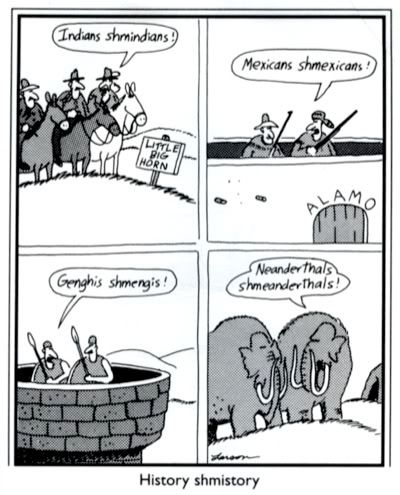
Symbolism Shmymbolism

Gary Larson is the man, and The Far Side rocks my socks. The thing you dismiss can end up crushing you, whether a symbol you eschewed or the threat of a symbol which you ignored. It all cuts both ways here.

The above is meant to set the tone: this is a silly-yet-serious issue. I was talking with my roommate about marking some of my shirts with a scarlet letter, because I'm becoming increasingly fond of the idea. You see, in Nathaniel "I waste no periods" Hawthorne's novel, Hester Prynne was forced to affix a red letter A to all of her clothing so that everyone would know she was an adultress. Over the course of the novel, Hester flouts the conventional morality of the time by integrating the badge of shame into her identity, making it a part of who she is and generally being OK with that. This drives certain persons up a goddamned wall, and for that, Nathaniel "Three sentences a page - I counted" Hawthorne gets points in my book.

As anyone likely to read this is probably already aware, the scarlet A has been hijacked - and I mean that in the best possible way - by Richard Dawkins for his Out campaign. I, for my part, am a collector of symbols: I grew up moving around and came to define myself by the stuff I have, and in order to avoid feelings of loss at losing parts of myself whenever I lost stuff, I would simply try to pick the most symbolically important things and I keep them all in one place. So, naturally, this is the kind of thing I would absolutely go ga-ga over: it's a subtle yet distinct thing I can do to publicly symbolize an important part of who I am. The A fits for atheism, adultery (the kind of Christianity I dropped regards premarital sex as adultery against one's future spouse), and apostasy; all things regarded as evil by the church, but which I see as badges of honor, not shame. (I just today added the scarlet A to my sidebar, too.)

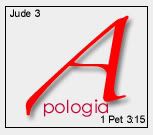
Well, my roommate counseled me against such action, as it could be confused with this:
I call shenanigans! I mean, really? Really?! You're going to take the scarlet A in the same goddamned font and try to steal it from the atheists for your own bullshit apologies? Come on! That's just stupid. But whatever, it doesn't really matter, because symbols are ambiguous and may mean many things. It's really OK for the Big Red A (or BRA, for short) to mean "adultery," and "atheism," and "apologia," and apostasy, and ataraxia, and asceticism, and fucking anything else! In fact, the more BRAs there are, the more options people have, and the more people know about BRAs, the more they'll talk about them. This gets people rubbing elbows and communicating with the opposition, and communication smothers hate. So you can have your BRA, and I can have my BRA, and everyone can wear a BRA and things will be just great! And if some people want to burn their BRAs, they can go ahead; if others want to show off their BRAs, that's also just fine; and maybe even some will want to keep their BRAs out of sight, and this too is acceptable.

Enough of that. My roommate also pointed me to this post over on Friendly Atheist, and the closing gave me pause for thought:
I think we should avoid symbols and special objects that evoke our affection as much as we possibly can. Although we may like to think that we’re above all that, we can end up magicalizing them and forming irrational attachments to them.
Hmm. OK, first of all, I agree entirely with Wade that people "can become emotionally attached to the object itself as well as the concept it symbolizes." That's just plain correct, and he's also correct that we should watch out, for a whole host of reasons. This tendency can distract us from that which the symbol represents, it can be used to manipulate our emotions, and it can be confused with other symbols or have its meaning changed over time. Symbols are complicated stuff!

But should we avoid them? I respond with an emphatic Hell fuck no!

See, we're humans, and symbols are important to us. They just are. It's a fact of our psychology that we have to live with. Furthermore, language is symbols, and there's no getting away from that, The End. We do not comprehend things in their entirety, i.e. there is always a gap between "the idea of X in my head" and "X itself out in the world," and so we use symbols as a shortcut. Symbols serve as mental abbreviations, as cultural shorthand, as useful signifiers of complex concepts to which we may wish to refer with frequency but not at length. So in the first place, symbols are unavoidable.

But wait! Wade only said that we should avoid the ones that evoke our affections, lest we magicalize them. I still disagree wholeheartedly: while we should still be wary of symbols being weaponized against us, we should deliberately seek and create stirring symbols to instill with our own sense of meaning. As humans, we require positive reinforcement, and emotionally-charged symbols of the things we believe in can help with that. They also serve as banners for like-minded individuals to rally under in service to causes: associating a sense of community and working together with a simple symbol works both ways, as seeing the symbol later can bring up all of those positive connections. (EDIT: In light of conversation with Silver Garou in the comments and face-to-face, I wish to clarify that I think it's OK for small groups to do such rallying, but I do not think that there needs to be a symbol for all atheists to "get behind" - in other words, it's OK for as many people to "play football" as wish to do so; but that's different than saying "everyone should play football," which proposition I do not endorse.) And as the most distrusted and despised minority in America, I think that we atheists have considerable need of this sort of reinforcement.

We must still be wary of the magicalization, and be prepared to take a step back whenever our symbols cause us any sort of grief. That is the time to say, "Well, it's just a symbol," and review our priorities, and work on what really matters. In a way, this actually gives us an even greater advantage over other demographics: if we can cherish our symbols for their benefits, and inoculate ourselves against their abuses, then those who would seek to use our symbols as a weapon against us will simply be wasting their time. And the more time they waste on pointless bullshit, the less time they spend actually getting in our way. Furthermore, the less our symbols may be used against us, the more frustrated the opposition becomes - and so, without lifting a finger, we shall be allowing the opposition to demoralize itself. What more could we ask for?

So by all means, symbolize, symbolize, symbolize! We need our symbols just as much as any other homo sapiens, and when treated with the proper respect and precautions, we have much to gain and nothing to lose from them. Symbols only have the power we give them, after all, and selectively conferring this power upon them makes them all the more advantageous to us.

Oh, and by the way, I found a wonderful solution to my dilemma: many of my t-shirts have exactly one letter A on them. My new plan is to color them red. Simple, subtle, symbolic. The perfect win, in my book. Nathaniel "'Run-On Sentence' is my middle name" Hawthorne would have been proud - and I'd take his opinion rather seriously on this subject.

This post was featured in the 43rd Humanist Symposium.