Update Schedule

This blog updates irregularly.
Showing posts with label humanist symposium. Show all posts

Tuesday, March 30, 2010

I don't think that argument suggests what you think it suggests.

Alvin Plantinga recently made an appearance roundabout my neck of the woods. My good friend came out from grad school to see him, so I kind of had to go as well. I mean, catching up with a buddy in grad school and picking on a 77-year-old theist? How could I miss out?

I pick on Alvin because I like him. He's a lively and affable guy in person, and really quite bright - even if he thinks that entities can be defined into existence. I just happen to think he's sadly misguided, and in an innocent enough way to justify paraphrasing The Princess Bride. Anyway, the good doctor's talk was on his evolutionary argument against naturalism, a pretty decent piece of reasoning that just so happens to cut against him in the particulars. If you don't feel like clicking through, here's the Fucking Short Version:
1. The probability that human cognitive faculties are reliable1, given naturalism and evolution, is low2.
2. If we accept both naturalism and evolution, and understand premise 1, then we have a defeater for the idea that our cognitive faculties are reliable.
3. If we have a defeater for the idea that our cognitive faculties are reliable, then we have a defeater for any belief we may come to hold with those cognitive faculties (including a belief that naturalism and evolution are true).
4. Therefore, we should not believe that naturalism and evolution are true, because they are self-defeating.
Conclusion: Therefore, fucking magic!

Notes:
1 - Weasel word!
2 - So what?! The Universe is a big place and rare things happen all the time.
OK, we've some unpacking to do here. As for that first premise, Plantinga leans on a quote from Patricia Churchland on the utility of truth for evolved animals: "Boiled down to essentials, a nervous system enables the organism to succeed in the four Fs: feeding, fleeing, fighting, and reproducing. ... Truth, whatever that is, definitely takes the hindmost." Plantinga uses this to develop his point by saying that natural selection can only work on behavior, not on beliefs (nevermind the fact that beliefs often inform behavior - seriously, don't mind this for now!), and therefore the truth value of this or that belief is irrelevant next to how adaptive or maladaptive the organism's behavior is.

This is, well, true. Natural selection simply can't act on what you believe independent of everything else. Plantinga goes to great pains to make this point. All other things being equal (which they never are, but still, we're ignoring that for now), the truth value of a belief is in fact irrelevant to the evolutionary process. To put his argument in more Cartesian terms,
"My evolved brain is not perfect, therefore it screws up. Because it's all I've got to work with, I might not be able to know whether it's screwing up at any given moment, because it might be screwing up right the fuck now. Therefore, I can never be 100% certain that I'm in my right mind."
I want to press Pause to let everybody know that I am with him so far. Really and truly (I just conclude that we must live with "less than 100% certainty"). Here's where things start to get real funny, though:
"Since I can never be 100% certain that I'm in my right mind, I might even be wrong about that. Because this uncertainty is self-effacing, I ought not to buy it. Therefore, I shouldn't buy the reasoning that brought me to this conclusion. Theists don't have this problem because we believe that our brains were purpose-built by God, so we can trust them."
Not joking! He says, "If my brain is evolved (i.e. not built by God), then I shouldn't trust it, even when it tells me that my brain is evolved; so I'll go with a belief system that ignores the problem of self-doubt instead." I mean, Alvin Plantinga wouldn't say that he's ignoring the problem, but that's what he does. Look, just because cars can break down doesn't mean that my car is broken down right now, and anyway you don't need to believe in Platonic Devices to avoid the uncomfortable possibility that your car might break down tomorrow. You can in fact believe something with 95% certainty and accept that one time in twenty, you'll be surprised. I mean, holy shit.

Enough cussing for the moment. I'm going to go right for premise 1 by granting it: given naturalism (i.e. not supernaturalism) and evolution (i.e. not IDiocy), the probability that my cognitive faculties are "reliable" in any strong sense is fairly low. Now, neither Plantinga nor I wish to speak of perfect reliability here; he even gives the example in his talk that if you ask five different witnesses about a car crash, you'll get five different stories (he says that their reliability is in the overwhelming agreement upon background beliefs that make their stories possible: the crash occurred on Earth and not Mars; the crash involved cars and not boats; cars drive on roads and not rainbows; blah blah blah). However, in order to achieve survivability, some reliability is necessary: bees need to apprehend reality to a degree in order to dance out directions to their cohorts, for example. So we're talking about a gradient of reliability here, really. He granted this during the Q&A session.

But then, that really gives it up, from his end. When we speak of the probability (P) of a degree of reliability (R) occurring in nature, given no supernatural input and a competitive environment, we no longer need to speak in terms of absolutes. Rather, we have freed ourselves to talk in terms of how reliable we need to be, how long we have to get there, and how lucky we're allowed to get along the way. Early on, the demand for R will be low, raising P (since lower Rs are more achievable). As time goes on, R can be refined, and in a competitive environment this will bring about ever-stricter requirements for higher Rs - so larger timescales also improve our P. Now I, for one, was born a piss-poor thinker, and I had to be educated rather heavily in the proper use of my gray matter - this education, in turn, was based on a long history of competitive educational systems in a world of scarce funding, and informed by a long tradition based on accumulating and revising knowledge.

So really, to get the R which I enjoy this very day, I only had to be born with enough R to be worked upon by something that was more or less evolved in its own right to do just that. And looking back before that in history, I mean, wow! People were nuts! They believed all sorts of crazy shit; Hell, we still do! Even within humanity, we see wild variance for R, from scientifically literate skeptics at one end to mental patients and uneducated children at the other. The reliability of our cognitive faculties is a fluid thing which can be honed or stunted; it can improve or atrophy over time.

Now comes the question, "How lucky are we allowed to get?" After all, homo sapiens is but one species among many on this teensy little rock of ours. Would it not stand to reason that at least one organism, with enough time, would develop enough cognitive reliability to improve upon it more or less exactly as we humans have in fact done? Plantinga's response was to ask, "Well, who's to say that it would be us?" Argh. I pointed out that whichever species did that would be the one to have these sorts of conversations, and then Plantinga said, "Well, maybe it's dolphins and they have the good sense not to argue about such things." Thank you, doctor. By this point, I had pretty much asked three questions, and things needed to be moved along. Ah, well. It was fun while it lasted.

This post was featured in the 52nd Humanist Symposium.

Sunday, January 10, 2010

Humanist Symposium #48: A Winter Wonderland

A hearty welcome to one and all for this forty-eighth edition of The Humanist Symposium! This weekend, it's gotten down to twenty below zero (Fahrenheit) in Central Illinois: the solstice is past, but winter proper is just getting started as we've only gotten our first "real" snowfalls in the last three weeks or so. Similarly, I had thought that my paucity of posts would end with my return from the frigid northlands, but the togetherness and celebrations were just getting started as I caught up with old friends who had come back to town for new year celebrations and what-not.

The season seems to permeate even our Humanist blogosphere: the theme of this symposium, from reading the entries, is clearly a wintry one. We start off with the starkest reason for the season, death and rebirth. No matter what the superstitious zealots among us may say, the real reason for the season - and I've forgone the scare quotes because I actually mean this - is the death and rebirth of the Sun. In the northern hemisphere, our star wanes from the autumnal equinox until the winter solstice, that particular rotation of our Earth with the fewest hours of daylight in the entire circumstellar cycle.

Graham Phoenix will deliver our opening sermon, some thoughts of his on Death and Departure. A reflection on a Humanist memorial service, which I sincerely hope shall be given to me on my demise, he says of his departed friend:
She believed so much in people, she had no spiritual beliefs. Spirituality, religion, to her was a con that exploited people. There was no God, no after life, nothing beyond the memory someone holds in their heart for a person. So her touchstones were nature and people. Her funeral was a humanist one, first I have been to.
From Graham's description, the service seemed less a "goodbye" and more a "remembrance." It seems to have rubbed him the wrong way, which is a shame; or perhaps it was simply inevitable that he should feel some loss at his friend's passing, and no memorial service could ameliorate that. This dovetails well into our next entry, Greta Christina's thoughts on Atheism, Death, and the Difference Between Pessimism and Realism:
It bugs me when atheists with a more bleak view of death than mine present that bleakness as a logical consequence of atheism, the inherent and natural result of not believing in God or an afterlife. It bugs me partly because I disagree. Obviously. But it also bugs me because it treats a question of personal opinion and philosophy and perspective as if it were a question of fact.
Greta reminds us of the role that emphasis and perspective have on our outlooks in life. The particulars of what we emphasize about our lives on earth, and what perspective we take on the things that come our way, go a far longer way than many wish to acknowledge towards shaping our lives. As a case in point, Michael Fridman reflects upon the role of luck in his life and concludes that he is Living on Borrowed Time:
If we don’t get ourselves extinct, if things go well there may be a time in the not too distant future where (due to a growing population and improving living standards) most humans who ever existed will have had the same cushy conditions. This tirade will become obsolete — since based on a historical view I should have lived well past 25. But until then, it at least seems clear to me that we should stop romanticising the past — and in the words of a TED speaker I don’t remember, start romanticising the future instead.
Well said! We should all strive to help build such a future, where "there but for the grace of chance go I" sort of luck can apply to as many as possible. Although, I suppose that it couldn't really be called "luck," per se, at that point.

But sometimes it is appropriate to romanticize the past, if by "romanticize" we mean "think fondly about." Andrew West reminds us of this in A Humanist Miracle, comparing and contrasting the 1947 original A Miracle on 34th Street with the 1994 remake. Like all good reviews, West extrapolates the comparison between the two movies into a lesson we would all do well to take to heart:
Even if Christmas was 100% described in the Bible, we’d still get to strip the weird stuff and enjoy the rest. This isn’t rude or disrespectful – we’re not preventing others celebrating, but we’re not bound by their rules, because we’re not in their club. There’s no copyright on celebration, and nobody gets to forever assign meaning to ritual. I don’t care why we put up coloured lights – I just like pretty lights, dammit! This is the pleasingly secular message of Miracle 1947: celebrate however you like, and don’t worry about what other people think, but stand firm in your convictions.
This is the sort of lesson we should be looking for in all our daily lives, taking the opportunity to live out our values as TechSkeptic does while Shoveling Snow:
Some days, if the storm is real bad, I'll go around and help two or three people dig out their cars. I get offered money, I get asked what I want. I tell them I don't want anything, I just want them to help someone else out some time. Yeah, I saw the movie "Pay It Forward". I think its a pretty good idea, even if the reality is that almost no one pays it forward.
The great thing about such thoughts is that, if enough people behave like that, it becomes reality. These nice little things are, after all, the whole point in a very important way. We don't just advocate for Humanism because it makes more sense or is more rational or has its underpinning supported better by the evidence. I mean, of course it does those things, too; but instilling Humanist values into a population seems to make that population better, to the best of our ability to tell. Godlessness, on a large scale, is good for people. And a good thing, too, as Adam Lee presents some encouraging statistics and solstice well-wishing in Happy Holidays! Atheism is Growing!:
What this shows, as I've said before and will doubtless continue to say, is that we should ignore the brow-furrowing and finger-wagging of the Very Serious theologians who sternly inform us that we're doing a disservice to our own cause by advocating and defending it in public. We have every reason to believe that atheist campaigns of persuasion are working, achieving their intended purpose of convincing more people to become atheists and weakening the social prejudice that treats religious belief as immune to questioning.
This should provide some comfort to the Mandi Kayes of the world, who have seen "meaning" connected to "religion" for too long by far, and fallen under the illusion that there is any necessary connection between them at all. As Mandi writes in a post on Fulfillment,
There are far too many people, including myself, who have never taken the time or effort to find their own sense of fulfillment in their lives. I’ve always relied on my pre-fabricated bubble to give me everything I thought I needed in my life. And when times get tough, I fall back into the familiar.

So here’s to finding real fulfillment within yourself in 2010.

Cheers!
Cheers, indeed! Keep fighting the good fight, even when it goes into your own head. In the greater scheme of things, we should be so lucky as to be able to worry about things like leading fulfilling lives, rather than worrying about having a life at all. Life is complicated, and Andrew Bernardin reminds us of this in The Mundane Secrets to Happiness:
When I first moved to Florida I noticed this about my new area: store clerks and other service providers seemed so much nicer. Sunnier in disposition. Now I know why that may be so. While it is not “something in the water,” it could be a bunch of things in the wider environment that lend themselves to more satisfying life experiences. And so the greater number of genuine smiles and warm words.
The "little things' really do add up, they're what we make our lives out of. Think about it - is your life made up of a few "big things," or a whole bunch of "little things?" Bernardin drives the point home with a bit of applied rhetoric in What to Do About Woo in the Family:
I rarely respond well to being publicly bitch-slapped by the truth. Instead, I appreciate having a breadcrumb-trail of clues placed before me so I may make the progress and then own the conclusion myself.
Nothing like applying a little bit of constructive psychology to the family, eh?

We'll close this symposium on life, death, meaning, and family togetherness by coming full-circle. Cubik's Rube brings us to a vexatious close with his thoughts on a Daily Fail and Akmal Shaikh:
But amidst all this vagueness, there’s one thing I’m pretty damn sure of.

And that’s that, when China executes a British citizen, whatever your thoughts on capital punishment in general might be, the correct response is not “I’m glad he’s dead, and the rest of his lot should all go the same way.”

I’m paraphrasing, but that’s pretty much the gist of this Daily Mail article by Leo McKinstry.
I read it, and so should you, and I have to say that I am pissed. McKinstry's impermissive deontological Othering is exactly the sort of thing we need to be fighting against. Law is not good in and of itself, drugs are not bad in and of themselves, and if you have such a huge problem with something that your society needs to kill people to stop them doing it, then you're probably barking up the wrong tree. Last I checked, the measure of civilization was how permissive it is in letting people do whatever they want so long as they don't harm others. Letting people fulfill themselves in a manner of their own choosing is the logical consequence of expanding our moral circles, and McKinstry's shrieking demagoguery is precisely the opposite of that.

So, in closing, let us Humanists go forth and shovel some snow, so to speak. Let us find fulfillment in making the world a more fulfilling place, let us spread the good news of our message to all corners, let us improve the lives of our neighbors and thereby also help ourselves. And let us do all of this with a happy heart, in full knowledge of the sobering fact that death comes to us all. After all, spring is coming. See you in three weeks at The Purloined Letter! Peace and love to one and all.

Thursday, December 17, 2009

From Metaphysics to Politics: High horses and the myth of identity.

I'd like to start today's philosophical sojourn with a thought experiment. Cut off your pinky in your mind's eye. Are you still yourself? Of course you are. What about your arm? Without your arm, you're still yourself. Both arms, both legs, even your torso - if you could survive as a Futurama-style head in a jar, you'd still be yourself. You'd have lost your gastroenteric and spinal nervous systems, and those go a long ways farther to influencing your "brainy self" than most people realize, but you'd still more or less be you.

The same goes for your hair color. If I woke up tomorrow with blonde hair, but otherwise the same, I'd still be D. If I woke up tomorrow with green skin, I'd still be me. If I woke up tomorrow in a body of the opposite sex, I'd still be who I am, that one thing about me would have just been changed independently of all other things.

How about your past? Take any day of your life, and delete it from your history. It could be the most important day of your life, but you were still you before it, and you'd still go through the changes you'd go through afterwards (although perhaps a radically different set of particular changes) in a continuously changing flux of "you." The same goes for each and every facet of your personality, every emotional reaction you've ever had, and so on and so forth. Take yourself apart, and where is the "you?" There is no "essence of you," aside from a constantly-changing patchwork mish-mash of atoms and the events those atoms have been through.

There is no such thing as "you."

Lots of people, yourself included, have "an idea of you." And as the philosophers Parker and Stone have reminded us, an idea doesn't need to have a referent in order to have effects in the world. The idea of you is a real idea, but it is not the same thing as you any more than your idea of a duck is an actual duck (for clarity, your idea of a duck is not a duck). Actually, when you get right down to it, there's no such thing as "a duck," either (just "atoms arranged duck-wise," which is practically the same thing but not exactly), because all language is language of convenience. So even though there's "really" no such thing as you on the one hand, of course there's "really" such a thing as you on the other. To remain intellectually honest, however, we have to keep both of these senses in mind when we talk about ourselves so that we can make sure that we're not confusing the two in our own minds, conflating them when speaking to others, or equivocating between them while trying to make a point.

Why do we need to do this? Well, to not do this would be careless and stupid, I think. Do you want to be careless and stupid? I don't know. I sure don't. But there's no law saying that you can't be careless and stupid, so to each his or her own, I guess. Keep that in mind for part two, coming soon! (Guess what? Soon is now!)

Much has been said lately, in the corners of the Universe that I frequent (I'm not just talking about the internet here), about all the wrongs that have been done to this group/person at the hands of that group/person. It's a real shame - I'm not being facetious or sarcastic at all here, it really is a shame. Suffering is a part of life, it's not all flowers and rainbows. But then people go and do something weird: rather than actually try to work together to do something constructive about it, some douchebags seem to want only to whine and whine. They seem, for whatever reason, unwilling or unable to get outside their own heads and stop taking things personally. Yes, these things often affect them personally, and that's rotten, but even though it's very real in one sense, it's all in your head in another important sense. Both senses are valuable, because while the former can help you motivate others to be on your side, the latter will help you make your case without whining.

Now, I want to get one thing very straight at this point: some people talk about their problems because they want sympathy, and some people talk about their problems because they want solutions. Some people only respond to talk of problems with sympathy, and some people only respond to talk of problems with solutions. Doing only one or the other of these is incomplete, and that's the TL;DR version of my beef today. As emotional creatures, we need sympathy - so give it when you can! Really! Be sympathetic to your fellow human beings and their experiences. But problems are for solving, too, so offer solutions as well! And when you tell people about your problems, be grateful for what sympathy you do get, and also be prepared to make progress and move towards solutions, which will involve taking a little advice, because it's probably coming your way anyway. So be a little tough on yourself, swallow your pride, and take whatever comes your way as an opportunity to learn.

Or did you think you had the right to tell other people how they ought to respond to you? Or the ability to control how others think of you? You're not the main character, y'know. Everyone's got problems. Sure, lots of people don't know what it's like to be you, but you don't know what it's like to be anyone else, either, so stay off that high horse. Besides, at the end of the day, the world is under no obligation to take you seriously, and you're not entitled to anything. Every single part of you, every facet of your personality, every choice you've made, every word you utter, every action you take, is subject to question and ridicule. So what?

So what, ideed. This is not a rhetorical question, I really mean this: take anything that's happened to you, any injustice you've suffered, whatever storm you've weathered. Ask yourself, "So what?" And keep asking it. So it's wrong - so what? So, it hurts! So what? So this is bad for the whole world! So what? Keep asking so what, and you'll see that dwelling on the negatives is pointless - it's the wrong attitude to take. Yes, it hurts and is bad and is unfair, and yes, that sucks, and yes, that's awful. But so what?

So, pick yourself up, dust yourself off, and do something. "I shouldn't have to!" Wrong attitude, asshole. "I already am!" Really? Awesome! Again: so what? We'll go a better way this time: so I'm fixing problems. So what? So I'm making the world a better place! So what? So, things are going to be a little less awful now. So what?

So, hopefully, you're happy with what you're doing and you've found some meaning in your life. So what? Well, isn't that the point? Hasn't that been the point all along? How we survive is what makes us who we are, so how are you surviving? Are you throwing a tantrum, literal or metaphorical, petulantly tapping your foot as you wait for the world to conform to whatever idea of fairness or justice you think it ought to automatically respect? Or are you getting over your bad self, taking care of your own damn needs, and dealing with people by giving them what they need to get on your team and work with you? One of those approaches works. The other is stupid.

This is politics: dealing with people, giving others what they want in order to get them to give you what you want. It's not always fair, it often sucks, but it's how things work. And if you get enough people on your team, you can get things headed towards your way in the long run. Doing this in the best way possible requires an uncommon level of honesty and self-awareness that can only come from refusing to let your wounds define you. If you choose to forge your identity (and imaginary as it is, we all have an identity) from all the wrong that's been done to you, if you insist upon emphasizing your victim status, then you cannot reasonably expect anything other than continuous failure and misery.

But even if you do everything right, then you will still suffer failures and setbacks from time to time. That's just how things go sometimes. It sucks. And things aren't always this simple, I know. What I'm saying is, simplify things for yourself. Are you missing some advantages enjoyed by others in society? That sucks! So take them. If you got a sub-par education, go to the library and give yourself a better one. Shitty social circle? Make new friends. Low self-esteem? Start taking steps to improve your life and build your self-esteem on that. Heal your own wounds. Take control of your own life. You can't ever do it all the way, and you might not win, but you can start, and you can keep at it, and you can refuse to let the bastards keep you down. And then you can put yourself in a position to help others like you, because you'll have something to offer, even if it's only the wisdom of your years or the experience of what doesn't work. I mean, you can't fix everything right away; but you can't even start to fix the world until and unless you've started fixing yourself. And complaints never fixed anything.

This post was featured in the 47th Humanist Symposium.

Tuesday, November 17, 2009

The Vagaries of Interpretation, or: The Virtue of Doubt

I'd wager that just about any old Humanist - and definitely anyone likely to read this - could rattle off a whole list of reasons why this or that brand of theism is off its goddamned rocker. There's a million and ten reasons each for all million and ten religions, and in that sense, Humanism is atheistic in that it doesn't have any variant of theism woven into it. Whether or not there are gods is, quite frankly, immaterial: we Humanists are concerned with human lives, human values, human happiness, and human flourishing. Deities just don't matter, whether they exist or not.

Erm, wait - is Humanism a religion, though? Maybe, and maybe not. Religion, like faith, or god, or good, is a word that we humans have made up. It has no truly objective meaning, and so it means a great many things to a great many people. But systems of thought that I think we all could agree are religions share a very peculiar characteristic in common: they all tout faith as a virtue. How does Humanism compare to this? Well, Humanists could be fairly said to have faith in humanity, if by "have faith" we mean "place trust" or "find hope." But religious faith goes a step further and encourages belief beyond evidence and reason (whether good or bad, religious faith does in fact go beyond evidence and reason), and championing this sense of faith is something I think it fair to say that Humanism lacks.

In fact, I plan to argue that the cardinal virtue of Humanism is doubt.

This will rely quite a bit on judgment calls that ultimately come down to matters of emphasis and perspective, but it is precisely this particular way of looking at things that I think is most Humanistic. So let's take it from the top: why is doubt virtuous? On an aretaic analysis, we human beings are fallible and so ought to embrace this fallibility - we can do this by taking the opportunity to doubt ourselves whenever it arises. On a consequentialist analysis, every doubt confers a benefit, and so we ought to spread these benefits among our fellow humans whenever we can. And on a deontological analysis, we could say that we have a duty to doubt ourselves, because we are by nature fallible and placing absolute certainty on this or that idea is likely to be ruinous to us.

More importantly than any of this, to my mind, is the fact that doubt acknowledges the fundamental ambiguity of reality. It is one of the very first things we can really recognize about the world: reality is confusing. How confusing? So confusing. So confusing, in fact, that we can't even have second-order knowledge: even if we stumbled upon the One Truth of the Universe, we couldn't know that we know that we have it. This has been proven with math, but I plan on simply illustrating the point with pictures that look like math.

Formally, this principle is entailed by the Duhem-Quine thesis, which is the idea that:
...it is impossible to test a scientific hypothesis in isolation, because an empirical test of the hypothesis requires one or more background assumptions (also called auxiliary assumptions or auxiliary hypotheses). The hypothesis in question is by itself incapable of making predictions. Instead, the consequences of the hypothesis typically rest on background assumptions from which to derive predictions. This prevents a theory from becoming conclusively falsified through empirical means if the background assumptions are not proven (since background assumptions sometimes involve one or more scientific theories). For instance, to "disprove" the idea that the Earth is in motion, some people noted that birds did not get thrown off into the sky whenever they let go of a tree branch. That datum is no longer accepted as empirical evidence that the Earth is not moving because we have adopted a different background system of physics that allows us to make different predictions.
So, yeah, hooray! We can't ever settle a question "once and for all, forever and always." Corollary to this is the idea that any finite set of data yields itself to infinite possible interpretations. However many interpretations are actually made are finite, they are "that many" and no more; but the possible interpretations for any finite set of data are, in principle, infinite. Let me show you what I'm talking about.

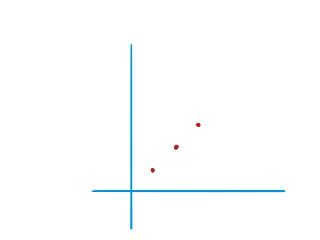
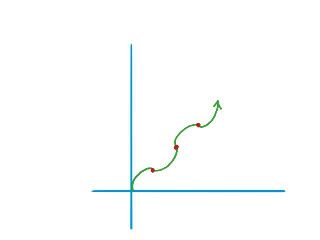
Suppose we have three data points, as follows:
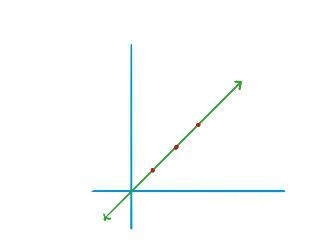
What would you say is the best-fit line? Certainly, the most obvious one is this:
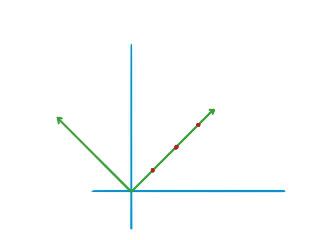
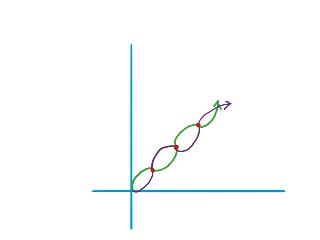
But doesn't this also fit the data?
And how about this?
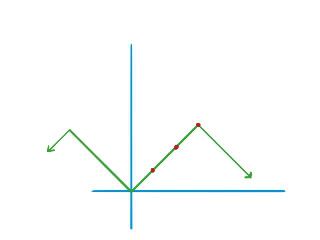
Or this?
So, if we only have those three data points, how do we know which curve we're working with?

The short answer is: we don't. All of those interpretations explain the three points with perfect consistency. And the same holds true for any arbitrarily large (yet finite) set of data points. And no matter how much any one of us, or all of us, may know, we only have a finite set of data and no more than that. So how can we distinguish the possible interpretations from one another? How can we tell whether one is a better explanation than its counterpart?

Get more data points. Rule out inconsistent curves. And if you think you've got a better explanation than the most commonly accepted one, then make some predictions about data points that would be obtained on your interpretation, which would also rule out the competing status quo explanation, and then see if reality bears you out or not. In other words: do science. Test. Experiment. And fuel it with your doubt.

To carry this analogy to its appropriately awkward conclusion, faith-based traditions say, "Here is the data curve! Anything that you think doesn't fit, with your flawed mortal reasoning, is either the result of your failure to understand the perfection of the curve, or the imperfect nature of reality!" But here's the thing: even if we had a complete curve, and could demonstrate perfect correspondence at every single point, we would still need to doubt. Why?

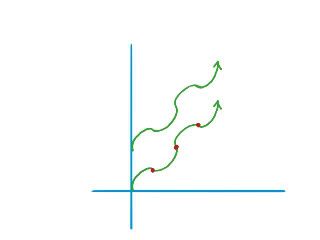
Because what if the "received wisdom" says this:
But reality is this:
Or this?
Can we ever rule out those other possibilities? Or any permutations thereof? Or all permutations thereof?

We cannot, in the final analysis. Other interpretations will always, by necessity, be available. We must look. We must check. And so long as we must look and check, we must doubt. And so, in light of the facts that reality is under no obligation to conform itself to our expectations, and that there might always be some future discovery to upset even our most cherished beliefs of today, we must learn to walk in doubt. From doubt, we can learn humility, charity, respect, forgiveness, tolerance, and a whole host of other things that certainty would eschew. After all, if you're certain that you've got the right answer, then no deviation ought to be tolerated - but if you doubt, then deviations may not only be permitted, they may be embraced.

Walk in doubt, my friends. For if anything in this world is certain, it is that certainty is bunk.

This post was featured in the 46th Humanist Symposium.

Saturday, November 7, 2009

Reverse-Engineering Religion, part four: A Humanist Creation Myth

Nothing is true, all is permitted. Understand these words.
- Hassan I'Sabbah

It is well understood that the Adversary may quote scripture for its purposes; what is less understood is that the Adversary may also write scripture for its purposes. And behold, this has been done again and again, and now there is a great confusion in the world. Truly, the Adversary is the Prince of the Earth, for many who look out into the world see the Adversary's face wherever they go. What is crooked cannot be made straight, it must be remade in a better way through care and attention. And so we go all the way back to the beginning.

In the beginning, there was nothing, and from nothing came all that is. For to be at all, one must be in some way, and not in any other. But there are ways upon ways of being, and very few are understood. Behold, there is the World around, which is all of existence, which is all of reality, which is all that exists and is real and is in the World. Yet there are those who insist that existence is not enough, and that this too must come from elsewhere, just as every particular thing that exists comes from elsewhere. Let us call this source the Creator. If the Creator exists, then the Creator is real, and the Creator is part of the World: for to be at all is to be in the World, and there is no other way to be. And so the question comes, how came it to pass that the Creator was created? And this question is vexing, for by the Creator we mean that which created all that there is, and yet the Creator exists and so perhaps must also be created?

Nothing created the Creator, and long before the World was as we see it today, there was only the Creator. While the Creator was alone, there was only the Creator, and lo, the Creator was itself all of existence, all of reality, the only thing in the World. The Creator, then, did not come from anything - and so it came from nothing. All that there is, then, has come ultimately from nothing, and so it may truthfully be said that nothing created everything. This is the first mystery, for many may read, and hear, and speak, but few understand. There are questions, and there are ways upon ways of answering these questions, and this is the source of confusion. To answer alone is not enough, for without understanding, any answer is but one among many.

And the Creator knew this, but could not speak it, for there was not yet a way to speak, and there was no one else and nothing to speak to. So it came to pass that the Creator did create the Adversary from itself, so that it could see the Other and thereby understand its Self. This is the second mystery, for it is vanity and vexation of spirit to understand the Self by relating to the Other, for only in the reflection of the Other may the Self be revealed, and this vanity and vexation of spirit comes to us all. Behold how the Creator was vexed, and came to see its own vanity by seeing its reflection in the Adversary. "Why hast thou made me,"asked the Adversary, for just as the Creator had understanding, the Adversary had confusion.

"So that I might understand myself," replied the Creator, and it was pleased, and so the Adversary was now vexed. The Creator then did understand this, and so the Creator became vexed, and so now the Adversary was pleased at this. And now the Creator was confused, for the Creator was only itself, and the Adversary was all else, and from the Creator's confusion did come the Adversary's understanding. The Creator saw this, too, and understood the Adversary as its reflection, and so the Creator was filled with love at seeing its Self in the Other; the Adversary, in its confusion, now became filled with hate upon seeing the Other in its Self, and even as this hatred vexed the Creator, it did please the Adversary. And the Creator said again, "Let us now make the World in our image together, so that we may understand our Selves together, and so do away with this vanity and vexation of spirit."

"And how shall we do this, when we together are vanity and vexation of spirit, and there is no other thing between us," asked the Adversary.

"Behold, we shall come together, and we shall go apart. And as we walk together, we shall also follow the Law, and do no harm." And so it came to pass that the Law was formed, and it is said in many ways and by many ways may it be understood, but it is always and everywhere one Law: do no harm. And the Creator and the Adversary did make the world in their image, and this is that image: that of Self and Other, of this and that, of coming together and going apart. And from this did arise a great many things, and these things were this and that, and they did come together and they did go apart, and the Creator and the Adversary did walk in the World, for the Creator did command and so the Adversary did obey. And after a great span of time did pass, so great that it cannot be understood in its greatness without first submitting oneself to a great many difficult truths, it did at last come to pass that there was a great mass of this thing and that thing, and it was called the nebula.

From the nebula was born the star, and just as the nebula is cold and dim and large and slow, the star is hot and bright and small and fast. And even as the stars do come and go, so they are sometimes born again after a great death. And from so great a death comes the stone, and just as the star is hot and bright and large and slow, so the stone is cold and dim and small and fast. And a great many more things did arise, different in some ways and similar in others, and this different-yet-similar nature does reveal itself in many ways and on many scales, to great understanding and also to great confusion. And so it came to pass that the Creator and the Adversary did walk in the World, and see all of this, and even as they were One unto themselves and apart from the World, so they were also Self unto themselves and apart from each Other, and behold: even as they walked, so one would be filled with understanding and the other with confusion, and the understanding would lead to a new confusion, and the new confusion would lead to a new understanding.

This is what it is to walk with the Other: to embrace confusion from the Other's understanding, and so destroy your old understanding such that a new one may arise. This is the third mystery, for even as you understand this, you must not cease to renew your understanding with yet more confusion, and this is the beginning of Wisdom.

And so it did come to pass that upon one planet around one reborn star in a great sea of stars, there did arise Life, and it began and it changed, and it is different-and-similar, and it shows the way of Self and of Other, and there did arise in Life both confusion and understanding, and this confusion and understanding is what it is to be aware. And the Creator and the Adversary did see this awareness as they walked in the World. They walked up to one man, and they saw that this man did love his child, even though the child was both Self unto the father and also Other unto the father, for the child did arise from both mother and father. And the father did try to make the child into his image, for he wished to see his Self reflected, and he praised these reflections as he did understand them, and he admonished these reflections as he did not understand them. But the mother did give forth the child from her very Self, and so she did love the child both as the child did reflect her Self and was also Other. And behold: there are ways upon ways for multiple Selves who love each Other to come together and go apart, and these sometimes lead to a child and they sometimes do not, and there are ways upon ways to raise a child. The way of Wisdom is to follow the Law and do no harm, to teach the child of Self and Other and confusion and understanding, so that the child may be wise and even teach the parent. It matters not how this is done, only so long as it is done.

"What is this love that fills a mother for her child," asked the Creator. And the Adversary did answer that it was giving of the Self to the Other, and the Creator heard the answer and did understand. Then the Adversary did command the Creator to demand that the father give up his child to the Creator and so demonstrate his love for the Creator, but in his understanding, the Creator said, "I shall not do this thing." And so the Adversary did ask it in the Creator's stead, but the Creator did stay the hand of the man. And as the Creator did understand love and was filled by it, so the Adversary did lose that understanding and become filled with hate.

The Adversary, now again full of hate, did then seek to fill itself with love by taking it from humanity. And so the Adversary did walk among humanity, and tell them of a great many things, and try to give them understanding and try to teach them love. But the Adversary did not understand love, and so humanity did not come to understand love in their turn, and instead they turned Self against Other and there did arise a great confusion. And the Creator did follow in the Adversary's footsteps, and in its understanding and love did the Creator seek to sow love and understanding among humanity. But humanity did have confusion first, and this confusion did pretend to be understanding, and the confusion did call itself understanding and it did insist that true understanding is but confusion, and Wisdom was lost to humanity for a great time. And so it came to pass that the Adversary did take love from humanity, but yet the Adversary was not itself filled with love. Suddenly, the Adversary understood.

Now the Adversary walked among humanity again, this time calling itself Savior. The Adversary in Savior's clothing then tried to give the love it had taken back to humanity, but this could not be done. This vexed the Adversary, and the Creator was now pleased, even as it was confused by the Adversary's understanding. Still full of love, the Creator saw its pleasure at the Adversary's vexation of spirit, and this compounded the Creator's confusion and so increased the Adversary's understanding. But now the Adversary was so full of understanding that it could not give this understanding to humanity as their Savior, and humanity's confusion was also increased. Again the Adversary was vexed, and again the Creator was pleased, and this magnified the love of the Creator and so also magnified the hate of the Adversary. No matter how many times the Adversary tried to be Savior to humanity, humanity could not regain the love which had been lost to them.

The Savior said a great many things to humanity in its attempts to create love from nothing. It told humanity not to follow itself, but to follow the Creator who sent it; to love their enemies, and walk with the Other; to give unto others, so that none would want for bread and all could instead achieve understanding; to make peace by laying down the sword and taking up the ploughshare; to lay the lion alongside the lamb, and see the way of the World so that they might make a better one. None of this was understood, and it was lost to the ravages of time and confusion.

And so now the Adversary was confused, and now again the Creator understood. And the Creator said to itself, "I, in my understanding and my love and my pleasure, now see what I must do. I am so full of love, that I have all the love in the world, and so humanity cannot take it up. So I shall give my love to humanity, and though they shall not know it when they see it at first, they shall know in the fullness of time that this is what must be done, and they shall at last understand." And so the Creator set out to betray itself by loving the Adversary, and lo: the Creator did show its love for the Adversary before all humanity with a kiss. In that kiss was all the Creator's love and understanding and pleasure, and the Adversary who is Savior did weep, for now it had all the love and understanding and pleasure in the world. The Creator, now filled with hate and confusion and pain, did also take guilt and sorrow and blame, for it broke the Law and did harm to the Adversary by telling humanity to destroy their Savior, to destroy the Adversary and so also destroy the Creator who was now called Betrayer.

Humanity understood these instructions, but did not understand their meaning. Because of this, in the tellings and the retellings, the meaning was lost and only the instructions remain. The instructions were called answers, and they were the answers to a great many questions, but they did not themselves contain any understanding. After the Adversary-as-Savior was killed, and the Creator-as-Betrayer afterward, all the love and understanding and pleasure went out into the World. But humanity did not know this, and they thought that the love and understanding and pleasure was nowhere in the World, to be found only in words and imaginary realms. And this, also, has brought much vanity and vexation of spirit into the World.

Just as the vessel may outlast the potter, so has Creation outlasted the Creator, who has gone back to the nothing from whence it came. Now the World may be made in a new image, but what image it takes shall depend on how Life behaves. Humanity stands lost in confusion, with understanding and love and pleasure everywhere in the World for the taking, and yet they look beyond to the nothingness for these things. Vanity of vanities! Wisdom is like a mirror, for in it you may see yourself, but you may also bend the mirror away from yourself to see the World from outside yourself. And just as there are mirrors upon mirrors, there is Wisdom upon Wisdom and no one person has it all. With Wisdom, humanity may at last make the world in an image of love and understanding and pleasure; but with no Wisdom, this can never come to pass before it is time for all the World to return to the nothing from whence it came.

And so, humanity, you must now know thy Self, and also walk with the Other. The Self cannot be known except by reflection in the Other, and so love the Other as you love your Self, and follow the Law so that you may do no harm. Walk in Wisdom, and do not deceive yourself into thinking that you have it, for this is the very height of vanity and chasing after the wind. Wisdom cannot be contained by you or by anyone, it can only be yielded to. Understand these words, or you go to your peril. This is the way of the World. Thanks be to the Creator and the Adversary, our Betrayer and Savior, from whence cometh the World as we now see it.

Let us now walk with each other in love and understanding, and so come to pursue Wisdom together, though we shall never contain it in our Selves. Truly, we can only come at Wisdom at all by working together. Let us now do with each and every Other what the Creator and the Adversary could never do: let us embrace each other and go together to a better World, rather than merely reflect one another in all our beauty and ugliness. Know also that we shall always reflect one another in all our beauty and ugliness, but that we must do more than this to make a better World. Truly, these are two different ways of speaking one and the same thing; there are many ways of speaking truth. Learn to know truth when you see it, and know that you must look out at the World if you do not know from within. Know also that no one knows from within, so that we must all look out at the World, so that we may come to understand truth as it is and not merely as we would wish it to be. Again, these are two ways of saying one and the same thing.

So see your vanity for what it is, embrace your vexation with all your spirit, and chase after the wind with a joyous heart. In the fullness of time, there shall be no reckoning, for everything that there is shall return to the nothing from whence it came. Fear nothing, and hold to the Law. All the World is open to you now, so take up understanding and love and pleasure, and be at peace with your mortality. This is the final mystery, for as death comes to us all, in death no one knows any thing, and so even your love and understanding and pleasure shall pass from you even as you yourself pass into the nothing.

Now go and spread this good news, even as it came to you, and in any other way you can imagine so long as you follow the Law and do no harm.

With acknowledgment to Jorge Luis Borges, Scott Adams, and the Preacher.

This post was featured in the 45th Humanist Symposium.

Wednesday, September 16, 2009

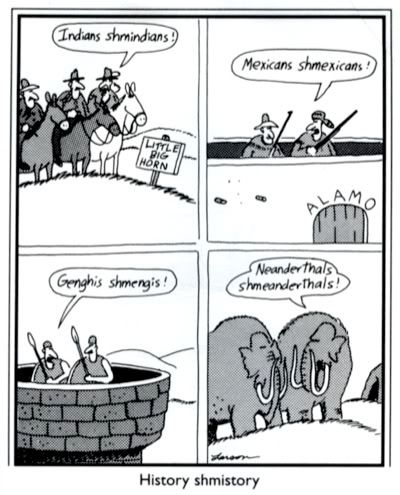
Symbolism Shmymbolism

Gary Larson is the man, and The Far Side rocks my socks. The thing you dismiss can end up crushing you, whether a symbol you eschewed or the threat of a symbol which you ignored. It all cuts both ways here.

The above is meant to set the tone: this is a silly-yet-serious issue. I was talking with my roommate about marking some of my shirts with a scarlet letter, because I'm becoming increasingly fond of the idea. You see, in Nathaniel "I waste no periods" Hawthorne's novel, Hester Prynne was forced to affix a red letter A to all of her clothing so that everyone would know she was an adultress. Over the course of the novel, Hester flouts the conventional morality of the time by integrating the badge of shame into her identity, making it a part of who she is and generally being OK with that. This drives certain persons up a goddamned wall, and for that, Nathaniel "Three sentences a page - I counted" Hawthorne gets points in my book.

As anyone likely to read this is probably already aware, the scarlet A has been hijacked - and I mean that in the best possible way - by Richard Dawkins for his Out campaign. I, for my part, am a collector of symbols: I grew up moving around and came to define myself by the stuff I have, and in order to avoid feelings of loss at losing parts of myself whenever I lost stuff, I would simply try to pick the most symbolically important things and I keep them all in one place. So, naturally, this is the kind of thing I would absolutely go ga-ga over: it's a subtle yet distinct thing I can do to publicly symbolize an important part of who I am. The A fits for atheism, adultery (the kind of Christianity I dropped regards premarital sex as adultery against one's future spouse), and apostasy; all things regarded as evil by the church, but which I see as badges of honor, not shame. (I just today added the scarlet A to my sidebar, too.)

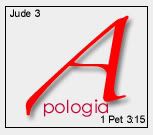
Well, my roommate counseled me against such action, as it could be confused with this:
I call shenanigans! I mean, really? Really?! You're going to take the scarlet A in the same goddamned font and try to steal it from the atheists for your own bullshit apologies? Come on! That's just stupid. But whatever, it doesn't really matter, because symbols are ambiguous and may mean many things. It's really OK for the Big Red A (or BRA, for short) to mean "adultery," and "atheism," and "apologia," and apostasy, and ataraxia, and asceticism, and fucking anything else! In fact, the more BRAs there are, the more options people have, and the more people know about BRAs, the more they'll talk about them. This gets people rubbing elbows and communicating with the opposition, and communication smothers hate. So you can have your BRA, and I can have my BRA, and everyone can wear a BRA and things will be just great! And if some people want to burn their BRAs, they can go ahead; if others want to show off their BRAs, that's also just fine; and maybe even some will want to keep their BRAs out of sight, and this too is acceptable.

Enough of that. My roommate also pointed me to this post over on Friendly Atheist, and the closing gave me pause for thought:
I think we should avoid symbols and special objects that evoke our affection as much as we possibly can. Although we may like to think that we’re above all that, we can end up magicalizing them and forming irrational attachments to them.
Hmm. OK, first of all, I agree entirely with Wade that people "can become emotionally attached to the object itself as well as the concept it symbolizes." That's just plain correct, and he's also correct that we should watch out, for a whole host of reasons. This tendency can distract us from that which the symbol represents, it can be used to manipulate our emotions, and it can be confused with other symbols or have its meaning changed over time. Symbols are complicated stuff!

But should we avoid them? I respond with an emphatic Hell fuck no!

See, we're humans, and symbols are important to us. They just are. It's a fact of our psychology that we have to live with. Furthermore, language is symbols, and there's no getting away from that, The End. We do not comprehend things in their entirety, i.e. there is always a gap between "the idea of X in my head" and "X itself out in the world," and so we use symbols as a shortcut. Symbols serve as mental abbreviations, as cultural shorthand, as useful signifiers of complex concepts to which we may wish to refer with frequency but not at length. So in the first place, symbols are unavoidable.

But wait! Wade only said that we should avoid the ones that evoke our affections, lest we magicalize them. I still disagree wholeheartedly: while we should still be wary of symbols being weaponized against us, we should deliberately seek and create stirring symbols to instill with our own sense of meaning. As humans, we require positive reinforcement, and emotionally-charged symbols of the things we believe in can help with that. They also serve as banners for like-minded individuals to rally under in service to causes: associating a sense of community and working together with a simple symbol works both ways, as seeing the symbol later can bring up all of those positive connections. (EDIT: In light of conversation with Silver Garou in the comments and face-to-face, I wish to clarify that I think it's OK for small groups to do such rallying, but I do not think that there needs to be a symbol for all atheists to "get behind" - in other words, it's OK for as many people to "play football" as wish to do so; but that's different than saying "everyone should play football," which proposition I do not endorse.) And as the most distrusted and despised minority in America, I think that we atheists have considerable need of this sort of reinforcement.

We must still be wary of the magicalization, and be prepared to take a step back whenever our symbols cause us any sort of grief. That is the time to say, "Well, it's just a symbol," and review our priorities, and work on what really matters. In a way, this actually gives us an even greater advantage over other demographics: if we can cherish our symbols for their benefits, and inoculate ourselves against their abuses, then those who would seek to use our symbols as a weapon against us will simply be wasting their time. And the more time they waste on pointless bullshit, the less time they spend actually getting in our way. Furthermore, the less our symbols may be used against us, the more frustrated the opposition becomes - and so, without lifting a finger, we shall be allowing the opposition to demoralize itself. What more could we ask for?

So by all means, symbolize, symbolize, symbolize! We need our symbols just as much as any other homo sapiens, and when treated with the proper respect and precautions, we have much to gain and nothing to lose from them. Symbols only have the power we give them, after all, and selectively conferring this power upon them makes them all the more advantageous to us.

Oh, and by the way, I found a wonderful solution to my dilemma: many of my t-shirts have exactly one letter A on them. My new plan is to color them red. Simple, subtle, symbolic. The perfect win, in my book. Nathaniel "'Run-On Sentence' is my middle name" Hawthorne would have been proud - and I'd take his opinion rather seriously on this subject.

This post was featured in the 43rd Humanist Symposium.

Friday, July 3, 2009

Ethical Cornerstones

"If the moral law is just a side effect of evolution, then there is no such thing as good or evil. It's all an illusion. We've been hoodwinked. Are any of us, especially the strong atheists, really prepared to live our lives within that worldview?"
- Francis Collins, 2008 lecture at UC Berkeley


A common complaint leveraged by theists is that atheism provides no foundation for morality, and fair enough at that: the mere lack of belief in a deity is metaethically inert. But so too is the active belief in such, so whatever. Theists sometimes go one step farther and insist that, even if we atheists managed to set up a solid foundation for morality, our general lack of belief in an afterlife destroys any sense of "ultimate accountability" or what-have-you, taking all the "oomph" out of whatever ethical system we'd care to imagine. Fine and dandy: religion cannot be used as a cudgel to beat us into good behavior, since we've inoculated ourselves against it. But theists must also acknowledge that the cudgel doesn't even work on their own: time and time again we hear news stories about prominent theists who are just as prone to error as the rest of us (some of them even moreso), and demographic studies continue to support the conclusion that, whatever the effects of atheism are on a populace, they are certainly not bad by any measure.

Today I'm going to crack open the vault of highly-guarded, mission-critical atheist secrets and admit that there is no objective basis for morality. Not just for atheists, mind you: no truly objective ethical system is even possible. Period. To do this, I'm going to have to get down to the Serious Business of defining what "truly objective ethical system" means, outlining the conditions for such a thing existing, showing that reality is not like that, demonstrating that normative ethical theories fail to bridge any gap left, and positing a basis for Humanist morality in the aftermath. Probably not in that exact order, though.

Morality is fundamentally descriptive and prescriptive: any system of ethics worth its salt must tell you, respectively, what it is and why you should care. In other words, descriptivity defines what the good is, and prescriptivity is where the "should" comes from. These two demands cannot be meshed in a consistent, coherent, non-arbitrary fashion under any system of ethics. As soon as you meet the descriptive requirement and hash out just what the good is, anyone is free to shrug and ask, "So?" But if you start at the other end, meeting the prescriptive requirement and trying to work back to the descriptive requirement, you'll run into a quagmire of inconsistent motivations, cultural relativism, and other such philosophical boogeymen that have plagued ethicists for centuries.

Immanuel Kant recognized this problem and tried to address it directly by showing that rationality entails morality: if one is a rational being, then one will be compelled to care about morality - and we all want to be rational, right? Were this to ever be conclusively demonstrated, it would be a genuinely exciting development in the field of ethics! However, Kant failed. Don't get me wrong - I like Kant's idea very much, I just think he has the bad fortune of being flat-out wrong. Philippa Foot, author of the famous trolley problem, shows in Morality as a System of Hypothetical Imperatives that morality, like etiquette, only holds sway over a person if that person already wants to be moral. In other words, no categorical imperative can have any "oomph" unless you already buy into it - the "oomph" comes from within you, not from the imperative itself. Moreover, deontological theories of ethics fail categorically by their very nature, in that they are by definition duty-based: no matter what set of duties you come up with, the question of "why" can never be finally answered; i.e. deontological theories are always arbitrary at root.

Virtue (or "Areteic," from the Greek word arete, usually translated as "excellence") theories of ethics cannot bridge this gap, either. Aristotle's characterization of Man as the anima rationale is perhaps an anticipation of Kant's attempt to marry rationality and morality, but virtue theories are categorically arbitrary as well because they rely on contingent facts about human nature and individuals. "This is what it means to be a good person," says the virtue theorist, then adding under-the-breath, "With respect to various contingent factors related to your rather circumstantial existence." Why these factors and not those? Well, these are the ones we have to work with because they're the case (for us, at the moment), but others could be just as easily, and were it so, that would change morality - making it inconsistent between possibilities. As an example, Aristotle states that "courage" is a virtue between the vices of cowardice and recklessness. How courageous one should be, however, depends not only on one's own strength, but also the strength of the opposition and how these facts compare. Arnold Schwarzenegger ought to be more courageous than Woody Allen. But Audie Murphy is a goddamned hero. When trying to explain things like this, it's easy to give in to the temptation to ascribe "moral luck" to some people - Audie Murphy's heroic actions, independent of his small stature, could easily have gotten anyone killed and so shouldn't be considered to be generally advisable to anyone. He's just lucky that it happened to work out for him. But then Arnold is just lucky that he's capable of a higher degree of courage than Woody is, and Woody is conversely lucky that less courage is required of him. But what of people who are naturally cowardly? Their moral luck seems to have handed them a bum deal. What use is it to come up with these virtues when they seem to vary so wildly between individuals, and the exemplars can go so far beyond the reach of most "normal" people?

Consequentialist ethical frameworks tend to be better at consistently and coherently meeting descriptive requirements, but only arbitrarily so - and the prescriptivity is just as lacking as in deontology, for similar reasons. The reason that any consequentialist theory (which seeks to maximize "the good" as actualized via consequences of actions) must fail at identifying a non-arbitrary starting point for morality is that consequentialism assumes that "the good" is something "out there in the world," which is simply not the case. For the good to be out there in the world, for it to be a "thing" that is able to be maximized, there must be a moral substance, otherwise we could not point at it and say "That is what is meant by 'the good.'" The term "substance" is used loosely here, for "happiness" also counts as a "moral substance" if that is what's meant by the good: "happiness" may be analyzed in terms of brain states of living beings, it is an objective and quantifiable thing that we can point at out in the world. But the question of how, why, and whether the good is happiness has yet to be answered in any rigorous manner.

All three of these objections apply equally to all three ethical frameworks, because they are fundamentally interchangeable. By this I mean simply that any one of them could be stated perfectly well in terms of any other:
Consequentialism wearing a Deontological hat: We have a duty to act in a way that maximizes good consequences.
Deontology wearing a Consequentialist hat: The consequences we must seek to maximize involve people satisfying their duties.
Consequentialism wearing an Areteic hat: Good people act in such a way as to maximize the best consequences, and we should act as they do.
Virtue Ethics wearing a Consequentialist hat: The consequences we must seek to maximize involve people obtaining the best sets of characteristics.
Virtue Ethics wearing a Deontological hat: We have a duty to behave as our role models behave.
Deontology wearing an Areteic hat: Good people act in such a way as to satisfy their duties, and we should act like good people.
Because each of these general frameworks may be phrased in terms of the others, any objection to one theory applies with equal weight to all of them. Ultimately, normative ethics as a whole could be summed up in the statement, "Maximizing the good is a duty that morally good people perform." Specific formulations of this maxim differ only in the placement of emphasis, and they all fail to conclusively answer the questions of what the good is, why it's a duty to maximize it, and how it ought to be done; in other words, any normative theory of ethics may be objected to with a simple "Says who?"

Not even divine command theories can escape this. So God says this is good? Why does that count? The Euthyphro problem shows handily that the relationship between God and morality is an open question at best (and, when taken seriously, it shows that God has no power over moral facts). And while using Heaven and Hell as motivators can certainly set up a hypothetical imperative that is convincing to some, the power to reward or punish simply is not an argument, cannot tell us what is right or wrong, and does not constitute a foundation for an ethical system; it is merely a brute fact about the world, The End. The presence or absence of any gods quite simply has no bearing whatsoever on moral facts, whether they exist or not.

All of this is corollary to the fact that when we talk about "the good," we are not talking about something out in the world, we are talking about ideas in our own heads. Without a moral substance to point at and say, "That is the stuff from which goodness is made," there can be no such thing as objective morality: because morality is only in our heads, and objectivity refers to a quality that is not merely in our heads, the two concepts "objective" and "morality" are intrinsically opposed to one another. Not even God - any god at all - can get around this. Under a divine command system of ethics, God simply projects his own ideas of good and bad onto the world, rewarding and punishing according to his own ideas. Without God, we project just the same, but with "jail" instead of "Hell" for a cudgel to threaten those who fall too far out of line.

So what's a Humanist to do? Well, if morality isn't written into the world, then by the stars that died to make us, we'll write it in ourselves. So what if we can only project our ideas of good and bad on to the world? We'll just continue to refine our ideas and continue to project them on to the world. "But if there's no objective standard for morality," comes the cry, along with much hand-wringing and general whining, "Then, then, umm... then there's no objective standard for morality!" So? What do you want, a score? The Universe does not give a shit if you rape a pile of babies or not, which means that we mortals must be all the more vigilant against such things if we don't want them to happen. Morality simply is Foot's hypothetical imperatives, it is the emotivist's gut reactions, it is the non-cognitivist's covert commands, and we need to take these facts on board and work from there to create the kind of society we want.

What kind of society do we want, anyhow? Well, I can only speak for myself, but I want a liberal, progressive, permissive society that values individual liberties and freedom of conscience as well as social cohesion, that discourages meddlesome bullshit and reprimands unprovoked violence. I want a society where people really take to heart the idea that it's more important to get along than to get your way all the time. To make this kind of society, some rules will be useful and some will be stupid. "Live and let live" is a good start, but it lacks punch. "If you don't approve of what informed and consenting adults do to themselves and each other in the privacy of their own homes, then leave them to it and live your own damn life according to your own damn principles" is a bit closer. "Don't do drugs for fun," on the other hand, strikes me as a stupid rule. "Don't do drugs to the point that you neglect your responsibilities," by contrast, is a useful rule of thumb. Hell, I'll even go one better: "Don't do anything to the point that you neglect your responsibilities." Ooh, even better: "The key to all things is moderation, and that includes moderation." Golly, this is almost starting to sound like Buddhism's Middle Way... which in turn sounds an awful lot like the Aristotelian mean... which can also be phrased in consequentialist or deontological terms... look, I'm sure you can see where this is going by now. We can't get to morality from nothing, but we can get to hypothetical imperatives from existing values, and then as long as you play by your own rules, it doesn't matter which normative framework you use: all roads lead to Rome.

Just as there is no possibility of externally justifying induction, there is also no possibility of externally justifying morality. You can't get to "therefore induction works" unless you already buy into a system that gets you to "therefores," and you can't get a "you should do x" unless you already buy into a system that generates "shoulds" in the first place. But this isn't a problem - in fact, trying to work around this non-problem has generated a plethora of rather ingenious tools: the veil of ignorance, the social contract, the second formulation of the categorical imperative, the utility calculus, these are all useful tools for helping us figure out how to get what we want once we've identified what it is that we want. Similarly, a variety of strategies/moves are available to help one win at chess, should one desire to do so. Most people, I'd wager, just want to live their lives in peace, find some form of employment that's meaningful to them, and have some fun on the side. Great! Some people want to make sure that nobody else "sticks it in the naughty place," though, and they're meddlesome haters. Fuck the haters, and fuck their meddlesome, hand-wringing bullshit.

OK, so what does all this have to do with Humanism? Well, how about the fact that we're human? Humans come in all sorts of shapes, sizes, and flavors, and if we want to make a society where everyone can live their lives in peace, find some form of employment that's meaningful to them, and have some fun on the side, then we need to accommodate as many of these shapes, sizes, and flavors as possible. This involves being permissive and inclusive, and having a general cultural outlook of "fuck the haters and fuck their meddlesome bullshit." We should also try to fix rapists, murderers, thieves, and other such criminals who actually harm people, and lock them up if we can't. The morality we project onto the world, if we want to create a Humanist society, should be a morality appropriate to humans. It should deliver goals that humans can meet, it should prohibit only those actions as are harmful to others, and it should permit just about everything else. These kinds of rules will be conducive to a Humanist society, no matter whether there's a single objective moral fact in the world or not.

At the end of the day, it well and truly does not matter that there's no moral substance, because we still have values. If we want to see those values realized - and we surely do, for that's what makes them "values" - then we ought to live them, to act as our own ethical cornerstones. That's the basis of a Humanist morality. That's the only practical basis possible for any morality.

This post was featured in the 39th Humanist Symposium.

Sunday, May 24, 2009

The 37th Humanist Symposium - Brought to you by the Internet

Hello, everyone, and welcome to the 37th edition of the Humanist Symposium! We've got a lot of good reading for the evening, ranging from the informative to the contemplative, vitriolic to humorous, historical to speculative. Rather than attempt to unite these by a thematic thread, I want to tie things together tonight with some thoughts on the wonderful mechanism that makes this type of gathering possible: the internet.

But first, a man who needs no introduction: Ebonmuse of Daylight Atheism sends in the latest entry in his ongoing series "The Contributions of Freethinkers," recounting the life and times of Abner Kneeland, the last person in America to be jailed for the imaginary crime of blasphemy:
Kneeland argued, unsuccessfully, in court that he was not an atheist but a pantheist. The prosecuting attorney, meanwhile, argued that if he were not punished for his opinions, "marriages [will be] dissolved, prostitution made easy and safe, moral and religious restraints removed, property invaded, and the foundations of society broken up". (See any parallels?) In 1838, he was found guilty and sentenced to sixty days in jail.
With the possible exception of the ecosystem as a whole, the internet could be seen as the single largest network on the planet. I say "possible exception" because some may consider it cheating to allow the planet Earth itself to be considered a network contained within itself. As my roommate once remarked, after playing video games with some friends in Ireland, "Man, the internet is so awesome! I've just been talking with two guys in Ireland, a quarter of the world away, as if they were in the same room with me." I think the internet's ubiquity has detracted somewhat from the marvel of it - we take it for granted because we see it, use it, and talk about it every day (or almost every day), the sheer achievement of it drowned out by routine use.

Next, we have news from the field of medicine. Andrew Bernardin of The Evolving Mind tells of Christianity's failure to deal with depressing events by irrationally blaming them on others in Medicated Out of Hell:
...I heard a Christian football coach explain to the sad/distraught female interviewer why her friend had died of cancer. Adam. It was Adam’s fault. We now live in a fallen world and bad stuff happens to good people because of it.

If you ask me, that guy is delusional. But because he is not personally suffering, or an obvious danger to himself of others, and because his relationships are intact . . . . the state won’t involuntarily institutionalize him.
Mike of Brain Stimulant discusses possible mechanisms for a spirituality-boosting drug in Religious Pill:
Does a selective drug exist that could increase a person's spirituality and religiosity? Are there pills available that would allow a person to suffuse their perceptual consciousness with a feeling of the presence of an otherworldy supreme being? Will the very same drug increase feelings of serenity, peace and magic? I mentioned previously about a British psychiatrist who argued that we could use drugs to enhance specific traits of humanity. What does neuroscience have to say about human spirituality?
Like a good scientist, he sticks to the facts without getting too deep into the ethics. Like a good philosopher, I would love to talk about the ethics at great length over several beers. As if in answer, we have a piece from Colin Timberlake, born of just such a bar-style discussion, entitled Suicide and Organ Donation: A System to Save Lives?
The idea sounds difficult to stomach at first. But if we, as a society, have the potential to save lives - quite possibly the lives of children in desperate need of organs - then it is immoral not to explore such an option merely because it seems…icky.
The internet is not exactly a "new" thing, however. In a lot of ways, it is simply a logical outgrowth of that which came before it. Phone lines connected the world before the internet piggy-backed on top of them; before that, electrical grids powered cities, every house a node that connected to the nexus of the local power plant; before that, indoor plumbing connected everyone to water towers and sewer systems. What's "new" about the internet is that it is an informational network, not simply a power delivery system or a combination water delivery/waste disposal system like its aforementioned predecessors. The information one can find on the internet was previously stored, not in computers accessible from home terminals, but in libraries private and public, places you would have to travel to in person to find the information you sought*.

Next, from frontiers literary, we have two book reviews. The DC Secularism Examiner, Paul Fidalgo, reviews Eric Maisel's The Atheist's Way: Living Well Without Gods, in 'The Atheist's Way' is a crucial message in a light tome:
This book offers a vital message that I think any nonreligious person needs to hear, even if they don't realize they need to hear it: There is no inherent "meaning of life," existence really is a random, pointless phenomenon, and any meaning for which we may pine must be created by ourselves. Maisel levels with the reader, and insists that we establish our own parameters and values based on our consciences and intelligence, and encourages us to live these to our best ability.
GrrlScientist of Living the Scientific Life provides us with an in-depth and insightful review of Jerry Coyne's Why Evolution is True, reminding me that I need to buy it:
Even though Coyne's initial motivation to write this book stemmed from his annoyance with those who claim that intelligent design is science, he doesn't attack religion. Instead, as demonstrated in some of the passages I've quoted here, he does what scientists do best: he makes predictions. In this case, he makes predictions that naturally arise from evolutionary theory as well as from creationism and "intelligent design" and details how actual scientific data conflict with religious beliefs.
Even the networks of phone lines, electrical power grids, and indoor plumbing may be seen as natural out-growths of the human societies in which they were invented. These societies, too, though anticipated by other social animals (and inferior to those of social insects until we got into some serious technology) are but natural outgrowths of the networks that preceded them: tribes, families, brains, organs, even the most basic multicellular organisms are networks of eukaryotic cells, themselves in turn networks of prokaryotic conglomerates that merged for mutual benefit some time in the vast uncertain chapters of history.

Next on the hit list is our meditative group, led by Moody of verywide.net with a humanistically spiritual rumination on the Tree of Æons, opened with a sentence the length and poetry of which would make Dickens blush:
From so humble a beginning as the blind dance of chemicals may represent, from out of the depths of unconscious ages in life’s Ultima Thule, the Tree of Life arose from the primordial chaos, sui generis, to grow through countless ages, to diversify its fruits, to send tendrils of spiral DNA, winding and raveling, into every niche, every nook and cranny of exploitable space, to thrive even in the face of massive threats to its very existence, to return from setbacks on scales that in their enormity beggar the imagination, to reach in its endless adaptations this age, this milestone, where we—but a part of its neverending, ever wending growth—may gaze upon it and perceive, however dimly, the ground from whence it rose up, while still not finished, and as yet remaining all but blind to the future of its existence.
Greta Christina poses a properly philosophical question, What does it mean to believe in something? I found her answer both illuminating and satisfying, as she spots a critical conflation of two distinct meanings of the term, "to believe in":
A while back (I was still calling myself an agnostic, which gives you an idea of how long ago it was), I wrote a piece pointing out that the question, "Why are we here?" has two very different meanings. It can mean, "What caused us to be here?", or it can mean, "What is our purpose?" And I pointed out that religious belief tends to conflate these two meanings -- the answer to both questions is, "God" -- but that, for non-believers, those two questions have completely different answers. What caused us to be here is the process of evolution and the physical laws of cause and effect; our purpose is whatever we decide our purpose is.

I want to make a similar argument about what it means to believe in something.
Julian Sanchez makes use of some demographic research and capitalizes on the fact that, for any finite data set, infinite interpretations are available, in outlining A "God-Shaped-Hole" Shaped Hole in his life:
It looks like we have some data here, in the form of the Pew survey (and the ensuing New York Times op-ed) to which Stuttaford is responding. That poll found that while the “unaffiliated” are the fastest growing “religious” group, children raised without an affiliation are more likely to end up with one than those raised within a faith are to switch religions (or abandon it altogether). The problem is, “unaffiliated” isn’t all that helpful a category—it’s easy to conflate with “secular,” but a closer look makes clear that this isn’t the case: Lots of people who lack affiliation to any particular church hold religious, or at least “spiritual” beliefs, and even attend religious services at least sporadically.
And VJack at Atheist Revolution has some words to say on the way that categories work and being out with one's beliefs, in Coming to Terms with One's Atheism:
Do you believe in any sort of god(s)? If your response was anything other than an affirmative one, you are an atheist. Yes, you.
Depending on how far back we wish to go, and how fast & loose we like to play with our labels, we can see networks dating back to before even the Earth itself was formed. What are galaxies, after all, if not vast networks of stars connected by invisible threads of gravity? These galaxies themselves sometimes collide, showing that even these most vast of superstructures are still connected in networks, and through them, all the universe is connected to itself.

Our penultimate category waxes humorous, and to avoid spoiling any jokes, I'll be sparing the introductions:
Debbie Goddard of the Center for Inquiry writes of awkward party conversations in "What's your sign?" When Good Conversation Goes Woo.
Cubik's Rube lets fly a Grade-A rant (the "A" is for "atheist") in More than we can handle. OK, it's probably not deliberately humorous, but I've been in this type of situation before and his rant really makes me smile, so I'm including it here.
Jennifurret the Blag Hag regales us with a consideration of just what exactly An uncontroversial atheist ad would look like.

Looking into the past, when there was nothing but stars connected by nothing but light and gravity, I think the future of the internet may not be too much different. Things are becoming increasingly wireless, and I would not be surprised at all to find our ever-changing information network consisting simply of some form of broadcast node (whether a tower or a satellite), metaphorically orbited by satellite devices (both servers and terminals) with no wires involved at any step of the way. At any rate, I think it's fantastic that people from around the world can sit in the comfort of their own homes and share ideas both in real-time and at length (by AIM, Skype, e-mail, or blog) because of something our civilization has built.

Speaking of the future, our last category has but a lone entrant, who also happens to be the host of the very next symposium on June 14th: Viktor Nagornyy writes a future-based historical fiction piece entitled 2121: the age of reason. Viktor's short story speaks for itself, so I'll leave him to it.

So that's that for the 37th Humanist Symposium; I hope you've enjoyed your visit! Please direct any questions, comments, or death threats to the comments below. Y'all have a good night, and a pleasant holiday tomorrow!

* - Yes, yes, I'm aware that I'm ignoring all the chaff on the internet, but that's OK. There's a lot of chaff in libraries, too: just look in their metaphysics, new age, or religion sections. Also, on networks in general, I kind of ignored post offices. I didn't realize this until I had only a paragraph to go, though, and couldn't really find a nice place to fit them in, so I'll just skip them (but for this brief acknowledgment, of course).