Update Schedule

This blog updates irregularly.
Showing posts with label science. Show all posts

Saturday, November 3, 2018

101 Interesting Things, part fifty-seven: Color Vision

A long-standing question in philosophy is whether the red I see is the same as the red you see.  The engineer's answer is that of course it's the same wavelength, and in accordance with the tradition of engineer answers, this is technically accurate but supremely unhelpful.  However, there is an answer, and that answer is clearly not, sometimes.

Pictured:  BULLSHIT.  (Not really.  Image found at Quora.)

For one thing, some people are colorblind.  But it gets so much cooler, and so today I'm writing about color perception!

You may have heard of the rods & cones in our eyes, and the short version is that rods help us detect brightness while cones help us detect color.  Rods are older, evolutionarily speaking, and much more responsive insofar as they take fewer photons to activate.  But cones, in helping us see color, allow us to distinguish predators among busy backgrounds and detect the ripeness of fruits.

Also found on Quora, but for a totally different conversation.

Interesting Miscellanies which You Prolly Know but Maybe Not

Most human beings are "trichromatic," having three kinds of cones:  red, blue, and green.  These respond, logically enough, to those corresponding colors of light.  This means that the only reason the RGB breakdown works is because it corresponds to our machinery, not because that's how anything "really" is.  But in some people, one of those sets of cones doesn't work, and they can't distinguish colors so well.  And there is of course more to it than that, but most people know about colorblind folks and it gets way more interesting than this so we are rolling right along!

On the opposite end of the spectrum (so far) are tetrachromats, people who have four kinds of cones in their eyes and can see not 33% more colors (as one might expect), but many times more colors than us measly trichromats.  This is because tetrachromacy doesn't "just" tack on another "kind" of color, but adds another dimension of color.  So on top of all the R values that can be mixed with all the G and B values, there's a fourth set of values that can be mixed with all of the previous.  But there's still more interesting to go!

The mantis shrimp sees our two to four color receptors, and raises:  they've got twelve to sixteen color receptors, on top of each eye being trinocular and thus independently depth perceptive.  Moreover, they can tune some of these receptors at will, and I don't even know how to imagine that twist on this thing I already can't imagine.  The mantis shrimp's eyes are truly a thing to behold, and I really wanna know what it's like to have them, and The Oatmeal made an amazing comic about it so just go read.  But even the mantis shrimp has to take a backseat to the very most interesting bit about color vision, and how we know sure as dammit that some people's red isn't the same as other people's red.

The Most Interesting Part of All!

Color perception is also influenced by culture.  Yeah, yeah, talk about the wine-dark sea and hair being compared to blue stones in Ancient Greek literature all you want, but this is some present-day go out and check now science.  Sadly, the video is now down, but it was explained in a BBC program and the episode was entitled "Do You See What I See?" (because of course it fucking was).  So some scientists found a tribe called the Himba and investigated their color terms and then devised a test:  show twelve swatches of color in a circle, eleven of which are identical, but one of which is different by a small but measurable RGB value.  We'll circle back after a brief tangent.

Us Westerners, with our internet and fashion industry, have pretty regular color terms (among present-day Western cultures, that is); this leads us into the trap of thinking they're objectively real and universal.  Our science of color perception has noted that cultures first develop terms for black and white, then red, then yellow (just like the TooL song), and so on; this leads us into the further trap of thinking that other cultures' color terms are deficient or primitive when they differ from ours.  But it turns out that other cultures can have color terms just as nuanced as ours but still different.  We can test this because we can make objectively different RGB values and then interrogate people for their subjective color distinctions.  I don't mean like Randall Munroe's color survey where clearly different colors are given the same name, I mean when actually different colors are perceived by us as the same color.

Not this, in other words.  But this:

(Top image from xkcd, bottom from PetaPixel's write-up of the documentary.)

Getting back to aforementioned test:  the image on the right has one swatch that's slightly more blue than the others, and the image on the left has one swatch that's slightly more yellow than the others*.  I bet you, being an Internet Person, are able to quickly & easily distinguish the odd one out on the right, but not on the left.  However, the Himba people of Namibia are the reverse from us:  they are able to distinguish the left set just as quickly & reliably as we can the right set, but they guess on the right set just as unreliably as we guess on the left set.  This is because the Himba distinguish more greens/yellows than us, but we distinguish more greens/blues.

Go ahead and take another look at those circles above, if you haven't already checked out the note below.  If you can't tell which one is different, SPOILER ALERT it's the same position in both circles.  /SPOILER  If you try real hard, you might be able to see the difference, now that you know - but would you really bother to single out that one square if asked whether they were all the same or if one was different?  If someone told you that the squares on the right looked all the same to them, would you say OK or would you call them colorblind?  In a way, this should be no more surprising than the fact that fashion industry professionals distinguish more colors in general than most of us (how many shades of grey do you really need, without a professional reason for training yourself to distinguish them?).  But the fact that the Himba so easily distinguish the left circle while having such difficulty with the right tells us, for sure, that what we see as blue they see as green as the rest of the circles - and vice versa for the circle on the left.

Age-Old Philosophical Problem:  solved!  We don't all see the same colors, it's influenced by a lot of things, from biology to culture.

Notes:

* - SPOILERS IF YOU'RE TRYING TO SOLVE IT YOURSELF!  I went & tested the RGB values, and it's a little disappointing because the "basic" green swatches are all 78/186/12, the blue one is 36/194/233, and the yellowish one (same position on the left) is 96/192/4.  Calculating the differences between them, the blue one is considerably more different than the others are from each other.  I went and made one that was "bluish" by the same numeric amounts as the yellowish one, and it didn't look very much different (and I also knew which one it was in advance, making the difference more noticeable to me).  But I was also able to distinguish the yellowish one, because I looked at the one on the right and then on the left and thought it was in the same position, but then I thought maybe it was just an after-image, so I looked at the one on the right and then turned the screen and looked at the left one, and the same one (now in a different position) looked different, so I figured I was right.  Then I tested them and I was vindicated, Hooray The End.

Saturday, October 20, 2018

101 Interesting Things, part fifty-six: Periodicity

The periodic table of elements is something I was aware of in grade school, but I didn't realize why it was called that until high school chemistry class.

I thought I had a joke lined up for here, but I'm not sure, because
I periodically forget them.  (Image taken from Wikipedia.)

My chemistry class was basically a college class, though - like, to the point that in actual college chemistry class, I didn't buy the textbook, own a calculator, or go to half the lectures (my buddy & I signed each other in because we're the fucking worst), and I got the highest grade on the first exam after being the first one done.  This is not to toot my own horn, I'm saying that's how much stuck despite my slacker habits because my high school chemistry teacher was awesome.  So I don't know what a "normal" high school education in chemistry is like, but I think this is interesting, so I'ma riff on it today.

Tuesday, October 2, 2018

Pile of Links: Science!

I've got a bunch of science articles saved for blogging purposes, which I thought were interesting but not quite enough for a post all their own, so I just hung on to them for a while.  But a pile of links is enough for a post, if it's big enough, so here we go!

I mean, not quite what I meant, but fine.

Just in case you're more up on science than I am, here's a quick summary before the cut:  blah de blah

First up, in Cooooooool!, we have:

Researchers studying mice find and fuck with a neural filter that learns to suppress movement sounds.  When I was taking cognitive science classes in undergrad, I learned about how bats are able to hear the faint echoes of their clicks off of bugs and surfaces, without going deaf from the loudness of making those clicks (in other words, "Why don't bats go deaf from their own sonar?).  The short version is that their muscles more or less clamp down on their ear bones only while they are clicking, and not in between clicks (because they can get an echo back before they're finished clicking).  This means that they clamp down about 200 times per second (IIRC), to stifle the click production without also stifling the click echoes.  And now it turns out that other mammals - specifically, mice - also stifle the noises of their own footsteps.  This isn't done by clamping down on their earbones, though, but instead with a neural filter that learns to filter them out.  Scientists figured this out by using acoustical VR (aVR) to manipulate what the sounds of their footsteps sound like, and watching as the brains of the mice then adapted to the aVR manipulation.

Researchers studying apes have found enormous overlap between the gestures used by chimpanzees and human infants.  Also in cognitive science, I read about some "grunts" and such that were found to be about as universal and uniform as microexpressions (the science of which serves as the real-world backdrop for the TV show Lie to Me).  Now in the same vein, we're finding gestures that are also universal and uniform - not just among human cultures, but also among other great ape species.  Human infants use 52 gestures to communicate, and chimps share 46 of those, not just in isolation but sometimes in sequence!  This leads me to speculate that there's some kind of hard-wired syntax in the brain that, with a little bit of abstraction, could easily explain how language exploded from there - the easy but tenuous connection between the gestures/"grunts" and abstract language could also show why some languages are very different in some ways but also super-samey in others.  Noam Chomsky, get on this!  Also, this could drop the bottom out of the stupid KekulĂ© problem (which I want to talk about, but that's a topic for another day).

Antibodies from HIV+ patients might enable us to make a vaccine!  I'm reminded of an old episode of the X-Men Saturday morning cartoon, when Cable came back in time to expose Wolverine to Apocalypse's mega-plague thing, and then he made antibodies which were used to vaccinate people against the plague, thereby saving the future.  For the benefit of any lay folk who may have wandered in, here's a quick & dirty run-down of immunology & HIV:  in general, when an antigen enters your system, your body doesn't know what to do at first; then your body figures out what to do; then it does it.  The "figure it out" step is the real magic:  every living cell basically has little Friend-or-Foe tags on the outside to help other cells know what to work with (and how), what to leave alone, and what to fight.  In viruses, these "FoF tags" are called "envelope proteins," because they're on the envelope surrounding the viral capsid (the protective "jacket" around the payload-bearing "undergarments").  When you're fresh out the box, your immune system doesn't really know what to do with all the antigens coming your way, and has to figure it out:  babies are under a more or less constant assault of antigens as their bodies figure out what's harmless and what sucks - this process can go wrong, as in allergies, or very wrong, as in lupus.  Once it figures out to fight something, it "remembers" it (your immune system has a "bank" of those "FoF tags" which it stores for future reference), and the next time it shows up there's an immediate response before the antigen can really do any damage - you are now immune to that antigen.  This is also how vaccines work for viruses, more or less:  the envelope has a capsid-ectomy and you're injected with that, so your body can "practice" on a "dummy version" of the virus, and you get the immunity without any negative effects of infection (with some limited exceptions that are well beyond the scope of this already-long-yet-paradoxically-oversimplified run-down).

HIV fucks with that whole process by basically telling your helper B cells - the "generals" to your immune system's "army" - "No, don't worry, this is fiiiiiiiine, everything is fiiiiiiiine," so no antigens' tags get spotted at all for the purposes of bodily defense (and hence its name, human immunodeficiency virus).  This is why HIV+ folks die not of HIV itself but of some usually innocuous and highly treatable disease like pneumonia:  the immune system is basically unable to tell what's a foe any more.  But some people, somehow - not sure quite how, not even the scientists know - are able to develop antibodies before their immune systems are completely shut down, and those antibodies can be used to develop a vaccine that could send HIV the same way as polio!

Next up, in the Not So Cooooooool! department, there is:

Children of color face racist attitudes from adults who volunteer and work with them.  I'll let ANU speak for itself: "New research from The Australian National University (ANU), Harvard T.H. Chan School of Public Health, and the University of Michigan has documented young children and youth of colour in the US face significant racial stereotyping from adults who work with them.

"For the first time this national study has analysed stereotypes held by White adults who work or volunteer with children across the US, examining their reported attitudes towards adults, teenagers and children from a range of racial and ethnic backgrounds. This includes attitudes towards Black and Hispanic/Latinx groups, but also towards those from Native American, Asian and Arab backgrounds.

"Lead author Associate Professor Naomi Priest of the ANU Centre for Social Research and Methods said the study found high levels of negative racial stereotyping towards non-Whites of all ages among adults working or volunteering with children."

A third kind of physiological stress response was found.  We already knew about nerves and hormones, how the former jacks us into overdrive right away and the latter keeps us going - and now we've found a third, delayed, and lasting mechanism that dilutes through cerebrospinal fluid.  Researchers think this will open new pathways to understanding chronic stress, PTSD, burnout, and associated issues.  I wonder what it'll indicate about the gigification of the economy and massive student loan debt?

BPA researcher finds the same bullshit in BPA-free plastics.  Patricia Hunt, who linked BPA to germ-line problems in her lab mice, is now finding the same kinds of effects in BPA alternatives, which... I mean... OK, so the alleged "problem chemical" was bisphenol A, and so they tried replacing it with bisphenol S and ran into the same stuff.  And with BPF, BPAF, and diphenyl sulfone.  At this point, can we maybe just say that bisphenol is the problem, and maybe plastic in general?  Just sayin'.  But she's got a cool nickname now that she basically stumbled into all this:  they call her "the accidental toxicologist."

Our final category is SPAAAAAAAACE!, featuring:

Theoretical exotic matter in neutron stars might be - stick with me here - special.  OK, so the idea here is that in the weirdness of a neutron star, you can get exotic matter that can't normally come to exist in any other part of the Universe, and while we can't go out & find any of it, we can make models that tell us how it would probably behave.  Because of the absolute bonkerballs environment of neutron stars, simulations indicate that the material would form into weird configurations - sphaghetti-like chains and lasagna-like sheets - which they therefore call "nuclear pasta."  Which is probably about the most innocuous name possible for something that's about ten billion times stronger than steel.

Finally, we may have some evidence for cyclic cosmology!  Scientists pretty much all agree that the Universe as we know it started about 14 billion years ago, mainly because the results of the CoBE mission agree so incredibly closely with our predictions of what they ought to be if the Universe was that way.  Well, lots of people then go and think, "What if there were other universes caused by other big bangs?"  And while we look to be headed for the Big Freeze rather than the Big Crunch,the latter of which could more obviously give rise to another big bang, the Big Freeze could also be cyclical.  See, if everything is uniformly distributed and nothing changes any more, then the concept of distance becomes meaningless - a giant uniform space is, mathematically speaking, pretty difficult to distinguish from a tiny uniform space, because WTF are rulers even, when all mass and energy has petered out?  To make a measurement, you have to have reference points; and if everything is uniform then everything's indistinguishable and there are no reference points and there's no possibility of measurement.  Moreover, it's less the idea that "well, distance is still real, but we just can't tell it" than "these two ideas seem different but are really just mathematically identical ways of describing what is in reality the same situation," like how vacuum fluctuation can be seen either as a particle-antiparticle pair spontaneously forming, parting, reuniting, and annihilating; or one particle doing little donuts in time.  The big idea isn't that it "could be one way, could be the other" - the big idea is "the thing is happening and how you choose to describe it is just a language game."

So this guy Penrose thought, "Wait, but what if the last things to die left tiny little imprints," and ran some numbers, and it came out "hotspots" in the White Noise of the Universe.  Other physicists scoffed and said, "Of course you'd have hotspots, it's random and sometimes you get anomalous-looking things when you roll dice a bunch of times."  So Penrose & pals ran eight thousand simulations and not one of them had hotspots like his theory predits (and finds).  Now, this is all still highly questionable, since a simulation is by definition an oversimplification, but the overall point that Penrose is making is that if you roll a d20 enough times, you will eventually get 20 twenties in a row, but you'll never ever roll a 47.  So, more research is needed, but this is an interesting avenue of research!

Tuesday, September 25, 2018

101 Interesting Things, part fifty-five: CRISPR

I don't have much by way of an intro for this one, so let's just say that CRISPR (pronounced "crisper," like the veggie drawer in your fridge) is the shit.  If you wanna watch a video, here's Kurzgesagt (whose channel I of course recommend for a million things) on genetic engineering, with a substantial segment on CRISPR:

Don't let the cutesy animation fool you, these guys rock the house.

John Oliver also did a show recently about CRISPR that reminded me how cool it is & how much I wanted to write about it.  His segment is really quite informative about the social context of it, but today I'm gonna bite into the nuts & bolts a bit.

Wednesday, September 11, 2013

Information, Entropy, and the End of the Universe

One of the first readings for my survey class was a review of James Gleick's The Information:  A History, a Theory, a Flood.  It's a fun read and I highly recommend it, touching as it does on a lot of the main points in the history of information theory, putting everything from Claude Shannon to Wikipedia into context.  What's more, it does what any good book review ought to do:  it makes me want to read the book.

But then the reviewer went and said a dumb thing:
The explosive growth of information in our human society is a part of the slower growth of ordered structures in the evolution of life as a whole.  Life has for billions of years been evolving with organisms and ecosystems embodying increasing amounts of information.  The evolution of life is a part of the evolution of the universe, which also evolves with increasing amounts of information embodied in ordered structures, galaxies and stars and planetary systems.  In the living and the nonliving world, we see a growth of order, starting from the featureless and uniform gas of the early universe and producing the magnificent diversity of weird objects that we see in the sky and in the rain forest.  Everywhere around us, wherever we look, we see evidence of increasing order and increasing information.  The technology arising from Shannon's discoveries is only a local acceleration of the natural growth of information.
There are a few things wrong with this.

Sunday, April 21, 2013

Enter the Monkeysphere!

Working on Tooth and Claw some more, I'm across the 60K mark now and I just want to get this vignette all out before I decide whether to divide it up into parts or not.  But in the meantime!  I was talking with a friend about the monkeysphere, a term I've been tossing about as a casual way of referring to Dunbar's number, the sciencey term with which I'm more familiar (but which doesn't quite capture the oomph in its phrasing).

Tonight, I just found out that the term "monkeysphere" was coined by David Wong, senior editor of Cracked.com and the author of John Dies at the End and This Book is Full of Spiders (the reading of which convinced me, incidentally, that the supernatural weirdness and big-brain ideas of Tooth and Claw might actually be able to achieve some manner of commercial success... if I just write the fucker).

Anyway, his original article, What Is the Monkeysphere?, is fascinating reading.  You should check it out right now.  :)

Thursday, November 15, 2012

101 Interesting Things, part fifty-two: Klein bottles

Uh-oh.  Two days between posts?  Par.  Three days?  Acceptable.  Four days?  Sliiiippiiiing...

I've been wanting to power my way through this article, where humanity and humousity interact with each other "on their own terms," but it keeps slipping away from me.  So fuggit, I will read it on my own time when I am bored (one magical, starry night, when there is nowhere to be and nothing to do, perhaps in another world or another life).  So, to get marginally back on track, I will riff on something with which I am very familiar:  four-dimensional single-surfaced super-edgeless objects.


Today we talk about Klein bottles!  I've even included an artsy-craftsy step-by-step, for the four-dimensionally impaired.  But seriously, if you don't know how this works, or have trouble visualizing four-dimensional surfaces (or even uncommon two- and three-dimensional ones), you can follow along with a piece of paper and a pair of scissors to achieve geometrical enlightenment.  You will also need either of:  A)  scotch tape and two different-colored crayons, B)  masking tape and two different-colored pencils, or C)  a stapler and two different-colored crayons or pencils.  A felt-tipped marker will help in any case.

Sunday, October 21, 2012

Pile of Links! (With Commentary!)

My best friend bought me Guild Wars 2 so we could play together (because I bought my best friend Torchlight and Torchlight II so we could play together... it's a vicious circle...).  I've been doing that quite a bit, lately; which is unfortunate, because I feel like I really turned a corner in chapter five.  In any event, I've been playing vidjamagames and catching up on the internet, so here are the highlights.

Saturday, September 8, 2012

Cross-post: Adventures in Taxonomy!

One of the unwritten problems with Tabula Rasa was that I kept wanting to interject little bits of the supernatural, but the whole blessed point was that the world was completely mundane.  So I sloughed them off to another story I had been thinking of which was legitimately about the supernatural.  Eventually, I had so many fragments and ideas shoved over there, it started becoming a story in its own right.  I know a story's good when characters I give placeholder names get names of their own - I'm famously bad at naming things, you see - and now I've got so much that I can't not write it.

First, though, I have a bit to write about silk for 101 Interesting Things.  And before that, I've got this humorous little bit that I pulled off from my Playskool blog.  The bit about the Wheel of Death waxes fantastical, but the rest of this is a real conversation that I really had in real life.  No joke, it's almost literally word-for-word, because I wrote it all down right after it happened (and, when I went wiki-walking, even jotted down notes on the story so far).  Anyway, enjoy!

"There are only three things in the sea:  fish, amphibians, and mammals.  OK, maybe a couple plants."

Tuesday, July 31, 2012

101 Interesting Things, part forty-eight: Pyura chilensis

Let's have ourselves a little climb up the family tree.  In the kingdom Animalia, phylum Chordata, you'll find the class Ascidiacea.  Ascidians are the sea squirts, immobile filter feeders who sit in one place and just process whatever floats by.  You know your sea squirts, right?


Saturday, July 28, 2012

How Can Science Be Objective?

This is a paper I wrote in my philosophy of science class.  The instructor told us that the class would be "one long argument," and at this late point in the course, our task was to summarize and synthesize the material presented thus far, and evaluate it.  The question was, "Can science be objective?  And if so, how?"  We were given six pages to answer (my bibliography was page seven).  This is another paper that I'm pretty proud of, so here it is for your enjoyment.  Links to the cited articles are given at the end, except for two which I couldn't track down (I'm not counting Locke, I only used him for a money quote at the end).  They're all good reads, so feel free to take a walk on the web if you're unclear on a point and want it in the author's own words.

Much ink has been spilled in the attempt to characterize science, both its process and its products, in a way that both is accurate and preserves at least some of our notions of what science is “supposed” to be about. Logical positivism has been rendered untenable by the ubiquity of underdetermination and the nature of observation as fundamentally theory-laden. Is there any way for science to be objective in this light, or is it just a highly political free-for-all? This depends on what we mean by “objective,” for some definitions of the term shall certainly fail. Yet there is an important way in which science can be seen as objective, and in a satisfyingly progressive way.

Saturday, July 21, 2012

On Cognition

Last spring, I took a class in the Interdisciplinary department on cognitive science - we covered philosophy of mind, computer science, and neuroscience, and it was awesome.  I gained a reputation in the class for hedging my answers very carefully, admitting when I didn't know things, but knowing quite a lot, and refusing to engage in wild speculation (unless I was explicitly asked to do so).  I was also the only philosophy major in the class, and I think I did a good job of representing the department rather well.  But then again, I also had at least five years on each of the other dozen or so students, and I had spent those years educating myself and arguing on the internet in my free time, so you could say I was a bit over-prepared.

The prompt for our final was, "What is the nature of human cognition?" and we were given six double-spaced pages to answer.  I think I did a rad job, and the material I brought together (almost all of which had been covered in class) was tremendously interesting, so I thought I'd share it with you, Dear Reader.  Enjoy!

Is Consciousness This Way or That Way?  A Robust Yes and No.

What is the nature of human cognition?  At the very least, we may say that it is complicated.  My own personal conjecture is that the first-person nature of consciousness is essentially a “story” that the brain “tells” to itself, after a fashion; but we humans have been using our minds to ponder our minds for millennia, and I probably stand very little chance of successfully advancing a new theory of mind in a six-page paper for an introductory course in cognitive science.  Three broad avenues of approach have been quite productive, however:  studying brains, attempting to manufacture consciousness “from scratch” (as it were), and inquiring as to what precisely we might mean when we talk about our minds.  Respectively, these may be called the empirical approach, the engineering approach, and the philosophical approach.  Each of these approaches has something to say on the three issues of brain brittleness, mental models, and the “directionality” of consciousness.  What I intend to show is that while each of the various answers proposed to the question, “What is consciousness?” contains at least a kernel of truth, no present account delivers the whole story and so we ought not to endorse one or the other as “essentially right.”

Friday, July 20, 2012

Follow-up Quickies: Bosons and ninjas!

OK, so my last post was kind of bullshit.  Here are a couple other interesting things to jam between yesterday and tomorrow.

National Geographic tackles Ninjutsu, hiring Glen Levy to put his skills to the test.  Please try to ignore his introductory banter; it pains me to listen to it, and I can all but guarantee that he was somehow contractually obligated to say that "journey to your own destruction" crap.  Pay attention to the bit on the vagus nerve, though, and check out the force he's able to deliver with a single punch:

That dummy needs shorts 'cuz it can't decide

In case you skipped it, I'll give you the TL;DR version:  this man is able to punch with the force of a shotgun.  No joke.  OK, it's a police shotgun firing a rubber bullet, but still.  You'd be hard-pressed to hit that hard with a baseball bat.  Yes, you.  Yes, baseball bat.  Glen Levy hits harder.

As for bosons, there was a reason I didn't trot out any of the goofy analogies that other writers have given for the Higgs field:  they don't explain where the mass comes from.  Passing through a sheet of molasses, and the molasses sticks to you?  Fine, but why is the molasses massive?  Walking through a crowded room and all your fans flock to you?  Fine, but why are the groupies massive?  Minute Physics to the rescue:

Physics in a minute.  Fifty-eight videos.  You could watch all his
stuff in an hour, and experience at least six flavors of enlightenment.

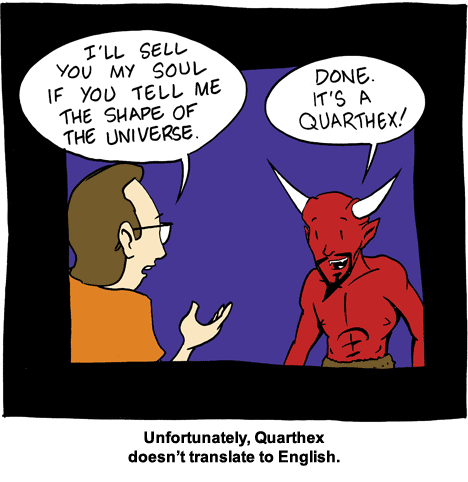
The TL;DR version here is that the mass is more or less resistance that comes from moving through the Higgs field all the time always.  In a kinda-sorta way, but it's closer.  Still don't get it?  OK, it's time to talk about the shape of the Universe.

Fortunately, Quarthex does translate to math, and souls don't exist.

It's been said that the Universe is "saddle-shaped."  Like if you took a square sheet of paper, and folded one set of opposite corners up, and the other set down.  Like so:

See?  Like a saddle on a fucked up horse!  (Is it weird that
I draw the shape of the Universe better than a horsey?)

Except - and here's the kicker - instead of starting with a flat thing and curving it around, you start with a tiny curled-up thing and blow it up so big it just looks flat.  Bam!  Now I bet you'll have a better understanding of this article, and this key image:

All of those circles, at every point of everywhere, are one other dimension.

All the "extra" dimensions are like that:  tiny and curled up, but existing at every point in spacetime.  Incidentally, this is also why I have never ever made fun of anyone for proposing that time is circular - because, son of a bitch, it's actually kinda-sorta plausible.  Now do that over and over until you get all the dimensions, and bam!  There you have it.  Is the Lorentz factor making a little more sense now?

Tuesday, July 10, 2012

Elvis Has Left the Building: Update on our cosmic voyage

I read the other day that Voyager I has left our solar system, so I decided to look into what exactly that means.  What exactly are the borders of our neighborhood?  I mean, when we're talking about cosmic distances, the sheer magnitudes we're dealing with make hard lines really tough to draw.  This is compounded by the fact that our space probes move at ponderously slow speeds (astronomically speaking).  However, cosmic weather gives us some convenient rough-and-ready figures.  So first, a little background on the structure of the solar system, and then I'll tie it back to the Voyager mission.

Earth, technically, is in space.  What makes us consider something as "on Earth" but not in space is being within Earth's atmosphere, though I suppose you might consider the magnetosphere or our moon as a boundary, and that's not entirely unreasonable.  But just like Earth has an atmosphere and a magnetosphere, so our star also has a local "sphere of influence" that separates it somewhat from the galaxy at large.  This is called the heliosphere, and while the boundaries are fundamentally fuzzy, it gives us something useful to work with.  What makes the heliosphere "be what it is" is solar wind, charged particles emanating from the Sun.  As the Sun rotates, these emanations twist and ripple in a rad-looking sheet that looks kinda like this:

It's like a cosmic bathtub drain, but in reverse.

Saturday, July 7, 2012

Loose Ends in Philosophology: The Multiple Realizability of Water

Robert Pirsig coined the term "philosophology" to describe the strange habit philosophy departments have of teaching philosophical history without teaching philosophical method - teaching "what it's been," in other words, without teaching "how to do it."  Many people don't see a difference, but it's as big as the difference between learning music theory from a book and composing your own actual music (again, Pirsig's example).

When I went back to school, some of the "problems" in the history of philosophy struck me as insulting - not because they were stupid questions (they were excellent questions at the time), but because apparently philosophers hadn't been keeping on top of their science in the intervening centuries.  So at least a couple of my papers were dedicated to actually settling these so-called "unanswerable" questions.  This one is dedicated to John Locke's question about multiple realizability - what if what we think of as one thing, and treat as one thing, is actually many different things that merely appear the same to our senses?  In one way, this makes no sense when you're up on your science - but in another equally important way, it's actually the case.

(All citations refer to the 1975 edition of Locke's An Essay concerning Human Understanding, edited by Peter H. Nidditch.)

John Locke defines the meaning of a word as its associated ideas, a superficially innocuous definition which becomes problematic in the details.  Because ideas are conscious states, we cannot define our terms with the unseen corpuscular structures that inform these conscious states, but must instead resort to the conscious states themselves, using words as symbols for them.  However, as there is always more than one way to skin a cat, this may lead us to the apparently absurd conclusion that more than one corpuscular structure could lead to the same set of ideas, and so we may be forced on this analysis to call two things with distinct real essences by the same word.  A more thorough analysis of this kind, with some understanding of modern physics and chemistry, dissolves the problem:  while Locke could not have known quite how, we are in fact able to escape the absurdity while still endorsing a Lockean conception of meaning and essences.

Thursday, July 5, 2012

Teetotal? Best avoid brand name colas!

"According to tests carried out by the Paris-based National Institute of Consumption (INC) more than half of leading colas contain the traces of alcohol."

What.

See, I used to think that cola only got alcoholic when I put rum or whiskey into it.  Guess I was wrong!  So now that we know that there's alcohol in it, the next question is naturally:  how much do I have to drink to get drunk?

Tuesday, July 3, 2012

The Higgs Boson!

Two electrons are sitting opposite each other at a lunch table.  A third electron walks up with its lunch on a tray and asks, "Can I sit with you?"  To which one electron replies, "What do you think we are, bosons?"

Electrons are fermions, and only one fermion can occupy a quantum state at a time - unless some other property is different (like spin, represented in the joke as the opposite sides of the table).  This is why you can only have two electrons in an orbit around an atomic nucleus.  Bosons operate under no such restrictions, which makes the joke funny, if you already know all of that.  If not, well, analyzing humor is like dissecting a frog:  few are interested, and the frog dies of it.

Friday, June 29, 2012

We can burn brighter than the Sun!

One of my high school history teachers was fond of quoting Mark Twain as saying, "There are lies, there are damned lies, and then there are statistics."  But Clemens attributed it to Benjamin Disraeli - which also turns out to have been wrong (in all likelihood).  It just goes to show, you can't always trust a citation.

Seems legit.

Wednesday, May 19, 2010

The Wrongest of Wrongnesses in the History of Wrongitude

Editor's Note: Do I count as my own editor? I mean, I edit my own stuff, but... nevermind. Look. My last post was a little vapid, pontificating as I was on an overnight webcomic kerfuffle that ended up being wiped off the face of the internet anyhow. I feel kinda bad about it. So I'm breaking my "weekends-only" rule to say something of a little more substance. This is also the third post in recent memory where I have used the word "kerfuffle" for lack of a better term. Should I consult a doctor? Or just a thesaurus?

I recently read on Pharyngula about a paper by Doug Theobald (subscription to Nature required) calculating the likelihood that the proteins shared by all organisms on the face of the planet came to be shared by a concatenation of events besides common descent. In other words, regardless of the likelihood that life came to be in this or that particular way (which Creatards frequently yammer on about, assuming evolutionary teleology and all sorts of other bullshit), what are the odds that life came to be, as it in fact did, by other means than common descent?

PZ's summary and the news coverage make for fascinating reading - really, you should check it out - but I'm going to jump right to the number at the end and play around with it. That number is 1:102,680 against. So, sure, the common proteins shared by all modern organisms could have come about by some other means than common descent, but the odds are real fuckin' long against it. How long? So long. Like, it's hard to think of a way to be wronger, mathematically speaking - these guys are wronger than anyone has ever been wrong in the history of wrongitude (sounds like "longitude").

I have a phrase I use to describe "as sure as I get," and that is, "As sure as I am that the Sun's coming up tomorrow." This is meant to convey pretty fuckin' sure but not quite 100% certain (because I'm not 100% certain of anything, other than the fact that I am now having some kind of experience, and that I've always got room for doubt). Sure, something could happen so that the Sun doesn't rise tomorrow, but the data so far suggest extremely otherwise. Just how much otherwise? Well, let's take every day in Earth's 4.54-billion-year history as a data point.*
4,540,000,000 x 365.25 = 1,658,235,000,000
(1.66 trillion, or 1.66 x 10¹²)
Hmm... that leaves us a shit-pot of orders of magnitude to make up. But yeah, it's settled: we're surer of common descent than we are that the Sun will rise tomorrow!

"But wait," comes the Creatard rebuttal, "You can't just count the days up like that, you have to take into account how many of us there are! After all, a large enough number of rabid IDiots can't be wrong!" Well, OK. It doesn't work that way, but we'll humor you. Let's just say that all 6.8-billion of us are Christians, and we have been since the Earth was formed. Not only is this over-generous to the literalists in giving them the actual age of the Earth rather than their Reader's Digest Condensed Books version, giving them all of the current population throughout all of Earth's history, and giving a decidedly democratic bent to our epistemology, it doesn't even come close.
(1.66 x 1012) x (6.8 x 109) = 1.13 x 10²²
"But... but... twenty-two isn't nearly close enough to two-thousand-six-hundred-eighty," replies the anti-science crusader. "And I believe that your numbers are wrong with every fiber of my being." You know what? That's still not good enough. I'll give you a data point for every nucleotide base pair inside of every single cell of every person now living on the planet for every day throughout all of Earth's history - and you know what that nets us? Take a look:
(3.1647 x 10⁹ base pairs) x (1 x 10¹⁴ cells) x (1.13 x 10²²) = 3.58 x 1045
Fuck! That's still not enough! OK, but what if every atom in the observable universe, itself a number beyond ordinary human comprehension, spawned a Universe with a special Earth with seven billion humans believing in Creation with every fiber of their being? Yeah, what then?! This is what:
(1.5 x 1082 atoms in the observable Universe) x (3.58 x 1045) = 5.37 x 10127
Just to recap, we've given a data point in favor of the Sun rising tomorrow for each of 3-billion-odd nucleotide base pairs inside of all hundred trillion cells in the bodies of six to seven billion people observing a sunrise for every single day (including leap years!) across Earth's four-and-a-half billion year history, repeated for every atom in the observable Universe. And given all of that, we're still surer that all life is related by common descent than we are that the Sun will rise tomorrow.

Suck on those numbers! Tomorrow's a dark day for creationism, epistemologically speaking. Yeah, I'd say the future prospects for monotheistic creation myths are looking pretty dim. We should just turn the light out on intelligent design, and leave the real science to light our path into the future.

OK, I'm done now, for real. Man, playing around with degrees of certainty is fun!

* - Yes, OK, to calculate the actual odds of the Sun not coming up tomorrow, I would have to calculate the odds of something happening which would prevent the Sun coming up. Fine. Not the point, and that's why this entry gets the "humor" tag. I'm just going to treat it as a chance event and assume the Sun doesn't rise tomorrow, making it 1 failure out of 1.6 trillion successes. I need to keep this back-of-the-envelope compatible, after all.

Monday, April 5, 2010

Epistemology and Spiders: This is how it should be done

OK, so assessing and revising the contents and standards of one's knowledge has nothing to do with Mindless Self-Indulgence - if anything, it's mindful self-restraint. But one of my recent forays into the world of Science Blogs handed me a case-in-point so neat and pat that I just had to share.

A bit of background: there's this wonderful little program called Before the Dinosaurs: Walking with Monsters (buy!) which goes through the history of life from Anomalocaris to Lystrosaurus. It's just awesome, and you should watch it. One of my favorite parts of that program was the puppy-sized spider, mesothelae, which lived at a time of eagle-sized dragonflies because the atmosphere was so oxygen-rich that giant bugs could get away with enormous bodies and simple respiratory apparatus.

Now, I love spiders. I really do. They're nature's ninjas, out-ninjered only by certain species of squid and octopus (ninjas of the sea). So a spider the size of a small dog is, like, my new favorite fantasy pet. Excluding giant spider-steed, of course (what it loses in ninjery, it more than gains in bad-assitude). OK, now we're good. My point is that I was very fucking excited to hear about this mesothelae, so excited that I went around telling people about it for weeks.

Fast-forward to last week, and I see this Laelaps headline link while catching up on Pharyngula: Megarachne, the Giant Spider That Wasn't. My first thought: "Ooh, spiders!" Second thought: "Aww, fake spiders?" So I click through and read the whole thing, and as it turns out, Before the Dinosaurs was originally slated to include megarachne, but during production it was discovered that the giant spider wasn't a giant spider, but a sea scorpion. Well, shit on toast! But the show must go on, and so the BBC just re-cast mesothelae in the role that megarachne had been written to play and fudged a couple details (bah, details!).

If you're like me, then right about now you've got to have a tangled web in your head involving sense, reference, justification, and a couple theories of truth, all wrapped up in a package labeled, "D's beliefs about carboniferous arthropods". OK, now that I put it that way, you're probably not like me. But that's what was going through my head as I processed this article. Of course, sorting out that Gordian knot would be like trying to diagram one of Nathaniel Hawthorne's third-of-a-page sentences, so I took the Alexandrian solution:

"Huh. Looks like I was wrong."

Because at the end of the day, it doesn't really matter that a bleeding-edge breakthrough in paleobiology took a backseat to a deadline, it doesn't really matter that there was still a kernel of truth in it, it doesn't really matter how much I love the idea of giant spiders, and it doesn't really matter exactly what labels or confidence levels I had for this or that bit of belief. What matters is that I became aware of one instance wherein my picture of the world failed to match up with the best our investigations have to offer. So I fixed it, The End. As Carl Sagan wrote,
Science thrives on errors, cutting them away one by one. False conclusions are drawn all the time, but they are drawn tentatively. Hypotheses are framed so they are capable of being disproved. A succession of alternative hypotheses is confronted by experiment and observation. Science gropes and staggers toward improved understanding. Proprietary feelings are of course offended when a scientific hypothesis is disproved, but such disproofs are recognized as central to the scientific enterprise.
(The Demon-Haunted World, page 20)
So I was reading about this Jesus fellow the other day... or was it Krishna? Or Mithras? Wait, Horus! Or maybe even Moses... look, you see where this is going.