Update Schedule

This blog updates irregularly.
Showing posts with label physics. Show all posts

Wednesday, September 11, 2013

Information, Entropy, and the End of the Universe

One of the first readings for my survey class was a review of James Gleick's The Information:  A History, a Theory, a Flood.  It's a fun read and I highly recommend it, touching as it does on a lot of the main points in the history of information theory, putting everything from Claude Shannon to Wikipedia into context.  What's more, it does what any good book review ought to do:  it makes me want to read the book.

But then the reviewer went and said a dumb thing:
The explosive growth of information in our human society is a part of the slower growth of ordered structures in the evolution of life as a whole.  Life has for billions of years been evolving with organisms and ecosystems embodying increasing amounts of information.  The evolution of life is a part of the evolution of the universe, which also evolves with increasing amounts of information embodied in ordered structures, galaxies and stars and planetary systems.  In the living and the nonliving world, we see a growth of order, starting from the featureless and uniform gas of the early universe and producing the magnificent diversity of weird objects that we see in the sky and in the rain forest.  Everywhere around us, wherever we look, we see evidence of increasing order and increasing information.  The technology arising from Shannon's discoveries is only a local acceleration of the natural growth of information.
There are a few things wrong with this.

Friday, April 5, 2013

Random things and stuff!

My new computer, which wasn't "supposed" to show up until the 16th, actually got delivered today.  Hooray!  But now I'm moving everything over, which is gonna take for-god-damned-ever.  It's easy, thanks to the aptly named Easy Transfer, which more or less amounts to a magic spell:  I wave my hands around and say, "You!  New 'puter!  Be just like my old 'puter!  Go!"  But Christ on a bike, this spell has a long-ass casting time!  I'm gonna be watching the progress on my sweet fuckin' 23" monitor until the wee hours, and until then I'm instructed, "Do not use this computer during the transfer."  Huh.  I sure hope blogging and blasting mp3s doesn't count as "using this computer."  :\

Anyway, I'm not up to any super-creative writing.  I'd meant to write another vignette for Tooth & Claw, I have it all planned out (more or less), but I just can't stop wanting my new 'puter to be ready.  So here are a few neat tidbits with no central organization.  First, scientists are hard at work decoding the visual experience of dreams from brain scans.  Here's a link to one article, focusing mainly on Japanese research.  And here's another one from Gizmodo, focusing mainly on what's been done at UC Berkeley (with video!).  An important note is that the constructed video is not a reading of the visual cortex, but actually a composite constructed from pre-existing video clips.  I caught the headline over lunch in USA Today (I think).  Those articles above are just what I was able to dig up in two minutes, but I have some more to say below the cut.

Second, here is a cool little infographic submitted to me by Allison on the visual IQ of Americans, showing how well (or poorly) we can identify certain people, symbols, and geographic regions on sight.

I was able to identify Boehner purely based on hatred of him as a person,
pick out the Euro, the Star of David, and the Twitter logo.  That... was it.

Third, Amina Tyler recently went missing after posting topless photos of herself on the internet in order to show that her body was hers to do with as she chooses.  The going speculation seems to be that her family kidnapped her, in direct contravention to Tyler's thesis, out of some bass-ackward idea of honor where "tits is bad" and it's somehow less embarrassing to abduct a member of your family than to let her do her own fuckin' thing.  Because Tyler's disappearance is probably going to be tragic, but it might not necessarily be just yet, (NSFW photos!) FEMEN recently organized a load of topless protests at a bunch of European mosques in order to say, "You think photos on the internet are bad?  Wait'll you see this all up in your fuckin' streets!"  OK, I was paraphrasing there, but here is an actual quote:  "We're free, we're naked, it's our right, it's our body, it's our rules, and nobody can use religion, and some other holy things, to abuse women, to oppress them... And we'll fight against them, and our boobs will be stronger than their stones."

Actions such as this were described as "evacuating" protesters.  Boy, those men
with truncheons sure evacuated the living daylights out of those half-naked protesters.

Fourth, some scientists seem to believe that they're on the cusp of experimentally confirming the existence of dark matter, which would quite frankly be rad as Hell.  What gives me pause for thought, however, is that they're looking at positrons in space - and positrons are antimatter.  The difference, briefly, is that antimatter is normal matter with its polarity reversed (protons become antiprotons, same mass but opposite charge; electrons become antielectrons or positrons, same mass but opposite charge).  We use antimatter in routine medical procedures - the "PET" in PET scan stands for "positron emission tomography."  Dark matter, on the other hand, is simply stuff that has mass and takes up space, but "doesn't shine" in the way that everything else in the Universe does - it's there, it exerts gravitational forces upon whatever's around, but we just can't detect it since it's not shiny like "normal" matter.  However, this positron/dark matter connection gives me faint and tenuous hope that Douglas' exclamation that dark matter (rather than antimatter) cancels out regular matter is actually oddly prophetic rather than a stupid fuckin' typo on my part.  Whatever, I'll probably change it anyway because I also have a few other infelicities to remedy for the next edition.  They're the scientists, I'll trust 'em until I hear better.  :)

OK, by way of wrapping up, here are some of my thoughts on the decoding of the visual elements of dreams.

Thursday, November 8, 2012

101 Interesting Things, part fifty: Time travel, for real!

OK, so you've heard of vacuum fluctuation, right?  A particle and antiparticle are spontaneously generated, and most of the time, they come back together and annihilate.  When that happens, they haven't interacted with anything else, and so they're called "virtual" particles.  But because both the particle and its antiparticle appear, nothing "actually" happens; it's just an interesting nothing.

Now that I put it like that, I suppose it seems really weird if you're uninitiated.  But hold on to your butts - it's about to get a whole lot weirder.  First, though, we need to talk about symmetry.  I promise, though:  by the time we get to the end of this, minds will be blown.

Friday, July 20, 2012

Follow-up Quickies: Bosons and ninjas!

OK, so my last post was kind of bullshit.  Here are a couple other interesting things to jam between yesterday and tomorrow.

National Geographic tackles Ninjutsu, hiring Glen Levy to put his skills to the test.  Please try to ignore his introductory banter; it pains me to listen to it, and I can all but guarantee that he was somehow contractually obligated to say that "journey to your own destruction" crap.  Pay attention to the bit on the vagus nerve, though, and check out the force he's able to deliver with a single punch:

That dummy needs shorts 'cuz it can't decide

In case you skipped it, I'll give you the TL;DR version:  this man is able to punch with the force of a shotgun.  No joke.  OK, it's a police shotgun firing a rubber bullet, but still.  You'd be hard-pressed to hit that hard with a baseball bat.  Yes, you.  Yes, baseball bat.  Glen Levy hits harder.

As for bosons, there was a reason I didn't trot out any of the goofy analogies that other writers have given for the Higgs field:  they don't explain where the mass comes from.  Passing through a sheet of molasses, and the molasses sticks to you?  Fine, but why is the molasses massive?  Walking through a crowded room and all your fans flock to you?  Fine, but why are the groupies massive?  Minute Physics to the rescue:

Physics in a minute.  Fifty-eight videos.  You could watch all his
stuff in an hour, and experience at least six flavors of enlightenment.

The TL;DR version here is that the mass is more or less resistance that comes from moving through the Higgs field all the time always.  In a kinda-sorta way, but it's closer.  Still don't get it?  OK, it's time to talk about the shape of the Universe.

Fortunately, Quarthex does translate to math, and souls don't exist.

It's been said that the Universe is "saddle-shaped."  Like if you took a square sheet of paper, and folded one set of opposite corners up, and the other set down.  Like so:

See?  Like a saddle on a fucked up horse!  (Is it weird that
I draw the shape of the Universe better than a horsey?)

Except - and here's the kicker - instead of starting with a flat thing and curving it around, you start with a tiny curled-up thing and blow it up so big it just looks flat.  Bam!  Now I bet you'll have a better understanding of this article, and this key image:

All of those circles, at every point of everywhere, are one other dimension.

All the "extra" dimensions are like that:  tiny and curled up, but existing at every point in spacetime.  Incidentally, this is also why I have never ever made fun of anyone for proposing that time is circular - because, son of a bitch, it's actually kinda-sorta plausible.  Now do that over and over until you get all the dimensions, and bam!  There you have it.  Is the Lorentz factor making a little more sense now?

Tuesday, July 10, 2012

Elvis Has Left the Building: Update on our cosmic voyage

I read the other day that Voyager I has left our solar system, so I decided to look into what exactly that means.  What exactly are the borders of our neighborhood?  I mean, when we're talking about cosmic distances, the sheer magnitudes we're dealing with make hard lines really tough to draw.  This is compounded by the fact that our space probes move at ponderously slow speeds (astronomically speaking).  However, cosmic weather gives us some convenient rough-and-ready figures.  So first, a little background on the structure of the solar system, and then I'll tie it back to the Voyager mission.

Earth, technically, is in space.  What makes us consider something as "on Earth" but not in space is being within Earth's atmosphere, though I suppose you might consider the magnetosphere or our moon as a boundary, and that's not entirely unreasonable.  But just like Earth has an atmosphere and a magnetosphere, so our star also has a local "sphere of influence" that separates it somewhat from the galaxy at large.  This is called the heliosphere, and while the boundaries are fundamentally fuzzy, it gives us something useful to work with.  What makes the heliosphere "be what it is" is solar wind, charged particles emanating from the Sun.  As the Sun rotates, these emanations twist and ripple in a rad-looking sheet that looks kinda like this:

It's like a cosmic bathtub drain, but in reverse.

Saturday, July 7, 2012

Loose Ends in Philosophology: The Multiple Realizability of Water

Robert Pirsig coined the term "philosophology" to describe the strange habit philosophy departments have of teaching philosophical history without teaching philosophical method - teaching "what it's been," in other words, without teaching "how to do it."  Many people don't see a difference, but it's as big as the difference between learning music theory from a book and composing your own actual music (again, Pirsig's example).

When I went back to school, some of the "problems" in the history of philosophy struck me as insulting - not because they were stupid questions (they were excellent questions at the time), but because apparently philosophers hadn't been keeping on top of their science in the intervening centuries.  So at least a couple of my papers were dedicated to actually settling these so-called "unanswerable" questions.  This one is dedicated to John Locke's question about multiple realizability - what if what we think of as one thing, and treat as one thing, is actually many different things that merely appear the same to our senses?  In one way, this makes no sense when you're up on your science - but in another equally important way, it's actually the case.

(All citations refer to the 1975 edition of Locke's An Essay concerning Human Understanding, edited by Peter H. Nidditch.)

John Locke defines the meaning of a word as its associated ideas, a superficially innocuous definition which becomes problematic in the details.  Because ideas are conscious states, we cannot define our terms with the unseen corpuscular structures that inform these conscious states, but must instead resort to the conscious states themselves, using words as symbols for them.  However, as there is always more than one way to skin a cat, this may lead us to the apparently absurd conclusion that more than one corpuscular structure could lead to the same set of ideas, and so we may be forced on this analysis to call two things with distinct real essences by the same word.  A more thorough analysis of this kind, with some understanding of modern physics and chemistry, dissolves the problem:  while Locke could not have known quite how, we are in fact able to escape the absurdity while still endorsing a Lockean conception of meaning and essences.

Tuesday, July 3, 2012

The Higgs Boson!

Two electrons are sitting opposite each other at a lunch table.  A third electron walks up with its lunch on a tray and asks, "Can I sit with you?"  To which one electron replies, "What do you think we are, bosons?"

Electrons are fermions, and only one fermion can occupy a quantum state at a time - unless some other property is different (like spin, represented in the joke as the opposite sides of the table).  This is why you can only have two electrons in an orbit around an atomic nucleus.  Bosons operate under no such restrictions, which makes the joke funny, if you already know all of that.  If not, well, analyzing humor is like dissecting a frog:  few are interested, and the frog dies of it.

Sunday, July 1, 2012

101 Interesting Things, part forty-six: Overtones

Enough of blood.  I mean, I'll probably wrap it up at some point, since the immune system is just so cool.  But enough of blood for now, I want to talk about other things.

So those Pentatonix guys I linked last time, that guy at (your) lower-right?  His name is Avi Kaplan, and he can do something called "overtone singing," and I can almost guarantee that you know what it sounds like even if you don't know what it's called.  Here he is:
See?  You know that sound, right?

Friday, June 29, 2012

We can burn brighter than the Sun!

One of my high school history teachers was fond of quoting Mark Twain as saying, "There are lies, there are damned lies, and then there are statistics."  But Clemens attributed it to Benjamin Disraeli - which also turns out to have been wrong (in all likelihood).  It just goes to show, you can't always trust a citation.

Seems legit.

Tuesday, July 20, 2010

101 Interesting Things, part forty-four: The Death Star Galaxy

The Death Star Galaxy is easy to remember in two different ways: first, it's called the Death Star Galaxy, and second, its designation is 3C 321. The mnemonics practically write themselves!

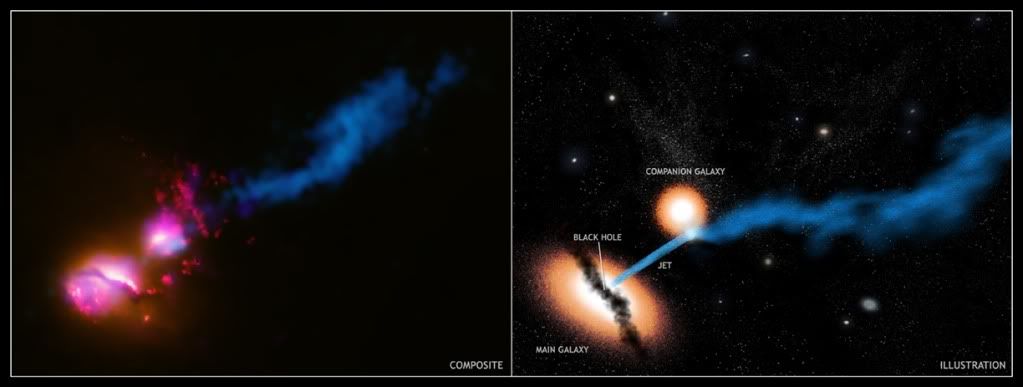
OK, so what's so crazy about formation 3C 321, and what makes it deserving of the title "Death Star Galaxy"? Well, for starters, the supermassive black hole at the center of this galaxy is blasting apart a nearby orbiting galaxy. Here's an artist's conception, so you can see the sort of thing we're talking about:
Just so we're clear, here's a breakdown of the situation. There's a supermassive black hole at the center of a galaxy, but no ordinary supermassive black hole: this one is emitting a jet of incredibly intense EM radiation. How intense? Intense enough to move stars. While jet emissions from black holes and other stellar formations are not rare, what is rare is to see one firing point-blank into a nearby celestial formation. Like, these galaxies are only about as far from each other as we are from the center of the Milky Way.

Heroes in lab coats are still trying to figure out what exactly causes these kinds of jets - I suspect the right hand rule, but the Devil's in the details. One strong possibility, though, is that the very process of blasting apart the neighboring galaxy will cause it to be re-formed around the area where the jet peters out. That is, assuming that the galaxies don't collide first. Dammit, why can't I live for billions of years so I can watch this sort of scene play out?

Here's a really cool animation showing how this plays out and giving a sense of scale to the operation: it starts by the event horizon of the supermassive black hole, then zooms out until you can see the whole scene. Check it out!

Tuesday, October 20, 2009

Look Out, Nonsense: Here Comes Science!

They Might Be Giants really took a page from the theists' playbook with their latest album, Here Comes Science: hook 'em while they're young (the Jesuits were famous for saying, "Give us the child for his first seven years, and we will show you the man"). I've been listening to Here Comes Science more or less every day since I got it. I know, I know, it's supposed to be children's educational music. But I like it! And it's a breath of fresh air! And it's a big "fuck you" to a whole bunch of superstitious nonsense without even making a big deal out of it! OK, it probably wasn't meant as a "fuck you," but still, that interpretation is available for almost every song (well, sixteen of the seventeen "real" songs, anyway). Here, watch:

1. Science Is Real: The message is clear in this song: "Science is real, your superstitious crap is imaginary." And people complain about this, which is awesome.
2. Meet the Elements: This one's kind of a stretch, but a belligerent interpretation is available. I imagine this song undermining homeopaths and other such hokum. Everything we think of as an "object" is made out of elements: nutrients are elements, medicines are elements, poisons are made out of elements, pizza places are made out of elements. It's all chemicals, and "chemicals is just chemicals." Keep in mind here that there are people who seriously believe that there is a difference between the ascorbic acid you find in an orange and the ascorbic acid you find in a vitamin C tablet (pro tip: there is no such difference, because ascorbic acid is ascorbic acid no matter where you get it from).
3. I Am a Paleontologist: One line: "It's so fun to think about how a species has evolved." Field scientists are the rock stars of their respective fields of inquiry, because they're out in the (sometimes literal) trenches looking at the world, and showing that to kids will help prepare them to laugh off Creatards & IDiots who don't know just how awesome a dig really is. Or all the science behind it, and all the science that goes into analyzing and interpreting whatever is found. For further reading, see Ardi's recent news spotlight on Easy Mode or Hard Mode, as well as PZ's coverage of the media circus to see the landmark discovery ignorantly dismissed as trivial, and abused to support homophobia.
4. The Bloodmobile: (Right song, but couldn't find the actual video.) Blood is life, which at least one holy book can tell you, but no holy book can tell you why. This song explains why. Oh, and all that crap you hear about "toxins" and whatever? Yep, that's what your blood is for. No pseudoscientific woo required, your body already takes care of it!
5. Electric Car: I love this song because it's unapologetic propaganda for electric cars. Y'know, to counterbalance all the anti-electric-car propaganda... right, guys? But you see, the USA makes guns which it sells to certain oil-rich nations (as Pat Condell put it, "It would be hard to think of a more oily place than Saudi Arabia"), and things like electric cars are inimical to such profitable business relationships. Y'know, now that I'm actually writing this, I can't say that this one is anti-superstition, but it is counter-anti-scientific progress, so I don't care.
6. My Brother the Ape: (Live performance.) All the world is kin, the end. We are not only related to apes, we are apes. Naked, brainy, hifalutin apes; but apes nonetheless. The best part: "They all kept saying how much we look alike. I don't think that we look alike at all, but I'll admit that I look more like a chimp than I look like my cousin the shrimp, or my distant kin the lichen, or the snowy egret, or the moss." Tru fax - the very truest.
7. What Is a Shooting Star?: (Live performance.) Oh, man! I'm excited about this one! See, there's this building called the Kaaba, the most sacred site in Islam. It's so fucking holy, it's why Muslims face Mecca to pray, no matter where in the world they are. So what's so goddamned special about it? Its eastern cornerstone is a black stone, which according to legend is a "piece of Heaven" that fell to Earth, showing Adam and Eve where to build the first shrine. Piece of Heaven? Fell to Earth? Sounds like a meteorite to me, or the firmament is falling! But Hell, it might just be obsidian or pumice instead - we haven't exactly been able to do any proper science to it, for stupid, stupid reasons.
8. How Many Planets?: One of the great things about science is that it is self-correcting (ideally). Rather than claiming absolute authority forever, scientists instead make provisional claims about what they can test and show. So when the IAU revised just what it means by the word "planet" back in 2006, they realized that they'd have to either cut out Pluto, or welcome in a bunch of other stuff, or engage in some rather egregious special-pleading shenanigans. Well, they picked option one, to the outrage of third-graders and small-minded adult-type persons alike. This song shows that reality is fuckin' complicated, and that planets aren't people and thus can't get their feelings hurt.
9. Why Does the Sun Shine?: This is just a groovy song. It also shows that the Sun is not a god, it's a naturally-occurring object just like any other star. The Universe has a few of them about, you see. One more metaphysical explanation supplanted by science!
10. Why Does the Sun Really Shine?: ...And one more scientific explanation revised by better science! Like How Many Planets?, Why Does the Sun Really Shine? shows explicitly that science is self-correcting: "The Sun is a miasma of incandescent plasma, the Sun's not simply made out of gas. The Sun is a quagmire, it's not made of fire, forget what you've been told in the past." Because, you see, we have something better now.
11. Roy G. Biv: Rainbows occur as a necessary consequence of the properties of light and water vapor in the air (such as after a rainfall). Rainbows are absolutely not the sign of a covenant between God and humanity to not blow up the world again because some people stick it in the naughty place. Besides, we see how well God's plan to wipe out evil forever has worked... over and over and over again. What a fuck-up.
12. Put It to the Test: When I'm away from my computer at work, the screen flashes with my favorite line from this song: "Find a way to show what would happen if you were incorrect; a fact is just a fantasy, unless it can be checked." I can't install electric sheep at the office, you see, so I put up something else that makes me smile instead. But yeah, falsifiability is important - I recently raised this point with cl, the idea being that a god who cannot be detected is epistemologically indistinct from a god who does not exist.
13. Photosynthesis: (No video available.) This one is pretty obvious. "Photosynthesis is why plants need light, and photosynthesis is why humans need plants, because through photosynthesis plants make oxygen, and humans need oxygen to breathe." But you see, there are some tool-bags who believe (as this person evidently once did) that it doesn't matter what we do to the planet because Jesus is returning soon, or even that the environment's decline is a sign of his impending arrival! ("So many incidents and elements that indicate the end of times have been taking place. First sign is the depletion of our natural resources...") Yeah, so... 'nuff said. Nutters.
14. Cells: (No video available.) Life, which includes people, is made out of cells. Not dirt, or clay, or mud, or spit, or ribs, or anything else that could be sculpted by an intelligent and magical creator. Just cells.
15. Speed and Velocity: Surprise, kids! Some words which are used interchangeably in common parlance have specific meanings in scientific contexts! It's an amazing fact, I know, but as it turns out, we sometimes need to watch our mouths when discussing matters if we wish to speak of facts and not bullshit. Because, y'know, words have meaning & all that jazz.
16. Computer Assisted Design: "See how you get from a thought to an object." It's not "God said 'Let there be light,' and lo, there was light." It's more like, "And humanity said, 'Let there be stuff,' and lo, with the aid of machines, there was stuff." No magic required!
17. Solid Liquid Gas: (No video available.) Yeah, so I spent this whole time trying to think of how the three (most commonly encountered) states of matter is anything in the face of superstitious nonsense. I got nothin'. Not even a stretch. Anyway, I hope you enjoyed what videos there are, and you should go check out the album, it comes with a DVD with all the videos that you can watch at your leisure under the intoxicant of your choice!

Monday, October 12, 2009

101 Interesting Things, part twenty-six: "Off switch? What off switch?"

Many thanks to Ebonmuse for pointing me at this neat little tidbit on how the LHC is turned off, which neither he (nor I, for that matter!) had considered to be a significant problem. My mother used to work at Fermilab (she did paperwork for the fire department, not physics), so atom smashers were part of growing up for me and I have no excuse. But then again, even the small amount of physics research that I did was theoretical, so "turning things off" has never been more complicated for me than exiting a program. As it turns out, this particular experimental apparatus is a bit more difficult to shut down.

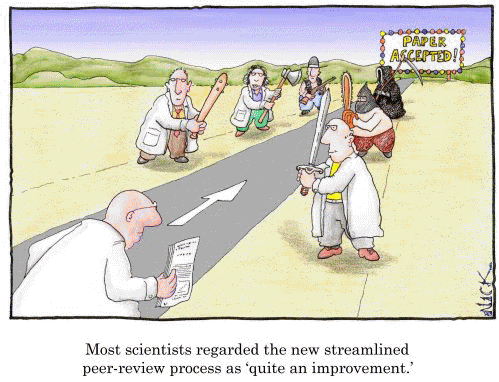
For those who aren't savvy, particle accelerators work by more or less swinging tiny bits of mass around in a circle and smacking them into each other at near-light speed so that we can see what happens. With a little bit of know-how and a whole lot of math, superheroes called "physicists" then decipher the results in research papers which must then withstand peer review. If you think that the superheroic designation is at all hyperbolic, then you clearly don't understand just how grueling peer review is.

For a little bit of perspective, there's enough energy at work in the LHC's twin beams to melt about a ton of copper. That's not a very rough estimate: "According to CERN LHC accelerator physicist Rüdiger Schmidt, who is in charge of machine protection systems, each unimpeded beam [of which there are two - D] is capable of melting a 500-kilogram block of copper." An exposure to such a beam just eighty-six millionths of a second long will bore a hole forty meters into a block of solid copper! So how do they stop it from doing just that?

Carbon, that's how.

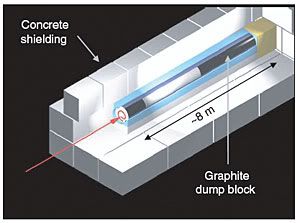
After colliding for a while, the particle beams are shunted off into a straight 700-meter "runway" where they are spread out to be more like shotgun fire and less like machine-gun fire (the beam is magnetically widened from .2mm to 1.5mm). Then they're scanned like a CRT image onto a ten-ton graphite cylinder (or "dump") 8m long and .7m wide, housed in a thousand tons of concrete. These guys seriously aren't fucking around:
The upside is that this system is completely reusable. Though the beams need to be refreshed from time to time (increased usage makes them unstable), the dump cools off in a couple of hours and only needs to be used once every ten hours (which is how often the proton beams are purged per failsafe protocols). Without diffusing the beam or scanning it onto the dump, however, direct exposure would melt the graphite as well.

Bottom line: physics is hot.

Saturday, August 29, 2009

101 Interesting Things, part twenty-two: The Coastline Paradox

So I've been in e-mail contact with island, who commented on my second Abusive Cosmology post. I had previously known that Earth is a rare specimen, but I have since gained a much greater appreciation for just how rare our circumstances are here on this pale blue dot.

Earth occupies what is known as a "Goldilocks Zone," a whimsical yet apt term which amounts to walking a knife-edge between competing runaway forces. Uninhabitable extremes characterize the overwhelming majority of the Universe and prevent life from cropping up almost everywhere. However, these opposed runaway forces of extreme heat and cold, crushing gravity and hungry vacuum, as well as others, occasionally strike a balance between them that makes it possible for life as we know it to arise and thrive.

Now, we can imagine Goldilocks Zones for any phenomenon we'd care to dream up, be it life, molten metal, solar flares, factories, or whatever. The simple fact of the matter is that there are just about always more ways for any given thing to not exist than there are ways for it to exist. What's interesting is that these Goldilocks Zones have relevant features at all levels of reality. In terms of life, there is a Goldilocks Zone between Earth's mantle and its ionosphere into which all life has shoe-horned itself. Locally, every organism has its niche, and there are plenty of places on the planet where any organism you'd care to name simply could not survive: no species can survive absolutely anywhere on Earth.

Earth itself is in a Goldilocks Zone relative to our star, Sol: too close and we burn, too far and we freeze. Our solar system itself is a roll of the die that came up "life-friendly," with gas giants sweeping up the riff-raff of cosmic debris (which would otherwise pelt every small rocky world into oblivion), and without so much eccentricity in their orbits as to screw with the inner rocky planets. And the position we occupy in the galaxy is far enough out from the gene-scrambling radiation of the galactic core, but not so far out as to lack the heavier elements needed for more complex life. With respect to time, life cannot come about during the initial or final phases of a planet, star, galaxy, or Universe (at least, not a Universe that starts with a Big Bang and ends with either a Big Crunch or heat death). And with respect to physical laws, they have to be such a way as to allow life to be possible anywhere at all (though whether they could be otherwise is at present an open question).

This preponderance of interesting features reminds me of the Coastline Paradox, which refers to the difficulty of determining the "exact" perimeter of a coastline. You see, coastlines have relevant features at all levels of detail, and these change on all timescales. From biggest to smallest, coastlines have features observable from space that change in geologic time, and features on the more human-appropriate scale of meters that change daily with the tides, and features on the atomic scale that change rapidly all along the progression and recession of every single wave.

So what's the "true" length of a coastline? Ain't none. We can arbitrarily decide which features are important and which are not (the Wikipedia page mentions the appropriately useful tactic of omitting features significantly less than the unit in which the measurement is being made), but no output from any such method has a privileged status over any other. Trying to find the true or exact length of a coastline, even in a snapshot of time, is like trying to find exactly how many grains of sand constitute "a heap."

Saturday, May 9, 2009

101 Interesting Things, part thirteen: Ice

If you had been living under a rock in the tropics for the last three hundred years or so, then you might have no idea what ice is.  No, not Immigration and Customs Enforcement, but plain old crystalline H2O.  I imagine that absolutely everyone who is able to read this blog is familiar with ice, yet I'd wager that the Wikipedia page on ice, in true knowledge repository fashion, holds more than a couple surprises for just about anyone.  For instance, did you know that there is no widespread agreement as to why ice is slippery?  I just found that out.  Isn't that interesting?

It gets better, though!  My main reason for writing this entry is that ice can form physically distinct crystalline structures at different temperatures and pressures, and the results can be surprising.  Water's status as the universal solvent is due to its molecular structure:  the oxygen atom's valence electrons, taken from the two hydrogen atoms, are in the first and relatively close-orbiting p-shells, and the ratio of electrons to protons (5:4) results in a strong negative charge for something that size.  The hydrogen atoms, on the other hand, are almost entirely stripped of their electrons (due to the oxygen nucleus' proximity to the surface of its valence shells), leaving them as more or less exposed protons.  This powerful polarity means that, at around one atmosphere of pressure and in temperatures normally encountered on Earth's surface, water crystallizes in a highly-structured fashion.  In other words, the way that ice "fits together" leaves a lot to be desired in terms of packing efficiency.  This is why water, unlike nearly any other substance, is less dense as a solid (as we would usually encounter it) than as a liquid, reaching its maximum density at about 4°C.

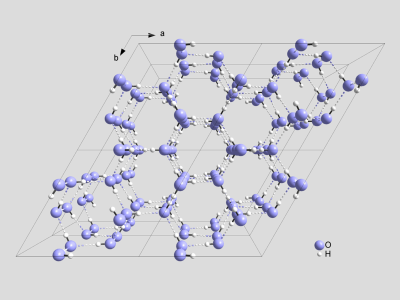
OK, down to brass tacks!  The various ways that water can freeze are so different that a bunch of scientists decided that it was a good idea to call them different names, starting with ice Ih (pronounced "ice one H" - the H is for hexagonal) & ice Ic ("ice one C," with a C for Cookie Cubic), all the way up through ice XIV.  Ice XV has been predicted, but has not yet been produced.  Ice Ih is the technical and highly-scientific name for the kind of ice you would find in your freezer, and if you could see individual molecules, then it would look like this:
However, between 150°-170°K, water freezes in a face-centered cubic crystalline lattice:
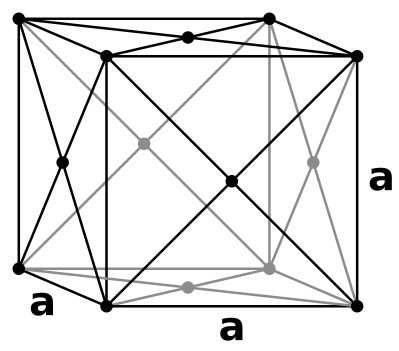
This last one's a bit tougher to visualize; the oxygen atoms are arranged in the face-centered cubic lattice, which looks like this on its own:
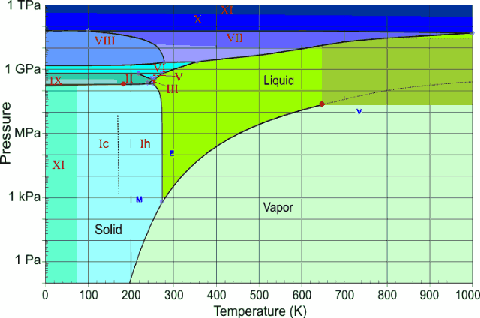
At any rate, the different phases of ice have some interesting properties.  Ice VII "has the widest stability field," its pressure tolerance owing to its disordered hydrogen arrangement.  Ice XI is ferroelectric!  I've heard that Ice VIII is actually red, though I can't find a source to corroborate that.  Many of the phases of ice can only be formed at pressures measured in mega- and giga-Pascals, and if you look at the phase diagram for water (complete with mouse-over notes at Water Structure and Science), you can see that we Earthlings don't really get into the environments conducive to other phases, hovering as we do around 250°-350°K and 1KPa:
OK, that's enough about ice for one day.  I could go on for ages about this stuff, but I need to start looking through a couple books I have for a nifty bit on carbon for the next post in the series.

Tuesday, March 24, 2009

Questions for Physicists, part two: Quantum Uncertainty vs. God, History, etc.

Let's start this one off with a little bit of background. And by "a little bit of background," I mean "a crash course in quantum physics." First, I think everyone's heard of the Heisenberg uncertainty principle: certain physical quantities, like position and momentum, cannot both have precise values at the same time (taken from the Wikipedia page). For instance, if you measure an electron's position, then you don't know its mass or velocity; and mutatis mutandis for any other information you could care to know about it: measuring one thing makes other things uncertain, in other words. This applies mainly to really tiny bits of matter that we want to look at one bit at a time, not the macroscopic objects we typically encounter in everyday life. The reason behind the uncertainty principle is that tiny bits of matter appear to behave as particles at some times, and as waves at others, as demonstrated in double-slit experiments. For those who aren't savvy, here's a well-done video that explains it in roughly the order physicists discovered these principles themselves:
OK, so observing things has an effect on them, fine and dandy. Well, a bunch of physicists started criticizing the uncertainty principle, saying things like, "Oh, your equipment just sucks at these tiny levels," or, "Hey, you're just using too clumsy a method to make your observation." In other words, the methods and equipment were being criticized, and everyone thought we just needed to invent more precise equipment, or discover more precise methods - until Einstein came along. In 1935, the physicists Einstein, Podolsky, and Rosen wrote a paper outlining what is now called the EPR paradox. This paper said, in a nutshell, "No, you're doing it wrong!" The upshot of it was that the observations we were obtaining were not due to shoddy equipment or anything of the kind; rather, the critical physicists didn't properly understand the uncertainty principle, and so weren't taking it seriously. An experiment was laid out that could settle the matter empirically by testing quantum entanglement - but Einstein had no idea as to how such an experiment could be conducted.

Enter John Bell, who was able to devise a method for performing the experiment in 1964. This class of experiment became known as "Bell test experiments," and has shown some interesting and confusing things about the world we live in. To make an already-long story medium-length, I'll skip the technical stuff and get right to brass tacks. Basically, we take two quantum-entangled particles, let's call them A & B. We measure something about A, say its mass, and then we measure something about B, say its velocity. Then we go to measure the mass of A again - and much to our surprise and philosophical chagrin, A's mass has changed. What this means is that, in a state of quantum uncertainty, things aren't just too subtle to measure without changing - they are actually probabilistic (more technical and more surprising, quantum entanglement is an observable phenomenon!). The research strongly suggests that there is actually an element of irreducible randomness to reality.

There are, of course, various interpretations for these results. Any finite set of data has an infinite set of possible interpretations, after all. These interpretations fall into three main lines: the "hidden variables" interpretation (endorsed by Einstein, but losing ground), the "many worlds" interpretation (which has a variety of metaphysical & epistemological convolutions all its own), and the "Copenhagen interpretation" (which posits metaphysical chance). The many worlds and Copenhagen interpretations are epistemologically indistinguishable, as I shall soon demonstrate, and also seem to be "fallback positions" should the hidden variables interpretation be soundly defeated at some point. Since the hidden variables interpretation is the simplest, I shall explain it first: these apparently probabilistic events are in reality governed entirely by some as-yet undiscovered set of principles which, upon their discovery and elaboration, shall show quantum uncertainty to be an illusion. It leaves a lot to be desired, sure, but what it's got going for it is that it's really close to the default position of science (as opposed to, say, fucking magic). But this view is losing ground, as our ever-closer and ever-more-careful observations of the world have been tending to lead us away from a fully deterministic world model.

The Copenhagen interpretation (there are actually several, the term is fraught with ambiguity) posits metaphysical chance as the explanation for these observations. Reality, on this view, contains some irreducibly random component that is fundamentally incompatible with a fully deterministic worldview. "Chance," it would seem, is not merely a way of talking about the limitations of our knowledge, but a fundamental part of the Universe. Let us use the metaphor of a deck of cards. In the everyday world, every deck of cards has a certain order which is determined entirely by the processes of its previous arrangements (whether by shuffling or otherwise). If one knew the initial conditions of the deck (or the conditions of the deck at any time T) and was able to precisely observe and track the deck's arrangement through time up until the present, then one could know with certainty the arrangement of the deck at present. It so happens that our inability to observe and track such minute events as the shuffling of a deck of cards prevents us from knowing its current arrangement, despite the fact that we know how the last hand went. In opposition to the hidden variables interpretation, the Copenhagen interpretation is the idea that not only are we simply incapable of tracking the shuffling of our quantum deck, all the cards are blank until we look at them. In a state of quantum uncertainty, prior to any measurement, there is no fact of the matter. Period. This is what is meant by metaphysical chance.

But it goes deeper than that. As the Bell experiments show, a "fact of the matter" emerges when an observation is made. As a young, naive physicist, I once postulated that matter behaved as waves until some sort of interaction behaved as a "call function," saying more or less, "Hey, you! Collapse your waveform, already! You're supposed to be particulate for this!" The problem with this position is that all matter in the Universe is always interacting with other matter in the Universe. It doesn't matter how much we isolate an electron from other charges, or the atmosphere, or cosmic background radiation - we have found no way to isolate an environment from ambient gravity, which means that it's not mere interactions with other matter that make the difference. No, what seems to be the "special" thing about the observer effect is that the observer is conscious. These are the interactions that matter, and this is friggin' strange. But enough on the Copenhagen interpretation for now.

Straddling the fence between the two is the fully deterministic and fully probablilistic mind-bender known as the many worlds hypothesis. In short, this is going to be weird. In "less short," the many worlds hypothesis is the view that all possible futures actually happen "on top of" each other in the Universe; or, put differently, that any "world-state" can be captured by an internally consistent mathematical model, and the "real world" is composed of all such models. This interpretation, I think, is best explained by a diagram:
This is the world!
The above image represents an extremely simplified (but complete) "many worlds" world. Also, I'm really sorry1 that sloppy MS Paint drawings are so much fun for me. OK, so T represents some initial condition, like the beginning of the universe or something, and the vertical axis represents time - time goes down here, because for something to "go down" means for it to "occur." Or give head. Your choice. Anyway, each horizontal line represents the smallest meaningful interval of time, which is the time between quantum events. Now, here's what's crazy: an observer at A can look back and see a single path going back to T, but looking forward sees all possible futures, a couple of which end abruptly, some of which go on for a while to be radically different from each other. But at A, our observer has but a single "option" open: go to A' or go to A'' (for the benefit of the uninitiated, these are pronounced "A prime" and "A double-prime," respectively). To which path does our observer travel down? Both. In fact, our observer at A travels to all endpoints in the world (assuming that death and destruction are scrupulously avoided along the way, of course).

Now, let us posit our observer at A'. Our observer still sees but a single path going back to T, but can only look forward to all paths proceeding from A', and none of the paths proceeding from A''. Vice versa for an observer posited at A''. So which is the "real" observer from A, just one quantum event earlier? Well, this is just the paradox of the ship of Theseus in fancy dress: our observer at A becomes both our observer at A' and our observer at A'', and neither of the derivative observers has any privileged claim to being "the" observer from A. In fact, if we want to play rigid designator with our identities, they're all the "same" observer. Time for a pop quiz! Suppose that you, personally are at A', going to one of the two points designated B: even with perfect knowledge of the possible states of the world, as well as the laws of causality and probability, can you predict which point B you will go to?

The clever reader will note that this is a trick question: you go down both. It is only by conceit of hindsight at either of the points B that you can describe a singular "you" as having come from A'. Similarly, the "you" at A travels to all points B and C, and only by conceit of hindsight at any of these may you say that "you" travelled down any particular path, because the "whole you" goes down all of them. Now here's the upshot of the diagram: since the "whole thing" is the complete world, every quantum event goes every way it can, and the act of observing quantum states (i.e. collapsing the waveforms out of quantum uncertainty) serves only to tell us what path we have just come down. Under the many worlds hypothesis, all the quantum states that can possibly happen, do actually happen2. This means that an "un-simplified" world diagram would be a nigh-infinite-dimensional idea space describing all logically possible states of the Universe, all of which are equally real, all of which truly exist as much as any other. Capisce?

I told you it was weird.

As promised, my penultimate note will be on the epistemological indistinguishability of the Copenhagen interpretation and the many worlds hypothesis. If you've stuck with me this far, but didn't understand that last sentence... well, you know what? I'm willing to say that that's entirely my fault - I'm trying to write this for the layman, after all. What I mean is that, if either the Copenhagen interpretation or the many worlds hypothesis was true, we could not tell the difference between them. The reason for this is that, under the many worlds hypothesis, we can only describe the future in terms of a probabilistic idea space (this is in fact what the many worlds hypothesis says reality is like). However, in hindsight, we will see only a series of quantum events that played out probabilistically. But under the Copenhagen interpretation, we can only describe the future in terms of probabilities, and if we were to fully describe all possible futures, this would be exactly the same as the many worlds idea space. And looking back, we would also see a series of quantum events that played out probabilistically - not due to some conceit of hindsight, but because this is what the world is actually like. To strain the language of convenience between two mutually exclusive possibilities, "we" would "experience" only one "actual path" down the idea space, but could only describe this path by looking backward, which looks the same under either model. Or, in other words, if you're standing at A', how could you possibly know there's actually an observer at A'' who diverged from you at A, as opposed to there being only you at A' based on a cosmic roll of the die?

Pro tip: you could do no such thing.

OK, so: here are my questions for physicists, at long last! First, how could we really give the hidden variables interpretation a sound thrashing? And suppose we did manage to falsify it, how could we then distinguish between the Copenhagen interpretation and the many worlds hypothesis? Furthermore, if the many worlds hypothesis is true, then how are we to reconcile this with the laws of thermodynamics (specifically, the second one)? Moreover, if the many worlds hypothesis is true, then that gives every logically consistent counterfactual a concrete referent, so why do I want to punch David Lewis in the face? (Sorry, I couldn't resist the esoteric philosophy joke.) And if the Copenhagen interpretation is true, does this mean that there simply was no fact of the matter regarding the Universe as a whole prior to conscious observation? (And if so, how did conscious observers, in fact, come about?) Finally, doesn't the Copenhagen interpretation necessarily exclude an omniscient deity? I mean, I'm pretty sure it does. Just sayin'.

I know it's been a long post, and my deepest thanks to those who stuck it out with me. I hope you can see, however, that the last paragraph would have made exactly zero sense to non-physicists without nearly all of the foregoing. Anyway, enjoy involuntarily reevaluating your conception of reality! Catch you next time around!

Notes:
1. At this point, I started drawing my MS Paint diagram, and I should really point out that MS Paint is like playing with crayons for me - it makes me giddy. As schoolgirls are giddy. Point is, I couldn't resist the silliness in the following paragraph. Hell, I still can't. It's got that whimsical MS Paint diagram above it, playin' at quantum physics! That's just too cute!
2. Full disclosure: the green, blue, pink, purple, and brown lines were all drawn just for fun. I actually drew out the whole diagram before I had even planned what to write (I'm a bad writer, I know), and I drew most of it because I felt like it. I'm telling you: like playing with crayons.

Sunday, March 22, 2009

Questions for Physicists, part one: The Lorentz Factor vs. Relativity

As I alluded to in my previous post, I used to be a physicist. I never got a PhD, or even a bachelor's degree, but as a freshman physics major intending to teach physics to high school students (and going to a public university with a modest scholarship and zero parental assistance), I needed money. Because I had a very high ACT score, I was offered a position in a research unit doing work for the university in theoretical physics. I even made a little discovery, in that I saw all the numbers we were putting into a computer and recognized the relationships between those numbers, so I was able to make a couple semi-educated guesses as to how the numbers could be juggled to yield interesting results, and one of those guesses panned out. So because I was doing physics, I feel justified in saying that I was a physicist.

I ended going in a different direction, but the point of all this is that I still like science, so from time to time I come up with some interesting questions that involve putting one esoteric bit of knowledge together with another esoteric bit of knowledge. One such question arose while writing about the Lorentz factor, and the other one that I'm going to discuss later arose while discussing the Bell experiment with some friends. To be sure, these questions probably have answers, but some cursory Google searches haven't yielded anything promising, so I'm going to be approaching some old contacts in the physics department to find out what's up.

OK, first question: does the Lorentz factor imply that absolute velocity exists? My last post explains the Lorentz factor (γ, the Greek letter gamma) in some depth, so I won't re-tread that old ground. What I will take a little time to explain is relativity: in particular, one of the upshots of relativity is that time and motion are relative, in that you can't speak of an object's velocity without respect to some observer (or "frame of reference"). On Earth, we speak of velocity relative to the Earth; in the Solar System, we speak of velocity relative to the Sun; in the Milky Way, we speak of velocity relative to the galactic core. But each of these scenarios suggests an obvious frame of reference, specifically, the body around which we are travelling. Let's take an example where a frame of reference does not so easily present itself to see what I'm talking about.

Suppose that a spacecraft is travelling from planet A in galaxy X to planet B in galaxy Y. Planets A & B, as well as galaxies X & Y, all provide us with equally valid frames of reference, and roughly equivalent ones to boot (for the sake of argument, if nothing else). In the darkness between the galaxies, our spacecraft begins accelerating towards c to such a point that γ starts to appreciably show itself in the forces experienced by the passengers relative to their actual acceleration with respect to A, B, X, and Y (let's just lump them all together as coordinate system Z). For the sake of argument, let's say that the spacecraft is travelling at 0.5c, half the speed of light. Here's my question: suppose the spacecraft then separates into two pieces, P and Q. Part P then begins to accelerate further, while Q stays at the same velocity - i.e. Q does not accelerate. After the spacecraft separates into parts P & Q, these two parts are travelling at exactly the same velocity with respect to each other, so with respect to Q, P is not moving and so has a velocity of zero. But with respect to Z, P is moving at 0.5c, which is substantially more than zero! Time to plug and chug! Forgive the MS Paint equations, but I don't feel like busting out the tablet right now. Let's just solve for γ to see how acceleration is affected:
So at .5c, γ=1.155, so F=1.155ma; we can juggle this to yield a=.866F/m. The point of the this is that, for a given force F exerted by P (casting off mass to change velocity), P will experience about 13% less acceleration with respect to Z than it will with respect to Q! Now, this is only initially, as P's mass will change, as will its velocity as it continues to accelerate - but for small masses lost and small accelerations, v won't change by much with respect to c and m won't change much at all, which means we should be able to see a much different a for the same F, depending on which frame of reference we use.

Now, this is weird, because one or the other frames of reference should be "chosen" in that P will experience some acceleration (a), and that acceleration will bear a relationship to the force (F) exerted, so we can calculate which frame of reference is being preferred - but relativity states that there is nothing special about any particular frame of reference. I'm probably fucking up somewhere, likely having to do with a Lorentz contraction that I'm not taking into account (because Lorentz basically assumed relativity to determine his γ, I suspect this may be relevant): P and Q will be experiencing Lorentz contractions which may cause the discrepancies to disappear under actual observation, in which case I am erroneously assuming some absolute frame of reference by not taking all the relevant relativistic effects into account. Still, that's just my best guess for where I may be wrong if I am, and I'm not quite sure about that.

OK, this is getting long, so I'm cutting it in two. In about three hours, I'll be starting a work week that has me going pretty much around the clock, so I probably won't be able to finish my bit on the happiness machine until next weekend. I haven't forgotten, though - that research supports the whole thrust of my argument, so I hope I get it soon!

Saturday, March 21, 2009

101 Interesting Things, part eleven: The Lorentz Factor

Like any young physicist, I spent my high-school years desperately attempting to break the very laws I was studying: perpetual motion machines, FTL drives, doomsday devices that swallowed universes, cold fusion reactors, the works. Because I failed to break any of the laws I learned, I imagine this would be like a DEA agent trying desperately to score some pot, but being totally unable to do so.  Somehow.  I don't know, maybe he was wearing his badge or something.  Every scientific principle I learned was either a catapult to becoming a Nobel laureate, or the roadblock I would inevitably hear about from my physics teachers later that day.

One of the earliest of these endeavors involved faster-than-light (FTL) travel.  You see, back in the Pleistocene, before the internet had infected everyone's house and I had to go halfway across town to an actual library to look something up (holy crap, do I feel old), I would take my designs to the physics department and ask the teachers why they wouldn't work.  I actually succeeded in stumping a few of them once or twice, but I would inevitably be shot down by some bit of trivia like Lenz's law (which is basically electromagnetic friction).  Right after we learned about vectors, we jumped into the application of actual forces (which was followed throughout the semester by figuring out those forces, roughly in order of ascending complexity and/or descending magnitude), where I learned the mighty F=ma.  For the uninitiated, or those who simply don't remember high school science (don't feel bad, I don't remember anything else), F is force, m is mass, and a is acceleration.

What this means is that if you know the mass of an object, as well as its current acceleration, you can calculate the force acting upon it.  Conversely, if you have some mass and want it to accelerate at a certain rate, then you can calculate the force that must be applied to do so.  Actually, as long as you know any two of those terms, you can calculate what the third one must be.  I reasoned that as long as we kept applying force, we could accelerate to any velocity we could choose.

So one day I asked my teacher why we couldn't go faster than the speed of light.  I was told that as we accelerated towards the speed of light, the forces involved in our acceleration would crush us.  Obviously, the more a mass accelerates, the greater the force acting upon it - but what if we accelerated really, really slowly?  It would take some time, but it should work, shouldn't it?  And, to jump ahead just a bit, subjective time "slows down" as one approaches the speed of light, so shouldn't the passengers experience the trip as a relatively quick one?

There were two things that I hadn't taken into account.  First, that modern spacecraft accelerate by casting off mass:  by throwing something in the opposite direction that you want to go, you move yourself in the direction you want to go, because for every action there is an equal and opposite reaction.  Spacecraft don't need fuel for a trip like cars do, because cars need fuel to travel a certain distance, but spacecraft only need the fuel required to accelerate to the desired travel speed; then they wait, and then maybe decelerate when they're about to arrive.  But the speed of light is really, really fast, and accelerating anything to such a speed would require a lot of mass to be cast off, which would in turn require a very massive craft which would in turn require a lot of fuel to take off in the first place.  I think you can see where this is going.

But that was merely a technical limitation, a problem for the engineers to work out.  The second thing I had not taken into account was the Lorentz factor, which actually makes accelerating to the speed of light impossible - for any living thing, anyway.  You see, as it turns out, F=ma isn't the whole story.  The whole story is F=γma, where Î³ (gamma) represents the Lorentz factor.  Î³ itself is defined as the inverse of the square root of the quantity one minus the square of the ratio of velocity to the speed of light.  Huh?  Yeah, I'm not very good with words, either.  Here it is mathematically (v is velocity, c is the speed of light):
OK, so there are a couple of important things with this new insight.  The above is Î³, and since F=γma, we can do some juggling to yield Î³=F/(ma).  Since F is precisely equal to m*a in most Earthly applications, it seems reasonable to assume that Î³=1 most of the time.  Fortunately, this is true!  Looking at the above equation, v/c is really tiny when velocity isn't close to the speed of light, because c is huge and v is not huge.  This means that (v/c)2 is going to be even tinier, so that 1-(v/c)2 is going to be really close to 1 (but just a tiny bit more).  The square root of this will also be close to 1, and 1 divided by something really close to 1 is also really, really, really close to 1.  This means that Î³ doesn't make much of a difference in our day-to-day lives, because we don't go anywhere near the speed of light.

But what if we did?  If v was equal to c, then v/c would equal 1, and 1-12 is zero, and... OK, now we're dividing by zero, which isn't allowed.  OK, let's say that v is really close to c instead.  With v being close to c (but not equal to it), v/c is going to be close to one, but just a little bit less.  Squaring something close to one will make it only a little bit less than one than it is right now, and so 1-(v/c)2 is going to be a tiny, tiny number.  The square root of a tiny, tiny number (that is less than one but ever so slightly more than zero) is also a tiny, tiny number - it's only a bit bigger.  And one divided by a tiny, tiny number is a really, really big number.

Moral of the story:  as v approaches c, Î³ becomes huge.  And when Î³ is huge enough, even a tiny m & a will make for a huge F.  What this means for our travelers is that, as they cast off a little bit of mass at a time, for them to accelerate to the speed of light is going to require increasing amounts of force.  Furthermore, the opposite side of that coin is that the travelers will also experience this force, and tiny bits of acceleration will result in huge amounts of force, to the point where just the margins of error in even our most precisely controlled accelerations could be deadly.  So, no, we mortals will probably never get appreciably close to the speed of light.

Thursday, March 5, 2009

A Review in Brief: "The Ancestor's Tale: A Pilgrimage to the Dawn of Evolution"

I just finished reading The Ancestor's Tale:  A Pilgrimage to the Dawn of Evolution, by Richard Dawkins.  It's a fantastic read, and I highly recommend it to anyone who is interested in just about anything.

Two features stand out most about this book, even moreso when taken together:  its breadth, and its accessibility.  Throughout the book, Dawkins relates a multitude of facts about various organisms, as well as scientific principles in general and discoveries in specific.  All of this is done in layman's terms, making the book a very easy read.  I read most of it either during fifteen-mintue breaks at work, or while undergoing plasmapheresis at the local plasma clinic.  While not specifically saying so, The Ancestor's Tale touches on a wide variety of scientific disciplines, all of which lend something of value to the confirmation of the theory of evolution.

Biology, obviously, is steeped in evolutionary theory.  Evolution is the basis of modern biology, after all, so it is unsurprising that there should be discussions of molecular genetics, taxonomy, ethology, and population genetics.  But in discussing fossils, Dawkins also brings in bits from geology; bits of physics lend to his discussion of radiometric dating; chemistry is brought to bear in his explanation of RNA transcription and protein synthesis; statistical analysis plays a part in his relation of how molecular data is arranged and analyzed to determine degrees of relatedness between organisms and species; even general philosophy makes a few appearances, most notably (to me, anyway) in the Orangutan's tale, which includes a lesson in parsimony as applied to the attempt to determine how many trips were taken by ancestral apes between Africa and Asia.

I confess that I find it slightly jarring to use the term "gripping" to describe a popular science text, but this book is a real page-turner!  Not only has The Ancestor's Tale provided a great deal of fuel for my 101 Interesting Things series, it's also enhanced my appreciation for the power of the scientific method and the wealth of opportunity available to us in the information age.  This book contains more information in it than Aristotle probably had access to during his entire life.  All in all, I think Dawkins has  rightly earned his place as Professor for Public Understanding of Science with this book alone.  If you ever have the time and the opportunity, I strongly urge you to work up the inclination to read this book.

Wednesday, January 7, 2009

101 Interesting Things, part 1: The Antenna Galaxies

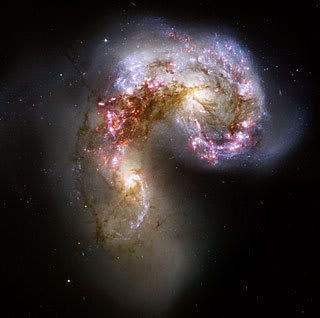
The Antenna Galaxies are a reminder that, in the grander scheme of things, we ain't shit. I mean, if you think you've got a dust problem behind your couch, you should see the dust clouds kicked up by a galactic collision.

Seriously.

These two galaxies have been colliding for hundreds of millions of years, orders of magnitude longer than all of recorded human history. They will continue to collide for hundreds of millions more years, in all likelihood well after we have died out and all traces of our civilization have disappeared wholly from the cosmos.

During this time, the scale of which is far beyond the human mind to truly grasp, events have been transpiring which are orders of magnitude grander than anything that could possibly happen on Earth - the reason is nothing to do with Earth or its inhabitants, but the simple fact that these events would destroy our world utterly.

These inconceivably epic collisions between all manner of celestial body have been happening always and everywhere on a stage far grander than any our species has ever known. If every single event of every history book of every nation were to be reenacted simultaneously, each upon a separate life-sized stage of its very own, all of these areas together would not even register on the above image, which is itself but a single moment in time that took forty-five million years just to reach our eyes.

In short, we can't even understand how much greater this is than even our ability to understand things in the first place.

The Antenna Galaxies are, in every conceivable way, utterly beyond our comprehension. We simply never deal directly with anything on a scale even remotely close to this size - not time, not distance, not force, not anything. If there existed a god, then surely this would be a prime candidate for the focus of divine attention: the magnificent story of two galactic formations swimming inexorably towards each other through the inky blackness, pulled by nothing but the universal force of attraction into a celestial mating dance of truly epic proportions.

Compared to this, all of humanity is but the blink of an eye upon a speck of dust in the next room over. We think we're hot stuff, all right, but even our invented gods were so petty and parochial as to be utterly ignorant of this truly grandiose phenomenon. Not one holy book mentions the antenna galaxies - one would think that a god would take notice, or at least want to show off its handiwork.

At any rate, I think it can safely be said that the Antenna Galaxies are well and truly interesting. To find out more, check out the Wikipedia page or my source for the above image.

This post was featured in the 31st Humanist Symposium.