It gets better, though! My main reason for writing this entry is that ice can form physically distinct crystalline structures at different temperatures and pressures, and the results can be surprising. Water's status as the universal solvent is due to its molecular structure: the oxygen atom's valence electrons, taken from the two hydrogen atoms, are in the first and relatively close-orbiting p-shells, and the ratio of electrons to protons (5:4) results in a strong negative charge for something that size. The hydrogen atoms, on the other hand, are almost entirely stripped of their electrons (due to the oxygen nucleus' proximity to the surface of its valence shells), leaving them as more or less exposed protons. This powerful polarity means that, at around one atmosphere of pressure and in temperatures normally encountered on Earth's surface, water crystallizes in a highly-structured fashion. In other words, the way that ice "fits together" leaves a lot to be desired in terms of packing efficiency. This is why water, unlike nearly any other substance, is less dense as a solid (as we would usually encounter it) than as a liquid, reaching its maximum density at about 4°C.
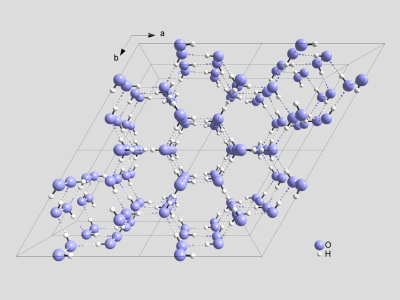
OK, down to brass tacks! The various ways that water can freeze are so different that a bunch of scientists decided that it was a good idea to call them different names, starting with ice Ih (pronounced "ice one H" - the H is for hexagonal) & ice Ic ("ice one C," with a C for Cookie Cubic), all the way up through ice XIV. Ice XV has been predicted, but has not yet been produced. Ice Ih is the technical and highly-scientific name for the kind of ice you would find in your freezer, and if you could see individual molecules, then it would look like this:
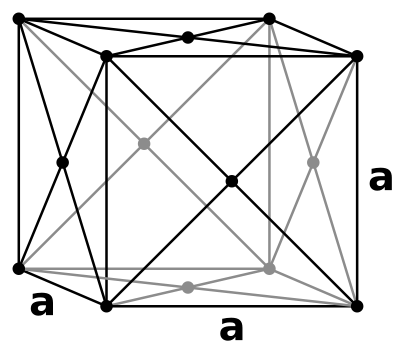
However, between 150°-170°K, water freezes in a face-centered cubic crystalline lattice:

This last one's a bit tougher to visualize; the oxygen atoms are arranged in the face-centered cubic lattice, which looks like this on its own:
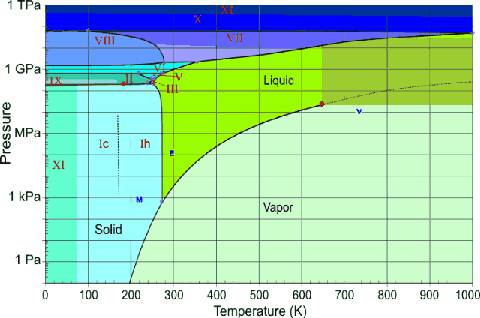
At any rate, the different phases of ice have some interesting properties. Ice VII "has the widest stability field," its pressure tolerance owing to its disordered hydrogen arrangement. Ice XI is ferroelectric! I've heard that Ice VIII is actually red, though I can't find a source to corroborate that. Many of the phases of ice can only be formed at pressures measured in mega- and giga-Pascals, and if you look at the phase diagram for water (complete with mouse-over notes at Water Structure and Science), you can see that we Earthlings don't really get into the environments conducive to other phases, hovering as we do around 250°-350°K and 1KPa:
OK, that's enough about ice for one day. I could go on for ages about this stuff, but I need to start looking through a couple books I have for a nifty bit on carbon for the next post in the series.


No comments:
Post a Comment