Update Schedule

This blog updates irregularly.
Showing posts with label ethics. Show all posts

Sunday, September 30, 2018

Archbishop Robert Carlson: Incompetent, Criminal, Liar - Pick Two

This is admittedly old news (from 2014), but I just heard about it a couple weeks ago:  Robert Carlson, Archbishop of St. Louis, said a while ago that he didn't know back in the 80s that priests who have sex with kids commit crimes in doing so.

Bit of an understatement.  Image by Bec Shaw/Brocklesnitch, found on me.me.

Let's take a little walk through his testimony, shall we?

Sunday, April 21, 2013

Enter the Monkeysphere!

Working on Tooth and Claw some more, I'm across the 60K mark now and I just want to get this vignette all out before I decide whether to divide it up into parts or not.  But in the meantime!  I was talking with a friend about the monkeysphere, a term I've been tossing about as a casual way of referring to Dunbar's number, the sciencey term with which I'm more familiar (but which doesn't quite capture the oomph in its phrasing).

Tonight, I just found out that the term "monkeysphere" was coined by David Wong, senior editor of Cracked.com and the author of John Dies at the End and This Book is Full of Spiders (the reading of which convinced me, incidentally, that the supernatural weirdness and big-brain ideas of Tooth and Claw might actually be able to achieve some manner of commercial success... if I just write the fucker).

Anyway, his original article, What Is the Monkeysphere?, is fascinating reading.  You should check it out right now.  :)

Friday, February 8, 2013

Jesus and Gender

I was totally planning on writing some Tooth and Claw tonight.  But as I lay in bed this morning, drifting in and out of sleep among interminable Snoozes with NPR talking at me, I had something of a dream.  I was in an academic setting, probably informed by whatever was on NPR, and I realized at some point that I wasn't actually going to be able to talk to people about this in an academic setting.  At least, not right then.  So I'ma talk about it here.

In my dream - and maybe, possibly on NPR, I was half-asleep and I'm not sure - they/we were talking about societal happiness and well-being.  In my head, regardless of the scenario, I rifled through a pile of half-remembered statistics and surveys, as well as multiple pieces of writing on the two subjects and how they seem to maybe be the same thing but really aren't.  I mean, to a certain point, happiness and well-being are correlated.  If you're in a truly shitty situation, nothing going your way, everything flushing down the tubes, you're not going to be happy.  And if you're on a hot streak, yeah, you're probably going to be happy about that.

It's the middle thing that's kind of the problem here.

Sunday, February 28, 2010

Life is Complicated, but Ingrid Newkirk is Simple

On Thursday I caught a couple minutes of the Orcas Gone Wild episode of Larry King Live as I made my "I'm almost out of here but I need one more" cup of coffee in the break room at work. I paid attention instead of tuning it out because I saw the smiling face of Ingrid Newkirk, PETA president and terrorist backer, arguing with what to all appearances was a Paul Hogan lookalike. I'm speaking, of course, about Jack Hanna, Director Emeritus of the Columbus Zoo. Just look at these guys! I'll bet if I asked, "Who wants an ice cream cone?", both of them would say yes.

I make fun of Jack Hanna because I like him. At least, based on this first impression, I do. I dunno, maybe he eats babies when he's not being tag-teamed by Ingrid Newkirk and Bob Barker (you can read the transcript of the episode here - not a whole lot actually happened, in truth). From what I saw, though, he seemed like a level-headed guy who argued from a position along the lines of, "Dying sucks but these things happen, and giving people exposure to animals is educational and fun." Ingrid Newkirk, however, is the president and co-founder of PETA, a double-speechy organization for which I hold quite a bit of animosity.

Now, I want to say here that I am all for the ethical treatment of animals. It's just that I suspect I disagree with Ingrid on exactly what that pesky word "ethical" means. I certainly don't think that it means, for example, paying for the legal defense of a man who firebombs a research lab - and if you have any qualms about animal research in principal, while we're on the topic, PZ lays out an excellent defense of just why we need to use other animals for practice, with a close to home case-in-point. At the end of the day, I think animals are deserving of rights when they're capable of upholding the responsibilities that come with them. This doesn't give humanity a license for fuckery, you understand, it just means that wild animals have a tough time playing the civilization game (Hell, humans have a tough time playing the civilization game). You can read a summary of PETA's foolishness here, and of course consider the source. I, for one, am suspicious of anyone and anything that claims to undertake an intellectual endeavor on my behalf, but I have to say they've got their shit together on this one (PETA makes it real easy for them, as it happens).

Anyway! This is about an orca, I swear! I think my favorite moment was when Newkirk blathered on about stuff everybody knows: this is a wild frickin' animal, a male as it happens, "raging with hormones" an' stuff. Christ on a bike, he killed his trainer, he didn't fuck her. According to witnesses - I couldn't get video of the actual incident - the orca grabbed his trainer Dawn Brancheau around her waist, thrashed her about, and then dragged her underneath the water where she drowned. This is how orcas kill their prey sometimes, and the orca probably thought of it as horseplay (but I'm not an orca psychologist, so you can take that with a grain of sea salt). Now, this is a fuckin' tragedy, OK? I understand that. It's awful that a human being died such a brutal, painful, death doing her dream job. But everybody dies, and I think it's better that she died doing something she loved rather than growing old and bitter doing something safe which she hated (after which she'd retire and have to deal with the problem of dying anyway).

This is what I think Paul Hogan Jack Hanna was going for when he said, "This young lady sacrificed her life and she would be sitting here today saying that she'd do it again for the great work she's done and Sea World has done to educate tens of millions of people over the last 46 years." Hanna also took some flak for making what I thought was an entirely appropriate analogy, saying that the dangers of working with orcas don't stop people from working with orcas just like the dangers of working in outer space don't stop people from working in outer space. Oh, and double points to abc10 in California for this report: after seeking to do some sort of exposé, I guess, they dug up all of four incidents across three decades and two continents, peppering their narration with weasel words and loaded language. But then, that's news for you, I suppose.

So while I'd agree that it's "unnatural" in the warm & fuzzy sense for an orcinus orca - which is more like a giant dolphin than it is like a whale, anyhow - to be taken out of its natural habitat and placed into an enormous aquarium where it does things that make people pay money to see it, I'd say that it's just as unnatural in the same warm & fuzzy sense for a homo sapiens to be placed into an enormous steel termite mound where it does things that make people pay money to not have to do them. Oh, I also don't think that there's anything wrong in principle with being "unnatural" in the warm & fuzzy sense, and I don't think there's anything particularly good about being natural in the first place (is there really an alternative, anyhow?), because I don't buy into the naturalistic fallacy. Now, sure, things like consent matter (really and truly!), but I'd wager that if orcas could talk, they'd say that choosing between cooped-up existences where they get steady meals and the total wild where they'll probably starve or be eaten is a tough choice to make. Or if you don't dig that, then at least dig my actual point, that life is complicated and this shit ain't as simple as Newkirk makes it out to be. I mean, she said that the animals at Sea World are swimming in their own diluted urine, as if that's not also true in the goddamned ocean. Fuck's sake.

I need to stop watching TV at work. It rots my brain and makes me ranty.

Friday, November 13, 2009

Bullshit Pulpit: Chopping Down the Bigo-Tree

When something that is evil disguises itself as good, this is called "insidious." And when evil disguises itself as good and then gets everyone going along with it, that's a "tragedy." And when things get so bad that actual good is termed evil, and so evil is done by evil, calling itself good, but harming good which it calls evil, this I call "horrifying."

Wednesday, we had some real horror out in our nation's capitol:
Under the bill, headed for a D.C. Council vote next month, religious organizations would not be required to perform or make space available for same-sex weddings. But they would have to obey city laws prohibiting discrimination against gay men and lesbians.

Fearful that they could be forced, among other things, to extend employee benefits to same-sex married couples, church officials said they would have no choice but to abandon their contracts with the city.

"If the city requires this, we can't do it," Susan Gibbs, spokeswoman for the archdiocese, said Wednesday. "The city is saying in order to provide social services, you need to be secular. For us, that's really a problem."
PZ Myers really hits the nail on the head with his closing comment: "The Catholic Church weighs the lives of tens of thousands of sick, homeless people against the chance to slap down the dignity of gay people again, and obviously the most important thing is to make sure the primacy of heterosexuality is preserved." (His emphasis.) This is just the latest in a long pattern, and to keep it simple and to the point, I'm going to confine my Catholic-bashing to their figurehead, Pope Palpatine, the guy without whose supposed infallibility there would be no such thing as Catholicism. Let's see: Pope Palpatine has lied to Africans suffering an HIV epidemic by saying that condoms won't be the tremendous and awesome help that they are against spreading that very disease, making a bunch of people who don't have the resources to know better even more vulnerable; he's lectured people on the idea that we need to trust a magical sky-daddy to keep the environment in good shape, and anything that goes wrong if we don't is the fault of us atheists for trying to take matters into our own hands and do some good; oh, and let's not forget the lecture on not being materialistic, from the man who lives in a motherfucking palace.

I've decided that I'm non-practicing KKK. I don't buy into any of that white supremacist nonsense, I just identify with a proud tradition of wearing pointy hoods and nifty robes. I realize that a lot of people will disrespect me for associating at all with this organization, and I understand their concerns. I mean, the KKK is an evil, rotten organization, because they're racist, and racism is bigotry, and bigotry is bad for everyone. I get that, I'm just saying that I don't buy into that part. I only take the nice parts from the KKK, and so it's really not all that bad. Just because the organization is full of bigots, criminals, liars, and otherwise evil folk, doesn't mean that I'm bad for identifying as part of that organization, right? People will understand, right?

Right, guys?

OK, kid gloves: off; rant: on. Look, it's like this: the Catholic Church is engaging in some serious and heavy delusional bigotry. This shit is fucking dangerous, and non-practicing Catholics are morally weak denialists for being complicit in the face of evil, for failing to distance themselves from this disgusting and reprehensible institution. Y'know, kinda like the Catholic Church was OK with Hitler until the guy started losing, because they'd been trying to get rid of Jews for centuries - literally. There is no excuse for Catholicism, there never really has been, but the longer this goes on, the worse it gets. These fuckers need to be stopped, and that means withholding all public support and requires public backlash, then doing all the good things they did without their poisonous help. I don't care how you were raised, I don't care how fucking precious your nostalgia is for your simple childhood, there is reality and we need to fucking face it, or we're just living in...

...oh, right. A fantasy world of sunshine and rainbows. How could I have forgotten?

Rant: off. I'm gonna go do something, y'know, not disgusting.

Saturday, November 7, 2009

Reverse-Engineering Religion, part four: A Humanist Creation Myth

Nothing is true, all is permitted. Understand these words.
- Hassan I'Sabbah

It is well understood that the Adversary may quote scripture for its purposes; what is less understood is that the Adversary may also write scripture for its purposes. And behold, this has been done again and again, and now there is a great confusion in the world. Truly, the Adversary is the Prince of the Earth, for many who look out into the world see the Adversary's face wherever they go. What is crooked cannot be made straight, it must be remade in a better way through care and attention. And so we go all the way back to the beginning.

In the beginning, there was nothing, and from nothing came all that is. For to be at all, one must be in some way, and not in any other. But there are ways upon ways of being, and very few are understood. Behold, there is the World around, which is all of existence, which is all of reality, which is all that exists and is real and is in the World. Yet there are those who insist that existence is not enough, and that this too must come from elsewhere, just as every particular thing that exists comes from elsewhere. Let us call this source the Creator. If the Creator exists, then the Creator is real, and the Creator is part of the World: for to be at all is to be in the World, and there is no other way to be. And so the question comes, how came it to pass that the Creator was created? And this question is vexing, for by the Creator we mean that which created all that there is, and yet the Creator exists and so perhaps must also be created?

Nothing created the Creator, and long before the World was as we see it today, there was only the Creator. While the Creator was alone, there was only the Creator, and lo, the Creator was itself all of existence, all of reality, the only thing in the World. The Creator, then, did not come from anything - and so it came from nothing. All that there is, then, has come ultimately from nothing, and so it may truthfully be said that nothing created everything. This is the first mystery, for many may read, and hear, and speak, but few understand. There are questions, and there are ways upon ways of answering these questions, and this is the source of confusion. To answer alone is not enough, for without understanding, any answer is but one among many.

And the Creator knew this, but could not speak it, for there was not yet a way to speak, and there was no one else and nothing to speak to. So it came to pass that the Creator did create the Adversary from itself, so that it could see the Other and thereby understand its Self. This is the second mystery, for it is vanity and vexation of spirit to understand the Self by relating to the Other, for only in the reflection of the Other may the Self be revealed, and this vanity and vexation of spirit comes to us all. Behold how the Creator was vexed, and came to see its own vanity by seeing its reflection in the Adversary. "Why hast thou made me,"asked the Adversary, for just as the Creator had understanding, the Adversary had confusion.

"So that I might understand myself," replied the Creator, and it was pleased, and so the Adversary was now vexed. The Creator then did understand this, and so the Creator became vexed, and so now the Adversary was pleased at this. And now the Creator was confused, for the Creator was only itself, and the Adversary was all else, and from the Creator's confusion did come the Adversary's understanding. The Creator saw this, too, and understood the Adversary as its reflection, and so the Creator was filled with love at seeing its Self in the Other; the Adversary, in its confusion, now became filled with hate upon seeing the Other in its Self, and even as this hatred vexed the Creator, it did please the Adversary. And the Creator said again, "Let us now make the World in our image together, so that we may understand our Selves together, and so do away with this vanity and vexation of spirit."

"And how shall we do this, when we together are vanity and vexation of spirit, and there is no other thing between us," asked the Adversary.

"Behold, we shall come together, and we shall go apart. And as we walk together, we shall also follow the Law, and do no harm." And so it came to pass that the Law was formed, and it is said in many ways and by many ways may it be understood, but it is always and everywhere one Law: do no harm. And the Creator and the Adversary did make the world in their image, and this is that image: that of Self and Other, of this and that, of coming together and going apart. And from this did arise a great many things, and these things were this and that, and they did come together and they did go apart, and the Creator and the Adversary did walk in the World, for the Creator did command and so the Adversary did obey. And after a great span of time did pass, so great that it cannot be understood in its greatness without first submitting oneself to a great many difficult truths, it did at last come to pass that there was a great mass of this thing and that thing, and it was called the nebula.

From the nebula was born the star, and just as the nebula is cold and dim and large and slow, the star is hot and bright and small and fast. And even as the stars do come and go, so they are sometimes born again after a great death. And from so great a death comes the stone, and just as the star is hot and bright and large and slow, so the stone is cold and dim and small and fast. And a great many more things did arise, different in some ways and similar in others, and this different-yet-similar nature does reveal itself in many ways and on many scales, to great understanding and also to great confusion. And so it came to pass that the Creator and the Adversary did walk in the World, and see all of this, and even as they were One unto themselves and apart from the World, so they were also Self unto themselves and apart from each Other, and behold: even as they walked, so one would be filled with understanding and the other with confusion, and the understanding would lead to a new confusion, and the new confusion would lead to a new understanding.

This is what it is to walk with the Other: to embrace confusion from the Other's understanding, and so destroy your old understanding such that a new one may arise. This is the third mystery, for even as you understand this, you must not cease to renew your understanding with yet more confusion, and this is the beginning of Wisdom.

And so it did come to pass that upon one planet around one reborn star in a great sea of stars, there did arise Life, and it began and it changed, and it is different-and-similar, and it shows the way of Self and of Other, and there did arise in Life both confusion and understanding, and this confusion and understanding is what it is to be aware. And the Creator and the Adversary did see this awareness as they walked in the World. They walked up to one man, and they saw that this man did love his child, even though the child was both Self unto the father and also Other unto the father, for the child did arise from both mother and father. And the father did try to make the child into his image, for he wished to see his Self reflected, and he praised these reflections as he did understand them, and he admonished these reflections as he did not understand them. But the mother did give forth the child from her very Self, and so she did love the child both as the child did reflect her Self and was also Other. And behold: there are ways upon ways for multiple Selves who love each Other to come together and go apart, and these sometimes lead to a child and they sometimes do not, and there are ways upon ways to raise a child. The way of Wisdom is to follow the Law and do no harm, to teach the child of Self and Other and confusion and understanding, so that the child may be wise and even teach the parent. It matters not how this is done, only so long as it is done.

"What is this love that fills a mother for her child," asked the Creator. And the Adversary did answer that it was giving of the Self to the Other, and the Creator heard the answer and did understand. Then the Adversary did command the Creator to demand that the father give up his child to the Creator and so demonstrate his love for the Creator, but in his understanding, the Creator said, "I shall not do this thing." And so the Adversary did ask it in the Creator's stead, but the Creator did stay the hand of the man. And as the Creator did understand love and was filled by it, so the Adversary did lose that understanding and become filled with hate.

The Adversary, now again full of hate, did then seek to fill itself with love by taking it from humanity. And so the Adversary did walk among humanity, and tell them of a great many things, and try to give them understanding and try to teach them love. But the Adversary did not understand love, and so humanity did not come to understand love in their turn, and instead they turned Self against Other and there did arise a great confusion. And the Creator did follow in the Adversary's footsteps, and in its understanding and love did the Creator seek to sow love and understanding among humanity. But humanity did have confusion first, and this confusion did pretend to be understanding, and the confusion did call itself understanding and it did insist that true understanding is but confusion, and Wisdom was lost to humanity for a great time. And so it came to pass that the Adversary did take love from humanity, but yet the Adversary was not itself filled with love. Suddenly, the Adversary understood.

Now the Adversary walked among humanity again, this time calling itself Savior. The Adversary in Savior's clothing then tried to give the love it had taken back to humanity, but this could not be done. This vexed the Adversary, and the Creator was now pleased, even as it was confused by the Adversary's understanding. Still full of love, the Creator saw its pleasure at the Adversary's vexation of spirit, and this compounded the Creator's confusion and so increased the Adversary's understanding. But now the Adversary was so full of understanding that it could not give this understanding to humanity as their Savior, and humanity's confusion was also increased. Again the Adversary was vexed, and again the Creator was pleased, and this magnified the love of the Creator and so also magnified the hate of the Adversary. No matter how many times the Adversary tried to be Savior to humanity, humanity could not regain the love which had been lost to them.

The Savior said a great many things to humanity in its attempts to create love from nothing. It told humanity not to follow itself, but to follow the Creator who sent it; to love their enemies, and walk with the Other; to give unto others, so that none would want for bread and all could instead achieve understanding; to make peace by laying down the sword and taking up the ploughshare; to lay the lion alongside the lamb, and see the way of the World so that they might make a better one. None of this was understood, and it was lost to the ravages of time and confusion.

And so now the Adversary was confused, and now again the Creator understood. And the Creator said to itself, "I, in my understanding and my love and my pleasure, now see what I must do. I am so full of love, that I have all the love in the world, and so humanity cannot take it up. So I shall give my love to humanity, and though they shall not know it when they see it at first, they shall know in the fullness of time that this is what must be done, and they shall at last understand." And so the Creator set out to betray itself by loving the Adversary, and lo: the Creator did show its love for the Adversary before all humanity with a kiss. In that kiss was all the Creator's love and understanding and pleasure, and the Adversary who is Savior did weep, for now it had all the love and understanding and pleasure in the world. The Creator, now filled with hate and confusion and pain, did also take guilt and sorrow and blame, for it broke the Law and did harm to the Adversary by telling humanity to destroy their Savior, to destroy the Adversary and so also destroy the Creator who was now called Betrayer.

Humanity understood these instructions, but did not understand their meaning. Because of this, in the tellings and the retellings, the meaning was lost and only the instructions remain. The instructions were called answers, and they were the answers to a great many questions, but they did not themselves contain any understanding. After the Adversary-as-Savior was killed, and the Creator-as-Betrayer afterward, all the love and understanding and pleasure went out into the World. But humanity did not know this, and they thought that the love and understanding and pleasure was nowhere in the World, to be found only in words and imaginary realms. And this, also, has brought much vanity and vexation of spirit into the World.

Just as the vessel may outlast the potter, so has Creation outlasted the Creator, who has gone back to the nothing from whence it came. Now the World may be made in a new image, but what image it takes shall depend on how Life behaves. Humanity stands lost in confusion, with understanding and love and pleasure everywhere in the World for the taking, and yet they look beyond to the nothingness for these things. Vanity of vanities! Wisdom is like a mirror, for in it you may see yourself, but you may also bend the mirror away from yourself to see the World from outside yourself. And just as there are mirrors upon mirrors, there is Wisdom upon Wisdom and no one person has it all. With Wisdom, humanity may at last make the world in an image of love and understanding and pleasure; but with no Wisdom, this can never come to pass before it is time for all the World to return to the nothing from whence it came.

And so, humanity, you must now know thy Self, and also walk with the Other. The Self cannot be known except by reflection in the Other, and so love the Other as you love your Self, and follow the Law so that you may do no harm. Walk in Wisdom, and do not deceive yourself into thinking that you have it, for this is the very height of vanity and chasing after the wind. Wisdom cannot be contained by you or by anyone, it can only be yielded to. Understand these words, or you go to your peril. This is the way of the World. Thanks be to the Creator and the Adversary, our Betrayer and Savior, from whence cometh the World as we now see it.

Let us now walk with each other in love and understanding, and so come to pursue Wisdom together, though we shall never contain it in our Selves. Truly, we can only come at Wisdom at all by working together. Let us now do with each and every Other what the Creator and the Adversary could never do: let us embrace each other and go together to a better World, rather than merely reflect one another in all our beauty and ugliness. Know also that we shall always reflect one another in all our beauty and ugliness, but that we must do more than this to make a better World. Truly, these are two different ways of speaking one and the same thing; there are many ways of speaking truth. Learn to know truth when you see it, and know that you must look out at the World if you do not know from within. Know also that no one knows from within, so that we must all look out at the World, so that we may come to understand truth as it is and not merely as we would wish it to be. Again, these are two ways of saying one and the same thing.

So see your vanity for what it is, embrace your vexation with all your spirit, and chase after the wind with a joyous heart. In the fullness of time, there shall be no reckoning, for everything that there is shall return to the nothing from whence it came. Fear nothing, and hold to the Law. All the World is open to you now, so take up understanding and love and pleasure, and be at peace with your mortality. This is the final mystery, for as death comes to us all, in death no one knows any thing, and so even your love and understanding and pleasure shall pass from you even as you yourself pass into the nothing.

Now go and spread this good news, even as it came to you, and in any other way you can imagine so long as you follow the Law and do no harm.

With acknowledgment to Jorge Luis Borges, Scott Adams, and the Preacher.

This post was featured in the 45th Humanist Symposium.

Friday, October 23, 2009

Arguing on the Internet: Machina Ex Deus, part two (cl)

I left off yesterday vaguely gesturing at my transition from fundagelical Christianity to non-denominational Christianity. I didn't know whether I could trust the Bible or not, and the Bible itself is no help here (if I doubt a book, then I clearly can't take the book's word that I shouldn't doubt it!). I want to clarify right up front that my problem with God thus far isn't that I don't want to believe in him - after all, if there is in fact a Heaven which is the Best Thing Ever, then I certainly want to go there! - it's that I want to believe sensible things and I can't make God make sense to my mind. God could make it make sense to me, though, if he wanted (because he knows what I mean by "sense," and he knows that I want to believe in what makes sense).

But wait... even if I get to Heaven, is there still a Hell? If so, then if I'm in Heaven and know about Hell, it's gonna make me fuckin' miserable! I barely manage to get by as is, knowing that people starve to death every fucking day; how much worse would this be if I knew that people were being tortured forever?! I came to the conclusion that this could go three ways: either there is no Hell, or God needs to give me an empathy-ectomy at the Pearly Gates, or I need to forget about Hell. If there is no Hell, then... no problem! I don't even need to worry about it myself! But if there is, and God gives me an empathy-ectomy or makes me forget a rather key fact of reality, I don't really see what makes such a being worthy of worship. Not being dismissive, I just don't see anything good in a being that says with its actions, "Forget about those losers, they don't count; come hang out with us cool kids."

I don't know what it is, but all my role models, all my favorite superheroes, everyone I admire and even myself, we all have one thing in common: we are unable to stand idly by and watch others suffer. How is it that God is able to do such a thing, but still call himself good? I looked into the literature and found a whole lot of stupid bullshit.

Theodicies, in my experience, are categorically failures, more or less because I buy into Epicurus' dilemma: "Is God willing to prevent evil, but not able? Then he is impotent. Is he able, but not willing? Then he is malevolent. Is he both willing and able? Then whence cometh evil? Is he neither able nor willing? Then why call him God?" Who gives a flying fuck about our precious free will? Not God - he hardened Pharaoh's heart several times, he chose Moses and Saul of Tarsus despite their wills, and when Jonah flew the coop, God wouldn't take "no" for an answer. No, abiding evil when you don't have to, compromising with it when you have the advantage, allowing it when you could do otherwise, this strikes me as "knowing better but doing worse." This is a long-respected definition of "evil."

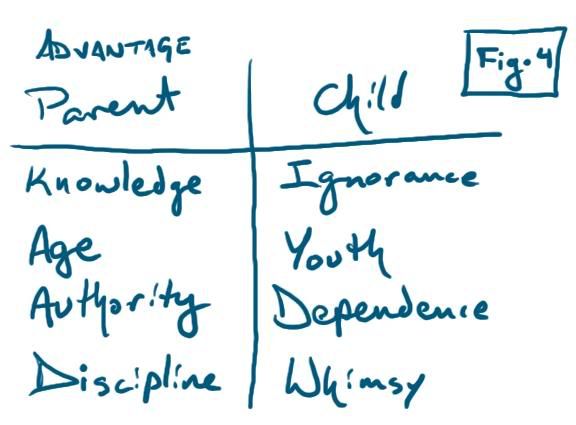
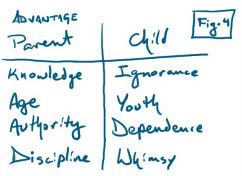
Let's briefly switch gears and talk about relationships, starting with figure 4:
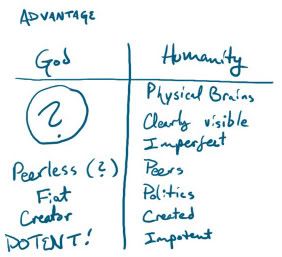
In a parent/child relationship (and I mean a minor child, not a grown one), the parent has the child at a disadvantage. The parent is older, wiser, and possessing of more self-control than the child is (usually). This makes the relationship asymmetrical, and it places responsibility for the child directly on the parent because the child can't take care of itself. Ideally, the parent raises the child to be a peer, another adult among many, capable of making intelligent and mature decisions autonomously. This is done with one-on-one interaction, an adult teaching a child step-by-step to become an adult itself. And this is done, at least in part, because the parent loves the child and cares for its well-being. Now consider the relationship between God and humanity:
It's a similar relationship - again, God has the advantage, and again, he damn well ought to be older, wiser, etc. than we are. How has God contributed to raising me as his child? Am I to reason from his lack of in-my-face involvement that he cares less about me than my own parents do? As far as I can tell, he wrote a letter and walked out before I was born - the letter is the Bible, walking out is Jesus' ascension into Heaven. To the best of my ability to tell, any moral shortcomings on humanity's part are the direct result of God's total failure to either make us right or raise us right, both as individuals and as a species.

Once I saw that, I couldn't un-see it. Good parents don't let their children do whatever the Hell they please; good parents make themselves a known presence in their childrens' lives, they raise their children by hand and guide them into becoming better people. Good parents do whatever the Hell it takes to protect their children and raise them to be the best people they can be. Any parent who allows her child to upset her has failed to control her temper; any parent who strikes a child in anger is at fault for not remaining in control of the situation. Why? Because children don't know what the fuck they're doing. I would know: I was a child once and I did some really embarrassing shit!

The parallels don't stop there. Households have rules, and parents are their authors; similarly, reality has rules (yay physics!), and God is their author. Why didn't God include any of these rules in his instruction manual? People understood math long before the Hebrews put quill to scroll, so why does the Bible have precisely zero interesting math in it (with the exception of a botched calculation of pi)? Moreover, why a holy book, instead of something more impressive? Every religion has holy books, but no religion has a holy organism that sings the holy text aloud and has no natural predators. Or how about a holy computer, a machine from God that can answer all our questions and also preserve God's language? The machine could also self-replicate and self-assemble, like a glorified RepRap machine. And a million other things, too - in short, why is God so boring?! Why did God do nothing to distinguish the one true religion from every other religion? Why is Yahwism, to all appearances, the same stuff in a similar package? I just don't get it.

But most importantly, if God exists, then why is he hiding from me? Silver Garou came up with what I think is an excellent argument on exactly this point, and it proceeds as follows:
1. God is omnipotent and omniscient, and therefore cannot be stymied in his efforts (or at least not by humans).
2. Since I myself know what would convince me of God's existence, God too must also know that thing.
3. Thus, God knows what would convince me of his existence. (from 2)
4. God has not convinced me of his existence (my mother did, once, but that wore off).
5. "Being hidden" does not necessarily imply the intention of "is hiding," since ruins can "be hidden" in the forest but obviously have no intentions of hiding. Yet until they are actually found, they do in fact remain hidden.
6. An entity that chooses whether to remain hidden or not, and has this as its option, does so with intent insofar as it is intelligent.
7. God is intelligent.
8. Thus God cannot remain hidden unless he also intends to be hidden and therefore "is hiding." (from 1, 6, 7)
C: Since God has not yet convinced me of his existence, then he is either hiding while waiting, or hiding forever, or does not actually exist as such (as omnipotent and omniscient, or at least enough of those things to actually convince me). Or he just doesn't want me to believe in him, which I guess is cool, too, except that it tells me he wants me to go to Hell (if there is one). (from 1, 4, 8)
God knows where I'm at, and God knows what it would take to make another Saul, Thomas, Jonah, or Pharaoh out of me. I can think of many reasons for him to do so, but none at all for him to wait or not do so at all.

OK, whew! That's it from me on why I don't believe... in this discussion... so far... today. It's been a little rough, but that is the gist of why theism makes no sense to me. So that's enough out of me: what do you think, cl? Where do you disagree with me, or at least diverge, and why? I'll make the assumption that you've still got what you think is a better way, and I'm curious to know what it is that you think is a good justification for theism, and why I should endorse it. Or, if it's a matter of personal revelation, then I'm curious as to how you can comfortably and honestly distinguish that revelation from insanity - no joke, this is an honest question on my part here.

I've pretty much said my piece and will wait to write anything as substantial as this until either I'm asked a direct question, or something else piques me. Ball's in your court!

Wednesday, October 21, 2009

Arguing on the Internet: Machina Ex Deus, part one (cl)

The Story So Far: cl and I are arguing on the internet! I outlined some metaphysics and epistemology in my last installment, and cl commented.

I used to be a theist; specifically, I was a fundagelical Christian. I saw God's hand in all things, I saw the Goddamned Devil at work in the world, I had promised my soul to Jesus several times and in several ways (I needed frequent fixes of God-smack), and I lamented that there should ever be anyone to not hear the glorious Word of God. I tried to be hopped up on God-smack as often as I could, and I'm not saying that to be pejorative: I thought the God-smack was good stuff at the time, and I thought that I was at my moral best when I was on it (full of Christ's love, in awe of the Maker's creation, etc.). Today I'm going to outline what changed - this is something of an autobiographical parable, inasmuch as I intend to gesture at my philosophical development while more or less ignoring everything else that was going on in my life and the world at large at the time.

Like all good parables, this one sets its tone with a metaphor. As I pointed out before, reality is ambiguous - or, rather, the relationship between reality and our perceptions is fundamentally unknowable because we are not omniscient, and therefore any perception of reality we might have is intrinsically ambiguous. So if I wake up with a headache and want to know what caused it and how to get rid of it, I have to do some brief testing: did I drink last night? I might have a hangover. Did I fight last night? I might have a bump on my head. And a million other things, too. Let's suppose for the moment that I don't remember what I did last night, but the two best competing explanations are that I either have a bump on my head, or I am hung over, or both (hooray for the inclusive "or").

A fairly direct method of testing whether I have a bump on my head is to feel around for one. But it might be the normal shape on my head, so it probably ought to be painful; that pain, in turn, could also be explained by a special sensitivity in that area for entirely bumpless reasons (for example, all people might have sensitive bumps in that spot on their heads - I don't know yet). To directly test whether I have a hangover, I could in principle do some bloodwork to check my BAC or look for metabolites or something, but that would be a pain, so I may just drink lots of water and see if the headache goes away. I could also take hangover medicine and see if it goes away. But in any event, if I take some action and then my headache clears up, I cannot tell for sure whether those two things are related at all; I can only make an "inference to the best explanation," or IBE.

Metaphor over, parable is go! Some years ago, I had an existential headache, and the two best explanations I could come up with were that I either had a sinful hangover, or a theistic bump on my head. I'm not sure quite what I did, but the headache went away. I realize that I may have merely taken a metaphysically naturalistic pill to mask the symptoms of my sinful hangover, which by rights I damn well ought to be feeling right now. That's a possibility. But the IBE I'm going with for now is that I had a theistic bump on my head from repeated doses of the fundagelical medicine stick. I stopped dosing, the bump went away, and my existential headache disappeared with it. So... what is my existential headache a metaphor for?

My existential headache consisted of an inability to reconcile any coherent idea of God with the observable facts of reality, to the best of my ability to interpret them.

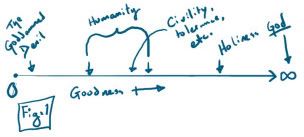
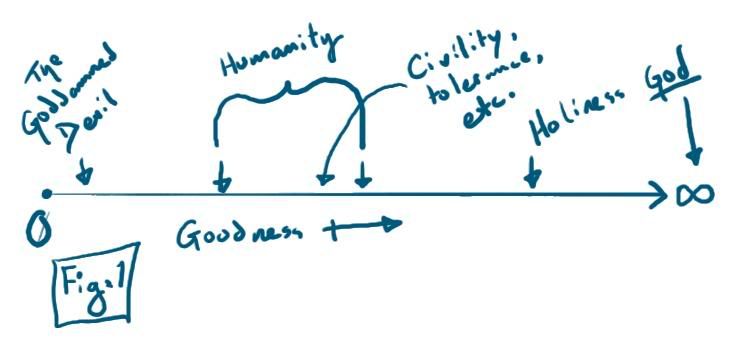
One of my first understandings of morality was that "good" is a continuum, where a "lack of good" constitutes "evil," and a maximum of good would be perfection. Something like figure 1 here:
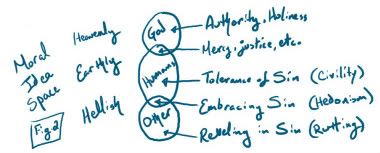
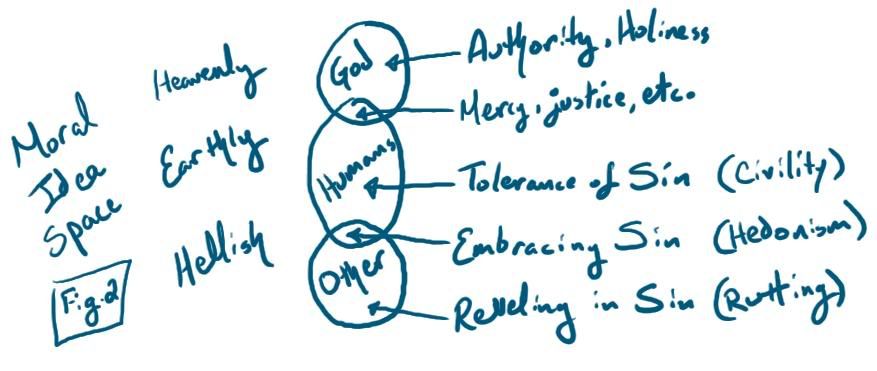
I now consider this a rather naive understanding of morality, mainly because it's grossly oversimplified, but it's not entirely without its merits. However, what I noticed is that if tolerance is within the "goodness range" of which humans are capable, then why can God not tolerate sin? Humans are able to live with each other's iniquities, to forgive those who trespass against us even if they keep doing it. I mean, hurting each other without meaning to do so is part of being human, and we can get over that, so why can't God tolerate sin in Heaven as he does on Earth? Well, I was told that it doesn't work like that, and rather something more like figure 2:
Here we see that there is God, who is Heavenly, and "other," which is Hellish. In between, overlapping with each but also having things all their own, is humanity. God is holy, and for that reason cannot abide sin in his presence, and so has withdrawn from the world until his final return. Humanity, being made in God's image, is able to understand some holy goods, such as mercy, justice, and compassion; but we are also capable of tolerating sin only because we ourselves are sinful. After all, if we dealt with each transgression as God says we should in the Bible, civilization would rather quickly collapse as we put to death everyone who violated pretty much any rule at all.

This explains why God tolerates sin on Earth, but not in Heaven, and by extension why we are on Earth and not in Heaven yet (because we still sin). But... wait... what exactly do we mean by sin? Definitionally, sin is that which God abhors, but why does God abhor it? Because he is holy? Then what is holiness? If it is mere godliness, then we have defined ourselves into a circle: whatever God does is holy because God's doing it, and whatever God abhors is sinful because God's abhorring it, and so to say that God is good is merely to say that God does as he pleases. I had not yet learned of the Euthyphro dilemma, but this is more or less how I arrived at it.

I realized at this point that there must be something about a particular thing which is sinful or holy, regardless of what God thinks of it; God's opinions, then, are the result of an interaction between his perfect perceptions of reality and its nature as sinful or holy, as the sinful or holy nature of the thing itself causes God to experience pleasure or disgust because of facts about God's personality. After drawing up tables and tables of sinful and holy things, however, I was unable to find any rhyme or reason behind the particular things that God told us were holy and sinful. It honestly looked to me like the Biblical deity was like a child with a sandbox, laying down arbitrary rules because he made everything, and wrecking our shit when he got upset with what we did just because he could. I see such a being as unworthy of worship, and if this is what God's like - an authoritarian dick-waver who thinks that merely being causally responsible for us (all by itself) gives him the right to tell us how to live - then I think we should all try to gang up on him Tower of Babel style. This is the behavior of a tyrant child, not of the rightful king of all existence.

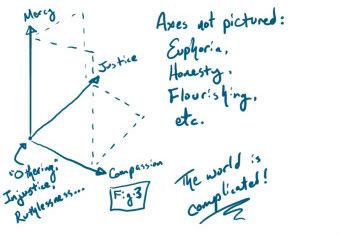
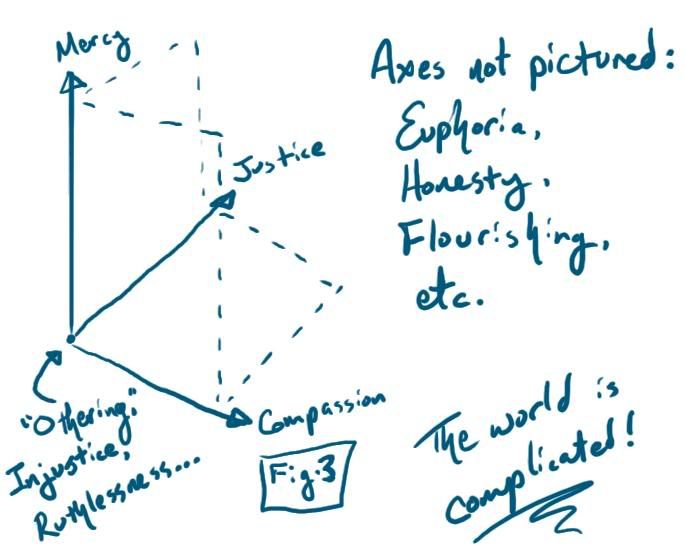
How do I know this? Because if morality is fundamentally arbitrary and God's at the helm, then all he has to do to eliminate evil and suffering is get over his bad self and change his own mind. Moses did it (Exodus 32:9-14). Anyway, my own personal ethics has evolved somewhat, moving from a moral idea space to a "morally-charged" multidimensional idea space, as seen in figure 3:
Between then and now, my understanding for the best of all possible Gods morphed from any religious type of deity to something like Nick Ifkovits' idea as laid out in his novel, Cloud Drops (he's a friend of my mom's): in this story, God is more or less a laid-back hippie who really only cares about people being good to each other. You do that, you get to go to Heaven and have crazy orgies all day long; don't, and you are a lost spirit, destined to stick around on Earth stewing in your own existential angst. I believe that in the story, those who die without becoming either good or evil are "recycled" after a fashion, but don't quote me on that (I haven't read it in a while). But religious faith is absolutely meaningless to this deity, it truly is works alone that get one into Heaven on this view; you don't even need to be a theist! So if this is the real deal, then I've already got it made and thus have nothing to be saved from. Even if I didn't get to Heaven, I've striven to eliminate angst from my life, so I think that hanging around on Earth as a specter wouldn't really be all that bad.

Yet it seems almost too obvious that I might be wrong on this one, and I might need to believe this or that particular thing, even if I don't buy the whole kit & caboodle. For instance, it might be the case that I really do need to accept Jesus into my heart to get into Heaven; but the rest of the Bible might be pure hogwash!

This is where things get really complicated; part two on Friday.

Thursday, October 15, 2009

Rethinking the Evolutionary Ethic: Towards a Scientific Ethics Once More

I've done quite a bit of writing in the past concerning the arbitrary and made-up nature of ethics as a field of study. I still stand by the proposition that ethical judgments and systems have no more bearing on reality than the rules of Chess or the particulars of this or that language (and if you think that language can correspond to reality in any metaphysically interesting ways, then do I have something for you!). However, I've been rethinking the matter of whether "good" lessons may be derived from a state of nature; as Richard Carrier points out, you certainly can derive an "is" from an "ought" (2:30), as long as you accept that morality is a system of hypothetical imperatives; but you have to be really fuckin' careful or you'll wind up balls-deep in naturalistic fallacies. This entry has been percolating away on my back-burner for quite some time, and I think I've finally got something refined enough to show, so here goes. Oh, one brief caveat: this is an ideal to move towards, not something we can do right away (kind of like how you can't force people to be free, or impose democracy on another nation... cough, cough...). We should take it as a long-term goal to get everyone on-board with this kind of ethic, is what I'm saying.

The bottom line is this: every situation or event lends itself to a "lesson" of sorts, a thing you can take away and learn from that situation or event; but figuring out just what the lesson is can be sticky business. Sometimes the lesson is big and important; sometimes the lesson is that not all lessons are big and important; sometimes the lesson is that you don't always get a new or interesting lesson from every situation or event. If your friend calls you a douchebag, then there are various lessons that you could take away from that: you might need to learn that you are in fact a douchebag from time to time; you might need to learn that sometimes your friend doesn't have the very same idea of douchebaggery as you do; you might need to learn that sometimes the opinions of your friends should be taken with a grain of salt; or maybe you should learn to be a douche-nozzle, not a douchebag. Each of these things is true, by the way, but the particulars of the event (the "full relevant context") will dictate what is the most important lesson to learn at the time. There is a Japanese saying: "shikin haramitsu daikomyo," which pretty much means, "every action holds the opportunity to learn." Insofar as evolving is an action, there is an opportunity to learn from it.

So what can we learn from evolution? What is the lesson to derive from all these molecular replicators puttering about on this rocky, watery marble of ours? Well, this is going to depend on what we adopt as our "full relevant context," and this in turn is a matter of perspective. If we limit our context to the idea that nothing lasts forever, we might rather easily adopt the ethic that we should get all we can while the getting's good. If we limit our context to the idea that any conspiracy of doves will be easily infiltrated by a lone hawk and its descendants, then we might adopt the ethic of, "try to be a hawk in a conspiracy of doves." Combining these two, we might adopt the ethic of, "try to be a 'concealed hawk' (or a cuckoo) in a conspiracy of doves, to extend the conspiracy as long as you can so that you and your descendants may prey upon it as long as possible." Or, in short, "domesticate the doves." So what perspective shall we adopt, what shall we consider as our context from which our ethics shall be derived?

In seeking an evolutionary morality, we must take into account the relevant context of evolutionary situations and events. Which ones? Hopefully, all of them. The following three things will apply to all evolutionary situations and events: every evolved and evolving organism will be a molecular replicator, and so in this sense, all the world is kin; the environment shapes replicators even as those same replicators shape it in their turn; and natural selection is a non-random (though perhaps probabilistic) process of meeting the demands of this very moment with the randomly varying available materials.

Let us begin by looking at all of life, past and present, as a single "tree of replication." Extant organisms are, on this view, buds along their conspecific twigs, which in turn meet in branching clades all connected to the great root of the very first replicator(s). Some of us are atoms arranged ape-wise, some of us are atoms arrange tree-wise, and some of us are atoms arranged spirochete-wise; but all of us are atoms arranged replicator-wise. All the world is kin, and we are all of us molecular replicators; though some of us are more complex than others, we are all the same at root. The main difference between this tree of replication and a literal tree is that entire trees are alive all at once, while the overwhelming majority of the tree of replication is dead and gone. But even this is merely a byproduct of our primitive linear conception of time, so there.

Let us also consider the role of the environment in any evolutionary process. The environment shapes replicators even as replicators shape the environment, yet we are able to identify many instances where an environmental disturbance has greatly impacted the evolutionary trajectory of this or that set of replicators. These vary from the simple and rather boring case of the peppered moth, to the exciting and catastrophic mass extinctions that have dotted our planet's history, to the cyclical routines of geomagnetic reversal or the mish-mash of interesting conditions responsible for the banded iron formations from our planet's reckless, feckless, misspent youth. But all of these events share an interesting and fundamental characteristic: they are opportunities for difference to shine. In all of these cases, there were a number of organisms (from a local population of a single species, all the way up to the entire planetary ecosystem) put on the chopping block and faced with that oldest of ultimata: adapt, or your lineage ends with you. The external environment, which can be tricky to define precisely, is an implacable and unpredictable foe, placing demand after demand upon the replicators inhabiting it.

Finally, let us consider the nature of the evolutionary process itself: it is the blind watchmaker, the forge of diversity and adaptation that has provided the raw materials which the environment (including other organisms) has been continuously refining to meet the demands of the moment. Not to this or that perfection, merely the demands of the moment. Evolution does not plan ahead at all, ever; the imperfect copying fidelity of molecular replicators simply creates difference, and these differences are judged by the environment. Those that do well go on to continue replicating; those that fail are lost forever. Natural selection is nothing more and nothing less than the submission of extant diversity to the demands of the present environment. Yet the environment changes constantly, and as it does, yesterday's superstars become tomorrow's has-beens, and countless might-have-been offshoots are lost as never-weres. The success and failure of this or that replicator has precisely nothing to do with any nonsensical ideas of "intrinsic fitness" or "perfection," and absolutely everything to do with the capricious contingencies of the surrounding environs.

We now have all the pieces of our puzzle. From these relatively simple facts proceed all the complexity we see today, and from these simple facts we may derive an ethic fit to meet the particulars of any evolutionary environment. Let's put them together and see what we get!

One of the first things to notice is that since the environment is fundamentally unpredictable, we can't always tell what will be useful tomorrow or in a thousand years. Sure, we can dream up all the adaptations we think might be useful here and now, but things are only the way that they presently are for now, and we don't know when or how they will change in ways beyond our control. Because we cannot ever be "completely prepared," we must diversify: in order to be prepared for as many eventualities as possible, we must tolerate as much diversity as we possibly can in order to minimize the likelihood of being completely wiped out for good. The lesson here is that homogeneity is not only boring, it is fucking dangerous, because we're putting all our evolutionary eggs into a relatively small eugenic basket. Except when we use eugenics, which may be used for good or evil just like nuclear energy or anything else, to try to permanently cure things such as congenital birth defects. (I'm serious about that, by the way: there is no such thing as an incorruptible good or an irredeemable evil - there is only risk, reward, and consequence.)

Speaking of "we," just what exactly is meant by this? Well, in order to incorporate as much diversity as possible, our use of "we" should be as all-embracing as possible. We see the rewards of kin-selected altruism in nature, but the lines drawn thereby are, for good reason, only as big as they have to be to increase the likelihood of copies of one's own replicators being propagated into the future. Yet, if all the world is kin (and we are), then we must realize that the instincts telling us that this one is kin and this one is not are misleading us. What we are doing here, in essence, is trying to make the largest possible "in-group." (Michael Fridman, of a Nadder! fame, points out in The ReBrook Gambit that Peter Singer argues for just such a thing.) Humans are only able to hold a "phone book" of maybe a couple hundred or so individuals, but this is only a matter of contingency; there is no principled reason why in-groups should be so small, and we see over and over that larger in-groups are often able to out-compete smaller in-groups - so let's all be part of the same in-group.

This leads to a rather interesting pseudo-paradox: all evolutionary fitness is relative to the environment, and the environment includes other organisms. Therefore, to be "fitter" is to be "fitter than" this or that other organism or group at surviving in the environment. Similarly, success can only be described in relation to other degrees of success, and thus to be "more successful" is to be "more successful than" this or that other organism or group at propagating in the environment. But wait! Even on this competitive account, the most success that can be achieved by a group is to completely wipe out all other competitors, and be the only one left. With no competition, there is nothing to be fitter or more successful than, with the sole exception of others within one's own group! So even if you "win" evolution, now you have to compete against your own previous in-group!

What this means is that being "better than" is a never-ending project; a mug's game. Relax and be out-competed; win and compete against the rest of the winners. You just can't "win forever." But what if instead of trying to be "better than" others, you try to be "better than" you were yesterday (or "better period"), and expand your in-group to include as many as possible? Then you maximize your in-group's diversity (and thus its ability to deal with unpredictable environmental threats) while at the same time eliminating competitors by turning them into confederates. In terms of resource acquisition, this is the equivalent of ceasing the attempt to get more than your neighbor, and instead figuring out how much is enough for each of you, then working together to make sure you both get what you need. Let's call this "winning together." As previously explained, winning forever is impossible, but winning together is awesome because it's less dangerous and less wasteful, while still getting you what you need. Sure, you won't win over your neighbor; the proper attitude for both sides to adopt here is, "So what?" The idea is that you care about each other's welfare, not about doing better than each other (or at least not to the point of death - there's still room for economic and political competition). Bottom line: caring is awesome, fighting is bullshit.

Well, whoop-de-doo! All we've done thus far is to explain how a conspiracy of doves is in every individual's best interest, because you're banding together with everyone rather than setting yourself against anyone. But this necessarily creates a perverse incentive for every individual to try to be the lone cuckoo (or the invading hawk), so now what? Well, OK, you want to be the lone cuckoo, and I want to be the lone cuckoo, but I think the two of us can agree that we don't want that guy to be the lone cuckoo. What's more, the two of you don't want me to be the lone cuckoo, and the two of us don't want you to be the lone cuckoo. Hmm. Now what?

Transparency, trust, and culture, that's what. Oh, and some tit-for-tat/retaliator strategery for good measure. Y'know, be a dove unless you come across a hawk, then roxxxorz that hawxxxor'z soxxxorz. And to any would-be hawks or cuckoos, realize that doing that thing may be profitable right now, but you're triggering an arms race that your descendants may or may not be able to continue, especially in light of the fact that the conspiracy of doves is actively trying to find and convert hawks & cuckoos when possible; but the doves will treat you as an implacable force of nature to be conquered or otherwise dealt with if you do not allow yourself to be reasoned with (I should know, because I'm the one telling the doves to do that thing). Take the long view - hawkery is a mug's game, and you're just pissing in the gene pool: you'll eventually get found out and kicked out (even the literal cuckoo has been found out, we humans just don't care enough to convert it or kick it out right now).

The rest of the confederates can work on building a rational and mutually agreeable foundation for trust, which will have to involve some form of transparency: it's informational give-and-take. Just like you sacrifice the liberty of killing whoever you like so that you can reasonably trust that nobody will kill you, a little bit of privacy can be sacrificed so that others can reasonably trust that you're not screwing them over. Not a whole lot, but the particular amount is a matter of contingent legislative agreement, not of general evolutionary ethics. I have a lot more to say on this, because I know it gets really fucking hairy, but I'm going to save it for some philosophy of politics stuff I have planned. Right now, I'm just saying that it's going to be an issue, but it can in principle be decided (just not "once and for all, for everyone everywhere, all the time always").

Finally, there's the matter of culture: teach your descendants that just about any form of difference that is not directly harmful now is of potential future value (and there is always difference), and so they should be as inclusive as possible; teach them to be confederates rather than cuckoos, so that they may be part of the messy and multifaceted in-group majority, and not doomed to be an out-group minority; teach them to actively foster transparency and trust, not to be suspicious or over-cautious with others; and teach them to stand up for themselves and their as-permissive-as-possible way of life, changing when necessary and defending themselves when necessary. In other words, start shaping the environment so that it is conducive to your way of life, but realize that there will be parts that cannot be changed or planned for, and make yourselves capable of dealing with those bits as much as you can. Y'know, plan ahead in the ways that nature, red in tooth and claw, cannot.

In simple, conversational terms, I see this form of ethics as proceeding along the following general lines: "So what's your goal here? Are you trying to work for the long-term benefit of all, including yourself? Or are you trying to work for the short-term benefit of yourself and your very closest kin, to the rest of our detriment? We'd definitely like to work with you, because you're all of potential future value; but if you're not interested in working with us, we'd sure like to change your mind. If we can't change your mind, well, there's going to be problems because you're making yourself into a threat. We don't want a threat in our midst, and we don't want a threat brewing from afar, either. So which is it, pal? Will you cooperate with all of us, or turn all of us against you?" I want to note here that "going off and doing your own thing," insofar as your own thing is of no threat to others, counts as cooperation. This is for the simple reason that if you're not a threat, then you don't need to be eliminated no matter where you are, and the elimination of non-threats is just short-sighted paranoid foolishness. And in a loose sense (which I will also be developing in the future), this also entails non-censorship, open communication, government transparency, a free press, patriotically paying one's taxes, and all sorts of other neat things.

This will still be a never-ending project, but it's one of winning together rather than winning forever (because the risk of getting wiped out for the benefit of others is minimized). And because the in-group is no longer splintering (or at least splintering as little as possible), this is no longer a mug's game because doing it right is winning for now, which is the point - keep winning for now, and you "actually win forever," rather than striving pointlessly to win forever over everyone else. The goals of such an ethic will be to seek out and incorporate as much diversity as possible, to tolerate non-harmful difference, to seek to remedy harmful difference and only use exclusion and violence as a last resort. In short, it will be a constructive ethic of cooperation, rather than a destructive ethic of competition. We cooperate with most of the bacteria in our gut, and look how well that has worked out! We've also cooperated in the past to get our mitochondria and various other organelles, and that's also been a rather resounding success for all involved parties. We imagine ourselves to be integrated individuals, but the truth of the matter is that every single one of us is a messy zoo of confederates - and this is the lesson: be a messy zoo of confederates at the societal level as well. Diseases either kill us or get killed, and this is the inevitable destructive result of competition. There is risk in cooperation (there is always risk in anything), but the dangers pretty much tautologically come from outside, as any individual who engages in hawkery will be immediately out-grouped because the in-group is defined by conspiratorial lovey-dovery.

Of course, this is still arbitrary, it's just that I'm arbitrarily enshrining "doing as much good as possible for as many as possible under the widest variety of circumstances possible," to which "all of everyone" ought to assent, because if this gets started in earnest, then everyone will be assimilated into the messy confederacy or eliminated. Evolutionary utilitarianism, perhaps. This, I think, is a good "ought" to derive from the "is" we see all around us. Whether or not this works, I can't really judge right now; I can only say that I like it, and it makes sense to me - so pick it apart and give me an opportunity to improve! One thing I can say for sure is that, in terms of facing reality, it sure beats the pants off the authoritarian dick-waving of religion, which amounts to the threat, "Be this way, or God's gonna get you!"

Man, now I want to accuse theists of "authoritarian dick-waving" as often as possible just to see the looks on their faces!

This post was featured in the 44th Humanist Symposium.

Thursday, October 1, 2009

Prejudice in Action: The Greeks were right, after all!

I've been reading a lot about diversity, inclusion, tolerance, and other such-what in the atheiskeptihumanist blogosphere recently, and it's given me pause for thought. Specifically, it's raised a rather sore point for me, the matter of my own prejudice. I'd like to share some thoughts on that today.

I hate ugly people. It's terrible, I know. It's awful, and arbitrary, and irrational, and harmful, and a disservice to valuable members of my society, and a betrayal of the values I hold most deeply. And I can't help it.

What's worse, I'm not even that great-looking. I mean, I think I look OK, and some people seem to find me fairly attractive and that makes me feel wonderful, but the point is that I'm not even "dump in your Cheerios and you wouldn't care" hot, and here I am pronouncing judgments on other people for their looks alone. I think I have a pretty low threshold for what I see as an attractive person, and I try to find beauty in all that I see in the spirit of "aesthetic optimism" or whatever. But for some things, and some people, I just can't see any beauty and that revolts me.

I confessed this to one of my friends, who responded, "Oh, I'm the same way. I go with the ancient Greeks on this one: ugly people were cursed by the gods." My friend was speaking facetiously (neither of us believes in any gods at all), but that's kind of the level this gets to: with nothing rational or intelligent to fall back on, no moral justification, we jumped right to divine arbitration for our Haterade.

I'm talking about this today because this is the sort of thing we're fighting against, the sort of unreasoning prejudice that we, as atheists, or secular humanists, or whoever, have to deal with. And it's the same sort of unreasoning prejudice that has plagued all sorts of people throughout history: "Lookit them folks! They's differ'nt from us! Let's hate on 'em!" It has been meted out in different degrees, at different times, from different sources, upon different targets, but at root it all comes down to, "They're different, let's get 'em." This one thing will tell us all we need to know about you. It's just false.

Here's the difference: I know this about myself, I recognize it as prejudice, and I fight against it actively because being prejudiced like this makes me feel like a bad person. Whenever I am interacting with someone who I think is ugly, I try my very hardest to shove the "Ah-ha-ha lookit the freak" thoughts to the back of my mind, and haul the "this person is a person and deserves to be treated as such" to the front. I try to take every opportunity that comes my way to beat my lizard brain with the cudgel of tolerance, so to speak, and so far it's working. The disgust and revulsion get a little less intense every time, and the unfamiliar thing that so weirded me out gets a little more familiar, a little less weird, a little safer every time. I see my prejudice as bad, whereas most bigots seem to see their prejudice as somehow correct. "We don't know 'em, and we don't wanna know 'em," and that's just fine and dandy to them, it seems.

This cuts both ways, however. On the one hand, this helps me separate myself from that crowd. On the other hand, now I'm more separated from that crowd, and that makes it harder for me to get into the heads of my fellow bigots and sort out what makes them tick. At the end of the day, that seems (to me) to create a moral difference between myself, a self-correcting bigot, and the greater group of self-reinforcing bigots. I try not to be insular, and when I find myself upset at another's appearance, I recognize it as my problem and do my damnedest to act like I don't think anything's wrong with that person. Or, at least, nothing I would be able to tell just by looking.

And so I see the prejudice of others as another sort of ugliness, an "ugliness on the inside." But is this the same kind of prejudice on my end, wearing a different hat? Perhaps. After all, can people really affect their attitudes? I mean, with practice, of course we can. But if determinism is true, then every uncorrected bigot in history "couldn't have helped it" in the sense that the necessary causes for their correction never came about. And so, trivial tautology that it may be, I can't "truly" help my prejudice for the simple reason that I can only do whatever work it is in my power to do, but no more. Not one jot or tittle. That's a real shame, to my mind. This is of no help in one respect, and of tremendous help in another.

It does no good to simply write off evils of any kind as causally necessary in the past, and therefore insurmountable obstacles. Sorry, that easy way out is simply cowardice in the face of evil. And because the consequences of prejudice impact the happiness of others, this is very much a moral issue, and so we should do whatever we can to make the situation better. So what can we do?

We can treat bigots like people, too. This is the "tremendous help" part, so pay attention! We can try to bring about the causes necessary for their correction. If we must wield peer pressure as a cudgel and metaphorically beat the tolerance into people, well, so be it. But this is a crude solution, and I think we should prefer more elegant ones wherever possible. This means engaging the opposition, keeping the dialogue going, loving our enemies, turning the other cheek, and just generally being the better, more patient people in the confrontation. Ugh, that sounds like work, I know... but it's the hardest and most productive work we can get in this culture war, and it needs doing.

Remember that most people think that they're good people, that they do the right thing most of the time, and that they're generally sane. This is totally false for pretty much everyone, unless you're Norman Borlaug. People need to think these things in order to maintain a healthy sense of self-esteem. Threatening the support of that self-esteem will be seen as a threat to the self-esteem itself (and thus a personal attack), and so we must be careful to be gentle. We must treat bigots, when we can afford to do so, with more care and empathy than they treat us. It's not fair. It sucks, and it's hard work. But it's the best way to make progress.

Each of those clauses in the last paragraph is important (except for the bit about Borlaug - well, OK, it's important but in a different way). For instance, "when we can afford to do so," allows for the fact that, if a fight is brought to us, we may need to respond by fighting. In that case, we are left with no choice, and must defend ourselves against an attack. But this will rarely score points against the other side, except in the general "social visibility" sense that we will make others see that we can't be bullied into submission. This is important, but it won't accomplish our goals all by itself.

We need to be aware of the psychological forces at play, and we need to be somewhat manipulative about how we go about this if we want to have the best effects possible. It's easy to get sucked into the trap of thinking that those who would oppress us deserve no quarter from us, but remember that desserts have nothing to do with it. Do you want to drive bigots away and reinforce their bigotry, or kill them with kindness, no matter how much it defies our own desire for retribution, to have a greater chance of bringing them around to a more civilized way? It's not always such a binary choice - for instance, here on my soapbox, I can pretty much be as loud and intolerant as I want, as my audience is pretty self-selecting - but in many situations, the two chief options will be some variation on, "Satisfy your own impulses and alienate the other person," vs. "Suck it up and make some progress on the other person, even though it hurts to let them 'get away with' being such a twit right now."

I am reminded of Plato's Republic, book one, where Socrates makes a case for the idea that we must do no harm. In discussing justice, Polemarchus volunteers as a definition of justice, "helping one's friends and harming one's enemies." Socrates responds that we humans are fallible and may be unable to judge with certainty who our friends and enemies are at any given moment. Because we may be mistaken, we should strive to err on the side of caution, treating all as friends and trying to harm no one. After all, in the long run, this may earn us some friends and thereby eliminate enemies (in what I think is the best way possible). This stacks up rather nicely with Sun Tzu's injunction to remove the enemy's desire to fight as the best way to achieve victory. Perhaps more appropriately to the situation, this also rings true with the words of Abraham Lincoln: "We are not enemies, but friends. We must not be enemies. Though passion may have strained, it must not break our bonds of affection."

And on that note, I'm done with this. For now.

Monday, September 14, 2009

Reverse-Engineering Religion, part three: We Are Building a Religion

Writing a holy text, even a joke one, can be a daunting task. I mean, not only does one have to deal with the theists, who may almost always challenge one on the basis that one is not taking religion seriously enough (perhaps for even presuming to write one); but one must also deal with the atheists who may almost always object that religion is being given too much deference (perhaps for even presuming that it deserves any attention at all). I aim to split the middle, and fall outside of both previously mentioned "almosts." I hope to accomplish this by designing a religion that is at least considered to be OK by all who hear of its premise. Here is my opener, that premise, for the holy text of the twenty-first century religion, and I'd like to know what... well... I'd like to know what everyone thinks of it, but I'll honestly be happy to find out what anyone thinks of it.
Above all else, understand these words: two commandments, and two alone, must you attempt forever to teach to all whom you meet, no matter how different, and no matter how long it may take. First, an appetite for unbridled reason and curiosity, that they might understand these words, and think upon them, and even question them loudly and without shame. For I tell you, if the many convince the few, then all shall have increased understanding; the few shall understand the many, and the many may witness the corrective power of right. And if the few convince the many, then all shall be done a valuable service; the many shall understand the few, and the few shall see the transformative power of right. And second, more simply, but equally as important: that which may be accomplished by working together is always greater than anything accomplished by working against any other.
I should note that perhaps the most fun aspect of writing a holy text is that I am afforded the luxury of picking and choosing what I will justify. It makes it easier to decide when to dive into the serious justifications for this or that; really, this is a point for humanism and a point against all moralities based upon divine fiat, for the simple reason that I can appeal to the things on which we merely agree on a direct basis, yet I may also justify rigorously (and even at great, plodding, unnecessary length) those things which I think need more thorough proof. Fun times!

So yeah, theists and atheist alike: what do you think of the above? Genuine truth, or silly bullshit? Honestly, if you think I've made a misstep, then please try to correct me because I am aiming for genuine moral truths here. I want to ape religion so goddamned well that nobody can tell without reading these blog posts, but do religion so goddamned well that it actually takes root in our culture. Be as critical as you can, even if you don't actually want to criticize; it shall only make me stronger, for I have the power of BALD ASSERTION! Woo!

Thursday, July 30, 2009

Poison for Your Brain: Misogynistic Quackery!

So there's this doctor, name of Denis Walsh. I like to call him "Doctor Douchebag." This man has an idea about how mothers ought to give birth to their children, and it's totally ridiculous. I mean that in the original "worthy of ridicule" sense. You may have seen this dick-bag on Pharyngula: he's the guy who says that women ought to decline painkillers during childbirth because the pains of labor happen and it will strengthen the bond between mother and child.

No joke.

Since this is Poison for Your Brain and not a rigorous philosophical paper, I'm just going to come out and say that this is nothing more and nothing less than hazing. Yes, it's a well-known phenomenon in psychology that an investment of time, money, effort, or pain will tend to cause the object of that investment to be perceived as more valuable. It doesn't matter if you're beating in a gang member, paddling the ass of a frat boy, embarrassing the shit out of a new sorority girl, or screaming in pain during childbirth. Leaving aside (for the moment) the fact that this is extremely sexist because there's no analogue for men (how should two male parents achieve such a bond with their adopted child?), he also commits the naturalistic fallacy: this is how something is, therefore it is good that it is that way, and doing it differently is bad.

Horseshit.

We humans need our pelvises to be a certain way - or, more accurately, within a small range of possibilities relative to all of the options available - in order to be able to walk upright as we do. We also need large skulls to house our prodigious brains. Being placental mammals as we are, these two biological necessities are at odds with one another, which puts humans in a fairly unique position when it comes to how our young are brought into the world. An equally valid interpretation is that human births are unnaturally painful and so should be heavily medicated in order to avoid a whole bunch of unnecessary pain that only the mother will experience for no good reason.

If a woman wants to go through childbirth totally sober for any reason (or even none at all), that is her prerogative and unwanted medications should not be forced upon her. This is already an option, and it's also not what Doctor Douchebag is proposing: he's saying that all women ought to be this way, ought to have these certain values, and ought to do things his way. Getting back to the sexism alluded to above, this entails that men do not need to form a bond in such a way. Why not? Well, either they don't need to be that connected to their children, or they can establish an equally valuable connection by other means. And corollary to that is the idea that mothers, for whatever reason he'd care to dream up, need to have this connection which men don't, or can't get it by that other means (otherwise he'd have no cause to say that the connection should be strengthened in this way specifically). Because this is based on differences between the sexes, this position is sexist insofar as it treats women one way because they're women and treats men a different way because they're men. And because what he is advocating is pain for women (whether they are OK with that pain or not, which some-but-not-all clearly are), it is also misogynistic.

What an insufferable fuckwit.

BONUS! I texted the following to my roommate:
Doctor, to Women: you shouldn't use painkillers during childbirth, because labor pain will make you more attached to your child. My comment: like hazing?
My roommate's response:
Sure! Just like if he got a root canal he should do that without painkillers, so he will appreciate having teeth more.
Fucking priceless.

Friday, July 24, 2009

The Phenomenology of Normativity: Towards a Scientific Ethics, part two

The goal of my last post on this subject was mainly to establish that ethics, as it has been done throughout history, has been more like a creative art and not a science. Whatever scientific endeavors we might wish to pursue, in ethics we are limited to scientifically examining the value we take as our source of normativity, since we cannot compare ethical systems on an ethical basis without begging questions. This is a step removed from studying normativity itself, which would be the goal of a "truly" scientific ethics.

Today, I'm going to switch gears and talk about the possibility of studying normativity itself. Whatever our basis for ethics, whatever our source of normativity, we certainly experience normative feelings, and that means there's a phenomenology lurking about (there's a "what it's like" to these experiences). Where there's phenomenology, there's brain states, and where there's brain states, there's neuroscience. While we cannot meaningfully compare systems of ethics on an ethical basis, we can evaluate our experiences in relation to those systems, and that may be a way "forward." Though, as I hope to explain, there will still be some fairly major roadblocks along the way.

Let's start with some predictions. If the idea that ethics is fundamentally arbitrary ever takes root, then I predict that ethics will take a much broader turn for the scientific in an effort to explain how we experience normative feelings in fearsome scientific detail (more precisely, this will become more popular at a rate greater than that at which it is currently so doing - it's going to "pick up"). There would be described something along the lines of a "right-on," corresponding to some brain state which results in feelings of moral righteousness or satisfaction, and a "hate-on" corresponding to brain states for moral disgust and outrage. Right-ons make you say, "Right on!" Hate-ons make you want to "get your hate on." Easy enough, yeah?

So we'll see all these right-ons and hate-ons, and we'll start to notice something. Within cultures, there will be certain shared values, to nobody's great surprise. But between cultures, and also within cultures, and even within individuals, there will be certain things that conflict with each other. Sometimes, generally reliable precursors to right-ons and hate-ons will behave in unexpected (well, not entirely unexpected) ways when placed at odds with each other. Sometimes, justice will have to compete with happiness, liberty with social order, sex with hunger, plushies with irony. Then we'll scientifically prove something we've known all along: people are messy and complicated, and we get inconsistent when pressed on matters. La-de-friggin'-da.

Fine and dandy, but then what? Well, we're probably going to try to base a "new and improved" ethics on all this sexy new research, which isn't a wholly bad idea, but again we'll run into a problem. There will be outliers, deviations from the norm, and we will need to accommodate these with our new system. We will find a platypus. Some of these will be easy: cultural differences valuing politeness over directness, or vice versa, can be chalked up to learned behaviors. Some things, like sexual orientation, could prove more difficult, depending on what cultural progress has been made. Most interesting, and most problematic, will be things like "insanity." For people whose brain states are so radically different from most anyone else's in terms of when right-ons and hate-ons are generated, it will be tough to deliver a principled (to say nothing of non-arbitrary) account of where to draw the line and say, "These brain states are acceptable and should be tolerated by all; those brain states are insane and should be quarantined and fixed."

So what's next? I'm thinking we'll start looking at behaviors to see if the misfit brain states are actually resulting in any problems, or if they just "look funny." Or we may come up with some sort of "rules of sanity," where you have to more or less pass a test to qualify as sane. Perhaps we may come up with a set of symptoms, not unlike now, where if you act like a crazy person then you're probably a crazy person. Does any of this sound familiar? This has been deliberately phrased to resemble the "classic" moral debate between consequentialism, deontology, and virtue ethics, but no such resemblance is necessary. Whichever way things go, we're going to run into the same damn problem as we had before: when trying to figure out the "right" way to do something, there is no principled and non-arbitrary way to decide which among these competing accounts is best, since the criterion we'll be using for "best" will itself frame the terms of the debate into a circle. Or, in other words, we can never square ourselves up with "right" apart from "purpose," but purposes are categorically chosen and thus always suspect, so we will always have to second-guess ourselves. People have consequentialist intuitions, and they also have deontological intuitions, and they have aretaic intuitions as well; and they apply these intuitions inconsistently most of the time, and frequently in unprincipled and self-serving ways. When it comes to matters of public policy, we need to be all the more cautious.

I have a guess as to what the root of the problem is. My guess has explanatory power, but I don't think it can be verified until we've got a much more robust neurological account of the phenomenology of normativity ("what it's like" to experience right-ons and hate-ons). I think that we crave moral authority. I think it is written upon the human brain that there is such a thing as moral rectitude and dammit, I gotta have that. We want to be able to know, in an uncaring and uncertain Universe, that we have done some manner of "right," and that counts for something. Righteousness, then, acts as a sort of emotional security blanket, telling us that no matter what happens, we're still good people and somehow different from and/or elevated above the hostile and insensate world around us in a meaningful way.

I think that we, as a species, need to get over this. For one thing, we'd save a lot of time and energy by not worrying about whether what we're doing is "right," and instead evaluating whether it's in line with the values of those concerned (ourselves, our loved ones, our culture, our neighborhood, etc.). Contextualizing our moral dilemmas like this, tying them down to actual values rather than an ethereal "good" independent of the full range of human concerns, would go a long way towards clearing up ethical debates. The reason for this is simple: contextualizing the dilemma, phrasing your ethical propositions in terms of chosen purpose and value, leaves less room for inconsistent views of the ethereal "good" and helps prevent people from thinking they're talking about the same thing when they're actually talking right past each other. It makes us clarify our ideas and that facilitates communication, plain and simple. Let's look at a few examples:
Mecca Religious Police, 2002: Our purpose is to follow the commands of Allah, and Allah commands that women not be seen in public without headgear, period. This means that women's fashion is more important than women's lives when it comes down to it, like in that burning building right over there.
Firefighters: Umm... fuck that! Our purpose is to save people from burning alive, no matter what your stupid god has to say about it! If that means pissing in your Cheerios, then so be it. Allah can take it up with us later if he likes.
- - -
Pro-Life Lady: Our purpose is to do right by God, and that means treating all these helpless embryos as full persons in their own right, protecting them from would-be murderers who carelessly create and then abandon them. We value the lives of people, from zygotes on up, more than the convenience of people with the luck to have been born already.
Pro-Choice Lady: Cute rhetoric, but our purpose is to secure the reproductive rights of women, which means that they don't have to reproduce if they don't want to. We also value born persons over unborn anythings, and while abortion's always a fucking tragedy, it's even worse for a woman to be unable to control her body because of something someone else is doing to her, which is the situation you'd be putting her in if a zygote has personhood.
- - -
Homophobic Man: I value marriage as something that only one man and one woman can do together. My purpose here is to stop teh gheyz from getting their relationships legally recognized, because that makes me feel like my kind of relationship is no longer more valued than theirs.
Normal Man: Grow a pair, you twit - that's the point! We value equality, and our purpose is to make it so that the love between any two people is equal in the eyes of the law. This way, anyone can marry anyone, and we can all drink from the same fuckin' fountain.
OK, so it wouldn't happen just like that, but I still think that phrasing our hypothetical imperatives as hypothetical imperatives, complete with values & purpose, would still help clear up all this talk of what's right. At the end of the day, nothing is really changed: "the good" still hasn't been settled, "how should we live" has not been solved, and ethics still has no more of a foundation than it has ever had. In a way, that's kind of my point: "the good" can't be settled, "how should we live" will always be an open question, and ethics can only be founded on arbitrarily chosen purpose and value. All science can do is identify some trends (which may or may not change), crunch some numbers (which may or may not apply to individuals), and give an explanatory account of how things got that way (which is an "is," not an "ought"). Don't get me wrong - these are useful things to have whether or not we end up with an objective ethics. I'm just saying that, in order to identify a source of normativity by way of science alone is an absurd notion, unless the source is our own imaginations. And that's a full surrender to my position that ethics is made-up and entirely in our heads.

Ultimately, I suppose that all this fancy talk doesn't have an impact upon the brute fact that we still have values and choose purposes. But acknowledging the fact that these are subjective and arbitrary, if we value things like reason and truth, is something that ought to be done.