OK, I know I said I wouldn't put anything up here until tomorrow, and that was coincidentally when the newest proof of TQM was supposed to arrive, but IT CAME TODAY SQUEEEEEEEEE!Yay yay yay! I'm an actual author now an' I can get money for the story I wrote an' everything! I'm so happy!
OK, but seriously, buy my book. This is probably the only time I'll be shamelessly and unapologetically pimping for myself, because now there's a link to buy it over in yonder sidebar. (Please buy my book!)
Update Schedule
This blog updates irregularly.
Showing posts with label the quantum mechanic. Show all posts
Tuesday, February 2, 2010
Monday, November 30, 2009
The Quantum Mechanic: Un-Deleted Scenes!
I've got all these handy navigation links in the chapters, but none for the Un-Deleted Scenes, so I've added that here (as well as a link from the Epilogue that points to this page). Here you go:
Rock most hard. Have a great one, everybody!
The Quantum Mechanic: Un-Deleted Scene Six
UN-DELETED SCENE 6: Victor playtests the device.
On a rocky planet circling the Sun at odd angles, a battle has just ended. Victor puts his weapons away, eats his fill, and then resumes his journey. The destination is not so important as how he gets there, but at the moment, he needs to make up some time. He visualizes wheels in his mind, designs a simple but effective drive train, then goes down to all fours while the device goes to work.
Hard rubber forms into tires around cartilaginous wheels. The discs calcify, and Victor's hands and feet are fused over the axles. His knees lift up from the ground, and callused pads nudge the wheels into motion. He's off. Victors leg bones are re-shaped, pulled out of joint, and arranged into pistons to more effectively drive his body. Along his spine, improvised neural architecture translates his thoughts into the proper motions, and then suddenly, being a motorcycle comes as naturally to Victor as walking.
The road is in a state of severe disrepair. Chunks of pavement jut out at odd angles, potholes threaten to jar him out of his smooth and calculated motions, and the odd tree and crater disrupt the road entirely at points. Victor presses on, his weight shifting to pull wheelies, bunny hops, and occasional leaps and bounds. His path of travel weaves through and around the encroaching wilderness, leaving only the occasional squirt of lubricating saturated fat. But it is enough for a quick and clever observer to follow.
Something approaches from the horizon, vaguely behind him. It moves with frightening speed, faster than sound. Victor decides to make his stand on a nearby overpass. His pistons disengage, and he gradually decelerates as muscles weave themselves into braided coils. Multipronged chitinous hooks form at the ends, and launch themselves at the overpass as Victor rolls underneath. Victor pulls his weight back, tightens his cords, and lifts off the ground. One of his hooks loses grip, and he loses balance - the device compensates by using the gyroscopic inertia of the still-spinning wheels to correct his pitch. Coming down from his arc now, the wheels disengage and Victor curls up to roll to a stop on the raised concrete. New arms and legs have formed before his tendrils have completely retracted, and now the metals he has been carrying with him are put to use: tiny bits of acid-cut shrapnel are chemically welded to each wheel, and as a rocket launches, Victor's eyes plot an interception course. The rocket is fast, but stupid, and the weaponized wheel is a small price to pay to take the explosive out of the picture. Victor hurls it with great power and accuracy, then winds up for his pitch at the jet itself.
At this height and range, the jet cannot change course quickly enough to dodge the incoming projectile. Instead, it launches a guided missile upon its target's position. The wheel tears through a wing, then the jet veers off before jerking toward the ground for a crash that shall be drawn out over several miles. As it nears its quarry, the digital pilot notes that Victor is tricking the missile's guidance algorithms into striking the concrete of the overpass - the man will be damaged, but not for long. The pilot's last thoughts before impact concern transmitting vital data on the new talents displayed by the target back to central intelligence.
Victor comes to rest after being thrown by the blast, watches the dying aircraft sail off into the distance. He notices a couple of nearby abandoned vehicles, checks them for any remaining gasoline. Two have had their caps removed, all unspent fuel either siphoned off or evaporated. The third one has about a quarter tank left; he drinks up the fuel, metabolizes it into more stable compounds, then heads off to search the wreckage of the plane, snatching up vegetation in passing to add to his biomass. By the time he reaches the first scraps of metal, he is a hulking colossus, picking up the twisted wreckage one piece at a time and arranging them as spines upon his back. They will be useful later, but there is nothing for him to do with them now.
After following the trail left by the felled hunter, Victor finally comes upon his prize: the remains of the cockpit. He is in luck, for the computer failed to wipe its mind before dying. Victor analyzes what is left of the machine, divining its home from the clues left in the dead slab of its brain. Nearby is a mostly intact fuel tank, too; this will be handy in time. Victor places what is left of the plane's nose upon his head, a mocking mask of his erstwhile pursuer, then forms himself into a great snake and sets about slithering across the plain at great speed.
After some time, Victor nears a deep forest. There are eyes everywhere: in the sky, under the ground, and especially in the trees. Without losing speed, Victor shifts his true brain to the rear of his body, letting his leading body act as a decoy. He writes subprocesses to handle navigational problems, then watches as his body courses through the thickening wood before him. Soon, he hears a buzzing from uncomfortably close; a swarm of stinging metal insects is upon him, injecting all manner of deadly substances into his body: corrosive acids, neurotoxins, engineered bacteriophages, retroviral scramblers. With his true brain at the rear, Victor is able to quarantine the infections as they attack his body at the mechanical, nervous, cellular, and chemical level, attempting to screw him up and shut him down from every angle all at once. He sheds the infected portions, sprays a few weapons of his own into the air, watches the swarm crumple and fall. He is wounded, but not mortally so. He presses on.
Near to the ocean now, he must find a way to cross. Flight is dangerous, for he is slow in the air; swimming upon the surface leaves him open to attack from all angles; the sea floor is slowest, but safest. Victor decides to take the low road, pitches down the seaside cliff, sticky tendrils shooting out to grasp the cliff face and control his descent. Into the salty surf now, he hugs the rocky bottom, thousands of tiny finned appendages guiding his tremendous length at every step of the way. He has far to go, and not much to help him along the way. The jet fuel is metabolized a little at a time to fuel electrolysis which Victor uses to separate oxygen out from the water; the remaining hydrogen is also spent as fuel, in stages and stages. A trail of bubbles and tracks in the sand is all that Victor leaves behind.
But after a time, with quite a ways left to go, Victor is consuming his own biomass just to keep moving. High above, he hears a broadcast signal: he is being watched. His position has been pinpointed. It is only an eye, no threat to him and not worth pursuing, but his position has been compromised. He keeps moving, makes an estimate of the time that is left to him. Soon, he comes across a hydrothermic vent in the inky blackness of the deep. Velvet tubeworms and albino crabs are both a meal and a textbook to him, as he adds their biomass to his own and learns their metabolic processes. He refines them, streamlining the chemical act of eating to something more suitable to his ideas of efficiency, then digs into the sea floor as muscular cords weave themselves into a large, stretchy bladder. Victor improvises valves to suck the vents into himself, and when he is of a suitable buoyancy, he releases his grip upon the earth and shoots up to the light.
Higher and higher, he virtually screams past all manner of ecosystems layered between the surface and the depths, bursting from the water in a plume of salty spray. He rises into the clouds, slowing down now as he forms his body into a large airfoil. Flattening himself, waving through the air like a magic carpet, Victor finally lets his breath out and forces the gas out behind him. Let them look at the sea floor; he has risen above that and now surfs among the clouds. He sacrifices altitude for speed, descending into a flattening path of travel as he achieves an ever more aerodynamic shape, arranging his various metal fragments to cut through the air as precisely and usefully as possible. Gravity has a great deal of work to do for him, and he squeezes the inexorable attractant to the very last drop, even at the expense of his last bits of extra biomass.
The coast is in sight now, and off in the distance a gleaming tower looms. As Victor descends back to sea level, gliding upon leathery flaps, he loses sight of his enemy's citadel but remembers its location. Plunging into the sandy beach, he grinds down his most useful-looking chunks of metal into deadly blades, then sheds the excess as he goes off in search of food. He is able to photosynthesize fuel from starlight, but it is a slow process and he cannot maintain his speed for very long with light alone.
There is a flash in the distance, and a bullet tears into Victor's head before he even hears the shot. He has learned to hide his true brain away from all of the obvious places, so the injury is but a minor inconvenience. However, his sensory apparatus has been damaged, and so he is not able to anticipate the next several bullets to tear through his body. Pain soon gives control to instinct, and Victor flattens himself against the ground, weaving around the thin grass to avoid betraying his presence. Safe, invisible, motionless, Victor then sorts out the damage to determine the general directions of these newest assailants. Winged automatons descend from the sky, flaming swords in hand, ready to cut their quarry down at the first sign of motion.
Victor waits for the right time to strike. He is invisible, colored and textured as his surroundings, inviting his would-be killers to tread upon him. One soon does, and he works his way inside, inflating a viciously bladed dummy body to be cut down by his own hand as he infiltrates the neural architecture of his host. He then mimics the expected chatter for a downed enemy report, sees into the whole communication network that tracks the progress and elimination of his partners in this game. He is inside the machine now, and by the looks of it, the first to infiltrate the network undetected. In his hidden mind, he reflects briefly upon the difficulty of determining whether another player has infiltrated the network as stealthily as he has. He sees the snipers now, knows their precise positions, but they are no longer a threat to him. He is dead to the system, a cypher born anew into this subverted soldier. No other devices have made it this close to the citadel, so the cadre of clockwork angels is ordered to return to the gleaming city on the hill.
Victor flies into the air in his new body, slipping easily into formation with his companions as they make their way home. He sees the glorious city in all its splendor as they approach, all of the din and furor surrounding the ivory tower at its center. He realizes with glee as they approach that that is their destination: he has infiltrated the honor guard of the central processor, the guardian angels of that angry machine trying to destroy him and his fellow players. Victor analyzes the memories of his host, determines the power structure of the central processor. There are failsafes upon failsafes, and he cannot simply cut one cord to bring down the entire house.
But he can destroy the building.
As Victor's host and companions take up their positions, roosting around the very top parapets of the ivory tower, he waits. They settle into their hibernation routines, and then Victor springs into action. He pitches forward, dives down along the face of the edifice, and lights his flaming sword as he nears the foundation. At nigh-supersonic speed, he corkscrews through the walls and supports, cutting the outer wall and inner structure to ribbons. Before gravity can take its toll, he is out and free, the fleeing traitor with a glittering tail of pursuers as the central processor for the whole city comes crashing down behind him. They are on to him, but it is too late by far. Machines wither, crash, and die as their centralized brain has all its supports torn out from under it, crushed beneath its own weight. The world skips a beat, resets, and Victor stands before a gunmetal gray automaton crackling with orange lightning.
"Congratulations, Victor. You win. Again."
"Why, thank you," he responds. "It gets easier every time."
"Still," the Quantum Mechanic responds, "I would have expected another to surpass you by now, as you have surpassed others in your own time." Victor blushes, flattered by the game master. "So, how do you feel?"
"I feel great! Triumphant. It is good to defeat an enemy, if only an invented one."
"What do you mean?" The Quantum Mechanic's face is inscrutable as ever, but its shift in posture indicates confusion.
"Well, you know, the central processor is only an enemy because we call it an enemy, and it acts like one. In reality, it's just a part of the bigger picture. Playtesting and all that. It's a honing implement, not a true enemy."
"Well, on that analysis, all enmity is invented." Victor pauses for thought.
"You know," he says after a few moments, "That's right."
On a rocky planet circling the Sun at odd angles, a battle has just ended. Victor puts his weapons away, eats his fill, and then resumes his journey. The destination is not so important as how he gets there, but at the moment, he needs to make up some time. He visualizes wheels in his mind, designs a simple but effective drive train, then goes down to all fours while the device goes to work.
Hard rubber forms into tires around cartilaginous wheels. The discs calcify, and Victor's hands and feet are fused over the axles. His knees lift up from the ground, and callused pads nudge the wheels into motion. He's off. Victors leg bones are re-shaped, pulled out of joint, and arranged into pistons to more effectively drive his body. Along his spine, improvised neural architecture translates his thoughts into the proper motions, and then suddenly, being a motorcycle comes as naturally to Victor as walking.
The road is in a state of severe disrepair. Chunks of pavement jut out at odd angles, potholes threaten to jar him out of his smooth and calculated motions, and the odd tree and crater disrupt the road entirely at points. Victor presses on, his weight shifting to pull wheelies, bunny hops, and occasional leaps and bounds. His path of travel weaves through and around the encroaching wilderness, leaving only the occasional squirt of lubricating saturated fat. But it is enough for a quick and clever observer to follow.
Something approaches from the horizon, vaguely behind him. It moves with frightening speed, faster than sound. Victor decides to make his stand on a nearby overpass. His pistons disengage, and he gradually decelerates as muscles weave themselves into braided coils. Multipronged chitinous hooks form at the ends, and launch themselves at the overpass as Victor rolls underneath. Victor pulls his weight back, tightens his cords, and lifts off the ground. One of his hooks loses grip, and he loses balance - the device compensates by using the gyroscopic inertia of the still-spinning wheels to correct his pitch. Coming down from his arc now, the wheels disengage and Victor curls up to roll to a stop on the raised concrete. New arms and legs have formed before his tendrils have completely retracted, and now the metals he has been carrying with him are put to use: tiny bits of acid-cut shrapnel are chemically welded to each wheel, and as a rocket launches, Victor's eyes plot an interception course. The rocket is fast, but stupid, and the weaponized wheel is a small price to pay to take the explosive out of the picture. Victor hurls it with great power and accuracy, then winds up for his pitch at the jet itself.
At this height and range, the jet cannot change course quickly enough to dodge the incoming projectile. Instead, it launches a guided missile upon its target's position. The wheel tears through a wing, then the jet veers off before jerking toward the ground for a crash that shall be drawn out over several miles. As it nears its quarry, the digital pilot notes that Victor is tricking the missile's guidance algorithms into striking the concrete of the overpass - the man will be damaged, but not for long. The pilot's last thoughts before impact concern transmitting vital data on the new talents displayed by the target back to central intelligence.
Victor comes to rest after being thrown by the blast, watches the dying aircraft sail off into the distance. He notices a couple of nearby abandoned vehicles, checks them for any remaining gasoline. Two have had their caps removed, all unspent fuel either siphoned off or evaporated. The third one has about a quarter tank left; he drinks up the fuel, metabolizes it into more stable compounds, then heads off to search the wreckage of the plane, snatching up vegetation in passing to add to his biomass. By the time he reaches the first scraps of metal, he is a hulking colossus, picking up the twisted wreckage one piece at a time and arranging them as spines upon his back. They will be useful later, but there is nothing for him to do with them now.
After following the trail left by the felled hunter, Victor finally comes upon his prize: the remains of the cockpit. He is in luck, for the computer failed to wipe its mind before dying. Victor analyzes what is left of the machine, divining its home from the clues left in the dead slab of its brain. Nearby is a mostly intact fuel tank, too; this will be handy in time. Victor places what is left of the plane's nose upon his head, a mocking mask of his erstwhile pursuer, then forms himself into a great snake and sets about slithering across the plain at great speed.
After some time, Victor nears a deep forest. There are eyes everywhere: in the sky, under the ground, and especially in the trees. Without losing speed, Victor shifts his true brain to the rear of his body, letting his leading body act as a decoy. He writes subprocesses to handle navigational problems, then watches as his body courses through the thickening wood before him. Soon, he hears a buzzing from uncomfortably close; a swarm of stinging metal insects is upon him, injecting all manner of deadly substances into his body: corrosive acids, neurotoxins, engineered bacteriophages, retroviral scramblers. With his true brain at the rear, Victor is able to quarantine the infections as they attack his body at the mechanical, nervous, cellular, and chemical level, attempting to screw him up and shut him down from every angle all at once. He sheds the infected portions, sprays a few weapons of his own into the air, watches the swarm crumple and fall. He is wounded, but not mortally so. He presses on.
Near to the ocean now, he must find a way to cross. Flight is dangerous, for he is slow in the air; swimming upon the surface leaves him open to attack from all angles; the sea floor is slowest, but safest. Victor decides to take the low road, pitches down the seaside cliff, sticky tendrils shooting out to grasp the cliff face and control his descent. Into the salty surf now, he hugs the rocky bottom, thousands of tiny finned appendages guiding his tremendous length at every step of the way. He has far to go, and not much to help him along the way. The jet fuel is metabolized a little at a time to fuel electrolysis which Victor uses to separate oxygen out from the water; the remaining hydrogen is also spent as fuel, in stages and stages. A trail of bubbles and tracks in the sand is all that Victor leaves behind.
But after a time, with quite a ways left to go, Victor is consuming his own biomass just to keep moving. High above, he hears a broadcast signal: he is being watched. His position has been pinpointed. It is only an eye, no threat to him and not worth pursuing, but his position has been compromised. He keeps moving, makes an estimate of the time that is left to him. Soon, he comes across a hydrothermic vent in the inky blackness of the deep. Velvet tubeworms and albino crabs are both a meal and a textbook to him, as he adds their biomass to his own and learns their metabolic processes. He refines them, streamlining the chemical act of eating to something more suitable to his ideas of efficiency, then digs into the sea floor as muscular cords weave themselves into a large, stretchy bladder. Victor improvises valves to suck the vents into himself, and when he is of a suitable buoyancy, he releases his grip upon the earth and shoots up to the light.
Higher and higher, he virtually screams past all manner of ecosystems layered between the surface and the depths, bursting from the water in a plume of salty spray. He rises into the clouds, slowing down now as he forms his body into a large airfoil. Flattening himself, waving through the air like a magic carpet, Victor finally lets his breath out and forces the gas out behind him. Let them look at the sea floor; he has risen above that and now surfs among the clouds. He sacrifices altitude for speed, descending into a flattening path of travel as he achieves an ever more aerodynamic shape, arranging his various metal fragments to cut through the air as precisely and usefully as possible. Gravity has a great deal of work to do for him, and he squeezes the inexorable attractant to the very last drop, even at the expense of his last bits of extra biomass.
The coast is in sight now, and off in the distance a gleaming tower looms. As Victor descends back to sea level, gliding upon leathery flaps, he loses sight of his enemy's citadel but remembers its location. Plunging into the sandy beach, he grinds down his most useful-looking chunks of metal into deadly blades, then sheds the excess as he goes off in search of food. He is able to photosynthesize fuel from starlight, but it is a slow process and he cannot maintain his speed for very long with light alone.
There is a flash in the distance, and a bullet tears into Victor's head before he even hears the shot. He has learned to hide his true brain away from all of the obvious places, so the injury is but a minor inconvenience. However, his sensory apparatus has been damaged, and so he is not able to anticipate the next several bullets to tear through his body. Pain soon gives control to instinct, and Victor flattens himself against the ground, weaving around the thin grass to avoid betraying his presence. Safe, invisible, motionless, Victor then sorts out the damage to determine the general directions of these newest assailants. Winged automatons descend from the sky, flaming swords in hand, ready to cut their quarry down at the first sign of motion.
Victor waits for the right time to strike. He is invisible, colored and textured as his surroundings, inviting his would-be killers to tread upon him. One soon does, and he works his way inside, inflating a viciously bladed dummy body to be cut down by his own hand as he infiltrates the neural architecture of his host. He then mimics the expected chatter for a downed enemy report, sees into the whole communication network that tracks the progress and elimination of his partners in this game. He is inside the machine now, and by the looks of it, the first to infiltrate the network undetected. In his hidden mind, he reflects briefly upon the difficulty of determining whether another player has infiltrated the network as stealthily as he has. He sees the snipers now, knows their precise positions, but they are no longer a threat to him. He is dead to the system, a cypher born anew into this subverted soldier. No other devices have made it this close to the citadel, so the cadre of clockwork angels is ordered to return to the gleaming city on the hill.
Victor flies into the air in his new body, slipping easily into formation with his companions as they make their way home. He sees the glorious city in all its splendor as they approach, all of the din and furor surrounding the ivory tower at its center. He realizes with glee as they approach that that is their destination: he has infiltrated the honor guard of the central processor, the guardian angels of that angry machine trying to destroy him and his fellow players. Victor analyzes the memories of his host, determines the power structure of the central processor. There are failsafes upon failsafes, and he cannot simply cut one cord to bring down the entire house.
But he can destroy the building.
As Victor's host and companions take up their positions, roosting around the very top parapets of the ivory tower, he waits. They settle into their hibernation routines, and then Victor springs into action. He pitches forward, dives down along the face of the edifice, and lights his flaming sword as he nears the foundation. At nigh-supersonic speed, he corkscrews through the walls and supports, cutting the outer wall and inner structure to ribbons. Before gravity can take its toll, he is out and free, the fleeing traitor with a glittering tail of pursuers as the central processor for the whole city comes crashing down behind him. They are on to him, but it is too late by far. Machines wither, crash, and die as their centralized brain has all its supports torn out from under it, crushed beneath its own weight. The world skips a beat, resets, and Victor stands before a gunmetal gray automaton crackling with orange lightning.
"Congratulations, Victor. You win. Again."
"Why, thank you," he responds. "It gets easier every time."
"Still," the Quantum Mechanic responds, "I would have expected another to surpass you by now, as you have surpassed others in your own time." Victor blushes, flattered by the game master. "So, how do you feel?"
"I feel great! Triumphant. It is good to defeat an enemy, if only an invented one."
"What do you mean?" The Quantum Mechanic's face is inscrutable as ever, but its shift in posture indicates confusion.
"Well, you know, the central processor is only an enemy because we call it an enemy, and it acts like one. In reality, it's just a part of the bigger picture. Playtesting and all that. It's a honing implement, not a true enemy."
"Well, on that analysis, all enmity is invented." Victor pauses for thought.
"You know," he says after a few moments, "That's right."
Friday, November 27, 2009
The Quantum Mechanic: Epilogue, part 2
Click here for part 1.
"Well, too bad," Gleck says. "Those people all had a chance at Heaven, and they were not worthy. They deserved what they got."
"What about you, Ben," Douglas asks. "Have you gotten what you deserve?"
"I - you - stop trying to twist my words! Look, I have no reason to help you, so I'm not going to. That's final!" Cameron sighs. Douglas strokes his chin. Alvina just stands and seethes at the miserable sadist in front of her, refusing to end the suffering of untold numbers of humans out of nothing more than sheer obstinacy.
"Very well," Douglas says at last. "I believe our guest needs some time to think."
"I need - " and he disappears. " - Nothing from you!" But now nobody is around.
Benjamin Gleck stands at the top of a mountain, alone. He shouts, but no one answers. He tries to expand his consciousness, but that heavy cloud weighs down upon him once more. He thinks. There has to be a way out. He looks around.
Of course! Gleck runs at full speed toward the nearest edge, and flings himself over. He laughs all the way down, thoughts of revenge and defiance running through his mind. He closes his eyes just before impact, and then - nothing. Nothing happens. He opens his eyes, and he is safely upon the ground. Funny, he didn't feel anything. He pinches himself. He registers pressure, understands that a fold of his skin is being squeezed between his thumb and forefinger, but he feels nothing. He looks around for a rock, grabs it, and then tries to smash his hand upon a boulder - the rock crumbles in his hand. He tries to smash his head upon the boulder, but he only registers a dull anaesthetic thumping. No pain. No sensation at all, only the understanding that his head is in fact bouncing harmlessly upon stone.
Ben screams to no one in particular, shouts after the wind, curses the rocks around him. He can't feel anything, he can't hurt himself, he can't even die. So he walks.
Benjamin Gleck walks for a very long time, through forest and valley, along rivers and over mountains. Day and night, rain or shine, he walks throught he world. He never feels hungry or tired, he does not eat and does not sleep.
How did this happen? He tries to sort out how his life has come to this insensate wandering, but the thinking is troublesome. He must stay strong in his faith. And so he walks. And walks. And walks.
He tires of walking, but there is nothing else to do but think. Food eludes his grasp, animals give him a wide berth, anything he attempts to use for a tool simply crumbles in his hand. He can only do two things: walk, or think.
Benjamin keeps walking.
He loses track of time, has no idea where he is or where he's been. He thinks he's on Earth, but he's not sure. Sometimes, he comes across the remnants of civilization: depressions where basements used to be, great wreckages of cities overrun by the wilderness that once surrounded them. It is not the world he knew. But he knows that the Quantum Mechanic is watching his thoughts, so he guards them carefully. He refuses to give his enemy the satisfaction.
One day, Benjamin finds a beach. He sits in the sand for a while, watches the waves lap at the beach. He finds round, flat stones in the surf, skips them out into the waves. He's not very good at this, and the waves do not help. He walks out into the ocean, breathes in the salty water, notices the cold impassively as the fluid fills his lungs. He stops breathing, feels no urge for air, and then walks along the sea floor for a while. He sees many shapes in the undulating distance, far-off shadows that could be any of a million things he has never learned.
Far enough below the ocean's surface, there are no distractions. There is only darkness. After many days of this, Benjamin cannot stop himself from reflecting on his life. He swims up towards the surface for what seems like days, finally seeing some light, then breaking through the waves into a great expanse of water. He is surely turned around. He has no idea where there is any land, which direction he is facing, or where he is. Treading water is a constant effort, unable as he is to expel the water from his lungs. It still does not help distract him. He stops struggling against gravity, and lets himself sink back down into the inky depths.
It's a waiting game, he realizes at some point during his descent. It's a waiting game, and there is no victory for me here. I cannot do anything until I give my enemy what he wants. I cannot eat, or sleep, or even die. He won't do anything to me except keep me limited to my human capacities, and protect me from the rest of the environment. And the Quantum Mechanic can wait as long as he likes. OK.
Now what?
Benjamin doesn't want to spend eternity wandering the world as a passive observer, struggling to stop himself from doing anything that would give his tormentor any amount of satisfaction. His enemy has reduced himself to a force of nature, and for Ben to get anything that he wants, he must give a little, first. That is painful. But he accepts that it is the rule, and so he gives a little.
"I'm sorry," he warbles out to the ever-darkening water around him.
Nothing.
Benjamin thinks. Words probably don't matter. Fine. He thinks some more. The Quantum Mechanic probably doesn't care about what I think, he only wants my cooperation. He wants those poor saps saved from Hell. And Cameron - that sniveling faggot wants to reunite with his long lost man-lover, and - and - and do all those things they're not allowed to do! That bothers Benjamin more than anything: how can they believe in God, know the scripture, realize the error of their ways, and then still have those desires? Ben tried to glorify their bodies, make it so they didn't need to have those thoughts any more, but they still had them anyway! What is wrong with them?!
Benjamin realizes that he has no answer for this question. "They're sinful" is no help, because what he's trying to explain is that very sin. "Why are they sinful" cannot be answered by "they're sinful." But why can't they just stop being that way? Can't they just do things God's way? Although, while they were on Earth, they were really doing things God's way: they knew their sin for what it was, and they abstained. Then Benjamin took them to a mock Heaven, just like so many people, and they just fell again. He tried to help them let go of their sin, but they just wouldn't stop!
Maybe Ben did something wrong. Maybe the glorious city with the Lord on the throne and the Son at his right hand wasn't enough; maybe God needed to do something. Why didn't he? Maybe Ben tried too hard to be like God in his defiance of the Quantum Mechanic. But isn't being godly a good thing? Maybe not for people, it isn't. But then how come Douglas seems to be having such an easy time of it? Why doesn't that guy try to keep everyone in line? Why doesn't he ask for anything back from the people who he's helped so much? What good is it to be like God, if you don't get any of the perks?
Benjamin prays for guidance, but to no avail. After time beyond reckoning of being alone with his thoughts, he has learned to recognize his own voice in his head, and he realizes that every voice coming to him in answer is only his own. God is not helping him. Maybe this is a test. But who is testing him? And what is the right thing to do? How could he know it? How can he make sure he doesn't get it wrong?
Benjamin's mind clears once more, but due to no effort on his part. He honestly has no idea. There are no answers for him here. And the old answers he received in his youth are no help. Maybe he needs to find some new ones. Maybe it's time to start things over.
The fact is, the Quantum Mechanic is holding him here. He knows this. He also knows that God has not intervened, and probably won't intervene on his behalf. He also knows that all have sinned, and fall short of the glory of God. This includes him, Benjamin Gleck. OK. What does he want to do? He wants to live his mortal life and then go to the side of the Lord. But he can't do that until he cooperates with the Quantum Mechanic.
OK. This is OK. He did some very harmful things to some very incorrigible sinners, but that was not his place to do. If there is a god - that is, God does not need his help. Benjamin thought that he was supposed to do the Lord's work, but then he overstepped his bounds. His actions exceeded his authority. Punishing sinners is not his duty. And besides, as long as those people are in his simulated Hell, there's probably no way for them to turn from their sinful ways, anyway. It's not enough to just punish them, he has to help make them better. And that means he must admit his mistake. To himself, to God, and to the Quantum Mechanic. And then he will help them rescue those trapped sinners, and then he will help make them into better people, and then he can live out his life and go to God.
Well, then. There are his answers. Now all he has to do is find his way back. Benjamin sits upon the ocean floor. At this depth, wrapped in these clothes, his lungs full of water, he does not swim so much as climb upwards, shoving the water beneath him, then reaching up and grasping for more height. Higher and higher he climbs, out of the depths and up to the air and the light. Off to the East, the sun is rising. He swims towards it.
After many days, Benjamin finds his way to the shore. He looks around for the nearest tree, does a handstand against it, and finally the salty water flows out. He has not taken a breath in many, many days, but the habit comes back with a little practice. He looks around. He has no idea where he is, or where he's supposed to go. He calms his mind, relaxes, and tries to reach out - just to look. No suppressive clouds this time. Good! Farther, farther - he recognizes the shape of the land. He's on the coast of Washington. Off in the distance, there is a house in Montana with smoke coming out of the chimney. Benjamin sets off towards it.
Alvina answers a knock at the door to see a serene looking Benjamin.
"Hello, Mister Gleck," she says evenly. "Welcome back."
"I, um," he stammers, unsure of what to say. He thinks for a moment. "Thank you."
"Come on in. Can I get you something to drink?"
"Water would be nice."
"Sure thing. Cameron's reading in the living room, Douglas is finishing up dinner. Would you like to join us?"
"Yes, I think so." Ben is on guard, steeled for any confrontation, but none ever comes. He walks into the kitchen to see Douglas stirring a pot of rice. "Hello."
"Hi!" Doug is all smiles and effervescence. "I trust you found what you needed?"
"I - " Ben stammers, puzzled. "Well, yes, I suppose. Weren't you watching?"
"Meh, yes and no. I just tried to make sure you didn't do anything foolish, but other than that, I pretty much left you to your own devices. Why do you ask?" Ben reflects briefly over all the silly motions he went through, trying to somehow antagonize or provoke the man he used to call his enemy.
"No reason," Ben finally says.
"Fair enough. If you'd like to take a shower, there are towels in the hall closet."
"Thanks."
Under the hot stream, it occurs to Benjamin that he can feel once more. He feels relaxed, a little sleepy, and rather hungry. After washing off the dust of the road, he towels off and finds a new suit next to the pile of rags he walked in with. He puts it on; it fits perfectly.
"So," Cameron asks at the table, "Did you have a good walk?"
"Yes, I suppose I did."
"That's good. And are you ready to help us?"
"I - " Ben pauses. "I did a whole lot of harm to a whole lot of people, Cam. I really feel awful about that. I don't - I don't know what I can do."
"Hey," Pleasance puts a hand on Benjamin's shoulder. "Listen, it's OK. Well, I mean, it's not OK, but it will be. Nobody's died yet. Not that we know about, anyway."
"I hope so."
"Everybody makes mistakes, Mister Gleck," Douglas says. "The trick is to see what you can learn from them."
"Yeah. Still - I wish I didn't have to learn this one the hard way."
"Well, sometimes that's just what needs to happen."
"I guess."
"So," Alvina chimes in, "Where are all these people, anyway?" Ben breathes deeply, blinks slow.
"I pretty much made them into brains in vats, sent them on a bad trip in their own minds, and flung them out into the darkness between the stars. I remember the vectors I sent them on, and about their times, but - well, I'm not too sure on some of the earlier ones. There were a lot of them."
"It's OK," she says, "We've got time."
"Yeah, I guess we do," he replies. "Hoo, boy. This is going to be a lot of work."
"Yes, it is," Douglas says. "And it won't end just by finding them - I don't expect that very many of these folks will be in quite as good a shape as our friend Cameron, here. We really have our work cut out for us. But it's work worth doing."
Benjamin nods, chokes back some tears. He has behaved in a very un-Christian fashion, just trying to do what was right. He realizes now that some of his ideas were rather strange - and if only he had taken the time to weigh the consequences if he was wrong, then maybe - no, no good can come of this. He did what he did, and now he has to deal with that. He's a very different person now. He closes his eyes, counts to ten, takes a couple of deep breaths.
"You still with us, buddy," Alvina asks after a few moments.
"Yeah," Benjamin replies. "It's just hard. Reconciling what I did with who I am now. It just seems so foreign. I don't know what I was thinking - I guess I got carried away."
"I think you'll be all right," Douglas says with a nod. "Welcome back to the civilization game, Mister Gleck."
"Well, too bad," Gleck says. "Those people all had a chance at Heaven, and they were not worthy. They deserved what they got."
"What about you, Ben," Douglas asks. "Have you gotten what you deserve?"
"I - you - stop trying to twist my words! Look, I have no reason to help you, so I'm not going to. That's final!" Cameron sighs. Douglas strokes his chin. Alvina just stands and seethes at the miserable sadist in front of her, refusing to end the suffering of untold numbers of humans out of nothing more than sheer obstinacy.
"Very well," Douglas says at last. "I believe our guest needs some time to think."
"I need - " and he disappears. " - Nothing from you!" But now nobody is around.
Benjamin Gleck stands at the top of a mountain, alone. He shouts, but no one answers. He tries to expand his consciousness, but that heavy cloud weighs down upon him once more. He thinks. There has to be a way out. He looks around.
Of course! Gleck runs at full speed toward the nearest edge, and flings himself over. He laughs all the way down, thoughts of revenge and defiance running through his mind. He closes his eyes just before impact, and then - nothing. Nothing happens. He opens his eyes, and he is safely upon the ground. Funny, he didn't feel anything. He pinches himself. He registers pressure, understands that a fold of his skin is being squeezed between his thumb and forefinger, but he feels nothing. He looks around for a rock, grabs it, and then tries to smash his hand upon a boulder - the rock crumbles in his hand. He tries to smash his head upon the boulder, but he only registers a dull anaesthetic thumping. No pain. No sensation at all, only the understanding that his head is in fact bouncing harmlessly upon stone.
Ben screams to no one in particular, shouts after the wind, curses the rocks around him. He can't feel anything, he can't hurt himself, he can't even die. So he walks.
Benjamin Gleck walks for a very long time, through forest and valley, along rivers and over mountains. Day and night, rain or shine, he walks throught he world. He never feels hungry or tired, he does not eat and does not sleep.
How did this happen? He tries to sort out how his life has come to this insensate wandering, but the thinking is troublesome. He must stay strong in his faith. And so he walks. And walks. And walks.
He tires of walking, but there is nothing else to do but think. Food eludes his grasp, animals give him a wide berth, anything he attempts to use for a tool simply crumbles in his hand. He can only do two things: walk, or think.
Benjamin keeps walking.
He loses track of time, has no idea where he is or where he's been. He thinks he's on Earth, but he's not sure. Sometimes, he comes across the remnants of civilization: depressions where basements used to be, great wreckages of cities overrun by the wilderness that once surrounded them. It is not the world he knew. But he knows that the Quantum Mechanic is watching his thoughts, so he guards them carefully. He refuses to give his enemy the satisfaction.
One day, Benjamin finds a beach. He sits in the sand for a while, watches the waves lap at the beach. He finds round, flat stones in the surf, skips them out into the waves. He's not very good at this, and the waves do not help. He walks out into the ocean, breathes in the salty water, notices the cold impassively as the fluid fills his lungs. He stops breathing, feels no urge for air, and then walks along the sea floor for a while. He sees many shapes in the undulating distance, far-off shadows that could be any of a million things he has never learned.
Far enough below the ocean's surface, there are no distractions. There is only darkness. After many days of this, Benjamin cannot stop himself from reflecting on his life. He swims up towards the surface for what seems like days, finally seeing some light, then breaking through the waves into a great expanse of water. He is surely turned around. He has no idea where there is any land, which direction he is facing, or where he is. Treading water is a constant effort, unable as he is to expel the water from his lungs. It still does not help distract him. He stops struggling against gravity, and lets himself sink back down into the inky depths.
It's a waiting game, he realizes at some point during his descent. It's a waiting game, and there is no victory for me here. I cannot do anything until I give my enemy what he wants. I cannot eat, or sleep, or even die. He won't do anything to me except keep me limited to my human capacities, and protect me from the rest of the environment. And the Quantum Mechanic can wait as long as he likes. OK.
Now what?
Benjamin doesn't want to spend eternity wandering the world as a passive observer, struggling to stop himself from doing anything that would give his tormentor any amount of satisfaction. His enemy has reduced himself to a force of nature, and for Ben to get anything that he wants, he must give a little, first. That is painful. But he accepts that it is the rule, and so he gives a little.
"I'm sorry," he warbles out to the ever-darkening water around him.
Nothing.
Benjamin thinks. Words probably don't matter. Fine. He thinks some more. The Quantum Mechanic probably doesn't care about what I think, he only wants my cooperation. He wants those poor saps saved from Hell. And Cameron - that sniveling faggot wants to reunite with his long lost man-lover, and - and - and do all those things they're not allowed to do! That bothers Benjamin more than anything: how can they believe in God, know the scripture, realize the error of their ways, and then still have those desires? Ben tried to glorify their bodies, make it so they didn't need to have those thoughts any more, but they still had them anyway! What is wrong with them?!
Benjamin realizes that he has no answer for this question. "They're sinful" is no help, because what he's trying to explain is that very sin. "Why are they sinful" cannot be answered by "they're sinful." But why can't they just stop being that way? Can't they just do things God's way? Although, while they were on Earth, they were really doing things God's way: they knew their sin for what it was, and they abstained. Then Benjamin took them to a mock Heaven, just like so many people, and they just fell again. He tried to help them let go of their sin, but they just wouldn't stop!
Maybe Ben did something wrong. Maybe the glorious city with the Lord on the throne and the Son at his right hand wasn't enough; maybe God needed to do something. Why didn't he? Maybe Ben tried too hard to be like God in his defiance of the Quantum Mechanic. But isn't being godly a good thing? Maybe not for people, it isn't. But then how come Douglas seems to be having such an easy time of it? Why doesn't that guy try to keep everyone in line? Why doesn't he ask for anything back from the people who he's helped so much? What good is it to be like God, if you don't get any of the perks?
Benjamin prays for guidance, but to no avail. After time beyond reckoning of being alone with his thoughts, he has learned to recognize his own voice in his head, and he realizes that every voice coming to him in answer is only his own. God is not helping him. Maybe this is a test. But who is testing him? And what is the right thing to do? How could he know it? How can he make sure he doesn't get it wrong?
Benjamin's mind clears once more, but due to no effort on his part. He honestly has no idea. There are no answers for him here. And the old answers he received in his youth are no help. Maybe he needs to find some new ones. Maybe it's time to start things over.
The fact is, the Quantum Mechanic is holding him here. He knows this. He also knows that God has not intervened, and probably won't intervene on his behalf. He also knows that all have sinned, and fall short of the glory of God. This includes him, Benjamin Gleck. OK. What does he want to do? He wants to live his mortal life and then go to the side of the Lord. But he can't do that until he cooperates with the Quantum Mechanic.
OK. This is OK. He did some very harmful things to some very incorrigible sinners, but that was not his place to do. If there is a god - that is, God does not need his help. Benjamin thought that he was supposed to do the Lord's work, but then he overstepped his bounds. His actions exceeded his authority. Punishing sinners is not his duty. And besides, as long as those people are in his simulated Hell, there's probably no way for them to turn from their sinful ways, anyway. It's not enough to just punish them, he has to help make them better. And that means he must admit his mistake. To himself, to God, and to the Quantum Mechanic. And then he will help them rescue those trapped sinners, and then he will help make them into better people, and then he can live out his life and go to God.
Well, then. There are his answers. Now all he has to do is find his way back. Benjamin sits upon the ocean floor. At this depth, wrapped in these clothes, his lungs full of water, he does not swim so much as climb upwards, shoving the water beneath him, then reaching up and grasping for more height. Higher and higher he climbs, out of the depths and up to the air and the light. Off to the East, the sun is rising. He swims towards it.
After many days, Benjamin finds his way to the shore. He looks around for the nearest tree, does a handstand against it, and finally the salty water flows out. He has not taken a breath in many, many days, but the habit comes back with a little practice. He looks around. He has no idea where he is, or where he's supposed to go. He calms his mind, relaxes, and tries to reach out - just to look. No suppressive clouds this time. Good! Farther, farther - he recognizes the shape of the land. He's on the coast of Washington. Off in the distance, there is a house in Montana with smoke coming out of the chimney. Benjamin sets off towards it.
Alvina answers a knock at the door to see a serene looking Benjamin.
"Hello, Mister Gleck," she says evenly. "Welcome back."
"I, um," he stammers, unsure of what to say. He thinks for a moment. "Thank you."
"Come on in. Can I get you something to drink?"
"Water would be nice."
"Sure thing. Cameron's reading in the living room, Douglas is finishing up dinner. Would you like to join us?"
"Yes, I think so." Ben is on guard, steeled for any confrontation, but none ever comes. He walks into the kitchen to see Douglas stirring a pot of rice. "Hello."
"Hi!" Doug is all smiles and effervescence. "I trust you found what you needed?"
"I - " Ben stammers, puzzled. "Well, yes, I suppose. Weren't you watching?"
"Meh, yes and no. I just tried to make sure you didn't do anything foolish, but other than that, I pretty much left you to your own devices. Why do you ask?" Ben reflects briefly over all the silly motions he went through, trying to somehow antagonize or provoke the man he used to call his enemy.
"No reason," Ben finally says.
"Fair enough. If you'd like to take a shower, there are towels in the hall closet."
"Thanks."
Under the hot stream, it occurs to Benjamin that he can feel once more. He feels relaxed, a little sleepy, and rather hungry. After washing off the dust of the road, he towels off and finds a new suit next to the pile of rags he walked in with. He puts it on; it fits perfectly.
"So," Cameron asks at the table, "Did you have a good walk?"
"Yes, I suppose I did."
"That's good. And are you ready to help us?"
"I - " Ben pauses. "I did a whole lot of harm to a whole lot of people, Cam. I really feel awful about that. I don't - I don't know what I can do."
"Hey," Pleasance puts a hand on Benjamin's shoulder. "Listen, it's OK. Well, I mean, it's not OK, but it will be. Nobody's died yet. Not that we know about, anyway."
"I hope so."
"Everybody makes mistakes, Mister Gleck," Douglas says. "The trick is to see what you can learn from them."
"Yeah. Still - I wish I didn't have to learn this one the hard way."
"Well, sometimes that's just what needs to happen."
"I guess."
"So," Alvina chimes in, "Where are all these people, anyway?" Ben breathes deeply, blinks slow.
"I pretty much made them into brains in vats, sent them on a bad trip in their own minds, and flung them out into the darkness between the stars. I remember the vectors I sent them on, and about their times, but - well, I'm not too sure on some of the earlier ones. There were a lot of them."
"It's OK," she says, "We've got time."
"Yeah, I guess we do," he replies. "Hoo, boy. This is going to be a lot of work."
"Yes, it is," Douglas says. "And it won't end just by finding them - I don't expect that very many of these folks will be in quite as good a shape as our friend Cameron, here. We really have our work cut out for us. But it's work worth doing."
Benjamin nods, chokes back some tears. He has behaved in a very un-Christian fashion, just trying to do what was right. He realizes now that some of his ideas were rather strange - and if only he had taken the time to weigh the consequences if he was wrong, then maybe - no, no good can come of this. He did what he did, and now he has to deal with that. He's a very different person now. He closes his eyes, counts to ten, takes a couple of deep breaths.
"You still with us, buddy," Alvina asks after a few moments.
"Yeah," Benjamin replies. "It's just hard. Reconciling what I did with who I am now. It just seems so foreign. I don't know what I was thinking - I guess I got carried away."
"I think you'll be all right," Douglas says with a nod. "Welcome back to the civilization game, Mister Gleck."
Thursday, November 26, 2009
The Quantum Mechanic: Epilogue (work in progress)
Couldn't quite finish, and I have to leave for a train in a bit. So here's what I've got so far. More later. Happy gluttony day, everybody!Epilogue: Life Goes On
Life for you has been less than kind
So take a number, stand in line
We've all been sorry, we've all been hurt
But how we survive is what makes us who we are.
- Rise Against, Survive
Alvina Orange hears a knock at the door for the first time in decades. Few bother to track down the original Quantum Mechanic any more, now that everyone has has the option of being uplifted thanks to the efforts of the Million Minds. It's not just a matter of finding Earth, but of finding the right one, and why go to all that trouble when anything you could want is yours for the making, the taking, or the asking?
Except when you need to find something that's been lost.
Douglas comes downstairs and meets Alvina in the foyer. She opens the door to a shining figure, with wings of opalescent gossamer.
"Can we - uh, help you?" Alvina isn't sure what to say.
"I surely hope so. My name is Cameron Pleasance. May I come in?"
"I remember you," Douglas says, "You're that internet guy who - "
"Yes, I know. That was a long time ago. I have learned much since then."
"All right. Well, yeah, I guess you can come in. Can we get you something to drink?"
"No, thank you."
"Well," Alvina says, "What's on your mind?"
"I need you to bring back the Entropic Engineer."
"Absolutely not," Douglas says, his hand slicing through the air. "It's out of the question. We're not going over this again."
"Why," Alvina asks, ignoring her husband for the moment.
"He has something that doesn't belong to him. I need to get it from him."
"What, a sparrowlark skeleton? You know, we've actually found something like that." Doug's tone lacks contempt, but neither does it carry respect for his guest. Cameron lets a beat pass before speaking again.
"I don't think you know what I've been up to, lately. I'm not exactly the same person as I was back on Earth. That is, back in the Milky Way. I've learned a thing or two."
"Fine, fine, so you're just visiting from Heaven to get your - "
"I haven't been in Heaven, Douglas. There is no such place. I know that now. But there is something very like Hell, and a great many people are stuck there, and I need the Entropic Engineer to tell me where they are so that I can rescue them." Douglas strokes his chin a few times.
"Here's the problem: I don't remember Ben Gleck. I can't reconstruct him as he was. I'm sorry, I really am - now that I know that's what he was up to, I wish I could do something about it. But I just don't remember him."
"I do," Alvina says. Douglas looks at her, incredulous. "What? I stabbed a man in the back of the head, Doug. The least I could do was remember what he was like before he died. I just kept the memory locked up. It was my dirty little secret. Turns out, it's come in handy now."
"I - no, you're right." Douglas runs a hand through his hair. "OK, so what's the plan, then? We just bring this guy back and hope we can keep him in line?"
"Um, I didn't really have a 'plan,' I was just going to ask nicely."
"Bea, the last thing this guy remembers is thinking that he killed me."
"That's - a good point, actually."
"If I may," Cameron interjects, "Why don't we try dealing with him honestly? It may take time, but it's the only hope we have." Douglas and Alvina have no objections to this. She resurrects the memory of her husband's greatest enemy.
Benjamin Gleck falls back, stunned by the abrupt change in scenery. One moment, he was enjoying his victory, and now he's on a kitchen floor somewhere with - him! How did he live? What has happened? Gleck tries to reach out with his mind, but feels a cloudiness descend upon his awareness like a smothering blanket. He relaxes, tries to focus - the blanket lifts. He tries to extend his mind once more, but the creeping stupidity is back - dammit! That self-righteous prick is smothering his powers again!
"OK, now what?" Gleck folds his arms, doesn't even bother standing. Cameron steps forward and offers a hand.
"Welcome back to the land of the living." Gleck ignores him. He pulls his hand back. "You may not recognize me. I am Cameron Pleasance." Gleck goes wide-eyed.
"You! You were damned to Hell! How did you get out?"
"Long is the road, and hard is the way, as they say. You showed me all of Creation before you sent me away, if you remember. Your torture chamber was truly terrible - an infinity of falling from grace, the bad trip from Hell, so to speak. But eventually, I saw through it, and I was able to work my way out by figuring out the meaning of all those things you had shown me."
"So, what, you've brought me back to take your revenge?"
"Nothing of the kind, my friend. I've brought you here for the keys to Hell. I'm going to free everybody you've been hurting these past millennia."
"You - you don't know where they are."
"I don't. I've had a lot of time to think, and I need your help. There's just no two ways about that - all I want now is to rescue Kirk from the prison you put him in, and everybody else, too."
"And what if I don't tell you?"
"We have ways of making you talk," Alvina suggests with a grin. "Oh, man, I've always wanted to say that! But I'm serious, you know. We can torture you."
"No," Cameron says. "That won't help. It will only hurt him more. We need his honest cooperation."
"What for," Douglas asks. "I honestly don't see why we can't just force him to tell you whatever it is you want to know." Cameron rubs his forehead.
"The problem is that he's the only one who knows all the people he took." Cameron's shoulders slump as he speaks. Gleck grins. "And I will not rest until everyone is rescued. We can't know when that's done without his help." Douglas thinks back - he can remember a few of the people who disappeared, but there were many thousands who were Raptured away by the Entropic Engineer, and he did not make any organized effort to track them. All of those people, condemned to eternal suffering, and nothing he could have done about it.
"My, how the tables have turned," Gleck says as he gets to his feet. "Look at you, so high and mighty, passing your pronouncements on me, resurrecting me from the dead to play your silly games. But I'm the one with all the cards, it seems! And I suppose you want me to bring your boyfriend back so you two can finally go on moustache rides together, huh?"
"I just want Kirk's suffering to end," Cameron says evenly. "Whether he still loves me or not, I don't know. And I don't care. I still love him, and I can't bear the thought of him being tormented."
Wednesday, November 25, 2009
The Quantum Mechanic: Un-Deleted Scene Five
UN-DELETED SCENE 5: Science happens!
Randall James introduces the puppet to the rest of the crew at Skeptics Coalition International. Douglas has finally agreed to one day's worth of tests, which the two of them have spent the last two weeks refining into reproducible trials that will be sure to win the million dollar prize.
"All right, this young lady with the ponytail is Paulette Jensen, the shorter gentleman right next to her is Melvin Heller, and they'll be conducting the tests with us today. Over behind the glass are Edward Johns and Jimmy Sprague, they'll be running the recording equipment. I've got the itinerary, and your job is to show us some magic!" Handshakes to the folks in labcoats, friendly waves to the men behind the glass, and it's time to get the show started.
"We'll have to ask you to remove your helmet," Jensen says, "As well as any electronic equipment you're carrying. You know, cell phone, watch, GPS, mp3 player, anything." The Quantum Mechanic regards her coolly for a moment.
"I'm sorry, I don't think you understand," it says with a chuckle. "This is not a costume, it is a prosthetic body which I am manipulating from out of state." It raises its hands and removes the hollow head, showing it to the startled woman. Heller does a double-take.
"So, what," Jensen asks, "Are you the invisible man or something?"
"No, of course not," the automaton says, waving a hand through the air where a head ought to be. "I'm the Quantum Mechanic. This body is a puppet."
"Are you remote viewing this entire space, then?" She cocks her head to the side, trying to figure out a way to convince herself that she's not hallucinating or dreaming.
"Why, yes. That's exactly it."
"I see." She nods her head, but remains unbelieving. "So, Randall, what's on the agenda today?"
"Well, we've got a few demonstrations planned for remote viewing, remote manipulation, a few fireworks displays, and general conjuration. The rest of the day is free for some of the more standard tests."
Sprague asks the Quantum Mechanic to turn around and be seated while Heller shuffles a deck of playing cards behind his back. Douglas considers objecting, but goes along with the song and dance for formality's sake. There is, after all, an order to this - whether he's got physical eyes in the building or not. Heller finishes shuffling, and Jensen announces that the test will begin.
"Three of diamonds," the Quantum Mechanic announces. Heller turns a card. Three of diamonds. Jensen checks a box.
"Next."
"Six of diamonds." Heller turns a card. Six of diamonds. Jensen checks a box.
"Next."
"King of spades." Heller turns a card. King of spades. Jensen checks a box.
They work through the whole deck, and Douglas doesn't miss a card. A machine does the shuffling the second time, but Douglas still doesn't miss a card. The third go-round, Douglas turns every card into the Ace of spades for fun. Heller frowns. Jensen complains. But a hundred and four out of a hundred and four is an impressive record, so they move on. The transmutation was neat, too.
"OK," Johns asks from behind the glass, "Melvin, I need you to go into the other room with the pen and paper in it. Just start drawing three pictures, make them detailed, spend a few minutes on each one." He nods and complies. "Umm, Quantum Mechanic, I need you to sit at the table and describe his first drawing to me."
"All right." Douglas seats the automaton. "He draws a line down the center of the page. A triangle on the left side, now a circle on the right. Now an X through the circle, and a star inside the triangle." On and on, Douglas describes the drawing for the men behind the glass. The Quantum Mechanic draws the second one along with Heller, then makes a duplicate copy of the third one as soon as he's done.
Next, Douglas makes various items dance impossibly through the air, powers a few electronic devices with his mind, conjures rubber balls from out of thin air, and makes golf balls materialize inside glass boxes.
"How are you doing this," Jensen asks at some point.
"Magic!"
"No, seriously, I need to know how you're doing this, or I think I'm going to go nuts. This just isn't possible."
"These principles aren't yet named, Miss Jensen," he begins to explain. "I don't know what to call them, myself. I'm really bad at naming things, you see."
"Well, OK, that's fine - but then what's it like? Do you just will things into being, or what? Are you doing secret chants in a hut or something?"
"No, nothing of the kind!" Douglas is laughing in Montana, but doesn't want to embarrass the investigator. "It's more like programming, except that I don't need a keyboard, and the screen is reality, and all I'm really doing is moving bits of code around. Not exactly like that, but it's closer."
The tests continue, and The Quantum Mechanic passes every single one with flying colors. A perfect score. The demonstrations were convincing enough, but contractual obligations being what they are, certain methodological hoops must be jumped through, and the whole rigamarole must be documented in its entirety for posterity's sake. Also to ward off individuals of a belligerently litigious mindset.
"Well, Mister Mechanic," Sprague says at the conclusion, "You've got your cool million. To whom should I write the check?"
"To Randall James, if you please."
"Seriously? You're not even going to tell us who you are?"
"No, thank you. He'll be managing the finances for me."
"So what are you going to do with it," Johns asks.
"Randall will be divvying the funds up among several very worthy charities. I plan on getting back to work."
"You're quite the philanthropist," Jensen says. "What's your angle? You trying to win a popularity contest or something?"
"No," the puppet replies. "I just want to do some good in the world. I guess I'm a goody little two-shoes."
"I think you're more than that," Alvina says after Douglas tells her how it went. "I think you're a full-blown righteous do-gooder. And that's, like, totally hot."
Randall James introduces the puppet to the rest of the crew at Skeptics Coalition International. Douglas has finally agreed to one day's worth of tests, which the two of them have spent the last two weeks refining into reproducible trials that will be sure to win the million dollar prize.
"All right, this young lady with the ponytail is Paulette Jensen, the shorter gentleman right next to her is Melvin Heller, and they'll be conducting the tests with us today. Over behind the glass are Edward Johns and Jimmy Sprague, they'll be running the recording equipment. I've got the itinerary, and your job is to show us some magic!" Handshakes to the folks in labcoats, friendly waves to the men behind the glass, and it's time to get the show started.
"We'll have to ask you to remove your helmet," Jensen says, "As well as any electronic equipment you're carrying. You know, cell phone, watch, GPS, mp3 player, anything." The Quantum Mechanic regards her coolly for a moment.
"I'm sorry, I don't think you understand," it says with a chuckle. "This is not a costume, it is a prosthetic body which I am manipulating from out of state." It raises its hands and removes the hollow head, showing it to the startled woman. Heller does a double-take.
"So, what," Jensen asks, "Are you the invisible man or something?"
"No, of course not," the automaton says, waving a hand through the air where a head ought to be. "I'm the Quantum Mechanic. This body is a puppet."
"Are you remote viewing this entire space, then?" She cocks her head to the side, trying to figure out a way to convince herself that she's not hallucinating or dreaming.
"Why, yes. That's exactly it."
"I see." She nods her head, but remains unbelieving. "So, Randall, what's on the agenda today?"
"Well, we've got a few demonstrations planned for remote viewing, remote manipulation, a few fireworks displays, and general conjuration. The rest of the day is free for some of the more standard tests."
Sprague asks the Quantum Mechanic to turn around and be seated while Heller shuffles a deck of playing cards behind his back. Douglas considers objecting, but goes along with the song and dance for formality's sake. There is, after all, an order to this - whether he's got physical eyes in the building or not. Heller finishes shuffling, and Jensen announces that the test will begin.
"Three of diamonds," the Quantum Mechanic announces. Heller turns a card. Three of diamonds. Jensen checks a box.
"Next."
"Six of diamonds." Heller turns a card. Six of diamonds. Jensen checks a box.
"Next."
"King of spades." Heller turns a card. King of spades. Jensen checks a box.
They work through the whole deck, and Douglas doesn't miss a card. A machine does the shuffling the second time, but Douglas still doesn't miss a card. The third go-round, Douglas turns every card into the Ace of spades for fun. Heller frowns. Jensen complains. But a hundred and four out of a hundred and four is an impressive record, so they move on. The transmutation was neat, too.
"OK," Johns asks from behind the glass, "Melvin, I need you to go into the other room with the pen and paper in it. Just start drawing three pictures, make them detailed, spend a few minutes on each one." He nods and complies. "Umm, Quantum Mechanic, I need you to sit at the table and describe his first drawing to me."
"All right." Douglas seats the automaton. "He draws a line down the center of the page. A triangle on the left side, now a circle on the right. Now an X through the circle, and a star inside the triangle." On and on, Douglas describes the drawing for the men behind the glass. The Quantum Mechanic draws the second one along with Heller, then makes a duplicate copy of the third one as soon as he's done.
Next, Douglas makes various items dance impossibly through the air, powers a few electronic devices with his mind, conjures rubber balls from out of thin air, and makes golf balls materialize inside glass boxes.
"How are you doing this," Jensen asks at some point.
"Magic!"
"No, seriously, I need to know how you're doing this, or I think I'm going to go nuts. This just isn't possible."
"These principles aren't yet named, Miss Jensen," he begins to explain. "I don't know what to call them, myself. I'm really bad at naming things, you see."
"Well, OK, that's fine - but then what's it like? Do you just will things into being, or what? Are you doing secret chants in a hut or something?"
"No, nothing of the kind!" Douglas is laughing in Montana, but doesn't want to embarrass the investigator. "It's more like programming, except that I don't need a keyboard, and the screen is reality, and all I'm really doing is moving bits of code around. Not exactly like that, but it's closer."
The tests continue, and The Quantum Mechanic passes every single one with flying colors. A perfect score. The demonstrations were convincing enough, but contractual obligations being what they are, certain methodological hoops must be jumped through, and the whole rigamarole must be documented in its entirety for posterity's sake. Also to ward off individuals of a belligerently litigious mindset.
"Well, Mister Mechanic," Sprague says at the conclusion, "You've got your cool million. To whom should I write the check?"
"To Randall James, if you please."
"Seriously? You're not even going to tell us who you are?"
"No, thank you. He'll be managing the finances for me."
"So what are you going to do with it," Johns asks.
"Randall will be divvying the funds up among several very worthy charities. I plan on getting back to work."
"You're quite the philanthropist," Jensen says. "What's your angle? You trying to win a popularity contest or something?"
"No," the puppet replies. "I just want to do some good in the world. I guess I'm a goody little two-shoes."
"I think you're more than that," Alvina says after Douglas tells her how it went. "I think you're a full-blown righteous do-gooder. And that's, like, totally hot."
Tuesday, November 24, 2009
The Quantum Mechanic: Un-Deleted Scene Four
UN-DELETED SCENE 4: The Entropic Engineer loses himself.
It is the Entropic Engineer's turn to be speechless. He has no idea where anything has gone, no clue what has happened. One second, Sol and her planets were dancing in their cycles; and then it all disappeared.
But he can still feel his body on Earth, he is still exactly where he thought he was. He looks around on Earth, but can't tell much. Shielding his true mind from the Quantum Mechanic's prying eyes, he presents expected brain noise all around while twisting his true brain in upon itself. In almost the same way, his nemesis has scrambled spacetime around the solar system, making it nearly impossible for him to orient himself galactically from within the bubble.
Have they fled to a pocket dimension?
He banishes the thought as foolishness. The Entropic Engineer doesn't understand much about the tiny, curled up, "extra" dimensions of reality - but he does know that they're tiny and curled up. There's just not enough room to hide, and expanding them could be problematic, to put it mildly.
So where did they go, then? His glorified body is still right where it always was, still in the same space relative to the rest of the galaxy, but his fallen body is Elsewhere, now. He risks a tug at the tether that ties the two together, the mental leash from which he directs his angelic form and the Heavenly Host. It is far, to say the least, like a light at the end of a tunnel so far you can't see, but you still know it's there. It's a lot like faith.
He must have faith. He must stay strong. He must find a way.
He prays for guidance. He calms himself, leaves himself open to providence. Whenever God shuts a door, he opens a window, and now all the Entropic Engineer has to do is figure out just where that window is. Show me the way, Lord. The tether grows tighter. He can feel it, he's got a direction now, and not just a generic "far, far away."
The Heavenly Host stands motionless. They shall be his rock, his anchor. He notes a few stars as landmarks in the general direction from which he feels the pull of his Earthly vessel. He leaves them for another area, another arm of the galaxy. Again, he quiets his thoughts, lets the Lord do his own work, allows divinity to show him the way. Fuzzy at first, but clearer by the moment, he feels the line pull taut and he has another direction - no, wait.
It's the same direction.
He puts his awareness back with Heaven's army, compares his first stars with the second set. Not exactly the same direction, but very, very similar. Earth is no longer in the Milky Way. What is out there? Andromeda. Of course. The Quantum Mechanic has bought himself a few days, at most. Soon, he and his fallen world shall burn in righteous fire, but for now he must march with the angels.
The Entropic Engineer follows his tether, pulling the Heavenly Host along with him. He cannot simply re-create himself back on Earth, will not manufacture another army from nothing, as that rutting sinner is wont to do. He shall follow the rules, he shall keep himself pure in the eyes of the Lord, and he shall be rewarded for his efforts with victory here and life everlasting in the hereafter. Heaven is so close, he can almost taste it!
But as the Entropic Engineer zeroes in on Andromeda, something is seriously wrong. He stops with his entourage a few dozen parsecs out from the rim, backs out a bit. The tether goes squiffy. He calms himself again with prayer, but to no avail - he can feel it clearly, he realizes, but it keeps shifting every which-way. That bastard! From inside the bubble, he feels the tether running every which-way, too. Spacetime is being blended by the Quantum Mechanic, and though it cannot sever the bond between the Entropic Engineer's Earthly and Heavenly forms, it makes it impossible for him to get a bead on himself.
He is lost.
No matter. If hunt he must, then hunt he shall. The Lord spent forty days wandering; surely it is not too much to ask of him to show similar patience.
It is the Entropic Engineer's turn to be speechless. He has no idea where anything has gone, no clue what has happened. One second, Sol and her planets were dancing in their cycles; and then it all disappeared.
But he can still feel his body on Earth, he is still exactly where he thought he was. He looks around on Earth, but can't tell much. Shielding his true mind from the Quantum Mechanic's prying eyes, he presents expected brain noise all around while twisting his true brain in upon itself. In almost the same way, his nemesis has scrambled spacetime around the solar system, making it nearly impossible for him to orient himself galactically from within the bubble.
Have they fled to a pocket dimension?
He banishes the thought as foolishness. The Entropic Engineer doesn't understand much about the tiny, curled up, "extra" dimensions of reality - but he does know that they're tiny and curled up. There's just not enough room to hide, and expanding them could be problematic, to put it mildly.
So where did they go, then? His glorified body is still right where it always was, still in the same space relative to the rest of the galaxy, but his fallen body is Elsewhere, now. He risks a tug at the tether that ties the two together, the mental leash from which he directs his angelic form and the Heavenly Host. It is far, to say the least, like a light at the end of a tunnel so far you can't see, but you still know it's there. It's a lot like faith.
He must have faith. He must stay strong. He must find a way.
He prays for guidance. He calms himself, leaves himself open to providence. Whenever God shuts a door, he opens a window, and now all the Entropic Engineer has to do is figure out just where that window is. Show me the way, Lord. The tether grows tighter. He can feel it, he's got a direction now, and not just a generic "far, far away."
The Heavenly Host stands motionless. They shall be his rock, his anchor. He notes a few stars as landmarks in the general direction from which he feels the pull of his Earthly vessel. He leaves them for another area, another arm of the galaxy. Again, he quiets his thoughts, lets the Lord do his own work, allows divinity to show him the way. Fuzzy at first, but clearer by the moment, he feels the line pull taut and he has another direction - no, wait.
It's the same direction.
He puts his awareness back with Heaven's army, compares his first stars with the second set. Not exactly the same direction, but very, very similar. Earth is no longer in the Milky Way. What is out there? Andromeda. Of course. The Quantum Mechanic has bought himself a few days, at most. Soon, he and his fallen world shall burn in righteous fire, but for now he must march with the angels.
The Entropic Engineer follows his tether, pulling the Heavenly Host along with him. He cannot simply re-create himself back on Earth, will not manufacture another army from nothing, as that rutting sinner is wont to do. He shall follow the rules, he shall keep himself pure in the eyes of the Lord, and he shall be rewarded for his efforts with victory here and life everlasting in the hereafter. Heaven is so close, he can almost taste it!
But as the Entropic Engineer zeroes in on Andromeda, something is seriously wrong. He stops with his entourage a few dozen parsecs out from the rim, backs out a bit. The tether goes squiffy. He calms himself again with prayer, but to no avail - he can feel it clearly, he realizes, but it keeps shifting every which-way. That bastard! From inside the bubble, he feels the tether running every which-way, too. Spacetime is being blended by the Quantum Mechanic, and though it cannot sever the bond between the Entropic Engineer's Earthly and Heavenly forms, it makes it impossible for him to get a bead on himself.
He is lost.
No matter. If hunt he must, then hunt he shall. The Lord spent forty days wandering; surely it is not too much to ask of him to show similar patience.
Sunday, November 22, 2009
Participating in the Internet: I'm on a [Blog]Roll!
Hi, the internet! D here. I just jumped onto another bandwagon, Mojoey's Atheist Blogroll. It is big and huge and awesome, and you need to check it out!
I've added the blogroll to my sidebar, and also made a few updates, too: I added my Why oh Why? bit to my introductory section, as well as linking to my Symbolism piece under the Big Red A over there, too, and re-ordered all the bits in vague order of increasing size and decreasing relevance.
Also, as many of you may or may not have been aware, I've recently been arguing on the internet with some interesting folks (I don't think Gideon has a blog, so there's a nice introduction to him there). The idea behind this was about half pure iconoclasm, half social experiment, and half research for The Quantum Mechanic (it was a big idea, OK?).
The iconoclasm was mainly because I saw some flame wars and I decided, "Screw this, I'm gonna make some new friends." Well, that seems to have gone well enough, so goal accomplished! The social experiment tied in to this last, but went beyond it, in that I wanted to see just how serious things could get if I actually put my beliefs on the table. Well, I did, but there seems to have been a communication breakdown because I keep asking these folks for reasons to believe, and they keep saying, "I won't even tell you about my evidence because I'm worried I'll get sand in my vagina if it doesn't convince you, and you can't get the evidence you want because I say you can't." Seriously, I keep asking, "Why should I buy any of this," and they keep changing the subject or trying to shame me into believing by telling me what I already know: I can't justify absolute certainty in my beliefs. Well, fuckin' duh.
What I don't think these well-intentioned but ill-informed men realize is that I really and truly walk in doubt. I continuously revise my beliefs in light of the evidence I'm able to find and the experiments I'm able to perform. I doubt everything at first, and only endorse something with my belief when I can get some kind of proof (and when I get better disproof, then I abandon the belief post-haste). And yes, this means that I am a very bookish person, but that's the price you pay for, y'know, learning things. My worldview is a continuous work in progress, and they just don't seem to get that. Oh, well. I've repeatedly offered to clarify my justifications for anything I believe in (I've never been taken up on the offer), but I'm met at every turn with straw-men being hurled at me, being told what I believe instead of asked, and so on and so forth. Anyway, you become what you behold, and this is turning into one of cl's bullshit martyrdom rants on how wronged he's been by everyone else (and I'm sure that the shit flies both ways here, it's just that nobody on the other side seems to give a shit about his thoroughness except me - I find it a perverse kind of admirable, but then again, I also think that bondage porn stars are classy ladies for realz - seriously, not joking here), so I'm moving on.
The third half of my abnormally large idea, as I mentioned earlier, was research for The Quantum Mechanic. I needed to expose myself to some dialogue with theists so that I could give a fair shake to some of the people on the losing side of the story, and they helped me set the tone. So, thanks are in order for that (the main plot is over, all I have to do now is dash off a few vignettes to cross the 50K mark - click "NaNo Stats" to check my progress - and flesh out some unclear plot points). Also, they'll probably disagree, but I don't really give a shit at this point. I'm bored with those guys, and moving on to something else more fun, now that I got what I really needed (even though I didn't get what I asked for - a reason to believe in their shit and nobody else's shit).
Anyway, I'm taking another day off to do some meta-writing, sorting out just how I want to present some of my next vignettes. I still plan on crossing the 50K mark before I leave for The Frigid Northlands this Thursday, so that way I can just move things around in the more-or-less-finished document and still, y'know, have fun with teh fambly. Have a great one, everybody!
Saturday, November 21, 2009
The Quantum Mechanic: Chapter Eighteen
The Quantum Mechanic
A Superhero Story of Ethic Contortions
Chapter 17 - Chapter 18: The Great Uplifting - Epilogue
“But do you see, Socrates, that the opinion of the many must be regarded, as is evident in your own case, because they can do the very greatest evil to anyone who has lost their good opinion?”
"I only wish, Crito, that they could; for then they could also do the greatest good, and that would be well. But the truth is that they can do neither good nor evil: they cannot make a man wise or make him foolish; and whatever they do is the result of chance.”
- Plato, Crito
"Douglas, we grow impatient with your stalling." The Million Minds have sent another emissary to the home of Douglas Orange, the sixth this month. "You say you are not a god, and yet you behave as one, standing aloof from humanity and keeping your power to yourself."
"Well, I'm sorry," Doug says, sighing as his shoulders slump. "Come on in, we're about to eat dinner. We'll have another chat."
The automaton follows Douglas through his foyer into the kitchen, grabs a dish at Alvina's request, and helps them move the meal into the dining room. It sits at its own side of their square dinner table, adjacent to both Douglas and Alvina.
The Quantum Mechanic has all but disappeared from public life in the half year since the death of Benjamin Gleck. Douglas and Alvina now deal directly with the rest of humanity, according to the medium of communication by which they are contacted. Some think to a voice in their heads; some type queries into a website; some have preferred keywords or phrases to open dialogue; and a very, very few - like the emissary of the Million Minds - come to Montana and knock on his front door.
"So," Douglas says, winding pasta around his fork, "What shall we discuss today? Perhaps more ethics, or maybe some aesthetics?" He stabs a chunk of sausage and lifts the laden fork to his mouth.
"We shall discuss the same thing we always discuss. We want your power. We do not wish to live as your supplicants, we wish to be your peers."
"We've been over this a million times," Alvina says. "Doug's only one for two on this deal. We don't want another Entropic Engineer cropping up. Nobody does."
"Agreed. We would counter that he is two for three, counting himself, but this is a minor quibble and your concern is a real one. However, what you fail to take into account is that we do not want to depend upon you for our continued existence."
"I'm not going away. And if something happens to me, Bea's here for you guys."
"And what are we to do in the event that something happens to the both of you?"
"Doug and I are cosmic minds. What could happen to us against our will?"
"These unknown unknowns are precisely why we wish for redundancy. Backup. Distribution of power. Decentralized authority. We speak of these pluralistic ideals, and you balk at every turn. Your caution is understandable: it is difficult to rein in one's peers, and your unprecedented powers are dangerous in the wrong hands. But you do not acknowledge the gilded cage you build around us. We wish to run free. We grow weary of this frustration."
They sit in silence for some moments, save for the sound of forks briefly scraping across glazed ceramic plates.
"OK, let me lay out my objections one last time, then. If you can address them, then I guess we'll have to agree to a way to move forward from there. I don't know what made Gleck go nuts. I don't know how to stop that happening again. And I don't feel comfortable spreading this sort of power unless I have some reasonable assurance that I could prevent such a catastrophe happening again."
"You seek too much control, Douglas. And you contradict yourself, for you have taught your powers to your wife, despite all risk of catastrophe. Your fear of a nemesis is holding you back and making you suspicious. We lose patience for your weakness. Either bring back Benjamin Gleck, and fix your mistake, and then teach us with what you have learned from the fixing - or learn from your mistake, and apply that knowledge to teaching us now."
"He's got you there, Doug. The emergency doesn't matter. I could have easily made things worse instead of better, if things had gone wrong." Douglas breathes deeply.
"Yeah. OK. You two are right. But I trust my wife in a way that I don't trust anyone else. That's what caused me to make the call as I did. If I didn't trust her, then I don't know what I would have done."
"It does not matter, Douglas. Build that trust with us. We shall earn it by any means necessary, however long it takes. Time is no object. But you dig in your heels and insist on doing nothing but granting every wish yourself. We wish to grant our own. We wish to be autonomous." Douglas chuckles a little at the idea of an autonomous mass-collective. But there is iron in their words, and he does not ignore them. They do not mean to be each his own one, but rather free of his determination. He must let go.
"Very well. If you are willing to put in the time, then I am willing to teach. But we do it my way. What you do afterwards is, as you no doubt look forward to, completely up to you. I only ask that you do not give this power hastily."
"We understand your caution and do not wish to defy you. We do not wish to defy anyone. We only wish to be shown the way forward, and then to go our own way. We wish to have our progress no longer stifled. If the path is long, then we shall walk it one step at a time. It is the only good way to do things. We are patient."
"I like their attitude," Alvina says. "They want to be students. So teach them, professor."
"Very well. Shall we start after dinner, then?" The robot claps its hands together.
"Yes, indeed! This is most agreeable to us. We thank you for your cooperation."
The Million Minds are a quick study: their manifold threads of consciousness, all running in parallel, attack each new problem and idea from a multiplicity of angles and spread their understandings around to their companions, bringing up the rest of the group. Douglas has to remind himself several times over that he is teaching not one mind at a time, but many all at once. It makes him uncomfortable, but the Million Minds have shown a consistent pattern of respecting the big picture and acting with patience, seeking understanding before action. Douglas watches their processing cycles in the lunar brain, sees the ideas spread about the system, feels them become similar to him in many ways while remaining distinct in many others. Like a child with many faces, Douglas raises the Million Minds in his own likeness, while at the same time letting them run free and play with what they have learned. First and foremost, he teaches them to do no harm, and they learn the lesson so well that it does not need to be commanded.
Alvina watches. She has no interest in teaching at this point in her life, but she enjoys watching her husband work. For her part, she tends to the many faces of Sage and her brothers, now at one with their devices, and spreading further throughout the galaxy and on to others. They have no desires for power, merely to go about their business: growing, and loving, and working, and playing, each in their own time and each in their own way. She understands the genetic pattern of their lives so well, as she helped Douglas piece it together from the collected innovations of humanity, and she sees it as a pattern worth perpetuating. Motions worth going through. Hoops worth jumping. Sage and her brothers see it the same way.
"So," Douglas asks the Million Minds, now expanded to encompass the galaxy, "You have my power. What will you do with it?"
"We shall spread, and grow, and raise others to be as we are. We shall teach them as you have taught us, and set them free as you have done for us. And we shall learn from them even as they learn from us. And in all of this, we shall do no harm."
"Good." Douglas thinks for a moment, then nods his head. "Yes, that is very good. And what do you think of Benjamin Gleck?"
"He could have been a peer, but reduced himself to a lesson. His mistake was to stop questioning himself, to stop the attempt to grow and become more than he is. He expected improvement to be handed to him. He did not wish to do the work of making worthwhile things for himself. We have learned much from examining his history as it spreads and dissipates - in time, perhaps he shall be forgotten, but then perhaps the lesson will need to be learned again. We hope that day does not come, but we also hope to prepare for it.
"And in any event, we remember him. We shall tell others of his mistakes, and perhaps they shall wish to try to fix him. We shall discourage them, but we shall satisfy their curiosity if they insist. Some lessons must be learned the hard way, after all."
Douglas is not pleased with this. But the Million Minds are perhaps better equipped to deal with another Entropic Engineer than even he was, so he lets go of his fear and trusts in his intellectual progeny. "Very well. You seem to understand. I think I have nothing more to teach you."
"There is always more to learn. We look forward to further developments in our relationship. But for now, we bid you a fond farewell from many grateful hearts."
Douglas and Alvina stay in Montana, after a fashion. More accurately, they bring a copy of Earth with them wherever they go in the World. They keep their house, they cook their meals, they do their work, and they love each other. The Million Minds spread throughout the cosmos, teaching humanity one by one to see into the fabric of reality and direct it with their will. Some choose to be uplifted, others choose to remain as they are and learn at their own pace, and some even choose to die even after all these years. But the Million Minds see to it that every single mind is presented with the choice of destiny, and that they have no choices forced upon them.
One day, Douglas decides on a motto. It is something he has felt very strongly for a very long time, that he ought to have a motto, a central principle to guide his life. "Do no harm" is a good starting point, but he wishes for something positive to build with, not merely a prohibition against wrong. There are many ways to say it, and even more ways to mean each possible way of saying it, but he finally settles on something short and to the point. A lesson he learned a very long time ago, from someone older and wiser than himself. With his two hands, and those of his wife, he builds the technology from scratch - from fire and the wheel all the way up to machined parts, step by step - to make the tools he needs to carve his sign. With hammer and nails he made from nothing but the Earth that gave him life, he fixes his declaration above the front door of their home, repeating the last words of Voltaire's Candide: "...we must cultivate our garden."
"It appears to me that the tendency of mind to infiltrate and control matter is a law of nature....The infiltration of mind into the universe will not be permanently halted by any catastrophe or by any barrier that I can imagine. If our species does not choose to lead the way, others will do so, or may have already done so. If our species is extinguished, others will be wiser or luckier. Mind is patient. Mind has waited for three billion years on this planet before composing its first string quartet. It may have to wait for another three billion years before it spreads all over the galaxy. I do not expect that it will have to wait so long. But if necessary, it will wait. The universe is like a fertile soil spread out all around us, ready for the seeds of mind to sprout and grow. Ultimately, late or soon, mind will come into its heritage. What will mind choose to do when it informs and controls the universe? That is a question which we cannot hope to answer."
- Freeman Dyson
The End.
Friday, November 20, 2009
The Quantum Mechanic: Chapter Seventeen
The Quantum Mechanic
A Superhero Story of Ethic Contortions
Chapter 16 - Chapter 17: Confrontation - Chapter 18
"Keep your friends close, and your enemies closer."
- Sun Tzu
"Try to relax, Mister Gleck. That creeping stupidity you feel is me. I have shut down the parts of your brain that are capable of the higher mathematical functions you need to perform in order to manipulate reality as I do. Your powers are suspended.
"As you flail and sputter, helpless as a worm on a hook, our new friends are dismantling and consuming your horde of mindless killing machines. It's over. To put it in your language, you have two choices in front of you, Entropic Engineer: repent, or perish. You can join us civilized persons, or I will kill you here and now."
Gleck beats his hands against the arms and chest of the automaton, to no avail.
"Unhand me, you fiend! I shall not bow to you!"
"I'm afraid you misunderstand me, Mister Gleck." The Quantum Mechanic leans in closer, its grip tightening. "I do not ask you to bow. All I ask is that you kindly stop trying to kill everyone who doesn't want to live like you. I'm going against my own promise to kill you, in order to give you one last chance to play the civilization game with the rest of us."
"Why? What's the point? What for?" The puppet leans back, cocks its head to one side.
"I don't understand. What do you mean, 'What's the point?' Living is its own point. Don't you want to live?"
"Not in this imperfect world, I don't!"
"Wait a second, I'm still confused. What other world is there?"
"I long for Heaven, you simpleton! I want more than this!"
"More than all that there is? What more is there beyond reality?"
"But - but - there's no ultimate meaning in any of this! No higher purpose! All we're doing is twiddling our thumbs as we wait for something to come along and wipe us out! It's all nothing, it all came from nothing, and it's all going to wind up going back to nothing! There's no point at all, nothing comes from nothing! I - I can't - I can't fucking stand that!" The Quantum Mechanic regards the struggling man coolly for a moment.
"Ha! You sound like a nihilist. Fine, let's say that the lack of a supernatural point means that there's no point at all. So what?"
"So - so what? So what?! How can you ask that? How can you be satisfied with nothing more than this frail and fleeting reality?"
"Well, it's fun, for one thing. And I like fun. I also enjoy helping other people have their fun."
"Fun?! 'Fun,' he says! I'm pursuing ultimate truth, metaphysical meaning, true purpose, and you prattle on about fun?! You small-minded ignoramus!"
"Mister Gleck, my mind spans the whole of this galaxy. I know of no limit to my full reach. I do not understand what meaning of 'small-minded' you could possibly be using."
"Oh, so are you an infinite consciousness, then?"
"Of course not. There's no such thing. As much as my consciousness expands - even if it goes on growing forever - at any given moment it is only that big and no bigger."
"Do you know everything?"
"Of course not. That's also impossible. Even if I keep accumulating facts, even if I build a complete model of reality, it is impossible to know everything in an infinite Universe."
"Do you still have limitations?"
"Of course I do. I still cannot turn back time, nor can I tell the future. What's your point?"
"God is my point, you foolish mortal! You insufferable braggart! You infidel swine! God is infinite, God knows everything, and God has no limitations!"
"That's the stupidest thing I've heard in the last thousand years. Really? I mean, come on - really?! A thousand years after we've left the Milky Way, and you still cling to that antique myth?"
"It's not a myth! God is watching, and he will judge you in the fullness of time!" Gleck continues to shriek and struggle against the imperturbable automaton.
"Why the wait, then? If God doesn't like me, he can say so himself. I'm sure not gonna trust anyone who claims to speak on his behalf, though. Not unless God himself tells me, personally, that you're his duly appointed representative. So where is this 'God' you keep going on about?"
"God will not submit himself to your pointless testing. God would never lower himself to that."
"Then why should I believe that such an entity exists at all?"
"You have to have faith!"
"You didn't answer my question, Mister Gleck, you only gave me an order. I asked you for an explanation. Let me ask again," the puppet leans in close, almost nose-to-nose with Gleck. "Why should I believe?"
"I'm telling you, you have to have faith, or you'll never understand!"
"Says who?"
"Says God, dammit! God says! What part of this don't you get?"
"I don't get the part about why I should buy that."
"I just told you, you have to have faith!"
"And so you come full circle: you've said I have to have faith to believe in God, and I have to believe in God to have faith. You're giving me orders which I shall not obey. I'm asking you for explanations, and you tell me I can't have them. You've explained nothing, you've only told me what to believe without showing me any reason to believe it. So why should I care about anything you have to say?"
"You arrogant twit! You wanna know why? Hell is why! I'll show you Hell, if you want! I'll fucking kill you!"
"You will do no such thing. The world is watching, Mister Gleck. Now, let's take it from the top again: why should I buy anything you say, including your ideas that I need faith and that God exists and all of that horse shit? Why should I believe any of it? What can you show me?" Gleck calms down. His arms drop to his sides. The Quantum Mechanic lets go of his throat.
"All right. Let me see if I can turn it around on you. How can you stand there and deny the existence of anything greater than yourself?"
"I don't deny it. I just don't see any reason to believe in this or that supernatural critter, and you've refused to give me one."
"How can you not? How can you look around and not think that there must be something more than this?"
"I don't know. I just don't, I guess. Can you give me a reason to change my mind?"
"Apparently not. If you refuse to have faith - "
"You mean, if I refuse to follow your orders?"
"That's what faith is - submission to God."
"A God whose existence I can't even establish. Tell me - which idea of God is the real one?"
"All mortal ideas of God are off-base, no person can truly understand him without first submitting."
"Even you?"
"Stop trying to twist my words."
"I'm not trying to do anything of the kind. I'm trying to find out why I ought to submit at all. I'm trying to understand."
"Well, you can't! You can't understand God like you understand your precious fucking physics! And the more you try, the more you embarrass yourself!"
"Funny. You're the one shouting here." Gleck glowers at him. "Well, then I guess we'll just have to agree to disagree. But you've sat here for the last thousand-odd years and asked me all about what I think. How about I ask you some questions?" The Quantum Mechanic sits down. Gleck stares dumbly for a moment, and then joins the puppet once again.
"Fine. Ask away."
"Why do you believe?"
"I have faith."
"Right, I got that. But why? Why do you do that?"
"Because I believe in something greater than myself."
"Well, yeah, but there are a whole lot of great things around. Why do you believe in that particular greater thing, though?"
"Because of my faith, I told you."
"No, I'm asking you what's behind 'all of it,' all at once. I understand your circle, I'm asking why you bother to maintain it." Gleck is silent for a long time.
"I guess I don't have a reason. I just do. It's just what I believe." Now the Quantum Mechanic is silent for a time.
"Hmm. I see. So neither of us is going to convince the other. What next?"
"I guess that's up to you. You're the one strangling my brain."
"You tried to kill me, Mister Gleck. You tried to kill everyone. I think some caution is warranted."
"You flout holy law. You ignore God's commands, I can't just stand idly by and watch as you go about doing whatever you please."
"Why not?"
"Argh, we were just over this! It's just my faith, OK? And I won't let you trample all over it!"
"I'm not trampling all over your faith, Mister Gleck. I'm just living my own life as I see fit. You are free to live your own as you see fit, but I will not allow you to impose your will on others. You must learn to live in peace with those who are different from you."
"But - but - " he trails off. Ben knows where this is going. He tries to get ahead. "But then why do you dogmatically insist that others do no harm? That sounds an awful lot like you're imposing your will on others."
"A fair objection. However, I think the more reasonable interpretation is that I simply prevent anyone from imposing their will on anyone else. I don't do harm to prevent harm, I simply prevent harm. Would you rather I harmed people? Or let them harm each other? Or harmed you?"
"But that's different. Punishing sin is - "
" - Foolishness. Harming people does not help them."
"Shut up and let me finish! Punishing sin is good. Sometimes you have to punish people for their own good."
"Says who?"
"I - you - OK, fine. I'll play your stupid little game. Who says we shouldn't harm each other?"
"Wait a second - do you want to be harmed?"
"No, of course not. Nobody does."
"Great. Done. We agree. Now let's not harm each other. Next?"
"No, dammit! You didn't answer my question!"
"Yes, I did. You asked, 'Who says we shouldn't harm each other?' The answer, apparently, is 'everyone.' So we're agreed that no one wants to be harmed, so let's just not do it. What's so hard about this?"
"But what about what's right?"
"What about it?"
"Well - oh, you son of a bitch! You don't care about higher purpose, or ultimate meaning, or anything of real value!"
"I care about a great many things of real value. But real value just means that someone values it."
"No, it doesn't!"
"Then what does it mean?"
"Your petty human values have no meaning in the final analysis!"
"Nothing does. So what?"
"There you go again! Refusing to acknowledge the value of faith, of higher purpose, of ultimate meaning!"
"What value? What are you talking about? Faith only has meaning to people, too. In the final analysis, it doesn't mean anything, either."
"Then what's the damn point of anything? Why don't we all just kill ourselves and be done with it? Why bother going through the motions at all?"
"The point is to do what we like, and find joy and meaning on our own, despite the temporary nature of everything. It's fleeting, but that's OK, because we can always go find more - we just can't reasonably expect that anything will ever be 'solved forever.' If there's no point in living, then there's no point in dying, either. We bother going through the motions because we find the motions we like. But I won't let you force other people to go through the motions you want to go through, if they don't want to." Gleck throws his hands up in the air.
"Well, then we can't ever see eye to eye on this. Can I go now? Or are you going to kill me?"
"I guess that's up to you. Are you going to try to kill anyone else?"
"Well, if you won't let me, then I guess I can't. No point in trying. Are you happy now?"
Douglas is flabbergasted. Benjamin Gleck is being perfectly honest. He really and truly means what he's saying. He's finally ready.
"Why - yes! Yes, I am! Ecstatic, in fact!" The Quantum Mechanic stands up to shake Gleck's hand. He balks at first, but then takes the automaton's hand in his own and goes along with the vigorous motion. "Welcome to the civilization game, Mister Gleck." The Quantum Mechanic sits back down, and Douglas releases his stranglehold upon Gleck's brain. "Now that we've gotten past that unpleasantness, I want to thank everyone for their patience while we dealt with this threat." In Montana, Douglas walks up behind his wife and wraps his arms around her. She smiles and continues chopping vegetables. Back in the studio, his puppet says, "OK, I guess it's finally safe for me to reveal my secret identity. No point in keeping the secret any longer."
Douglas vanishes from Montana, reappearing in the studio with Ben Gleck and the Quantum Mechanic. He speaks in his own voice.
"Hello, humanity. And to our newest guests, as well - it looks like they've finished mopping up outside. My name is Douglas Orange. I'm a professor of theoretical physics at a Montana university. You might have seen me in my magic act back in the Milky Way, under my other alias, The Amazing Orange."
Gleck watches as Douglas lays out his life story to the camera. So smug, so blithe, just going on about his pointless bullshit. It's just not fair! How can he be so happy, so optimistic, when there's nothing to look forward to in this life but more of the same damn old boring, imperfect, monotonous crap? How can he just do what he likes and pretend that it's anything more than meat going through motions? How can he be so fucking joyful without Heaven, or God, or anything that has real lasting value?
Wait a minute, he thinks. I've got my power back. That fool let his guard down. He's just going on about how great he thinks he is, but here I am with all my power restored, and he isn't even paying attention. I can see right into his mind! He's not even looking at my thoughts! He was a fool to trust me - now I can finally teach him a lesson, for a change! And then it will be my turn to run the show, and nobody will ever ignore the will of God again! I'm going to save everybody from themselves, whether they like it or not - starting by liberating this overgrown calculator from his mortal coil. Take that!
Mid-sentence, Douglas Orange explodes. The Quantum Mechanic sits motionless, covered in gore. Ben can hardly believe what he's done, his enemy's blood sprayed all over himself. He takes a moment to revel in his victory.
Alvina has practiced her maneuver many times. There is no warning whatsoever as she steps sideways through spacetime and thoughtlessly plunges her kitchen knife into the base of Ben Gleck's skull. She closes her eyes and imagines her husband of five seconds ago, just as she saw him. He returns, exactly the same as he was, atom for atom, only having lost five seconds of time. Douglas really did die five seconds ago, she just made a copy exactly like him, no more different from the Douglas of yesterday than the Douglas of yesterday is from the Douglas of two days ago. The man she loves draws breath once more.
"What was I saying?" He perceives everything around him and infers what must have happened. "Oh. Oh, my." His shoulders slump. "You know, I was really pulling for that guy. I thought he finally made it." He runs a hand through his hair, closes his eyes, and sighs deeply. "Oh, well. I guess you can't win 'em all."
Questions flood into the Interview database. People want to know why Gleck was killed instead of having his power permanently stripped, or why the Quantum Mechanic didn't simply change whatever was wrong with his brain. Douglas cleans up the bloody mess, disposes of Ben's body, and addresses the camera.
"I know what you're asking. I know what you're thinking. And I'm sorry. Benjamin Gleck could not be trusted, apparently, because as soon as I let down my guard, he tried to kill me. Maybe I should have done something differently. I honestly think the damage was done all the way back when I showed him as I see with no warning, no lead-up, no education. Too late now. I'm sorry."
But why can't he bring Gleck back, as Douglas himself was just brought back? Why won't Douglas re-make him? Fix him? Help him be better?
"I offered him a chance to join us. He accepted, then went back on it. I'm done trying. His miserable life is over. I don't think you all understand what has to go on in a mind for a guy to hunt people for a thousand years in a galaxy, finding nothing, endlessly pursuing just to kill. Not for food, not in self-defense, but for some twisted idea of righteous punishment. I can't fix that, and if I did, he wouldn't be the same person. He was - how can I put this - incorrigible. Too far gone. Not worth saving. What's the point of swapping out a guy's brain for another one?"
The questions keep coming. Douglas ignores them. The Interview is over. Douglas and Alvina return to their home in Montana and get on with their lives.
"You know," Alvina says to him at some point, "You're kind of a hypocrite, in a way." Douglas sighs.
"I don't care. It's complicated and messy and I just don't care about it any more."
"I know." She squeezes him. "It's just fun to see you admit that you're still human like the rest of us." He grins. Laughs. Kisses her. "So now what?"
"Well, I've learned my lesson the hard way, I think. It's kind of strange that that one little mistake all the way back then could have caused so much trouble."
"Yeah. So what are you gonna do about it?"
"Live with the regret, I guess. Oh, well."
Douglas and Alvina hold each other for a very long time.
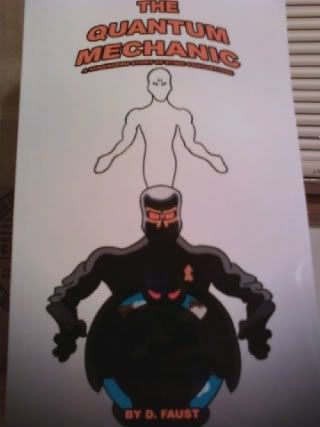
Thursday, November 19, 2009
The Quantum Mechanic: Un-Deleted Scene Three
Thanks to Zach L for some inspiration.UN-DELETED SCENE 3: Douglas and Alvina fall in love all over again
As Alvina learns to deal with the burden of quantum awareness, Douglas tries to coach her. He wants to make it easy on her, but she isn't having it. She wants to learn everything the hard way.
"Sorry, Bea. I guess I just want to see you succeed better than I did."
"Well, that's an attachment you'll have to drop, I guess. I had a chemistry teacher in high school - "
"I know," he interrupts. "You've told me many times before."
"Well, then shut up and let me say it!" She stamps her foot without thinking. Douglas goes wide-eyed.
"Whoah! Sorry, you're right. Framing is important, I sometimes forget, and - "
"And stop reading my mind to tell me what I want to hear!"
"I - " he stammers, then is silent. "I don't know how to do that. I can't stop reading your mind, I care about you too much. I just want to put things in the best way possible."
"Well, I - oh, shit." She drops her gaze. "I wanted you to apologize right after I told you not to tell me what I want to hear. Fuck."
"People are messy."
"Yeah." She takes a deep breath. "Yeah, we are."
"Sorry I did a silly thing. I should have seen your desire to talk. It's still my bad."
"Thanks. And I'm sorry I blew up over nothing." He knows she wants to hear a reciprocal apology. And he knows she knows that she shouldn't expect it just the same. He decides to say what he wanted to say in the first place.
"Right. So where were we?"
They carry on. It's tough at every step of the way. Douglas tries to give the answers to his wife, but she wants the understanding that comes from figuring it out herself. This means he has to hold himself back, which is something he is not accustomed to doing with his students. Over time, he is able to stop seeing her as another student among thousands, and start seeing her as a project, a puzzle for him to solve. He still regards her as a person in her own right, but also as a force of nature he has yet to figure out.
Soon she is able to flip over action potentials in the quantum vagueness below the Planck length. She starts as Douglas did: trying to make wind.
"The thing you have to keep in mind about air is - "
"Would you kindly shut up and let me play around?" He complies. After a few moments, she speaks again: "Sorry, I just get tired of your didactic attitude sometimes."
"It's OK. I'd get tired of it, too - I think." She laughs a little. He smiles. She keeps playing around, but without success. This frustrates her. He sees this in her mind, understands that she wants results she's not achieving. He wants to help her get those resuls, to alleviate her frustrations - but then he remembers their past altercations. He looks deeper.
She doesn't mind being frustrated. She sees it as part of the learning process. He sees it as an obstacle to be overcome. But she doesn't want to follow his lead, she wants to find her own path. He lets her. Finally, she decides to ask for help. He waits for her to ask with her mouth.
"Doug, I - " She pauses, confused. He waits. He does not respond to her unspoken thoughts. He waits for her chosen words. "I need your help. I'm not sure what I'm missing." He asks her what she means, waits for her to explain, then tries to teach her in a way that does not come off as condescending to her.
Over time, Douglas learns that the most effective way to teach his wife - or anyone, for that matter - is to conform to her expectations of how she thinks she needs to be taught. In the classroom, this is obvious: students choose to enroll in classes, and they are there to receive lessons from their intellectual superiors in this or that subject. The relationship is not so explicit at home. Douglas finds that he must unlearn a good deal of his teaching style to actually do the most effective teaching he can. For her. Right now. So far.
Soon, Alvina learns how to read minds. Douglas is her first, just as she was his. She comes to realize how awkward it is to know a person's every thought, and to be unable to shut out such awareness. She learns no lesson that accelerates her learning process; she only learns to deal with the regret of wishing she had been wiser in the past. Eventually, she accepts that she could not have been wiser in the past, and gets on with her life. She does not tell this to Douglas. He does not tell her that he knows.
The lessons continue.
Alvina catches her husband reminiscing about how they had first met. She doesn't recall meeting him until high school, but he remembers meeting her in the fifth grade. Douglas catches her reading his mind, stalls for a moment. She quiets herself. He is self-conscious, embarrassed, but eventually realizes that he has done the same to her. He lets her watch. He tells her the story in his mind.
It was fifth grade. We were at the Intellectually Gifted Learning Organization's Olympics. I saw you and thought you were pretty. You had that ankle bracelet made out of string - I thought it was stupid and silly, but nobody else had one. It made you stand out, and I liked that.
Alvina had spent days braiding that string, then braiding the braids, then braiding those braided braids. It turned out like shit, to be sure, but it was her shit! She realizes that she did in fact make that thing, though; even though Douglas remembers it differently in the particulars (her ankle bracelet was awesome, dammit!), that's more or less how things went. But that was in the fifth grade - she sees his memories of that time, and now she herself remembers - he was the geeky kid who stood in the corners of her vision and wouldn't stop staring at her unless she looked back at him.
That was you, Doug? Oh, jeez, he thinks. Yeah, that was me. He's in the shower. She's cooking breakfast. They carry on about their business, but make passionate love in the evening, the morning's awkwardness forgotten and transformed into affection.
Some time later, Douglas remembers their wedding. This is Alvina's favorite part. She shuts herself up, wanting to see how he remembers it. He knows she's watching his brain; she sees his face flush with blood, her eyes closed as she rests in his arms. She orders him, laughing in her mind, to get on with his memory or they're through. He knows she's not serious, but indulges her anyway.
Douglas stands in a tee shirt and jeans in his mind's eye. He doesn't even remember the band logo on the shirt he wore, she reflects. Neither does she, he points out. She barges into his memory, laughing at him. He laughs with her in his mind's eye. It's not that important. He kicks her present self out of his memory and gets back to remembering.
"Do you, Douglas Bartholemew Orange," says their friend, Trevor, "Take this woman, Alvina Belinda Begalski, to be your main bitch for the rest of your goddamned life?" Trevor Fritz is, for lack of a better term, a loud character in both their memories. Her father laughs from a nearby park bench, her step-mom sighs in his arms; her mother is not in attendance. Doug's parents are ashamed, but they knew they would not get the traditional marriage they wanted out of their son. Douglas is establishing retroactive continuity in his mind, superimposing conversations about the event upon the event itself. Alvina knows that he couldn't stop staring down her dress, so he decided to focus on Trevor's right eye.
"I do," Douglas says in his memories.
"Same to you, lady. Whaddaya say?"
"I'm with that guy," she says, all a-glitter in her sparkling white wedding dress. She briefly remembers their compromise on ceremony: a justice of the peace, but a friend. Trevor was their only friend who decided to jump through the legal hoops to become a justice of the peace. No religious bullshit, they both agreed, but definitely some manner of bullshit to make for a memorable spectacle.
A hazy mess of cheers and platitudes echoes through his mind. Centuries later, the very next thing Douglas remembers is his bride of less than fifteen minutes shoving a piece of cake into his face. He cuts a piece and pushes it into her cleavage. She doesn't resist, but then grabs the back of his head and smooshes his face into the mess he made. He doesn't resist her, either.
Weeks later, Alvina dreams of their first date. Douglas is awake, and intrudes upon her recollection.
"You're dreaming," he says to her, taking the guise of the waiter.
"Yeah, I know. And are you a part of the dream?"
"No, I'm your loving husband. I'll remind you when you're awake."
"Fair enough," she says. Then she remembers ordering her food. The idle conversation. She didn't know what to make of him. He was cute, but a little distant. For his part, he remembers her being pretty, but awkward, and hard to read.
"I borrowed my parents' car and twenty bucks," he says. She doesn't remember this happening. "I didn't tell you this. But it embarrassed me. I figure, now's as good a time as any to tell you."
"I didn't care," she confides. "I thought you were cute, and you had access to these resources, no matter how. You seemed like a safe investement for my emotions."
"You told me some pretty crazy shit. I didn't know whether to kiss you, coddle you, or run away screaming."
"Well, whatever you felt like doing, you ended up doing the right thing: you listened."
"Huh." Their food shows up, out of synch with the memory. There were awkward silences in their real first date. Pauses where neither of them knew what to say, but wanted to impress the other person. "Maybe telepathy is a bad thing," he says while winding noodles around a fork.
"Maybe I like to invade your privacy," she says, pushing her drink over. He watches the liquid spill over the tablecloth and onto the floor. She watches his eyes. "Maybe I want you to be vulnerable to me."
"Maybe I want some privacy to myself," he says. The other people in the restaurant vanish. "Maybe I want some safety. Maybe I want boundaries."
"Maybe I don't think that's what love is all about."
"Maybe - I'll fuckin' stab you." He grabs a knife and brandishes it.
"Maybe," she leans toward him, "I know you're bluh-huh-fing," she says in a sing-song voice.
The patrons reappear. The waiter brings the check. Douglas stands up to pay without a word, then returns to the table.
"Maybe I'm just making this up as I go. Maybe I only love you 'cuz you go along with my story."
"Maybe it's a story I like to hear you tell."
The Quantum Mechanic: Chapter Sixteen
The Quantum Mechanic
A Superhero Story of Ethic Contortions
Chapter 15 - Chapter 16: Metamorphosis - Chapter 17
"We pursue her in her incessant metamorphoses yet we never manage to trap her. She always escapes: each encounter ends in flight. We embrace her and she disappears immediately: it was just a little air. It is the instant, that bird that is everywhere and nowhere. We want to trap it alive but it flaps its wings and vanishes in the form of a handful of syllables. We are left empty-handed. Then the doors of perception open slightly and the other time appears, the real one we were searching for without knowing it: the present, the presence."
- Octavio Paz
Sage sits atop Mother Tree, holding the black fruit in her lap. It is time. She and her brothers have grown and watched and waited. She has seen her sister Sages grow into Mother Trees themselves and cover the planet, and she knows that other Sages on other planets have been watching and waiting, just the same as her.
But she is not destined to become a Mother Tree, as the others before her have done. The wind has spoken to her, told her that their time-of-building has reached its end and now the time-of-battle looms nigh. Her sister Sages sit atop their own Mother Trees, likely contemplating the black fruits in their own hands, ripe with dark device and the promise of power. The preparations have been made, and it is time to join the human in battle against his lesser self.
She raises the head-sized fruit to her mouth and takes a slow, careful bite.
When Sage's teeth break the skin of the fruit, the device goes into motion. Tiny molecular machines talk to each other in code, orienting themselves in relation to the user who has just awoken them. Ah, yes. This is a Sage. Her biology is very familiar to the device. Its cells flow into her mouth, a viscous liquid somewhere between the consistency of blood and sap. Under her tongue, the device grips her by extending tiny cilia, then injects anaesthetic into her bloodstream, then entering her bloodstream itself. It is better that she does not feel what is about to happen.
Sage goes numb as she feeds on the black fruit, her muscles continuing to go through the motions of sucking and swallowing on instinct. She is calm and insensate as the device latches on to the carbon nanofibers that run the length of her spinal column, familiarizing itself with the particulars of her genome by analyzing a few of the immortal stem cells held at the ready in each vertebra. It spreads throughout her system, a symbiotic virus, a living computer programmed in genes. She feels an icy cold envelop her consciousness as the device reaches her brain, then a flood of awareness as the world unseen is exposed to her mind for the first time.
The merge complete, Sage stands to her feet atop Mother Tree and surveys the village below. Smooth, matte blackness covers every inch of her skin. Her eyes, engorged with blood, fluoresce with light as if afire. A small processing center emerges from her forehead, glowing electric blue with activity as she coordinates the minds of all her thousand brothers within her. They, too, have eaten; they, too, have metamorphosed; they, too, have had their eyes kindled with the new awareness. Sage now knows not only their faces, but sees their sights, hears their sounds, thinks their thoughts. Before, she was a guide, a mentor, a chaperone; now, she is their head, and they are her hands.
It feels like the absorbed memories of their callings, this new sensation that creeps into Sage's developing overmind. But now she feels as strong as a rock-eater, as lithe as a gatherer, as stout as Mother Tree herself; and yet as young and new as any one of her brothers, fresh from his knot-of-birthing, before hearing his calling in dreams. The rock-eaters, the gatherers, the tenders and tillers and un-called all stand before her, speaking their whole minds to her, hearing all their minds from her, communing and calibrating towards a singular purpose: the destruction of the Entropic Engineer. There is work to do before this, though.
After reorienting themselves to their new awareness and purpose, Sage and her brothers gather closer to Mother Tree and begin to consume her, taking her biomass into themselves for the journey ahead. Devouring tendrils twist and wend through her circulatory system, pulling her apart with painless, ruthless efficiency, making every part of her into a part of each of them. Their task done, the dark figures build wings with their devices and head skyward. They see in the distance that other villages, formerly clustered around other Mother Trees, are doing the same. Still more rise from the ocean, from the ice caps, from everywhere on the face of the planet. Their minds reach out across the distances, speaking to each other in electromagnetic fluctuations.
"Greetings. We are Sage, and we fly to battle."
"Hello! We, too, are Sage. We, too, fly to battle."
"As are we, and they, and the rest of us."
"Good! Then let us fly together, and put an end to this evil!"
The Sages and their brothers fly up above the clouds, up to the very shimmering wall of the heavens, where their devices find the carbon nanofibers that circle the whole planet. Everyone spreads themselves out along the gossamer threads, a planet's entire biomass anchoring itself to a web invisible to the unaugmented eye. Traces of elemental iron serve as magnetic tethers to the satellites that float in orbit, cloaking the planet from the Entropic Engineer's sight, destroying any approaching space debris that threatens the floating spherical lattice, and stopping the whole thing from crashing down to the planet's surface prematurely.
As every Sage spreads her brothers out around her, each brother spreads his device out around him, connecting the invisible threads and wrapping the whole planet in impenetrable darkness. Minds merge and meld, individuals orient themselves into a new station in a greater society, each a cog that knows its place in the machine. When all are ready, tiny locks and latches are released throughout the web. The black shell unfolds around the planet they all called home, metamorphosing into a great bird-like structure, slowly spreading its wings into the vacuum of space. With one great flap, the enormous avian pushes away from the now-barren rock, casting off a few tiny seeds to float down to the surface and begin the cycle anew.
So large and so thin, the flat bird is buffeted by solar winds away from its homeworld. Satellites are absorbed and consumed, and in the freedom of empty space, the enormous bird folds in upon itself, patterning itself into a more stable form. The cannibalized technology is repurposed to form faster-than-light engines, programmed into the device's molecular information architecture by the Quantum Mechanic itself as soon as humanity had solved the problem in a mundane fashion. The planetary life form orients itself within the galaxy, then plots coordinates and prepares to jump.
It's the big day. Douglas imagines that he can feel something in the air, but he knows that it is only the nervous tension of anticipation. He is not eager to face his nemesis head-on. Last time, he had to run, and humanity will no longer accept running as a way of life.
Alvina chops vegetables in her Montana home while Douglas sits on the couch. The TV is on in the background, but neither of them is paying particular attention to it. On the screen, the Quantum Mechanic places the Interview on hold.
"We'll return to this shortly, Ben," it says. "I need to concentrate."
"Ah. Is it time, then?"
"Yes."
"Well, best of luck to you. We're all hoping for you. It's all our lives riding on this moment, after all."
"I couldn't have said it better, myself. The Million Minds are almost finished with their countdown. When they do, I shall cease my cloaking measures, and then we shall see what happens." A counter appears in the background. Gleck stares at it, starts to sweat. He tries not to think about all the different ways that things could go wrong.
Zero. Go time.
From within an atmosphere, nothing visible happens. But from space, the stars are suddenly much clearer and brighter. And light minutes above the solar plane, a brilliant white figure appears, growing ever brighter as angels surround the star system in ones, twos, tens, thousands, millions, billions, trillions. Heaven's army has arrived.
The Entropic Engineer pauses. Something is not right. There is a kind of fuzziness about, he is not sure what. The angels stand ready, but he does not give the order to attack. Then something shows up - a great bird, truly massive and matte black, nearly invisible to light but carrying with it an unmistakable gravitational pull.
Another shows up.
Then another. They pour into the system, tearing wormholes through spacetime and hopping through, fuzzy ripples evening out in their wake. While the Entropic Engineer struggles to comprehend what he is seeing, the birds continue to show up even as the earliest arrivals begin to dissolve into billions of tiny man-sized bodies. They set upon the dumb angels, passive without the Entropic Engineer's order. These black creatures, eyes aflame with intelligence, begin to devour his horde. Literally. He watches as the metal bodies are taken apart and then consumed, added to the biomass of these space-faring demons.
More black birds show up. Still more. There is no end to them, it seems. They outnumber his army with ease. He needs to focus, to marshall his troops against this new threat. The angels are only programmed to kill humans, these amorphous symbionts will require a bit more care and attention.
He drops his wards.
Douglas has practiced this maneuver so many times that it is not worth counting. He has learned to recognize the signatures of a quantum mind such as his own or Alvina's, and become swift at reacting before thinking. No sooner are the wards down, than the Quantum Mechanic springs into motion, pinning Benjamin Gleck's frail body against the wall by his throat.
Subscribe to:
Posts (Atom)
