Update Schedule

This blog updates irregularly.
Showing posts with label free speech. Show all posts

Sunday, May 23, 2010

Dear The Internet: Today I made the cutest blasphemy EVAR*!

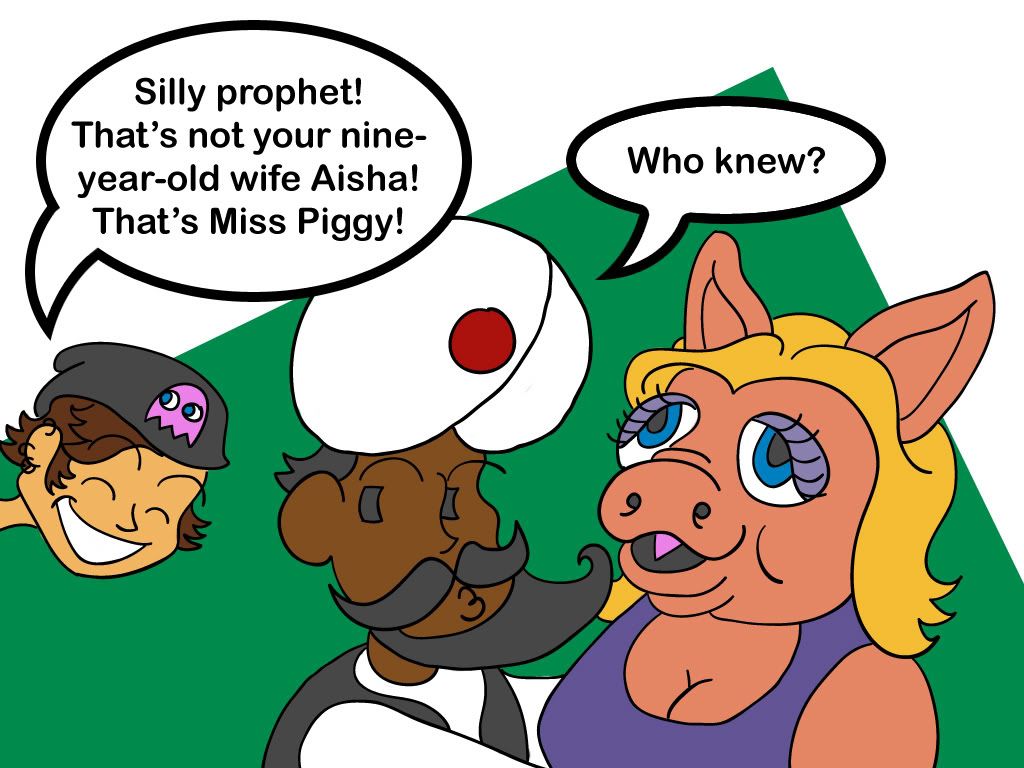
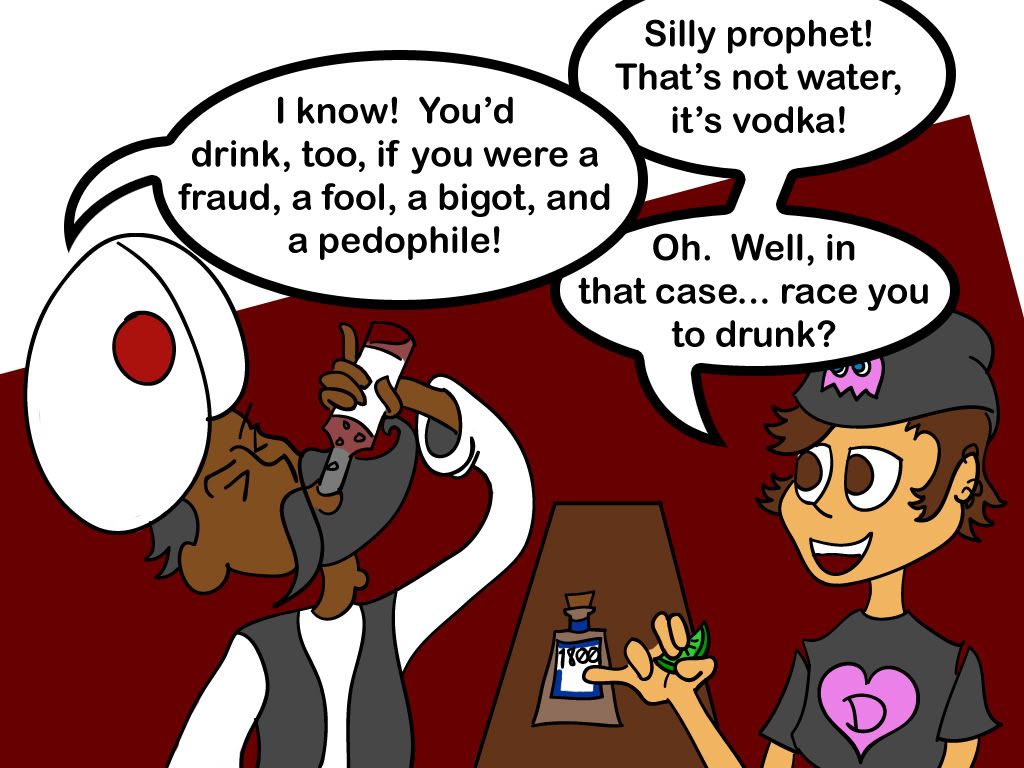
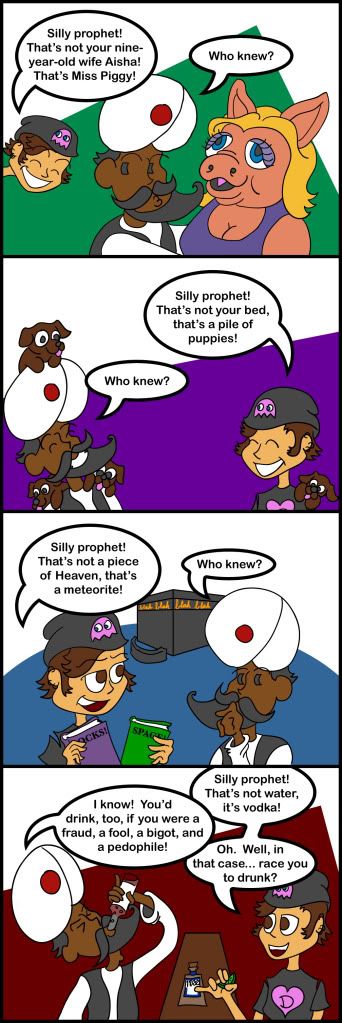
Better late than never, right? OK, so Steve Bowen informed me on Thursday that Thursday was "Everybody Draw Muhammad" Day, which would have been cool if I weren't working fourteen hours that day. BUT! It reminded me that I had made a previous commitment, in a proud tradition of blasphemy, to blaspheme some more. Without further ado:
Click for huge. Oh, and also for ALL FOUR PANELS. It didn't take long because I'm un-skilled, it took long because I forgot. (My lack of skill is irrelevant to the delay.) Anyway. I think I hit the big five: pigs, dogs, the Kaaba, and liquor, all while drawing the prophet Muhammad and me spending some quality time together. Rock most hard.

If you're interested in the individual panels: 1, 2, 3, 4. Enjoy!

EDIT: Photobucket does not want to give me the full-size version of the four-panel thing in all of its irreverent glory, for some reason. If anyone knows of an image hosting service that's man enough to put up a 1044x3122 image on the free, let me know - otherwise I can be e-mailed for full-size versions, if anyone wants 'em.

* - With the possible exception of Moo-ham-ed, I must admit.

Sunday, January 17, 2010

Dear The Internet: Today I made another blasphemy!

OK, so I'm all about doing those things I say I'll do. Really, I am, I'm just a procrastinator, too. At any rate:
You can click that for huge. And, y'know, complete. So far. Look, this is like a progress report because I wanted to put something up, I'm just sick of Photoshop right now.

Anyway, in all my dawdling, I came up with a far grander vision for what I wanted this to be (with a little prodding help from Silver Garou and Rhodopsin), and I've scaled it back to something I can do in a reasonable amount of time. Two weeks isn't already past unreasonable, is it? I think I can safely tell you that a pile of puppies is involved. Stay tuned!

Monday, January 4, 2010

Dear The Internet: Today I made a blasphemy!

Ahem. Inspired by Saturday's Daylight Atheism, I cooked up a little blasphemy in my kitchen just now to tide me over until I get the rest of my stuff in the mail. All of the below photographs can be clicked for huge.
Can you guess where this is going?
Wait for it...
I'd say "boo-yah," or something similarly triumphant, but the thing is, I don't give a fuck. Like, I know that some book-burning, cartoonist-threatening, bacon-hating shit-heads with carp for brains would get their undies in a bind over this, but they're stupid, so who cares what they think?

OK, that's enough pointless nonsense for now. I'll wait for the death threats to roll in, and follow them up with Miss Piggy kissing Mohammed (unless you, the General Reader, can give me something even more blasphemous to draw).

Wednesday, July 29, 2009

Participating in the Internet: Beware the spinal trap

So there's been a bunch of to-do about Simon Singh, the science writer who said "bogus" when he probably meant to say "bullshit" and is being sued for libel. Personally, I don't know what's wrong with the Britich Chiropractic Association - they can't even make acronyms properly, it ought to be the British Association of Chiropractors, making it a proper backronym! Anyway, Orac has the scoop, PZ has joined in, and others have as well. There are alterations in these at the request of SAS (Sense About Science, not the British commandos), on the grounds that they could still get Singh in trouble. Whether or not that's true - and in a country without our robust protections of free speech, it may well be - I don't think the factual claims made in his article are affected by the presence or absence of the word "bogus." At any rate, as a gesture of journalistic aptitude, here is the internet cache of the original article. Below is the "current" version:
Some practitioners claim it is a cure-all, but the research suggests chiropractic therapy has mixed results - and can even be lethal, says Simon Singh.

You might be surprised to know that the founder of chiropractic therapy, Daniel David Palmer, wrote that "99% of all diseases are caused by displaced vertebrae". In the 1860s, Palmer began to develop his theory that the spine was involved in almost every illness because the spinal cord connects the brain to the rest of the body. Therefore any misalignment could cause a problem in distant parts of the body.

In fact, Palmer's first chiropractic intervention supposedly cured a man who had been profoundly deaf for 17 years. His second treatment was equally strange, because he claimed that he treated a patient with heart trouble by correcting a displaced vertebra.

You might think that modern chiropractors restrict themselves to treating back problems, but in fact some still possess quite wacky ideas. The fundamentalists argue that they can cure anything, including helping treat children with colic, sleeping and feeding problems, frequent ear infections, asthma and prolonged crying - even though there is not a jot of evidence.

I can confidently label these assertions as utter nonsense because I have co-authored a book about alternative medicine with the world's first professor of complementary medicine, Edzard Ernst. He learned chiropractic techniques himself and used them as a doctor. This is when he began to see the need for some critical evaluation. Among other projects, he examined the evidence from 70 trials exploring the benefits of chiropractic therapy in conditions unrelated to the back. He found no evidence to suggest that chiropractors could treat any such conditions.

But what about chiropractic in the context of treating back problems? Manipulating the spine can cure some problems, but results are mixed. To be fair, conventional approaches, such as physiotherapy, also struggle to treat back problems with any consistency. Nevertheless, conventional therapy is still preferable because of the serious dangers associated with chiropractic.

In 2001, a systematic review of five studies revealed that roughly half of all chiropractic patients experience temporary adverse effects, such as pain, numbness, stiffness, dizziness and headaches. These are relatively minor effects, but the frequency is very high, and this has to be weighed against the limited benefit offered by chiropractors.

More worryingly, the hallmark technique of the chiropractor, known as high-velocity, low-amplitude thrust, carries much more significant risks. This involves pushing joints beyond their natural range of motion by applying a short, sharp force. Although this is a safe procedure for most patients, others can suffer dislocations and fractures.

Worse still, manipulation of the neck can damage the vertebral arteries, which supply blood to the brain. So-called vertebral dissection can ultimately cut off the blood supply, which in turn can lead to a stroke and even death. Because there is usually a delay between the vertebral dissection and the blockage of blood to the brain, the link between chiropractic and strokes went unnoticed for many years. Recently, however, it has been possible to identify cases where spinal manipulation has certainly been the cause of vertebral dissection.

Laurie Mathiason was a 20-year-old Canadian waitress who visited a chiropractor 21 times between 1997 and 1998 to relieve her low-back pain. On her penultimate visit she complained of stiffness in her neck. That evening she began dropping plates at the restaurant, so she returned to the chiropractor. As the chiropractor manipulated her neck, Mathiason began to cry, her eyes started to roll, she foamed at the mouth and her body began to convulse. She was rushed to hospital, slipped into a coma and died three days later. At the inquest, the coroner declared: "Laurie died of a ruptured vertebral artery, which occurred in association with a chiropractic manipulation of the neck."

This case is not unique. In Canada alone there have been several other women who have died after receiving chiropractic therapy, and Edzard Ernst has identified about 700 cases of serious complications among the medical literature. This should be a major concern for health officials, particularly as under-reporting will mean that the actual number of cases is much higher.

If spinal manipulation were a drug with such serious adverse effects and so little demonstrable benefit, then it would almost certainly have been taken off the market.

Simon Singh is a science writer in London and the co-author, with Edzard Ernst, of Trick or Treatment? Alternative Medicine on Trial. This is an edited version of an article published in The Guardian for which Singh is being personally sued for libel by the British Chiropractic Association.
Update: We have something of an expert opinion on this, right in the comments! Dale, the first commenter, has posted some good points which have precipitated a further response of my own. Depending on how involved the discussion gets, this may be followed up on in another post (due to space restrictions in the comments). Stay tuned!

Tuesday, February 17, 2009

Two steps forward, one step back

Daylight Atheism, one of my two favorite blogs in the world, recently posted an article about the events surrounding Johann Hari's criticism of the Universal Islamic Declaration of Human Rights, itself a response to the UN's Universal Declaration of Human Rights.  The summary of events over on Daylight Atheism is excellent, and I will refer you there if you are not yet aware of the matter - it's a quick read, and very informative.

My intention with this post is to bring further attention to the matter, and encourage you, the General Reader, to speak out on this subject.  Just so we're perfectly clear on what's at stake here, let me point out that the UN has basically caved to pressure from Muslim nations, as nations have previously caved to pressure from Muslim fanatics, and made it explicitly verboten to address human rights violations carried out by Muslims in accordance with shariah law.  As I wrote in a letter to my congressperson today,
As a student of philosophy, and more generally as a human being, I cannot understand what bearing the beliefs of an individual have upon the justice of that individual's conduct towards others.  Is a rape not a rape, is a murder not a murder, is bigotry not bigotry, simply by virtue of the god worshiped by the perpetrator?  I think not.  I should hope you agree with me that for all to have equal rights, all must be subject to the same laws, regardless of race, sex, or creed.  The Universal Islamic Declaration of Human Rights is, put bluntly, antithetical to this basic egalitarian idea.
I would hate to take an apocalyptic tenor unnecessarily, but it does seem that what hope we have had of protecting the rights of individuals from the superstitions of others is being threatened.  While neither the UN nor any individual nation enjoy the status of perfection, this development is most certainly a step in the absolutely wrong direction, and we must do what we can to set it right.  As individual citizens, we may not be able to participate directly in the policymaking discussions that shape these events - but we can make our voices heard nonetheless.  If you live in the USA, then take ten minutes to write your congressperson.  Get up ten minutes earlier, or stay up ten minutes later, whatever suits you.  Like voting, writing to a representative is one of those civic duties that works better when more people participate.

Monday, January 5, 2009

The Cuckoo and the Con-Man: a meditation on marketplaces

I had a constructive conversation with my boss at work a while back in the wake of the Wafergate scandal.  We got to talking about free speech, ultimately, and a parallel jumped into my mind.  Up until now, I've been unequivocally in favor of free speech, and unapologetically so.  I was thinking about the marketplace of ideas and how it needs to be open and free, and then I made a cognitive leap to the marketplace of actual money and our current economic disaster.  As it's important to question even cherished beliefs from time to time, I'll be exploring that today.

It would be great if we could just let the marketplace, ideological or economical, operate freely with zero interference, and everything would work out perfectly as a result.  However, that's just not realistic.  The dog-eat-dog, state-of-nature sort of unrestricted natural selection that Mother Nature oversees is precisely the thing from which Civilization has been trying to protect us, because Mother Nature is a heartless bitch (see the is-ought problem).  A splendid, multifaceted, wondrous and downright hot heartless bitch, but a heartless bitch nonetheless.  For all that reciprocal altruism and mutually-beneficial cooperation are naturally encouraged, there is still room for the cuckoo - not every cuckoo gets away with it, but enough do.  Similarly, con-men are often exposed as the frauds they are, but not always, and many get away with it.

There is no straightforward demand for con-men in the economy, nor is there a need for cuckoos in the biosphere.  They do not satisfy any needs or desires.  They survive not by contributing, but by exploiting available opportunities at the expense of others in the community (the pocketbooks of the gullible and the genuine progeny of other birds, respectively).  Con-men do not create wealth, cuckoos do not fill a niche; both survive by skimming off the top of a system that would, on any analysis, be better off without them.

Con-men are outlawed from existence, cuckoo eggs are killed when discovered.  Similarly, in the marketplace of ideas, there are harmful ones that do not contribute to humanity, but instead drag the system down, surviving only by the grace of their betters which got us, as a species, this far in the first place.  Slander and libel are the obvious ones:  these kinds of ideas so egregiously detract from discourse that they are banned from the process entirely, and prosecuted when discovered.  Threats, too, are not allowed into the marketplace, because they accomplish nothing aside from indicating that a certain crime is likely to occur.

But is it enough?

As with the economy, excessive regulation breeds tyranny and oppression, suffocating legitimate contributions and generally doing more harm than good.  But how much constitutes "excessive," and who gets to draw that line?  When speaking of liberties, I think a good principle is that people should be left as free as possible, with regulations only applied when someone else is harmed - as Jefferson said, "The legitimate powers of government extend to such acts only as are injurious to others."  So let's look at the consequences, shall we?

Economic collapse can ensue, as history shows, from either too much or too little regulation.  Too much, and there is no incentive to tease the motivations that drive us into action; too little, and short-sighted greed will win out over long-term stability.  Even in nature, animals can eat themselves into extinction if the blind watchmaker crafts too prolific a form.  We have not yet seen what total ecological collapse looks like from the inside (yes, we are inside the ecosphere, and just as much a part of nature as everything else), we have only been able to look back upon past catastrophes foisted upon our tiny blue bubble.  What is good in the long run, what is often called "the right thing to do," can often be a thin line walked carefully between two extremes.

What would a collapse of the marketplace of ideas look like?  What would the proper analogue be, exactly?  Cultural stagnation, even regression, could follow from over-regulation, as only the blandest and most insipid fare could pass the test of too many timid cooks objecting to flavors they dislike, instead of sucking it up and just eating a different meal.  There is no single thing that will fail to offend absolutely everyone - I, for one, find the bland to be offensive for precisely the reason that it cowers behind political correctness at the expense of thought-provoking content.  It drains ideas of their power in the name of coddling people like children who can't be trusted to think for themselves.  It is an insult of enormous magnitude:  you can't be trusted with this thought, but we can administer your thoughts by filtering what we decide is or is not appropriate.  I'll take a pass on that, and to hell with you for offering!

But what would excessive deregulation cause?  Not in advertising, mind you - that falls under the purview of the economy.  Hmm... now that I think about it, perhaps not.  All media, after all, has economic roots.  Maybe that's not a fair distinction to make.  But that's a topic for another day, the matter at hand is whether our current system permits too-free speech, and how the marketplace of ideas could conceivably thereby collapse.  Leaving aside slander, libel, and false advertising claims, what are the dangers of unregulated discourse?  How bad could it possibly get?  I've been staring at my screen, trying to imagine something - anything - but the only thing I can come up with is:  feelings get hurt.

Cry more, why don't you?

Ideas are not a resource like money or food is a resource:  they are not consumed or spent, but can only spread or stagnate.  False advertising claims, slander, libel; these have all been outlawed from our marketplace of ideas1, and I think that's enough.  There are particularly nasty and infectious ideas that will no doubt spread regardless of any other merits, but the way to combat them is not to censor them like the child on the playground who thinks words are magic and says, "Ooh, you can't say that!"  Rather than censoring them, we should let them fend for themselves just like any other idea, because the idea that they're precious and oh-so-special is itself just another idea, and for that matter, so's the idea that free speech is good.  Feelings will get hurt, to be sure - but you know what?  Offense is very different from actual harm.  A little alienation is good, every now and then2.  Having your beliefs called into question is good for you.  Examining your thought processes is good for you.  Learning to deal with ridicule is good for you.  Being able to take a joke is good for you.

And, perhaps most importantly of all, learning to get along with those who disagree with you, sharing your ideas and staying civil with each other, is good for you.

Too much of anything is bad for you, of course, and the same applies to all of the above.  We should not perpetually question our beliefs, or we would be paralyzed by doubt.  Constantly examining our thought processes leaves us locked in the ivory tower, never acting in the world outside.  Too much ridicule can break the human spirit.  Too much jocularity leaves no room for Serious Business.  Having a ready defense of every single opinion is impossible.

And getting along with those who harm others, instead of helping their victims and working to abolish the tyranny du jour, is morally bad.  Just so this is perfectly clear, I'm looking at you, Saudia Arabia, Zimbabwe, Darfur, Pakistan, Somalia, Sudan, South Africa, Russia, Bosnia, Kosovo, Britain, and especially you, America - the way you grew up, knowing what you've been through, and now seeing what you're putting others through - what would your founders think?

Whoah, kinda got sidetracked there.  To the OnTopicMobile!

Actually, my diatribe gland is starting to feel a little dry.  I've looked it over, and I am again sure that free speech is not negotiable.  Freedom is simply too important to be held in check by the whims of others' feelings.  I think I can say with confidence that if anyone doesn't like that, they've got some serious growing up to do.

Notes:
1.  False advertising claims, slander, libel; these have all been outlawed from our marketplace of ideas.  Not entirely, actually.  This seems a little too easy, to be honest, but I'm going for it anyway.  Religion makes claims that it can't support; several make libellous claims about unbelievers.  I do not advocate book-burning under any circumstances, I'm just saying that in a religious context, we as a society still have trouble recognizing these otherwise criminal statements for what they are (or, perhaps more appropriately, classifying them more accurately as "fiction").
2.  A little alienation is good, every now and then.  Thanks to Peter Railton for this bit.  For more on this, or just to read a good paper, check out Alienation, Consequentialism, and the Demands of Morality.