Update Schedule

This blog updates irregularly.

Wednesday, September 16, 2009

Symbolism Shmymbolism

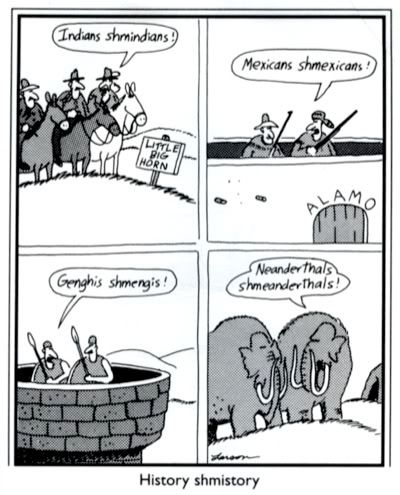
Gary Larson is the man, and The Far Side rocks my socks. The thing you dismiss can end up crushing you, whether a symbol you eschewed or the threat of a symbol which you ignored. It all cuts both ways here.

The above is meant to set the tone: this is a silly-yet-serious issue. I was talking with my roommate about marking some of my shirts with a scarlet letter, because I'm becoming increasingly fond of the idea. You see, in Nathaniel "I waste no periods" Hawthorne's novel, Hester Prynne was forced to affix a red letter A to all of her clothing so that everyone would know she was an adultress. Over the course of the novel, Hester flouts the conventional morality of the time by integrating the badge of shame into her identity, making it a part of who she is and generally being OK with that. This drives certain persons up a goddamned wall, and for that, Nathaniel "Three sentences a page - I counted" Hawthorne gets points in my book.

As anyone likely to read this is probably already aware, the scarlet A has been hijacked - and I mean that in the best possible way - by Richard Dawkins for his Out campaign. I, for my part, am a collector of symbols: I grew up moving around and came to define myself by the stuff I have, and in order to avoid feelings of loss at losing parts of myself whenever I lost stuff, I would simply try to pick the most symbolically important things and I keep them all in one place. So, naturally, this is the kind of thing I would absolutely go ga-ga over: it's a subtle yet distinct thing I can do to publicly symbolize an important part of who I am. The A fits for atheism, adultery (the kind of Christianity I dropped regards premarital sex as adultery against one's future spouse), and apostasy; all things regarded as evil by the church, but which I see as badges of honor, not shame. (I just today added the scarlet A to my sidebar, too.)

Well, my roommate counseled me against such action, as it could be confused with this:
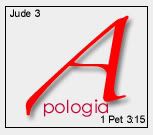
I call shenanigans! I mean, really? Really?! You're going to take the scarlet A in the same goddamned font and try to steal it from the atheists for your own bullshit apologies? Come on! That's just stupid. But whatever, it doesn't really matter, because symbols are ambiguous and may mean many things. It's really OK for the Big Red A (or BRA, for short) to mean "adultery," and "atheism," and "apologia," and apostasy, and ataraxia, and asceticism, and fucking anything else! In fact, the more BRAs there are, the more options people have, and the more people know about BRAs, the more they'll talk about them. This gets people rubbing elbows and communicating with the opposition, and communication smothers hate. So you can have your BRA, and I can have my BRA, and everyone can wear a BRA and things will be just great! And if some people want to burn their BRAs, they can go ahead; if others want to show off their BRAs, that's also just fine; and maybe even some will want to keep their BRAs out of sight, and this too is acceptable.

Enough of that. My roommate also pointed me to this post over on Friendly Atheist, and the closing gave me pause for thought:
I think we should avoid symbols and special objects that evoke our affection as much as we possibly can. Although we may like to think that we’re above all that, we can end up magicalizing them and forming irrational attachments to them.
Hmm. OK, first of all, I agree entirely with Wade that people "can become emotionally attached to the object itself as well as the concept it symbolizes." That's just plain correct, and he's also correct that we should watch out, for a whole host of reasons. This tendency can distract us from that which the symbol represents, it can be used to manipulate our emotions, and it can be confused with other symbols or have its meaning changed over time. Symbols are complicated stuff!

But should we avoid them? I respond with an emphatic Hell fuck no!

See, we're humans, and symbols are important to us. They just are. It's a fact of our psychology that we have to live with. Furthermore, language is symbols, and there's no getting away from that, The End. We do not comprehend things in their entirety, i.e. there is always a gap between "the idea of X in my head" and "X itself out in the world," and so we use symbols as a shortcut. Symbols serve as mental abbreviations, as cultural shorthand, as useful signifiers of complex concepts to which we may wish to refer with frequency but not at length. So in the first place, symbols are unavoidable.

But wait! Wade only said that we should avoid the ones that evoke our affections, lest we magicalize them. I still disagree wholeheartedly: while we should still be wary of symbols being weaponized against us, we should deliberately seek and create stirring symbols to instill with our own sense of meaning. As humans, we require positive reinforcement, and emotionally-charged symbols of the things we believe in can help with that. They also serve as banners for like-minded individuals to rally under in service to causes: associating a sense of community and working together with a simple symbol works both ways, as seeing the symbol later can bring up all of those positive connections. (EDIT: In light of conversation with Silver Garou in the comments and face-to-face, I wish to clarify that I think it's OK for small groups to do such rallying, but I do not think that there needs to be a symbol for all atheists to "get behind" - in other words, it's OK for as many people to "play football" as wish to do so; but that's different than saying "everyone should play football," which proposition I do not endorse.) And as the most distrusted and despised minority in America, I think that we atheists have considerable need of this sort of reinforcement.

We must still be wary of the magicalization, and be prepared to take a step back whenever our symbols cause us any sort of grief. That is the time to say, "Well, it's just a symbol," and review our priorities, and work on what really matters. In a way, this actually gives us an even greater advantage over other demographics: if we can cherish our symbols for their benefits, and inoculate ourselves against their abuses, then those who would seek to use our symbols as a weapon against us will simply be wasting their time. And the more time they waste on pointless bullshit, the less time they spend actually getting in our way. Furthermore, the less our symbols may be used against us, the more frustrated the opposition becomes - and so, without lifting a finger, we shall be allowing the opposition to demoralize itself. What more could we ask for?

So by all means, symbolize, symbolize, symbolize! We need our symbols just as much as any other homo sapiens, and when treated with the proper respect and precautions, we have much to gain and nothing to lose from them. Symbols only have the power we give them, after all, and selectively conferring this power upon them makes them all the more advantageous to us.

Oh, and by the way, I found a wonderful solution to my dilemma: many of my t-shirts have exactly one letter A on them. My new plan is to color them red. Simple, subtle, symbolic. The perfect win, in my book. Nathaniel "'Run-On Sentence' is my middle name" Hawthorne would have been proud - and I'd take his opinion rather seriously on this subject.

This post was featured in the 43rd Humanist Symposium.

Tuesday, September 15, 2009

Poison for Your Brain: Google Feeds the Crazies

Well, OK, maybe not. But today's Google doodle is on crop circles:
This reminds me of a dude who... well... look, I'm ashamed to say I know this guy:

Yeah. I don't like him, he's just been... around at some of the campus stuff I've attended. I see him all the time.

Listen, folks. It's like this: get a sheet of plywood and some rope, carry it vertically out into the field, steam the bases of the plants, and then you can make whatever kind of crop circle you like. They did it for Signs, and creative country bumpkins with too much time on their hands have apparently done it for years before. People even do this for money, apparently.

Bottom line: they don't mean anything. Tool-bag.

Monday, September 14, 2009

Call Ripley! Mormon calls it like he sees it, and winds up right.


TL;DR version: "Hey! Mormons! Look, honest people sometimes get weirded out when they find out some facts about our religion's history! If you want to talk to them, you need to understand this and take it into account."

Reverse-Engineering Religion, part three: We Are Building a Religion

Writing a holy text, even a joke one, can be a daunting task. I mean, not only does one have to deal with the theists, who may almost always challenge one on the basis that one is not taking religion seriously enough (perhaps for even presuming to write one); but one must also deal with the atheists who may almost always object that religion is being given too much deference (perhaps for even presuming that it deserves any attention at all). I aim to split the middle, and fall outside of both previously mentioned "almosts." I hope to accomplish this by designing a religion that is at least considered to be OK by all who hear of its premise. Here is my opener, that premise, for the holy text of the twenty-first century religion, and I'd like to know what... well... I'd like to know what everyone thinks of it, but I'll honestly be happy to find out what anyone thinks of it.
Above all else, understand these words: two commandments, and two alone, must you attempt forever to teach to all whom you meet, no matter how different, and no matter how long it may take. First, an appetite for unbridled reason and curiosity, that they might understand these words, and think upon them, and even question them loudly and without shame. For I tell you, if the many convince the few, then all shall have increased understanding; the few shall understand the many, and the many may witness the corrective power of right. And if the few convince the many, then all shall be done a valuable service; the many shall understand the few, and the few shall see the transformative power of right. And second, more simply, but equally as important: that which may be accomplished by working together is always greater than anything accomplished by working against any other.
I should note that perhaps the most fun aspect of writing a holy text is that I am afforded the luxury of picking and choosing what I will justify. It makes it easier to decide when to dive into the serious justifications for this or that; really, this is a point for humanism and a point against all moralities based upon divine fiat, for the simple reason that I can appeal to the things on which we merely agree on a direct basis, yet I may also justify rigorously (and even at great, plodding, unnecessary length) those things which I think need more thorough proof. Fun times!

So yeah, theists and atheist alike: what do you think of the above? Genuine truth, or silly bullshit? Honestly, if you think I've made a misstep, then please try to correct me because I am aiming for genuine moral truths here. I want to ape religion so goddamned well that nobody can tell without reading these blog posts, but do religion so goddamned well that it actually takes root in our culture. Be as critical as you can, even if you don't actually want to criticize; it shall only make me stronger, for I have the power of BALD ASSERTION! Woo!

Saturday, September 12, 2009

Reverse-Engineering Religion, part two: Purposes and Mechanics

In general, my goal with this little project is to design a mind virus that captures the benefits religion confers upon people, while doing away with its most grievous harms. If you've heard Patton Oswalt's bit on Sky Cake, then the analogous goal is to build a Sky Cake that is genuinely better in every way. The challenge of building a better religion is that it must preserve the good that religion does for people and in the world, while at the same time staying consistent (or at least out of conflict) with non-religious accounts of ethics, astronomy, etc. In other words, the consequences of this reverse-engineered religion must come out good on a humanistic analysis, satisfying the moralities of atheists and sparing their intellects wherever possible, while at the same time satisfying the emotions and faiths of the believers.

Perhaps the greatest perceived benefit of religion is that it is able to help some people come to terms with their mortality. The best possible religion must retain this benefit; this may also be accomplished with reason alone, and atheists are living proof of this. However, the mechanism by which religion accomplishes the same feat is an emotional one, not a rational one; whatever the cause, reason just doesn't do it for believers. So the best of all possible religions must deliver an emotionally satisfying account of mortality which appeals to a naive sense of fairness (so that naive people will buy it), while at the same time actually conferring the rather unique tranquility that comes with knowing that one shall die and truly accepting that fact with a calm heart. Remember that I am not forsaking sophisticated and non-religious morality - appealing to the naive as well as the sophisticated is a challenge and a half, and I'm trying to take it all in one bite here.

A related benefit is the problem of evil: atheists deal with the problem of evil in the only way they can, i.e. with reason. Evil exists, and with no observable intelligence behind the Universe at large, we ourselves must be the ones to work against it at every step of the way with no outside help, unfair as that is. Again, while this is intellectually sound and, in my experience, tends to bring a modicum of steely resolve to one's life, it lacks the emotionally satisfying purposive account of evil's origin which believers seem to crave. If this is to be a better religion as a religion, then the emotional impulses that keep so many in the firm grip of faith simply must be satisfied. Remember, I'm playing for keeps here: religion's hooks are many, and dirty, and they strike deep. To succeed in this task, I will need to be even better at this game.

Another benefit of religion is social cohesion. While equanimity in the face of inevitable* death and evil is of great personal benefit, social cohesion is an even greater one, though it tends to go relatively unnoticed. The fact of the matter is that human beings always find a way to foster a sense of community; religion codifies this in tradition and shared beliefs, which gives it more long-term and far-reaching effects than memes such as, for example, Local Sports Team Rocks, or Tuesday Night Parties Are The Shit. Any religion may be believed by anyone, anywhere, at any time; and so the best of all possible religions must foster a greater sense of social cohesion than even this transcendent bond between believers. The best way I can think of to accomplish this is by strict moral injunctions to embrace outsiders - or in other words, to foster total social cohesion for its own sake, and not as a fringe benefit to members only. Exclusion must be demonized, and inclusion exalted, for this religion to stand out among its peers as a force for helping people get along even when they're not all getting their way.

These are the purposes towards which this experiment shall be bent: encouraging acceptance of mortality, providing an emotionally satisfying explanation of evil, and the fostering of universal social cohesion. These purposes shall be pursued as ends, and the means to them I shall describe below as the mechanics of this religion.

Concision. Religious texts in general tend to be long, boring, tortured, and self-contradictory. This thing I'm doing here, yeah, it's not gonna go like that. People simply have better things to do with their lives than hole up in a monastery and copy scripture, and a modern religion needs to take this into account. There will be a holy text, and it will be full of mythic storytelling and instructive parables and so on and so forth. But these principles, unlike those that developed orgainically from naturally occurring religions, have the advantage of a single author with an eye to consistency: me! Also, I can make sure that I'm not promoting outdated cultural mores, as so many religions do. My intention with the short holy text is to cut out the riff-raff of boring nonsense and backwardness that plague the literary meanderings of most (if not all, I don't know for sure) religions.

Clear Humanistic Moral Priorities. Any moral theory worth its salt will be consistent, coherent, and well-reasoned. Remember, however, that though this reverse-engineered religion is designed by reasoning processes, it is not designed to appeal to reason. Instead, the morals will be conveyed along emotional lines; it just so happens that all these emotionally-phrased moral codes will have solid rationale available. In other words, the reasoned path to this new religion's morality shall be clear and available, but it is a long one; so the shortcut of faith, which so many claim to use for their morals anyway, shall be made available to those who lack the time, intellect, or inclination to engage in such philosophically oriented pursuits. Hell, I'll even include some good solid rationale, and make this the more esoteric part of the holy text, bottom-lining it for the lay reader in clear and certain terms in the "mainstream" parts.

Peek-a-Boo God, or "God of the Gaps." Whatever the creative force behind reality as we know it, it has to hide in gaps. These gaps are continuously narrowing, so I'm thinking I'll have to posit a parallel universe which cannot be accessed by mere mortals, and can only be conceived of by "secret knowledge." The point is that this is supposed to be unfalsifiable, but not in conflict with scientific knowledge (whether currently available or forthcoming). This is still a tough row to hoe, as the gaps of science are a moving target - or rather, an ever-shrinking target, but shrinking in unpredictable ways. I basically have to predict where science shall tread, and take care to deliberately avoid crossing paths with it for as long as possible. I think that avoiding conflict with science is going to be the hardest part. This is why, in the spirit of the above (on morals), I shall also make explicit the below:

Deference to Science. In point of fact, the best way to learn about the world is to look at it. However, how we look at the world counts, and so our investigations will perforce be constrained by the ways we are able to look. If we humans, or even just one of us, received allegedly divine communications which were reliably borne out by reality - in other words, if miracles were promised and then unambiguously delivered - then this would be a perfectly acceptable means of looking at the world. However, to the best of our ability to determine whether or not this is actually the case, it appears not to be the way the world works. And so we must ply the world for its secrets with silky smooth science. It is important to understand this point, whatever we are investigating, and be sure to investigate the world in ways which involve testable, tentative ideas. This means that our reverse-engineered religion will have to be genuinely adaptable, while maintaining the appearance of claiming to have access to the One Truth of the Universe. Peek-a-Boo God helps walk this razor's edge of competing values - believing we have the One Truth of the Universe, and being willing to defer to science as needed - but there is no way to guarantee a permanent solution to this problem, as some ideas are simply not compatible with reality once we discover that bit of reality. And, science being the progressive up-and-comer that it is, we still have quite a bit to discover and we can't say for sure what metaphysical propositions will or won't (or even "can or can't") be ruled out by scientific investigation.

This, to me, is the most important point: I want to do my damnedest to avoid the asinine chicanery that is Creationism, Geocentrism, Flat Earthism, and so on and so forth. However, as a religious advocate in this highly specific case, I also want to overstep the bounds of legitimate science. My goal in accomplishing this tightrope walk, as mentioned above, must take the form of abject deference to science in all empirical matters, casting my supernatural claims as far from the realm of investigable phenomena as possible while still remaining intelligible to the general readership. In other words, atheists will remain unconvinced (and justly so, for we're right), but all the world should be able to see that this is a damn sight better than any extant religion on any sensible analysis.

* - Here I mean only that some death and some evil is inevitable; these problems can't be "solved forever" and we will be better off if we can accept what we truly cannot change while still changing all that we can. Tough line to walk, I know, I'm just saying that we should give it our best shot and be happy with that (unless we think we can do better, in which case that wasn't really our best shot, now was it?). In other words, we should try to be happy with as much good as it is in our power to do - no more, and no less.

Friday, September 11, 2009

Reverse-Engineering Religion, part one: An Immodest Proposal

I have a deep and perverse fascination with religion as a mind virus. I don't mean that it's morally perverse, but... umm... "phenomenologically perverse." Yeah, that's a properly awkward term for a rather awkward experience: the more I satisfy my curiosity on religion, the more I indulge my fascination by thinking about it and looking at it, the worse I feel. Religion is just so good at infecting and repurposing human minds to propagate itself throughout culture, and I feel so icky that it has these awful effects on those people and those minds. To paraphrase Voltaire, if there were no God, the idea of him would make zombies of us anyway.

That's thing one. Thing two is this Times Online article that PZ Myers thrashed on Pharyngula. Now, I don't disagree with Dr. Myers - I mean, after all, he would know. The shit is just common sense, and he's a doctor - that's just a winning setup for being right. This is a thought experiment, though, so I want to ask: what if we're wrong? If we're wrong on this one, and somehow, for whatever reason, it actually turns out to be the case that some people need religion, then... shouldn't they have the best religion possible?

That's the hook, and here's the pitch: let's hedge our bets on the principle of skepticism (you know, take precautions just in case we're wrong), while also taking into account the idea that "religious belief [is] a path of least resistance for many people," and have a little fun at the same time! Let's give the religious moderates the path of least resistance we'd like them to take, as a sort of cultural triage to save the world from the very worst evils of religion by building a better one until we can eliminate it completely. Let's reverse-engineer religion, see if we can find out what makes it tick as a mind-infecting idea, but design it to have good effects: an intelligently designed memetic symbiote built to oust the obsolete organic model, until we've outgrown the whole thing as a species.

It worked for L Ron Hubbard (building a religion, not making the world a better place), and I think I'm smarter than he is. I also think I'm a better person, so I'm going to try to do a better job than he did: I'm going to try to maximize the social cohesion aspect, minimize the bigotry and insanity, maintain the mystery of faith and sense of mythic storytelling, deliver a code of conduct in line with the best humanist ethics I'm aware of, and top it off with some metaphysical ultimates that in no way conflict with science (I promise!). This religion is going to be reason-proof and reason-friendly, if you can believe it! For bonus points, I'll try to future-proof it by working in some sort of auto-correcting update mechanism (something like, "listen to the scientists, even if this book disagrees with them").

Still not with me on this one? OK, let me put it this way: imagine yourself in the tragic dilemma of needing to pick a religion to be the One Truth of the Universe. I know it could never happen, but still. My goal is to build a religion that would be an easy choice. See? It's like a game!

Thursday, September 10, 2009

Work Related

This is an actual snippet from this morning's conference call - I transcribed it just moments after it happened (details obscured for purposes of anonymity and intelligibility):
Client: Your agents have been doing [X] too much.
D: Oh. OK, how much do your own reps do [X]?
Client: Well, you're not that high, just a little on the high side.
D: Right, but you didn't answer my question: how much do your own reps do [X]? What's "normal" here? I need to know what we're shooting for.
Client: Well, we don't really track it on our side, we just think you guys are a little bit high.
D: Erm, well... OK, then what number would be better? What would you consider "not high" for doing [X]? What should I tell the team to aim for?
Client: Yeah, we don't really keep track of that. I don't know what to tell you.
D: OK, what I'm getting at is that if you don't define normal, then how do you know what's outside of normal?
Client: Well, we're just assuming it's high right now.
I had to literally bite my tongue (that hurts!) or the next thing out of my mouth would have been a drippingly sarcastic, "Well, that's not viciously arbitrary at all!" I was incredulous; this is a conversation I honestly never expected to have. God God Dammit Dammit! "High" is a relative term which only has meaning in relation to some other number! What's so hard to understand about this?!

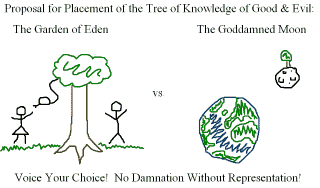
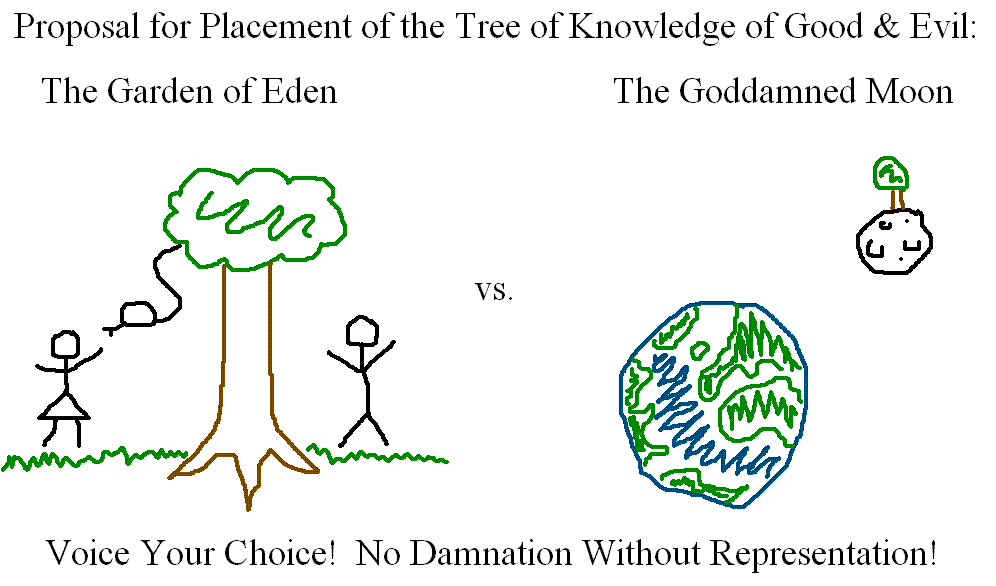
I made a picture!

Inspired by this comment over on Daylight Atheism. I want this on a t-shirt or something. I would so wear that!

There is so much wrong with the Abrahamic creation myth, it's hard to know where to begin. But morally speaking, I've always been a fan of Ayn Rand's take on it:
What is the nature of the guilt that your teachers call his Original Sin? What are the evils man acquired when he fell from a state they consider perfection? Their myth declares that he ate the fruit of the tree of knowledge — he acquired a mind and became a rational being. It was the knowledge of good and evil — he became a moral being. He was sentenced to earn his bread by his labor — he became a productive being. He was sentenced to experience desire — he acquired the capacity of sexual enjoyment. The evils for which they damn him are reason, morality, creativeness, joy — all the cardinal values of his existence. It is not his vices that their myth of man’s fall is designed to explain and condemn, it is not his errors that they hold as his guilt, but the essence of his nature as man. Whatever he was — that robot in the Garden of Eden, who existed without mind, without values, without labor, without love — he was not man.
I disagree with Ayn Rand on a great many things, but this is not one of them. I mean, I could pick a few nits in this specific formulation, but the central idea - that Original Sin condemns humanity for being human, and terms "evil" the very things that make life worthwhile - is right the fuck on. The cited source for the above quote is a good read, maybe about a page long; if you're not already savvy, it's definitely worth a glance. Go! Read! Enjoy! Now if you'll excuse me, I have some very important sinning to do.

Wednesday, September 9, 2009

They say that quitting cigarettes can be worse than quitting heroin...

... but I don't believe them.

I mean, I think drugs are awesome, but I won't even try heroin, because I'm worried that it might be that good. There is absolutely no fucking way that that's less awful than quitting cigarettes. Yet here I am, at five to two in the morning, and fretting over the fact that there's no place I can buy cigarettes in town. I mean, I have money... but no, says my super-ego, I'm supposed to quit this time. Wow. This is fucking tough.

Quitting cigarettes is supposed to be good for you, right?

Monday, September 7, 2009

SECKS: The "Bull-in-a-China-Shop" Approach to the Birds and the Bees

I think that we need to get laid. Like, every single one of us. I'm talking specifically here about the USA, but I suppose a good deal of this would apply to large chunks of Europe, as well as the "first world" in general. Consider how much our culture is steeped in sex, and how little we talk about it: advertisers make their money by literally preying on public perceptions of "sexy," underwear models adorn our buses, and we think nothing of the dating service ads and sex shops we see every day of our lives; but at the same time, we have people convinced that pornography is waging war on the human vagina, that breastfeeding in public is motherfucking dangerous, and that some people shouldn't be able to get a certain kind of contract signed by the state because of how they like to stick it in the naughty place.

This is fucking stupid.

Look, Humanity: Sex was here before we were, and it's got squatter's rights. We absolutely have to concede that point, or we're not going to make any progress on this one. But nooo, some people get all squeamish about the S-word, or the P-word, or the V-word, or the I-word, or whatever fucking word you want to use to talk about fucking. The truth of the matter is that porn is not intrinsically exploitative of women (though many men are - and so are some women, for that matter!), otherwise sites like (SUPER NOT-WORK-SAFE WARNING!) Men in Pain, Bound Gods, Naked Kombat, and Butt Machine Boys wouldn't exist. (And that's just one porn company!) The myth that seeing a breast is bad absolutely stupefies me - everyone has nipples, OK? And ain't nothin' wrong with a tit - it causes no harm, there's no such thing as "moral fiber" for it to damage, and if someone gets a little tickle in their "down there" because of it, I say good for them! As for our culture being stuck in the mud when it comes to recognizing homosexual relationships as legal, ugh, I don't even know where to start on that one. I'll just say I fucking hate Utah and leave it at that (and if you're reading this and happen to live in Utah... umm... well, OK, you're an exception). We really need to get over our bad selves - and I know just how to do it!

Here's my plan: we make a fucking float (i.e. "a float that fucks," I'm not just being foul-mouthed here) and put it in the Macy's Day parade. I mean one man, one woman, missionary-style reproductive intercourse. 1v1 PVI. We do it this way so that nobody can claim it's not as God intended - we're pandering to the Fanatical Wrong now, we just don't let them in on the Master Plan. And there's no way they'll find out, because there's no way they're reading my blog. Anyway, if they say they're offended, we can just slap them and ask what's offensive about the act that brought them into the world. Then we'll ask how they feel about their relationships with their mothers.

Think about that: everyone's parents fucked. Even yours. Your friends, too: ever meet a friend's parents? They fucked. Oh, they got it on! In fact, they probably tried everything you've ever tried - and since they're older than you, they've had more time to try more things. Please, take your time in pondering this.

Oops, got a little side-tracked there. OK, so we've got our fucking float, and now we just wait for it to become de rigueur, and then we start putting in a fucking gay float, and a fucking bondage float, and a fucking threesome float, and so on and so forth. We'll have all these fucking floats and as soon as anyone complains, we'll just slap them and say that people come in all shapes, sizes, and flavors, and we've had the first fucking float for forever, so everyone else needs to be represented here, too. Turn it into an equality/inclusion issue, that will almost guarantee a victory. OK, so that's phase two. Also, I may or may not be making this up as I go.

Phase three is "a miracle happens" and phase four is "victory," and those are pretty self-explanatory. I actually think my problem is in phase one, since people think they'll be harmed by seeing a naked body or a clear representation of the physical act of love (it doesn't harm them to have a naked body, such as their own, just to see another one). So, sure, maybe some people are offended by the sight of a nekkid body. So what? I'm offended by clothing: the proposition that there is something wrong with the human body which needs to be covered up is morally offensive to me, and I can't bear to see a human body hidden from plain view. But people's bodies are their own, so we should be able to do as we like, says I. Problem is, that's a rational conclusion, and people well and truly aren't rational about sex. I don't think they're capable of it, in fact, for what I think are some pretty embarrassing reasons.

We're a race of sex-crazed maniacs. People, that is. All of us. Every single one of your genetic ancestors had to lie, cheat, steal, charm, and/or muscle his and her way into the next generation by fucking. Fair enough at that: natural selection being what it is, those who are best at something will tend to keep on doing it, and sexual reproduction is certainly something one may be good or bad at. To that end, so much of our lives has been brought into the courtship, mating, and child-rearing rituals we've needed to survive; our lives are tied up in sex, it is an essential part of who we are and our instincts have been formed accordingly.

There's a problem with this, though, and like so many other problems, it is not inherent in the situation but arises from a mis-match between two things. Intellectually and technologically, we're beyond this sexy nonsense. Culturally and psychologically, we most definitely are not.

This needs some unpacking. OK, so sex is the way by which genes are able to ensure their transmission into the next generation - by "the way," I mean simply that there are plenty of other ways to improve one's odds, but sex is necessary in a way that other things just aren't. A horse can be as strong, fast, or intelligent as it likes, but without a mate and some offspring, that horse's genes won't propagate themselves into the next generation. Animals, accordingly, often act as if the genes inside them are taking calculated steps to increase their likelihood of continued propagation; this is just so, for the simple reason that those genes which have a tendency to cause their hosts to act in such fashion will, in the long term, win out over those which do not.

But the goals which may reasonably be imputed to genes are so far removed from the goals that humans choose in their individual lives, this often isn't worth thinking about - yet this mis-match is exactly what's at issue here. In fact, if we were not able to intellectualize our lives and consciously reject what our genes would say we "ought" to do, then nobody would ever adopt a child and all men would seek to become prolific sperm donors. Each of us is a collective of dead-end somatic cells with two tenuous glandular connections to the germ line, and as such we have all these instincts clustered around maintaining these connections and seeing to it that they do in fact convey our patterned base pairs to the next generation.

Intelligence changed this - sort of. Once we were able to realize our place in the greater scheme of things, we were on to the game and could see sex for what it is. And, well, it turns out that we need to be a little sex-nuts to win at genesmanship; more precisely, those individuals who are sex-nuts will tend to win at sex for the same reason sports nuts tend to be better at sports than non-enthusiasts, and so genes and culture "for" being sex-nuts get propagated. But being sex-nuts is just like being any other kind of nuts, insofar as it's fucking crazy. We have all these cute little ideas about sex: it's a private thing, it's special, it's only for two, you're a loser if you don't get any, a whole bunch of truly legendary nonsense about the hymen, and so on and so forth. These are all myths and contrivances - they're complications we add to sex because we're complicated, and we project those complications upon things that matter to us.

Sex had good reason to be private back in the day when someone could fuck with your fucking - especially if you were the fucker fucking with some other fucker's fucking. But honestly, there's no reason it can't be out in the open - we know enough about it and can keep it safe enough that there's just no reason we can't fuck in the street. I'm not saying we should, and I'm not saying you won't get arrested for it; I'm saying that there's no purely rational reason outside our own ad hoc psychology that prevents sex from being a wildly public thing. The idea that it "ought" to be private is only in our heads. That in and of itself is sufficient reason to make it private, but what I'm saying is that we're not rational for being this way in the first place - we're simply programmed to be that way, it's not a reasoned conclusion we arrived at after any deliberation. It's simple fucking insanity to have this idea for no reason and with no support, and most people never fucking question it their entire lives. It's much the same story for how many partners a person ought to have at one time or throughout a lifetime, who those partners ought to be, how regularly those partners should be replaced, and on and on and on. We are all naturally insane about this, and it will never be diagnosed as such until it's tremendously unpopular, because questioning this insanity, ironically, is what will make you dysfunctional.

We can make sex safer from STDs than ever before, we have the luxury of terms like "unwanted pregnancy" which would make no sense in the wild, we can check our DNA against that of our alleged offspring, we can fertilize an egg with a sperm in a test tube, we have mapped the human genome and we're hard at work demystifying embryonic development. We know so goddamned much about sex and we've made it safer and easier than ever before, yet while nobody bats an eye when a man wants to jam his peepee in a vajayjay, a lot of those same people absolutely lose their shit when a man wants to shove his wing-wong into another dude's manhole, or when a woman wants to do anything to another woman's hoohoo (this last one's way more popular on the internet, though). For the sake of social cohesion, we should call all of these activities "normal," as well as anything else that consenting adults care to do to each other; but in reality, it's all fuckin' weird. All of it. We're all just as weird as everyone else, only some people are weird in popular ways and other people are weird in unpopular ways. "Normal" is an invented, bullshit term.

This is exactly what I'm talking about: the fact of the matter is that people come in all sorts of shapes, sizes, and flavors, and they have all sorts of desires and perversions and proclivities, yet we think sex "ought" to be this or that way because that's how we like it or that's how we were taught. That's fucking nuts! What is wrong with people? Worse still, we go and pass fucking laws about who's allowed to pair off with whom, and how and when we're allowed to stick it in the naughty place. We need these strictures, in the "just-so" sense that of fucking course we'd go and make rules about sex; but we need them because we can't be rational about sex, and these rules show just exactly how much we can't be rational about sex.

The rules aren't right, they're not rational, they're not just, they're fucking crazy. But so are we. I guess what I'm saying is that we need to accept that we're all bat-shit loco and just live with that - but then again, part of our butt-puckering insanity is that we can't just live with it, we angst over it and primp and preen ourselves and try to put on a show and act like we know what's what, when we're all just as confused as anybody else. Welcome to the human race, where nobody knows what the fuck they're doing, but everybody acts like they do, anyway. People are fucking complicated, The End.

My vitriol gland just ran dry, so I guess rant is off now. I don't really have a solution to any of this, I just wanted to yell and holler about how we're all necessarily crazy about this one stupid thing, because it was driving me batty. But I'm done now. Y'all have a good one!

Fun Fact: I used the words "fuck," "fucked," "fuckers," and "fucking" a combined total of 37 times in this post. All were legitimate; not one of them was necessary. As Penn and Teller put it, sex is an end in itself and everything around it is what's gratuitous.

Thursday, September 3, 2009

Quickies Before Work

  • Chariots of Iron: These guys are awesome, and you know from the title that God can't beat 'em! My favorite line: "If you really think the Earth is only six thousand years old, you shouldn't be able to get a driver's license, let alone run a country." (#33)
  • Dan Savage lets drunks do his job for a day! It's cooler than it sounds, I promise.
  • District 9 is awesome and everybody needs to see it. It's got everything in it (action, drama, social commentary, political allegory, you name it), and it's all done well.
  • Here's a bottomless pit of stupid fun: Motivated Photos. Check them out.
  • I quit cigarettes today. Mainly 'cuz I'm out and don't want to keep buying them. But I want to socially pressure myself into actually quitting and not just stopping temporarily, hence the announcement.

A Message to the Folks in Charge: I MAED A GAM3 W1TH Z0MBIES 1N IT!!!1

So there's this thing called XBLA (pronounced "ecks-blah") where you can try, buy, and play games alone or online with your friends. It's awesome because Microsoft has this other thing on their first thing which they used to call "Community Games," which meant "games made by gamers in the XBox community." This was an appropriately informative title, but now they're called "Indie Games," which is misleading in at least one way. I mean, sure, the games are created independently, which I guess is the important part, but they're advertised, sold, and distributed by Microsoft, which is the closest you can get to an avatar of The Man.

Whatever. I still call them "Community Games," and they're still awesome. Well, some of them are, and some of them are not. But I can download free trials of all of them, and play them like I'm in an old-timey video game arcade! And with no quarters! So I found a truly awesome one, and it's probably the most stellar example I've seen of a creative and fresh new twist on an old favorite. Due to what I assume is a character limit, the game in question is called, I MAED A GAM3 W1TH ZOMBIES!!!1 However, the game's picture displays what I believe is the full title, I MAED A GAM3 W1TH ZOMBIES 1N IT!!!1 It's a twin-stick shooter, which means that you move with one joystick and shoot in whatever direction the other joystick is pointing, like Smash TV. Or Geometry Wars. Or any other twin-stick shooter.

So what makes this game so crazy fun? Well, it's got a solid gold core of simple-yet-addictive gameplay: shoot everything that moves! And surrounding that pristine nugget is a whole bunch of silly shit that cannot be taken seriously. But it's not self-conscious at all! The guys who did this (or guy? I don't know) just surrounded that quantum of joy with a whole bunch of ridiculousness and went for it. Did they make it? Umm... I think so! The background music is a poppy, catchy tune with lyrics that are about the game, and how it only costs a dollar.

WHAT?!

Yes, this simple addictive shooter, with background music that probably took longer to make than the rest of the game combined, costs but one single American dollar. Deal!

My message to the Folks in Charge is this: gameplay is king. I don't care how pretty your game is - or, rather, I care about graphics less than I care about gameplay. Everyone - and I mean absolutely everyone - is the same way, we just have minimum standards of gameplay that we will accept. Do you know how I know this? Because every gamer I know still loves old games with fantastic gameplay. Every single one of them.

Anyway, below is a video, although playing is always better than watching. Also, here is the song if you just wanna listen.