Update Schedule

This blog updates irregularly.

Thursday, September 3, 2009

A Message to the Folks in Charge: I MAED A GAM3 W1TH Z0MBIES 1N IT!!!1

So there's this thing called XBLA (pronounced "ecks-blah") where you can try, buy, and play games alone or online with your friends. It's awesome because Microsoft has this other thing on their first thing which they used to call "Community Games," which meant "games made by gamers in the XBox community." This was an appropriately informative title, but now they're called "Indie Games," which is misleading in at least one way. I mean, sure, the games are created independently, which I guess is the important part, but they're advertised, sold, and distributed by Microsoft, which is the closest you can get to an avatar of The Man.

Whatever. I still call them "Community Games," and they're still awesome. Well, some of them are, and some of them are not. But I can download free trials of all of them, and play them like I'm in an old-timey video game arcade! And with no quarters! So I found a truly awesome one, and it's probably the most stellar example I've seen of a creative and fresh new twist on an old favorite. Due to what I assume is a character limit, the game in question is called, I MAED A GAM3 W1TH ZOMBIES!!!1 However, the game's picture displays what I believe is the full title, I MAED A GAM3 W1TH ZOMBIES 1N IT!!!1 It's a twin-stick shooter, which means that you move with one joystick and shoot in whatever direction the other joystick is pointing, like Smash TV. Or Geometry Wars. Or any other twin-stick shooter.

So what makes this game so crazy fun? Well, it's got a solid gold core of simple-yet-addictive gameplay: shoot everything that moves! And surrounding that pristine nugget is a whole bunch of silly shit that cannot be taken seriously. But it's not self-conscious at all! The guys who did this (or guy? I don't know) just surrounded that quantum of joy with a whole bunch of ridiculousness and went for it. Did they make it? Umm... I think so! The background music is a poppy, catchy tune with lyrics that are about the game, and how it only costs a dollar.

WHAT?!

Yes, this simple addictive shooter, with background music that probably took longer to make than the rest of the game combined, costs but one single American dollar. Deal!

My message to the Folks in Charge is this: gameplay is king. I don't care how pretty your game is - or, rather, I care about graphics less than I care about gameplay. Everyone - and I mean absolutely everyone - is the same way, we just have minimum standards of gameplay that we will accept. Do you know how I know this? Because every gamer I know still loves old games with fantastic gameplay. Every single one of them.

Anyway, below is a video, although playing is always better than watching. Also, here is the song if you just wanna listen.

Monday, August 31, 2009

Inglourious Basterds: A sort-of review by a not-really critic

I suspect that killing Nazis is, for most Westerners, more or less like killing zombies is for me: an end in itself, a wellspring of amusement and satisfaction, an everlasting Gobstopper of joy that banishes all unpleasantness. I have a bottomless appetite for zombie-slaying, hating the undead with a passion as I do; given the chance, I would gladly risk my real life on a daily basis to kill real zombies, should they ever become a genuine threat (though I would be loath to see such a threat foisted upon the world). Replace "zombies" with "Nazis" in the previous sentence, and that's what I imagine the general consensus is in the Western world, and why we Americans so enthusiastically consume WWII shooters: it's righteous violence for a good cause against an implacable evil that is diametrically opposed to our very existence (in the shooters, that is... and in the imaginations of many overzealous patriots... the reality of the situation gets quite a bit stickier when we try to paint it in black and white like that, though).

So I watched Inglourious Basterds last night. I had only seen one preview of it, and it looked like either a satire or parody of the World War II genre; then I found out it has Brad Pitt in it (who is hot to death and a good actor to boot); and then I found out it was directed by Quentin Tarantino, who has never done anything I haven't liked. Well, maybe it's a commentary on World War II films, but it's not a satire or a parody (at least, not in the usual way). And as for Tarantino's involvement, the tone of the movie is more or less Pulp Fiction in the 1940s (Tarantino himself describes it as a spaghetti Western in WWII). That's about all I can say without getting into spoiler territory, so take that as you will; I do recommend seeing the movie if any of that sounds even vaguely interesting to you, though.

Beware of the Spoilers! They are all floating down here!

Inglourious Basterds is a Tarantino movie through-and-through: the protagonists are not people you'd have over for dinner for any sane reason, the plot is continuously contorting itself in a series of convoluted and inscrutable gyrations like a confused stripper on E, and there's not really a central message or point except that the world is a messy place where everyone's got their fare share of fuckups, hangups, and moral failings. Normally, this makes for witty one-liners, juicy water cooler gossip, and car-crash-like scenes that make me feel good and guilty at the same time (good because I like what I'm seeing; guilty because I feel prurient for liking it). I like this feeling. So I hope you understand when I say that it was even more pronounced while watching Inglourious Basterds.

Brad Pitt's character, Aldo "the Apache" Raine, scalps Nazis. Literally. He's got a command of eight American Jews who all hate Hitler and every last bit of Aryan supremacist bullshit he stands for, and Aldo tells these men that each of them owes him one hundred Nazi scalps. Aldo doesn't take prisoners - those few who he doesn't scalp are sent back to their leaders to tell horror stories of how their entire unit was killed and scalped - oh, and the survivors have swastikas carved into their foreheads with a Bowie knife, too. The reason for this last bit is that a Nazi uniform can be taken off: Aldo likes it when the Nazis wear their uniforms, because it makes them easier to identify; if they take their uniforms off, though, they can blend in with the rest of society. Aldo can't abide this, so he gives these men "something they can't take off." ::shudder::

But Nazis are evil, dammit! Right, guys? Well, OK, yes... but so is scalping people and permanently scarring them! How much evil is permissible in defense against a greater evil? Should despicable fear tactics such as scalping and mutilation be considered "good" when employed against things like genocide? Shit, I don't know. I mean, I'm a consequentialist, and as such I have to acknowledge that demoralizing an enemy is an effective tactic. As Sun Tzu wrote, the best way to achieve victory is to remove your opponent's desire to fight. But man, where do we draw the line?

This kind of moral inclarity is delectable to me. If you want to feel good about Nazis "getting theirs," then this probably isn't the movie for you - or Hell, maybe it is, but you might not get the same things out of seeing a Nazi officer beaten to death with a baseball bat that your friends get out of it. And there's a whole bunch of neat little character development segments and some really cool symbolism (such as when Shosanna Dreyfus is putting on her makeup, and it looks like she's putting on warpaint during a couple cuts). But all this is secondary in my mind to the moral muddle that Tarantino creates by eschewing the cartoonish portrayal of World War II seen in most of the genre (or perhaps by applying such cartoonish strokes liberally upon all sides). You know what I'm talking about: Hellboy doesn't fight Nazis, he fights "Nazis" who can't be reasoned with (like zombies), and "Nazis" also populate Germany, Italy, and France in most of the World War II genre. Tarantino's Nazis are closer to real Nazis, whom it must be remembered were also real people, than they are to "Nazis."

So yeah, I enjoyed watching Inglourious Basterds, and I recommend at least one viewing, but this sure isn't your daddy's World War II film. Given how saturated the market is with your daddy's WWII film, I say hooray for that.

Saturday, August 29, 2009

101 Interesting Things, part twenty-two: The Coastline Paradox

So I've been in e-mail contact with island, who commented on my second Abusive Cosmology post. I had previously known that Earth is a rare specimen, but I have since gained a much greater appreciation for just how rare our circumstances are here on this pale blue dot.

Earth occupies what is known as a "Goldilocks Zone," a whimsical yet apt term which amounts to walking a knife-edge between competing runaway forces. Uninhabitable extremes characterize the overwhelming majority of the Universe and prevent life from cropping up almost everywhere. However, these opposed runaway forces of extreme heat and cold, crushing gravity and hungry vacuum, as well as others, occasionally strike a balance between them that makes it possible for life as we know it to arise and thrive.

Now, we can imagine Goldilocks Zones for any phenomenon we'd care to dream up, be it life, molten metal, solar flares, factories, or whatever. The simple fact of the matter is that there are just about always more ways for any given thing to not exist than there are ways for it to exist. What's interesting is that these Goldilocks Zones have relevant features at all levels of reality. In terms of life, there is a Goldilocks Zone between Earth's mantle and its ionosphere into which all life has shoe-horned itself. Locally, every organism has its niche, and there are plenty of places on the planet where any organism you'd care to name simply could not survive: no species can survive absolutely anywhere on Earth.

Earth itself is in a Goldilocks Zone relative to our star, Sol: too close and we burn, too far and we freeze. Our solar system itself is a roll of the die that came up "life-friendly," with gas giants sweeping up the riff-raff of cosmic debris (which would otherwise pelt every small rocky world into oblivion), and without so much eccentricity in their orbits as to screw with the inner rocky planets. And the position we occupy in the galaxy is far enough out from the gene-scrambling radiation of the galactic core, but not so far out as to lack the heavier elements needed for more complex life. With respect to time, life cannot come about during the initial or final phases of a planet, star, galaxy, or Universe (at least, not a Universe that starts with a Big Bang and ends with either a Big Crunch or heat death). And with respect to physical laws, they have to be such a way as to allow life to be possible anywhere at all (though whether they could be otherwise is at present an open question).

This preponderance of interesting features reminds me of the Coastline Paradox, which refers to the difficulty of determining the "exact" perimeter of a coastline. You see, coastlines have relevant features at all levels of detail, and these change on all timescales. From biggest to smallest, coastlines have features observable from space that change in geologic time, and features on the more human-appropriate scale of meters that change daily with the tides, and features on the atomic scale that change rapidly all along the progression and recession of every single wave.

So what's the "true" length of a coastline? Ain't none. We can arbitrarily decide which features are important and which are not (the Wikipedia page mentions the appropriately useful tactic of omitting features significantly less than the unit in which the measurement is being made), but no output from any such method has a privileged status over any other. Trying to find the true or exact length of a coastline, even in a snapshot of time, is like trying to find exactly how many grains of sand constitute "a heap."

Monday, August 24, 2009

Bullshit Pulpit: So help me, Pythagoras...

Pop Quiz! The Bible contains which two of the following three things (answered by clicking, so don't cheat):
1. Instructions on how to sell one's daughter into slavery.
2. An explicit declaration that rape is morally wrong.
3. A proclamation that God is as strong as a unicorn.
If you answered 1 and 3, congratulations! You know your Bible! Next, please rank the following three ideas in order from greatest importance to least:
1. The lives and rights of women are just as important as those of men.
2. The comparative strength of God against that of other mythical creatures.
3. People are not property.
If you ranked 2 last, congratulations! You're civilized! Finally, please reconcile your answer to the previous question with the fact of the matter of the first. If you're an atheist, or some manner of theist who acknowledges that the Bible is just some book written by primitive men with a whole mess of backward ideas, congratulations! You're rational!

Now I shall abruptly switch gears. Suppose that I hold up a math textbook in one hand, and while gesturing wildly with the other, I proclaim that I believe everything in this book is true. Yes, I know that you know where I'm going with this, just trust me for now. Suppose also that you ask me, "Well, do you believe that the quantity, 'A plus B,' squared, is equal to A squared plus two AB plus B squared?" And suppose once more that I respond, "Preposterous twaddlecock!"

Well, as it happens, (a+b)2=(a2+2ab+b2) is a quadratic equation, and these are among the foundations of algebra. Also, the book in my hand is a high-school algebra textbook, so it damn well ought to be in there. Page 382, for the sake of argument. The point here is not whether this quadratic equation is true or not, or whether my math book has any errors or not; the point is that, by pronouncing my belief in a book I have not read and do not fully understand, I have put myself in a position to look awfully silly.

Let's shift back to the original topic of this evening's symposium: Biblical and moral pop quizzes. Respondents may be grouped by their answers and I suspect that these groups will have a strong correlation with the beliefs of those respondents. Those who recognize that the Bible does not say that rape is wrong will, for the most part, turn out to be atheists (or perhaps theologians, but these will be a clear minority unless I somehow acquire a selection bias in favor of theologians). Those who suspect that the Bible does not compare God's strength to that of an imaginary creature will, by and large, turn out to be believers. I'm not sure about that first one, though - it strikes me as less preposterous than 3, but less necessary than 2 - so I'll withhold any predictions about that one for now. And there will of course be those who are neither atheist nor Christian (you know, people who are religious but don't think the Bible is true) who could reject any one of them for a whole host of competing reasons (in America, they'd be a minority).

My point is that Biblical belief, absent Biblical education, will lead to something like the following general thought process in believers: "Hmm... well, the Bible is a morally good book, the word of God in fact, and so 2 is definitely in... and 1 is pretty bad, but 3 is just stupid. If I had to guess, I'd say 3 is the missing one; and I have to guess, so I'm going to say that 3 isn't in there, and 1 & 2 are." BZZT! Wrong! Beliefs about the book formed a rational prediction, and that prediction turned out to be incorrect. Since the prediction was incorrect, we are left to examine the beliefs from which the prediction was formed. I maintain that the Bible is not a morally good book and is not the word of God, but is rather the work of many different men throughout antiquity who didn't know what atoms or germs are and probably thought that unicorns are real. Other answers are possible, though: for instance, God may have been so preoccupied over the possibility of people wearing linen and wool together that he forgot to tell the men of his chosen people that they shouldn't fuck the women of his chosen people against their will. Hey, it's cool, sometimes I forget to pay the gas bill until I get an e-mail about it.

This type of thinking leads to some fairly silly situations, though. Consider the brouhaha over the Ten Commandments, as debated in Alabama (among other places). There are people who believe, and institutions who declare, that the Ten Commandments are an advanced and wonderful set universal moral laws which were ahead of their time and are respected by all societies. Really?! What the fuck?! Do these people even know what the Ten Commandments are?!

No, as it turns out, they don't. Ask a person on the street, or a Christian in church, to name all ten and you will get confused looks at least 90% of the time, and complete answers from perhaps two or three percent (again, unless you've got a selection bias in favor of theologians). Just about everyone will be able to give you "don't kill" and "don't steal." Other popular ones include "honor your parents" and "remember the Sabbath." Let's see if I can get all ten from my desk at work with no Bible (I'm not using SAB to cheat, I promise!):
1. I am the Lord thy God; thou shalt have no other gods before me.
2. Thou shalt not make unto thee any molten gods.
3. Honor thy father and mother.
4. Thou shalt not kill.
5. Thou shalt not steal.
6. Remember the Sabbath and keep it holy.
7. Thou shalt not bear false witness against thy neighbor.
8. Thou shalt not commit adultery.
9. Thou shalt not covet thy neighbor's wife, nor his goods, nor his ass, nor his house.
10. Thou... umm... something about yeast?
Shit! Only nine! OK, let's see how I did:
From Exodus 20:
1. Thou shalt have no other gods before me.
2. Thou shalt not make unto thee any graven image.
3. Thou shalt not take the name of the LORD thy God in vain.
4. Remember the sabbath day, to keep it holy.
5. Honour thy father and thy mother.
6. Thou shalt not kill.
7. Thou shalt not commit adultery.
8. Thou shalt not steal.
9. Thou shalt not bear false witness against thy neighbour.
10. Thou shalt not covet thy neighbour's house, thou shalt not covet thy neighbour's wife, nor his manservant, nor his maidservant, nor his ox, nor his ass, nor any thing that is thy neighbour's.
Argh! So close! OH, WAIT. NO, I AM NOT EVEN CLOSE. You know why? Because those aren't the Ten Commandments. I can prove it right now, too. Just grab your fuckin' Bible and follow along with me, no sleight of hand or shenanigans here at all.

Got your Bible? OK, open up to Exodus 19:20. This is after the Israelites have left their made-up captivity at the hands of the Egyptians (the latest archaeology shows that the Israelites, as they came to be known, were probably the lower classes of extant Canaanite civilizations who rose against, broke stuff, and then ran to the hills, using Egypt as a stand-in for their faceless oppressors), but before the milk and honey hijinks. In chapters 19 and 20, Moses goes on up to Mount Sinai and has a chat with God - no tablets, no commandments, they're just talking - and then Moses comes down. The End. Later on, in Exodus 31, Moses goes back up to Mount Sinai. This time, there is writing, but the Bible itself simply states that God wrote what he and Moses talked about - so it ought to be the same, right? Still no mention of any commandments, though. Well, Moses goes back on down with his two stone liqui-gels tablets, but he sees that Aaron has got them all worshipping a golden calf, so he throws a tantrum the tablets to the ground... no, wait, he throws a tantrum, too... and the tablets break. Then Moses has to talk God out of killing every last fucking Israelite stone-dead (no joke: read Exodus 32:9-14).

Nowhere in this part of the story is the writing on those tablets explicitly reviewed, and neither is this piece of genius referred to at any point thus far as "The Ten Commandments." You have to go back to chapter 20 to get the words themselves which are today called the Ten Commandments, and you have to go forward to Exodus 34:28 to get the word "commandments," and this is a problem. In Exodus 34, it says that Moses goes up Mount Sinai a third time, and this time he writes what was written on the tablets before, which writings bear no apparent relationship to what they had talked about the first time, and only now are they called commandments. So far, so good... except the commandments are entirely different, viz:
1. No other gods.
2. No molten gods. (So far, so good.)
2. Keep the feast of unleavened bread. (What?)
2. Work six days, rest on the seventh. (Oh, OK, back to normal...)
2. Ovserve the feast of weeks, the firstfruits of the wheat harvest, and the feast of ingathering at the year's end. (That's quite a few parties...)
2. All the male children should appear before God three times a year. (Double-what?!)
2. Don't offer a blood sacrifice with leavening.
2. Don't leave the passover sacrifice until morning.
2. The first of the firstfruits of the land are God's.
2. Don't boil a baby goat in its mother's milk.
Really? I mean, really?! Those are the Ten Commandments? You're goddamned right, they are. That is, until you get to Deuteronomy 5, where we're back to that first conversation that Moses had with God*.

I once had a professor tell me that, convoluted as the Bible was, it does not contain any contradictions because a contradiction is of the form "X is the case, and X is not the case." Leaving aside simple paradoxes (such as "People are good, people are evil," where "evil" means "not good" and therefore "people are evil" means "people are not good"), this is still false because we have here the statement, "The Ten Commandments are A, such that any B which is not A is not the Ten Commandments" (for any statement of A=C, it is implied that there is a B which is not C and is therefore also not A, otherwise A=C is an uninteresting tautology). And then later on we have the statement, "The Ten Commandments are B." So check it out in premise format:
1. A. (Where A is the Ten Commandments in Exodus 34 described as the Ten Commandments).
2. A implies ~B. ("~" means "not," or in this case, "B is not the case," where B is any non-A set of the Ten Commandments.)
3. ~B. (From 1 and 2, above, with modus ponens.)
4. B. (Where B is the Ten Commandments in Deuteronomy 5 or Exodus 20, which is also a non-A set of the Ten Commandments - it's a "true B," in other words.)
So we have here A, A implies ~B, therefore ~B, and B. We have here a contradiction: ~B and B.

Something is wrong here. Options include, but are not limited to:
1. There are actually Twenty Commandments, with some duplicates.
2. Moses wrote it wrong (or dictated it wrong, or was transcribed wrong) in Exodus.
3. Deuteronomy is wrong with respect to the Big Ten, as well as parts of Exodus.
4. God changed his mind.
5. There has been a change which would be rather difficult to trace today and which has resulted in different accounts of what was supposed to be the same mythical (not literal) event.
6. The whole thing's hogwash.
As it happens, 6 is true - but so is 5! (Happily, they're not mutually exclusive like B and ~B, so they can both be true at the same time without contradiction.) You see, some people (who apparently had nothing better to do) have determined that the Old Testament is actually an amalgamation of no less than five distinct sets of writings. One of those sets of writings, the latest one (omitted by the Wikipedia article, it's called "R" for "redactor"), is the result of an ongoing attempt to work the other four into one continuous narrative, and this is why we have the Bible as we have it today (well, that and the third Council of Carthage in AD397). To accomplish this task, many techniques were employed under the general heading of midrash, the important parts of which (for our purposes) amount to the Biblical equivalent of DC re-telling Superman's origin over and over again, or of Nintendo's continuous re-telling of the Legend of Zelda: it is a regular sexing-up of otherwise outdated material for a new generation of audience members. One of these techniques is to take different accounts of the same event, like Moses' trip up Mt. Sinai, and to say that all versions happened in sequence (as opposed to instead of one another).

This professor of mine tried to explain away the "B and ~B" contradiction outlined above - yes, that very one - by saying that since the current version is just a re-telling of several other versions rolled up into one, it's not "really" a contradiction. That's like saying, "Well, you see, the original Superman was named Clark and raised by John and Martha Kent, but the next Superman is named Arthur and raised by John and Martha Dent, and so even though the newest Superman literature says in one place that he's always been named Clark and raised by the Kents, but in another place that he's always been named Arthur and raised by the Dents, it's not really a contradiction because it's just a re-telling." Oh, and don't forget that a whole lot of people worship Superman in this hypothetical world, insist that his comic-book history is the inspired word of Superman (who is perfect and therefore never lies) which is without flaw or error, and also that when people die they will be either resurrected by Superman to live in the Fortress of Solitude with him (for serious!) or they will be imprisoned in the Phantom Zone forever.

That's stupid.

Anyway, I really think that if more people read their damn Bibles, we'd have a lot fewer believers. Or at least a lot fewer literalists (though there would still be some). Also, I want to swear on math textbooks in a courtroom now. "Do you solemnly swear to tell the truth, the whole truth, and nothing but the truth, so help you Pythagoras?" "I do, so help me Pythagoras."

- - -
* - Extra Credit: OK, so there are a few other things going on here as well. First of all, beyond Moses arguing with God (that's how you know he's a true Jew), you've also got the part in Exodus 34 where God say's he'll do the writing at the start of the chapter, but then he pussies out and has Moses doing the writing by the end of the chapter. Also, in Deuteronomy 5, it says that God made the covenant with Moses at Horeb, whereas Exodus places all covenantry clearly at Sinai. And do keep in mind that the only place in the Bible that the Big Ten are called the Big Ten - that is, the only place in the whole fuckin' Bible where the words "The Ten Commandments" are used thus - is in Exodus 34. What do you think ought to be the official ruling on this one?

Wednesday, August 19, 2009

Poison for your Brain: Stephen Hawking should be DEAD! Long live Stephen Hawking!

Thanks to PZ for pointing this out:
"The controlling of medical costs in countries such as Britain through rationing, and the health consequences thereof, are legendary," read a recent editorial from the paper. "The stories of people dying on a waiting list or being denied altogether read like a horror script...

"People such as scientist Stephen Hawking wouldn't have a chance in the UK, where the National Health Service would say the life of this brilliant man, because of his physical handicaps, is essentially worthless."

The paper has since been notified that Hawking is both British and still among the living. And it has edited the editorial, acknowledging that the original version incorrectly represented the whereabouts of perhaps the world's most famous scientific mind. But it has not acknowledged that its mention of Hawking misrepresented the NHS as well.

"I wouldn’t be here today if it were not for the NHS," Hawking told The Guardian. "I have received a large amount of high-quality treatment without which I would not have survived."
Well, that's a pretty clear conditional statement from the IBD: "If Stephen Hawking were British and therefore subject to the NHS, then Stephen Hawking would be dead." Guess what? Stephen Hawking is British and therefore subject to the NHS, and Stephen Hawking is not dead; the conditional statement is false, and the argument which the point is supposed to support is therefore stupid. OK, fine, flawed. But still.

I will never understand how such out-and-out lying passes muster in the American populace. Sure, sure, Investor's Business Daily may have made a merely-ironic-but-honest mistake... but seriously, nobody over there knew that Stephen Hawking is British? And nobody thought to check before going to print?

What are you, new?!

This isn't funny any more. "Atheists have no morals" is funny. "Obama wasn't born in the USA" is funny. "Stephen Hawking died for lack of health care" is funny. But these are all funny because they're manifestly false and relatively harmless in my day-to-day life. "Baseline nationalized health care dedicated to raising the minimum standard of living will result in mandatory euthanasia and no children getting any health care at all" is not funny; it's obviously false and stupid, stupid, stupid. It's a kind of stupid that is downright dangerous, if you ask me, since the other lies from the Right are matters of empirical fact which can be disproven with even passing knowledge of... well, anything. This, right here, is not that. This is something else.

This is different because it's screwy logic that preys on a clear and obvious misunderstanding of the pitch: if you listened to Obama at all, you'd have to know that what he says is not matching up with what is said about that. So the citizens on the Right who buy this horseshit are in the unenviable position of either A) thinking themselves informed for listening to the commentary on an issue alone (and buying it despite its obvious insanity), without actually paying any attention to the issue itself, or B) hearing the commentary and being informed on the issue and still going with the commentary, in flagrant defiance of all logic.

I don't know which is worse.

Le sigh. Look, it's like this: everyone is afraid that, should shit hit the fan, someone I care about might not have access to health care. That's a rational fear, and I get it. However, if you live in America, that's a rational fear in the current situation. It's been a rational fear for... forever. The people you love will die, and some of them will die for stupid reasons you don't like. That's how it goes, man. Obama's proposed changes are aimed at minimizing the extent to which this happens, and that means putting a price tag on human life just like we do now. You know why we put a price tag on human life? Because sustaining human life has a cost. Who's gonna pay yours? You do! Well, more accurately, you pick up where your parents left off as soon as you enter the work force and file independent on your tax returns. You make money, and you use some of that to sustain your life, and you do what you like with the rest. And right there, whatever it is that you spend before you get into your disposable income, that's the cost of your own personal Human Life, plain as day in beautiful green dollars and cents. Hooray!

But what if shit happens and you don't have enough? Well, that's what insurance is for, and insurance isn't going away - it's being supplemented. It's getting better. The uninsurable have a baseline below which the government won't let them fall, and while the quality of that thing will vary with the costs of doing that thing, the private sector will now have an objective goal: do it better than the government. If you think you can get something better from the private sector, fucking go for it! More power to ya! (Just be prepared to pay!) If you can't, or don't want to, then Obama's changes are for you, and suck though they may compared to something you can't afford anyway, it's better than nothing at all which is where things are right now. And if you've got the money to afford health care on your own, then nothing will be able to get in the way because you can afford it.

Fuckin' Hell, what is so hard to understand about this?

Call Ripley! AI vs. AI in a No-Holds-Barred Video Game Contest!

Fine, not quite; but AIs are playing Super Mario Brothers! No joke!
Baumgarten's AI also had some pleasant surprises. Without programming, the AI learned to grab the shells from defeated enemies and use them to destroy other enemies.

"This nice behavior sometimes just appears," said Baumgarten. "We try to optimize the behaviors that will lead to success."
They're learning! Or at least "acting as if learning," which is close enough (and what we do, anyway, once you get past the whole "self-awareness" issue). Now, this may be premature, but I welcome our new robot overlords. I can't wait for the day when we as a species outgrow our cyberpunk adolescence and move on to a postcyberpunk utopia.

Monday, August 17, 2009

Tycho Brahe already said everything I wanted to say!

I don't know how these guys keep hitting the nail right on the goddamned head. Tycho (of Penny Arcade, as opposed to History) writes on the ThinkB4YouSpeak campaign:
Trying to regulate how people speak is a problematic endeavor. People sometimes try to assert that Information Wants To Be Free, when that isn't actually true, because information can't want things. It's a false corollary of something that is true, though - namely, that Communication Cannot Be Contained. A true corollary of this notion would be that People Will Say Things You Don't Like, And May Even Hate, a shard of schoolyard wisdom I previously thought well distributed.
Gabe, in deliciously uncharacteristic form, has his own riff right below where he gives undue analysis to what was, in all likelihood, a rather thoughtless comment from someone he doesn't even remember.

I gotta say, I'm with 'em. (Full Disclosure: I was against 'em before, and with the ThinkB4YouSpeak folks, but I've since changed my mind.) I think that people who think "gay" is an insult are stupid, but you can't really fight stupid with stupider. "Gay" will continue to be an insult as long as those assholes think it is, for the same reason that "special" is now (and "retard" before it, and "moron" & "idiot" before that). It's a very simple thing, really: the insult word is something that the speaker does not wish to be. "Chug that beer or you're gay" has the same argumentative weight as "Chug that beer or you have cancer." It's every bit as insensitive and ignorant, no matter the specific manifestation.

So how do we win? Well, leaving aside for the moment that you can't actually "win culture" or "win language" (OK, maybe you can... I certainly lose at language when under certain chemical influences...), I like Dan Savage's "leotarded" approach. I like it because it's fun, it's stupid, and it shows just how stupid the whole thing is. You want me to stop saying "leotarded?" Fine, stop saying "retarded" and I'll think about it. Neener-neener, nanny-fuckin'-boo-boo. And when you've blown the last raspberry, then you'll know you've won.

Just kidding. The insult, it turns out, only has the power you let it have (like, say, any other insult). Things may or may not change in your lifetime, and you'd save yourself a lot of grief & angst if you'd just get over it. Yeah, I know, they're wrong and it sucks and you just wanna do something about it. Well, by all means, do something about it! But if you're not also preparing yourself for the inevitable backlash and the possibility of failure by inoculating yourself against such barbs, well, then you might go a little nuts. And cry in public when someone calls you "gay," then cry more when they call you "gay for crying."

Besides, if we couldn't use "gay" frivolously, then skeletons couldn't be gay for deals! And that would be a true tragedy. For Serious.

101 Interesting Things, part one double follow-up!

Damn, this just keeps getting better and better!

OK, so first I went on about how the Antenna Galaxies are awesome. And then I was all like, "Hey, here's some other cool stuff just like that!" And now, thanks to the internet (more specifically, thanks to the internet bringing me PZ Myers), there's this other really cool thing:
Oh, man! Galaxies in 3D?! I'm so there!

Wednesday, August 12, 2009

Abusive Cosmology: The Anthropic Principle

A comment by Kallan.G on my previous Abusive Cosmology post inspired me to write this one. With one cantankerous rant already under my belt, I think I can kick it up a notch today. BAM! If you like your philosophy sprinkled with vulgarity and harsh invective, like some kind of belligerent cupcake piled high with foul-mouthed frosting, then this post is for you. Lucky you! Let's get started.

A lot of people think the simple fact that we exist is somehow "special." These people are stupid. If anyone ever tells you that the Universe is fine-tuned to support intelligent life, you need to punch him in the face immediately. Look at the Universe - just fucking look at it! It's not "for us" by any stretch of the imagination, unless your imagination is dumb. Most of it, even on the medium scale we're used to, is cold, sterile, empty space. There's a quarter-million miles between the Earth and the Moon, and only a tiny bit of that is habitable by life as we know it. Beyond that, it's unremarkable empty space in all directions for millions of miles, unless you happen to run into an asteroid, or head in the direction of Mars or Venus (even then, they'd have to be at least vaguely aligned with the Earth in order to be anywhere even remotely close to our neighborhood). Farther out, things get even worse: beyond our solar system, there is nothing but the darkness between the stars, until you get to Proxima Centauri. In all that space, the only place we know that there's life is a thin, hollow, semi-spherical volume comprising Earth's upper crust and atmosphere.

And yet some people claim that the Universe is fine-tuned for intelligent life. What is wrong with these morons?!

Looking at the Earth itself, the picture is hardly prettier. Pick any spot on the planet at random, for example by spinning a globe and then shooting it with a gun, and you'll probably wind up in the motherfuckin' ocean. For those of us who aren't marine biologists, most of the ocean is sterile saline. It's like a desert, except rather than being dry and teeming with life just out of sight, it's fucking soaked and harbors no life whatsoever - look, I don't know what it is with people and thinking deserts are especially lifeless, you'd have to ask them. If you managed to find a spot that did have life, congratulations: you've got fucking phytoplankton, which, while being more intelligent than your average Creationist, hardly qualifies as intelligent life. Sure, there will be stuff that eats the phytoplankton, and stuff that eats that other stuff, and so on and so forth up the food chain. You might wind up catching some humans in the act of fishing, or perhaps diving or in a submarine. Maybe a dolphin counts as intelligent when it's beating a baby porpoise to death - smart enough to hate, so why not?

When we up the scale, and look at things on a galactic level, the picture becomes even more disheartening. That's a nice way of saying, "People who think the Universe is fine-tuned for intelligent life do not qualify as intelligent life." Look at the Hubble Deep Field image: that area of sky, from Earth, looks pitch black, and is about the size of a dime held at seventy-five feet. It's fucking packed with galaxies, though! As far as we know, every single one of those galaxies is sterile. The light from them is probably so old that, at the time it was emitted, life may not have had time to get started yet even if the conditions were right. However, for life to arise organically, consider all that must happen: a star has to form, live its life, and burn out. It has to burn out in such a way that it's able to form a second-generation star, and then that fucker has to have enough dust orbiting it (not ejected, not consumed, just hangin' out) to accrete into planets. It will also need at least one gas giant to sweep up would-be meteors, but that gas giant has to leave the Earth-like distances relatively untouched. Then a rocky world needs to build up with a rotating, metallic, liquid core to generate a magnetic field to protect against the deadliest forms of solar radiation; it also needs a moon to stabilize its axis, or else it can "roll flat" along its orbit, with extreme polar seasons producing too much of an environmental variance for anything to tolerate; and it needs to be in a damn-near-circular orbit so it doesn't alternately freeze and bake during the seasons.

On top of all that shit, it also needs to have the right chemistry! Carbon-based life, boring as it may be to sci-fi writers, seems to be the only way that life can come about - that's because carbon is the shit. As for sulfur-based life, just look at the hydrothermal vents at the bottom of the ocean: plenty of sulfur there, and sulfur-based life could easily have gotten started along with or instead of the carbon-based variety. But it didn't (or, if it did, carbon-based life simply outcompeted and then ate it). Now look at Venus, a planet with a motherfucking ass-load of sulfur in its atmosphere, and what does it do? Oh, shit, son! All the sulfur is tied up in compounds that are inimical to life! Specifically, sulfur dioxide and sulfuric acid would in all likelihood break down any would-be replicators (more specifically, their distant chemical precursors) before they could really get started. As for silicon-based life... look, I'm willing to grant that some silicon-based life could be designed, I'm saying that it's even less likely for silicon-based life to evolve on its own. I had a million fucking footnotes here, but really, the whole paragraph just needs its own. So here1.

These are the preconditions of life: a ruthlessly narrow range each of possible stellar pedigree, planetary arrangement, and homeworld configuration (which by looking at the Universe we can tell come in all sorts of life-preventing flavors) all have to come together before we even say the word Go. Whether or not there is in fact life elsewhere in the Universe is incidental at this point - the deck is already stacked the Hell against it! The Universe is not in any meaningful sense "fine-tuned" for life, intelligent or otherwise; it's fucking hostile and we're fucking lucky. The End.

Oh, but wait, we still got lucky. Christ on a bike, that's fucking right! Give that cock-sucker a cookie! (I'm gonna go eat a cookie now. Wait here, I'll be right back. ... OK, I'm back2.) We got lucky, and so we're here to sit and think about all of that - and isn't that special? Well, define "special," shit-for-brains: if you just mean "statistically unlikely," then yeah, you've just defined your way to victory. Congratulations, asshole (no, really, it's OK - I define my way to victory all the time). You've won yourself a trivial tautology and nobody gives a cunt-suck. Or do you mean metaphysically special, like some kind of "cosmic significance" besides the idea that if you roll a die enough times, then it will eventually punch you in the kidneys? Doesn't it "mean something," in the warm-and-fuzzy sense, that we're here on this rock and not some other, much shittier rock?

Of course not, dumbass! What, do you think we were fucking planted here or some shit? Eat me. It's like this: if intelligent live does in fact evolve at all, then of fucking course it's going to evolve on a planet that meets the preconditions for that to happen! Fuckin' DUH! Did you think humans just sprang whole from the fabric of reality out in the dead of space? I didn't think so. You're damn right we can only come about to think about these questions on planets where this sort of thing can happen in the first place - that's fucking elementary. Yeah, Sherlock Holmes called (I have his induction on loan, which is why he's been stuck with deduction all this time), and he left a message for you: LRN 2 INFERENCE, NOOB. For any event, it is trivially and obviously true that it can only come to pass if the necessary preconditions are met - what shithead needs to be told this?! Did you know that bread can only be baked if the necessary preconditions are met, too? Does baking bread now also have cosmic significance? Fuck me running, this is getting stupid!

This bullshit line of reasoning touches on what's called "the anthropic principle," and in short, it's the idea that intelligent life can only contemplate its origin in a Universe which is capable of supporting intelligent life in the first place. We're doing that thing, so therefore we have to be in that sort of place - and that's exactly as far as it goes. What you don't get to say is whether it "ought" to be one way or the other, or whether that has "special meaning" aside from the fact that we got lucky. Jesus titty-fucking Christ, what is so hard to understand about this?

As for the likelihood of such a thing occurring, in the first place, it's purely incidental: no matter the chances of this sort of Universe happening, it did happen, and that's that. Count your lucky stars, if you're the simple-minded superstitious type. Feel good just 'cuz if you're not. In the second place, sorting out just what the odds are, as it turns out, is a tricky goddamned proposition. See, here's the thing: we don't have a lot of experience with Universes. Just the one, really. So whatever sexy math and pretty words we'd like to spout about initial conditions and variant laws and mutable constants, at the end of the day, we don't fuckin' know. Maybe there are other Universes, maybe it's just the one; maybe the Universe could have been otherwise, maybe it couldn't have; maybe there's a fucking multiverse and we only see one facet of it, maybe this is all there is to reality. We don't fuckin' know.

Now, don't get me wrong: all that sexy math is still sexy, and all those pretty words are still pretty. What we've been able to find out about the Universe just by looking at it carefully is, in a non-trivial sense, sphincter-clenchingly stupendous! But we need to be extra-special careful when we go about speculating on things beyond our ken, because it's still just speculation and these matters are still beyond our ken (at present, anyway). But I swear to porn, if any motherfucker tries to say that the mere fact of our existence indicates anything beyond the fact that our Universe is capable of producing that existence, I will pee on that guy's soul. And that's a stain that don't wash out.

Notes:
1. Yeah, yeah, I'm doing the same fucking thing here that I'm yelling about throughout the rest of this post, with one big BUT. Sure, sure, we all know that we're carbon-based life and all our retrospective stuff (which the parent paragraph to this footnote is based on) is only in the context of "looking at what carbon-based life does and/or needs." Fair enough. Still, I maintain that it is more rational to remain skeptical of S/Si-based life being possible until something shows that it in fact is. Could it be designed? Surely, and in a number of creative ways. But until or unless we can construct some causal story with some manner of empirical oomph behind it (and here, I'm not gonna be picky, so if there's anything out there on this, please send it my way!), I'm going to say it's more rational to remain skeptical of the possibility. All my yelling above is more or less to show reasons to remain skeptical, in a kinda-sorta analogous way to how we ought to be skeptical of life actually existing on other planets until we find it.
2. Damn, that was a tasty fuckin' cookie!

New stuff! And things, too!

I has a search thinger! Now anyone can search this blog, as well as the sites in the link list below, or any page I've linked to in the past! Not only that, but those are actually three distinct tabs in the search results which pop up in the blog's text column! I'm getting way too excited over this... I mean, that's three exclamation points in a row. OK, calm down, D.

Also, after eight months, if I don't have enough content for a representative sample by now, then I never will. I finally filled in the "Posts I recommend to see if you dig my style" bit in the "First time here?" section at right. I've got, in order, something funny, something thoughtful, something angry, something poppy, something weird, and something druggy. I figure that ought to do it - between all of those posts, I touch on science, philosophy, entertainment, history, research, and poetry.

Also, note to self: do more Poison for Your Brain and Call Ripley! before they get eclipsed by The Cuckoo and the Con-Man and Abusive Cosmology. Or re-prioritize your series. You have no chance to survive make your time!

Anyway, enough about that. Eep! I have to get to work! Have a great day, everybody! (There's another three - I'm still too excited, I guess.)

Tuesday, August 11, 2009

101 Interesting Things, part twenty-one: Mixotricha Paradoxa

Great fleas have little fleas upon their backs to bite 'em,
And little fleas have lesser fleas, and so ad infinitum.
And the great fleas themselves, in turn, have greater fleas to go on,
While these again have greater still, and greater still, and so on.
- Augustus de Morgan, A Budget of Paradoxes, 1872

If you thought slime moulds were cool, then you're in for a rockin' good time. The above is quoted by Richard Dawkins in The Ancestor's Tale during the mixotrich's tale. Dawkins goes on for pages about it, and no one passage is more crucial than any other. Rather than quote the good doctor at extreme length, I shall simply summarize and point around (ugh, you mean work?).

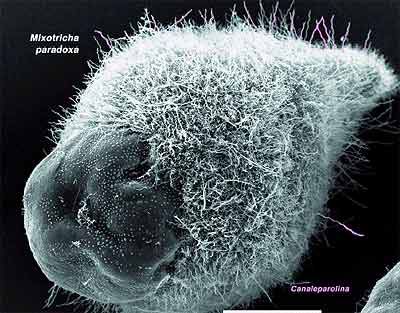
First, this is what I'm talking about:
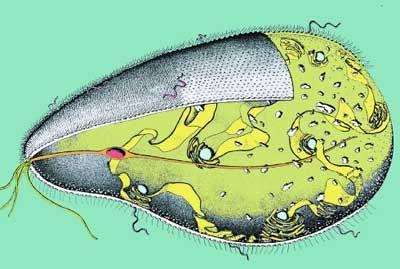
The mixotrich appears at first glance to be a protozoan with flagella and a "fur coat" of cilia. My, my, how looks can deceive. Back in the 1930s, when the mixotrich was discovered by J. L. Sutherland, protozoans were supposed to have cilia only or flagella only (a mere supposition, as it turns out, after the same fashion that animals were "supposed to" lay eggs only or have hair only before the platypus was discovered). Hence the name, mixotricha paradoxa, the "unexpected combination of hairs." It was Lynn Margulis who finally dispensed with the totally unnecessary distinction between cilia and flagella, which was rather like having entirely separate terms for short hairs and long hairs anyway, lumping them both together as undulipodia and reserving the term "flagellum" for the free-rotating bacterial variety. A dynamic duo of super-cool scientists, with the film noir detective names of Cleveland and Grimstone, did the heavy lifting of looking at the thing with properly scientific rigor, and they found two very interesting facts.

The first and lesser of these is that the mixotrich is an unusually smooth swimmer for a protozoan. On its own, this is a mere curiosity; it is downright amazing when considered alongside the second and greater fact: the mixotrich doesn't actually have cilia.

Those hairs are spirochetes, living bacteria with their own DNA. What's more, the basal bodies which normally root undulipodia in place have analogous structures in the mixotrich, but these aren't basal bodies, either. They're pill-shaped living bacteria with their own DNA. Every single one of those 250,000-some-odd "hairs" is, in a very real sense, a separate organism, itself rooted into yet another organism still, all mounted in a rather stunningly regular arrangement of brackets along the mixotrich's surface (which brackets themselves are finally of the mixotrich's own genetic design).

The mixotrich lives exclusively in the stomach of Darwin's termite, mastotermes darwiniensis, where it aids in breaking down the wood which has been so generously pulped into easily-digestible chunks by the termite's jaws. As our planet is host to what may be termed a single biosphere, subdivided into ecosystems, themselves in turn subdivided into communities of organisms, so too are termite colonies made up of individual termites, themselves myriad individuals with other semi-distinct organisms living in tandem with them and inside them. The mixotrich makes these distinctions difficult, and when we try to justify those distinctions at the higher levels by separating them from the "other, falser" lower distinctions, we find that this is a tricky proposition indeed.

Once again, our categories simply refuse to stick to reality, as the Universe defies our compartmentalization while piling itself up and down like de Morgan's fleas and Swift's before him. Neat!

Monday, August 10, 2009

101 Interesting Things, part twenty: The Pythagorean Theorem

Did you go to high school? Have you heard of geometry? Ever study fifth-century BCE Greek history? If you answered "yes" to any of the foregoing, then you've almost assuredly heard of Pythagoras, or at least his famous theorem. Perhaps the simplest version of the theorem is presented on this stamp:
In and of itself, well, it may be unimpressive. Fine. Mathematics, after all, is nothing if not the study of tautologies (interesting tautologies, if you ask me). But then there's this page, which has a whopping eighty-one proofs! They range from simple to "Damn it, I need to take more math courses" in complexity.

What I find so cool about this is that so many cultures have arrived at the conclusion independently. As geometry is simply formal logic about numbers and their relations, I think it could be used as a rough measure of intellectual sophistication (give or take a whole bunch of whatever, of course). Consider, for example, the following image:
I can't read that. It's fuckin' Chinese to me, man. But I sure as Hell know what it means! Mathematics, truly, is the Universal language - and geometric proofs are perhaps the only ideas that could in any sense at all be flawlessly translated between languages.