Update Schedule

This blog updates irregularly.

Sunday, July 25, 2010

101 Interesting Things, part forty-five (a): Blood - An Overview

Leviticus 17:11 says, in part, "the life of the flesh is in the blood". This is one of those things where the Bible actually gets it right, but they really had no idea how right they were. It doesn't take any great leap of creativity to notice that draining the blood from an organism is, by and large, fatal to said organism: massive blood loss is so consistently fatal because blood does so goddamned much for us in the first place.

Blood carries oxygen, food, and water to living tissues; it carries waste to the kidneys, liver, and lungs; it maintains the police presence of the immune system and carries vital hormonal signals all throughout the body; it even has pressurized hydraulics and helps regulate body temperature, all within a narrow range of pH values (a tenth of a point, between 7.35 & 7.45). Your body is basically a sac for your blood, the universal fluid that ties every part and function together. They Might Be Giants explain it in broad strokes and easy language in The Bloodmobile:
In many ways, your life revolves around your blood: your bones make erythrocytes in their marrow, and your tendons (which technically aren't vascularized) hold your bones together in ways that (usually) don't impinge upon the flow of your circulatory system; your circulatory system, in turn, carries blood to the various organs you use to maintain the fuel supply within your blood, including the brain and heart with their minute-to-minute demand for oxygen; your digestive tract is a tube within a tube, busting up what you eat at the molecular level to harvest the aforementioned fuel before dispensing with the unnecessary bits; and your skin holds it all in and keeps unwelcome elements out.

Blood's very ubiquity made this an unusually research-intensive entry, and there's so much interesting stuff that I want to take it by parts. This weekend - and since I'm not spending all my time reading about blood, I'll actually have time to write about it, so it will actually be this weekend - I'll write about blood's role in respiration and homeostasis, ferrying oxygen and carbon dioxide hither & yon, and regulating pH levels & body temperature. Next Wednesday, I'll write about the immune system, which I would normally give its very own entry except for the fact that it all kind of takes place within the blood. And the following weekend, I'll talk about blood technologies and diseases, because they are also fascinating. Stay tuned!

Tuesday, July 20, 2010

101 Interesting Things, part forty-four: The Death Star Galaxy

The Death Star Galaxy is easy to remember in two different ways: first, it's called the Death Star Galaxy, and second, its designation is 3C 321. The mnemonics practically write themselves!

OK, so what's so crazy about formation 3C 321, and what makes it deserving of the title "Death Star Galaxy"? Well, for starters, the supermassive black hole at the center of this galaxy is blasting apart a nearby orbiting galaxy. Here's an artist's conception, so you can see the sort of thing we're talking about:
Just so we're clear, here's a breakdown of the situation. There's a supermassive black hole at the center of a galaxy, but no ordinary supermassive black hole: this one is emitting a jet of incredibly intense EM radiation. How intense? Intense enough to move stars. While jet emissions from black holes and other stellar formations are not rare, what is rare is to see one firing point-blank into a nearby celestial formation. Like, these galaxies are only about as far from each other as we are from the center of the Milky Way.

Heroes in lab coats are still trying to figure out what exactly causes these kinds of jets - I suspect the right hand rule, but the Devil's in the details. One strong possibility, though, is that the very process of blasting apart the neighboring galaxy will cause it to be re-formed around the area where the jet peters out. That is, assuming that the galaxies don't collide first. Dammit, why can't I live for billions of years so I can watch this sort of scene play out?

Here's a really cool animation showing how this plays out and giving a sense of scale to the operation: it starts by the event horizon of the supermassive black hole, then zooms out until you can see the whole scene. Check it out!

Sunday, July 11, 2010

Cosmetic Brain Surgery

Some time ago, I wrote about a church sign with an offer for a free trip. Well, the same church had come up with another offer, though it has since been taken down and I could not get a picture. I need to give myself more time to travel between jobs, so I can stop to take pictures of these obnoxious godvertisements. Anyway, this time their sign read, "Need a new look? Come in for a faith-lift!" As with last time, I came up with a few questions and concerns while mulling over their offer.

Unlike the trip to Heaven, this offer didn't have "free" anywhere in it. Is this faith-lift included in the "10% of your income for life" price of membership in their organization, or does it incur an additional charge? I just moved and had to pay double rent for July, so money's tight and I can't afford to be spending on unnecessary procedures. Do they offer installment plans? Or is it maybe like the Templeton Prize, where they pay you for your trouble in order to get free advertising?

As for the procedure itself, how exactly is it performed? Do they just permanently affix a god-walloping grin to your face? What if I want to express emotions besides generic oblivious felicity? I've heard that they can go in through the ear, with boring music and uninspiring sermons which are very slightly less anesthetizing and invasive than putting you under and cutting on your face. But if everyone's getting this routine procedure every Sunday, I don't know if it's really worth it. I mean, cosmetic surgery is all about looking better than your peers because you can afford to spend loads of money on superficial beauty. I'm not sure that the procedure to which they allude is really in keeping with their overall mission as a spiritual institution. Or maybe I'm coming at this wrong and it's spot-the-Hell-on.

Finally, I'm at least a little worried about complications. I've heard that these sorts of operations can leave one with eyes glazed over, taking the sharp edges off the world and making it look less dangerous than it really is. Also, making room for all that religion in one's head can require that chunks of the frontal lobe be completely removed, impairing one's decision making and critical thinking skills. What's more, I've heard that some people can come out so hopped up on God-smack that they've been left permanently desensitized to the plights of others, and thinking that this one procedure is a panacaea - like it doesn't matter who you are or where you live, all you need is more Jesus and your problems will go away. I've looked into the research, and some of the signs of a botched faith-lift include: thinking of one's demographic as a persecuted minority perpetually on the verge of acquiring the influence it already in fact enjoys, anticipating the end of the world with apocalyptic glee, advocating against real-world solutions to real-world problems because one is no longer capable of grasping coherent arguments or basic implications of evidence gathered through research, and experiencing diminished outrage against pedophiles when said vile monsters happen to also be priests.

You know what? I don't think I'm going to risk it. The offer seems sketchy, the procedure is of dubious value, and the risk that something will go horribly wrong and leave me with a lifelong cognitive impairment is just too high to ignore. I mean, I guess if you want to be able to feel more self-righteous than other people, and you don't mind abdicating reality to do so, maybe a faith-lift is right for you. Count me out, though.

Sunday, July 4, 2010

Thoughts on "Food, Inc."

I recently watched Food, Inc. (yes, it's two years old; no, I don't care), and I have to say, I agree with the advertising. This is an important movie, and everybody should watch it, for one simple reason. There are others, of course, and I agree or disagree with them to various degrees, but one reason I think any decent person could agree to is: it is important to know where your food comes from.

I also ought to say that I am a quality consultant in my office life, and so I am marginally sympathetic to the corporate perspective in this situation. I mean, I spend my downtime at the office reading up on things like process compliance an' shit. Just two days ago, I read about How To Think Like a Factory, and my mind is abuzz with ways to apply this to the call center floor which will be good for both the corporation's bottom line and the mental stability of us drones.

With those caveats out of the way, you should still watch Food, Inc. It's really well made, and it highlights some core parts of the industry that a great many people would probably prefer to ignore. Blissful ignorance is precisely why the food industry has been able to get away with this sort of thing, and if it makes people uncomfortable, then they need to be made aware so that they can vote with their dollars and pay the extra buck-two-ninety-eight to get a product that is brought to them in a way they can stomach.

OK, so I want to talk about how things got here, and not in terms of blame and disgust and harsh invective, but in terms of impersonal and perfectly logical (if unfortunate) progression. It's very simple. So simple, in fact, it's stupid. Try walking out into the street and asking people about "factory farming", and I can almost guarantee that a sizable fraction will think it's a metaphor, most will have vaguely unpleasant thoughts, a few will regurgitate very similar talking points (and probably smell of patchouli), and a tiny minority will have something well-informed and thoughtful to say. This is just the industrial revolution, applied to what you put in your belly every single day: a similar thing is happening in consumer electronics, Wired put out an article on it and called it "The Good Enough Revolution". In most of our day-to-day lives, quick & dirty is just fine, and top-of-the-line gizmos can be left for professionals and cutting-edge aficionados. Ah, but when you're struggling to feed your family, what approach is going to garner the most of your votes dollars? The costlier but more wholesome product, or the cheaper bulk product? Imagine this decision being made in dozens of millions of homes across the nation, and at the other end are chief executive officers who want to make as much money as they can and control as much of the market as they can. How should they do this? By trying to put out a costlier but more wholesome product, or by putting out cheaper bulk products? It all comes down to selection pressures.

What do you think a successful climber of the corporate ladder would do? I'm not asking what you would do, since you haven't climbed to the top of your corporate ladder - these decisions are in the hands of the ruthless opportunists who have climbed on the backs of their competitors to be where they are today, not the people who have made the decision to be satisfied with a modest existence.

So of course we're in the situation we're in today. It couldn't have happened any other way. No single person is to blame for this: we're all to blame. The producers are to blame for their production, and the consumers are to blame for their consumption, and no single person "decided" that this is the way it would go. This is the way it had to go. At least, so far. I dunno, maybe I'm just saying that because I'm a determinist, but the point remains that there's no great and powerful wizard behind the curtain. There's nobody behind the curtain at all.

I want to take some time to talk about some of the "gross" aspects of industrial food production, like chlorine baths. Actually, that's a great example in itself. See, if you've got a huge food operation, this is going to be a literal wellspring of opportunity for disease. Any disease that could infiltrate such an enormous and far-reaching niche would be hugely successful. But of course we don't want diseases to be able to carve out a niche in our food supply - we want our food supply to be a safe, standardized, idiot-proof sort of thing that we can set up anywhere and have a dependable outcome. We don't want to have to think about every single fucking food purchase, we want to be able to just pick something we want that's in our price range and take the rest for granted. We want factory farming, and so as a corollary we want to set up an over-the-top obstacle to give pathogenic would-be infiltrators as little opportunity as possible to survive and adapt. Corporations have an honest interest in making their operations disease-proof, because their customers can sue if something goes wrong. Food, Inc. has a segment where a mother relates the story of how her son fucking died from a food-borne pathogen. It's a goddamned tragedy, and I'm being perfectly serious about this: losing a child is one of the worst experiences a person can have, and for a whole lot of reasons, and if that death was caused by the food you put in that child's mouth, but you didn't make that food, then whoever did is going to fucking pay.

But now stop and consider the numbers. We're not talking about whether this particular child would have died or not, but the raw, impersonal statistics. This is reality, where things go wrong, and sometimes they go wrong in very bad ways, and there's nothing anyone can do to stop it for good. Mistakes shall always be made, and someone will always need to pay for them, because we are a litigious people and that's how things go. As it stands, this is one child out of millions, and it's terrible and awful and a genuine tragedy, and the corporation paid something for their mistake - but what's the alternative? Let's say that we go all organic and local, and all our producers feed grass to their cows and butcher their free-range chickens under open sky and they all have twenty times fewer pathogens. This is great! Ninety-five percent less children will die of food-borne pathogens!

But what about the other five percent? For every twenty food-related lawsuits we have now, we'll only have one, and this is truly great news. But in order to save nineteen families from a personal tragedy, we'll have to upset the lives of an entire farm's worth of folks because I can guarantee that those honest, hard-working, wholesome farmers who fucked up once won't have the money to pay hot-shot lawyers to stop litigious citizens from breaking their banks. When something bad happens with less frequency, those few times it does happen become all the more significant, and someone will still have to pay. Now, personally, I think it's better that a few dozen families have their incomes destabilized in order to save nineteen out of twenty lives. This is a genuinely smaller cost. But it's still a cost, it's just diffused and lessened, and it bothers me when people think that going all-organic (or whatever the fuckin' buzzword is gonna be) will make everything turn to sunshine and rainbows. I dunno, maybe I'm just upset that not everybody is as cynical as I am.

Anyway.

Enough defending dehumanizing corporate practices as logical outgrowths of consumer disinterest. We should follow the film's advice and vote for the bucolic, sustainable approach to our food - y'know, the kind that costs more money because you'll have to train folks to do more steps in a process, which requires a larger up-front investment and blah blah blah - because if we don't, I can see where things are going. The corporations will continue to control the means of production, and pretty soon, complete nutrition will come in the form of convenient pills so that people can keep their bodies running smoothly without all those pesky calories that make you fat. I mean, who wouldn't want to be able to ensure that they stay slim and get all the nutrients they need without drinking Liquid Sanctimony? Sure, the act of actually eating will become a luxury, but that's OK because more folks will be able to eke out a decent living on less money. The cost of feeding oneself will become an increasingly known quantity, and when you combine that with the cost of housing and clothing oneself, suddenly we have a precise calculation of what the minimum wage needs to be to let people just barely keep their heads above water. And honestly, that's all you need: to tread water your whole life, with tax breaks for deciding to permanently shack up with someone and raise some offspring, and the requirements for this will also be a known quantity. Pretty soon, the middle class will be entirely eliminated, and the corporate overlords will manage the lives of their drones with vaguely humane efficiency, since they know exactly what they need to pay their workers to keep them alive without giving them the opportunity for their offspring to break into the upper class.

You might have doubts that things could go that far, for the simple reason that pills alone won't fill you up - but have you heard of the Full Bar?

Saturday, June 19, 2010

Mary Midgley says you can't rock someone's world. Everyone and their grandma disagrees.

PZ calls her a twit, and another hip & cool professor (name of ArithmoQuine) tries a more charitable interpretation.

PZ's right, but ArithmoQuine is being more helpful to the dialogue. Midgley is being a twit, saying that we ought not to turn the world-views of others upside-down and shake them for loose change. From her first sentence, "Science really isn't connected to the rest of life half as straightforwardly as one might wish", you can tell that she's arguing from human foolishness - just because people don't unfailingly connect science to their everyday lives doesn't mean that the connection isn't there. And yeah, sure, there's no One True sure-fire method for changing someone's mind on this or that topic (unless we count brainwashing, can we please count brainwashing?), but people change their own minds all the time and the words of other people often have something to do with it. Fuckin' duh. You'd think that a fellow philosopher, of all people, would have a clue about that. I mean, our favorite activity is sitting around in the lotus position trying to find ways to blow our own minds, and our second-favorite activity is sharing these techniques with others so we can watch them try it out.

ArithmoQuine takes a more effective tack and tries to grant Midgley the strongest case he can piece together from her writing. This is called the principle of charity, and it's how you avoid straw-manning the opposition: you help your opponent into the very best suit of armor the two of you can agree upon, and then proceed to show that not even this can withstand your A-bomb. (The A is for Argument.) And really, all Midgley can possibly be saying is that if you take on the underpinning of someone's whole damn world-view, then you're going to run into cognitive dissonance. Which is true. Who gives a shit?

Well, of course, we all give a shit. I mean, cognitive dissonance - well, our drive to resolve cognitive dissonance, more precisely - is what makes the rational world go 'round. And the irrational world. Rational folk, upon noting such dissonance, will reconcile the mis-match between their imperfect minds and obstinate reality by changing their minds to be more in-line with the observed facts. For clarity, I don't mean that this is how "people I'd call rational" consistently behave, I mean that when you do this, you are behaving as a rational person. The alternative, of course, is to try to force the world to fit your idea of how it ought to be when it's clearly not. This can often take the form of kicking the shit out of whoever's existence is causing you angst in order to preserve your idea of moral order in the world.

This is the kind of bullshit we're up against, and I don't just mean atheists: I mean people who accept reality and try to work within its confines. See, dropping your preconceptions about how you first happened to believe the world ought to be, and then accepting implacable reality for what it is, can help produce a kind of serenity that will allow you to become a peaceful, permissive, moral, fun-loving Dane. Siding with your preconceptions in opposition to implacable reality will cause you to brainwash your family and other miscellaneous fuckwits into becoming a national disgrace. Of course, these are the extreme ends of the spectrum and your mileage will vary: Denmark is towards the Very Good end, and Fred Phelps is towards the Fucking Horrible end, and most people pile up to form that smooth bell shape in the middle.

But this spectrum is a moving one, more of a travelling wave as we become ever more civilized over time. Those fuckers on the hump are better than the Phelpses of the world, but they sure provide a lot of dead weight for the Danes to haul along as they (i.e. the majority) passively reinforce the status quo by comprising it. This is where Midgley really screws the pooch: she claims in her closing that we need to try to improve existing world-views and take them on as wholes (good so far), with the implication that trying to actually change anything is a fool's errand. The comparisons to other changes in the status quo are numerous, easy, and left to the reader; ours is a campaign of memocide, and if ideas were people, then we'd be rotten to the core for even considering it. But they're not, so we can keep on truckin'.

Midgley is right, however, that plucking a few hairs from the beast won't kill it. The memes we're up against are self-perpetuating and self-reinforcing, and they're deeply entwined with other memes we don't like, such as patriarchy and tribalism, and the whole rotten thicket is itself a perfectly natural outgrowth of our very own psychological flaws, so excising this cultural tumor is going to be a task and a half. I said a-good-God-damn.

Midgley does make one profoundly stupid error, though, and I haven't seen anyone call her out on it yet, so I'm gonna. See, Midgley says,
Belief in God is not an isolated factual opinion, like belief in the Loch Ness monster – not, as Richard Dawkins suggests, just one more "scientific hypothesis like any other". It is a world-view, an all-enclosing vision of the kind of world that we inhabit. We all have these visions.
I call equivocation! See, the phrase "belief in God" could be understood either as the genuine world-view of theism, or as the "isolated factual opinion" of a particular person's particular belief in a particular deity (it might not be a clear idea, but it is a particular one). By not clarifying this ambiguity and then immediately trading on it, Midgley has committed textbook equivocation and should brush up on her basic logic. Sure, theism isn't an isolated factual opinion, but believing in this or that god sure the Hell is!

I want to note that believing in the Loch Ness monster requires belief in Loch Ness, and in general requires some sort of world-view. We all have them, as Midgley correctly points out, and there's no "escaping" from them. You can't just "step out" from your world-view without "stepping into" another one, since world-views are the very framework within which we evaluate our experiences. Formally, this is known as the Duhem-Quine thesis, and it says that no single hypothesis can be tested in isolation because every testable hypothesis rests on background assumptions. So naturally, every belief in particular gods is going to go along with some sort of world-view in the actual minds of actual people in the actual world. Those world-views are, by virtue of accommodating one or more gods, categorically theistic. Successfully excising particular god beliefs from a theistic world-view will require one of two things:
1) A different god must be placed in the god-spot, or
2) The world-view itself must be exchanged for a new model without a god-spot.
Since the god-spot holds up huge chunks of the cognitive tapestry for many, of course most theists will shuffle gods in and out of their god-spots, taking great pains to ensure that any god in which they can no longer bear to maintain belief is taken out of the rotation. This helps them avoid the trouble of opting for number two, which is shit. But shit is natural and if you try to avoid it then you'll end up full of it, and I suddenly don't feel like pursuing this metaphor any further.

Point is, it will eventually be cognitively easier to opt for #2 than to continue avoiding it, but there's no telling when for a particular person, and individuals vary wildly in this respect. Son of a bitch, you mean this is going to be hard? Oi, if I'd known that, I never would'a signed up!

Just kidding. All Midgley has done with the best possible version of her point is to clearly outline the problem before us with two scoops of pessimism. What does she want, a pat on the head and a warm glass of milk?

Sunday, June 13, 2010

Cross-Post: How Many Books are in the Library of Babel?

I remembered at some point in my cogitations upon qualitative wrongitude that I had actually covered something even wronger back on my Playskool blog. Here it is. I mixed up a couple things, like math at one point, and Borges actually lays out some of his figures in the story and I didn't take this into account. Research fail. But I wanted to mainly highlight that Garou is wronger here than the Creationists are in, well, any context I could think of, but he still manages to change his mind. Good on him! The difference, of course, is that Garou was willing to listen to reason and concede defeat instead of dogmatically defending his misconceptions. Anyway. Enjoy!
Jack and I were talking in Borders the other day about a short story by Jorge Luis Borges called The Library of Babel (Wikipedia page here - I've skimmed parts of it, and there are some differences between it and what we had talked about). In this story, according to Jack (and that's what I'm working with here, since this was the frame for the original disagreement), Borges describes a library containing a series of books, all 450 pages in length, and each book is one of all the possible combinations of characters that can be placed in 450 pages of space. Jack went into the details of the story, and then we started talking about just how many books that would be. After ruminating on all the possible combinations of Hamlet with any number of typos (including moving the word "fuck" one space to the right in successive iterations, as well as multiple repetitions of Hamlet and variations thereof, such as Hamlet-Tom Clancy Novel-Hamlet, or Backwards-Hamlet with or without the character of Hamlet being named "Backwards Hamlet"), Jack decided that it was more books than there are atoms in the Universe. I readily agreed.

I related the conversation to Silver Garou, who expressed extreme skepticism that there were more books in that Universe than atoms in ours. In fact, I believe his exact words were, "There's no way there's more books in that library than atoms in our Universe!" Or something to that effect. So today, I decided to do some math. By some standard measurements, there are 250 words per page, and a "word" - for publishing purposes - means six letters. Working with 450-page books, that gives us:

250 words/page x 6 letters/word x 450 pages/book = 675,000 letters/book

As for how many books this is, we can think of each book as a number - a long number in a strangely high base. For instance, if we were looking at all the "books" we could have using only the numbers zero through nine, and each "book" is only two characters long, that leaves us with 100 books - 00 thru 99 - or 1x10² books. Each of our Babel books is simply a number that is 675,000 characters long, and for each number in that series, we have a single book. In base ten, this would be every combination from 675,000 zeroes in a row to 675,000 nines in a row, for a total of 1x10675,000 books. So... what's our base? That's determined by how many characters are in our total alphabet, as each one of those can be a digit in our number:

52 alpha characters (26x2 - for caps)
30 accented characters (tilde, both ways accents, umlaut, carrot, horizontal line - 6 accents over each of 5 vowels)
48 greek characters (again with the caps)
10 numbers
32 additional characters on a keyboard
2 more for the cedilla (that fuckin' French C with the curlicue beneath it, caps & lower)
1 space
TOTAL: 175 characters

So we're looking at 1x10675,000 books - in base 175. So we're clear, this is a severe lower-bound number, as I'm excluding Egyptian/Chinese/Arabic/etc. characters. Mainly because I don't know how many characters there are in those languages. But anyway, imagine that you had to count to a number, but your first digit had to get up to 175 before you got to "10," and you had to get to 175 175's before you got to "100" (ten tens), and you had to keep counting until the number was 675,000 digits long, and then exhaust all of those possibilities (you get to stop counting right before the next number in sequence would make your number 675,001 digits long).

We would have 1x175675,000 books in our Library of Babel. At least. The reason this works, in short, is that scientific notation is awesome. At length, any number can be represented as [number][base]x[base][base][power][base] - and each of those numbers has its own base. As long as you're sticking with the same base throughout, then you don't need to worry about notating it and that will give you your straightforward number (we use base ten most of the time, so we don't even bother).

A "base" determines how high you can count on one digit before you need to go back to zero and count with the next number, or when they all go back to zero you add another digit: base two (binary) counts 1, 10, 11, 100, 101, 110, 111, 1,000, etc. The pattern is that you get one number (zero doesn't count because it's 0, 00, 000, and so on), then have to increase the digit count to count higher, then you get two numbers, then increase the digit count, then get four numbers, and increase the digit count. Base three (ternary) counts 1, 2, 10, 11, 12, 20, 21, 22, 100, 101, 102, 110, 111, 112, 120, 121, 122, 200, 201, 202, 210, 211, 212, 220, 221, 222, 1,000, etc. The pattern now is that you get two numbers and then have to increase the digit count, then you get six numbers and increase digit count, then get eighteen numbers and increase digit count, and so on. In base ten, we humans count 1-9, 10-99, 100-999, and so on. The pattern here is that you get nine digits and increase, then 90, then 900. Here's the magic: 1, 2, 4; 2, 6, 18; 9, 90, 900; are all series of the same composition, namely (x-1)x10x(n-1), where x is your base (and n is your step in the series). Looks an awful lot like scientific notation, doesn't it?

I think this might be some universal language among base number systems, or just an easily-convertible method of notating numbers (which is useless for anything else). I don't know, I kind of discovered this on my own while trying to figure out the answer to this problem. There's probably a name for this, and math majors probably know it. I don't (but I know the math works). Whatever, the point is that you can convert numbers from one base to another by "exporting" that base like I've done - I just left some labels out. I started with the figure "1x10675,000," but I should have notated it as "110x1010675,00010," or "One, base ten, times ten, base ten, to the power of six-hundred-seventy-five-thousand, base ten." For an example of how this works, the number 365 (days in the year) can be represented as:
3.6510x1010210

This gives us 3.65 (in base ten) times ten (in base ten) to the power of two (in base ten). The first number (3.65) gives you the first few digits of the number, the second number (10) tells you your base, and the third number (2) tells you how long your number is (102 means that two zeroes come after the one).

Now, I want to find out how big a number is if it's a one (in base ten) with six-hundred-seventy-five-thousand (in base ten) zeroes after it, in base one-hundred-seventy-five. I could shortcut this as (1x10675,000)175, but this is useless; I want my answer to be in base ten. So how do I do this? Well, using base ten throughout, 1x10[anything] will give me that many tens, all "times" each other - 1 is just ten, 2 is "ten times ten," 3 is "ten times (ten times ten)," 4 is "ten times (ten times (ten times ten))," and so on. Just replace every time I said "ten" with "one-hundred-seventy-five," and even King Douchebag of Fuckhead Hill (don't ask) - who says he's shitty at math (I tested this on him) - can understand that this is like counting in base 175, converted to base ten. So, the number I want to find is 110x10175675,00010, or "one, base ten, times ten, base one-hundred-seventy-five, to the power of six-hundred-seventy-five-thousand, base ten." I replace 10175 with its decimal equivalent, 17510 (just like 102=210=23, or 1012=123=510 if you like advanced stuff), and do the math: 175650,000, and put it back in scientific notation. Ka-pow, finished!

The trick, of course, is keeping your bases straight and knowing when to do the math and when not to. That done, it's a piece of cake, I swear!
This gives us... too large a number, it turns out. No calculator I was able to find had the capacity to tackle that straight on. I had to break it down:

175675,000=1756.75105


This can also be written as (1756.75)100,000, and 1756.75=3.8x10¹⁴. And, as everyone knows, (3.8x10¹⁴)100,000=3.8x101,400,000. That many books. (EDIT: I fucked up. In my original calculations, I had somehow substituted 650K for 675K, and I did a double-plus un-good math when I decided that 175^(6.75x10^5)=175^(6.75^(10^5)), and that puts me at the same roadblock I'm at in the next problem (outlined below), so results are pending the math professor's review. I'd given an outline of the problem to King Douchebag of Fuckhead Hill with instructions to the math professor to show work, but he never came through. Hoo-ha! Edit over.)

Now our question is, how many atoms are there in the Universe? There are several answers to this question. I'm going to go with Wikipedia's calculations on matter content of the observable Universe, which yields two figures: a lower bound of 3x1079, and an upper bound of 7x1079. All the other figures I was able to find either corroborate these data, or are dramatically lower. The lower boundary is a rough-and-ready approximation of the number of atoms in all the stars, were they broken down to hydrogen atoms (so one helium atom is just two hydrogen atoms), and stars account for well over 90% of the mass in their systems. The upper boundary figure is based on the mean density of the whole observable Universe and its volume. Both of these figures account for all 80 billion galaxies, with the 3 to 7 x 10²² stars therein (in sum, not each). Even supposing that we counted all mass, not just normal atoms, it would come to about 1.75x1081 hydrogen atoms (were all mass converted into hydrogen). Keep in mind that though this is based on the "observable Universe," and there may be very much that we haven't observed, "the observable Universe" is every fucking thing we've seen, ever. Silver Garou suspects that these figures are "hugely off," but I don't think so - these numbers are still mind-bogglingly huge, just not quite on the order of the hugeness of those 450-page books.

Still, let's work in some margins of error. The orders of magnitude of difference here are, themselves, on the order of orders of further magnitude. Like, Creationists think the Universe is 6-12,000 years old when it's more like 15 billion; Bill Gates thought nobody could ever need more than 64K hard disk space and we've got terabytes; and then there's this (to be fair, Garou has simply supposed that there are far more atoms in the Universe than we can even get close to verifying, and by orders of magnitude, but on scales which it is beyond the capacity of the human mind to comprehend - he is not an expert in the field making a terrible prediction, or an asshole trying to shoehorn observed facts into taken-for-granted belief systems). Let's take this supposed number of atoms in the Universe and assume that it's off by the order of magnitude of itself, so:

(1.75x1081)1.75x1081


...keeping in mind that 100100 is 100 times itself, 100 times, this is like taking every atom in the observed Universe and splitting it into a number of atoms equal to the number of atoms in the observed Universe, and repeating the process a number of times equal to the number of atoms in the observed Universe.

Dammit. This also overflowed any calculator into which I put it, but it can't handle powers of more than two digits. But I have a sneaking suspicion it will still be short. I gave the problem to King Douchebag of Fuckhead Hill, and he's going to show it to some math professors tomorrow. We'll see how that goes. (EDIT AGAIN: That still didn't happen. But if anyone wants to correct my mistakes, or explain how to do the steps I'm missing, or even just link me to a page explaining how to do so, then I will happily correct it all!)

Tuesday, June 8, 2010

OMFG, the news is SUNG now?!

Yes. Yes, it is. I give you auto-tuned news:
Seriously, this is the only way it could be made more of a spectacle, and less of a ridiculous circus. Ooh, and this one is good, too, because it involves autotuned talking heads talking about exceptionalism and smoking lettuce:
It's not a weekend. I need sleep. G'night!

Wait. OK, you also need to learn about the Federal Commission of T-Pain (bonus dragon charts included at no extra cost!), and the three greatest keywords EVAR for press coverage: pirates, drugs, gay marriage. News just don't get any better than this. I mean, unless it's good news, that is.

Saturday, June 5, 2010

Pascal's Scantron: an atheist parable (part two)

Click here for part one.

The grading machine was small, discolored with age, covered in dust like most of the things in the English department storage room. It had a cracked digital readout, a few buttons with the labels missing, and a slot with "INSERT FORM HERE" stamped next to it. I didn't care when I heard we found it, because I don't care about the forms anyhow - everyone else seemed to think it was some kind of miracle, though. A fight broke out over who would get to use it first, and Jimmy Dempster's nose got broken. We were finally able to agree that it had to be used in public, in plain sight of everyone, and what we'd cast votes to see who would get to go first and all of that. It took us two whole days just to decide how we were going to use it, for crying out loud. I stayed and watched because even though it wasn't important to me, the way everyone reacted would be very important to everyone.

Well, we all decided that someone from E-column could go first, since they were clearly the most excited about it. It seemed fair. Then one of those upside-down A-column kids could go, because they seemed like the most opposed group to the E-column crowd. Then we'd let a C-column kid go, then one of the "ABCDEABCDE" folks, then one of the kids who filled out every bubble, and then we'd go in alphabetical order by name from there (most everyone knew everyone else's name, so there wasn't any concern about cheating). Everything was fine, we were all agreed that we had found a fair way to resolve this little dispute, and somehow everything still managed to go straight to shit.

Brandon Anderson was the E-column kid who went first, since he was first alphabetically. We plugged the machine in, turned it on, made sure it didn't break down straightaway, and then Brandon put his form through. There was some humming and whirring, and then his form came out just like he'd put it in. He even asked, "So did I pass?" Nobody said anything for a while. Someone said he must not have gotten anything wrong, but then another person said that we didn't know if he got anything right either, and then another fight almost broke out. We decided to keep feeding the forms through, and then figure out what to do.

Jill Becker was next, the upside-downers' first pick. She fed her form through and nothing happened again, and this time we were a little calmer but still nobody said anything. A couple people started to say that maybe the machine didn't work right, but everyone else shushed them. I was starting to hope that everyone would just feed their form through and things would be nice and boring. Silly me.

Dick Benson stepped up, he was the "ABCDEABCDE" crowd's first pick. Not because he was alphabetically first, they also had a Chris Allen, but because they all paired off and played a rock-paper-scissors tournament and Dick won. Anyway, Dick fed his form into the grading machine, and there was this awful grinding sound. Something started to smell, and so we unplugged the grading machine from the generator and opened up the front panel. We got Dick's form out, but it was all chewed up, and we couldn't get the machine working again after that.

Pretty soon, people started arguing about what all this meant. Someone started saying that the machine ate Dick's form because he was wrong, that he should have stuck to one column instead of filling out all kinds of bubbles. I tried to point out that we couldn't be sure that Dick had anything to do with it, using one of those fallacies I learned from the logic book. I can't remember the Latin name, but what it says is that just because something happens after something else, it doesn't mean that the first thing caused it - there could have been something else going on that you didn't know about. You might as well say that Dick's form got eaten because he played rock-paper-scissors. I mean, for crying out loud, the grading machine was old and locked up in the English department closet for a reason, and that's probably because it wasn't working right in the first place, so we should see if we could fix it and then try again.

Well, nobody listened, of course. People started shouting that we shouldn't tamper with the grading machine any more, that we'd done enough by letting Dick put his form through and we saw how that went, and since Brandon & Jill's forms went through fine, we know that everyone else who filled out their form like them should be fine, too. Soon you couldn't tell who was yelling what since everyone was screaming at the top of their lungs. Then someone just reached out and punched Dick Benson right in the face. Then it was a dog-pile: some people tried to break it up, but they just got sucked into the fight, and by the end of it the bloody mess on the floor didn't even look like Dick any more.

Now, I mean, I just want to say this plainly, because I don't know how we let it happen: Dick Benson was beaten to death because a dusty old machine ate his test form. A kid fucking died over this. Some other kids got hurt, too, but cuts and bruises happen even when you're playing a game of soccer, and you get better from 'em anyhow. Dick's dead 'cuz he made marks on paper, and I think anyone who could let that happen is plain crazy, I don't care how strongly they feel about their precious fucking forms.

Well, not everyone feels the same way, I guess. Pretty soon everyone started saying that what happened to Dick was bad, but his form ruined the grading machine, so what could you expect? I tried to say that something ought to be done about it, but nobody knew who struck the killing blow, there were too many kids involved to punish all of them, emotions were running high so you couldn't really blame anyone, and it wasn't gonna bring Dick back anyhow, so who cares? Well, I care. I care about a person's life more than the way they fill out some form, and I think anyone whose priorities are the other way 'round is an idiot. And I think anyone who isn't bothered by a human life being lost because of a disagreement over unknowable matters is less than human.

So I left. I left that crazy world, and now it seems I'm in a crazier one. It wasn't just our school that forgot, apparently, but all I've found in the three days since I left are crazier and crazier people. Some of thesm have guns, and some of them are in gangs, and some of them just have some really off-the-wall ideas about how the world is. I have half a mind to try to help the school get prepared in case one of the gangs finds it, but all I can bear to do is find a quiet out-of-sight place to sleep at night. I don't know how to fix this, the world's really screwed up and I'm just one person. Maybe I can find some other people who aren't nuts, and help them. I don't know. Maybe I'm crazy, too. I don't know. But there's gotta be something good out there, and I gotta find it. Writing this down is a start.

With acknowledgment to Sam Harris, Blaise Pascal, and the Scantron company.

Thursday, June 3, 2010

Pascal's Scantron: an atheist parable (part one)

Whoa! I missed a weekend. Sorry about that. But I have part of a short story here, and I hope you like it. More this weekend, double-promise!

"What if all our knowledge about the world were suddenly to disappear? Imagine that six billion of us wake up tomorrow morning in a state of utter ignorance and confusion. Our books and computers are still here, but we can't make heads or tails of their contents. We have even forgotten how to drive our cars and brush our teeth. What knowledge would we want to reclaim first? Well, there's that business about growing food and building shelter that we would want to get reacquainted with. We would want to relearn how to use and repair many of our machines. Learning to understand spoken and written language would also be a top priority, given that these skills are necessary for acquiring most others. When in this process of reclaiming our humanity will it be important to know that Jesus was born of a virgin? Or that he was resurrected? And how would we relearn these truths, if they are indeed true? By reading the Bible? Our tour of the shelves will deliver similar pearls from antiquity - like the "fact" that Isis, the goddess of fertility, sports an impressive pair of cow horns. Reading further, we will learn that Thor carries a hammer and that Marduk's sacred animals are horses, dogs, and a dragon with a forked tongue. Whom shall we give top billing in our resurrected world? Yahweh or Shiva? And when will we want to relearn that premarital sex is a sin? Or that adulteresses should be stoned to death? Or that the soul enters the zygote at the moment of conception? And what will we think of those curious people who begin proclaiming that one of our books is distinct from all others in that it was actually written by the Creator of the universe?"
- Sam Harris, The End of Faith: Religion, Terror, and the Future of Reason, p. 23-24.

"I sure wish this life were a test and I could reason out the right answer, so that all my wishful thinking had a metaphysical justification embedded into reality itself, and then I could finally be confident that all this speculation wasn't just me jerking off."
- Pascal's Wager (abridged)

Where to begin? At the start? Or at the present? Or with my purpose? I guess I should try to sort all that out first.

My memories start about four months ago, on the first day of February, which I call the Great Forgetting. Today is the third of June. By my reckoning, it is the year 2010, though all of these dates are in dispute. I'm writing this down in case another Forgetting happens. There. Now for details.

Nobody knows how the Great Forgetting happened - or why, for that matter. Stories abound, of course, but nobody really knows. Here is what I remember: everything starts with a loud popping sound, and then I was aware of the room around me. I had a splitting headache, and a couple people screamed. Someone by the door flipped the light switch a couple times, and nothing happened. Then he stood up on a chair to open one of the light covers, and broken glass came pouring down on him. I laughed.

At some point, I became aware of the fact that I was holding a pencil. On my desk was a piece of paper, white with green markings on it. It looked fuzzy at first, like it wasn't quite anything in particular; as I stared, it became more sharply defined until I could read it. It was a form, a form for taking a test. What test, I didn't know. I had started writing my name, but I only got the first letter down: the letter D. That was all I had written on my form. It did not occur to me until much later that I was able to recognize the first letter of my name, but not my whole name. I could also recognize the names and purposes of many things, but not all things. Others seemed to be in similar situations.

It took us over an hour to figure out how to talk again, and in a few days we got settled into what our lives have now become. Within the week, we had eaten through all the school's food and started raiding local grocery stores for canned goods and clean water. Someone found a store with seeds, and now we have gardens everywhere around campus and even on the rooftops. We also built some rain caches, and there's a still being built by a few kids who know how to weld.

Even now, though, things seem poised for upheaval. Nobody really knows what's around the corner. We might get our heads screwed back on straight, but with all this craziness around, it seems a slim possibility. Somebody, thankfully, found an almanac - the latest one we could find was for 2010, and by measuring the daylight hours, we were able to pinpoint the equinox on March 20th and figure out the date and time from there. But not everybody buys it - some people insist it's the year zero, others that it's the year one, still others insist on two thousand (or even one thousand) and that the almanacs are printed in advance by benevolent outside cultures who are manipulating our brains and the world around us.

Like I said, there's a lot of craziness about.

Weirdest of all are these test forms. Everybody in the school had one, but nobody can find the test we're supposed to use the form with. None of the instructors' desks have test booklets. Every room had a television set in it, and most people think that the test was going to be delivered by some sort of broadcast. It makes sense, but there's no way to tell for sure. Everything that was plugged in or had a battery in it got fried at the Great Forgetting. Light bulbs burst, CRTs burned out, circuit boards cooked, watches melted on the inside, it's all gone. Things in packages work, as long as the batteries were outside of them - we used new stopwatches from the Phys Ed office to measure the days until the equinox. So even if the test was being delivered by television, there's no way we could tell what it was about today.

Consent is somewhat less than unanimous on this last point, to put it mildly.

It all started innocently enough, as I suppose these things tend to do. Some people filled out their forms out of habit. I can't really blame them, it probably seemed like a good idea at the time, and it certainly didn't do any harm on its own. But then people started comparing answers, and they started banding together according to how they filled out the bubbles. About half the people went straight down the C column, apparently since that was in the middle. If you ask them, they don't feel too strongly about their answers, they just seem to think that their forms ought to be filled out. Lots of people filled out the right-most E bubbles, maybe through some quirk of association - that's what's "right", after all. Some answered A, B, C, D, then E, repeating over and over; others filled out the first five in order and then stopped. Some filled out the front only, others filled out both sides - no way to tell how many today, since most of those who later filled out the backs of their forms now insist that they had them filled out all along.

A few filled out the A column, and then someone found a logic textbook and discovered that an upside-down A is the universal quantifier - it means "all". These folks turned their forms upside-down, saying that the world turned upside-down at the Great Forgetting, and now the A column is "right" and they all think this is some profound insight. Even though they didn't learn about symbolic logic until after they'd filled out their forms, they insist that they knew that's how they were supposed to fill out their forms all along, and for that reason. How the Hell do you argue with that kind of bullshit?

A tiny minority filled out all the bubbles, everywhere, and these folks say that all the answers are right and it doesn't really matter how you fill out your form, so long as you get along with everyone else. We're here in school to learn, they say, not to pick fights with each other. I tend to agree with their principles, just not with their reasoning, and these folks get along with the C-column crowd so nobody else picks on them, either.

I didn't fill out my form. I didn't write anything on it at all, except for that letter D which I had already written down. Most people who didn't fill out their forms at first later went and filled them out, usually out of pressure to fit in or avoid getting beaten up. Some of the people who still don't have their forms filled out just don't care. Some of them insist that we shouldn't fill out our forms at all, and anyone who does is an idiot. For my part, I just don't know what to put on it. I don't know, so I don't put anything. I think some of the ideas out there are interesting, but not one of them is for sure, and it doesn't really matter at the end of the day because we're here and we have shit to do that's just more important. So put whatever you want on your test forms, it's fine by me - but if you start telling people that they have to fill them out this or that way, and threaten to beat them up by the bike racks if they don't, that's when I think you're crazy.

Unfortunately, there are a lot of people here who I think are bat-shit loco.

Some of these nuts say that not answering at all is a form of answering. I don't know what they're thinking, since I most definitely did not fill out any of the bubbles. That strikes me as rather like saying that an empty plate is a kind of meal - fucking stupid, in other words. "Empty form, empty head," is another common taunt I hear in the hallways - this one usually comes from those folks who safety-pinned their test forms to their shirts, or who draw them in permanent marker on their skin. If that's what you want to do, go ahead. I mean, I think it's pretty silly, but they think it's silly to not answer, so I'm comfortable with living and letting live. They say I'll be sorry when we all get graded, that I can't get a high test score if I don't answer, but I don't even think that's ever going to happen. Especially not after what happened three nights ago.

It started a couple weeks back. We found old machines in the school's basement and in a lot of back rooms - covered in dust, but they weren't plugged in, so some of them still worked. There was a gas generator in the machine shop, where they taught automobile and manufacturing stuff, so we were able to get some of them running. First was an old record player, one of those simple dealies with the turntable and the flower-shaped thing for the sound to come out. People started recognizing some of the songs, which says to me that we can still have some of our memories jogged from before the Great Forgetting, just like we remember how to walk and how to speak and what tables and chairs are. But some people insist that it means we can know things "a priori", a word they got from one of those logic textbooks. I say the name of a song is just something you picked up somewhere, and it can be taught anyhow, so who cares?

We found more and more machines, in increasing complexity until we got to the burned-out stuff that was being used right up until the Great Forgetting. Some of the other kids, all kinds but mostly the C-column crowd, started to use the simplest machines and some of the library books and instruction manuals to figure out how some of the more recent ones must work. They're really, really smart - until they start to talk about how it was all left here as a puzzle for us to figure out, so we could re-start civilization on our own. That's when I start to roll my eyes and wish they'd stick to what they can find out and demonstrate. I mean, sure, it would be nice if there was a puzzle, if we were supposed to figure this all out (and there's nothing wrong with figuring things out, even if nobody tells us to do it), if all this was actually planned and had a grand overarching point. But I see no reason to think so. They ask how it all got here; I say I don't know, and they call me stupid for not making up answers.

I say that wanting an answer doesn't mean there is one, and making one up isn't better than admitting you don't know. I sure as Hell wish other people weren't so fucking confident in their made-up answers when we found the grading machine. I wish we never found it at all.

Sunday, May 23, 2010

Dear The Internet: Today I made the cutest blasphemy EVAR*!

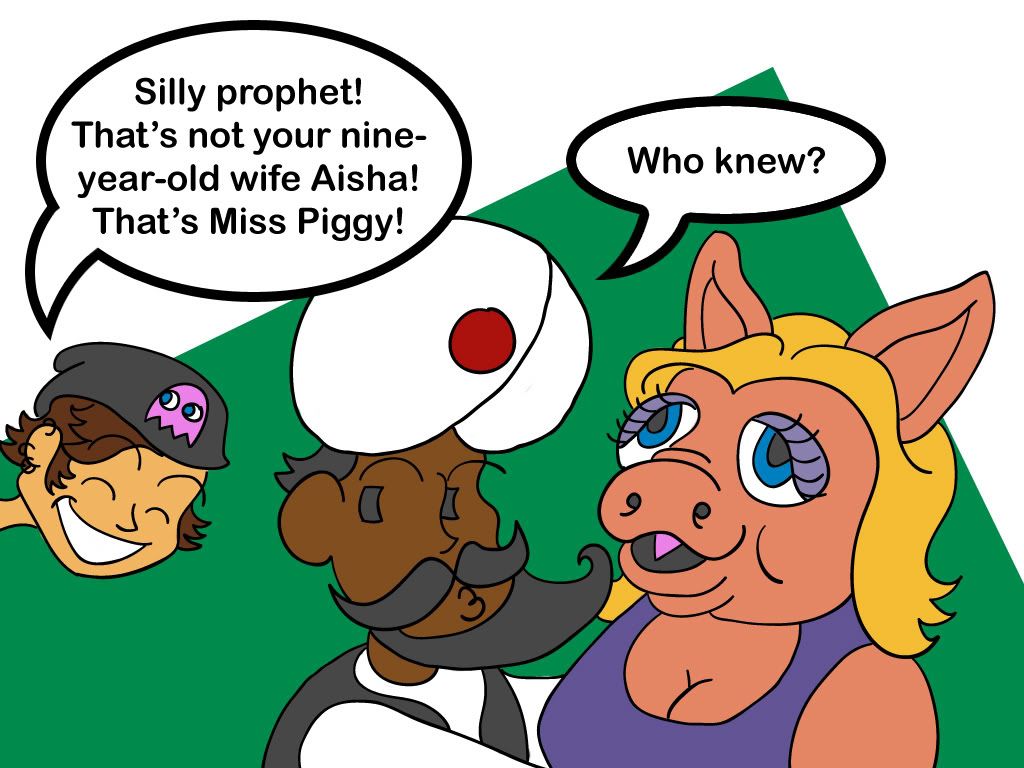
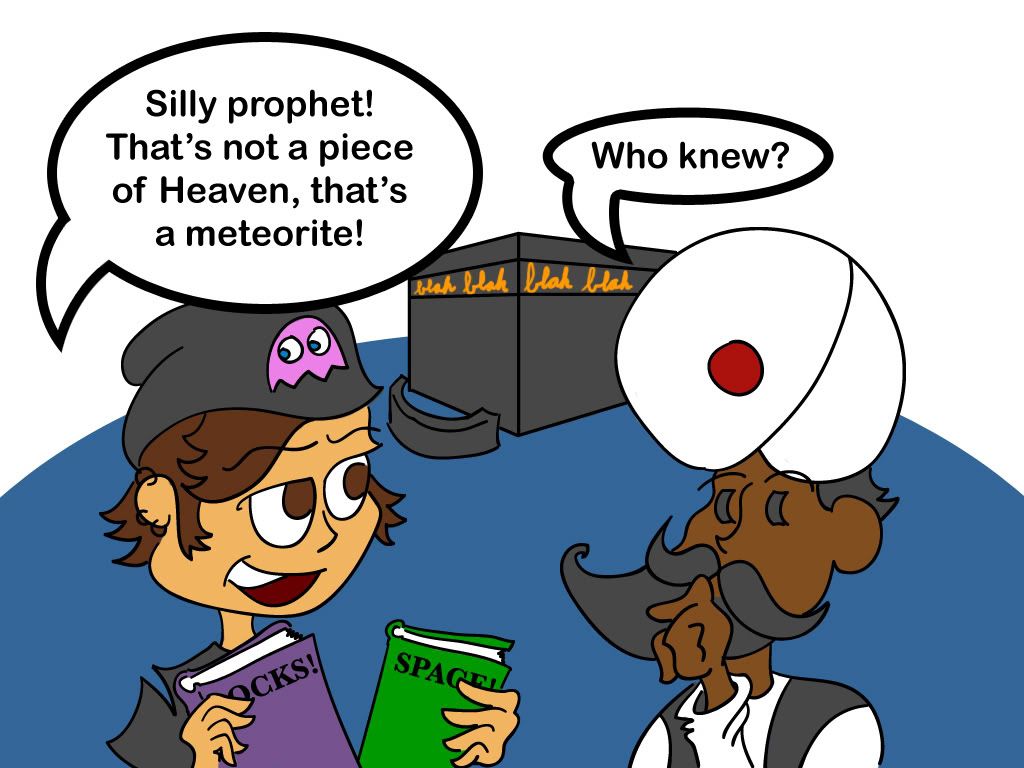
Better late than never, right? OK, so Steve Bowen informed me on Thursday that Thursday was "Everybody Draw Muhammad" Day, which would have been cool if I weren't working fourteen hours that day. BUT! It reminded me that I had made a previous commitment, in a proud tradition of blasphemy, to blaspheme some more. Without further ado:
Click for huge. Oh, and also for ALL FOUR PANELS. It didn't take long because I'm un-skilled, it took long because I forgot. (My lack of skill is irrelevant to the delay.) Anyway. I think I hit the big five: pigs, dogs, the Kaaba, and liquor, all while drawing the prophet Muhammad and me spending some quality time together. Rock most hard.

If you're interested in the individual panels: 1, 2, 3, 4. Enjoy!

EDIT: Photobucket does not want to give me the full-size version of the four-panel thing in all of its irreverent glory, for some reason. If anyone knows of an image hosting service that's man enough to put up a 1044x3122 image on the free, let me know - otherwise I can be e-mailed for full-size versions, if anyone wants 'em.

* - With the possible exception of Moo-ham-ed, I must admit.

Wednesday, May 19, 2010

The Wrongest of Wrongnesses in the History of Wrongitude

Editor's Note: Do I count as my own editor? I mean, I edit my own stuff, but... nevermind. Look. My last post was a little vapid, pontificating as I was on an overnight webcomic kerfuffle that ended up being wiped off the face of the internet anyhow. I feel kinda bad about it. So I'm breaking my "weekends-only" rule to say something of a little more substance. This is also the third post in recent memory where I have used the word "kerfuffle" for lack of a better term. Should I consult a doctor? Or just a thesaurus?

I recently read on Pharyngula about a paper by Doug Theobald (subscription to Nature required) calculating the likelihood that the proteins shared by all organisms on the face of the planet came to be shared by a concatenation of events besides common descent. In other words, regardless of the likelihood that life came to be in this or that particular way (which Creatards frequently yammer on about, assuming evolutionary teleology and all sorts of other bullshit), what are the odds that life came to be, as it in fact did, by other means than common descent?

PZ's summary and the news coverage make for fascinating reading - really, you should check it out - but I'm going to jump right to the number at the end and play around with it. That number is 1:102,680 against. So, sure, the common proteins shared by all modern organisms could have come about by some other means than common descent, but the odds are real fuckin' long against it. How long? So long. Like, it's hard to think of a way to be wronger, mathematically speaking - these guys are wronger than anyone has ever been wrong in the history of wrongitude (sounds like "longitude").

I have a phrase I use to describe "as sure as I get," and that is, "As sure as I am that the Sun's coming up tomorrow." This is meant to convey pretty fuckin' sure but not quite 100% certain (because I'm not 100% certain of anything, other than the fact that I am now having some kind of experience, and that I've always got room for doubt). Sure, something could happen so that the Sun doesn't rise tomorrow, but the data so far suggest extremely otherwise. Just how much otherwise? Well, let's take every day in Earth's 4.54-billion-year history as a data point.*
4,540,000,000 x 365.25 = 1,658,235,000,000
(1.66 trillion, or 1.66 x 10¹²)
Hmm... that leaves us a shit-pot of orders of magnitude to make up. But yeah, it's settled: we're surer of common descent than we are that the Sun will rise tomorrow!

"But wait," comes the Creatard rebuttal, "You can't just count the days up like that, you have to take into account how many of us there are! After all, a large enough number of rabid IDiots can't be wrong!" Well, OK. It doesn't work that way, but we'll humor you. Let's just say that all 6.8-billion of us are Christians, and we have been since the Earth was formed. Not only is this over-generous to the literalists in giving them the actual age of the Earth rather than their Reader's Digest Condensed Books version, giving them all of the current population throughout all of Earth's history, and giving a decidedly democratic bent to our epistemology, it doesn't even come close.
(1.66 x 1012) x (6.8 x 109) = 1.13 x 10²²
"But... but... twenty-two isn't nearly close enough to two-thousand-six-hundred-eighty," replies the anti-science crusader. "And I believe that your numbers are wrong with every fiber of my being." You know what? That's still not good enough. I'll give you a data point for every nucleotide base pair inside of every single cell of every person now living on the planet for every day throughout all of Earth's history - and you know what that nets us? Take a look:
(3.1647 x 10⁹ base pairs) x (1 x 10¹⁴ cells) x (1.13 x 10²²) = 3.58 x 1045
Fuck! That's still not enough! OK, but what if every atom in the observable universe, itself a number beyond ordinary human comprehension, spawned a Universe with a special Earth with seven billion humans believing in Creation with every fiber of their being? Yeah, what then?! This is what:
(1.5 x 1082 atoms in the observable Universe) x (3.58 x 1045) = 5.37 x 10127
Just to recap, we've given a data point in favor of the Sun rising tomorrow for each of 3-billion-odd nucleotide base pairs inside of all hundred trillion cells in the bodies of six to seven billion people observing a sunrise for every single day (including leap years!) across Earth's four-and-a-half billion year history, repeated for every atom in the observable Universe. And given all of that, we're still surer that all life is related by common descent than we are that the Sun will rise tomorrow.

Suck on those numbers! Tomorrow's a dark day for creationism, epistemologically speaking. Yeah, I'd say the future prospects for monotheistic creation myths are looking pretty dim. We should just turn the light out on intelligent design, and leave the real science to light our path into the future.

OK, I'm done now, for real. Man, playing around with degrees of certainty is fun!

* - Yes, OK, to calculate the actual odds of the Sun not coming up tomorrow, I would have to calculate the odds of something happening which would prevent the Sun coming up. Fine. Not the point, and that's why this entry gets the "humor" tag. I'm just going to treat it as a chance event and assume the Sun doesn't rise tomorrow, making it 1 failure out of 1.6 trillion successes. I need to keep this back-of-the-envelope compatible, after all.

Sunday, May 16, 2010

Rambling Towards Consensus

I wish there were some way for me to get paid for taking aimless, random wiki walks. Seriously.

OK, so there's this fancypants principle called the observer effect, which basically says that the act of checking things out will change them - observation has effects, in other words. It's hard for us to think about this if we haven't already been taught, visually-oriented as we are; our eyes passively receive photons, which trivially diminishes ambient light, but otherwise doesn't change much (Wikipedia's example of a tire pressure gauge is quite helpful, though). But when we're talking about a subatomic particle, we can't just wait for the relevant information to waft off of it from the background noise already present in the environment, we have to bounce an intelligible signal off of the object of our curiosity and that signal has an effect - bats would probably understand this better, or they would, if their prey responded to sonar. OK, last try: submarine captains understand. Fuckin' cripes.

Perhaps a better example, one I could relate to my pre-teen siblings, is the reason that an ice cube feels colder than ice water. Physically, they've got the same temperature and the same chemical composition, but why does one feel colder than the other? Well, because phase changes involve the transfer of energy: taking H2O molecules apart from an integrated crystalline structure into a free-flowing pile is a process that requires work, and your body heat rushes to the task in the same way that a kid with a wrecking ball would jump at the opportunity to reduce a building to a pile of bricks. Since it takes more heat from you, it feels colder, even though it's not.

Now, before you jump down my throat, let me reassure you that I know the observer effect and the perception of temperature aren't even the same sport, let alone in the same ballpark. What I'm getting at is not this or that physical phenomenon, but rather the philosophical point that they both touch on: we are active participants in reality, and not passive outside observers of it. Thus, all that we do shall in some way be inherently tinted by bias, since you cannot view at all without having a point of view. This goes double for culture, including discussons concerning any aspect or element thereof. I am continuously amazed at the extent to which people - myself included - are able to avoid taking this fact into proper account.

That was my point, and here is my case: on Wednesday, an internet mans with a great many fans did proceed to poke fun at Wikipedia by sharing his idea for an imaginary entry on malamanteau. Well, some yahoo then went and created the actual page for it, which is funny but doesn't quite fit Wikipedia's policies for a wide variety of reasons which others have capably pointed out. (TL;DR version: Randall Munroe made a joke, and Wikipedia is not a compendium of webcomic jokes; if fans started using the word "malamanteau" in their speech, the comic would get a bullet under the inspired activities section; the media attention this kerfuffle has already generated would probably justify an "in the media" section, but that hasn't been done yet; if the term enters common parlance, then the origin and etymology and early controversy and everything could go on its own page. Gawd.)

These policies (and others like them) are at the same time both the source of my respect for Wikipedia as a project, and the reason that I'll probably never be an active contributor. I gave them a once-over and then edited the phrasing of the Two Envelopes problem, but while double-checking my work I fell into a rules rabbit hole from which I was only able to escape by saying, "Balls to this!"

Anyway, Randall Munroe is a Wikipedian himself, and he jumped into the discussion Thursday morning, saying, "Hey, this is cute but totally unnecessary. How about we all chill out?" (I'm paraphrasing.) He closed by saying, and I'm quoting now, "Also, just so you know, nobody used the word 'disambiguation' until you people showed up. <3">disambiguation was used long before Wikipedia, as a cursory search of Google Books before opening your mouth would have revealed." Munroe responded to this in the best possible way by saying, "Moreover, I took some measurements, and my mom barely sits halfway around the house! I'm starting to suspect you're not an entirely reliable source on these matters!" This, of course, caused the other party to get butt-hurt because someone more popular was not taking him/her seriously.

What this discussion has revealed is that Wikipedia does in fact have words that it likes a whole lot, but not the ones Munroe pointed out in his joke. No, these favorite words are things like notability, neutral point of view, and Wikipedia is not a dictionary. What I find hilarious about all this, however, is that the discussion about how this ought to be treated has become something of an issue unto itself: by trying to clamp down and say how not-notable the whole thing is, the ensuing argument has in the process become something notable. Looking at things jacks up pageviews; talking about things changes the state of the discussion; even looking for things will affect Google trends. Using the internet invariably amounts to participating in it, and trying to control it is often an exercise in futility.

Of course, now that I go to check the state of the discussion on Sunday night, I find that everything's been resolved (and all the links I had to points in the discussion are now broken, thanks). Now searching for the word will redirect you to something generic about xkcd without explaining anything about all the discussion that ensued, a fine compromise in that nothing has been accomplished but at least everyone has shut up. Jeez, you'd think all these people were married or something.