Update Schedule

This blog updates irregularly.

Friday, September 11, 2009

Reverse-Engineering Religion, part one: An Immodest Proposal

I have a deep and perverse fascination with religion as a mind virus. I don't mean that it's morally perverse, but... umm... "phenomenologically perverse." Yeah, that's a properly awkward term for a rather awkward experience: the more I satisfy my curiosity on religion, the more I indulge my fascination by thinking about it and looking at it, the worse I feel. Religion is just so good at infecting and repurposing human minds to propagate itself throughout culture, and I feel so icky that it has these awful effects on those people and those minds. To paraphrase Voltaire, if there were no God, the idea of him would make zombies of us anyway.

That's thing one. Thing two is this Times Online article that PZ Myers thrashed on Pharyngula. Now, I don't disagree with Dr. Myers - I mean, after all, he would know. The shit is just common sense, and he's a doctor - that's just a winning setup for being right. This is a thought experiment, though, so I want to ask: what if we're wrong? If we're wrong on this one, and somehow, for whatever reason, it actually turns out to be the case that some people need religion, then... shouldn't they have the best religion possible?

That's the hook, and here's the pitch: let's hedge our bets on the principle of skepticism (you know, take precautions just in case we're wrong), while also taking into account the idea that "religious belief [is] a path of least resistance for many people," and have a little fun at the same time! Let's give the religious moderates the path of least resistance we'd like them to take, as a sort of cultural triage to save the world from the very worst evils of religion by building a better one until we can eliminate it completely. Let's reverse-engineer religion, see if we can find out what makes it tick as a mind-infecting idea, but design it to have good effects: an intelligently designed memetic symbiote built to oust the obsolete organic model, until we've outgrown the whole thing as a species.

It worked for L Ron Hubbard (building a religion, not making the world a better place), and I think I'm smarter than he is. I also think I'm a better person, so I'm going to try to do a better job than he did: I'm going to try to maximize the social cohesion aspect, minimize the bigotry and insanity, maintain the mystery of faith and sense of mythic storytelling, deliver a code of conduct in line with the best humanist ethics I'm aware of, and top it off with some metaphysical ultimates that in no way conflict with science (I promise!). This religion is going to be reason-proof and reason-friendly, if you can believe it! For bonus points, I'll try to future-proof it by working in some sort of auto-correcting update mechanism (something like, "listen to the scientists, even if this book disagrees with them").

Still not with me on this one? OK, let me put it this way: imagine yourself in the tragic dilemma of needing to pick a religion to be the One Truth of the Universe. I know it could never happen, but still. My goal is to build a religion that would be an easy choice. See? It's like a game!

Thursday, September 10, 2009

Work Related

This is an actual snippet from this morning's conference call - I transcribed it just moments after it happened (details obscured for purposes of anonymity and intelligibility):
Client: Your agents have been doing [X] too much.
D: Oh. OK, how much do your own reps do [X]?
Client: Well, you're not that high, just a little on the high side.
D: Right, but you didn't answer my question: how much do your own reps do [X]? What's "normal" here? I need to know what we're shooting for.
Client: Well, we don't really track it on our side, we just think you guys are a little bit high.
D: Erm, well... OK, then what number would be better? What would you consider "not high" for doing [X]? What should I tell the team to aim for?
Client: Yeah, we don't really keep track of that. I don't know what to tell you.
D: OK, what I'm getting at is that if you don't define normal, then how do you know what's outside of normal?
Client: Well, we're just assuming it's high right now.
I had to literally bite my tongue (that hurts!) or the next thing out of my mouth would have been a drippingly sarcastic, "Well, that's not viciously arbitrary at all!" I was incredulous; this is a conversation I honestly never expected to have. God God Dammit Dammit! "High" is a relative term which only has meaning in relation to some other number! What's so hard to understand about this?!

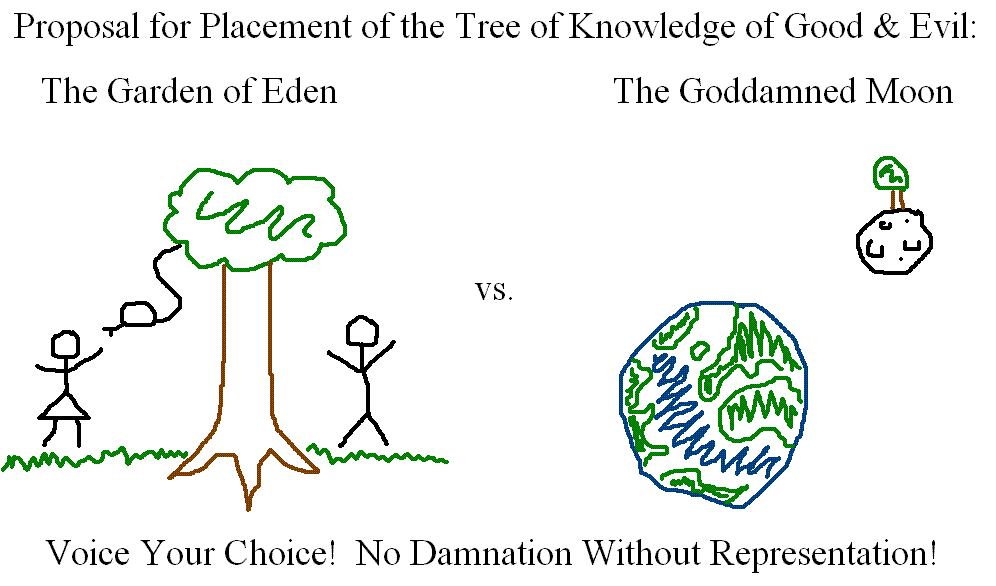
I made a picture!

Inspired by this comment over on Daylight Atheism. I want this on a t-shirt or something. I would so wear that!

There is so much wrong with the Abrahamic creation myth, it's hard to know where to begin. But morally speaking, I've always been a fan of Ayn Rand's take on it:
What is the nature of the guilt that your teachers call his Original Sin? What are the evils man acquired when he fell from a state they consider perfection? Their myth declares that he ate the fruit of the tree of knowledge — he acquired a mind and became a rational being. It was the knowledge of good and evil — he became a moral being. He was sentenced to earn his bread by his labor — he became a productive being. He was sentenced to experience desire — he acquired the capacity of sexual enjoyment. The evils for which they damn him are reason, morality, creativeness, joy — all the cardinal values of his existence. It is not his vices that their myth of man’s fall is designed to explain and condemn, it is not his errors that they hold as his guilt, but the essence of his nature as man. Whatever he was — that robot in the Garden of Eden, who existed without mind, without values, without labor, without love — he was not man.
I disagree with Ayn Rand on a great many things, but this is not one of them. I mean, I could pick a few nits in this specific formulation, but the central idea - that Original Sin condemns humanity for being human, and terms "evil" the very things that make life worthwhile - is right the fuck on. The cited source for the above quote is a good read, maybe about a page long; if you're not already savvy, it's definitely worth a glance. Go! Read! Enjoy! Now if you'll excuse me, I have some very important sinning to do.

Wednesday, September 9, 2009

They say that quitting cigarettes can be worse than quitting heroin...

... but I don't believe them.

I mean, I think drugs are awesome, but I won't even try heroin, because I'm worried that it might be that good. There is absolutely no fucking way that that's less awful than quitting cigarettes. Yet here I am, at five to two in the morning, and fretting over the fact that there's no place I can buy cigarettes in town. I mean, I have money... but no, says my super-ego, I'm supposed to quit this time. Wow. This is fucking tough.

Quitting cigarettes is supposed to be good for you, right?

Monday, September 7, 2009

SECKS: The "Bull-in-a-China-Shop" Approach to the Birds and the Bees

I think that we need to get laid. Like, every single one of us. I'm talking specifically here about the USA, but I suppose a good deal of this would apply to large chunks of Europe, as well as the "first world" in general. Consider how much our culture is steeped in sex, and how little we talk about it: advertisers make their money by literally preying on public perceptions of "sexy," underwear models adorn our buses, and we think nothing of the dating service ads and sex shops we see every day of our lives; but at the same time, we have people convinced that pornography is waging war on the human vagina, that breastfeeding in public is motherfucking dangerous, and that some people shouldn't be able to get a certain kind of contract signed by the state because of how they like to stick it in the naughty place.

This is fucking stupid.

Look, Humanity: Sex was here before we were, and it's got squatter's rights. We absolutely have to concede that point, or we're not going to make any progress on this one. But nooo, some people get all squeamish about the S-word, or the P-word, or the V-word, or the I-word, or whatever fucking word you want to use to talk about fucking. The truth of the matter is that porn is not intrinsically exploitative of women (though many men are - and so are some women, for that matter!), otherwise sites like (SUPER NOT-WORK-SAFE WARNING!) Men in Pain, Bound Gods, Naked Kombat, and Butt Machine Boys wouldn't exist. (And that's just one porn company!) The myth that seeing a breast is bad absolutely stupefies me - everyone has nipples, OK? And ain't nothin' wrong with a tit - it causes no harm, there's no such thing as "moral fiber" for it to damage, and if someone gets a little tickle in their "down there" because of it, I say good for them! As for our culture being stuck in the mud when it comes to recognizing homosexual relationships as legal, ugh, I don't even know where to start on that one. I'll just say I fucking hate Utah and leave it at that (and if you're reading this and happen to live in Utah... umm... well, OK, you're an exception). We really need to get over our bad selves - and I know just how to do it!

Here's my plan: we make a fucking float (i.e. "a float that fucks," I'm not just being foul-mouthed here) and put it in the Macy's Day parade. I mean one man, one woman, missionary-style reproductive intercourse. 1v1 PVI. We do it this way so that nobody can claim it's not as God intended - we're pandering to the Fanatical Wrong now, we just don't let them in on the Master Plan. And there's no way they'll find out, because there's no way they're reading my blog. Anyway, if they say they're offended, we can just slap them and ask what's offensive about the act that brought them into the world. Then we'll ask how they feel about their relationships with their mothers.

Think about that: everyone's parents fucked. Even yours. Your friends, too: ever meet a friend's parents? They fucked. Oh, they got it on! In fact, they probably tried everything you've ever tried - and since they're older than you, they've had more time to try more things. Please, take your time in pondering this.

Oops, got a little side-tracked there. OK, so we've got our fucking float, and now we just wait for it to become de rigueur, and then we start putting in a fucking gay float, and a fucking bondage float, and a fucking threesome float, and so on and so forth. We'll have all these fucking floats and as soon as anyone complains, we'll just slap them and say that people come in all shapes, sizes, and flavors, and we've had the first fucking float for forever, so everyone else needs to be represented here, too. Turn it into an equality/inclusion issue, that will almost guarantee a victory. OK, so that's phase two. Also, I may or may not be making this up as I go.

Phase three is "a miracle happens" and phase four is "victory," and those are pretty self-explanatory. I actually think my problem is in phase one, since people think they'll be harmed by seeing a naked body or a clear representation of the physical act of love (it doesn't harm them to have a naked body, such as their own, just to see another one). So, sure, maybe some people are offended by the sight of a nekkid body. So what? I'm offended by clothing: the proposition that there is something wrong with the human body which needs to be covered up is morally offensive to me, and I can't bear to see a human body hidden from plain view. But people's bodies are their own, so we should be able to do as we like, says I. Problem is, that's a rational conclusion, and people well and truly aren't rational about sex. I don't think they're capable of it, in fact, for what I think are some pretty embarrassing reasons.

We're a race of sex-crazed maniacs. People, that is. All of us. Every single one of your genetic ancestors had to lie, cheat, steal, charm, and/or muscle his and her way into the next generation by fucking. Fair enough at that: natural selection being what it is, those who are best at something will tend to keep on doing it, and sexual reproduction is certainly something one may be good or bad at. To that end, so much of our lives has been brought into the courtship, mating, and child-rearing rituals we've needed to survive; our lives are tied up in sex, it is an essential part of who we are and our instincts have been formed accordingly.

There's a problem with this, though, and like so many other problems, it is not inherent in the situation but arises from a mis-match between two things. Intellectually and technologically, we're beyond this sexy nonsense. Culturally and psychologically, we most definitely are not.

This needs some unpacking. OK, so sex is the way by which genes are able to ensure their transmission into the next generation - by "the way," I mean simply that there are plenty of other ways to improve one's odds, but sex is necessary in a way that other things just aren't. A horse can be as strong, fast, or intelligent as it likes, but without a mate and some offspring, that horse's genes won't propagate themselves into the next generation. Animals, accordingly, often act as if the genes inside them are taking calculated steps to increase their likelihood of continued propagation; this is just so, for the simple reason that those genes which have a tendency to cause their hosts to act in such fashion will, in the long term, win out over those which do not.

But the goals which may reasonably be imputed to genes are so far removed from the goals that humans choose in their individual lives, this often isn't worth thinking about - yet this mis-match is exactly what's at issue here. In fact, if we were not able to intellectualize our lives and consciously reject what our genes would say we "ought" to do, then nobody would ever adopt a child and all men would seek to become prolific sperm donors. Each of us is a collective of dead-end somatic cells with two tenuous glandular connections to the germ line, and as such we have all these instincts clustered around maintaining these connections and seeing to it that they do in fact convey our patterned base pairs to the next generation.

Intelligence changed this - sort of. Once we were able to realize our place in the greater scheme of things, we were on to the game and could see sex for what it is. And, well, it turns out that we need to be a little sex-nuts to win at genesmanship; more precisely, those individuals who are sex-nuts will tend to win at sex for the same reason sports nuts tend to be better at sports than non-enthusiasts, and so genes and culture "for" being sex-nuts get propagated. But being sex-nuts is just like being any other kind of nuts, insofar as it's fucking crazy. We have all these cute little ideas about sex: it's a private thing, it's special, it's only for two, you're a loser if you don't get any, a whole bunch of truly legendary nonsense about the hymen, and so on and so forth. These are all myths and contrivances - they're complications we add to sex because we're complicated, and we project those complications upon things that matter to us.

Sex had good reason to be private back in the day when someone could fuck with your fucking - especially if you were the fucker fucking with some other fucker's fucking. But honestly, there's no reason it can't be out in the open - we know enough about it and can keep it safe enough that there's just no reason we can't fuck in the street. I'm not saying we should, and I'm not saying you won't get arrested for it; I'm saying that there's no purely rational reason outside our own ad hoc psychology that prevents sex from being a wildly public thing. The idea that it "ought" to be private is only in our heads. That in and of itself is sufficient reason to make it private, but what I'm saying is that we're not rational for being this way in the first place - we're simply programmed to be that way, it's not a reasoned conclusion we arrived at after any deliberation. It's simple fucking insanity to have this idea for no reason and with no support, and most people never fucking question it their entire lives. It's much the same story for how many partners a person ought to have at one time or throughout a lifetime, who those partners ought to be, how regularly those partners should be replaced, and on and on and on. We are all naturally insane about this, and it will never be diagnosed as such until it's tremendously unpopular, because questioning this insanity, ironically, is what will make you dysfunctional.

We can make sex safer from STDs than ever before, we have the luxury of terms like "unwanted pregnancy" which would make no sense in the wild, we can check our DNA against that of our alleged offspring, we can fertilize an egg with a sperm in a test tube, we have mapped the human genome and we're hard at work demystifying embryonic development. We know so goddamned much about sex and we've made it safer and easier than ever before, yet while nobody bats an eye when a man wants to jam his peepee in a vajayjay, a lot of those same people absolutely lose their shit when a man wants to shove his wing-wong into another dude's manhole, or when a woman wants to do anything to another woman's hoohoo (this last one's way more popular on the internet, though). For the sake of social cohesion, we should call all of these activities "normal," as well as anything else that consenting adults care to do to each other; but in reality, it's all fuckin' weird. All of it. We're all just as weird as everyone else, only some people are weird in popular ways and other people are weird in unpopular ways. "Normal" is an invented, bullshit term.

This is exactly what I'm talking about: the fact of the matter is that people come in all sorts of shapes, sizes, and flavors, and they have all sorts of desires and perversions and proclivities, yet we think sex "ought" to be this or that way because that's how we like it or that's how we were taught. That's fucking nuts! What is wrong with people? Worse still, we go and pass fucking laws about who's allowed to pair off with whom, and how and when we're allowed to stick it in the naughty place. We need these strictures, in the "just-so" sense that of fucking course we'd go and make rules about sex; but we need them because we can't be rational about sex, and these rules show just exactly how much we can't be rational about sex.

The rules aren't right, they're not rational, they're not just, they're fucking crazy. But so are we. I guess what I'm saying is that we need to accept that we're all bat-shit loco and just live with that - but then again, part of our butt-puckering insanity is that we can't just live with it, we angst over it and primp and preen ourselves and try to put on a show and act like we know what's what, when we're all just as confused as anybody else. Welcome to the human race, where nobody knows what the fuck they're doing, but everybody acts like they do, anyway. People are fucking complicated, The End.

My vitriol gland just ran dry, so I guess rant is off now. I don't really have a solution to any of this, I just wanted to yell and holler about how we're all necessarily crazy about this one stupid thing, because it was driving me batty. But I'm done now. Y'all have a good one!

Fun Fact: I used the words "fuck," "fucked," "fuckers," and "fucking" a combined total of 37 times in this post. All were legitimate; not one of them was necessary. As Penn and Teller put it, sex is an end in itself and everything around it is what's gratuitous.

Thursday, September 3, 2009

Quickies Before Work

  • Chariots of Iron: These guys are awesome, and you know from the title that God can't beat 'em! My favorite line: "If you really think the Earth is only six thousand years old, you shouldn't be able to get a driver's license, let alone run a country." (#33)
  • Dan Savage lets drunks do his job for a day! It's cooler than it sounds, I promise.
  • District 9 is awesome and everybody needs to see it. It's got everything in it (action, drama, social commentary, political allegory, you name it), and it's all done well.
  • Here's a bottomless pit of stupid fun: Motivated Photos. Check them out.
  • I quit cigarettes today. Mainly 'cuz I'm out and don't want to keep buying them. But I want to socially pressure myself into actually quitting and not just stopping temporarily, hence the announcement.

A Message to the Folks in Charge: I MAED A GAM3 W1TH Z0MBIES 1N IT!!!1

So there's this thing called XBLA (pronounced "ecks-blah") where you can try, buy, and play games alone or online with your friends. It's awesome because Microsoft has this other thing on their first thing which they used to call "Community Games," which meant "games made by gamers in the XBox community." This was an appropriately informative title, but now they're called "Indie Games," which is misleading in at least one way. I mean, sure, the games are created independently, which I guess is the important part, but they're advertised, sold, and distributed by Microsoft, which is the closest you can get to an avatar of The Man.

Whatever. I still call them "Community Games," and they're still awesome. Well, some of them are, and some of them are not. But I can download free trials of all of them, and play them like I'm in an old-timey video game arcade! And with no quarters! So I found a truly awesome one, and it's probably the most stellar example I've seen of a creative and fresh new twist on an old favorite. Due to what I assume is a character limit, the game in question is called, I MAED A GAM3 W1TH ZOMBIES!!!1 However, the game's picture displays what I believe is the full title, I MAED A GAM3 W1TH ZOMBIES 1N IT!!!1 It's a twin-stick shooter, which means that you move with one joystick and shoot in whatever direction the other joystick is pointing, like Smash TV. Or Geometry Wars. Or any other twin-stick shooter.

So what makes this game so crazy fun? Well, it's got a solid gold core of simple-yet-addictive gameplay: shoot everything that moves! And surrounding that pristine nugget is a whole bunch of silly shit that cannot be taken seriously. But it's not self-conscious at all! The guys who did this (or guy? I don't know) just surrounded that quantum of joy with a whole bunch of ridiculousness and went for it. Did they make it? Umm... I think so! The background music is a poppy, catchy tune with lyrics that are about the game, and how it only costs a dollar.

WHAT?!

Yes, this simple addictive shooter, with background music that probably took longer to make than the rest of the game combined, costs but one single American dollar. Deal!

My message to the Folks in Charge is this: gameplay is king. I don't care how pretty your game is - or, rather, I care about graphics less than I care about gameplay. Everyone - and I mean absolutely everyone - is the same way, we just have minimum standards of gameplay that we will accept. Do you know how I know this? Because every gamer I know still loves old games with fantastic gameplay. Every single one of them.

Anyway, below is a video, although playing is always better than watching. Also, here is the song if you just wanna listen.

Monday, August 31, 2009

Inglourious Basterds: A sort-of review by a not-really critic

I suspect that killing Nazis is, for most Westerners, more or less like killing zombies is for me: an end in itself, a wellspring of amusement and satisfaction, an everlasting Gobstopper of joy that banishes all unpleasantness. I have a bottomless appetite for zombie-slaying, hating the undead with a passion as I do; given the chance, I would gladly risk my real life on a daily basis to kill real zombies, should they ever become a genuine threat (though I would be loath to see such a threat foisted upon the world). Replace "zombies" with "Nazis" in the previous sentence, and that's what I imagine the general consensus is in the Western world, and why we Americans so enthusiastically consume WWII shooters: it's righteous violence for a good cause against an implacable evil that is diametrically opposed to our very existence (in the shooters, that is... and in the imaginations of many overzealous patriots... the reality of the situation gets quite a bit stickier when we try to paint it in black and white like that, though).

So I watched Inglourious Basterds last night. I had only seen one preview of it, and it looked like either a satire or parody of the World War II genre; then I found out it has Brad Pitt in it (who is hot to death and a good actor to boot); and then I found out it was directed by Quentin Tarantino, who has never done anything I haven't liked. Well, maybe it's a commentary on World War II films, but it's not a satire or a parody (at least, not in the usual way). And as for Tarantino's involvement, the tone of the movie is more or less Pulp Fiction in the 1940s (Tarantino himself describes it as a spaghetti Western in WWII). That's about all I can say without getting into spoiler territory, so take that as you will; I do recommend seeing the movie if any of that sounds even vaguely interesting to you, though.

Beware of the Spoilers! They are all floating down here!

Inglourious Basterds is a Tarantino movie through-and-through: the protagonists are not people you'd have over for dinner for any sane reason, the plot is continuously contorting itself in a series of convoluted and inscrutable gyrations like a confused stripper on E, and there's not really a central message or point except that the world is a messy place where everyone's got their fare share of fuckups, hangups, and moral failings. Normally, this makes for witty one-liners, juicy water cooler gossip, and car-crash-like scenes that make me feel good and guilty at the same time (good because I like what I'm seeing; guilty because I feel prurient for liking it). I like this feeling. So I hope you understand when I say that it was even more pronounced while watching Inglourious Basterds.

Brad Pitt's character, Aldo "the Apache" Raine, scalps Nazis. Literally. He's got a command of eight American Jews who all hate Hitler and every last bit of Aryan supremacist bullshit he stands for, and Aldo tells these men that each of them owes him one hundred Nazi scalps. Aldo doesn't take prisoners - those few who he doesn't scalp are sent back to their leaders to tell horror stories of how their entire unit was killed and scalped - oh, and the survivors have swastikas carved into their foreheads with a Bowie knife, too. The reason for this last bit is that a Nazi uniform can be taken off: Aldo likes it when the Nazis wear their uniforms, because it makes them easier to identify; if they take their uniforms off, though, they can blend in with the rest of society. Aldo can't abide this, so he gives these men "something they can't take off." ::shudder::

But Nazis are evil, dammit! Right, guys? Well, OK, yes... but so is scalping people and permanently scarring them! How much evil is permissible in defense against a greater evil? Should despicable fear tactics such as scalping and mutilation be considered "good" when employed against things like genocide? Shit, I don't know. I mean, I'm a consequentialist, and as such I have to acknowledge that demoralizing an enemy is an effective tactic. As Sun Tzu wrote, the best way to achieve victory is to remove your opponent's desire to fight. But man, where do we draw the line?

This kind of moral inclarity is delectable to me. If you want to feel good about Nazis "getting theirs," then this probably isn't the movie for you - or Hell, maybe it is, but you might not get the same things out of seeing a Nazi officer beaten to death with a baseball bat that your friends get out of it. And there's a whole bunch of neat little character development segments and some really cool symbolism (such as when Shosanna Dreyfus is putting on her makeup, and it looks like she's putting on warpaint during a couple cuts). But all this is secondary in my mind to the moral muddle that Tarantino creates by eschewing the cartoonish portrayal of World War II seen in most of the genre (or perhaps by applying such cartoonish strokes liberally upon all sides). You know what I'm talking about: Hellboy doesn't fight Nazis, he fights "Nazis" who can't be reasoned with (like zombies), and "Nazis" also populate Germany, Italy, and France in most of the World War II genre. Tarantino's Nazis are closer to real Nazis, whom it must be remembered were also real people, than they are to "Nazis."

So yeah, I enjoyed watching Inglourious Basterds, and I recommend at least one viewing, but this sure isn't your daddy's World War II film. Given how saturated the market is with your daddy's WWII film, I say hooray for that.

Saturday, August 29, 2009

101 Interesting Things, part twenty-two: The Coastline Paradox

So I've been in e-mail contact with island, who commented on my second Abusive Cosmology post. I had previously known that Earth is a rare specimen, but I have since gained a much greater appreciation for just how rare our circumstances are here on this pale blue dot.

Earth occupies what is known as a "Goldilocks Zone," a whimsical yet apt term which amounts to walking a knife-edge between competing runaway forces. Uninhabitable extremes characterize the overwhelming majority of the Universe and prevent life from cropping up almost everywhere. However, these opposed runaway forces of extreme heat and cold, crushing gravity and hungry vacuum, as well as others, occasionally strike a balance between them that makes it possible for life as we know it to arise and thrive.

Now, we can imagine Goldilocks Zones for any phenomenon we'd care to dream up, be it life, molten metal, solar flares, factories, or whatever. The simple fact of the matter is that there are just about always more ways for any given thing to not exist than there are ways for it to exist. What's interesting is that these Goldilocks Zones have relevant features at all levels of reality. In terms of life, there is a Goldilocks Zone between Earth's mantle and its ionosphere into which all life has shoe-horned itself. Locally, every organism has its niche, and there are plenty of places on the planet where any organism you'd care to name simply could not survive: no species can survive absolutely anywhere on Earth.

Earth itself is in a Goldilocks Zone relative to our star, Sol: too close and we burn, too far and we freeze. Our solar system itself is a roll of the die that came up "life-friendly," with gas giants sweeping up the riff-raff of cosmic debris (which would otherwise pelt every small rocky world into oblivion), and without so much eccentricity in their orbits as to screw with the inner rocky planets. And the position we occupy in the galaxy is far enough out from the gene-scrambling radiation of the galactic core, but not so far out as to lack the heavier elements needed for more complex life. With respect to time, life cannot come about during the initial or final phases of a planet, star, galaxy, or Universe (at least, not a Universe that starts with a Big Bang and ends with either a Big Crunch or heat death). And with respect to physical laws, they have to be such a way as to allow life to be possible anywhere at all (though whether they could be otherwise is at present an open question).

This preponderance of interesting features reminds me of the Coastline Paradox, which refers to the difficulty of determining the "exact" perimeter of a coastline. You see, coastlines have relevant features at all levels of detail, and these change on all timescales. From biggest to smallest, coastlines have features observable from space that change in geologic time, and features on the more human-appropriate scale of meters that change daily with the tides, and features on the atomic scale that change rapidly all along the progression and recession of every single wave.

So what's the "true" length of a coastline? Ain't none. We can arbitrarily decide which features are important and which are not (the Wikipedia page mentions the appropriately useful tactic of omitting features significantly less than the unit in which the measurement is being made), but no output from any such method has a privileged status over any other. Trying to find the true or exact length of a coastline, even in a snapshot of time, is like trying to find exactly how many grains of sand constitute "a heap."

Monday, August 24, 2009

Bullshit Pulpit: So help me, Pythagoras...

Pop Quiz! The Bible contains which two of the following three things (answered by clicking, so don't cheat):
1. Instructions on how to sell one's daughter into slavery.
2. An explicit declaration that rape is morally wrong.
3. A proclamation that God is as strong as a unicorn.
If you answered 1 and 3, congratulations! You know your Bible! Next, please rank the following three ideas in order from greatest importance to least:
1. The lives and rights of women are just as important as those of men.
2. The comparative strength of God against that of other mythical creatures.
3. People are not property.
If you ranked 2 last, congratulations! You're civilized! Finally, please reconcile your answer to the previous question with the fact of the matter of the first. If you're an atheist, or some manner of theist who acknowledges that the Bible is just some book written by primitive men with a whole mess of backward ideas, congratulations! You're rational!

Now I shall abruptly switch gears. Suppose that I hold up a math textbook in one hand, and while gesturing wildly with the other, I proclaim that I believe everything in this book is true. Yes, I know that you know where I'm going with this, just trust me for now. Suppose also that you ask me, "Well, do you believe that the quantity, 'A plus B,' squared, is equal to A squared plus two AB plus B squared?" And suppose once more that I respond, "Preposterous twaddlecock!"

Well, as it happens, (a+b)2=(a2+2ab+b2) is a quadratic equation, and these are among the foundations of algebra. Also, the book in my hand is a high-school algebra textbook, so it damn well ought to be in there. Page 382, for the sake of argument. The point here is not whether this quadratic equation is true or not, or whether my math book has any errors or not; the point is that, by pronouncing my belief in a book I have not read and do not fully understand, I have put myself in a position to look awfully silly.

Let's shift back to the original topic of this evening's symposium: Biblical and moral pop quizzes. Respondents may be grouped by their answers and I suspect that these groups will have a strong correlation with the beliefs of those respondents. Those who recognize that the Bible does not say that rape is wrong will, for the most part, turn out to be atheists (or perhaps theologians, but these will be a clear minority unless I somehow acquire a selection bias in favor of theologians). Those who suspect that the Bible does not compare God's strength to that of an imaginary creature will, by and large, turn out to be believers. I'm not sure about that first one, though - it strikes me as less preposterous than 3, but less necessary than 2 - so I'll withhold any predictions about that one for now. And there will of course be those who are neither atheist nor Christian (you know, people who are religious but don't think the Bible is true) who could reject any one of them for a whole host of competing reasons (in America, they'd be a minority).

My point is that Biblical belief, absent Biblical education, will lead to something like the following general thought process in believers: "Hmm... well, the Bible is a morally good book, the word of God in fact, and so 2 is definitely in... and 1 is pretty bad, but 3 is just stupid. If I had to guess, I'd say 3 is the missing one; and I have to guess, so I'm going to say that 3 isn't in there, and 1 & 2 are." BZZT! Wrong! Beliefs about the book formed a rational prediction, and that prediction turned out to be incorrect. Since the prediction was incorrect, we are left to examine the beliefs from which the prediction was formed. I maintain that the Bible is not a morally good book and is not the word of God, but is rather the work of many different men throughout antiquity who didn't know what atoms or germs are and probably thought that unicorns are real. Other answers are possible, though: for instance, God may have been so preoccupied over the possibility of people wearing linen and wool together that he forgot to tell the men of his chosen people that they shouldn't fuck the women of his chosen people against their will. Hey, it's cool, sometimes I forget to pay the gas bill until I get an e-mail about it.

This type of thinking leads to some fairly silly situations, though. Consider the brouhaha over the Ten Commandments, as debated in Alabama (among other places). There are people who believe, and institutions who declare, that the Ten Commandments are an advanced and wonderful set universal moral laws which were ahead of their time and are respected by all societies. Really?! What the fuck?! Do these people even know what the Ten Commandments are?!

No, as it turns out, they don't. Ask a person on the street, or a Christian in church, to name all ten and you will get confused looks at least 90% of the time, and complete answers from perhaps two or three percent (again, unless you've got a selection bias in favor of theologians). Just about everyone will be able to give you "don't kill" and "don't steal." Other popular ones include "honor your parents" and "remember the Sabbath." Let's see if I can get all ten from my desk at work with no Bible (I'm not using SAB to cheat, I promise!):
1. I am the Lord thy God; thou shalt have no other gods before me.
2. Thou shalt not make unto thee any molten gods.
3. Honor thy father and mother.
4. Thou shalt not kill.
5. Thou shalt not steal.
6. Remember the Sabbath and keep it holy.
7. Thou shalt not bear false witness against thy neighbor.
8. Thou shalt not commit adultery.
9. Thou shalt not covet thy neighbor's wife, nor his goods, nor his ass, nor his house.
10. Thou... umm... something about yeast?
Shit! Only nine! OK, let's see how I did:
From Exodus 20:
1. Thou shalt have no other gods before me.
2. Thou shalt not make unto thee any graven image.
3. Thou shalt not take the name of the LORD thy God in vain.
4. Remember the sabbath day, to keep it holy.
5. Honour thy father and thy mother.
6. Thou shalt not kill.
7. Thou shalt not commit adultery.
8. Thou shalt not steal.
9. Thou shalt not bear false witness against thy neighbour.
10. Thou shalt not covet thy neighbour's house, thou shalt not covet thy neighbour's wife, nor his manservant, nor his maidservant, nor his ox, nor his ass, nor any thing that is thy neighbour's.
Argh! So close! OH, WAIT. NO, I AM NOT EVEN CLOSE. You know why? Because those aren't the Ten Commandments. I can prove it right now, too. Just grab your fuckin' Bible and follow along with me, no sleight of hand or shenanigans here at all.

Got your Bible? OK, open up to Exodus 19:20. This is after the Israelites have left their made-up captivity at the hands of the Egyptians (the latest archaeology shows that the Israelites, as they came to be known, were probably the lower classes of extant Canaanite civilizations who rose against, broke stuff, and then ran to the hills, using Egypt as a stand-in for their faceless oppressors), but before the milk and honey hijinks. In chapters 19 and 20, Moses goes on up to Mount Sinai and has a chat with God - no tablets, no commandments, they're just talking - and then Moses comes down. The End. Later on, in Exodus 31, Moses goes back up to Mount Sinai. This time, there is writing, but the Bible itself simply states that God wrote what he and Moses talked about - so it ought to be the same, right? Still no mention of any commandments, though. Well, Moses goes back on down with his two stone liqui-gels tablets, but he sees that Aaron has got them all worshipping a golden calf, so he throws a tantrum the tablets to the ground... no, wait, he throws a tantrum, too... and the tablets break. Then Moses has to talk God out of killing every last fucking Israelite stone-dead (no joke: read Exodus 32:9-14).

Nowhere in this part of the story is the writing on those tablets explicitly reviewed, and neither is this piece of genius referred to at any point thus far as "The Ten Commandments." You have to go back to chapter 20 to get the words themselves which are today called the Ten Commandments, and you have to go forward to Exodus 34:28 to get the word "commandments," and this is a problem. In Exodus 34, it says that Moses goes up Mount Sinai a third time, and this time he writes what was written on the tablets before, which writings bear no apparent relationship to what they had talked about the first time, and only now are they called commandments. So far, so good... except the commandments are entirely different, viz:
1. No other gods.
2. No molten gods. (So far, so good.)
2. Keep the feast of unleavened bread. (What?)
2. Work six days, rest on the seventh. (Oh, OK, back to normal...)
2. Ovserve the feast of weeks, the firstfruits of the wheat harvest, and the feast of ingathering at the year's end. (That's quite a few parties...)
2. All the male children should appear before God three times a year. (Double-what?!)
2. Don't offer a blood sacrifice with leavening.
2. Don't leave the passover sacrifice until morning.
2. The first of the firstfruits of the land are God's.
2. Don't boil a baby goat in its mother's milk.
Really? I mean, really?! Those are the Ten Commandments? You're goddamned right, they are. That is, until you get to Deuteronomy 5, where we're back to that first conversation that Moses had with God*.

I once had a professor tell me that, convoluted as the Bible was, it does not contain any contradictions because a contradiction is of the form "X is the case, and X is not the case." Leaving aside simple paradoxes (such as "People are good, people are evil," where "evil" means "not good" and therefore "people are evil" means "people are not good"), this is still false because we have here the statement, "The Ten Commandments are A, such that any B which is not A is not the Ten Commandments" (for any statement of A=C, it is implied that there is a B which is not C and is therefore also not A, otherwise A=C is an uninteresting tautology). And then later on we have the statement, "The Ten Commandments are B." So check it out in premise format:
1. A. (Where A is the Ten Commandments in Exodus 34 described as the Ten Commandments).
2. A implies ~B. ("~" means "not," or in this case, "B is not the case," where B is any non-A set of the Ten Commandments.)
3. ~B. (From 1 and 2, above, with modus ponens.)
4. B. (Where B is the Ten Commandments in Deuteronomy 5 or Exodus 20, which is also a non-A set of the Ten Commandments - it's a "true B," in other words.)
So we have here A, A implies ~B, therefore ~B, and B. We have here a contradiction: ~B and B.

Something is wrong here. Options include, but are not limited to:
1. There are actually Twenty Commandments, with some duplicates.
2. Moses wrote it wrong (or dictated it wrong, or was transcribed wrong) in Exodus.
3. Deuteronomy is wrong with respect to the Big Ten, as well as parts of Exodus.
4. God changed his mind.
5. There has been a change which would be rather difficult to trace today and which has resulted in different accounts of what was supposed to be the same mythical (not literal) event.
6. The whole thing's hogwash.
As it happens, 6 is true - but so is 5! (Happily, they're not mutually exclusive like B and ~B, so they can both be true at the same time without contradiction.) You see, some people (who apparently had nothing better to do) have determined that the Old Testament is actually an amalgamation of no less than five distinct sets of writings. One of those sets of writings, the latest one (omitted by the Wikipedia article, it's called "R" for "redactor"), is the result of an ongoing attempt to work the other four into one continuous narrative, and this is why we have the Bible as we have it today (well, that and the third Council of Carthage in AD397). To accomplish this task, many techniques were employed under the general heading of midrash, the important parts of which (for our purposes) amount to the Biblical equivalent of DC re-telling Superman's origin over and over again, or of Nintendo's continuous re-telling of the Legend of Zelda: it is a regular sexing-up of otherwise outdated material for a new generation of audience members. One of these techniques is to take different accounts of the same event, like Moses' trip up Mt. Sinai, and to say that all versions happened in sequence (as opposed to instead of one another).

This professor of mine tried to explain away the "B and ~B" contradiction outlined above - yes, that very one - by saying that since the current version is just a re-telling of several other versions rolled up into one, it's not "really" a contradiction. That's like saying, "Well, you see, the original Superman was named Clark and raised by John and Martha Kent, but the next Superman is named Arthur and raised by John and Martha Dent, and so even though the newest Superman literature says in one place that he's always been named Clark and raised by the Kents, but in another place that he's always been named Arthur and raised by the Dents, it's not really a contradiction because it's just a re-telling." Oh, and don't forget that a whole lot of people worship Superman in this hypothetical world, insist that his comic-book history is the inspired word of Superman (who is perfect and therefore never lies) which is without flaw or error, and also that when people die they will be either resurrected by Superman to live in the Fortress of Solitude with him (for serious!) or they will be imprisoned in the Phantom Zone forever.

That's stupid.

Anyway, I really think that if more people read their damn Bibles, we'd have a lot fewer believers. Or at least a lot fewer literalists (though there would still be some). Also, I want to swear on math textbooks in a courtroom now. "Do you solemnly swear to tell the truth, the whole truth, and nothing but the truth, so help you Pythagoras?" "I do, so help me Pythagoras."

- - -
* - Extra Credit: OK, so there are a few other things going on here as well. First of all, beyond Moses arguing with God (that's how you know he's a true Jew), you've also got the part in Exodus 34 where God say's he'll do the writing at the start of the chapter, but then he pussies out and has Moses doing the writing by the end of the chapter. Also, in Deuteronomy 5, it says that God made the covenant with Moses at Horeb, whereas Exodus places all covenantry clearly at Sinai. And do keep in mind that the only place in the Bible that the Big Ten are called the Big Ten - that is, the only place in the whole fuckin' Bible where the words "The Ten Commandments" are used thus - is in Exodus 34. What do you think ought to be the official ruling on this one?

Wednesday, August 19, 2009

Poison for your Brain: Stephen Hawking should be DEAD! Long live Stephen Hawking!

Thanks to PZ for pointing this out:
"The controlling of medical costs in countries such as Britain through rationing, and the health consequences thereof, are legendary," read a recent editorial from the paper. "The stories of people dying on a waiting list or being denied altogether read like a horror script...

"People such as scientist Stephen Hawking wouldn't have a chance in the UK, where the National Health Service would say the life of this brilliant man, because of his physical handicaps, is essentially worthless."

The paper has since been notified that Hawking is both British and still among the living. And it has edited the editorial, acknowledging that the original version incorrectly represented the whereabouts of perhaps the world's most famous scientific mind. But it has not acknowledged that its mention of Hawking misrepresented the NHS as well.

"I wouldn’t be here today if it were not for the NHS," Hawking told The Guardian. "I have received a large amount of high-quality treatment without which I would not have survived."
Well, that's a pretty clear conditional statement from the IBD: "If Stephen Hawking were British and therefore subject to the NHS, then Stephen Hawking would be dead." Guess what? Stephen Hawking is British and therefore subject to the NHS, and Stephen Hawking is not dead; the conditional statement is false, and the argument which the point is supposed to support is therefore stupid. OK, fine, flawed. But still.

I will never understand how such out-and-out lying passes muster in the American populace. Sure, sure, Investor's Business Daily may have made a merely-ironic-but-honest mistake... but seriously, nobody over there knew that Stephen Hawking is British? And nobody thought to check before going to print?

What are you, new?!

This isn't funny any more. "Atheists have no morals" is funny. "Obama wasn't born in the USA" is funny. "Stephen Hawking died for lack of health care" is funny. But these are all funny because they're manifestly false and relatively harmless in my day-to-day life. "Baseline nationalized health care dedicated to raising the minimum standard of living will result in mandatory euthanasia and no children getting any health care at all" is not funny; it's obviously false and stupid, stupid, stupid. It's a kind of stupid that is downright dangerous, if you ask me, since the other lies from the Right are matters of empirical fact which can be disproven with even passing knowledge of... well, anything. This, right here, is not that. This is something else.

This is different because it's screwy logic that preys on a clear and obvious misunderstanding of the pitch: if you listened to Obama at all, you'd have to know that what he says is not matching up with what is said about that. So the citizens on the Right who buy this horseshit are in the unenviable position of either A) thinking themselves informed for listening to the commentary on an issue alone (and buying it despite its obvious insanity), without actually paying any attention to the issue itself, or B) hearing the commentary and being informed on the issue and still going with the commentary, in flagrant defiance of all logic.

I don't know which is worse.

Le sigh. Look, it's like this: everyone is afraid that, should shit hit the fan, someone I care about might not have access to health care. That's a rational fear, and I get it. However, if you live in America, that's a rational fear in the current situation. It's been a rational fear for... forever. The people you love will die, and some of them will die for stupid reasons you don't like. That's how it goes, man. Obama's proposed changes are aimed at minimizing the extent to which this happens, and that means putting a price tag on human life just like we do now. You know why we put a price tag on human life? Because sustaining human life has a cost. Who's gonna pay yours? You do! Well, more accurately, you pick up where your parents left off as soon as you enter the work force and file independent on your tax returns. You make money, and you use some of that to sustain your life, and you do what you like with the rest. And right there, whatever it is that you spend before you get into your disposable income, that's the cost of your own personal Human Life, plain as day in beautiful green dollars and cents. Hooray!

But what if shit happens and you don't have enough? Well, that's what insurance is for, and insurance isn't going away - it's being supplemented. It's getting better. The uninsurable have a baseline below which the government won't let them fall, and while the quality of that thing will vary with the costs of doing that thing, the private sector will now have an objective goal: do it better than the government. If you think you can get something better from the private sector, fucking go for it! More power to ya! (Just be prepared to pay!) If you can't, or don't want to, then Obama's changes are for you, and suck though they may compared to something you can't afford anyway, it's better than nothing at all which is where things are right now. And if you've got the money to afford health care on your own, then nothing will be able to get in the way because you can afford it.

Fuckin' Hell, what is so hard to understand about this?

Call Ripley! AI vs. AI in a No-Holds-Barred Video Game Contest!

Fine, not quite; but AIs are playing Super Mario Brothers! No joke!
Baumgarten's AI also had some pleasant surprises. Without programming, the AI learned to grab the shells from defeated enemies and use them to destroy other enemies.

"This nice behavior sometimes just appears," said Baumgarten. "We try to optimize the behaviors that will lead to success."
They're learning! Or at least "acting as if learning," which is close enough (and what we do, anyway, once you get past the whole "self-awareness" issue). Now, this may be premature, but I welcome our new robot overlords. I can't wait for the day when we as a species outgrow our cyberpunk adolescence and move on to a postcyberpunk utopia.