Update Schedule

This blog updates irregularly.

Wednesday, January 7, 2009

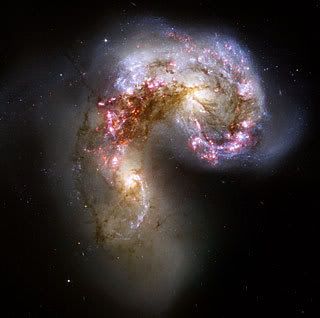
101 Interesting Things, part 1: The Antenna Galaxies

The Antenna Galaxies are a reminder that, in the grander scheme of things, we ain't shit. I mean, if you think you've got a dust problem behind your couch, you should see the dust clouds kicked up by a galactic collision.

Seriously.

These two galaxies have been colliding for hundreds of millions of years, orders of magnitude longer than all of recorded human history. They will continue to collide for hundreds of millions more years, in all likelihood well after we have died out and all traces of our civilization have disappeared wholly from the cosmos.

During this time, the scale of which is far beyond the human mind to truly grasp, events have been transpiring which are orders of magnitude grander than anything that could possibly happen on Earth - the reason is nothing to do with Earth or its inhabitants, but the simple fact that these events would destroy our world utterly.

These inconceivably epic collisions between all manner of celestial body have been happening always and everywhere on a stage far grander than any our species has ever known. If every single event of every history book of every nation were to be reenacted simultaneously, each upon a separate life-sized stage of its very own, all of these areas together would not even register on the above image, which is itself but a single moment in time that took forty-five million years just to reach our eyes.

In short, we can't even understand how much greater this is than even our ability to understand things in the first place.

The Antenna Galaxies are, in every conceivable way, utterly beyond our comprehension. We simply never deal directly with anything on a scale even remotely close to this size - not time, not distance, not force, not anything. If there existed a god, then surely this would be a prime candidate for the focus of divine attention: the magnificent story of two galactic formations swimming inexorably towards each other through the inky blackness, pulled by nothing but the universal force of attraction into a celestial mating dance of truly epic proportions.

Compared to this, all of humanity is but the blink of an eye upon a speck of dust in the next room over. We think we're hot stuff, all right, but even our invented gods were so petty and parochial as to be utterly ignorant of this truly grandiose phenomenon. Not one holy book mentions the antenna galaxies - one would think that a god would take notice, or at least want to show off its handiwork.

At any rate, I think it can safely be said that the Antenna Galaxies are well and truly interesting. To find out more, check out the Wikipedia page or my source for the above image.

This post was featured in the 31st Humanist Symposium.

Tuesday, January 6, 2009

101 Interesting Things: introduction

So one of my coworkers asked me a stupid question the other day, the story doesn't matter. The point is, at the end, she asked, "Isn't that just interesting?" I looked her in the eye and said, "Lots of things are interesting." She basically said nuh-uh, and I looked at her like she was stupid. Then I thought about it and said, "Well, I suppose that depends on what you think 'a lot' is. I'm pretty sure there are at least a hundred interesting things." She thought about that and said, "Yeah, you're probably right." Then I thought, damn, I'd like to come up with one hundred things that are just plain interesting.

Not just to me, but to everyone.

There's a problem with this, of course, and that's the fact that "interesting" is a subjective term. However, I think it has less to do with the person or the thing in question, and more to do with perspective - from a certain angle, just about anything can be interesting! I want to find those angles.

So here's my new project: I'm going to come up with 101 interesting things, taken from all fields of study, one day at a time - and post a brief article about each one. Starting tomorrow!

Monday, January 5, 2009

The Cuckoo and the Con-Man: a meditation on marketplaces

I had a constructive conversation with my boss at work a while back in the wake of the Wafergate scandal.  We got to talking about free speech, ultimately, and a parallel jumped into my mind.  Up until now, I've been unequivocally in favor of free speech, and unapologetically so.  I was thinking about the marketplace of ideas and how it needs to be open and free, and then I made a cognitive leap to the marketplace of actual money and our current economic disaster.  As it's important to question even cherished beliefs from time to time, I'll be exploring that today.

It would be great if we could just let the marketplace, ideological or economical, operate freely with zero interference, and everything would work out perfectly as a result.  However, that's just not realistic.  The dog-eat-dog, state-of-nature sort of unrestricted natural selection that Mother Nature oversees is precisely the thing from which Civilization has been trying to protect us, because Mother Nature is a heartless bitch (see the is-ought problem).  A splendid, multifaceted, wondrous and downright hot heartless bitch, but a heartless bitch nonetheless.  For all that reciprocal altruism and mutually-beneficial cooperation are naturally encouraged, there is still room for the cuckoo - not every cuckoo gets away with it, but enough do.  Similarly, con-men are often exposed as the frauds they are, but not always, and many get away with it.

There is no straightforward demand for con-men in the economy, nor is there a need for cuckoos in the biosphere.  They do not satisfy any needs or desires.  They survive not by contributing, but by exploiting available opportunities at the expense of others in the community (the pocketbooks of the gullible and the genuine progeny of other birds, respectively).  Con-men do not create wealth, cuckoos do not fill a niche; both survive by skimming off the top of a system that would, on any analysis, be better off without them.

Con-men are outlawed from existence, cuckoo eggs are killed when discovered.  Similarly, in the marketplace of ideas, there are harmful ones that do not contribute to humanity, but instead drag the system down, surviving only by the grace of their betters which got us, as a species, this far in the first place.  Slander and libel are the obvious ones:  these kinds of ideas so egregiously detract from discourse that they are banned from the process entirely, and prosecuted when discovered.  Threats, too, are not allowed into the marketplace, because they accomplish nothing aside from indicating that a certain crime is likely to occur.

But is it enough?

As with the economy, excessive regulation breeds tyranny and oppression, suffocating legitimate contributions and generally doing more harm than good.  But how much constitutes "excessive," and who gets to draw that line?  When speaking of liberties, I think a good principle is that people should be left as free as possible, with regulations only applied when someone else is harmed - as Jefferson said, "The legitimate powers of government extend to such acts only as are injurious to others."  So let's look at the consequences, shall we?

Economic collapse can ensue, as history shows, from either too much or too little regulation.  Too much, and there is no incentive to tease the motivations that drive us into action; too little, and short-sighted greed will win out over long-term stability.  Even in nature, animals can eat themselves into extinction if the blind watchmaker crafts too prolific a form.  We have not yet seen what total ecological collapse looks like from the inside (yes, we are inside the ecosphere, and just as much a part of nature as everything else), we have only been able to look back upon past catastrophes foisted upon our tiny blue bubble.  What is good in the long run, what is often called "the right thing to do," can often be a thin line walked carefully between two extremes.

What would a collapse of the marketplace of ideas look like?  What would the proper analogue be, exactly?  Cultural stagnation, even regression, could follow from over-regulation, as only the blandest and most insipid fare could pass the test of too many timid cooks objecting to flavors they dislike, instead of sucking it up and just eating a different meal.  There is no single thing that will fail to offend absolutely everyone - I, for one, find the bland to be offensive for precisely the reason that it cowers behind political correctness at the expense of thought-provoking content.  It drains ideas of their power in the name of coddling people like children who can't be trusted to think for themselves.  It is an insult of enormous magnitude:  you can't be trusted with this thought, but we can administer your thoughts by filtering what we decide is or is not appropriate.  I'll take a pass on that, and to hell with you for offering!

But what would excessive deregulation cause?  Not in advertising, mind you - that falls under the purview of the economy.  Hmm... now that I think about it, perhaps not.  All media, after all, has economic roots.  Maybe that's not a fair distinction to make.  But that's a topic for another day, the matter at hand is whether our current system permits too-free speech, and how the marketplace of ideas could conceivably thereby collapse.  Leaving aside slander, libel, and false advertising claims, what are the dangers of unregulated discourse?  How bad could it possibly get?  I've been staring at my screen, trying to imagine something - anything - but the only thing I can come up with is:  feelings get hurt.

Cry more, why don't you?

Ideas are not a resource like money or food is a resource:  they are not consumed or spent, but can only spread or stagnate.  False advertising claims, slander, libel; these have all been outlawed from our marketplace of ideas1, and I think that's enough.  There are particularly nasty and infectious ideas that will no doubt spread regardless of any other merits, but the way to combat them is not to censor them like the child on the playground who thinks words are magic and says, "Ooh, you can't say that!"  Rather than censoring them, we should let them fend for themselves just like any other idea, because the idea that they're precious and oh-so-special is itself just another idea, and for that matter, so's the idea that free speech is good.  Feelings will get hurt, to be sure - but you know what?  Offense is very different from actual harm.  A little alienation is good, every now and then2.  Having your beliefs called into question is good for you.  Examining your thought processes is good for you.  Learning to deal with ridicule is good for you.  Being able to take a joke is good for you.

And, perhaps most importantly of all, learning to get along with those who disagree with you, sharing your ideas and staying civil with each other, is good for you.

Too much of anything is bad for you, of course, and the same applies to all of the above.  We should not perpetually question our beliefs, or we would be paralyzed by doubt.  Constantly examining our thought processes leaves us locked in the ivory tower, never acting in the world outside.  Too much ridicule can break the human spirit.  Too much jocularity leaves no room for Serious Business.  Having a ready defense of every single opinion is impossible.

And getting along with those who harm others, instead of helping their victims and working to abolish the tyranny du jour, is morally bad.  Just so this is perfectly clear, I'm looking at you, Saudia Arabia, Zimbabwe, Darfur, Pakistan, Somalia, Sudan, South Africa, Russia, Bosnia, Kosovo, Britain, and especially you, America - the way you grew up, knowing what you've been through, and now seeing what you're putting others through - what would your founders think?

Whoah, kinda got sidetracked there.  To the OnTopicMobile!

Actually, my diatribe gland is starting to feel a little dry.  I've looked it over, and I am again sure that free speech is not negotiable.  Freedom is simply too important to be held in check by the whims of others' feelings.  I think I can say with confidence that if anyone doesn't like that, they've got some serious growing up to do.

Notes:
1.  False advertising claims, slander, libel; these have all been outlawed from our marketplace of ideas.  Not entirely, actually.  This seems a little too easy, to be honest, but I'm going for it anyway.  Religion makes claims that it can't support; several make libellous claims about unbelievers.  I do not advocate book-burning under any circumstances, I'm just saying that in a religious context, we as a society still have trouble recognizing these otherwise criminal statements for what they are (or, perhaps more appropriately, classifying them more accurately as "fiction").
2.  A little alienation is good, every now and then.  Thanks to Peter Railton for this bit.  For more on this, or just to read a good paper, check out Alienation, Consequentialism, and the Demands of Morality.

Saturday, January 3, 2009

Introduction II: this time, it's personal!

I thought I'd take some time to rattle off the general personal stuff that typically goes in the "about" section but which I don't have space for in that little box.

What are you doing here?  Anything and everything I feel like.  This is my soapbox.  This is my lectern.  This is my podium.  This is my mic.  I'll probably talk about a lot of stuff with a philosophical bent, but I may geek out over tech news from time to time, or lambast religious insanity (or applaud religious sanity, for that matter), or talk about books that I'm reading, or just talk about everyday news news.  I will rarely talk about my personal life, except when it serves as a segue into a broader philosophical point.

What kind of stuff will be discussed here?  As the description indicates, I'll be writing lots about philosophy (but trying to keep a practical angle in mind), I'll put up science-y stuff from time to time (but translated into everyday English), and I'll occasionally write out a short essay on some speculative matter or other (but only when I think it would be interesting to other people).  Every November, there's a small but non-zero probability that I will participate in National Novel Writing Month.  I will also have some ongoing series, such as "Call Ripley," for improbable developments; "Poison for Your Brain," for stupidities of epic proportions; "101 Interesting Things," for encouraging lifelong learning; and maybe a few others.  We'll see how it goes!

Why should I care?  The key to maintaining an audience is consistent content, and I'm going to post at least one interesting thing here three or four times a week.  I want each and every one of those interesting things to be readily accessible, to lend itself easily to a more thorough analysis, and to be interesting enough to provoke additional thought in the reader.  If you like interdisciplinary studies, or if you find a breadth of topics to be refreshing, or if you think being an intellectual tourist isn't necessarily a bad thing, this will probably be a good place for you to bookmark/RSS/subscribe/whatever.  In short:  I'm an applied general philosopher - if that sounds interesting to you, I think we'll have lots to talk about!

Why like this?  On previous Playskool blogs of mine, I would often link to grown-up blogs and talk about whatever they talked about... but I'm trying to move past that.  I kept wanting to do what they did, but I never just went and did it.  Here on my very own grown-up blog, I'm going to do that thing.  I may still comment on other blogs from time to time, but only if I disagree or think that something huge has been missed (no "mere pointing," except for the occasional one-time referral to an interesting site).  Mainly, I want to get away from the "journal-ish" sort of blog and closer to the "journalism-ish" sort of blog.  More precisely, I'd like this place to be a modern version of my hero Socrates talking to people in the street - no, I don't think I'm nearly as important as Socrates, but that's the kind of thing I want to go on here.

Why are you doing this now?  Oh, that one's easy!  I couldn't take not doing it any more.

Why "She Who Chatters?"  My father once gave to me a silver ring with an engraving of a kachina on it.  He couldn't remember the name, but he said to me, "This kachina is the storyteller - the verbose one - the long-winded one - do you get the picture?"  [stage_whisper]YEAH, I TALK A LOT![/stage_whisper]  The first time I ever looked up the name Deirdre, it returned "she who chatters."  I have a blog where I can say whatever I want, and I plan to say a lot.  Somehow, it seemed appropriate - but I didn't write down my work, and I may have forgotten to carry the one, so maybe you should do the math instead.

Is there anything you forgot to put up here?  I don't know, you tell me!  Hoo-ha!

Thursday, January 1, 2009

Introduction: What I Believe

Criticism often flows one way in soapbox-esque situations such as this, but I want the dialogue to flow freely in both directions here. So I had this great idea for an introduction where I would just lay out the baldest assertions of what I believe. I am liable to explain, expand, and expound on any of these points at the slightest provocation (and probably will in future posts), but for now, I think that simple declarative sentences will do. Here goes!

Metaphysics: I believe that existence exists, and only existence exists. (I don't believe in Objectivism, but it does have a lot of useful stepping stones in it.) I believe that the term "nature," in metaphysics, ought to encompass all that is, and therefore the idea of the "supernatural" is borderline incoherent. I believe that our senses aren't reliable truth detectors, but they are the only way we can get data from the world, so we just need to be careful when we try to bridge that gap.

Metaethics: I believe that benefits are good and harms are bad, a tweak on the "happiness/suffering" view of most utilitarians.  I believe that happiness and suffering are both important parts of life, but they are momentary, and focusing on long-term benefits and harms goes a long way to clarifying consequentialism.  I believe that empathy is a fine foundation for morality. I also believe that, insofar as an objective meaning of life is possible, we are here to live a joyous life. I believe that, as a field, ethics is a game with fundamentally arbitrary rules, just like language or Chess, but we can still do useful and interesting things with this game and these rules, just like language or Chess - and I think that a forward-thinking, all-embracing hedonistic utilitarianism is the best game in town. I believe that, in everyday usage, morally-charged language is usually a covert expression of a value judgment or a command (e.g. "That's yucky to me," or, "Don't do that!").

Epistemology: I believe that the only way to learn about the world is by looking at it. I also believe that the only way to sort out just what we know is to think carefully about it - but please let's not get carried away (I'm looking at you, Hume!). I believe that careful epistemology should be kept in mind, but should be tempered with a healthy amount of pragmatism just to prevent being paralyzed by doubt.

Linguistics: I believe that language is a game where nobody's ever playing by exactly the same rules, but lots of us are usually pretty close, and that makes it useful. I believe that the utility of language has limits - you can't define entities into existence, for example. I also believe that language games belie their subtlety and intricacy: there are levels and levels to this stuff, and lots of it boils down to matters of perspective and emphasis. At the same time, I believe that words have meaning - but only intersubjectively so.

Ontology: I believe that philosophical atoms exist, metaphysically speaking; everything else only exists conventionally. This includes tables, chairs, persons, genes, memes, gluons, species, sexes, nouns, numbers, and your grandmother. There's nothing "wrong" or "bad" about conventional existence, we just ought to keep it in mind so that we play our language games properly. "Philosophical atoms" is a placeholder term for whatever the most fundamental component of reality happens to be; I also recognize that this term may in fact have no referent, in which case all the world is infinitely subdivisible "gunk" all the way down. I believe in the ontological disjunction: "either there are philosophical atoms, or it's gunk all the way down."

Ethics: I believe in determinism, and I believe that man is free as an undammed river is free. I believe that determinism does not diminish moral responsibility, it just complicates some things (and can clarify others). I believe that deontology is a relic of our superstitious past, specifically: beliefs in moral "substance" and divine fiat, inexcusable ever since the Euthyphro problem - however, I also believe that the second formulation of the categorical imperative (treat persons as ends in themselves and never as mere means) is an excellent principle. I believe that virtue ethics effectively captures many of our intuitions, and is useful for approximating the robust everyday ethics we often employ in practice, but it has deep and serious flaws. I believe that consequentialism is the best ethical framework available on the grounds that it is consistent, coherent, and practical, and lends itself easily to principled analysis - but it is also easy to abuse, so we need to be careful.

Politics: I believe that to govern men is a difficult matter. I believe that democracy is the worst form of government, except for every other form of government. I believe that truth and ethics are not subject to majority vote, but it's ultimately the only civil way we have of resolving conflicts when we can't convince each other. I believe that any system of governance is only as good as its people, and that perfect people need no governance, and it's all one giant downhill clusterfuck from there. I also believe that not everything is subject to the democratic process, because a tyranny of the majority is still tyranny.

Rights: I believe that the only truly inalienable right is the right to one's opinion - but that's only because we can't reliably read and change minds at this point in time. I belive that "human rights" is nonsense on stilts, because there's nothing you have that can't be taken away from you. I also believe that this makes it all the more important to have a sound legal system in place to give people sensible rights and protections under the law, and I believe that this centers around "negative" rights - phrasing rights in such a way as to only obligate other people to stay out of one's way, so long as no harm is coming to others.

Drug Policy: I believe that humanity has always had a strong commitment to getting wasted on whatever's handy. I believe that what you do to yourself in the privacy of your own home is your business, and yours alone, so long as you're not doing harm to others (like neglecting your kids). I believe that all drugs should be legal, and a construction worker should not be in a crane on pot any more than a surgeon should be drunk in the OR. I believe that drugs are no more a waste of time than theme parks - and no less.

Theology: I believe that all religions are fundamentally bunk as religions. They're simply the codified superstitions of our fearful and primitive ancestors, and we don't need them any longer - anthropologically interesting as they may be, they're simply not guides to The One Truth of the Universe. As philosophies, however, they've all got something useful to say, even if they're often instructive by negative example - so take what is useful and develop from there. I believe that there's nothing wrong with using a philosophy as a stepping stone.

Spirituality: I believe that spirituality has gotten a bum rap from being too long associated with religion. It also means a lot of different things to a lot of different people. Words relating to "spirit" still have a lot of use for atheists: the spirit of the law or a holiday, the human spirit, a spirited person, kindred spirits, and so on. I believe that we're made of no different stuff than the rest of the universe, but despite that, we still feel like there's some metaphysical "I" at the helm of consciousness. I believe that it's entirely appropriate to refer to things that depend upon or cluster around that kind of feeling as "spiritual" - for an atheist such as myself, it just means that it's about being alive and conscious (and perhaps vividly aware of that fact), not about having a soul or whatever.

Etiquette: I believe that etiquette is a system of hypothetical imperatives and nothing more - what is rude or polite is a matter of contingent cultural context. I believe that nobody has the right not to be offended, and we should try to be open-minded and apply the principle of charity by default - but let's not be so open-minded that our brains fall out. I believe that, in most situations you're likely to encounter in civilized society, it's more important to get along than to get your way - in other words, live and let live. I believe that respect is to be earned, but we can afford to be generous with kindness.

Introspection: I believe that the unexamined life is not worth living. I believe that it's important to question one's beliefs, to keep an open mind, to always be willing to revise (or abandon) even one's most cherished beliefs when the situation calls for it (and that's a complicated matter in itself). I believe that philosophy applies to everything and everyone, and that it ought to be a subject at all levels of education - though it would have to be handled differently for different age groups.

Humanity: I believe that human history is a mess, our minds are a mess, our culture is a mess... we're just generally messy. I believe that the human body is dirty, and sexy, and gross, and beautiful, and ad hoc, and wonderful. I believe that the human mind is not a reliable truth generator, but is very useful for analyzing ideas when properly trained and carefully applied. I believe that we will always make mistakes, but this doesn't mean that we're always mistaken. I believe in optimism as a moral imperative: for all our messiness and flaws, we're all we've got, so we'd better make the most of it.

- - -

Postscript - Acknowledgements: I wrote this off the top of my head, but I freely admit that a lot of this is phrased in the words of others. I do actually believe these things, even though I didn't come up with them on my own (or at least not first). However, I also don't know where I got them all, so I'm going to try to do a "blanket attribution" thing here, rather than look up a billion obscure quotes. Acknowledgment for where I am today in my thinking is due, in no particular order, to all of:
  • Greek philosophers such as Plato, Socrates, Aristotle, Epicurus, Epictetus, and others (so wrong on some things, so right on others, and so hard to tell the difference on still more).
  • Eastern philosophers, both ancient and not-so-ancient, such as Confucius, Siddhartha Gautama, Sun Tzu, Daisuke Togakure, and others (what they lack in analytic strength, they more than make up in suggestive power).
  • Western philosophers, medieval to modern, such as Kant, Bentham, Leibniz, Voltaire, Rousseau, Hobbes, and others (still plagued by the same problems as the Greeks).
  • Twentieth Century philosophers such as Ayn Rand, Bruce Lee, Winston Churchill, my father, my school teachers, my friends, and others (maybe not all career philosophers, but philosophers all in their own ways).
  • Internet-capable philosophers, such as Richard Dawkins, Richard Carrier, PZ Myers, Adam Lee, Pat Condell, and others (the internet doesn't always make you stupid).
  • The founding fathers of the United States of America, despite their flaws (and, in a way, because of them - for teaching me that hero worship is generally silly).
  • Stand-up philosophers such as George Carlin, Lenny Bruce, Bill Hicks, Bill Maher, Richard Pryor, Lewis Black, Eddie Izzard, Eddie Murphy, and others (maybe not the most rigorous of philosophers, but similarly influential).
Even this is an incomplete list - I know I'm missing some, but I'm not sure whom. On top of it, this list also came right off the top of my head, but I hope it's good enough. My apologies to any who have been excluded, living or dead, and to the readers: anything you can identify as originating from someone else, I'll be happy to include (hooray for editing!).
Friday, October 10, 2008

THIS BE A TITLE!

And this be a text!

Look, you found my blog before I've really done anything with it. This might be a while. Thanks for your interest, though!

Check back soon!

(1/1/09 edit) P.S. - OK, so I think I bollocksed up a couple things. Like the order things are posted in (1/3/09 edit:  Pfft, fixed). But there is drinking to do and I don't have time for this now! Happy New Year, all!