Two electrons are sitting opposite each other at a lunch table. A third electron walks up with its lunch on a tray and asks, "Can I sit with you?" To which one electron replies, "What do you think we are, bosons?"
Electrons are fermions, and only one fermion can occupy a quantum state at a time - unless some other property is different (like spin, represented in the joke as the opposite sides of the table). This is why you can only have two electrons in an orbit around an atomic nucleus. Bosons operate under no such restrictions, which makes the joke funny, if you already know all of that. If not, well, analyzing humor is like dissecting a frog: few are interested, and the frog dies of it.
Tuesday, July 3, 2012


Sunday, July 1, 2012
101 Interesting Things, part forty-six: Overtones
Enough of blood. I mean, I'll probably wrap it up at some point, since the immune system is just so cool. But enough of blood for now, I want to talk about other things.
So those Pentatonix guys I linked last time, that guy at (your) lower-right? His name is Avi Kaplan, and he can do something called "overtone singing," and I can almost guarantee that you know what it sounds like even if you don't know what it's called. Here he is:
So those Pentatonix guys I linked last time, that guy at (your) lower-right? His name is Avi Kaplan, and he can do something called "overtone singing," and I can almost guarantee that you know what it sounds like even if you don't know what it's called. Here he is:
See? You know that sound, right?
Friday, June 29, 2012
We can burn brighter than the Sun!
One of my high school history teachers was fond of quoting Mark Twain as saying, "There are lies, there are damned lies, and then there are statistics." But Clemens attributed it to Benjamin Disraeli - which also turns out to have been wrong (in all likelihood). It just goes to show, you can't always trust a citation.

Seems legit.
Wednesday, June 27, 2012
*Ahem* Fast-forward like twenty months...
OK, I'm back. Jeez, I left this place a mess. Gonna have to fix that.
But oh, am I excited to be back in the saddle! It's been a crazy year and a half, here's a recap...
But oh, am I excited to be back in the saddle! It's been a crazy year and a half, here's a recap...
Friday, October 15, 2010
By the stars, would you look at the time!
This has been a crazy few weeks for me. I was fired from my office job near the end of September (Pro Tip: It is never a good idea to say or imply that certain individuals ought to "do their fucking jobs or eat a bag of dicks." You can get fired on the quick-a-like.), but it's OK because I found another one within a week. It's a part-time telecommute, I can set my own availability for work, and I'm paid on commission, so it's rather close to ideal for putting myself through school. My formerly part-time job has become my full-time job, and I may be replacing that one soon as well, so long as nobody else in this town is really gunning to be a flooring sales specialist...
I also found out that I can pocket everything in my Roth IRA, which is tempting as fuck, but it's OK because I'm currently waiting for a call from a financial advisor. I imagine he will tell me, "No, bad D! Do not mortgage your future! Put all that money over here in our very large pile, and we will make your part of the pile even bigger." And I will say OK. But not before settling my outstanding debts and getting this Helluva bargain laptop! Well, maybe I'll set aside a few pennies for a Christmas miracle or two... no, bad D! Do not mortgage your future!
There is one good reason to mortgage my future, though, and that is to get a better future. So I have applied back to college. I have a measly 27 credit hours left to graduate, I have a plan to do it all by the end of next fall, I have applied and filled out my FAFSA, and I already have a pre-approved override from the department chair to get an independent study for a course which I need in order to graduate, but which is no longer offered (because I just kind of stopped going five years ago). Everybody tells me that my admission is a slam dunk because I'm a senior in good standing, so everything is coming up roses. It's looking like a blitz to my Bachelor's degree, then a year or two in a Master's program, and I will be a librarian! Hooray!
In the meantime, however, I have zero jobs where I can slack off, because one of them is paid on commission for work produced, and the other is overnight stocking in a retail store (it was the only full-time position available, and I needs the moneys). Since slacking off at work was how I got most of my writing done, I must sadly close the blog. I don't want to. I really don't. But I have been sucking at it lately - the consistent content thing, if not the writing skills thing - and I really need to put that energy towards school come January. Philosophy, as a discipline, is seriously starting to bore me now that I have all the Big Questions answered. And neuroscience is steadily encroaching on philosophy of mind's turf, so pretty soon I think the discipline of philosophy will be primarily one of historical bookkeeping and literary criticism. Well, even more than it is now, at any rate.
Look, the point is, when you know that there are individual brain cells that fire to make you perceive edges and contrast of a certain angle, in a certain area of the visual field; and others that fire when that edge is moving, but only at a certain angle; and others still that fire to tell you whether that edge or contrast is in the foreground or background... that makes it hard to take a guy seriously when he asks, "What exactly is the 'redness' of red?" with a dopey look of profundity on his face. It's a freakin' artifact of your visual architecture, dumbass! What is the good? It's a word we made up to describe the feelings we get when contemplating certain aspects of certain relationships. Fuckin' duh. Logic and epistemology are probably the only two sub-fields left which hold any legitimacy in my mind, but there are still some kooks who manage to get in and fuck 'em all up. Oh, well; that probably means there's room for my weirdness, too. At least for a year.
So yeah. I'm getting a little misty here, partly because I still haven't finished 101 Interesting Things, and partly because I don't think I'll be arguing on the internet any time soon. Thanks to everyone who has read, or commented, or linked, or just popped by and had a look-see. It's been fun, but I've run this organization into the ground, and I need to move on to bigger and better things. Bye!
I also found out that I can pocket everything in my Roth IRA, which is tempting as fuck, but it's OK because I'm currently waiting for a call from a financial advisor. I imagine he will tell me, "No, bad D! Do not mortgage your future! Put all that money over here in our very large pile, and we will make your part of the pile even bigger." And I will say OK. But not before settling my outstanding debts and getting this Helluva bargain laptop! Well, maybe I'll set aside a few pennies for a Christmas miracle or two... no, bad D! Do not mortgage your future!
There is one good reason to mortgage my future, though, and that is to get a better future. So I have applied back to college. I have a measly 27 credit hours left to graduate, I have a plan to do it all by the end of next fall, I have applied and filled out my FAFSA, and I already have a pre-approved override from the department chair to get an independent study for a course which I need in order to graduate, but which is no longer offered (because I just kind of stopped going five years ago). Everybody tells me that my admission is a slam dunk because I'm a senior in good standing, so everything is coming up roses. It's looking like a blitz to my Bachelor's degree, then a year or two in a Master's program, and I will be a librarian! Hooray!
In the meantime, however, I have zero jobs where I can slack off, because one of them is paid on commission for work produced, and the other is overnight stocking in a retail store (it was the only full-time position available, and I needs the moneys). Since slacking off at work was how I got most of my writing done, I must sadly close the blog. I don't want to. I really don't. But I have been sucking at it lately - the consistent content thing, if not the writing skills thing - and I really need to put that energy towards school come January. Philosophy, as a discipline, is seriously starting to bore me now that I have all the Big Questions answered. And neuroscience is steadily encroaching on philosophy of mind's turf, so pretty soon I think the discipline of philosophy will be primarily one of historical bookkeeping and literary criticism. Well, even more than it is now, at any rate.
Look, the point is, when you know that there are individual brain cells that fire to make you perceive edges and contrast of a certain angle, in a certain area of the visual field; and others that fire when that edge is moving, but only at a certain angle; and others still that fire to tell you whether that edge or contrast is in the foreground or background... that makes it hard to take a guy seriously when he asks, "What exactly is the 'redness' of red?" with a dopey look of profundity on his face. It's a freakin' artifact of your visual architecture, dumbass! What is the good? It's a word we made up to describe the feelings we get when contemplating certain aspects of certain relationships. Fuckin' duh. Logic and epistemology are probably the only two sub-fields left which hold any legitimacy in my mind, but there are still some kooks who manage to get in and fuck 'em all up. Oh, well; that probably means there's room for my weirdness, too. At least for a year.
So yeah. I'm getting a little misty here, partly because I still haven't finished 101 Interesting Things, and partly because I don't think I'll be arguing on the internet any time soon. Thanks to everyone who has read, or commented, or linked, or just popped by and had a look-see. It's been fun, but I've run this organization into the ground, and I need to move on to bigger and better things. Bye!
Tuesday, August 24, 2010
Aggravation
Ugh. This sucks. My computer is chronically overheating, and dying of it. I should get another processor fan. But my graphics card is also chronically overheating, which makes my screen go all wonky, and my network card is burned out so I have a USB-to-ethernet adapter, and it doesn't quite start up right, and when it does start up I get a weird message every time saying that an unspecified file can't be found (The file "//" cannot be found. Please make sure the path or directory is correct and blah blah blah), and I've got six other problems - that's not hyperbole, they have to do with jacks and compatibility issues between different programs and other startup things which I thought I had handled but mysteriously aren't - which are all beyond my ken and I'm pretty sure I've got bubble gum in there somewhere as a structural component. OK, that last one is hyperbole.
In short: I need a new computer.
Anyway. All this makes for an angry D, and writing is now too frustrating. Worst. Timing. Ever. I'm sure I won't be able to stand not writing soon, though, so this shouldn't be long. I give it 'til the end of September - which may sound long to you, but September is a busy month for me, between my dad's birthday and the accompanying family get-together, an engagement party for a friend, a housewarming party for another friend, and... and that's all my free time, pretty much, between the two jobs and all. So we'll see how it goes.
See you in October! Oh, and since I won't be posting just to announce it, it's almost a year since I quit smoking [cigarettes]! Happy Birthday, Dad!
Sunday, August 8, 2010
Excuses! And a prologue. Or a foreword.
Rawls' balls, I cannot do this non-weekend thing like I said I could. And now I can't even do the weekend thing like I said I could! The nice thing is that I can just say "seventy-hour work week", and know that I'm justified. The rotten thing is that there's actually a seventy-hour work week justifying it. Blargh.It is Friday, the fifth of May in the year 2000, the fifth day of the fifth month according to the Gregorian calendar. If not for the Leap Year, it would also be the 125th day of the year, or five cubed. Most of the world is looking forward to a pleasant spring weekend. This particular day is celebrated the world over for a wide variety of reasons that vary from place to place.So it turns out that the immune system is way the Hell more complicated than I thought it was. Also, I have been arguing on the internet, and that takes time away from studying things and writing about them. Hmm... need content...Well, Jack informed me of a book called The Unimaginable Mathematics of Borges' Library of Babel, which is exactly what it says on the tin. I want to write about that some time soon. Ebonmuse informed me of something which shall provide fuel for another 101IT entry, so I want to write about that, soon, too. And I didn't even cover clotting in my blood overview, so I'll have to squeeze that in somewhere, because it's complicated and interesting! But I haven't written anything about any of those yet. Blargh again.OK, so I guess it's time to bust out the, uh, "big guns". As foretold in the prophecy, I am working on another book, entitled Tabula Rasa: A Novel Approach to Epistemology. Here is the prologue, though it may become a foreword, I don't know. Enjoy!
In the United States of America, the Mexican victory against overwhelming French opposition at the Battle of Puebla is celebrated, though it is confused with Mexico's Independence Day in the minds of many Americans. Citizens of Puebla observe the holiday, but it is little recognized elsewhere in Mexico. Other war holidays include Patriots' Victory Day in Ethiopia, signifying the end of Italian occupation in 1941; and Liberation Day in both Denmark and the Netherlands, commemorating local defeats of German forces in 1945. In politics, Kyrgyzstan celebrates the seventh anniversary of adopting their first constitution after breaking free of the former Soviet Union; the Council of Europe celebrates the fifty-first anniversary of its founding; Albanians honor those who died for their nation's freedom with Martyrs' Day; and King Bhumibol Adulyadej of Thailand looks back across half a century since his coronation, just six years shy of becoming Thailand's longest-reigning monarch. Familial celebrations are peculiarly abundant: Japan and South Korea observe Children's Day, Romania observes Men's Day, Senior Citizens' Day is observed in Palau, Indian descendants in Guyana celebrate the 1838 arrival of their ancestors to work on sugar plantations, and the ninth International Midwives' Day is observed thanks to the efforts of the International Confederation of Midwives.
The feast of Blessed Edmund Ignatius Rice is also held on this day, his beatification occurring in 1995 when Pope John Paul II officially recognized as a miracle the strange convalescence of one Kevin Ellison in 1976. Ellison, then nineteen, developed gangrene in his large intestine as a complication from an appendectomy. Five doctors agreed that Ellison's colon did not have enough healthy tissue to see him through the next two days, but after a priest gave a relic of Edmund Rice to the family to be placed by Ellison's bedside, there appeared quite a bit more healthy tissue in Ellison's colon, and he went on to a full recovery. Two competing explanations seem to offer themselves for our consideration: either five practicing doctors made an egregious error, or a dead man cured intestinal gangrene through the strategic placement of one of his Earthly knick-knacks. When confronted with the opportunity to believe in either serious magic or serious human error, the Pope chose to affirm a belief in magic. One cannot help but wonder whether such a mind places greater implicit trust in the powers of deities or doctors.
Other uncelebrated but nonetheless historic occurrences have also marked this day throughout history. In 1981, Bobby Sands died in prison, ending his 66-day hunger strike in a two-day coma. In 1961, Commander Alan Shepard became the first American in space, launched 115 miles into the sky during a fifteen-minute flight. In 1925, John Scopes was arrested for teaching the theory of evolution to public school children, the first of many legal absurdities wherein scientists would be forced to struggle against the forces of parental ignorance in order to have an overwhelming preponderance of evidence presented honestly to the next generation. And in 1955, when the fifth of May was in fact the 125th day of the year, Jonas Salk witnessed the 500,000th (that's a five followed by five zeroes) London vaccination against polio, less than one month after announcing his discovery. All those fives, while certainly prominent, are utterly meaningless, arising as they do from nothing more profound than the arbitrary counting conventions of our culture.
Such coincidences occur regularly throughout history - roll six dice enough times, and they'll eventually all come up six. To the ominously minded, omens abound, and every chance event and surprising occurrence is positively laden with tantalizing but illusory auspice. Yet a question remains: what's the difference? How can we know whether we are dealing with doctoral error or divine intervention, especially when doctors might jump at the opportunity to gloss over a mistake, and priests might seek to rekindle the faith of a dwindling congregation? What is the difference between the meaningless parade of fives from Dr. Salk's footnote of a trip, and the highly meaningful parade of laboratory experiments that led him down the road to one of the most remarkable medical breakthroughs of the twentieth century? It certainly seems that we should want some way of knowing whether Salk's findings were attributable to chance, a medical one-in-a-zillion freak occurrence; surely another one-in-a-zillion freak occurrence might be five doctors completely missing part of a person's colon when that's exactly what they were poking around for, never mind the odds that a man in the sky cured gangrene overnight because the feng shui was just thus and so. When we decide to question our answers, where does it end? And what do we risk by dwelling on these questions too long, or answering them too hastily?
Call it fate, call it chance, call it blind cause and effect, but today is an auspicious day. Given enough time, good bookkeeping, and the human desire to immortalize today in the memory of tomorrow, every day is bound to become auspicious. But this day is extraordinary, even as every person goes about his or her business in a perfectly ordinary way. Children play on playgrounds, adults procrastinate at work, teachers teach and preachers preach, while street corner doomsayers shout the words of long-dead prophets at passing motorists and pedestrians. The doomsayers are wrong in many important ways, of course: the world is not ending, Christ is not coming, the end is not nigh, and no repentance is necessary. The prophecies that so move them today have moved them and countless others like them to similarly foolish acts, and other prophecies have moved others still to yet more foolishness. Nevertheless, the fact remains that in one very important way, they are right: human civilization stands on the brink of collapse, as it has collapsed at other historical junctures.
Even for all that, you can't really give credit to the doomsayers for their inadvertent accuracy. After all, a broken clock is still correct for two glorious minutes of every day.
Sunday, August 1, 2010
101 Interesting Things, part forty-five (b): Blood - Hemoglobin and Homeostasis
"Hemoglobin is the key to a healthy heartbeat."
- Placebo, Haemoglobin
Blood - vertebrate* blood, at any rate - is red because the erythrocytes that float in plasma are red. The erythrocytes, in turn, are red because of all the hemoglobin in their cytoplasm. It's chock-full of the stuff. In the diagram below, the four green wire-frame looking bits (as opposed to the red and blue ribbon-looking bits) are the ferrous heme groups that bind up the oxygen you breathe into your lungs:
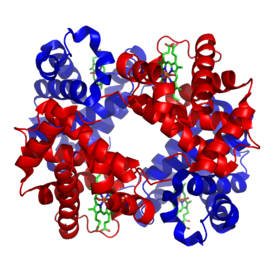

Oxygen diffuses into your red blood cells through the alveoli of the lungs, where each of those heme groups grabs an oxygen molecule. It's easy to do, since oxygen is fairly plentiful in the air we breathe. That may not seem like a whole lot, but it increases the amount of oxygen your blood can absorb by about seventy times, since otherwise oxygen could only dissolve into your plasma as a gas. Then, as your blood courses through your body, the lack of oxygen causes the iron atom in each heme group to lose its grip on the oxygen molecule it's holding, and the oxygen diffuses into nearby cells where it fuels the chemical reactions that drive you. That's... really all it is! Just pressure. Lots of chemical reactions, it turns out, are more like making soup than they are like building a machine, and the body's urgent need for oxygen in every cell means that a quick and dirty solution like this is all it takes (no fancy-pants calcium ion pumps or anything).
Of course, hemoglobin isn't the only solution to this problem. Molluscs and arthropods use cuprous hemocyanin, which does the same thing but has way cooler color-change action. See, deoxygenated blood is dark burgundy in color, whereas oxygenated blood is a more vibrant red. When hemocyanin is deoxygenated, it's colorless - but when oxygenated, it's blue. Look at this crab:


To be fair, hemocyanin bonds a little stronger to oxygen, which is what makes it so good for the invertebrates that use it, because they often inhabit oxygen-poor environments. On a related note, carbon monoxide bonds much stronger to the heme groups, rendering them useless because it never leaves, and this is why CO is such a deadly poison. Other solutions to the "Gee, I need oxygen in my blood" problem include hemerythrin, which is pink when oxygenated and colorless when deoxygenated, and the Christmas-themed chlorocruorin, which is red when oxygenated but green when deoxygenated.
OK, enough about other kinds of blood, back to your blood! After your erythrocytes have dumped their truckload of oxygen into your hungry hungry cells, they pick up the carbon dioxide to carry it to the lungs for exhalation. This is done in three ways: about 7% of your waste CO2 is dissolved directly into plasma, 23% combines with hemoglobin, and a whopping 70% is transformed by carbonic anhydrase (which is in your erythrocytes' cytoplasm) into carbonic acid. The Alert Reader who is passing familiar with chemistry will notice that carbonic acid dissolves in water by separating into a negatively charged bicarbonate ion and a positively charged hydrogen ion (or, as physicists are wont to call it, a proton). The Alert Reader who is passing familiar with chemistry will also notice that free-floating protons in water tend to result in hydronium ions, and the negative log of the hydronium ion content is what is measured when we refer to "pH". Here is a chart showing what happens when your blood pH gets outside the narrow range of 7.35-7.45 that I mentioned when we spoke last:


The Alert Reader who is passing familiar with Greek will notice that everything outside of Normal ends in "-osis", which means problem (loosely translated). So how does your body fastidiously avoid such problems? Well, in the first place, it's not like all your cells take in oxygen at once and then pass off carbon dioxide all at once. That would just be silly. But your body is always metabolizing, all the time always until you're dead, and so it needs to keep a tight rein on your blood pH as you go through your varying levels of activity.
Blood is slightly alkaline, and your bones are basically load-bearing mineral deposits, so that helps at least a little bit (Fun Fact: consuming too much animal protein in relation to vegetable protein has been implicated in bone mass loss in females!). Short term pH imbalance can be corrected by altering respiration: expelling more CO2 will increase the proportion of CO2 dissolved in blood (less carbonic acid means more alkaline blood), and holding on to more CO2 will increase the proportion held as carbonic acid (or H+ and HCO3-) and increase acidity. In the long term, your kidneys respond by excreting the leftover acid or base that builds up in your bloodstream, and also regulating the amount of buffering ammonia in your blood.
Your blood also helps regulate your body temperature through the clever application of plumbing. Heat is generated in various organs such as the liver and the brain (even thinking is exothermic!), and blood acts as a coolant to help you avoid overheating by absorbing some of the heat and bringing it to the heat sink that is your skin. In addition to sweating, your body sheds excess heat by expanding its arterial walls, increasing blood flow to the capillaries near the surface of the skin where the heat escapes into the atmosphere, or at least into your sweat (if the surrounding air temperature is higher than your body temperature). When you need to conserve heat, your arteries constrict, reducing blood flow to the skin and extremities to conserve heat and thus maintain core body temperature. This is why the cold will often make you numb and pale: your thoracic cavity needs all the heat it can hold on to, and the rest of you is somewhat more expendable. Note that this is distinct from frostbite, which results from ice crystals puncturing cellular membranes and causing cell death (this is why frostbitten tissues are kinda gelatinous when thawed, and one of the key hurdles for cryonics to overcome in the quest for legitimacy).
OK, oxygen transport, acid-base homeostasis, and thermoregulation - check! Tune in next Wednesday when I chatter on about the army of your immune system!
* - There just had to be an exception, didn't there?! The crocodile icefish does not use hemoglobin, and is the only vertebrate known not to do so. It lives in sub-zero seawater where it can absorb all the oxygen it needs right through it's goddamned skin. Fuckin' icefishes have it so stupid easy.
Sunday, July 25, 2010
101 Interesting Things, part forty-five (a): Blood - An Overview
Leviticus 17:11 says, in part, "the life of the flesh is in the blood". This is one of those things where the Bible actually gets it right, but they really had no idea how right they were. It doesn't take any great leap of creativity to notice that draining the blood from an organism is, by and large, fatal to said organism: massive blood loss is so consistently fatal because blood does so goddamned much for us in the first place.
Blood carries oxygen, food, and water to living tissues; it carries waste to the kidneys, liver, and lungs; it maintains the police presence of the immune system and carries vital hormonal signals all throughout the body; it even has pressurized hydraulics and helps regulate body temperature, all within a narrow range of pH values (a tenth of a point, between 7.35 & 7.45). Your body is basically a sac for your blood, the universal fluid that ties every part and function together. They Might Be Giants explain it in broad strokes and easy language in The Bloodmobile:
In many ways, your life revolves around your blood: your bones make erythrocytes in their marrow, and your tendons (which technically aren't vascularized) hold your bones together in ways that (usually) don't impinge upon the flow of your circulatory system; your circulatory system, in turn, carries blood to the various organs you use to maintain the fuel supply within your blood, including the brain and heart with their minute-to-minute demand for oxygen; your digestive tract is a tube within a tube, busting up what you eat at the molecular level to harvest the aforementioned fuel before dispensing with the unnecessary bits; and your skin holds it all in and keeps unwelcome elements out.
Blood carries oxygen, food, and water to living tissues; it carries waste to the kidneys, liver, and lungs; it maintains the police presence of the immune system and carries vital hormonal signals all throughout the body; it even has pressurized hydraulics and helps regulate body temperature, all within a narrow range of pH values (a tenth of a point, between 7.35 & 7.45). Your body is basically a sac for your blood, the universal fluid that ties every part and function together. They Might Be Giants explain it in broad strokes and easy language in The Bloodmobile:
In many ways, your life revolves around your blood: your bones make erythrocytes in their marrow, and your tendons (which technically aren't vascularized) hold your bones together in ways that (usually) don't impinge upon the flow of your circulatory system; your circulatory system, in turn, carries blood to the various organs you use to maintain the fuel supply within your blood, including the brain and heart with their minute-to-minute demand for oxygen; your digestive tract is a tube within a tube, busting up what you eat at the molecular level to harvest the aforementioned fuel before dispensing with the unnecessary bits; and your skin holds it all in and keeps unwelcome elements out.
Blood's very ubiquity made this an unusually research-intensive entry, and there's so much interesting stuff that I want to take it by parts. This weekend - and since I'm not spending all my time reading about blood, I'll actually have time to write about it, so it will actually be this weekend - I'll write about blood's role in respiration and homeostasis, ferrying oxygen and carbon dioxide hither & yon, and regulating pH levels & body temperature. Next Wednesday, I'll write about the immune system, which I would normally give its very own entry except for the fact that it all kind of takes place within the blood. And the following weekend, I'll talk about blood technologies and diseases, because they are also fascinating. Stay tuned!
Tuesday, July 20, 2010
101 Interesting Things, part forty-four: The Death Star Galaxy
The Death Star Galaxy is easy to remember in two different ways: first, it's called the Death Star Galaxy, and second, its designation is 3C 321. The mnemonics practically write themselves!
OK, so what's so crazy about formation 3C 321, and what makes it deserving of the title "Death Star Galaxy"? Well, for starters, the supermassive black hole at the center of this galaxy is blasting apart a nearby orbiting galaxy. Here's an artist's conception, so you can see the sort of thing we're talking about:

Just so we're clear, here's a breakdown of the situation. There's a supermassive black hole at the center of a galaxy, but no ordinary supermassive black hole: this one is emitting a jet of incredibly intense EM radiation. How intense? Intense enough to move stars. While jet emissions from black holes and other stellar formations are not rare, what is rare is to see one firing point-blank into a nearby celestial formation. Like, these galaxies are only about as far from each other as we are from the center of the Milky Way.
Heroes in lab coats are still trying to figure out what exactly causes these kinds of jets - I suspect the right hand rule, but the Devil's in the details. One strong possibility, though, is that the very process of blasting apart the neighboring galaxy will cause it to be re-formed around the area where the jet peters out. That is, assuming that the galaxies don't collide first. Dammit, why can't I live for billions of years so I can watch this sort of scene play out?
Here's a really cool animation showing how this plays out and giving a sense of scale to the operation: it starts by the event horizon of the supermassive black hole, then zooms out until you can see the whole scene. Check it out!
Sunday, July 11, 2010
Cosmetic Brain Surgery
Some time ago, I wrote about a church sign with an offer for a free trip. Well, the same church had come up with another offer, though it has since been taken down and I could not get a picture. I need to give myself more time to travel between jobs, so I can stop to take pictures of these obnoxious godvertisements. Anyway, this time their sign read, "Need a new look? Come in for a faith-lift!" As with last time, I came up with a few questions and concerns while mulling over their offer.
Unlike the trip to Heaven, this offer didn't have "free" anywhere in it. Is this faith-lift included in the "10% of your income for life" price of membership in their organization, or does it incur an additional charge? I just moved and had to pay double rent for July, so money's tight and I can't afford to be spending on unnecessary procedures. Do they offer installment plans? Or is it maybe like the Templeton Prize, where they pay you for your trouble in order to get free advertising?
As for the procedure itself, how exactly is it performed? Do they just permanently affix a god-walloping grin to your face? What if I want to express emotions besides generic oblivious felicity? I've heard that they can go in through the ear, with boring music and uninspiring sermons which are very slightly less anesthetizing and invasive than putting you under and cutting on your face. But if everyone's getting this routine procedure every Sunday, I don't know if it's really worth it. I mean, cosmetic surgery is all about looking better than your peers because you can afford to spend loads of money on superficial beauty. I'm not sure that the procedure to which they allude is really in keeping with their overall mission as a spiritual institution. Or maybe I'm coming at this wrong and it's spot-the-Hell-on.
Finally, I'm at least a little worried about complications. I've heard that these sorts of operations can leave one with eyes glazed over, taking the sharp edges off the world and making it look less dangerous than it really is. Also, making room for all that religion in one's head can require that chunks of the frontal lobe be completely removed, impairing one's decision making and critical thinking skills. What's more, I've heard that some people can come out so hopped up on God-smack that they've been left permanently desensitized to the plights of others, and thinking that this one procedure is a panacaea - like it doesn't matter who you are or where you live, all you need is more Jesus and your problems will go away. I've looked into the research, and some of the signs of a botched faith-lift include: thinking of one's demographic as a persecuted minority perpetually on the verge of acquiring the influence it already in fact enjoys, anticipating the end of the world with apocalyptic glee, advocating against real-world solutions to real-world problems because one is no longer capable of grasping coherent arguments or basic implications of evidence gathered through research, and experiencing diminished outrage against pedophiles when said vile monsters happen to also be priests.
You know what? I don't think I'm going to risk it. The offer seems sketchy, the procedure is of dubious value, and the risk that something will go horribly wrong and leave me with a lifelong cognitive impairment is just too high to ignore. I mean, I guess if you want to be able to feel more self-righteous than other people, and you don't mind abdicating reality to do so, maybe a faith-lift is right for you. Count me out, though.
Unlike the trip to Heaven, this offer didn't have "free" anywhere in it. Is this faith-lift included in the "10% of your income for life" price of membership in their organization, or does it incur an additional charge? I just moved and had to pay double rent for July, so money's tight and I can't afford to be spending on unnecessary procedures. Do they offer installment plans? Or is it maybe like the Templeton Prize, where they pay you for your trouble in order to get free advertising?
As for the procedure itself, how exactly is it performed? Do they just permanently affix a god-walloping grin to your face? What if I want to express emotions besides generic oblivious felicity? I've heard that they can go in through the ear, with boring music and uninspiring sermons which are very slightly less anesthetizing and invasive than putting you under and cutting on your face. But if everyone's getting this routine procedure every Sunday, I don't know if it's really worth it. I mean, cosmetic surgery is all about looking better than your peers because you can afford to spend loads of money on superficial beauty. I'm not sure that the procedure to which they allude is really in keeping with their overall mission as a spiritual institution. Or maybe I'm coming at this wrong and it's spot-the-Hell-on.
Finally, I'm at least a little worried about complications. I've heard that these sorts of operations can leave one with eyes glazed over, taking the sharp edges off the world and making it look less dangerous than it really is. Also, making room for all that religion in one's head can require that chunks of the frontal lobe be completely removed, impairing one's decision making and critical thinking skills. What's more, I've heard that some people can come out so hopped up on God-smack that they've been left permanently desensitized to the plights of others, and thinking that this one procedure is a panacaea - like it doesn't matter who you are or where you live, all you need is more Jesus and your problems will go away. I've looked into the research, and some of the signs of a botched faith-lift include: thinking of one's demographic as a persecuted minority perpetually on the verge of acquiring the influence it already in fact enjoys, anticipating the end of the world with apocalyptic glee, advocating against real-world solutions to real-world problems because one is no longer capable of grasping coherent arguments or basic implications of evidence gathered through research, and experiencing diminished outrage against pedophiles when said vile monsters happen to also be priests.
You know what? I don't think I'm going to risk it. The offer seems sketchy, the procedure is of dubious value, and the risk that something will go horribly wrong and leave me with a lifelong cognitive impairment is just too high to ignore. I mean, I guess if you want to be able to feel more self-righteous than other people, and you don't mind abdicating reality to do so, maybe a faith-lift is right for you. Count me out, though.
Sunday, July 4, 2010
Thoughts on "Food, Inc."
I recently watched Food, Inc. (yes, it's two years old; no, I don't care), and I have to say, I agree with the advertising. This is an important movie, and everybody should watch it, for one simple reason. There are others, of course, and I agree or disagree with them to various degrees, but one reason I think any decent person could agree to is: it is important to know where your food comes from.
I also ought to say that I am a quality consultant in my office life, and so I am marginally sympathetic to the corporate perspective in this situation. I mean, I spend my downtime at the office reading up on things like process compliance an' shit. Just two days ago, I read about How To Think Like a Factory, and my mind is abuzz with ways to apply this to the call center floor which will be good for both the corporation's bottom line and the mental stability of us drones.
With those caveats out of the way, you should still watch Food, Inc. It's really well made, and it highlights some core parts of the industry that a great many people would probably prefer to ignore. Blissful ignorance is precisely why the food industry has been able to get away with this sort of thing, and if it makes people uncomfortable, then they need to be made aware so that they can vote with their dollars and pay the extra buck-two-ninety-eight to get a product that is brought to them in a way they can stomach.
I also ought to say that I am a quality consultant in my office life, and so I am marginally sympathetic to the corporate perspective in this situation. I mean, I spend my downtime at the office reading up on things like process compliance an' shit. Just two days ago, I read about How To Think Like a Factory, and my mind is abuzz with ways to apply this to the call center floor which will be good for both the corporation's bottom line and the mental stability of us drones.
With those caveats out of the way, you should still watch Food, Inc. It's really well made, and it highlights some core parts of the industry that a great many people would probably prefer to ignore. Blissful ignorance is precisely why the food industry has been able to get away with this sort of thing, and if it makes people uncomfortable, then they need to be made aware so that they can vote with their dollars and pay the extra buck-two-ninety-eight to get a product that is brought to them in a way they can stomach.
OK, so I want to talk about how things got here, and not in terms of blame and disgust and harsh invective, but in terms of impersonal and perfectly logical (if unfortunate) progression. It's very simple. So simple, in fact, it's stupid. Try walking out into the street and asking people about "factory farming", and I can almost guarantee that a sizable fraction will think it's a metaphor, most will have vaguely unpleasant thoughts, a few will regurgitate very similar talking points (and probably smell of patchouli), and a tiny minority will have something well-informed and thoughtful to say. This is just the industrial revolution, applied to what you put in your belly every single day: a similar thing is happening in consumer electronics, Wired put out an article on it and called it "The Good Enough Revolution". In most of our day-to-day lives, quick & dirty is just fine, and top-of-the-line gizmos can be left for professionals and cutting-edge aficionados. Ah, but when you're struggling to feed your family, what approach is going to garner the most of your votes dollars? The costlier but more wholesome product, or the cheaper bulk product? Imagine this decision being made in dozens of millions of homes across the nation, and at the other end are chief executive officers who want to make as much money as they can and control as much of the market as they can. How should they do this? By trying to put out a costlier but more wholesome product, or by putting out cheaper bulk products? It all comes down to selection pressures.
What do you think a successful climber of the corporate ladder would do? I'm not asking what you would do, since you haven't climbed to the top of your corporate ladder - these decisions are in the hands of the ruthless opportunists who have climbed on the backs of their competitors to be where they are today, not the people who have made the decision to be satisfied with a modest existence.
So of course we're in the situation we're in today. It couldn't have happened any other way. No single person is to blame for this: we're all to blame. The producers are to blame for their production, and the consumers are to blame for their consumption, and no single person "decided" that this is the way it would go. This is the way it had to go. At least, so far. I dunno, maybe I'm just saying that because I'm a determinist, but the point remains that there's no great and powerful wizard behind the curtain. There's nobody behind the curtain at all.
I want to take some time to talk about some of the "gross" aspects of industrial food production, like chlorine baths. Actually, that's a great example in itself. See, if you've got a huge food operation, this is going to be a literal wellspring of opportunity for disease. Any disease that could infiltrate such an enormous and far-reaching niche would be hugely successful. But of course we don't want diseases to be able to carve out a niche in our food supply - we want our food supply to be a safe, standardized, idiot-proof sort of thing that we can set up anywhere and have a dependable outcome. We don't want to have to think about every single fucking food purchase, we want to be able to just pick something we want that's in our price range and take the rest for granted. We want factory farming, and so as a corollary we want to set up an over-the-top obstacle to give pathogenic would-be infiltrators as little opportunity as possible to survive and adapt. Corporations have an honest interest in making their operations disease-proof, because their customers can sue if something goes wrong. Food, Inc. has a segment where a mother relates the story of how her son fucking died from a food-borne pathogen. It's a goddamned tragedy, and I'm being perfectly serious about this: losing a child is one of the worst experiences a person can have, and for a whole lot of reasons, and if that death was caused by the food you put in that child's mouth, but you didn't make that food, then whoever did is going to fucking pay.
But now stop and consider the numbers. We're not talking about whether this particular child would have died or not, but the raw, impersonal statistics. This is reality, where things go wrong, and sometimes they go wrong in very bad ways, and there's nothing anyone can do to stop it for good. Mistakes shall always be made, and someone will always need to pay for them, because we are a litigious people and that's how things go. As it stands, this is one child out of millions, and it's terrible and awful and a genuine tragedy, and the corporation paid something for their mistake - but what's the alternative? Let's say that we go all organic and local, and all our producers feed grass to their cows and butcher their free-range chickens under open sky and they all have twenty times fewer pathogens. This is great! Ninety-five percent less children will die of food-borne pathogens!
But what about the other five percent? For every twenty food-related lawsuits we have now, we'll only have one, and this is truly great news. But in order to save nineteen families from a personal tragedy, we'll have to upset the lives of an entire farm's worth of folks because I can guarantee that those honest, hard-working, wholesome farmers who fucked up once won't have the money to pay hot-shot lawyers to stop litigious citizens from breaking their banks. When something bad happens with less frequency, those few times it does happen become all the more significant, and someone will still have to pay. Now, personally, I think it's better that a few dozen families have their incomes destabilized in order to save nineteen out of twenty lives. This is a genuinely smaller cost. But it's still a cost, it's just diffused and lessened, and it bothers me when people think that going all-organic (or whatever the fuckin' buzzword is gonna be) will make everything turn to sunshine and rainbows. I dunno, maybe I'm just upset that not everybody is as cynical as I am.
Anyway.
Enough defending dehumanizing corporate practices as logical outgrowths of consumer disinterest. We should follow the film's advice and vote for the bucolic, sustainable approach to our food - y'know, the kind that costs more money because you'll have to train folks to do more steps in a process, which requires a larger up-front investment and blah blah blah - because if we don't, I can see where things are going. The corporations will continue to control the means of production, and pretty soon, complete nutrition will come in the form of convenient pills so that people can keep their bodies running smoothly without all those pesky calories that make you fat. I mean, who wouldn't want to be able to ensure that they stay slim and get all the nutrients they need without drinking Liquid Sanctimony? Sure, the act of actually eating will become a luxury, but that's OK because more folks will be able to eke out a decent living on less money. The cost of feeding oneself will become an increasingly known quantity, and when you combine that with the cost of housing and clothing oneself, suddenly we have a precise calculation of what the minimum wage needs to be to let people just barely keep their heads above water. And honestly, that's all you need: to tread water your whole life, with tax breaks for deciding to permanently shack up with someone and raise some offspring, and the requirements for this will also be a known quantity. Pretty soon, the middle class will be entirely eliminated, and the corporate overlords will manage the lives of their drones with vaguely humane efficiency, since they know exactly what they need to pay their workers to keep them alive without giving them the opportunity for their offspring to break into the upper class.
You might have doubts that things could go that far, for the simple reason that pills alone won't fill you up - but have you heard of the Full Bar?
Subscribe to:
Posts (Atom)