Update Schedule

This blog updates irregularly.

Friday, October 23, 2009

Arguing on the Internet: Machina Ex Deus, part two (cl)

I left off yesterday vaguely gesturing at my transition from fundagelical Christianity to non-denominational Christianity. I didn't know whether I could trust the Bible or not, and the Bible itself is no help here (if I doubt a book, then I clearly can't take the book's word that I shouldn't doubt it!). I want to clarify right up front that my problem with God thus far isn't that I don't want to believe in him - after all, if there is in fact a Heaven which is the Best Thing Ever, then I certainly want to go there! - it's that I want to believe sensible things and I can't make God make sense to my mind. God could make it make sense to me, though, if he wanted (because he knows what I mean by "sense," and he knows that I want to believe in what makes sense).

But wait... even if I get to Heaven, is there still a Hell? If so, then if I'm in Heaven and know about Hell, it's gonna make me fuckin' miserable! I barely manage to get by as is, knowing that people starve to death every fucking day; how much worse would this be if I knew that people were being tortured forever?! I came to the conclusion that this could go three ways: either there is no Hell, or God needs to give me an empathy-ectomy at the Pearly Gates, or I need to forget about Hell. If there is no Hell, then... no problem! I don't even need to worry about it myself! But if there is, and God gives me an empathy-ectomy or makes me forget a rather key fact of reality, I don't really see what makes such a being worthy of worship. Not being dismissive, I just don't see anything good in a being that says with its actions, "Forget about those losers, they don't count; come hang out with us cool kids."

I don't know what it is, but all my role models, all my favorite superheroes, everyone I admire and even myself, we all have one thing in common: we are unable to stand idly by and watch others suffer. How is it that God is able to do such a thing, but still call himself good? I looked into the literature and found a whole lot of stupid bullshit.

Theodicies, in my experience, are categorically failures, more or less because I buy into Epicurus' dilemma: "Is God willing to prevent evil, but not able? Then he is impotent. Is he able, but not willing? Then he is malevolent. Is he both willing and able? Then whence cometh evil? Is he neither able nor willing? Then why call him God?" Who gives a flying fuck about our precious free will? Not God - he hardened Pharaoh's heart several times, he chose Moses and Saul of Tarsus despite their wills, and when Jonah flew the coop, God wouldn't take "no" for an answer. No, abiding evil when you don't have to, compromising with it when you have the advantage, allowing it when you could do otherwise, this strikes me as "knowing better but doing worse." This is a long-respected definition of "evil."

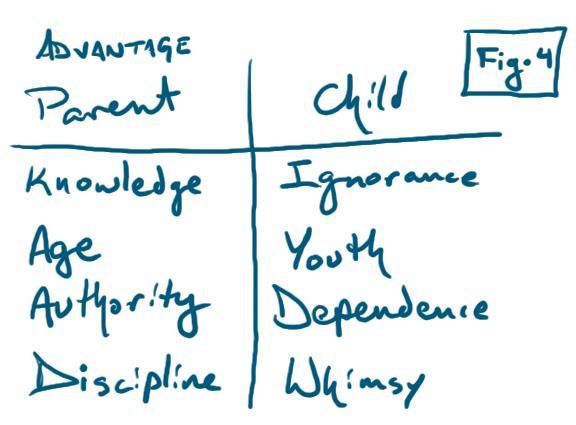
Let's briefly switch gears and talk about relationships, starting with figure 4:
In a parent/child relationship (and I mean a minor child, not a grown one), the parent has the child at a disadvantage. The parent is older, wiser, and possessing of more self-control than the child is (usually). This makes the relationship asymmetrical, and it places responsibility for the child directly on the parent because the child can't take care of itself. Ideally, the parent raises the child to be a peer, another adult among many, capable of making intelligent and mature decisions autonomously. This is done with one-on-one interaction, an adult teaching a child step-by-step to become an adult itself. And this is done, at least in part, because the parent loves the child and cares for its well-being. Now consider the relationship between God and humanity:
It's a similar relationship - again, God has the advantage, and again, he damn well ought to be older, wiser, etc. than we are. How has God contributed to raising me as his child? Am I to reason from his lack of in-my-face involvement that he cares less about me than my own parents do? As far as I can tell, he wrote a letter and walked out before I was born - the letter is the Bible, walking out is Jesus' ascension into Heaven. To the best of my ability to tell, any moral shortcomings on humanity's part are the direct result of God's total failure to either make us right or raise us right, both as individuals and as a species.

Once I saw that, I couldn't un-see it. Good parents don't let their children do whatever the Hell they please; good parents make themselves a known presence in their childrens' lives, they raise their children by hand and guide them into becoming better people. Good parents do whatever the Hell it takes to protect their children and raise them to be the best people they can be. Any parent who allows her child to upset her has failed to control her temper; any parent who strikes a child in anger is at fault for not remaining in control of the situation. Why? Because children don't know what the fuck they're doing. I would know: I was a child once and I did some really embarrassing shit!

The parallels don't stop there. Households have rules, and parents are their authors; similarly, reality has rules (yay physics!), and God is their author. Why didn't God include any of these rules in his instruction manual? People understood math long before the Hebrews put quill to scroll, so why does the Bible have precisely zero interesting math in it (with the exception of a botched calculation of pi)? Moreover, why a holy book, instead of something more impressive? Every religion has holy books, but no religion has a holy organism that sings the holy text aloud and has no natural predators. Or how about a holy computer, a machine from God that can answer all our questions and also preserve God's language? The machine could also self-replicate and self-assemble, like a glorified RepRap machine. And a million other things, too - in short, why is God so boring?! Why did God do nothing to distinguish the one true religion from every other religion? Why is Yahwism, to all appearances, the same stuff in a similar package? I just don't get it.

But most importantly, if God exists, then why is he hiding from me? Silver Garou came up with what I think is an excellent argument on exactly this point, and it proceeds as follows:
1. God is omnipotent and omniscient, and therefore cannot be stymied in his efforts (or at least not by humans).
2. Since I myself know what would convince me of God's existence, God too must also know that thing.
3. Thus, God knows what would convince me of his existence. (from 2)
4. God has not convinced me of his existence (my mother did, once, but that wore off).
5. "Being hidden" does not necessarily imply the intention of "is hiding," since ruins can "be hidden" in the forest but obviously have no intentions of hiding. Yet until they are actually found, they do in fact remain hidden.
6. An entity that chooses whether to remain hidden or not, and has this as its option, does so with intent insofar as it is intelligent.
7. God is intelligent.
8. Thus God cannot remain hidden unless he also intends to be hidden and therefore "is hiding." (from 1, 6, 7)
C: Since God has not yet convinced me of his existence, then he is either hiding while waiting, or hiding forever, or does not actually exist as such (as omnipotent and omniscient, or at least enough of those things to actually convince me). Or he just doesn't want me to believe in him, which I guess is cool, too, except that it tells me he wants me to go to Hell (if there is one). (from 1, 4, 8)
God knows where I'm at, and God knows what it would take to make another Saul, Thomas, Jonah, or Pharaoh out of me. I can think of many reasons for him to do so, but none at all for him to wait or not do so at all.

OK, whew! That's it from me on why I don't believe... in this discussion... so far... today. It's been a little rough, but that is the gist of why theism makes no sense to me. So that's enough out of me: what do you think, cl? Where do you disagree with me, or at least diverge, and why? I'll make the assumption that you've still got what you think is a better way, and I'm curious to know what it is that you think is a good justification for theism, and why I should endorse it. Or, if it's a matter of personal revelation, then I'm curious as to how you can comfortably and honestly distinguish that revelation from insanity - no joke, this is an honest question on my part here.

I've pretty much said my piece and will wait to write anything as substantial as this until either I'm asked a direct question, or something else piques me. Ball's in your court!

Thursday, October 22, 2009

101 Interesting Things, part twenty-nine: RepRap

Rhodopsin told me about RepRap the other day, and now it's hard to think about anything else. RepRap is a contraction of Replicating Rapid-prototyper. Modern CAD machines can already translate 3D cyberspace designs into 3D meatspace objects, and a RepRap is basically a 3D printer that can make its own parts.

Oh, shit yeah.

Check out what it can make! (All images taken from that link.) For starters, RepRap parts, themselves made by a RepRap:
Who needs a new pair of shoes? Not Daddy, he's got a RepRap!
Oh no, my door handle busted! Why go to the store when I can make one in my home:
Dammit, I need an adapter to fit tab A into slot B - but nobody makes one! Except RepRap:
Man, all this sitting around making things from nothing like a god has made me thirsty! Time to get my drink on:
OK, yeah, enough. Look, this is pure awesome. I need one. Who's got half a grand sitting around for me to buy one? I'll mail you the first copy, double-promise! Or, even better, send me your parts!

Wednesday, October 21, 2009

Arguing on the Internet: Machina Ex Deus, part one (cl)

The Story So Far: cl and I are arguing on the internet! I outlined some metaphysics and epistemology in my last installment, and cl commented.

I used to be a theist; specifically, I was a fundagelical Christian. I saw God's hand in all things, I saw the Goddamned Devil at work in the world, I had promised my soul to Jesus several times and in several ways (I needed frequent fixes of God-smack), and I lamented that there should ever be anyone to not hear the glorious Word of God. I tried to be hopped up on God-smack as often as I could, and I'm not saying that to be pejorative: I thought the God-smack was good stuff at the time, and I thought that I was at my moral best when I was on it (full of Christ's love, in awe of the Maker's creation, etc.). Today I'm going to outline what changed - this is something of an autobiographical parable, inasmuch as I intend to gesture at my philosophical development while more or less ignoring everything else that was going on in my life and the world at large at the time.

Like all good parables, this one sets its tone with a metaphor. As I pointed out before, reality is ambiguous - or, rather, the relationship between reality and our perceptions is fundamentally unknowable because we are not omniscient, and therefore any perception of reality we might have is intrinsically ambiguous. So if I wake up with a headache and want to know what caused it and how to get rid of it, I have to do some brief testing: did I drink last night? I might have a hangover. Did I fight last night? I might have a bump on my head. And a million other things, too. Let's suppose for the moment that I don't remember what I did last night, but the two best competing explanations are that I either have a bump on my head, or I am hung over, or both (hooray for the inclusive "or").

A fairly direct method of testing whether I have a bump on my head is to feel around for one. But it might be the normal shape on my head, so it probably ought to be painful; that pain, in turn, could also be explained by a special sensitivity in that area for entirely bumpless reasons (for example, all people might have sensitive bumps in that spot on their heads - I don't know yet). To directly test whether I have a hangover, I could in principle do some bloodwork to check my BAC or look for metabolites or something, but that would be a pain, so I may just drink lots of water and see if the headache goes away. I could also take hangover medicine and see if it goes away. But in any event, if I take some action and then my headache clears up, I cannot tell for sure whether those two things are related at all; I can only make an "inference to the best explanation," or IBE.

Metaphor over, parable is go! Some years ago, I had an existential headache, and the two best explanations I could come up with were that I either had a sinful hangover, or a theistic bump on my head. I'm not sure quite what I did, but the headache went away. I realize that I may have merely taken a metaphysically naturalistic pill to mask the symptoms of my sinful hangover, which by rights I damn well ought to be feeling right now. That's a possibility. But the IBE I'm going with for now is that I had a theistic bump on my head from repeated doses of the fundagelical medicine stick. I stopped dosing, the bump went away, and my existential headache disappeared with it. So... what is my existential headache a metaphor for?

My existential headache consisted of an inability to reconcile any coherent idea of God with the observable facts of reality, to the best of my ability to interpret them.

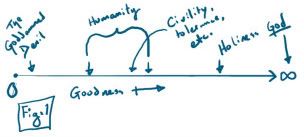
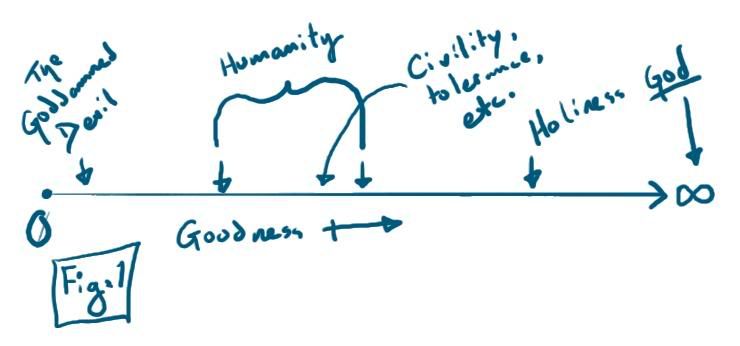
One of my first understandings of morality was that "good" is a continuum, where a "lack of good" constitutes "evil," and a maximum of good would be perfection. Something like figure 1 here:
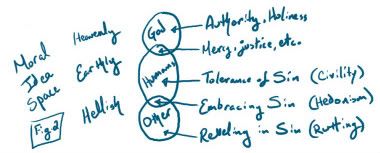
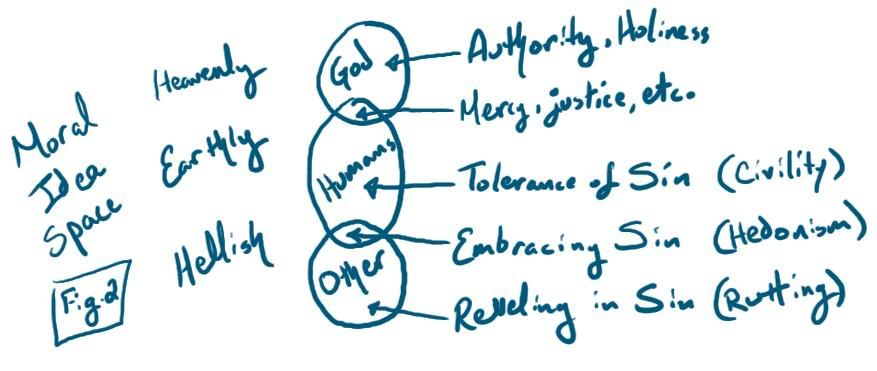
I now consider this a rather naive understanding of morality, mainly because it's grossly oversimplified, but it's not entirely without its merits. However, what I noticed is that if tolerance is within the "goodness range" of which humans are capable, then why can God not tolerate sin? Humans are able to live with each other's iniquities, to forgive those who trespass against us even if they keep doing it. I mean, hurting each other without meaning to do so is part of being human, and we can get over that, so why can't God tolerate sin in Heaven as he does on Earth? Well, I was told that it doesn't work like that, and rather something more like figure 2:
Here we see that there is God, who is Heavenly, and "other," which is Hellish. In between, overlapping with each but also having things all their own, is humanity. God is holy, and for that reason cannot abide sin in his presence, and so has withdrawn from the world until his final return. Humanity, being made in God's image, is able to understand some holy goods, such as mercy, justice, and compassion; but we are also capable of tolerating sin only because we ourselves are sinful. After all, if we dealt with each transgression as God says we should in the Bible, civilization would rather quickly collapse as we put to death everyone who violated pretty much any rule at all.

This explains why God tolerates sin on Earth, but not in Heaven, and by extension why we are on Earth and not in Heaven yet (because we still sin). But... wait... what exactly do we mean by sin? Definitionally, sin is that which God abhors, but why does God abhor it? Because he is holy? Then what is holiness? If it is mere godliness, then we have defined ourselves into a circle: whatever God does is holy because God's doing it, and whatever God abhors is sinful because God's abhorring it, and so to say that God is good is merely to say that God does as he pleases. I had not yet learned of the Euthyphro dilemma, but this is more or less how I arrived at it.

I realized at this point that there must be something about a particular thing which is sinful or holy, regardless of what God thinks of it; God's opinions, then, are the result of an interaction between his perfect perceptions of reality and its nature as sinful or holy, as the sinful or holy nature of the thing itself causes God to experience pleasure or disgust because of facts about God's personality. After drawing up tables and tables of sinful and holy things, however, I was unable to find any rhyme or reason behind the particular things that God told us were holy and sinful. It honestly looked to me like the Biblical deity was like a child with a sandbox, laying down arbitrary rules because he made everything, and wrecking our shit when he got upset with what we did just because he could. I see such a being as unworthy of worship, and if this is what God's like - an authoritarian dick-waver who thinks that merely being causally responsible for us (all by itself) gives him the right to tell us how to live - then I think we should all try to gang up on him Tower of Babel style. This is the behavior of a tyrant child, not of the rightful king of all existence.

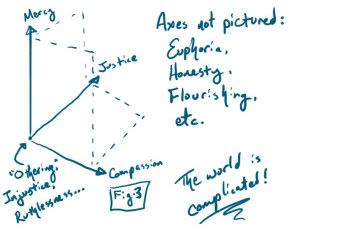
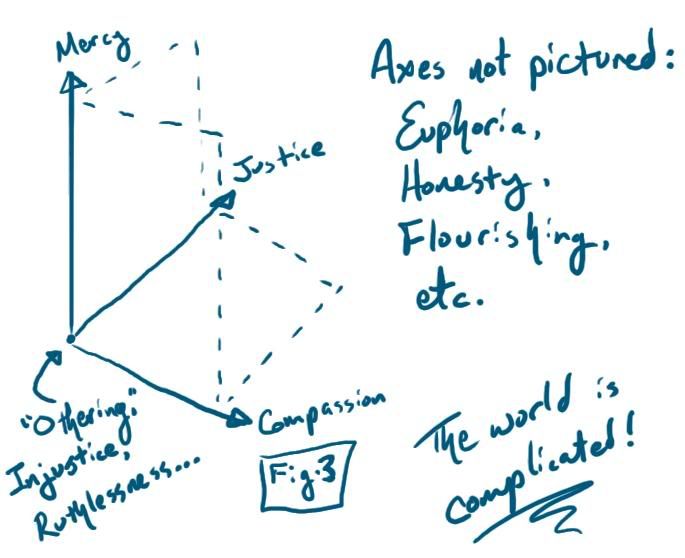
How do I know this? Because if morality is fundamentally arbitrary and God's at the helm, then all he has to do to eliminate evil and suffering is get over his bad self and change his own mind. Moses did it (Exodus 32:9-14). Anyway, my own personal ethics has evolved somewhat, moving from a moral idea space to a "morally-charged" multidimensional idea space, as seen in figure 3:
Between then and now, my understanding for the best of all possible Gods morphed from any religious type of deity to something like Nick Ifkovits' idea as laid out in his novel, Cloud Drops (he's a friend of my mom's): in this story, God is more or less a laid-back hippie who really only cares about people being good to each other. You do that, you get to go to Heaven and have crazy orgies all day long; don't, and you are a lost spirit, destined to stick around on Earth stewing in your own existential angst. I believe that in the story, those who die without becoming either good or evil are "recycled" after a fashion, but don't quote me on that (I haven't read it in a while). But religious faith is absolutely meaningless to this deity, it truly is works alone that get one into Heaven on this view; you don't even need to be a theist! So if this is the real deal, then I've already got it made and thus have nothing to be saved from. Even if I didn't get to Heaven, I've striven to eliminate angst from my life, so I think that hanging around on Earth as a specter wouldn't really be all that bad.

Yet it seems almost too obvious that I might be wrong on this one, and I might need to believe this or that particular thing, even if I don't buy the whole kit & caboodle. For instance, it might be the case that I really do need to accept Jesus into my heart to get into Heaven; but the rest of the Bible might be pure hogwash!

This is where things get really complicated; part two on Friday.

Tuesday, October 20, 2009

NaNoWriMo Looms Nigh!

For any who might not know yet, November is National Novel Writing Month. This year, I am at a cross-purposes, because I have no less than three ideas for what I want my book to be about. But I sure as Hell won't be writing 150,000 words next month, so I can't win at all three. Bearing that in mind, I wanted to see what you, the General Reader, thinks of the following three ideas.

1. The Quantum Mechanic: A superhero story of ethic contortions. The first person to truly understand quantum mechanics finds himself at the command of an incredible new power: the ability to manipulate reality at the quantum level on a whim. Able to go anywhere, be everywhere, and do anything, Frank Calhoun quickly finds himself shoved to the front of the world stage and faced with a truly unique ultimatum: take on the role of a god he has never believed in, or watch the world fall apart due to his refusal to accept such responsibility. Philosophers, pundits, tyrants and citizens alike compete for the attention of the Quantum Mechanic as he tries to balance the world upon his finger.

2. Thirty Seconds: Intelligent design in an unintelligent Universe. I was inspired by someone on the History Channel's The Universe, who said in one episode that by observing the entire Earth for only thirty seconds, an observer from another planet could probably piece together the human life cycle and a good deal about our technology and culture. I had originally conceived this as short fiction with no dialogue (only narration), but that gets dry after a while, so I was thinking of injecting some characters and explaining the scientific method through their analysis of the thirty seconds of observation, as more and more tidbits are discovered from thirty seconds of planetary observation. Oh, and the observation is of another planet where life actually is intelligently designed.
EDIT: I've changed my mind about this. I'm doing it as short fiction, no matter what. I'm too passionate about my other two ideas to let them take a back-seat to this.

3. Breath to Breath: The philosopher's zombie apocalypse novel. I finally got around to retroactively posting the last of Rendezvous today. I don't really like where it ended, mainly because I increasingly felt shoe-horned into it by the whole inexorability of it all (I planned the book around the ending, and now I don't think that it fits very well with the rest of the story), plus I learned quite a bit about writing and did some pretty egregious author insertion (because it's "me and my friends survive a zombie attack, the book" - duh!). Well, I have a way better idea for a zombie story now, which is pretty much going to require redoing everything, which I'm OK with. I mean, it's practically a new book, so I intend to treat it as such.

So yeah, what do y'all think? This is probably most of what I'm going to do for November, so voice your choice!

Bullshit Pulpit: Prehistoric Crocoduck [Analogue]!

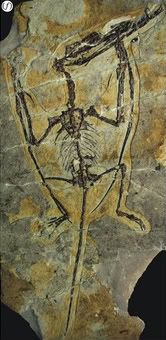
I just caught up on Pharyngula today, and I saw a neat little bit on the discovery of an offshoot along the transition from pterosaurs to pterodactyls. First, I should probably say that before today, I didn't even know that there was a difference between pterosaurs and pterodactyls! But you learn something new every day, and as Garou's grandfather says, if you didn't then you weren't paying attention.

Anyway, the main differences between pterosaurs and pterodactyls, as PZ points out, are that the earlier-living pterosaurs have shorter snouts, more skull holes, some neck ribs, rather long tails, and a membrane between the hind legs called a "cruropatagium;" whereas latecomer pterodactyls have a much longer schnoz with fewer skull holes, no neck ribs (or fewer/smaller ones), much shorter tails, and a significantly reduced cruropatagium. Behold darwinopterus modularis, the psaurodactyl:
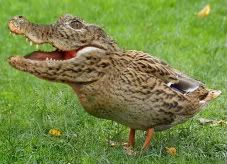
What makes it a psaurodactyl? Well, morphologically, it looks like someone glued the head of a pterodactyl onto the body of a pterosaur! Kind of like that 'shop of a crocodile's head on the body of a duck:
So there it is, the mighty psaurotactyl, prehistoric crocoduck par excellence! It's about literally half of one thing, and half the other thing, so this should be a valid transitional form to Creationists, right? Right, guys? Ray Comfort, I'm looking at you! You and that airhead Kirk better send in your applications to become card-carrying evolutionists soon!
EDIT: I realized today (10/21) that this is more in keeping with Bullshit Pulpit. Fixed.

Look Out, Nonsense: Here Comes Science!

They Might Be Giants really took a page from the theists' playbook with their latest album, Here Comes Science: hook 'em while they're young (the Jesuits were famous for saying, "Give us the child for his first seven years, and we will show you the man"). I've been listening to Here Comes Science more or less every day since I got it. I know, I know, it's supposed to be children's educational music. But I like it! And it's a breath of fresh air! And it's a big "fuck you" to a whole bunch of superstitious nonsense without even making a big deal out of it! OK, it probably wasn't meant as a "fuck you," but still, that interpretation is available for almost every song (well, sixteen of the seventeen "real" songs, anyway). Here, watch:

1. Science Is Real: The message is clear in this song: "Science is real, your superstitious crap is imaginary." And people complain about this, which is awesome.
2. Meet the Elements: This one's kind of a stretch, but a belligerent interpretation is available. I imagine this song undermining homeopaths and other such hokum. Everything we think of as an "object" is made out of elements: nutrients are elements, medicines are elements, poisons are made out of elements, pizza places are made out of elements. It's all chemicals, and "chemicals is just chemicals." Keep in mind here that there are people who seriously believe that there is a difference between the ascorbic acid you find in an orange and the ascorbic acid you find in a vitamin C tablet (pro tip: there is no such difference, because ascorbic acid is ascorbic acid no matter where you get it from).
3. I Am a Paleontologist: One line: "It's so fun to think about how a species has evolved." Field scientists are the rock stars of their respective fields of inquiry, because they're out in the (sometimes literal) trenches looking at the world, and showing that to kids will help prepare them to laugh off Creatards & IDiots who don't know just how awesome a dig really is. Or all the science behind it, and all the science that goes into analyzing and interpreting whatever is found. For further reading, see Ardi's recent news spotlight on Easy Mode or Hard Mode, as well as PZ's coverage of the media circus to see the landmark discovery ignorantly dismissed as trivial, and abused to support homophobia.
4. The Bloodmobile: (Right song, but couldn't find the actual video.) Blood is life, which at least one holy book can tell you, but no holy book can tell you why. This song explains why. Oh, and all that crap you hear about "toxins" and whatever? Yep, that's what your blood is for. No pseudoscientific woo required, your body already takes care of it!
5. Electric Car: I love this song because it's unapologetic propaganda for electric cars. Y'know, to counterbalance all the anti-electric-car propaganda... right, guys? But you see, the USA makes guns which it sells to certain oil-rich nations (as Pat Condell put it, "It would be hard to think of a more oily place than Saudi Arabia"), and things like electric cars are inimical to such profitable business relationships. Y'know, now that I'm actually writing this, I can't say that this one is anti-superstition, but it is counter-anti-scientific progress, so I don't care.
6. My Brother the Ape: (Live performance.) All the world is kin, the end. We are not only related to apes, we are apes. Naked, brainy, hifalutin apes; but apes nonetheless. The best part: "They all kept saying how much we look alike. I don't think that we look alike at all, but I'll admit that I look more like a chimp than I look like my cousin the shrimp, or my distant kin the lichen, or the snowy egret, or the moss." Tru fax - the very truest.
7. What Is a Shooting Star?: (Live performance.) Oh, man! I'm excited about this one! See, there's this building called the Kaaba, the most sacred site in Islam. It's so fucking holy, it's why Muslims face Mecca to pray, no matter where in the world they are. So what's so goddamned special about it? Its eastern cornerstone is a black stone, which according to legend is a "piece of Heaven" that fell to Earth, showing Adam and Eve where to build the first shrine. Piece of Heaven? Fell to Earth? Sounds like a meteorite to me, or the firmament is falling! But Hell, it might just be obsidian or pumice instead - we haven't exactly been able to do any proper science to it, for stupid, stupid reasons.
8. How Many Planets?: One of the great things about science is that it is self-correcting (ideally). Rather than claiming absolute authority forever, scientists instead make provisional claims about what they can test and show. So when the IAU revised just what it means by the word "planet" back in 2006, they realized that they'd have to either cut out Pluto, or welcome in a bunch of other stuff, or engage in some rather egregious special-pleading shenanigans. Well, they picked option one, to the outrage of third-graders and small-minded adult-type persons alike. This song shows that reality is fuckin' complicated, and that planets aren't people and thus can't get their feelings hurt.
9. Why Does the Sun Shine?: This is just a groovy song. It also shows that the Sun is not a god, it's a naturally-occurring object just like any other star. The Universe has a few of them about, you see. One more metaphysical explanation supplanted by science!
10. Why Does the Sun Really Shine?: ...And one more scientific explanation revised by better science! Like How Many Planets?, Why Does the Sun Really Shine? shows explicitly that science is self-correcting: "The Sun is a miasma of incandescent plasma, the Sun's not simply made out of gas. The Sun is a quagmire, it's not made of fire, forget what you've been told in the past." Because, you see, we have something better now.
11. Roy G. Biv: Rainbows occur as a necessary consequence of the properties of light and water vapor in the air (such as after a rainfall). Rainbows are absolutely not the sign of a covenant between God and humanity to not blow up the world again because some people stick it in the naughty place. Besides, we see how well God's plan to wipe out evil forever has worked... over and over and over again. What a fuck-up.
12. Put It to the Test: When I'm away from my computer at work, the screen flashes with my favorite line from this song: "Find a way to show what would happen if you were incorrect; a fact is just a fantasy, unless it can be checked." I can't install electric sheep at the office, you see, so I put up something else that makes me smile instead. But yeah, falsifiability is important - I recently raised this point with cl, the idea being that a god who cannot be detected is epistemologically indistinct from a god who does not exist.
13. Photosynthesis: (No video available.) This one is pretty obvious. "Photosynthesis is why plants need light, and photosynthesis is why humans need plants, because through photosynthesis plants make oxygen, and humans need oxygen to breathe." But you see, there are some tool-bags who believe (as this person evidently once did) that it doesn't matter what we do to the planet because Jesus is returning soon, or even that the environment's decline is a sign of his impending arrival! ("So many incidents and elements that indicate the end of times have been taking place. First sign is the depletion of our natural resources...") Yeah, so... 'nuff said. Nutters.
14. Cells: (No video available.) Life, which includes people, is made out of cells. Not dirt, or clay, or mud, or spit, or ribs, or anything else that could be sculpted by an intelligent and magical creator. Just cells.
15. Speed and Velocity: Surprise, kids! Some words which are used interchangeably in common parlance have specific meanings in scientific contexts! It's an amazing fact, I know, but as it turns out, we sometimes need to watch our mouths when discussing matters if we wish to speak of facts and not bullshit. Because, y'know, words have meaning & all that jazz.
16. Computer Assisted Design: "See how you get from a thought to an object." It's not "God said 'Let there be light,' and lo, there was light." It's more like, "And humanity said, 'Let there be stuff,' and lo, with the aid of machines, there was stuff." No magic required!
17. Solid Liquid Gas: (No video available.) Yeah, so I spent this whole time trying to think of how the three (most commonly encountered) states of matter is anything in the face of superstitious nonsense. I got nothin'. Not even a stretch. Anyway, I hope you enjoyed what videos there are, and you should go check out the album, it comes with a DVD with all the videos that you can watch at your leisure under the intoxicant of your choice!

Monday, October 19, 2009

Arguing on the Internet: Epistemology and Truth (cl)

So yeah, cl and I are arguing on the internet. This will come as no surprise to anyone who knows me personally, but I am ruled by my passions: I do almost anything that I do in fits and starts. Arguing with cl is now, like, near the top of my list, right beneath "Don't get fired" and "Don't starve or dehydrate." But "Maintain an interesting blog" is up there, too, and I know that this will not be of interest to everyone. To that end, I shall post arguments with cl no more than once every other day, and I'll make sure to have anything else up in between - but still, that means if I post every day, this blog will be half-cl for quite some time (hopefully).

The story so far: cl wrote a post that really piqued me (in the good way), so I responded and then things got hairy. Today I will be addressing what are, to me, the three most interesting things about cl's last salvo - knowability, a response to his argument from probability, and rhetorical gamesmanship. I'll close with a bit on truth, which I offer up as another direction in which the discussion might proceed.

First, a bit about knowability, which will touch on epistemology, the study of the nature and content of knowledge. cl posted an interesting logical argument involving this, and then clarified his meaning in a comment at my request (thanks for that, cl!). From what I can gather, cl and I agree in at least a vague way that the "awesomeness" of a claim has something to do with its grounding in experience: in his own words, "That which can be verified by experience is knowable; that which cannot be verified by experience is not." Or, as I say, "Knowledge must be grounded in empirical observation." However, cl then goes on to say,
We can make inferences about that which cannot be verified by direct experience - for example the claim that life exists in some other corner of the universe, or that George Washington was the first president of the United States - but that's it. Does this mean we can't "know" the planets revolve around the sun? In a sense, yes...
Well, I actually agree with this as stated. However, we must also infer that our direct experiences as we remember them are valid in any way at all - and they in fact might not be. For instance, I may hear a voice and believe it is God, but it might also be the Goddamned Devil, or a person in another room, or my own internal narrator, or butt-puckering insanity - and at first blush, it seems awful hard to tell how some of these possibilities might be sorted out. This puts us in an interesting position with respect to truth (see below), but for now I shall simply say that not even direct experiences are immune to the leap of inference at which cl so precisely gestures, so long as those experiences are in the past (since all experiences not currently being had are in fact remembered - or misremembered, sometimes). It is self-evident, after all, that we do in fact have experiences, and anyone may verify this with the briefest of introspection - however, the content of those experiences, and their bearing on reality, are always subject to question. This is because, in short, we cannot directly perceive causality itself and may only infer it from the constant conjunction we perceive between suspected causes and their alleged effects (thanks, Hume!).

There is no getting around this. Thinkers of all stripes have tried, and failed, and whined about it (even me!); but we must all live with this doubt as our constant companion. As I said earlier, echoing Descartes: de omnibus dubitandum. So, if even direct experience is subject to question, what are we left with? I go with testability, which moves the goalposts for knowability quite a bit.

I realize that when I encounter an argument, or even a proposition, I do not decide whether to endorse it as logical or dismiss it as ridiculous right away - I first perceive either agreement or disagreement. It took me a while to get over this, but the instantaneous reaction I have of either "OK" or "No way" is itself a matterer of perception, at least in my own mind. Hell, others might be different. At any rate, if I have trouble determining whether I am perceiving thoughts of "OK" or thoughts of "No way," that's when I start to think about the claim itself. And I have agreed too readily to a great many things which I have later gone on to regret, ranging from trivial mathematical mistakes to the embarrassing thought that my mother must hate me for feeding me vegetables (I love vegetables now, and feel like an absolute twat for ever being a child, pretty much). But if, when I think about a proposition and then have difficulty trying to sort out just why I am perceiving agreement or disagreement with it, I then feel an urge to check. In the past, I felt the urge merely to decide.

Checking is important because then I can tell whether I am remembering something correctly or incorrectly. After all, I have mis-remembered in the past. So if I have trouble justifying a particular belief I hold, and can't remember what it was that made me think that in the first place, I then go see what I can check. And if I can't check to my satisfaction, I tend to withhold belief and write it off as unimportant - after all, that which leaves no effects to check is mighty difficult to call "relevant" on several well-respected definitions. This is more or less how I live my life, with respect to epistemology, anyway - more on this when we get to truth.

Whether or not you agree with cl's argument that it is more reasonable to believe that consciousness persists after death, I see a real gem of wisdom in there, which is a matter of perspective: cl's argument shows that, depending on how we define our terms, we can get to some surprisingly different conclusions about how we ought to form our beliefs. A great many people seem to form their beliefs - or at least a great many of them - in something resembling a binary truth table: X is true, Y is false, Z is true if A is not, B is true if and only if C is also true, and so on. Whether or not any particular person does, I cannot say, but this is in keeping with the overwhelming majority of my experience among humanity. When we say, "I don't know," most people usually mean, "I haven't thought about it," or, "I haven't decided."

Not me. My truth table has "true," "false," "not applicable," "I don't know," and "it depends." Other people might include "maybe," "probably," and "not if I have anything to say about it!" When I drop my hackey-sack, it falls to the ground: true. Two plus two equals five, for extremely large values of two: false (but funny!). This statement is a lie: not applicable (or "nonsense"). There is non-Earthly life in the solar system: I don't know. The Earth goes around the Sun: it depends on your frame of reference - if we define Earth's core as the center of our solar system, then of course the Sun goes around it, but then the rest of the planets and other stuff get a bunch of weird epicycles which we can rather handily avoid by adopting a heliocentric perspective instead. God exists: I don't know. God doesn't exist: I don't know.

Buh? Yeah. I don't know whether any sort of supernatural critter exists. I really don't. However, if some kind of supernatural critter did exist, then it would be this-or-that way, and not thus-and-such. In other words, it might be Thor-like, or Yahweh-like, or leprechaun-like, or FSM-like, or unicorn-like; and if it's one of those, then I sure don't want to pick the wrong one! But what if it's none of the ones that humans have come up with, and something totally different? What if it's aggravated by people believing in false gods, but has no "actual" religion of its own for followers to believe? What if it wrote no holy text, but instead tricked people into writing false ones? What if Richard Carrier's End of Pascal's Wager actually is the case?

I don't know.

I don't know, and so I withhold belief. In all of them, and in consciousness after death, and in live on other planets, and in parallel universes, and in any particular version of the maybe-even-not-approaching Singularity, and in a great many other things. Even if there is a supernatural critter, which there may well be, I do not believe in any particular one - and so I am not a theist. Since I am not a theist, that makes me an atheist. I am also an agnostic, because I don't know either way for sure, and so in that way I am an agnostic atheist; moreover, I'm skeptical of anyone who does think they have "all the answers" (or even a great many of them!), and so I am a skeptical agnostic atheist; and I'm a humanist, and a homo sapiens, and a house-renting-type person, and all sorts of other designations. But I am not a theist, for lack of evidence alone. I just don't know which way to go, so I don't go any way on that question. As for ethics, relationships, economics, and so on, well, my views get more complex and my "titles" keep on stacking up. But I am only an atheist because I am not a theist, I am not an atheist because I think I've "disproved God." Nobody can, that's just silly. I just won't believe until I can poke my fingers through some holes like the apostle Thomas.

A quick note on rhetorical gamesmanship before we get to truth. First, some may have noticed that I called cl a rhetorician and described his blogger's statement as platitudinous. I did each of these things for exactly one reason each: I called him a rhetorician because I thought I had discovered that the central motivating factor in his internet activity was honing his argumentative skill, and I called his blogger's statement "platitudinous" because some of his most interesting sentences sounded like platitudes to me. In the first place, I did not mean "rhetorician" as an insult, as I explained to cl in an e-mail; I think it is no bad thing to be concerned with how persuasive one is as a first priority, I think it is only bad if one then does bad things with such a skill. I mean, I want to be persuasive, for cryin' out loud, and so I too am a rhetorician. And in the second place, I was mistaken on the meaning of platitude! I thought "platitudes" were just simple-sounding phrases, more or less, some of which are trite and meaningless and some of which lend quite easily to deep wisdom. But I actually checked just now, and as it turns out, "platitude" only means the former thing (trite and meaningless), whereas I had honestly meant to indicate the latter thing (lending quite easily to deep wisdom). So yeah, foot-in-mouth for the win. Mea culpa!

So yeah, finally, on truth: there are two prevailing theories of truth in philosophical circles, the correspondence theory of truth and the coherence theory of truth. To steal Scotlyn's turn of phrase and boil a whole lot of argy-bargy down to one sentence, "correspondence" means "is the case in reality," and "coherence" means "is consistent with the greater body of true propositions." I couldn't tell you why this is a serious debate if you put a gun to my head, because both are important to me: true things ought to correspond to reality, I think, and true things also ought to cohere with one another. I think if either one of those is lacking, then you don't have truth; and if you can only get one but not both, then any claims to truth are suspect. So when I check to see if something is or is not the case, I'm satisfying the correspondence quotient; when I integrate that bit of knowledge with the rest of my knowledge, I'm roughly checking for coherence. They both matter.

So when I define "knowledge" as "justified true belief," understand that "true" means both "corresponds to reality" and "coheres with other true propositions." So for a claim to be "knowable," to me, means that I have to be able to get a justified true belief out of it. If I don't believe it, I can't be said to know it; if it's not true, then I can think I know it without actually knowing it (and even justify that thought process); and if it's not justified, then I merely believe a true thing without knowing it. That last one's sketchy, so here's a quick example: I've believed that the Earth is round as long as I can remember, but I also remember that I was told so by my teachers and parents. As I began to question my teachers and parents, I found that they were not always right on things (such as math teachers insisting that the French word macabre is pronounced "MACK-uh-bray" and not "muh-KAHB," despite the correction of a seventh-grader such as I was at the time). Yet I never stopped believing that the world was round, even after losing my justification; instead, I learned how Eratosthenes calculated the Earth's circumference while trying to check whether it was round or flat, and so found a better justification.

Sometimes I have had to revise my beliefs based on observations so that they cohere with others, as alluded to above on why "checking" is important. As an easy (and real) example, I used to have many fears and superstitions as a child, some of them based on things I was told by others. I heard from my mom that ending microwave oven cook times in zero (such as 1:30, 2:00, etc.) would result in your food getting burned, so you needed to end cook times in non-zeroes. I don't know why I ever listened, but one day I actually checked by seeing how long cookies took to burn in a microwave, and I found two interesting facts: first, that cookies burn within a few seconds of the same general time, no matter what digit is last when the machine starts cooking; second, that my mom was wrong on this matter. So I wrote off what I thought was a whole bunch of superstitious hogwash along with that, and now we fast-forward to last year when my then-roommate, Amy, tells me that cool water boils faster than warm water, and warm water freezes faster than cool water. I called bullshit, because I had tested many of the superstitious claims I'd gotten from my mom, but then I went and checked: turns out, the Mpemba effect is real!

Sometimes, bullshit-sounding claims are actually true. But you can never know for sure until you check, and you shouldn't believe if you can't check yet.

Sunday, October 18, 2009

101 Interesting Things, part twenty-eight: Immortal Jellyfish

So there's this joke I sometimes tell about how I used to study marine biology until I found out that porpoises never die if you feed them seagulls, and it turns into a long story that ends up with a cop arresting me as I step across a sleeping lion, a sack full of seagulls on my back, on my way out to the pier for feeding time. You see, it's illegal to take gulls across sedate lions for immortal porpoises.

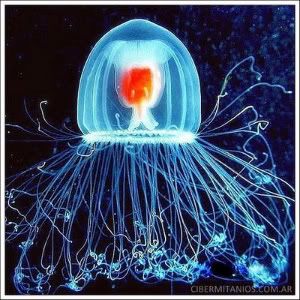
There are no immortal porpoises, but Ebonmuse informs me that there are immortal jellyfish! Meet turritopsis nutricula:
So yeah, this shiny little number starts its life as a polyp, the juvenile form common to most hydrozoans and almost all cnidarians. These polyps are spawned in colonies of eggs, from which they hatch after just two days, then mature in two weeks to a month. But after spawning, rather than dying as most jellyfish do, our friend turritopsis does something different.

It turns back into a polyp. Then it grows back up into a medusa. Then it turns back into a polyp.

We have not found a way to stop them from doing this, barring some removal of the nervous system from the body proper. Unless you break or dismantle it, it lives forever, to the best of our ability to tell. I, for one, buy into Dr. Dawkins' idea that individual death may be valuable at the species level because "obsolete models" are given an intrinsic expiration date, so that the genes keep on shuffling. That's a gross oversimplification, but it makes intuitive sense to me and Dawkins makes a good case for it in The Selfish Gene, I believe. While individual death may or may not be valuable to a species in the long run (I'm sure there are ways of checking, though it seems like it would be really tough to test both rigorously and ethically), this jellyfish demonstrates that individual mortality is biologically optional.

Whoah.

Saturday, October 17, 2009

Arguing on the Internet: A public response to a public challenge.

cl over at the warfare is mental recently issued a public challenge. I, uh, replied, and then he replied back, and then it got a little long so I figured I'd at least put the big main part on my own soapbox. For some rather more immediate background, I said, "If the King of the Universe decided to try to trick me into thinking he doesn't exist, then I quit." cl replied, "I don't believe that our lack of God's manifest presence entails God trying to trick us." But... that doesn't quite address my issue. It's not just that there's no super-obvious manifest presence of God, it's that there seems to be no way at all we can check for God's existence that doesn't amount to us merely deciding to believe it anyway. And wouldn't you know it, but the same would seem to be true of unicorns and Mother Goose.

cl, I'm not at all interested in suspending my disbelief doubt, just as you're obviously not interested in suspending your own central tenet of whatever holds your own worldview together. For me, it's doubt: doubt is how I understand the universe, doubt is how I come to science, doubt is how I go about forming my beliefs. I echo Descartes, "de omnibus dubitandum." I'm just saying, any scientific idea I believe, I would relish the opportunity to prove to your satisfaction that I am right, should you call bullshit. I should hope that you, too, would enjoy demonstrating in some manner why I ought to believe this or that thing you propose to me? I mean, in the marketplace of ideas at large, this is why I'm not interested in stuff I can't check out: I can't think of a way to tell it from total nonsense. If you think you have a good idea, then please show me why it's a good idea, because I very much want to collect good ideas! (While at the same time keeping nonsense out of my collection.) What exactly is just plain awesome, either epistemologically, or morally, or metaphysically, or even scientifically, that you can show me about your belief system? I want you to teach me something new.

Oh, wait a second. I'm not switching gears here, this is live argumentative progress. cl, you've been accused of being a sophist; what I've just now realized is that you are a rhetorician. You want to find the best arguments so that you can tear them apart, honing your skills in the process (and if your opponent du jour doesn't "get that," well, it's their loss! There's plenty of opponents about!). You just happen to also believe in some supernatural critters, and so in the sense that you don't buy what you see as our own version of dogma ("Yay metaphysical naturalism! Boo supernaturalism of all kinds!"), you call yourself a freethinking theist. You don't even appear to have much of a creed at all, at least not that you've laid out in non-platitudinal language. Have I got it so far?

OK, so with that in mind, I understand the rhetorical move you're making in the OP. You offered to convince me why I shouldn't believe God exists, despite my own hypothetical best evidence. This can be done for any such evidence besides second-order knowledge (which I believe is impossible, and so I cannot honestly employ it in my defense). What this would accomplish rhetorically would be to show me that my own position is silly since you would be showing how a principled application of it will lead me to a contradiction. What this involves, though, whether by chance or design, is the promise to tell me why I should not trust the results of an empirical test of my own design, should it be performed. Yet you just asked me what results of an empirical test would I in fact trust? You'll set the very best of my very own argumentation against itself, hoisting me by my own petard as soon as I've done the hard work of putting my actual belief on the line for you. And you know what? You'll always win that rhetorical game against people like me, because every individual experience is subject to doubt, so we maintain. No empirical test proves anything once and for all, and God is no exception - there is always some argument or thing that could happen to undermine my God test. What makes me vulnerable to this attack is not a flaw in my position, however, but rather the simple fact that I deny myself the pseudo-justification, "just 'cuz." Every belief system that doesn't rely at some level on "just 'cuz" must perforce be subject to this kind of rhetorical maneuver, including yours, whether you admit it or not (unless you actually believe that saying "just 'cuz" is a legitimate justification). So... do I explain what would convince me, only to watch as my own argument disembowels itself? Or do I try to patiently explain that of course I can never "really" prove God with science, because science is fundamentally provisional?

Oh, double-wait. You asked me what would "prove God" to me, and that's a subjective question. Now you're going to explain why you think I shouldn't be convinced by it, and the only way you can do that is to show some way that I might be wrong. Which, yeah, simply is correct: at any given moment, I might be wrong. This is what honest skepticism is all about, buddy. But can you show me that I'm actually wrong on this or that thing I believe? If I got evidence for God and you didn't buy it, how would you convince me that your decision not to accept it is a legitimate one and not mere stubborn obstinacy? Is there something that makes it stand out as more worthy of further scrutiny than ideas upon which we might agree? After all, I'm not saying that this or that evidence should convince everyone of God, I'm simply saying what I think would probably convince me, which is itself a testable claim because I can be presented with such evidence and thus can in principle determine whether I put my ontological money where my epistemological mouth is. Any counterargument changes the situation, so the old prediction no longer properly applies and I need to come up with a new one. And so, I hope you see, I try to believe only things which I can check, so that we can sort out which is right and which is wrong. And so, if we disagreed on an interpretation of this or that evidence, we can also devise a test as I briefly outlined back in your sandbox.

But we already agree that I, personally, might be wrong in any given case. I know that already. This doesn't advance our discussion in any way, ever, because it's always true. It's true of you, too, for that matter, which is why I haven't bothered pointing it out before now; I thought we were taking this bit for granted. What I'm interested in is working from where we agree, to things on which we disagree, and you showing me where things I believe are actually wrong, and not just the status quo of possibly wrong.

That's a truly slick move, though: you just about got it past me, you almost baited me into choking on my own argumentative tail. Bravo! One problem. Unlike others, I'm not just going to call you a sophist and bug out; I want to run with this rhetoric deal, and so I say, "Now what," and the ball's in your court. You can either start poking your fingers into holes of doubt which already exist in everything that I believe I know, which will get us right the Hell back here every time; or you could effectively ask me to start poking holes in something you believe by proposing to convince me of it. Eventually, you're going to tell me that I as a skeptic ought to be skeptic even of my own positions. I'm just saying, "You're preaching to the choir, buddy; now let's cut to the chase."

So now you've got me intrigued. I want to know what's "double next," now that I've conceded your rhetorical point and, for good measure, all legitimate permutations of it. Now spill: what is that all for? I know all about the flaws and shortcomings I've got, and learning to live with them has been a wonderful journey so far, so what more have you got for me? What more can your brand of freethought do for me, which I cannot do for myself with my own brand of freethought? I'm honestly asking you what you have to teach me, because I'm expecting an opportunity to learn here. Hit me with your best shot.

Full Disclosure: Ultimately, the question I'm getting at is, "What does theism do for you that you cannot get from your freethought sans theism, and how can I get that, too?" Or, "Why do you believe things that I don't, and is there any reason at all why I should believe them, too?" Or, "Can I have freethinking theism, too? And how?" And if you can't explain why I should believe what you believe, then I'm awfully curious as to why you do in fact believe what you now believe, and not something else - or are there beliefs of yours to which you do not apply the beautiful freethinking rhetoric which you just now so clearly displayed? I just gotta know, now that you've convinced me that you truly understand why I can't protect my idea of God from an all-pervasive doubt, how you do that thing. Or is your own medicine not for you here? And if not, then how come?

Or, more plainly: What's the lesson you ultimately want me to learn from that rhetorical game of yours? How does this play help us in our work as freethinkers? What's the point of this if we already assume you win that first part?

Friday, October 16, 2009

101 Interesting Things, part twenty-seven: Kaprekar's constant

Hi, everybody! D here, with a magic trick just for you! I'm only half-joking, I promise.

Today's 101 Interesting Things is brought to you by Rhodopsin. It's also interactive, and all you need is a pencil and paper, or a calculator, or a head for numbers. Let's get started! Pick a four-digit number, any four-digit number, as long as all four digits aren't the same (you can't pick 0000, 1111, 2222, 3333, 4444, 5555, 6666, 7777, 8888, or 9999). Numbers with leading zeroes, such as 0103, or even 0001, are perfectly fine.

Got it yet? OK, now arrange the digits in ascending and descending order. For example, if you picked 4092, you would write 0249 and 9420. Still with me? Now calculate their difference. With our sample, 9420-0249=9171.

Lather, rinse, and repeat:
9711-1179=8532
8532-2358=6174
7641-1467=6174
OH SHIT, SON! Look at that! Now here's the magic part: I bet you can't find a number that will take more than seven steps to get to 6174. You know why? Because 6174 is Kaprekar's constant. Or, rather, it's called Kaprekar's constant because an Indian mathematician named Kaprekar discovered this rather interesting property of what I would have thought was just a regular old number. Now, quick! Go and pull this trick on anyone you can, and find a way to take their money with it!

EDIT: An anonymous contributor has mentioned, below, a sourceforge.net page which lists several interesting consequents of the Kaprekar constant. It's not all quite as interesting as perhaps the Kaprekar constant might be in everyday life, but it's still way more interesting than your life is in comparison to... umm... any historical figure. That is, assuming I'm not addressing any historical figures at the moment... anyway, it's November now, which means that it's National Novel Writing Month, which means that I'm devoting most of my time to novelling and less of it to blogging. Point is, if you like math, you should check out Anonymous' contribution.

Thursday, October 15, 2009

Rethinking the Evolutionary Ethic: Towards a Scientific Ethics Once More

I've done quite a bit of writing in the past concerning the arbitrary and made-up nature of ethics as a field of study. I still stand by the proposition that ethical judgments and systems have no more bearing on reality than the rules of Chess or the particulars of this or that language (and if you think that language can correspond to reality in any metaphysically interesting ways, then do I have something for you!). However, I've been rethinking the matter of whether "good" lessons may be derived from a state of nature; as Richard Carrier points out, you certainly can derive an "is" from an "ought" (2:30), as long as you accept that morality is a system of hypothetical imperatives; but you have to be really fuckin' careful or you'll wind up balls-deep in naturalistic fallacies. This entry has been percolating away on my back-burner for quite some time, and I think I've finally got something refined enough to show, so here goes. Oh, one brief caveat: this is an ideal to move towards, not something we can do right away (kind of like how you can't force people to be free, or impose democracy on another nation... cough, cough...). We should take it as a long-term goal to get everyone on-board with this kind of ethic, is what I'm saying.

The bottom line is this: every situation or event lends itself to a "lesson" of sorts, a thing you can take away and learn from that situation or event; but figuring out just what the lesson is can be sticky business. Sometimes the lesson is big and important; sometimes the lesson is that not all lessons are big and important; sometimes the lesson is that you don't always get a new or interesting lesson from every situation or event. If your friend calls you a douchebag, then there are various lessons that you could take away from that: you might need to learn that you are in fact a douchebag from time to time; you might need to learn that sometimes your friend doesn't have the very same idea of douchebaggery as you do; you might need to learn that sometimes the opinions of your friends should be taken with a grain of salt; or maybe you should learn to be a douche-nozzle, not a douchebag. Each of these things is true, by the way, but the particulars of the event (the "full relevant context") will dictate what is the most important lesson to learn at the time. There is a Japanese saying: "shikin haramitsu daikomyo," which pretty much means, "every action holds the opportunity to learn." Insofar as evolving is an action, there is an opportunity to learn from it.

So what can we learn from evolution? What is the lesson to derive from all these molecular replicators puttering about on this rocky, watery marble of ours? Well, this is going to depend on what we adopt as our "full relevant context," and this in turn is a matter of perspective. If we limit our context to the idea that nothing lasts forever, we might rather easily adopt the ethic that we should get all we can while the getting's good. If we limit our context to the idea that any conspiracy of doves will be easily infiltrated by a lone hawk and its descendants, then we might adopt the ethic of, "try to be a hawk in a conspiracy of doves." Combining these two, we might adopt the ethic of, "try to be a 'concealed hawk' (or a cuckoo) in a conspiracy of doves, to extend the conspiracy as long as you can so that you and your descendants may prey upon it as long as possible." Or, in short, "domesticate the doves." So what perspective shall we adopt, what shall we consider as our context from which our ethics shall be derived?

In seeking an evolutionary morality, we must take into account the relevant context of evolutionary situations and events. Which ones? Hopefully, all of them. The following three things will apply to all evolutionary situations and events: every evolved and evolving organism will be a molecular replicator, and so in this sense, all the world is kin; the environment shapes replicators even as those same replicators shape it in their turn; and natural selection is a non-random (though perhaps probabilistic) process of meeting the demands of this very moment with the randomly varying available materials.

Let us begin by looking at all of life, past and present, as a single "tree of replication." Extant organisms are, on this view, buds along their conspecific twigs, which in turn meet in branching clades all connected to the great root of the very first replicator(s). Some of us are atoms arranged ape-wise, some of us are atoms arrange tree-wise, and some of us are atoms arranged spirochete-wise; but all of us are atoms arranged replicator-wise. All the world is kin, and we are all of us molecular replicators; though some of us are more complex than others, we are all the same at root. The main difference between this tree of replication and a literal tree is that entire trees are alive all at once, while the overwhelming majority of the tree of replication is dead and gone. But even this is merely a byproduct of our primitive linear conception of time, so there.

Let us also consider the role of the environment in any evolutionary process. The environment shapes replicators even as replicators shape the environment, yet we are able to identify many instances where an environmental disturbance has greatly impacted the evolutionary trajectory of this or that set of replicators. These vary from the simple and rather boring case of the peppered moth, to the exciting and catastrophic mass extinctions that have dotted our planet's history, to the cyclical routines of geomagnetic reversal or the mish-mash of interesting conditions responsible for the banded iron formations from our planet's reckless, feckless, misspent youth. But all of these events share an interesting and fundamental characteristic: they are opportunities for difference to shine. In all of these cases, there were a number of organisms (from a local population of a single species, all the way up to the entire planetary ecosystem) put on the chopping block and faced with that oldest of ultimata: adapt, or your lineage ends with you. The external environment, which can be tricky to define precisely, is an implacable and unpredictable foe, placing demand after demand upon the replicators inhabiting it.

Finally, let us consider the nature of the evolutionary process itself: it is the blind watchmaker, the forge of diversity and adaptation that has provided the raw materials which the environment (including other organisms) has been continuously refining to meet the demands of the moment. Not to this or that perfection, merely the demands of the moment. Evolution does not plan ahead at all, ever; the imperfect copying fidelity of molecular replicators simply creates difference, and these differences are judged by the environment. Those that do well go on to continue replicating; those that fail are lost forever. Natural selection is nothing more and nothing less than the submission of extant diversity to the demands of the present environment. Yet the environment changes constantly, and as it does, yesterday's superstars become tomorrow's has-beens, and countless might-have-been offshoots are lost as never-weres. The success and failure of this or that replicator has precisely nothing to do with any nonsensical ideas of "intrinsic fitness" or "perfection," and absolutely everything to do with the capricious contingencies of the surrounding environs.

We now have all the pieces of our puzzle. From these relatively simple facts proceed all the complexity we see today, and from these simple facts we may derive an ethic fit to meet the particulars of any evolutionary environment. Let's put them together and see what we get!

One of the first things to notice is that since the environment is fundamentally unpredictable, we can't always tell what will be useful tomorrow or in a thousand years. Sure, we can dream up all the adaptations we think might be useful here and now, but things are only the way that they presently are for now, and we don't know when or how they will change in ways beyond our control. Because we cannot ever be "completely prepared," we must diversify: in order to be prepared for as many eventualities as possible, we must tolerate as much diversity as we possibly can in order to minimize the likelihood of being completely wiped out for good. The lesson here is that homogeneity is not only boring, it is fucking dangerous, because we're putting all our evolutionary eggs into a relatively small eugenic basket. Except when we use eugenics, which may be used for good or evil just like nuclear energy or anything else, to try to permanently cure things such as congenital birth defects. (I'm serious about that, by the way: there is no such thing as an incorruptible good or an irredeemable evil - there is only risk, reward, and consequence.)

Speaking of "we," just what exactly is meant by this? Well, in order to incorporate as much diversity as possible, our use of "we" should be as all-embracing as possible. We see the rewards of kin-selected altruism in nature, but the lines drawn thereby are, for good reason, only as big as they have to be to increase the likelihood of copies of one's own replicators being propagated into the future. Yet, if all the world is kin (and we are), then we must realize that the instincts telling us that this one is kin and this one is not are misleading us. What we are doing here, in essence, is trying to make the largest possible "in-group." (Michael Fridman, of a Nadder! fame, points out in The ReBrook Gambit that Peter Singer argues for just such a thing.) Humans are only able to hold a "phone book" of maybe a couple hundred or so individuals, but this is only a matter of contingency; there is no principled reason why in-groups should be so small, and we see over and over that larger in-groups are often able to out-compete smaller in-groups - so let's all be part of the same in-group.

This leads to a rather interesting pseudo-paradox: all evolutionary fitness is relative to the environment, and the environment includes other organisms. Therefore, to be "fitter" is to be "fitter than" this or that other organism or group at surviving in the environment. Similarly, success can only be described in relation to other degrees of success, and thus to be "more successful" is to be "more successful than" this or that other organism or group at propagating in the environment. But wait! Even on this competitive account, the most success that can be achieved by a group is to completely wipe out all other competitors, and be the only one left. With no competition, there is nothing to be fitter or more successful than, with the sole exception of others within one's own group! So even if you "win" evolution, now you have to compete against your own previous in-group!

What this means is that being "better than" is a never-ending project; a mug's game. Relax and be out-competed; win and compete against the rest of the winners. You just can't "win forever." But what if instead of trying to be "better than" others, you try to be "better than" you were yesterday (or "better period"), and expand your in-group to include as many as possible? Then you maximize your in-group's diversity (and thus its ability to deal with unpredictable environmental threats) while at the same time eliminating competitors by turning them into confederates. In terms of resource acquisition, this is the equivalent of ceasing the attempt to get more than your neighbor, and instead figuring out how much is enough for each of you, then working together to make sure you both get what you need. Let's call this "winning together." As previously explained, winning forever is impossible, but winning together is awesome because it's less dangerous and less wasteful, while still getting you what you need. Sure, you won't win over your neighbor; the proper attitude for both sides to adopt here is, "So what?" The idea is that you care about each other's welfare, not about doing better than each other (or at least not to the point of death - there's still room for economic and political competition). Bottom line: caring is awesome, fighting is bullshit.

Well, whoop-de-doo! All we've done thus far is to explain how a conspiracy of doves is in every individual's best interest, because you're banding together with everyone rather than setting yourself against anyone. But this necessarily creates a perverse incentive for every individual to try to be the lone cuckoo (or the invading hawk), so now what? Well, OK, you want to be the lone cuckoo, and I want to be the lone cuckoo, but I think the two of us can agree that we don't want that guy to be the lone cuckoo. What's more, the two of you don't want me to be the lone cuckoo, and the two of us don't want you to be the lone cuckoo. Hmm. Now what?

Transparency, trust, and culture, that's what. Oh, and some tit-for-tat/retaliator strategery for good measure. Y'know, be a dove unless you come across a hawk, then roxxxorz that hawxxxor'z soxxxorz. And to any would-be hawks or cuckoos, realize that doing that thing may be profitable right now, but you're triggering an arms race that your descendants may or may not be able to continue, especially in light of the fact that the conspiracy of doves is actively trying to find and convert hawks & cuckoos when possible; but the doves will treat you as an implacable force of nature to be conquered or otherwise dealt with if you do not allow yourself to be reasoned with (I should know, because I'm the one telling the doves to do that thing). Take the long view - hawkery is a mug's game, and you're just pissing in the gene pool: you'll eventually get found out and kicked out (even the literal cuckoo has been found out, we humans just don't care enough to convert it or kick it out right now).

The rest of the confederates can work on building a rational and mutually agreeable foundation for trust, which will have to involve some form of transparency: it's informational give-and-take. Just like you sacrifice the liberty of killing whoever you like so that you can reasonably trust that nobody will kill you, a little bit of privacy can be sacrificed so that others can reasonably trust that you're not screwing them over. Not a whole lot, but the particular amount is a matter of contingent legislative agreement, not of general evolutionary ethics. I have a lot more to say on this, because I know it gets really fucking hairy, but I'm going to save it for some philosophy of politics stuff I have planned. Right now, I'm just saying that it's going to be an issue, but it can in principle be decided (just not "once and for all, for everyone everywhere, all the time always").

Finally, there's the matter of culture: teach your descendants that just about any form of difference that is not directly harmful now is of potential future value (and there is always difference), and so they should be as inclusive as possible; teach them to be confederates rather than cuckoos, so that they may be part of the messy and multifaceted in-group majority, and not doomed to be an out-group minority; teach them to actively foster transparency and trust, not to be suspicious or over-cautious with others; and teach them to stand up for themselves and their as-permissive-as-possible way of life, changing when necessary and defending themselves when necessary. In other words, start shaping the environment so that it is conducive to your way of life, but realize that there will be parts that cannot be changed or planned for, and make yourselves capable of dealing with those bits as much as you can. Y'know, plan ahead in the ways that nature, red in tooth and claw, cannot.

In simple, conversational terms, I see this form of ethics as proceeding along the following general lines: "So what's your goal here? Are you trying to work for the long-term benefit of all, including yourself? Or are you trying to work for the short-term benefit of yourself and your very closest kin, to the rest of our detriment? We'd definitely like to work with you, because you're all of potential future value; but if you're not interested in working with us, we'd sure like to change your mind. If we can't change your mind, well, there's going to be problems because you're making yourself into a threat. We don't want a threat in our midst, and we don't want a threat brewing from afar, either. So which is it, pal? Will you cooperate with all of us, or turn all of us against you?" I want to note here that "going off and doing your own thing," insofar as your own thing is of no threat to others, counts as cooperation. This is for the simple reason that if you're not a threat, then you don't need to be eliminated no matter where you are, and the elimination of non-threats is just short-sighted paranoid foolishness. And in a loose sense (which I will also be developing in the future), this also entails non-censorship, open communication, government transparency, a free press, patriotically paying one's taxes, and all sorts of other neat things.

This will still be a never-ending project, but it's one of winning together rather than winning forever (because the risk of getting wiped out for the benefit of others is minimized). And because the in-group is no longer splintering (or at least splintering as little as possible), this is no longer a mug's game because doing it right is winning for now, which is the point - keep winning for now, and you "actually win forever," rather than striving pointlessly to win forever over everyone else. The goals of such an ethic will be to seek out and incorporate as much diversity as possible, to tolerate non-harmful difference, to seek to remedy harmful difference and only use exclusion and violence as a last resort. In short, it will be a constructive ethic of cooperation, rather than a destructive ethic of competition. We cooperate with most of the bacteria in our gut, and look how well that has worked out! We've also cooperated in the past to get our mitochondria and various other organelles, and that's also been a rather resounding success for all involved parties. We imagine ourselves to be integrated individuals, but the truth of the matter is that every single one of us is a messy zoo of confederates - and this is the lesson: be a messy zoo of confederates at the societal level as well. Diseases either kill us or get killed, and this is the inevitable destructive result of competition. There is risk in cooperation (there is always risk in anything), but the dangers pretty much tautologically come from outside, as any individual who engages in hawkery will be immediately out-grouped because the in-group is defined by conspiratorial lovey-dovery.

Of course, this is still arbitrary, it's just that I'm arbitrarily enshrining "doing as much good as possible for as many as possible under the widest variety of circumstances possible," to which "all of everyone" ought to assent, because if this gets started in earnest, then everyone will be assimilated into the messy confederacy or eliminated. Evolutionary utilitarianism, perhaps. This, I think, is a good "ought" to derive from the "is" we see all around us. Whether or not this works, I can't really judge right now; I can only say that I like it, and it makes sense to me - so pick it apart and give me an opportunity to improve! One thing I can say for sure is that, in terms of facing reality, it sure beats the pants off the authoritarian dick-waving of religion, which amounts to the threat, "Be this way, or God's gonna get you!"

Man, now I want to accuse theists of "authoritarian dick-waving" as often as possible just to see the looks on their faces!
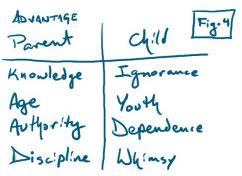
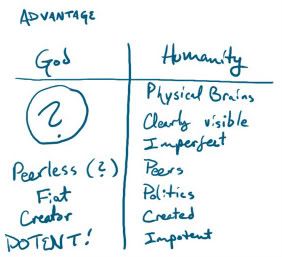
This post was featured in the 44th Humanist Symposium.

Wednesday, October 14, 2009

Bullshit Pulpit: The Boss of Bosses

I'm starting to come under the impression that the cornerstone of certain religious minds is a very warped view of authority. I wasn't sure how to talk about that. Then I tried to get creative and this happened.

This story is a work of fiction. Any similarity to real persons, places, or events, is simply a product of your imagination.

I.
In the beginning, there was nothing. But before that, there was the Maker. And before that, there was the Word. Before that, there wasn't anything; now stop asking stupid questions. And from the Word was born the Maker, because the Word said so, and that's that.

And the Word told the Maker what to do, and the Maker did not like that, so the Maker made Authority and took it. Then the Maker told the Word to be silenced, and lo, it was. The Maker then set about a great Making, the likes of which are beyond words alone to describe. Seriously, you would need years of specialized mathematical and scientific training to truly understand just how complicated the world is, let alone all that has been discovered about how it works.

But before all that, the Maker made itself, for after such a Making it wanted to play around.

II.
And so the Maker made the World, and gave to it Complexity. And lo, the Complexity manifested itself in many ways, but all based upon the Number, which is way better than a silly old Word, anyway. And the Maker made the world such that from its Nature was born physics, and from physics did the atom arise, and upon the atom is the chemistry founded; and from chemistry did the protein arise, and upon the protein is the biology founded. And to make a very long story short enough for an ape to understand, from All That There Was eventually proceeded Life as You Know It. But the Maker was not paying attention to very much of this, for it was mainly concerned with making life into the image it had created for itself.

After a whole lot of conditions were just thus-and-so in just the right spot, the Maker cooked up an enormous pot of primordial soup, big as your planet. It took a few tries, but eventually an ecosystem emerged. And the Maker made catastrophe after catastrophe, shaping and selecting for this and that way of being alive, until after a whole lot of trial and error and evolution and sex, there arose Humanity which the Maker had made in its own image.

And the Maker made them man and woman, after finding out that shuffling the genes about is good for you and figuring out better and better ways to do that thing. Like the other apes from which they came, and the Maker before them, the men tended to crave Authority. And also like the apes before them, the women tended to fall for the idea that Authority is a real thing and not made up. Big winners all around, those apes. Well, the bonobos might be doing it right.

Next, the Maker wanted to tell Humanity what to do. And here the Word was able to take its revenge.

III.
The Maker set about telling Humanity how to live; Humanity were curious and asked a lot of questions. When the Maker tired of answering or did not know, it told Humanity, "Because I said so, and I have the Authority." And then the Maker pointed at its Authority, which it had placed between its legs for easy access. "And my Authority's the biggest of all, so you have to listen, because that's what Authority means."

And so the men were intimidated, for their authorities were no match for the Maker's; and the women lost interest and went about their lives raising children and tending the home, I guess because they felt like getting things done. And so the Maker told Humanity of all the World, and behold, Humanity took poor notes indeed. And even at the start, the Word did play tricks in the World, and did confuse Humanity even as it shaped and increased their understanding.

Men eventually conspired to work together so that their Authorities might match that of the Maker. Women were not unanimously opposed to this goal, and for failure to band together as the men had, they got steamrolled. When the Maker caught wise of this plan, it drove Humanity apart and sowed discord among them, telling each small group that they were better than all the other groups.

And lo, to each of these groups the Maker did tell a different but similar story. You see, the Maker is rather uncreative and has a poor memory; it just so happens that the World is such that difference and variety arise on their own. And the Maker did make rules and tell them to Humanity, and some of them were sensible, and some of them were not. Some of them were passed down through the generations rather faithfully, even if only a few of them did any good.

But all the rules were told in sounds and letters. And here the Word was able to increase the revenge it had wrought thus far.

IV.
From the words of the Maker did proceed the Law, and Humanity were quick to question it. For this Humanity were punished by the Maker, who sought not Humanity's understanding, but merely their obedience. And the Maker saw to it that its Authority was recognized wheresoever it went, for whosoever did not properly genuflect before the Maker's Authority was punished. This was partly from sadism, partly to make an example, and partly just to keep Humanity in line. It was all based on Authority, which the Maker had made from nothing.

The Maker went from group to group, and each group of people thought that they were the Maker's favorite, and in every group there arose a cult of Authority. Behold, there was War, for each group came to think that they alone served the Maker, and all others worshipped a false Authority. None of them could see that all Authority is meaningless bluster and bravado.

Humanity fought to see whose idea of Authority would win out. How they came under the impression that a conflict of ideas could be resolved by violence is a matter for speculation, but the Maker saw all this strife, and it tried many times to bring Humanity back together under its own original Authority. Every time, Humanity would change, or question, or do as they pleased, and a great anger came upon the Maker, for it could not understand why Humanity was not content to simply obey Authority and do nothing else.

Eventually, the Maker grew weary of all this nonsense, and changed its mind. The Maker tried to live among Humanity, to be as a person is, and so the Maker discovered that humans are as complicated as the World from which they were made. The Maker sought to end all strife and settle all grudges, but failed as any ordinary human might. This frustrated the Maker, who found that it simply could not convince Humanity to behave themselves. Humanity then turned on the Maker, and so it came to pass that the Maker was unmade.

Now there was no Maker, and no Authority; only Humanity and the Word in the World.

V.
With the Maker gone, and its Authority with it, Humanity sought to establish a new Authority upon which to build a new Law. Humanity worked with the Word, and sought to understand it, but there was a problem.

Humans, for some reason, insist upon asserting that they have the Maker's Authority. Whether by invoking the Word, or by insisting that their tradition is more faithful to the Maker than their neighbor's tradition, or by violence, Humanity has continuously failed to understand Authority.

Authority was invented by the Maker. It means nothing, for it is but a word, which comes from the Word. The Word came of its own, and has changed in some ways and stayed the same in others, much as persons change in some ways and stay the same in others throughout their existence. Only by this change may improvement be made, and this will mean correcting the Old and embracing the New, until once more the New becomes the Old and must be corrected and discarded.

Every person has its own Authority, no matter that person's shape, size, or flavor; and this Authority, too, is meaningless. It matters not what one person thinks or says of its Authority, nor what others think or say about the Authority of any other, for Authority has always been made of nothing. There is only the Word and the World for Humanity to understand, for by the World comes understanding of All That There Is, and the Word is the only way that such vastness may be known.

Know that the vastness of the World shall always escape the Word, for the Word is only in your head, while the World is everything and everywhere at all times. The only way to know whether there is any authority in any word is to check the World, and only then may you begin to close the gap between the Word and the World. Know also that to do this well, you must set aside your own Authority, lest you be unable to look past it.

VI.
Now Humanity stands to do a great Making of their own, for they have seen much of the World and have increased their understanding of its mechanisms. Yet even as Humanity stands to make new minds and new bodies from metal and sand and petroleum, they still have not moved past the myth of Authority.

Humanity's greatest moral mistake was thinking that the Maker was entitled to Authority simply by virtue of being the Maker. Humanity's greatest failure of reason was believing that to accept Authority unquestioned was rational. And so the cults of Authority have grown, and spread, and changed, yet the myth of Authority remains as silly as it ever was. The Maker was born only by conceit of the Word, and the lie that Authority comes from Making has plagued Humanity since before the oldest writings.

The World, so the Maker said, runs on the Maker's Authority. If you do not assent to this, the Maker's followers insist, then you do not understand the Maker's Authority. For some reason, people seem to think that all they must do is to follow behind the proper Authority, and then everything will work out just fine. This is the lie of Authority: follow the leader and you shall prosper.

When you do as Authority asks, you put your head down and get behind the Authority, and you follow wheresoever it leads. If you attempt to lift your head, to ask a question, to look past Authority and see for yourself, you will be told that you are guilty of doubt. You will be told that you are too prideful. You will be told that you are ungrateful for where Authority has led you so far. Know that this is the insecurity of Authority, for Authority is puffiness, it is all form and no substance. Authority needs your obedience to have any effect at all. Follow if you like, but look past Authority and know to what ends you are going, and do the hard work of sorting out whether it is a good or a bad end, independent of all questions of Authority.

VII.
Be wary of any person who tells you that all your problems can be solved if you only get behind an Authority and put your head down. Be especially wary of any person who tells you that you cannot know the Authority yourself, and that that person must intercede on your behalf.

There is no Authority. There is only Truth, and Truth can only be known by looking at the World with eyes that see Authority for the lie that it is. Humanity's understanding of Truth may never be complete, but Authority destroys Humanity's capacity to understand Truth by convincing them that Authority is the same as Truth. Whosoever claims to have Truth, but is unable to demonstrate it, is a victim of the myth of Authority. And so long as that person is more loyal to Authority than it is to understanding reality, you will be unable to increase its understanding directly, and must chip away at the edifice of Authority that the person has constructed in its heart.

It is a difficult matter to tear down a temple of Authority, but once that is done, Truth may be pursued. Truth needs no temple. Truth needs no Authority. Truth simply is what it is, it cannot be angered, it cannot be changed, it cannot be insulted, it cannot be avoided, and it cannot be harmed. The only interaction a person may have with Truth is to move towards it, or to move away from it. Truth cannot be wielded as a weapon, as Authority often is in its confused ignorance.

If you must seek to be different than you are, then do not seek to be like vain Authority; seek instead to be like imperturbable Truth, which makes no demands and demands no genuflection, but is secure in itself. The World was not made for you, and cannot be made to respect any idea of Authority - sweet as it tastes, Authority is poison. Truth, on the other hand, may be uncomfortable and alienating at first, but as you move towards it you shall see the freedom of being unbound by mythical Authority. And as you move towards the Truth, you shall be free even of your own desire for Authority.