Update Schedule

This blog updates irregularly.

Friday, November 20, 2009

The Quantum Mechanic: Chapter Seventeen

The Quantum Mechanic
A Superhero Story of Ethic Contortions

Chapter 16 - Chapter 17: Confrontation - Chapter 18

"Keep your friends close, and your enemies closer."
- Sun Tzu


"Try to relax, Mister Gleck. That creeping stupidity you feel is me. I have shut down the parts of your brain that are capable of the higher mathematical functions you need to perform in order to manipulate reality as I do. Your powers are suspended.

"As you flail and sputter, helpless as a worm on a hook, our new friends are dismantling and consuming your horde of mindless killing machines. It's over. To put it in your language, you have two choices in front of you, Entropic Engineer: repent, or perish. You can join us civilized persons, or I will kill you here and now."

Gleck beats his hands against the arms and chest of the automaton, to no avail.

"Unhand me, you fiend! I shall not bow to you!"

"I'm afraid you misunderstand me, Mister Gleck." The Quantum Mechanic leans in closer, its grip tightening. "I do not ask you to bow. All I ask is that you kindly stop trying to kill everyone who doesn't want to live like you. I'm going against my own promise to kill you, in order to give you one last chance to play the civilization game with the rest of us."

"Why? What's the point? What for?" The puppet leans back, cocks its head to one side.

"I don't understand. What do you mean, 'What's the point?' Living is its own point. Don't you want to live?"

"Not in this imperfect world, I don't!"

"Wait a second, I'm still confused. What other world is there?"

"I long for Heaven, you simpleton! I want more than this!"

"More than all that there is? What more is there beyond reality?"

"But - but - there's no ultimate meaning in any of this! No higher purpose! All we're doing is twiddling our thumbs as we wait for something to come along and wipe us out! It's all nothing, it all came from nothing, and it's all going to wind up going back to nothing! There's no point at all, nothing comes from nothing! I - I can't - I can't fucking stand that!" The Quantum Mechanic regards the struggling man coolly for a moment.

"Ha! You sound like a nihilist. Fine, let's say that the lack of a supernatural point means that there's no point at all. So what?"

"So - so what? So what?! How can you ask that? How can you be satisfied with nothing more than this frail and fleeting reality?"

"Well, it's fun, for one thing. And I like fun. I also enjoy helping other people have their fun."

"Fun?! 'Fun,' he says! I'm pursuing ultimate truth, metaphysical meaning, true purpose, and you prattle on about fun?! You small-minded ignoramus!"

"Mister Gleck, my mind spans the whole of this galaxy. I know of no limit to my full reach. I do not understand what meaning of 'small-minded' you could possibly be using."

"Oh, so are you an infinite consciousness, then?"

"Of course not. There's no such thing. As much as my consciousness expands - even if it goes on growing forever - at any given moment it is only that big and no bigger."

"Do you know everything?"

"Of course not. That's also impossible. Even if I keep accumulating facts, even if I build a complete model of reality, it is impossible to know everything in an infinite Universe."

"Do you still have limitations?"

"Of course I do. I still cannot turn back time, nor can I tell the future. What's your point?"

"God is my point, you foolish mortal! You insufferable braggart! You infidel swine! God is infinite, God knows everything, and God has no limitations!"

"That's the stupidest thing I've heard in the last thousand years. Really? I mean, come on - really?! A thousand years after we've left the Milky Way, and you still cling to that antique myth?"

"It's not a myth! God is watching, and he will judge you in the fullness of time!" Gleck continues to shriek and struggle against the imperturbable automaton.

"Why the wait, then? If God doesn't like me, he can say so himself. I'm sure not gonna trust anyone who claims to speak on his behalf, though. Not unless God himself tells me, personally, that you're his duly appointed representative. So where is this 'God' you keep going on about?"

"God will not submit himself to your pointless testing. God would never lower himself to that."

"Then why should I believe that such an entity exists at all?"

"You have to have faith!"

"You didn't answer my question, Mister Gleck, you only gave me an order. I asked you for an explanation. Let me ask again," the puppet leans in close, almost nose-to-nose with Gleck. "Why should I believe?"

"I'm telling you, you have to have faith, or you'll never understand!"

"Says who?"

"Says God, dammit! God says! What part of this don't you get?"

"I don't get the part about why I should buy that."

"I just told you, you have to have faith!"

"And so you come full circle: you've said I have to have faith to believe in God, and I have to believe in God to have faith. You're giving me orders which I shall not obey. I'm asking you for explanations, and you tell me I can't have them. You've explained nothing, you've only told me what to believe without showing me any reason to believe it. So why should I care about anything you have to say?"

"You arrogant twit! You wanna know why? Hell is why! I'll show you Hell, if you want! I'll fucking kill you!"

"You will do no such thing. The world is watching, Mister Gleck. Now, let's take it from the top again: why should I buy anything you say, including your ideas that I need faith and that God exists and all of that horse shit? Why should I believe any of it? What can you show me?" Gleck calms down. His arms drop to his sides. The Quantum Mechanic lets go of his throat.

"All right. Let me see if I can turn it around on you. How can you stand there and deny the existence of anything greater than yourself?"

"I don't deny it. I just don't see any reason to believe in this or that supernatural critter, and you've refused to give me one."

"How can you not? How can you look around and not think that there must be something more than this?"

"I don't know. I just don't, I guess. Can you give me a reason to change my mind?"

"Apparently not. If you refuse to have faith - "

"You mean, if I refuse to follow your orders?"

"That's what faith is - submission to God."

"A God whose existence I can't even establish. Tell me - which idea of God is the real one?"

"All mortal ideas of God are off-base, no person can truly understand him without first submitting."

"Even you?"

"Stop trying to twist my words."

"I'm not trying to do anything of the kind. I'm trying to find out why I ought to submit at all. I'm trying to understand."

"Well, you can't! You can't understand God like you understand your precious fucking physics! And the more you try, the more you embarrass yourself!"

"Funny. You're the one shouting here." Gleck glowers at him. "Well, then I guess we'll just have to agree to disagree. But you've sat here for the last thousand-odd years and asked me all about what I think. How about I ask you some questions?" The Quantum Mechanic sits down. Gleck stares dumbly for a moment, and then joins the puppet once again.

"Fine. Ask away."

"Why do you believe?"

"I have faith."

"Right, I got that. But why? Why do you do that?"

"Because I believe in something greater than myself."

"Well, yeah, but there are a whole lot of great things around. Why do you believe in that particular greater thing, though?"

"Because of my faith, I told you."

"No, I'm asking you what's behind 'all of it,' all at once. I understand your circle, I'm asking why you bother to maintain it." Gleck is silent for a long time.

"I guess I don't have a reason. I just do. It's just what I believe." Now the Quantum Mechanic is silent for a time.

"Hmm. I see. So neither of us is going to convince the other. What next?"

"I guess that's up to you. You're the one strangling my brain."

"You tried to kill me, Mister Gleck. You tried to kill everyone. I think some caution is warranted."

"You flout holy law. You ignore God's commands, I can't just stand idly by and watch as you go about doing whatever you please."

"Why not?"

"Argh, we were just over this! It's just my faith, OK? And I won't let you trample all over it!"

"I'm not trampling all over your faith, Mister Gleck. I'm just living my own life as I see fit. You are free to live your own as you see fit, but I will not allow you to impose your will on others. You must learn to live in peace with those who are different from you."

"But - but - " he trails off. Ben knows where this is going. He tries to get ahead. "But then why do you dogmatically insist that others do no harm? That sounds an awful lot like you're imposing your will on others."

"A fair objection. However, I think the more reasonable interpretation is that I simply prevent anyone from imposing their will on anyone else. I don't do harm to prevent harm, I simply prevent harm. Would you rather I harmed people? Or let them harm each other? Or harmed you?"

"But that's different. Punishing sin is - "

" - Foolishness. Harming people does not help them."

"Shut up and let me finish! Punishing sin is good. Sometimes you have to punish people for their own good."

"Says who?"

"I - you - OK, fine. I'll play your stupid little game. Who says we shouldn't harm each other?"

"Wait a second - do you want to be harmed?"

"No, of course not. Nobody does."

"Great. Done. We agree. Now let's not harm each other. Next?"

"No, dammit! You didn't answer my question!"

"Yes, I did. You asked, 'Who says we shouldn't harm each other?' The answer, apparently, is 'everyone.' So we're agreed that no one wants to be harmed, so let's just not do it. What's so hard about this?"

"But what about what's right?"

"What about it?"

"Well - oh, you son of a bitch! You don't care about higher purpose, or ultimate meaning, or anything of real value!"

"I care about a great many things of real value. But real value just means that someone values it."

"No, it doesn't!"

"Then what does it mean?"

"Your petty human values have no meaning in the final analysis!"

"Nothing does. So what?"

"There you go again! Refusing to acknowledge the value of faith, of higher purpose, of ultimate meaning!"

"What value? What are you talking about? Faith only has meaning to people, too. In the final analysis, it doesn't mean anything, either."

"Then what's the damn point of anything? Why don't we all just kill ourselves and be done with it? Why bother going through the motions at all?"

"The point is to do what we like, and find joy and meaning on our own, despite the temporary nature of everything. It's fleeting, but that's OK, because we can always go find more - we just can't reasonably expect that anything will ever be 'solved forever.' If there's no point in living, then there's no point in dying, either. We bother going through the motions because we find the motions we like. But I won't let you force other people to go through the motions you want to go through, if they don't want to." Gleck throws his hands up in the air.

"Well, then we can't ever see eye to eye on this. Can I go now? Or are you going to kill me?"

"I guess that's up to you. Are you going to try to kill anyone else?"

"Well, if you won't let me, then I guess I can't. No point in trying. Are you happy now?"

Douglas is flabbergasted. Benjamin Gleck is being perfectly honest. He really and truly means what he's saying. He's finally ready.

"Why - yes! Yes, I am! Ecstatic, in fact!" The Quantum Mechanic stands up to shake Gleck's hand. He balks at first, but then takes the automaton's hand in his own and goes along with the vigorous motion. "Welcome to the civilization game, Mister Gleck." The Quantum Mechanic sits back down, and Douglas releases his stranglehold upon Gleck's brain. "Now that we've gotten past that unpleasantness, I want to thank everyone for their patience while we dealt with this threat." In Montana, Douglas walks up behind his wife and wraps his arms around her. She smiles and continues chopping vegetables. Back in the studio, his puppet says, "OK, I guess it's finally safe for me to reveal my secret identity. No point in keeping the secret any longer."

Douglas vanishes from Montana, reappearing in the studio with Ben Gleck and the Quantum Mechanic. He speaks in his own voice.

"Hello, humanity. And to our newest guests, as well - it looks like they've finished mopping up outside. My name is Douglas Orange. I'm a professor of theoretical physics at a Montana university. You might have seen me in my magic act back in the Milky Way, under my other alias, The Amazing Orange."

Gleck watches as Douglas lays out his life story to the camera. So smug, so blithe, just going on about his pointless bullshit. It's just not fair! How can he be so happy, so optimistic, when there's nothing to look forward to in this life but more of the same damn old boring, imperfect, monotonous crap? How can he just do what he likes and pretend that it's anything more than meat going through motions? How can he be so fucking joyful without Heaven, or God, or anything that has real lasting value?

Wait a minute, he thinks. I've got my power back. That fool let his guard down. He's just going on about how great he thinks he is, but here I am with all my power restored, and he isn't even paying attention. I can see right into his mind! He's not even looking at my thoughts! He was a fool to trust me - now I can finally teach him a lesson, for a change! And then it will be my turn to run the show, and nobody will ever ignore the will of God again! I'm going to save everybody from themselves, whether they like it or not - starting by liberating this overgrown calculator from his mortal coil. Take that!

Mid-sentence, Douglas Orange explodes. The Quantum Mechanic sits motionless, covered in gore. Ben can hardly believe what he's done, his enemy's blood sprayed all over himself. He takes a moment to revel in his victory.

Alvina has practiced her maneuver many times. There is no warning whatsoever as she steps sideways through spacetime and thoughtlessly plunges her kitchen knife into the base of Ben Gleck's skull. She closes her eyes and imagines her husband of five seconds ago, just as she saw him. He returns, exactly the same as he was, atom for atom, only having lost five seconds of time. Douglas really did die five seconds ago, she just made a copy exactly like him, no more different from the Douglas of yesterday than the Douglas of yesterday is from the Douglas of two days ago. The man she loves draws breath once more.

"What was I saying?" He perceives everything around him and infers what must have happened. "Oh. Oh, my." His shoulders slump. "You know, I was really pulling for that guy. I thought he finally made it." He runs a hand through his hair, closes his eyes, and sighs deeply. "Oh, well. I guess you can't win 'em all."

Questions flood into the Interview database. People want to know why Gleck was killed instead of having his power permanently stripped, or why the Quantum Mechanic didn't simply change whatever was wrong with his brain. Douglas cleans up the bloody mess, disposes of Ben's body, and addresses the camera.

"I know what you're asking. I know what you're thinking. And I'm sorry. Benjamin Gleck could not be trusted, apparently, because as soon as I let down my guard, he tried to kill me. Maybe I should have done something differently. I honestly think the damage was done all the way back when I showed him as I see with no warning, no lead-up, no education. Too late now. I'm sorry."

But why can't he bring Gleck back, as Douglas himself was just brought back? Why won't Douglas re-make him? Fix him? Help him be better?

"I offered him a chance to join us. He accepted, then went back on it. I'm done trying. His miserable life is over. I don't think you all understand what has to go on in a mind for a guy to hunt people for a thousand years in a galaxy, finding nothing, endlessly pursuing just to kill. Not for food, not in self-defense, but for some twisted idea of righteous punishment. I can't fix that, and if I did, he wouldn't be the same person. He was - how can I put this - incorrigible. Too far gone. Not worth saving. What's the point of swapping out a guy's brain for another one?"

The questions keep coming. Douglas ignores them. The Interview is over. Douglas and Alvina return to their home in Montana and get on with their lives.

"You know," Alvina says to him at some point, "You're kind of a hypocrite, in a way." Douglas sighs.

"I don't care. It's complicated and messy and I just don't care about it any more."

"I know." She squeezes him. "It's just fun to see you admit that you're still human like the rest of us." He grins. Laughs. Kisses her. "So now what?"

"Well, I've learned my lesson the hard way, I think. It's kind of strange that that one little mistake all the way back then could have caused so much trouble."

"Yeah. So what are you gonna do about it?"

"Live with the regret, I guess. Oh, well."

Douglas and Alvina hold each other for a very long time.

Thursday, November 19, 2009

The Quantum Mechanic: Un-Deleted Scene Three

Thanks to Zach L for some inspiration.
UN-DELETED SCENE 3: Douglas and Alvina fall in love all over again

As Alvina learns to deal with the burden of quantum awareness, Douglas tries to coach her. He wants to make it easy on her, but she isn't having it. She wants to learn everything the hard way.

"Sorry, Bea. I guess I just want to see you succeed better than I did."

"Well, that's an attachment you'll have to drop, I guess. I had a chemistry teacher in high school - "

"I know," he interrupts. "You've told me many times before."

"Well, then shut up and let me say it!" She stamps her foot without thinking. Douglas goes wide-eyed.

"Whoah! Sorry, you're right. Framing is important, I sometimes forget, and - "

"And stop reading my mind to tell me what I want to hear!"

"I - " he stammers, then is silent. "I don't know how to do that. I can't stop reading your mind, I care about you too much. I just want to put things in the best way possible."

"Well, I - oh, shit." She drops her gaze. "I wanted you to apologize right after I told you not to tell me what I want to hear. Fuck."

"People are messy."

"Yeah." She takes a deep breath. "Yeah, we are."

"Sorry I did a silly thing. I should have seen your desire to talk. It's still my bad."

"Thanks. And I'm sorry I blew up over nothing." He knows she wants to hear a reciprocal apology. And he knows she knows that she shouldn't expect it just the same. He decides to say what he wanted to say in the first place.

"Right. So where were we?"

They carry on. It's tough at every step of the way. Douglas tries to give the answers to his wife, but she wants the understanding that comes from figuring it out herself. This means he has to hold himself back, which is something he is not accustomed to doing with his students. Over time, he is able to stop seeing her as another student among thousands, and start seeing her as a project, a puzzle for him to solve. He still regards her as a person in her own right, but also as a force of nature he has yet to figure out.

Soon she is able to flip over action potentials in the quantum vagueness below the Planck length. She starts as Douglas did: trying to make wind.

"The thing you have to keep in mind about air is - "

"Would you kindly shut up and let me play around?" He complies. After a few moments, she speaks again: "Sorry, I just get tired of your didactic attitude sometimes."

"It's OK. I'd get tired of it, too - I think." She laughs a little. He smiles. She keeps playing around, but without success. This frustrates her. He sees this in her mind, understands that she wants results she's not achieving. He wants to help her get those resuls, to alleviate her frustrations - but then he remembers their past altercations. He looks deeper.

She doesn't mind being frustrated. She sees it as part of the learning process. He sees it as an obstacle to be overcome. But she doesn't want to follow his lead, she wants to find her own path. He lets her. Finally, she decides to ask for help. He waits for her to ask with her mouth.

"Doug, I - " She pauses, confused. He waits. He does not respond to her unspoken thoughts. He waits for her chosen words. "I need your help. I'm not sure what I'm missing." He asks her what she means, waits for her to explain, then tries to teach her in a way that does not come off as condescending to her.

Over time, Douglas learns that the most effective way to teach his wife - or anyone, for that matter - is to conform to her expectations of how she thinks she needs to be taught. In the classroom, this is obvious: students choose to enroll in classes, and they are there to receive lessons from their intellectual superiors in this or that subject. The relationship is not so explicit at home. Douglas finds that he must unlearn a good deal of his teaching style to actually do the most effective teaching he can. For her. Right now. So far.

Soon, Alvina learns how to read minds. Douglas is her first, just as she was his. She comes to realize how awkward it is to know a person's every thought, and to be unable to shut out such awareness. She learns no lesson that accelerates her learning process; she only learns to deal with the regret of wishing she had been wiser in the past. Eventually, she accepts that she could not have been wiser in the past, and gets on with her life. She does not tell this to Douglas. He does not tell her that he knows.

The lessons continue.

Alvina catches her husband reminiscing about how they had first met. She doesn't recall meeting him until high school, but he remembers meeting her in the fifth grade. Douglas catches her reading his mind, stalls for a moment. She quiets herself. He is self-conscious, embarrassed, but eventually realizes that he has done the same to her. He lets her watch. He tells her the story in his mind.

It was fifth grade. We were at the Intellectually Gifted Learning Organization's Olympics. I saw you and thought you were pretty. You had that ankle bracelet made out of string - I thought it was stupid and silly, but nobody else had one. It made you stand out, and I liked that.

Alvina had spent days braiding that string, then braiding the braids, then braiding those braided braids. It turned out like shit, to be sure, but it was her shit! She realizes that she did in fact make that thing, though; even though Douglas remembers it differently in the particulars (her ankle bracelet was awesome, dammit!), that's more or less how things went. But that was in the fifth grade - she sees his memories of that time, and now she herself remembers - he was the geeky kid who stood in the corners of her vision and wouldn't stop staring at her unless she looked back at him.

That was you, Doug? Oh, jeez, he thinks. Yeah, that was me. He's in the shower. She's cooking breakfast. They carry on about their business, but make passionate love in the evening, the morning's awkwardness forgotten and transformed into affection.

Some time later, Douglas remembers their wedding. This is Alvina's favorite part. She shuts herself up, wanting to see how he remembers it. He knows she's watching his brain; she sees his face flush with blood, her eyes closed as she rests in his arms. She orders him, laughing in her mind, to get on with his memory or they're through. He knows she's not serious, but indulges her anyway.

Douglas stands in a tee shirt and jeans in his mind's eye. He doesn't even remember the band logo on the shirt he wore, she reflects. Neither does she, he points out. She barges into his memory, laughing at him. He laughs with her in his mind's eye. It's not that important. He kicks her present self out of his memory and gets back to remembering.

"Do you, Douglas Bartholemew Orange," says their friend, Trevor, "Take this woman, Alvina Belinda Begalski, to be your main bitch for the rest of your goddamned life?" Trevor Fritz is, for lack of a better term, a loud character in both their memories. Her father laughs from a nearby park bench, her step-mom sighs in his arms; her mother is not in attendance. Doug's parents are ashamed, but they knew they would not get the traditional marriage they wanted out of their son. Douglas is establishing retroactive continuity in his mind, superimposing conversations about the event upon the event itself. Alvina knows that he couldn't stop staring down her dress, so he decided to focus on Trevor's right eye.

"I do," Douglas says in his memories.

"Same to you, lady. Whaddaya say?"

"I'm with that guy," she says, all a-glitter in her sparkling white wedding dress. She briefly remembers their compromise on ceremony: a justice of the peace, but a friend. Trevor was their only friend who decided to jump through the legal hoops to become a justice of the peace. No religious bullshit, they both agreed, but definitely some manner of bullshit to make for a memorable spectacle.

A hazy mess of cheers and platitudes echoes through his mind. Centuries later, the very next thing Douglas remembers is his bride of less than fifteen minutes shoving a piece of cake into his face. He cuts a piece and pushes it into her cleavage. She doesn't resist, but then grabs the back of his head and smooshes his face into the mess he made. He doesn't resist her, either.

Weeks later, Alvina dreams of their first date. Douglas is awake, and intrudes upon her recollection.

"You're dreaming," he says to her, taking the guise of the waiter.

"Yeah, I know. And are you a part of the dream?"

"No, I'm your loving husband. I'll remind you when you're awake."

"Fair enough," she says. Then she remembers ordering her food. The idle conversation. She didn't know what to make of him. He was cute, but a little distant. For his part, he remembers her being pretty, but awkward, and hard to read.

"I borrowed my parents' car and twenty bucks," he says. She doesn't remember this happening. "I didn't tell you this. But it embarrassed me. I figure, now's as good a time as any to tell you."

"I didn't care," she confides. "I thought you were cute, and you had access to these resources, no matter how. You seemed like a safe investement for my emotions."

"You told me some pretty crazy shit. I didn't know whether to kiss you, coddle you, or run away screaming."

"Well, whatever you felt like doing, you ended up doing the right thing: you listened."

"Huh." Their food shows up, out of synch with the memory. There were awkward silences in their real first date. Pauses where neither of them knew what to say, but wanted to impress the other person. "Maybe telepathy is a bad thing," he says while winding noodles around a fork.

"Maybe I like to invade your privacy," she says, pushing her drink over. He watches the liquid spill over the tablecloth and onto the floor. She watches his eyes. "Maybe I want you to be vulnerable to me."

"Maybe I want some privacy to myself," he says. The other people in the restaurant vanish. "Maybe I want some safety. Maybe I want boundaries."

"Maybe I don't think that's what love is all about."

"Maybe - I'll fuckin' stab you." He grabs a knife and brandishes it.

"Maybe," she leans toward him, "I know you're bluh-huh-fing," she says in a sing-song voice.

The patrons reappear. The waiter brings the check. Douglas stands up to pay without a word, then returns to the table.

"Maybe I'm just making this up as I go. Maybe I only love you 'cuz you go along with my story."

"Maybe it's a story I like to hear you tell."

The Quantum Mechanic: Chapter Sixteen

The Quantum Mechanic
A Superhero Story of Ethic Contortions

Chapter 15 - Chapter 16: Metamorphosis - Chapter 17

"We pursue her in her incessant metamorphoses yet we never manage to trap her. She always escapes: each encounter ends in flight. We embrace her and she disappears immediately: it was just a little air. It is the instant, that bird that is everywhere and nowhere. We want to trap it alive but it flaps its wings and vanishes in the form of a handful of syllables. We are left empty-handed. Then the doors of perception open slightly and the other time appears, the real one we were searching for without knowing it: the present, the presence."
- Octavio Paz


Sage sits atop Mother Tree, holding the black fruit in her lap. It is time. She and her brothers have grown and watched and waited. She has seen her sister Sages grow into Mother Trees themselves and cover the planet, and she knows that other Sages on other planets have been watching and waiting, just the same as her.

But she is not destined to become a Mother Tree, as the others before her have done. The wind has spoken to her, told her that their time-of-building has reached its end and now the time-of-battle looms nigh. Her sister Sages sit atop their own Mother Trees, likely contemplating the black fruits in their own hands, ripe with dark device and the promise of power. The preparations have been made, and it is time to join the human in battle against his lesser self.

She raises the head-sized fruit to her mouth and takes a slow, careful bite.

When Sage's teeth break the skin of the fruit, the device goes into motion. Tiny molecular machines talk to each other in code, orienting themselves in relation to the user who has just awoken them. Ah, yes. This is a Sage. Her biology is very familiar to the device. Its cells flow into her mouth, a viscous liquid somewhere between the consistency of blood and sap. Under her tongue, the device grips her by extending tiny cilia, then injects anaesthetic into her bloodstream, then entering her bloodstream itself. It is better that she does not feel what is about to happen.

Sage goes numb as she feeds on the black fruit, her muscles continuing to go through the motions of sucking and swallowing on instinct. She is calm and insensate as the device latches on to the carbon nanofibers that run the length of her spinal column, familiarizing itself with the particulars of her genome by analyzing a few of the immortal stem cells held at the ready in each vertebra. It spreads throughout her system, a symbiotic virus, a living computer programmed in genes. She feels an icy cold envelop her consciousness as the device reaches her brain, then a flood of awareness as the world unseen is exposed to her mind for the first time.

The merge complete, Sage stands to her feet atop Mother Tree and surveys the village below. Smooth, matte blackness covers every inch of her skin. Her eyes, engorged with blood, fluoresce with light as if afire. A small processing center emerges from her forehead, glowing electric blue with activity as she coordinates the minds of all her thousand brothers within her. They, too, have eaten; they, too, have metamorphosed; they, too, have had their eyes kindled with the new awareness. Sage now knows not only their faces, but sees their sights, hears their sounds, thinks their thoughts. Before, she was a guide, a mentor, a chaperone; now, she is their head, and they are her hands.

It feels like the absorbed memories of their callings, this new sensation that creeps into Sage's developing overmind. But now she feels as strong as a rock-eater, as lithe as a gatherer, as stout as Mother Tree herself; and yet as young and new as any one of her brothers, fresh from his knot-of-birthing, before hearing his calling in dreams. The rock-eaters, the gatherers, the tenders and tillers and un-called all stand before her, speaking their whole minds to her, hearing all their minds from her, communing and calibrating towards a singular purpose: the destruction of the Entropic Engineer. There is work to do before this, though.

After reorienting themselves to their new awareness and purpose, Sage and her brothers gather closer to Mother Tree and begin to consume her, taking her biomass into themselves for the journey ahead. Devouring tendrils twist and wend through her circulatory system, pulling her apart with painless, ruthless efficiency, making every part of her into a part of each of them. Their task done, the dark figures build wings with their devices and head skyward. They see in the distance that other villages, formerly clustered around other Mother Trees, are doing the same. Still more rise from the ocean, from the ice caps, from everywhere on the face of the planet. Their minds reach out across the distances, speaking to each other in electromagnetic fluctuations.

"Greetings. We are Sage, and we fly to battle."

"Hello! We, too, are Sage. We, too, fly to battle."

"As are we, and they, and the rest of us."

"Good! Then let us fly together, and put an end to this evil!"

The Sages and their brothers fly up above the clouds, up to the very shimmering wall of the heavens, where their devices find the carbon nanofibers that circle the whole planet. Everyone spreads themselves out along the gossamer threads, a planet's entire biomass anchoring itself to a web invisible to the unaugmented eye. Traces of elemental iron serve as magnetic tethers to the satellites that float in orbit, cloaking the planet from the Entropic Engineer's sight, destroying any approaching space debris that threatens the floating spherical lattice, and stopping the whole thing from crashing down to the planet's surface prematurely.

As every Sage spreads her brothers out around her, each brother spreads his device out around him, connecting the invisible threads and wrapping the whole planet in impenetrable darkness. Minds merge and meld, individuals orient themselves into a new station in a greater society, each a cog that knows its place in the machine. When all are ready, tiny locks and latches are released throughout the web. The black shell unfolds around the planet they all called home, metamorphosing into a great bird-like structure, slowly spreading its wings into the vacuum of space. With one great flap, the enormous avian pushes away from the now-barren rock, casting off a few tiny seeds to float down to the surface and begin the cycle anew.

So large and so thin, the flat bird is buffeted by solar winds away from its homeworld. Satellites are absorbed and consumed, and in the freedom of empty space, the enormous bird folds in upon itself, patterning itself into a more stable form. The cannibalized technology is repurposed to form faster-than-light engines, programmed into the device's molecular information architecture by the Quantum Mechanic itself as soon as humanity had solved the problem in a mundane fashion. The planetary life form orients itself within the galaxy, then plots coordinates and prepares to jump.

It's the big day. Douglas imagines that he can feel something in the air, but he knows that it is only the nervous tension of anticipation. He is not eager to face his nemesis head-on. Last time, he had to run, and humanity will no longer accept running as a way of life.

Alvina chops vegetables in her Montana home while Douglas sits on the couch. The TV is on in the background, but neither of them is paying particular attention to it. On the screen, the Quantum Mechanic places the Interview on hold.

"We'll return to this shortly, Ben," it says. "I need to concentrate."

"Ah. Is it time, then?"

"Yes."

"Well, best of luck to you. We're all hoping for you. It's all our lives riding on this moment, after all."

"I couldn't have said it better, myself. The Million Minds are almost finished with their countdown. When they do, I shall cease my cloaking measures, and then we shall see what happens." A counter appears in the background. Gleck stares at it, starts to sweat. He tries not to think about all the different ways that things could go wrong.

Zero. Go time.

From within an atmosphere, nothing visible happens. But from space, the stars are suddenly much clearer and brighter. And light minutes above the solar plane, a brilliant white figure appears, growing ever brighter as angels surround the star system in ones, twos, tens, thousands, millions, billions, trillions. Heaven's army has arrived.

The Entropic Engineer pauses. Something is not right. There is a kind of fuzziness about, he is not sure what. The angels stand ready, but he does not give the order to attack. Then something shows up - a great bird, truly massive and matte black, nearly invisible to light but carrying with it an unmistakable gravitational pull.

Another shows up.

Then another. They pour into the system, tearing wormholes through spacetime and hopping through, fuzzy ripples evening out in their wake. While the Entropic Engineer struggles to comprehend what he is seeing, the birds continue to show up even as the earliest arrivals begin to dissolve into billions of tiny man-sized bodies. They set upon the dumb angels, passive without the Entropic Engineer's order. These black creatures, eyes aflame with intelligence, begin to devour his horde. Literally. He watches as the metal bodies are taken apart and then consumed, added to the biomass of these space-faring demons.

More black birds show up. Still more. There is no end to them, it seems. They outnumber his army with ease. He needs to focus, to marshall his troops against this new threat. The angels are only programmed to kill humans, these amorphous symbionts will require a bit more care and attention.

He drops his wards.

Douglas has practiced this maneuver so many times that it is not worth counting. He has learned to recognize the signatures of a quantum mind such as his own or Alvina's, and become swift at reacting before thinking. No sooner are the wards down, than the Quantum Mechanic springs into motion, pinning Benjamin Gleck's frail body against the wall by his throat.

Wednesday, November 18, 2009

D takes a day off!

Yep, no new chapter on The Quantum Mechanic today (it's OK, I'm still ahead). Regularly scheduled programming will resume tomorrow. I've been drained by discussions on polyamory, epistemology, and writing for the next Humanist Symposium.

I'll see y'all on Wednesday; have a great one!

EDIT: My little extra vignettes have been re-named as Un-Deleted Scenes, because that's closer to what they are. Huttah!

Tuesday, November 17, 2009

The Vagaries of Interpretation, or: The Virtue of Doubt

I'd wager that just about any old Humanist - and definitely anyone likely to read this - could rattle off a whole list of reasons why this or that brand of theism is off its goddamned rocker. There's a million and ten reasons each for all million and ten religions, and in that sense, Humanism is atheistic in that it doesn't have any variant of theism woven into it. Whether or not there are gods is, quite frankly, immaterial: we Humanists are concerned with human lives, human values, human happiness, and human flourishing. Deities just don't matter, whether they exist or not.

Erm, wait - is Humanism a religion, though? Maybe, and maybe not. Religion, like faith, or god, or good, is a word that we humans have made up. It has no truly objective meaning, and so it means a great many things to a great many people. But systems of thought that I think we all could agree are religions share a very peculiar characteristic in common: they all tout faith as a virtue. How does Humanism compare to this? Well, Humanists could be fairly said to have faith in humanity, if by "have faith" we mean "place trust" or "find hope." But religious faith goes a step further and encourages belief beyond evidence and reason (whether good or bad, religious faith does in fact go beyond evidence and reason), and championing this sense of faith is something I think it fair to say that Humanism lacks.

In fact, I plan to argue that the cardinal virtue of Humanism is doubt.

This will rely quite a bit on judgment calls that ultimately come down to matters of emphasis and perspective, but it is precisely this particular way of looking at things that I think is most Humanistic. So let's take it from the top: why is doubt virtuous? On an aretaic analysis, we human beings are fallible and so ought to embrace this fallibility - we can do this by taking the opportunity to doubt ourselves whenever it arises. On a consequentialist analysis, every doubt confers a benefit, and so we ought to spread these benefits among our fellow humans whenever we can. And on a deontological analysis, we could say that we have a duty to doubt ourselves, because we are by nature fallible and placing absolute certainty on this or that idea is likely to be ruinous to us.

More importantly than any of this, to my mind, is the fact that doubt acknowledges the fundamental ambiguity of reality. It is one of the very first things we can really recognize about the world: reality is confusing. How confusing? So confusing. So confusing, in fact, that we can't even have second-order knowledge: even if we stumbled upon the One Truth of the Universe, we couldn't know that we know that we have it. This has been proven with math, but I plan on simply illustrating the point with pictures that look like math.

Formally, this principle is entailed by the Duhem-Quine thesis, which is the idea that:
...it is impossible to test a scientific hypothesis in isolation, because an empirical test of the hypothesis requires one or more background assumptions (also called auxiliary assumptions or auxiliary hypotheses). The hypothesis in question is by itself incapable of making predictions. Instead, the consequences of the hypothesis typically rest on background assumptions from which to derive predictions. This prevents a theory from becoming conclusively falsified through empirical means if the background assumptions are not proven (since background assumptions sometimes involve one or more scientific theories). For instance, to "disprove" the idea that the Earth is in motion, some people noted that birds did not get thrown off into the sky whenever they let go of a tree branch. That datum is no longer accepted as empirical evidence that the Earth is not moving because we have adopted a different background system of physics that allows us to make different predictions.
So, yeah, hooray! We can't ever settle a question "once and for all, forever and always." Corollary to this is the idea that any finite set of data yields itself to infinite possible interpretations. However many interpretations are actually made are finite, they are "that many" and no more; but the possible interpretations for any finite set of data are, in principle, infinite. Let me show you what I'm talking about.

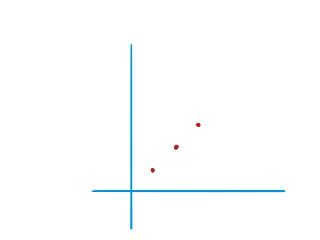
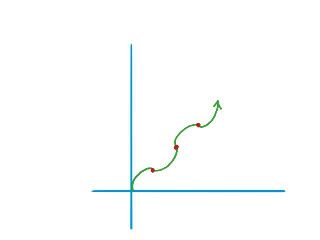
Suppose we have three data points, as follows:
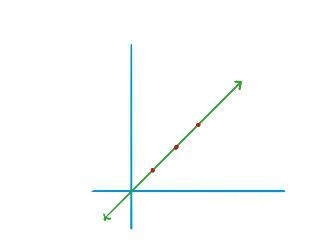
What would you say is the best-fit line? Certainly, the most obvious one is this:
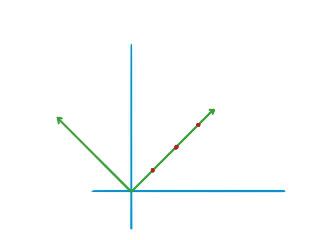
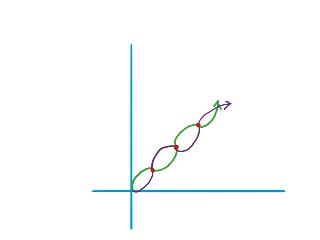
But doesn't this also fit the data?
And how about this?
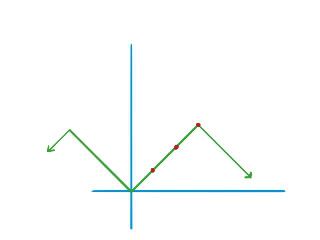
Or this?
So, if we only have those three data points, how do we know which curve we're working with?

The short answer is: we don't. All of those interpretations explain the three points with perfect consistency. And the same holds true for any arbitrarily large (yet finite) set of data points. And no matter how much any one of us, or all of us, may know, we only have a finite set of data and no more than that. So how can we distinguish the possible interpretations from one another? How can we tell whether one is a better explanation than its counterpart?

Get more data points. Rule out inconsistent curves. And if you think you've got a better explanation than the most commonly accepted one, then make some predictions about data points that would be obtained on your interpretation, which would also rule out the competing status quo explanation, and then see if reality bears you out or not. In other words: do science. Test. Experiment. And fuel it with your doubt.

To carry this analogy to its appropriately awkward conclusion, faith-based traditions say, "Here is the data curve! Anything that you think doesn't fit, with your flawed mortal reasoning, is either the result of your failure to understand the perfection of the curve, or the imperfect nature of reality!" But here's the thing: even if we had a complete curve, and could demonstrate perfect correspondence at every single point, we would still need to doubt. Why?

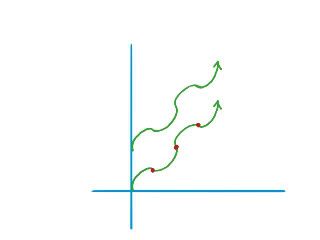
Because what if the "received wisdom" says this:
But reality is this:
Or this?
Can we ever rule out those other possibilities? Or any permutations thereof? Or all permutations thereof?

We cannot, in the final analysis. Other interpretations will always, by necessity, be available. We must look. We must check. And so long as we must look and check, we must doubt. And so, in light of the facts that reality is under no obligation to conform itself to our expectations, and that there might always be some future discovery to upset even our most cherished beliefs of today, we must learn to walk in doubt. From doubt, we can learn humility, charity, respect, forgiveness, tolerance, and a whole host of other things that certainty would eschew. After all, if you're certain that you've got the right answer, then no deviation ought to be tolerated - but if you doubt, then deviations may not only be permitted, they may be embraced.

Walk in doubt, my friends. For if anything in this world is certain, it is that certainty is bunk.

This post was featured in the 46th Humanist Symposium.

The Quantum Mechanic: Chapter Fifteen

The Quantum Mechanic
A Superhero Story of Ethic Contortions

Chapter 14 - Chapter 15: The Hunt - Chapter 16

"God does not play dice with the universe: He plays an ineffable game of His own devising, which might be compared, from the perspective of any of the other players [i.e. everybody], to being involved in an obscure and complex variant of poker in a pitch-dark room, with blank cards, for infinite stakes, with a Dealer who won't tell you the rules, and who smiles all the time."
- Neil Gaiman and Terry Pratchett,
Good Omens

The Entropic Engineer hunts, desperately trying to pick up the trail of his quarry. He felt the pull of the Quantum Mechanic's cosmic disappearing act, saw a trail through spacetime that pointed right at Andromeda. But galaxies are large places, and even solar-system-spanning civilizations can easily lose themselves amid the din and fury of Andromeda's trillion stars.

One trillion stars. Even if the Entropic Engineer spent only a second at each star, it would take him over thirty thousand years to search the whole galaxy. In that time, the Quantum Mechanic could easily pick up and leave for another spot, another galaxy, maybe even hide between a cluster of black holes in the vast darkness between the stars.

He does not have thirty thousand years to kill his enemy. That is too long by far. The fear must be fresh in his mind, he wants to taste the sweet terror as their pointless existences are brought to an end. They are laughing at him. They must fear him. They must! Their foolishness cannot be allowed to continue, they must be forced to face their fate, Quantum Mechanic or no.

But now the Entropic Engineer must face reality. He does not have a race of intelligent minds at his disposal to solve problems for him, but what he does have is several dozen solar masses of angelic drones programmed to find and destroy humans. He leaves a few at each star, just in case something shows up. He can always make more, he can always swallow another star, he can always tap into the bounty of nature before him. There is no need to create from nothing, as the Quantum Mechanic is so irresponsibly hasty to do. That is the work of God alone, and the Entropic Engineer shall not step on the toes of the deity he still worships.

Even now, he hears his Lord's voice, compelling him to obey. Instructing him to hunt. Inspiring him to keep fighting the good fight. He shall restore balance to the Universe, and then he shall reap his eternal reward, remove the sanctifying wards that shield his Earthly body from the Devil's prying eyes, and lay himself to rest. These very same wards stop him from orienting his mortal form in relation to the galaxy, however, and he cannot feel anything but the vaguest tether to his true body. The hunger is exhausting. He looks forward to the final rest after his long hunt. He failed before, but he shall not fail again.

"This is a test," he tells himself. "This is only a test. I must be strong. I must stay faithful. I must place my trust in the Lord, and he shall guide me to victory. Thy will be done. Amen."

The prayer turns into a mantra.

The days turn into decades.

Douglas watches from transported Earth, his mind now spanning the whole breadth of Andromeda. He has wrapped Sol and its environs in a muffling blanket of curled-up spacetime, giving a false atmospheric shimmer to the night sky even from empty space. What electromagnetic radiation does escape is too jumbled to be recognized as the aura of civilization.

And yet the Entropic Engineer hunts on, leaving its angels at each star. He was thorough at first, methodical, but after decades of silence and tracking down a few dozen decoy signatures from Doug's false light cones, the Entropic Engineer's path becomes erratic, random. He becomes distracted, Douglas presumes, re-visiting some stars dozens of times.

"You know," Alvina suggests at some point, "We could lobotomize a few of those robots. Send him on a couple wild goose chases." Douglas ponders this.

"No," he says at last. "We don't want to provoke him. He may start destroying stars, and while I could protect us from the direct harm, we would eventually be exposed. Better to let him hang himself with half a plan, than to give him something to go on."

"Hm. I guess you're right."

The Interview has changed in some ways, and stayed the same in others. Benjamin Gleck still sits across from the Quantum Mechanic, wearing the same suit he wore on his last day at Fawkes News, reading questions from a sheet of paper that keeps changing before his very eyes. Questions are still asked on a wide variety of topics, but most these days have to do with the Entropic Engineer's pursuit, and the Quantum Mechanic's opinions on matters of pop culture. Many humans are around Doug's own age, living relics from the days before his fateful night cooking pasta in the kitchen. Their memories are stored in a variety of media, some choosing to upload themselves into machine intelligence conglomerates, others writing their memoirs or archiving recordings of their favorite day-to-day experiences, and a few choosing to live in the moment and not be burdened by an unfailing memory. Douglas finds this last group the most fascinating: while he sustains their living bodies, they deliberately experience the same things over and over again, always as if for the first time, forgetting the experience by the time they come back around.

Seven hundred years after their departure from the Milky Way, Douglas places a population cap on the solar system. The Million Minds swiftly forms as an organization to deal with this perceived tyranny. They are represented first and foremost by a collective intellect of the same name that resides primarily on the lunar brain. A public debate convenes between the Quantum Mechanic and a robot shell receiving the thoughts of the Million Minds.

"We do not wish to be so constrained," the Million opens.

"I am sorry," the Quantum Mechanic responds, "But I am left with little choice. I cannot keep us safe from the Entropic Engineer without placing some kind of limit on our expansion."

"We are most grateful for your assistance," comes the Million's rejoinder, "And yet we are frustrated by your behaviors. Why do we hide instead of fight? What is needed to defeat the Entropic Engineer?"

"I do not know."

"How long will it take to find out?"

"I do not know."

"What do you know, then? What is your plan?"

"I need the Entropic Engineer to expose himself. I do not expect that he will do this willingly, and yet I cannot devise a way to accomplish this without placing all of humanity at undue risk."

"You are presumably working on a way to accomplish this?"

"I am."

"And what progress have you made?"

"I cannot say."

Several cycles pass before the Million Minds respond.

"We understand that you are at risk of exposing your strategy to a potentially present threat. Again, we are grateful for your assistance. However, we cannot place our trust in you for no reason. We must work out a deal."

"I have little patience for politics."

"And yet you seek to rule."

"I - erm - OK, you've got me there." The Quantum Mechanic runs a gloved hand over its smooth metal head. "What do you propose?"

"It depends on several facts. We must have facts to form our proposition. With current uncertainty, our proposed solutions are too numerous to list."

"Very well. I shall answer to the best of my ability."

"First, can you send us to other galaxies? May our civilization be spread throughout the Universe?"

"I can do this. But the Entropic Engineer was able to follow us here from the Milky Way. I suspect that he shall be able to follow you, as well, and I shall not be able to protect or sustain anyone at so great a distance."

"This narrows down our options quite a bit. We must consult with ourselves."

"Of course." Minutes pass.

"We are decided. We wish to stay within your protection, yet we find your methods stifling. We wish to reach an agreement regarding when to stop hiding and make a stand. Are you amenable to this?"

"That depends on the time frame, as well as the opinions of the rest of humanity."

"Give us three hundred years to convince the rest of humanity of our proposal." Douglas will have to hurry, but he can prepare everything he needs in that time.

"Agreed. If you can get a unanimous decision to stop hiding in three centuries' time, then I shall stop hiding us. If not, then we shall re-evaluate the situation at that point."

"Very well. We shall set about our preparations immediately. Until we meet again, Quantum Mechanic." The representative automaton stands lifeless.

Three centuries pass. Consensus is reached. Humanity will stop hiding and face the Entropic Engineer. Douglas and Alvina are as ready as they'll ever be. The show is coming to an end.

Monday, November 16, 2009

The Quantum Mechanic: Un-Deleted Scene Two

So Zach and I have been discussing whether this is retcon or not. Regardless of the first one, this one definitely is not. But I'm sticking with it anyway, because I don't get to use the word "retcon" enough in my day-to-day life.

Also, I need some more vignette ideas. I only have like two more things I can think of to throw in here, and I'm running out of plot to carry me across the 50K mark. Suggestions wanted!
UN-DELETED SCENE 2: Douglas reads too much

Alvina had noticed her husband growing more distant as he set about fighting crime. It wasn't anything specific - he simply seemed changed, somehow. She didn't want to upset him, but he could sense her discomfort all the same, like a vague cloud of despair storming inside her head.

She confronts him on a Wednesday. He sits alone in his study, fingers steepled, a pile of graded exams stacked neatly on the corner of his desk.

"Doug, is something on your mind?"

"A great many things are on my mind, hon. Were you thinking of something particular?" He looks at her and smiles. Alvina can't tell if that's his usual smile, or if he's only trying to wear his usual smile to put her mind at ease.

"I dunno, you just seem - detached, I guess. A little cold. A little far-off." His look softens. He stands and walks toward her, wraps his arms around her shoulders, kisses her just below the ear.

"Baby, I love you - but you're right. I do have a lot on my mind. Most of Montana, in fact." She pushes him back to look him in the eye, but does not break the embrace.

"Doug." He sighs.

"OK, you're right again. I'm sorry. Look, why don't you tell me what's on your mind, and I'll tell you why I've been acting like a jerk. Sound good?" She leans into his shoulder and sighs.

"Yeah, that sounds good. I'm worried that we're growing apart. I'm worried that you're too involved with your - umm, your 'work.' I'm worried that it's making you cold. And I'm worried that maybe I can't warm you up any more." Her hands trace lazy ovals on his back. He tries to relax, but he's preventing a mugging six miles away.

"I see. It's - look, hon, it's hard to explain."

"Well, then try. Please?" His eyes close tightly.

"I stop murders. I stop rapes. I stop arson. I stop theft. These things make me feel good. I can stop these things, and so I do, and it's all over the news, and people talk about me all over. This is not the problem."

"Well, then for crying out loud, what is?" There is no anger in her voice, only exhaustion and the threat of heartbreak. He breathes deeply. He doesn't know how to say this. He tries anyway.

"It's the things I can't stop."

"Like what?"

"You know - hate, depression, bad relationships, a lonely drunk passing out on the living room floor. Crimes are obvious evils, I can easily justify interfering with that stuff. But how can I make it OK for a gay teenager to come out to his parents? What do I do when a child blames herself for her father's disappearance? How do I fix that?" Alvina squeezes her husband's shoulders in her hands. Douglas pulls her closer into his embrace, leaning on her a little.

"Listen, Doug - you can't fix people. You can help them, but you can't fix them."

"I know, but I want to. And it still hurts. I can't just shut out the awareness - what if things get violent? All I can do is sit and watch as things go to Hell."

"Baby, I'm sorry - I'm so, so sorry. I wish I could do something."

"You're listening. You're here for me. You love me. That makes me - " he chokes back a sob. Another comes. And another. Douglas stops fighting, and lets his wife comfort him, even as he prevents a car from losing control on the highway. "That makes me feel like a real person, not just - not just some alien cosmic do-gooder."

"Doug, honey, you are a real person." He sniffs.

"It's not just that, Bea. There are libraries. Computers. I can't quite take it all in at once, but it all hits me. I see - I see fucking everything. History, case law, criminal records, psychological workups, it doesn't matter whether it's in a police precinct, it wouldn't matter if it was in For Knox. I see it all. There's so much." He shudders. "Bea, the world is a really screwed up place."

"I know, love." She wipes away his tears, kisses his cheek. "That's why you're so important. That's why it matters so much for you to do what you do."

"I know - it's just - it's hard sometimes, you know? I just wish I could fix everything right now. I wish I could do more than just watch, but I don't know what to do. And I don't know who to talk to. I don't want to hurt you with - "

"Doug!" Alvina cuts him off. Her tone is simply firm. "If you go through something, I am here for you. This is what I want. This is why I'm still around. I. Love. You. And that means that if something's on your mind, then you need to tell me, or I can't help you carry your burden."

"It's not that, I just - " He is silenced by her stare. "You're right. Again. And I'm sorry. Again."

They stand for several minutes, rocking back and forth in each other's arms. Doug finally breaks the silence.

"Thank you."

The Quantum Mechanic: Chapter Fourteen

The Quantum Mechanic
A Superhero Story of Ethic Contortions

Chapter 13 - Chapter 14: And Behold, It Was Good - Chapter 15

"High in the mountains there is a small, hidden valley. In this valley there is small town. Physically isolated, modern communication technology keeps it in touch with the rest of the world. Even so, the town's people still remember traditions passed down through countless generations. When a new idea comes along, they don't dismiss it; but neither do they ignore the hard-won wisdom of their ancestors."
- James Huber,
The Physician and the Priest

Sage travels through the village, leaning upon her staff-of-walking. She smiles at people, greeting them in passing. The Sun hangs low in the sky, dark red through the exhaust belched by the rock-eaters. Invisible at this distance, Sage knows that the smoke-gatherers must be flitting to and fro throughout the cloud, cleaning up the waste of the rock-eaters in order to do their own building.

As Sage stares off into the distance, the feeders return from their labor. People in the village whoop and cheer as the pack lumbers into the village, exchanging hugs, kisses, and the occasional playful bite with all who they pass. The gatherers begin to scamper up Mother Tree, collecting her fruit to share with all her children. At twilight, the great song-flowers open their chitinous bodies, exposing their delicate vocal cords to the cooling air, harmonizing with one another as they prepare to sing their lullabies. A few impatient ones grab low-hanging fruits and begin to eat immediately.

Everyone in the village moves from their places-of-working to return to their home in Mother Tree, enchanted by the building harmonies as the song-flowers hear each other out underneath her great canopy. Feeders, tillers, tenders, all file into their mossy knots-of-resting to wait for the gatherers. Sage watches her brothers to to their places, waits for the gatherers to deliver the nightly meal, and then begins her climb. She smells each knot-of-resting briefly as she passes. A few have been injured in their labors, but they are calm and they shall be well. Towards the top, one of her youngest brothers is troubled. She smells this.

"Child, what is your name," she asks to the reclining youth within.

"I have called myself Grass."

"What is your trouble, young Grass?" He sighs, fidgets nervously.

"I'm not sure. A few things have been on my mind today as I watched the tenders pick up Mother Tree's fallen branches."

"Then think on what troubles you. I shall return to you after I have eaten." Sage kisses her brother upon his forehead, then continues her climb to the top of Mother Tree, to her own place of rest.

Sage does not have a knot-of-resting, as all her brothers do. She was born from the great flower atop Mother tree, the first and oldest of the children to open herself to the Sun's warm embrace. Soon, Sage shall grow her wings-of-journey and fly over the horizon, out of sight from the Mother Tree that gave birth to her, and she shall become a Mother Tree herself. She shall then birth her first daughter, who shall watch over all her other children as Sage now watches over her brothers.

But now, it is time to eat from Mother Tree's bounty. Unlike her brothers, Sage does not wait for a passing gatherer to bring fruit to her. Sage grew up before the gatherers were born, and she ate from the fruits that grew around her. The gatherers leave these sun-ripened orbs for her, taking only from the fruits that grow down the thick hanging vines beneath Mother Tree's expansive canopy. Today, the fruits that are ripe for Sage are a dark red bloodfruit, and a bright pink sweetfruit. She savors the coppery taste as she slowly sinks her teeth into the bloodfruit, carefully sucking the thick juice so that it does not run down her face. She contemplates life as the sky grows ever darker. A speckled spice fruit tempts her, but it is not yet ripe. One day, she shall have it; until then, she shall be patient. Green sky-berries continue to grow around her sleeping place, and once they are blue, then she shall eat them one at a time until she has grown her wings-of-journey.

Her meal done, Sage descends the stair-like boughs of Mother Tree to return to the knot-of-resting of her brother, Grass. She strokes his hair and asks him to tell her his thoughts.

"I do not feel my calling, as others seem to do. I don't know what's wrong. I feel like I should be called, and yet I am not."

"Have patience, my brother. Your calling shall come in time."

"And what if it doesn't? What then? All our brothers have their callings, even the youngest who have not yet molted. What is mine?"

"I cannot say, brother Grass. It is not my decision."

"Then whose is it?" Sage draws a deep breath, closes her eyes, and calms herself. It is sometimes difficult for her to remember that her brothers do not share the great chain-of-memory that has passed from Mother Tree down to her. She finds her center, opens her eyes, and speaks from her heart.

"It is no one's decision, for nothing is decided. The earth beneath us speaks to Mother Tree, and she listens and passes the message on to each of us in our sleep, from the holes-of-dreaming you see all around your knot-of-resting. But the earth does not decide, it simply is how it is. Mother Tree knows how to listen, and she tells us in our dreams."

"Yes, yes, the song-flowers lull us to sleep with these tales every night. But what if they're wrong?"

"I see. The seed-of-doubting has taken root in your mind. We shall call a meeting, and summon the Who Man to show us the way."

"Do we have to call a meeting? I don't want one just for my own sake. Besides, the summoning of the Who Man at a meeting is for the time-of-doubting, when all have fallen from the path. I am the only one of our brothers who has not heard his calling. Can't the Who Man just tell me?"

Sage thinks for a while. She has never summoned the Who Man without a village meeting; but then, she has never summoned the Who Man at all, in her lifetime. Her memories of ancestral summonings in days long gone grow cloudy. She knows not what to do, so she listens to her brother instead of her memory.

"You listen to the song-flowers well, brother Grass. You are right, this is a different situation. I shall summon the Who Man, and if he does not come, then we shall call a meeting. Is this fair?" Grass nods. Sage helps him to his feet, for drowsiness makes him feel heavy in his own body, as this is normally the time for sleeping to the sounds of the song-flowers. They climb the rest of the way up Mother Tree. Sage takes a large orange berry from the vine-of-calling, crushes it between her fingers, and rubs the juice on the palms of her hands. She works her hands through the mossy mat on which she sleeps, reaching down to the heart-of-calling, and massages the berry juice into the large gland. They wait a few moments. Mother Tree shivers, though there is no wind upon the plain.

Crackle. Poof.

A glowing orange figure appears atop Mother Tree. Grass squeaks in surprise, and grabs for Sage; she wraps her arms gently but tightly around him. She greets the Who Man as its orange glow fades to gray.

"Argh," the Quantum Mechanic slaps its metal forehead. "I told you guys like a million times, it's 'hyoo-man.' Human. Anyway, what's going on? This doesn't look like a meeting."

"Our apologies, hyoo-minn." Sage pronounces the word stiffly, for it is her first try. "I am Sage, this is my brother Grass. The seed-of-doubting has grown in his mind, for he does not hear his calling."

"So? He's probably still young. Give it time, kiddo. You'll perk up."

"But I am not the youngest of my brothers, and they have heard their callings!" Grass is still frightened by the robot before him, but not too frightened to speak his mind.

"Hmm, I see. You'll have to bear with me, I didn't build you guys, but let me take a look."

"You did not build us? Are you not the Condom Mechanic?" Sage is evidently confused as she speaks. The Quantum Mechanic does another facepalm.

"I - look - argh. This is what we get for programming Earthling language into non-Earthly life. I am not the Quantum Mechanic, I'm his wife, but I'm borrowing this body so I can help. He's working on faster-than-light travel, and they're just about finished. But the last steps are the hardest, so he's using his full attention for that."

"Light - travels?" Grass is evidently confused.

"Quiet, Grass, the song-flowers have not yet told us of the outer heavens. This shall be explained to you in time."

"But - "

"Silence. If you must know now, then I shall sing to you of the great clouds and their children, the stars, after we have spoken with this human." Grass is satisfied with this.

"OK, so - Grass, right?" He nods. "Good. Look, I'm not sure why you haven't heard your calling yet. You say that all your younger brothers have heard theirs, though?" Another nod. "OK, that's good. This isn't a seed-of-doubting we're working with, then. In all likelihood, it's just something to do with you. Let me look at your knot-of-resting - it's the only empty one, right?"

"Yes, I can take you to it."

"No need. The holes-of-dreaming are secreting their pheromones even now. Here, let me put you to sleep for a moment, and I'll see what's going wrong." Grass nods, then goes limp in Sage's arms. Aromatic compounds fill the air, and Sage wafts the vapors into her brother's nose. Alvina peers into his brain, watching neural connections as chemicals dance around them, simulating his dreams in her own mind. Something is missing. She looks more closely. There's a misfire, somewhere. Maybe a developmental defect, though those are rare. Maybe an injury, those are more common. It doesn't matter, she has found the misfiring cluster and created a new connection. Everything is working perfectly once again. She guides Grass slowly out of his slumber after making sure that he can hear his calling now. His eyes open, and Sage can smell that his mood has improved already.

"I heard it! I heard it, Sage my sister! I know my calling now!"

"Good, my brother. How clear was it?"

"It is far off yet, but it is clear. I am to be a tiller, keeping the earth soft so that we may walk upon it. I shall molt my body and be as my other brothers, in time. But I can hear it now, just like the song-flowers tell us! It's exactly what I had dreamed!"

"Good, very good." Sage kisses her brother on the forehead, then lifts him to accompany him back to his knot-of-resting. "Thank you, human, for all of your help this night. We are sorry to keep you from your work."

"Oh, it's no trouble, sweetie! My husband's the busy one, this kind of thing is what I'm here for. You folks have a great night, and keep up the good work."

"We only walk the path you have laid before us."

"Then you walk it with grace and wonder. You walk it very well, indeed. Farewell, sister."

"To you, as well."

Crackle. Poof.

Grass sleeps soundly, and dreams of his calling. Sage feels her faith flowering anew in the depths of her heart. She dreams of the day far-off when they shall all eat of the black fruit and join the human in his fight against his lesser self, the darkness who pretends to be light. They shall wrap themselves in darkness and tear asunder the very heavens to come to the aid of their maker. Sage does not hope for battle or bloodshed, but she does look forward to the final vanquishing of evil.

Sunday, November 15, 2009

The Quantum Mechanic: Un-Deleted Scene One

No bells or whistles for this, I'll have to find a place to insert it later. Maybe this will replace the conversation with Riley Williams. Anyhow.
UN-DELETED SCENE 1: Douglas wins a prize

Randall James knocks on a door in Montana. Alvina Orange answers, then stares mute for a moment as she recognizes the man standing before her.

"Omigosh," she gushes. "I, uh, I'll go get - no, wait, you come on in, make yourself at home. I'll go find Doug, OK?" Randall smiles, nods, and steps inside.

"Hey, there," Douglas says affably as he walks into the living room. "I see you're not above a phone book. To what do I owe this visit?"

"You need to do a little PR work, my friend. I want you to have the Randall James Prize for Proof of the Supernatural."

"I don't need to be rich, Randall. I just need to work on building my powers so that I can do some real good."

"I understand, and this will be real good. Here's what you do: you take a few minutes to show us that you're 'real magic,' then you donate the million dollars to charity. I could think of six really deserving ones right now. No matter whether it ends up being six weeks, six months, or six years until you decide to do your thing, you'll be helping a lot of needy people in the meantime."

"Well, that's true. But - "

"But, nothing! This is a win-win situation! You're already public, you'll get a ton of good publicity, and you'll be laying the groundwork overseas by showing some good will to those outside your home nation."

"I understand. I even agree. Here's the problem: do you really think a bunch of SkepCo investigators are going to just sit and listen as I explain my powers? It will take too much time. I'd rather stop actual crimes than mere tragedies."

"Who says you can't do both?"

"Randall, I can't be everywhere at once."

"But you're here, now. Were you also here when you came to show me your fancy new duds?"

"Yes. What of it?"

"I'm on special assignment from SkepCo to find you. I've got two weeks to get them something, but until then, I'm completely unaccountable. So you put me up here, and I get my scoop. Then you take a few minutes to go through our tests, and you get the prize. We'll give you cash, even. Hell, if you like, I can even handle the whole thing for you! It's my money, I've just got it tied up in SkepCo waiting for some asshole to come up and take it. So do you feel like being that asshole?"

Douglas thinks. It seems almost too easy - no, wait, Randall is just making it easier for him. The paperwork, the write-ups, devising tests that Douglas can complete quickly, this is all hard work. But Randall will be the one doing it, leaving Douglas free to fight crime in the meantime.

"OK, I'm sold. When do we start?"

"Can you talk and fight crime at the same time?"

"Yeah, that's what I've been doing this whole time."

"Then how about now?"

The Quantum Mechanic: Chapter Thirteen

The Quantum Mechanic
A Superhero Story of Ethic Contortions

Chapter 12 - Chapter 13: Defeat - Chapter 14

"If there's no war outside our heads, why are we losing?
I don't ask for much - truth be told, I'd settle for a life less frightening"
- Rise Against,
Life Less Frightening

"Well," the Entropic Engineer says, "You had better hurry, then. I plan on razing this entire system down to rocks and wreckage."

Douglas feels a shift in the gravitational pull surrounding the solar system. Countless shapes - yes, Doug is completely incapable of counting them - swarm and dance, swirling in to converge on Earth. Accelerating. Twisting and turning. Douglas stops trying to take it all in; he folds spacetime around his mind and flings his consciousness out into the slowest moving spot in the horde.

Angels. Polished, angular metal angels, all sharp and shiny in their featureless homogeneity. "I hope you like my army," his nemesis continues, "They're likely to be the very last thing you see. I started with Proxima Centauri, but then I thought to myself, 'No, a single stellar mass may not make enough robots.' So I made more."

Raw numbers, Doug's only weakness. He can't keep track of them all. His starbeam cannons kick into gear, opening wormhole apertures into stellar cores and tapping a bit of their tremendous power. The first one fires, punching a hole a mile wide through the teeming morass. Those in the center of the blast are vaporized, hundreds of thousands more flung into their neighbors with explosive results. "Now THAT is a neat trick! You'll have to teach it to me some day. You might even have a full day, so I guess I could pencil you in for tomorrow, if you've got time." The Quantum Mechanic glowers at the Entropic Engineer, orange lightning crackling about its body in impotent rage. More cannons are needed.

Douglas sets bout making cannon after cannon, while the swarm continues constricting around the entire star system. Round after round fires, and Douglas is no closer to wrapping his mind around them all. He begins pulling colonies, laboratories, even the outer planets and plutoids, all towards Sol, buying more time.

"Ooh," the Entropic Engineer exclaims with mock excitement, "Does this mean we have time to play our guessing game? Let's see if I can guess your name! Does it start with," the gleaming white apparition strokes its chin in mock thought, "A? Does it start with A? Aaron, Adam, Alfonso, Alonzo? No? Then how about B?"

A few million gunmetal gray puppets appear in the midst of the angelic army. Each of them carries inside of it a thermonuclear device, and they begin taking pot-shots at passing robots even as their bodies are flayed by razor-sharp wings. One detonates, the blast destroying many, the resulting EMP deactivating far more. "You continue to surprise me, my friend! But even at this pace, you won't be able to stop me. It would take you seven days to undo all that I have made, but my Heavenly Host will have scoured your pathetic civilization clean by this time tomorrow. That includes you, by the way.

"So it's not a B name. What about C? Am I getting closer?" Douglas gives the fire order to all of humanity, and they unleash their fury. They can't aim at specific angels, they're too far and too fast for even a light-speed weapon to be accurate. But they are so numerous that their numbers work against them - any passing laser fire has upwards of a ninety-five percent chance to strike at least one passing angel.

The solar system is ablaze with conflict, heat and light pouring out, robot angels pouring in. Douglas is losing.

"Why are you doing this? What's the point? What do you get out of this?" The Quantum Mechanic speaks to the Entropic Engineer with palms open, frantic desperation creeping into its voice.

"Victory."

"What?! Victory over what, for crying out loud?!"

"Pointlessness. You have been gallavanting about, painting a very pretty picture, and I'm just sick of it. So I'm doing the only thing I can: I'm tearing it down."

"But there's no point in that, either!"

"Of course there is. I'm teaching you a lesson. And upholding the fundamental nature of reality."

"Oh, you think so? And what would that be?"

"Nothing. You have been creating a whole lot of anything. I am here to restore the nothing."

"You - you - you don't even know how this works, do you?" Douglas is aghast. "The whole Universe is always nothing, it has always been nothing and will always be nothing! For all the matter that we see, there is dark matter to cancel it out; for all the energy there is, dark energy counterbalances the disturbance. The net energy of the entire Universe is precisely zero - it's nothing - I'm just trying to create the most interesting and fulfilling nothing that I can. What's so wrong with that?"

"It is vanity, Douglas. Pride, gluttony, lust, sloth, greed, and envy - you have made it possible for six of the deadly sins to be realized by all persons, at all times. The only one you have managed to quash is wrath, and here I am to complete the picture. Here I am to be your undoing, the logical end result of all that you have worked for."

"So what? So fucking what? People can do what they like, and you think you have to come piss on our parade? What's your fucking problem?"

"You have stamped out the possibility of virtue. Restraint, delayed gratification, these values no longer hold meaning when the magical sky-daddy gives people everything they want."

"But I don't." The Quantum Mechanic's tone is firm now, resolute. "I can't give people everything they want, I can only give people some nice things that they've come to associate with success and living the good life. We still have work to do, we still have things to find out. I don't know everything, and I can't do just anything. We haven't lost the value of a hard day's labor, goddammit! We're just defining life in a different direction now."

"Vanity of vanities! This conversation is over. You can no longer run from the consequences of your actions. Your little hippie commune is coming to an end."

And with that, all is gone.

It takes a moment for the Entropic Engineer to realize what has happened. The Heavenly Host stands inert, their targets gone, their raison d'être vanished without so much as a crackle of orange lightning. Angelic wreckages drift through empty space, starbeam cannons initiate self-destruct sequences, and the Entropic Engineer floats in the near-vacuum where Megiddo used to be. The pillar of light dissipates. No point in putting on that show any longer. Now where did they go?

Sol and its orbital entourage have found themselves yanked through spacetime into a particularly noisy region of Andromeda. With any luck, the Entropic Engineer moved his physical body in one of the many disappearances that were staged over the last several months. Maybe they'll never see an angel for a million years. Without luck, Douglas reasons, he has brought his enemy with him and it's only a matter of moments until he gets his bearings back. Either way, Douglas needs to be ready.

"Hey, Bea?"

"Yeah?"

"I need you to be my secret weapon now. We've got to work on expanding our minds. Maybe the two of us together can nail this guy."

"I hope so, baby. I really, really hope so."

Douglas and Alvina peer into black holes, vivisect the hearts of stars, and create life again and again. They probe each other for weaknesses, looking for threads in each other's minds to pull and unravel the whole. They create simulacra of their native solar system, making decoy light cones to throw off the Entropic Engineer if he tries to follow humanity with his angelic horde.

But Douglas needs something more. Something big, something really big, in case something bigger than he can imagine comes for him again. He needs to be a step ahead. And so, in the darkness between the stars, a carbon lattice begins to form. It outlines an enormous superstructure, light and strong enough to not collapse in upon itself despite its great size. Live or die, this shall be the legacy of Douglas Orange, if he can only complete it in time.

As days roll on, Douglas finds himself unable to reasonably estimate just how big an "if" that is.

D's Sunday To-Do List

  1. Write Chapter 13 and put it up.
  2. Write a little ret-con vignette for earlier.
  3. Write Chapter 14 for noon tomorrow.
  4. Do laundry!
  5. Then, if that's all done, you can play Dragon Age for a little bit.
  6. EDIT: Oh! I forgot about walking with the Other. But I just did that - now I'm starting again at step 1.

Saturday, November 14, 2009

The Quantum Mechanic: Chapter Twelve

The Quantum Mechanic
A Superhero Story of Ethic Contortions

Chapter 11 - Chapter 12: Armageddon - Chapter 13

"It's like they gathered up the city, sold it to the Devil, and now
It's gone to Hell, and they wonder how"
- The Protomen,
Light Up the Night

"Can you give superpowers to other people?"

"You know, I honestly have no idea. I often simulate superpowers in alternate reality games, but I've never given 'actual' superpowers to anyone else. I'd hesitate to do so, if only for the reason that it could create problems."

"What kind of problems?" Gleck starts down another one of his elaborational tangents.

"Um, you've seen the Entropic Engineer, right?"

"Yeah, I think we all have."

"Well, that seems to be a result of my powers. It may be the case that there's no way to get rid of it without also getting rid of me. And if so, then I guess I'll just have to step down."

"You - you would do that? After all that you've done for - for everyone? You would just walk away from it all, kill yourself to eliminate a threat?"

"If that's what I have to do - then that's what I have to do."

Alvina's brow is furrowed, even as her head lays on her husband's chest. She half-listens to the Interview as Douglas runs a hand through her hair.

"Honey?" She lifts her head to look at him.

"Yeah, Bea?"

"I want you to teach me to do what you do." Now Douglas frowns.

"Why?"

"Maybe I'd understand you better, that way. Maybe we can teach everyone. Maybe we can all be as gods, and no one will have to depend on you. You could set people free for real."

"Yeah. Maybe." Alvina shifts under the covers, folding her arms over Doug's torso.

"Well, c'mon - don't you think it's worth a shot?"

"I don't know. I don't know what would happen. I mean, what if everyone gets their own Entropic Engineer? What if that doesn't happen, but people turn against each other again?"

"Well, then that happens. But the Universe is flat and infinite, right? Couldn't someone just take off if things got too hairy for them?"

"Yeah, sure, but what if someone decides to create some life and rule as a tyrant over an entire species? Or several of them? What if someone deliberately creates lesser life forms just to watch them suffer? I don't think I could live with myself if I allowed that to happen."

Alvina is silent for a long moment. Her mind is confused now, messy with uncertainty. "It's like this, babe: it doesn't matter whether I could make people powerful or not. I'd need to make them good, first. Otherwise, I'd be abusing my own power, carelessly trusting it to other people before being sure they'd know what to do with it. Like the military giving a rifle to someone on the first day. It's just irresponsible."

"I guess you've got a point there." She thinks for a moment. Douglas sees the question form in her mind even before she does. "Can you still teach me?" He sighs in that resigned fashion that lets her know he's going to give in. She smiles.

"Yeah. I guess I had better. Someone's gonna have to carry on my work if I die."

Ben Gleck reads another question from the paper in front of him. "How will you fight the Entropic Engineer when he comes back?"

"There are a variety of things we can do. I fully expect him to lead a multi-pronged assault, so I have stockpiled smart rifles and powered armor for everyone in the solar system. We'll need everyone we can get, and even if you don't want to fight - well, the fight's probably coming to you, anyhow." Gleck swallows hard.

"And if that doesn't work?"

"Then we're all dead." Gleck stares mute for a moment before asking the next question.

Douglas teaches physics to his wife. He starts with vectors, the same place his own education started in high school. Trigonometry, calculus, force diagrams, tools and concepts organize themselves into an integrated conceptual hierarchy in Alvina's mind, under the expert tutelage of her husband. He senses when she is tired, frustrated, or not understanding, and he tailors his teaching style specifically to meet her needs. Her experience as a science journalist prepares her for dealing with concepts she can't quite wrap her mind around, and one by one, principle by principle, Douglas helps her overcome the hurdles and wrap her mind fully around each facet of reality, in the general order of increasing subtlety.

In two months, she is attending his lectures, a fantastic student just like all of Doug's other charges. She soon surpasses even them, for her private sessions do not stop. The Interview continues apace.

"What is the good?"

"It's many things. First and foremost, it's a word we made up to describe what helps us give meaning and purpose to our lives. But if you want to know what contributes best to a flourishing life, I've found four things: happiness, peace, love, and wisdom. We need all of these things."

"So what's happiness, then?"

"Many things to many people. So long as we do no harm, we should strive to accommodate as many different visions of happiness as we can."

"And peace?"

"Simply the absence of violence. Like happiness, it manifests in many ways."

"Love seems obvious, but does it have any special meaning to you?"

"I think of it as resonance, in a metaphorical way. Identifying so well with another that their happiness means as much to you as your own. There's admiration in it, respect, a little bit of expectation, and a whole lot of forgiveness. It's complicated. But you don't need me to tell you that."

"Fair enough. What about wisdom, though? What's that?"

"Here's the part where I'm supposed to get all mystical on you, right?"

"I dunno, you tell me. You're the guru."

"Heh. I guess so. I don't think wisdom can really be 'explained,' because apprehending wisdom is the same as having it. There are ways and ways of coming at it, but the answer all by itself won't mean anything to an unwise person. Wisdom isn't just having answers, it's understanding. That's not something you can give someone in words. You can tell someone all the answers you want, but wisdom comes from understanding the questions in a more robust way. And from understanding that you'll never have all the answers."

"Sounds complicated."

"This is 'wisdom' we're talking about here, not a carburetor. It's not a 'thing,' it's more like an attitude. It's a way of attacking the big questions: an open mind, a calm heart, and a willingness to see things for what they are, no matter how uncomfortable that might make you."

"So how do you know if you've got that?"

"I guess you really can't. It's not something you can 'get,' it's more like something you 'do.' If you're doing it right, then you'll have those things: an open mind, a calm heart, and a willingness to see things for what they are. You'll probably also start seeing a whole lot of things as rather silly, and you'll probably be OK with that."

"So, what, are wise people just happy all the time?"

"No, that's happiness, which is an emotion. There's no guarantee that wisdom will lead to happiness."

"Well, then what's the point of being wise, if it won't make you happy?"

"Nothing, if all you want is to be happy. But if you want to be wise, then wisdom can help you see that maybe happiness isn't all it's cracked up to be - I mean, it's great stuff, but we have other priorities, too. There's no single end-all, be-all for life. We are complicated critters."

"OK, so is it a kind of emotional asceticism?"

"No, not exactly. But that's one way of coming at it."

"I'm starting to see what you mean about this being complicated."

"Good! Now you're getting it!"

The Entropic Engineer appears at Megiddo. Extending an arm to the sky, a great pillar of light rises, a beacon to signal the destination for Heaven's approaching army.

"I'm sorry," the Quantum Mechanic says to Ben Gleck, "I'm going to have to call a recess. We've got work to do."

"Wh-what do you mean?"

"The Entropic Engineer just materialized at Megiddo. And I can feel a great gravitational pull from - from - oh, my. From everywhere." A laser rifle appears in the Quantum Mechanic's hands, and it extends the weapon to Gleck. "Here. You'll want this."

"But I - I've never fired a rifle before!" He takes it in his hands anyway.

"Don't worry. It's bonded to you now. It knows what to do."

"Which is - what, now?"

"Kill angels. What else?"

People all over the solar system are filing into great ships, small pods, suits of powered armor, and trying to make some sense of the mounting threat. The Quantum Mechanic appears at the Entropic Engineer's beacon, head cocked at the spectacle.

"Ah, you've decided to show yourself."

"Here I am. Are you planning to rock, as tropical storms are wont to rock? Or is it still possible for diplomacy to stem the tide of battle?"

"I suppose that if you repent of your sins, you may yet be written in the Book of Life. Accept Christ into your soul, and you shall be forgiven. All others who do the same shall walk with us, and be spared the coming flood. But Earth, Sol, your civilization - this all ends today. There shall be nothing left here when Heaven's work is done."

"That may well be. I'll tell you what: if Jesus Christ himself comes down - " A man appears next to the Entropic Engineer, looking for all the world like an itinerant prophet of the Ancient Near East who has been through Hell. "I, uh, wasn't finished, you know." Silence. "OK, fine. I am finished. What do you want, guy?"

"My son, I want you to forsake your sinful ways, to accept me into your heart, and put an end to this foolishness. There need be no death on this day, but evil shall be ended once and for all. The decision is yours as to what side you shall take."

"That's all very nice, but I hope you understand that I'm just a bit skeptical. I mean, I could poof some harried-looking preachy-types into existence, too, if I wanted. Here, watch." Half a dozen figures appear, Mithras, Horus, Mohammad, Moses, Elijah, and the Buddha. Each of them starts shouting prophecies in their native tongues. They prattle on for a few seconds, then disappear as abruptly as they had arrived.

"My friend Thomas was skeptical, until I allowed him to put his fingers through the holes in my hands. We stand here on the brink of war, and if a simple word or deed will bring you into my father's house, then I shall be happy to oblige you, my son."

Douglas thinks. How could God prove his divinity? He himself is able to do all the things that God is said to have done, so how can he know that he's not just being tricked by the Entropic Engineer? The Quantum Mechanic strokes its metal chin with a gloved thumb and forefinger. What has the Entropic Engineer never done? What has he himself never done?

Oh. Duh.

"Very well, I am willing to let this be settled on one question. Answer it correctly, and I am your man. I shall fight at your side, if need be, against any who do not follow me to your kingdom. Is this a satisfactory deal?" Christ nods. "OK, and if you can't answer my question? What then?"

"Then, my son, I am sorry to say that we shall be at odds. If you are not with me, then you are against me."

"Oh, really? I could have sworn that Luke 9:50 says, 'For he that is not against us is for us.' Or do I have that backwards?"

"But in the gospels of both Luke and in Matthew, it is written, 'He that is not with me is against me: and he that gathereth not with me scattereth.' Do not quote scripture lightly."

"Fine, but Mark 9:40 says, 'For he that is not against us is on our part.' We need a tie-breaker, don't we?"

"Enough of this foolishness. Ask your question."

"As you wish. What is my real name?"

Silence.

"Hello? My real name. Y'know, the one I used in school, it's written on my birth certificate. The All-Knowing King of the Universe ought to know that, yeah?"

Silence.

"Look, you could at least give me some kind of answer at all." But Douglas has cleaned his light cone of all traces that could expose his secret identity. There is no evidence. It must be known from nothing, and cannot be found. Not even Douglas himself could find it, even if he tried: government records, papers, driver's license, even if these jokers knew his true face, they could never match it to his real name. Douglas Orange doesn't even exist on paper any more. The Quantum Mechanic hums the theme song from Jeopardy. Christ makes no move. The Entropic Engineer steps out from the beacon, and Christ disappears.

"All right. You win. Now prepare to die."

"You really have no idea who I am, do you?"

"Not a one. What of it?"

"Then you are not me. You are not my reflection. Nor are you of divinity. You are someone else. You are mortal."

"Guilty as charged. But again - what of it?"

"You have one chance to surrender, or I will find you, and I will eliminate you as the threat you are."

"Hmm. I see. And I do not surrender. But you have no idea who I am, either - do you?"

"And so the race is on."