Update Schedule

This blog updates irregularly.

Friday, October 16, 2009

101 Interesting Things, part twenty-seven: Kaprekar's constant

Hi, everybody! D here, with a magic trick just for you! I'm only half-joking, I promise.

Today's 101 Interesting Things is brought to you by Rhodopsin. It's also interactive, and all you need is a pencil and paper, or a calculator, or a head for numbers. Let's get started! Pick a four-digit number, any four-digit number, as long as all four digits aren't the same (you can't pick 0000, 1111, 2222, 3333, 4444, 5555, 6666, 7777, 8888, or 9999). Numbers with leading zeroes, such as 0103, or even 0001, are perfectly fine.

Got it yet? OK, now arrange the digits in ascending and descending order. For example, if you picked 4092, you would write 0249 and 9420. Still with me? Now calculate their difference. With our sample, 9420-0249=9171.

Lather, rinse, and repeat:
9711-1179=8532
8532-2358=6174
7641-1467=6174
OH SHIT, SON! Look at that! Now here's the magic part: I bet you can't find a number that will take more than seven steps to get to 6174. You know why? Because 6174 is Kaprekar's constant. Or, rather, it's called Kaprekar's constant because an Indian mathematician named Kaprekar discovered this rather interesting property of what I would have thought was just a regular old number. Now, quick! Go and pull this trick on anyone you can, and find a way to take their money with it!

EDIT: An anonymous contributor has mentioned, below, a sourceforge.net page which lists several interesting consequents of the Kaprekar constant. It's not all quite as interesting as perhaps the Kaprekar constant might be in everyday life, but it's still way more interesting than your life is in comparison to... umm... any historical figure. That is, assuming I'm not addressing any historical figures at the moment... anyway, it's November now, which means that it's National Novel Writing Month, which means that I'm devoting most of my time to novelling and less of it to blogging. Point is, if you like math, you should check out Anonymous' contribution.

Thursday, October 15, 2009

Rethinking the Evolutionary Ethic: Towards a Scientific Ethics Once More

I've done quite a bit of writing in the past concerning the arbitrary and made-up nature of ethics as a field of study. I still stand by the proposition that ethical judgments and systems have no more bearing on reality than the rules of Chess or the particulars of this or that language (and if you think that language can correspond to reality in any metaphysically interesting ways, then do I have something for you!). However, I've been rethinking the matter of whether "good" lessons may be derived from a state of nature; as Richard Carrier points out, you certainly can derive an "is" from an "ought" (2:30), as long as you accept that morality is a system of hypothetical imperatives; but you have to be really fuckin' careful or you'll wind up balls-deep in naturalistic fallacies. This entry has been percolating away on my back-burner for quite some time, and I think I've finally got something refined enough to show, so here goes. Oh, one brief caveat: this is an ideal to move towards, not something we can do right away (kind of like how you can't force people to be free, or impose democracy on another nation... cough, cough...). We should take it as a long-term goal to get everyone on-board with this kind of ethic, is what I'm saying.

The bottom line is this: every situation or event lends itself to a "lesson" of sorts, a thing you can take away and learn from that situation or event; but figuring out just what the lesson is can be sticky business. Sometimes the lesson is big and important; sometimes the lesson is that not all lessons are big and important; sometimes the lesson is that you don't always get a new or interesting lesson from every situation or event. If your friend calls you a douchebag, then there are various lessons that you could take away from that: you might need to learn that you are in fact a douchebag from time to time; you might need to learn that sometimes your friend doesn't have the very same idea of douchebaggery as you do; you might need to learn that sometimes the opinions of your friends should be taken with a grain of salt; or maybe you should learn to be a douche-nozzle, not a douchebag. Each of these things is true, by the way, but the particulars of the event (the "full relevant context") will dictate what is the most important lesson to learn at the time. There is a Japanese saying: "shikin haramitsu daikomyo," which pretty much means, "every action holds the opportunity to learn." Insofar as evolving is an action, there is an opportunity to learn from it.

So what can we learn from evolution? What is the lesson to derive from all these molecular replicators puttering about on this rocky, watery marble of ours? Well, this is going to depend on what we adopt as our "full relevant context," and this in turn is a matter of perspective. If we limit our context to the idea that nothing lasts forever, we might rather easily adopt the ethic that we should get all we can while the getting's good. If we limit our context to the idea that any conspiracy of doves will be easily infiltrated by a lone hawk and its descendants, then we might adopt the ethic of, "try to be a hawk in a conspiracy of doves." Combining these two, we might adopt the ethic of, "try to be a 'concealed hawk' (or a cuckoo) in a conspiracy of doves, to extend the conspiracy as long as you can so that you and your descendants may prey upon it as long as possible." Or, in short, "domesticate the doves." So what perspective shall we adopt, what shall we consider as our context from which our ethics shall be derived?

In seeking an evolutionary morality, we must take into account the relevant context of evolutionary situations and events. Which ones? Hopefully, all of them. The following three things will apply to all evolutionary situations and events: every evolved and evolving organism will be a molecular replicator, and so in this sense, all the world is kin; the environment shapes replicators even as those same replicators shape it in their turn; and natural selection is a non-random (though perhaps probabilistic) process of meeting the demands of this very moment with the randomly varying available materials.

Let us begin by looking at all of life, past and present, as a single "tree of replication." Extant organisms are, on this view, buds along their conspecific twigs, which in turn meet in branching clades all connected to the great root of the very first replicator(s). Some of us are atoms arranged ape-wise, some of us are atoms arrange tree-wise, and some of us are atoms arranged spirochete-wise; but all of us are atoms arranged replicator-wise. All the world is kin, and we are all of us molecular replicators; though some of us are more complex than others, we are all the same at root. The main difference between this tree of replication and a literal tree is that entire trees are alive all at once, while the overwhelming majority of the tree of replication is dead and gone. But even this is merely a byproduct of our primitive linear conception of time, so there.

Let us also consider the role of the environment in any evolutionary process. The environment shapes replicators even as replicators shape the environment, yet we are able to identify many instances where an environmental disturbance has greatly impacted the evolutionary trajectory of this or that set of replicators. These vary from the simple and rather boring case of the peppered moth, to the exciting and catastrophic mass extinctions that have dotted our planet's history, to the cyclical routines of geomagnetic reversal or the mish-mash of interesting conditions responsible for the banded iron formations from our planet's reckless, feckless, misspent youth. But all of these events share an interesting and fundamental characteristic: they are opportunities for difference to shine. In all of these cases, there were a number of organisms (from a local population of a single species, all the way up to the entire planetary ecosystem) put on the chopping block and faced with that oldest of ultimata: adapt, or your lineage ends with you. The external environment, which can be tricky to define precisely, is an implacable and unpredictable foe, placing demand after demand upon the replicators inhabiting it.

Finally, let us consider the nature of the evolutionary process itself: it is the blind watchmaker, the forge of diversity and adaptation that has provided the raw materials which the environment (including other organisms) has been continuously refining to meet the demands of the moment. Not to this or that perfection, merely the demands of the moment. Evolution does not plan ahead at all, ever; the imperfect copying fidelity of molecular replicators simply creates difference, and these differences are judged by the environment. Those that do well go on to continue replicating; those that fail are lost forever. Natural selection is nothing more and nothing less than the submission of extant diversity to the demands of the present environment. Yet the environment changes constantly, and as it does, yesterday's superstars become tomorrow's has-beens, and countless might-have-been offshoots are lost as never-weres. The success and failure of this or that replicator has precisely nothing to do with any nonsensical ideas of "intrinsic fitness" or "perfection," and absolutely everything to do with the capricious contingencies of the surrounding environs.

We now have all the pieces of our puzzle. From these relatively simple facts proceed all the complexity we see today, and from these simple facts we may derive an ethic fit to meet the particulars of any evolutionary environment. Let's put them together and see what we get!

One of the first things to notice is that since the environment is fundamentally unpredictable, we can't always tell what will be useful tomorrow or in a thousand years. Sure, we can dream up all the adaptations we think might be useful here and now, but things are only the way that they presently are for now, and we don't know when or how they will change in ways beyond our control. Because we cannot ever be "completely prepared," we must diversify: in order to be prepared for as many eventualities as possible, we must tolerate as much diversity as we possibly can in order to minimize the likelihood of being completely wiped out for good. The lesson here is that homogeneity is not only boring, it is fucking dangerous, because we're putting all our evolutionary eggs into a relatively small eugenic basket. Except when we use eugenics, which may be used for good or evil just like nuclear energy or anything else, to try to permanently cure things such as congenital birth defects. (I'm serious about that, by the way: there is no such thing as an incorruptible good or an irredeemable evil - there is only risk, reward, and consequence.)

Speaking of "we," just what exactly is meant by this? Well, in order to incorporate as much diversity as possible, our use of "we" should be as all-embracing as possible. We see the rewards of kin-selected altruism in nature, but the lines drawn thereby are, for good reason, only as big as they have to be to increase the likelihood of copies of one's own replicators being propagated into the future. Yet, if all the world is kin (and we are), then we must realize that the instincts telling us that this one is kin and this one is not are misleading us. What we are doing here, in essence, is trying to make the largest possible "in-group." (Michael Fridman, of a Nadder! fame, points out in The ReBrook Gambit that Peter Singer argues for just such a thing.) Humans are only able to hold a "phone book" of maybe a couple hundred or so individuals, but this is only a matter of contingency; there is no principled reason why in-groups should be so small, and we see over and over that larger in-groups are often able to out-compete smaller in-groups - so let's all be part of the same in-group.

This leads to a rather interesting pseudo-paradox: all evolutionary fitness is relative to the environment, and the environment includes other organisms. Therefore, to be "fitter" is to be "fitter than" this or that other organism or group at surviving in the environment. Similarly, success can only be described in relation to other degrees of success, and thus to be "more successful" is to be "more successful than" this or that other organism or group at propagating in the environment. But wait! Even on this competitive account, the most success that can be achieved by a group is to completely wipe out all other competitors, and be the only one left. With no competition, there is nothing to be fitter or more successful than, with the sole exception of others within one's own group! So even if you "win" evolution, now you have to compete against your own previous in-group!

What this means is that being "better than" is a never-ending project; a mug's game. Relax and be out-competed; win and compete against the rest of the winners. You just can't "win forever." But what if instead of trying to be "better than" others, you try to be "better than" you were yesterday (or "better period"), and expand your in-group to include as many as possible? Then you maximize your in-group's diversity (and thus its ability to deal with unpredictable environmental threats) while at the same time eliminating competitors by turning them into confederates. In terms of resource acquisition, this is the equivalent of ceasing the attempt to get more than your neighbor, and instead figuring out how much is enough for each of you, then working together to make sure you both get what you need. Let's call this "winning together." As previously explained, winning forever is impossible, but winning together is awesome because it's less dangerous and less wasteful, while still getting you what you need. Sure, you won't win over your neighbor; the proper attitude for both sides to adopt here is, "So what?" The idea is that you care about each other's welfare, not about doing better than each other (or at least not to the point of death - there's still room for economic and political competition). Bottom line: caring is awesome, fighting is bullshit.

Well, whoop-de-doo! All we've done thus far is to explain how a conspiracy of doves is in every individual's best interest, because you're banding together with everyone rather than setting yourself against anyone. But this necessarily creates a perverse incentive for every individual to try to be the lone cuckoo (or the invading hawk), so now what? Well, OK, you want to be the lone cuckoo, and I want to be the lone cuckoo, but I think the two of us can agree that we don't want that guy to be the lone cuckoo. What's more, the two of you don't want me to be the lone cuckoo, and the two of us don't want you to be the lone cuckoo. Hmm. Now what?

Transparency, trust, and culture, that's what. Oh, and some tit-for-tat/retaliator strategery for good measure. Y'know, be a dove unless you come across a hawk, then roxxxorz that hawxxxor'z soxxxorz. And to any would-be hawks or cuckoos, realize that doing that thing may be profitable right now, but you're triggering an arms race that your descendants may or may not be able to continue, especially in light of the fact that the conspiracy of doves is actively trying to find and convert hawks & cuckoos when possible; but the doves will treat you as an implacable force of nature to be conquered or otherwise dealt with if you do not allow yourself to be reasoned with (I should know, because I'm the one telling the doves to do that thing). Take the long view - hawkery is a mug's game, and you're just pissing in the gene pool: you'll eventually get found out and kicked out (even the literal cuckoo has been found out, we humans just don't care enough to convert it or kick it out right now).

The rest of the confederates can work on building a rational and mutually agreeable foundation for trust, which will have to involve some form of transparency: it's informational give-and-take. Just like you sacrifice the liberty of killing whoever you like so that you can reasonably trust that nobody will kill you, a little bit of privacy can be sacrificed so that others can reasonably trust that you're not screwing them over. Not a whole lot, but the particular amount is a matter of contingent legislative agreement, not of general evolutionary ethics. I have a lot more to say on this, because I know it gets really fucking hairy, but I'm going to save it for some philosophy of politics stuff I have planned. Right now, I'm just saying that it's going to be an issue, but it can in principle be decided (just not "once and for all, for everyone everywhere, all the time always").

Finally, there's the matter of culture: teach your descendants that just about any form of difference that is not directly harmful now is of potential future value (and there is always difference), and so they should be as inclusive as possible; teach them to be confederates rather than cuckoos, so that they may be part of the messy and multifaceted in-group majority, and not doomed to be an out-group minority; teach them to actively foster transparency and trust, not to be suspicious or over-cautious with others; and teach them to stand up for themselves and their as-permissive-as-possible way of life, changing when necessary and defending themselves when necessary. In other words, start shaping the environment so that it is conducive to your way of life, but realize that there will be parts that cannot be changed or planned for, and make yourselves capable of dealing with those bits as much as you can. Y'know, plan ahead in the ways that nature, red in tooth and claw, cannot.

In simple, conversational terms, I see this form of ethics as proceeding along the following general lines: "So what's your goal here? Are you trying to work for the long-term benefit of all, including yourself? Or are you trying to work for the short-term benefit of yourself and your very closest kin, to the rest of our detriment? We'd definitely like to work with you, because you're all of potential future value; but if you're not interested in working with us, we'd sure like to change your mind. If we can't change your mind, well, there's going to be problems because you're making yourself into a threat. We don't want a threat in our midst, and we don't want a threat brewing from afar, either. So which is it, pal? Will you cooperate with all of us, or turn all of us against you?" I want to note here that "going off and doing your own thing," insofar as your own thing is of no threat to others, counts as cooperation. This is for the simple reason that if you're not a threat, then you don't need to be eliminated no matter where you are, and the elimination of non-threats is just short-sighted paranoid foolishness. And in a loose sense (which I will also be developing in the future), this also entails non-censorship, open communication, government transparency, a free press, patriotically paying one's taxes, and all sorts of other neat things.

This will still be a never-ending project, but it's one of winning together rather than winning forever (because the risk of getting wiped out for the benefit of others is minimized). And because the in-group is no longer splintering (or at least splintering as little as possible), this is no longer a mug's game because doing it right is winning for now, which is the point - keep winning for now, and you "actually win forever," rather than striving pointlessly to win forever over everyone else. The goals of such an ethic will be to seek out and incorporate as much diversity as possible, to tolerate non-harmful difference, to seek to remedy harmful difference and only use exclusion and violence as a last resort. In short, it will be a constructive ethic of cooperation, rather than a destructive ethic of competition. We cooperate with most of the bacteria in our gut, and look how well that has worked out! We've also cooperated in the past to get our mitochondria and various other organelles, and that's also been a rather resounding success for all involved parties. We imagine ourselves to be integrated individuals, but the truth of the matter is that every single one of us is a messy zoo of confederates - and this is the lesson: be a messy zoo of confederates at the societal level as well. Diseases either kill us or get killed, and this is the inevitable destructive result of competition. There is risk in cooperation (there is always risk in anything), but the dangers pretty much tautologically come from outside, as any individual who engages in hawkery will be immediately out-grouped because the in-group is defined by conspiratorial lovey-dovery.

Of course, this is still arbitrary, it's just that I'm arbitrarily enshrining "doing as much good as possible for as many as possible under the widest variety of circumstances possible," to which "all of everyone" ought to assent, because if this gets started in earnest, then everyone will be assimilated into the messy confederacy or eliminated. Evolutionary utilitarianism, perhaps. This, I think, is a good "ought" to derive from the "is" we see all around us. Whether or not this works, I can't really judge right now; I can only say that I like it, and it makes sense to me - so pick it apart and give me an opportunity to improve! One thing I can say for sure is that, in terms of facing reality, it sure beats the pants off the authoritarian dick-waving of religion, which amounts to the threat, "Be this way, or God's gonna get you!"

Man, now I want to accuse theists of "authoritarian dick-waving" as often as possible just to see the looks on their faces!

This post was featured in the 44th Humanist Symposium.

Wednesday, October 14, 2009

Bullshit Pulpit: The Boss of Bosses

I'm starting to come under the impression that the cornerstone of certain religious minds is a very warped view of authority. I wasn't sure how to talk about that. Then I tried to get creative and this happened.

This story is a work of fiction. Any similarity to real persons, places, or events, is simply a product of your imagination.

I.
In the beginning, there was nothing. But before that, there was the Maker. And before that, there was the Word. Before that, there wasn't anything; now stop asking stupid questions. And from the Word was born the Maker, because the Word said so, and that's that.

And the Word told the Maker what to do, and the Maker did not like that, so the Maker made Authority and took it. Then the Maker told the Word to be silenced, and lo, it was. The Maker then set about a great Making, the likes of which are beyond words alone to describe. Seriously, you would need years of specialized mathematical and scientific training to truly understand just how complicated the world is, let alone all that has been discovered about how it works.

But before all that, the Maker made itself, for after such a Making it wanted to play around.

II.
And so the Maker made the World, and gave to it Complexity. And lo, the Complexity manifested itself in many ways, but all based upon the Number, which is way better than a silly old Word, anyway. And the Maker made the world such that from its Nature was born physics, and from physics did the atom arise, and upon the atom is the chemistry founded; and from chemistry did the protein arise, and upon the protein is the biology founded. And to make a very long story short enough for an ape to understand, from All That There Was eventually proceeded Life as You Know It. But the Maker was not paying attention to very much of this, for it was mainly concerned with making life into the image it had created for itself.

After a whole lot of conditions were just thus-and-so in just the right spot, the Maker cooked up an enormous pot of primordial soup, big as your planet. It took a few tries, but eventually an ecosystem emerged. And the Maker made catastrophe after catastrophe, shaping and selecting for this and that way of being alive, until after a whole lot of trial and error and evolution and sex, there arose Humanity which the Maker had made in its own image.

And the Maker made them man and woman, after finding out that shuffling the genes about is good for you and figuring out better and better ways to do that thing. Like the other apes from which they came, and the Maker before them, the men tended to crave Authority. And also like the apes before them, the women tended to fall for the idea that Authority is a real thing and not made up. Big winners all around, those apes. Well, the bonobos might be doing it right.

Next, the Maker wanted to tell Humanity what to do. And here the Word was able to take its revenge.

III.
The Maker set about telling Humanity how to live; Humanity were curious and asked a lot of questions. When the Maker tired of answering or did not know, it told Humanity, "Because I said so, and I have the Authority." And then the Maker pointed at its Authority, which it had placed between its legs for easy access. "And my Authority's the biggest of all, so you have to listen, because that's what Authority means."

And so the men were intimidated, for their authorities were no match for the Maker's; and the women lost interest and went about their lives raising children and tending the home, I guess because they felt like getting things done. And so the Maker told Humanity of all the World, and behold, Humanity took poor notes indeed. And even at the start, the Word did play tricks in the World, and did confuse Humanity even as it shaped and increased their understanding.

Men eventually conspired to work together so that their Authorities might match that of the Maker. Women were not unanimously opposed to this goal, and for failure to band together as the men had, they got steamrolled. When the Maker caught wise of this plan, it drove Humanity apart and sowed discord among them, telling each small group that they were better than all the other groups.

And lo, to each of these groups the Maker did tell a different but similar story. You see, the Maker is rather uncreative and has a poor memory; it just so happens that the World is such that difference and variety arise on their own. And the Maker did make rules and tell them to Humanity, and some of them were sensible, and some of them were not. Some of them were passed down through the generations rather faithfully, even if only a few of them did any good.

But all the rules were told in sounds and letters. And here the Word was able to increase the revenge it had wrought thus far.

IV.
From the words of the Maker did proceed the Law, and Humanity were quick to question it. For this Humanity were punished by the Maker, who sought not Humanity's understanding, but merely their obedience. And the Maker saw to it that its Authority was recognized wheresoever it went, for whosoever did not properly genuflect before the Maker's Authority was punished. This was partly from sadism, partly to make an example, and partly just to keep Humanity in line. It was all based on Authority, which the Maker had made from nothing.

The Maker went from group to group, and each group of people thought that they were the Maker's favorite, and in every group there arose a cult of Authority. Behold, there was War, for each group came to think that they alone served the Maker, and all others worshipped a false Authority. None of them could see that all Authority is meaningless bluster and bravado.

Humanity fought to see whose idea of Authority would win out. How they came under the impression that a conflict of ideas could be resolved by violence is a matter for speculation, but the Maker saw all this strife, and it tried many times to bring Humanity back together under its own original Authority. Every time, Humanity would change, or question, or do as they pleased, and a great anger came upon the Maker, for it could not understand why Humanity was not content to simply obey Authority and do nothing else.

Eventually, the Maker grew weary of all this nonsense, and changed its mind. The Maker tried to live among Humanity, to be as a person is, and so the Maker discovered that humans are as complicated as the World from which they were made. The Maker sought to end all strife and settle all grudges, but failed as any ordinary human might. This frustrated the Maker, who found that it simply could not convince Humanity to behave themselves. Humanity then turned on the Maker, and so it came to pass that the Maker was unmade.

Now there was no Maker, and no Authority; only Humanity and the Word in the World.

V.
With the Maker gone, and its Authority with it, Humanity sought to establish a new Authority upon which to build a new Law. Humanity worked with the Word, and sought to understand it, but there was a problem.

Humans, for some reason, insist upon asserting that they have the Maker's Authority. Whether by invoking the Word, or by insisting that their tradition is more faithful to the Maker than their neighbor's tradition, or by violence, Humanity has continuously failed to understand Authority.

Authority was invented by the Maker. It means nothing, for it is but a word, which comes from the Word. The Word came of its own, and has changed in some ways and stayed the same in others, much as persons change in some ways and stay the same in others throughout their existence. Only by this change may improvement be made, and this will mean correcting the Old and embracing the New, until once more the New becomes the Old and must be corrected and discarded.

Every person has its own Authority, no matter that person's shape, size, or flavor; and this Authority, too, is meaningless. It matters not what one person thinks or says of its Authority, nor what others think or say about the Authority of any other, for Authority has always been made of nothing. There is only the Word and the World for Humanity to understand, for by the World comes understanding of All That There Is, and the Word is the only way that such vastness may be known.

Know that the vastness of the World shall always escape the Word, for the Word is only in your head, while the World is everything and everywhere at all times. The only way to know whether there is any authority in any word is to check the World, and only then may you begin to close the gap between the Word and the World. Know also that to do this well, you must set aside your own Authority, lest you be unable to look past it.

VI.
Now Humanity stands to do a great Making of their own, for they have seen much of the World and have increased their understanding of its mechanisms. Yet even as Humanity stands to make new minds and new bodies from metal and sand and petroleum, they still have not moved past the myth of Authority.

Humanity's greatest moral mistake was thinking that the Maker was entitled to Authority simply by virtue of being the Maker. Humanity's greatest failure of reason was believing that to accept Authority unquestioned was rational. And so the cults of Authority have grown, and spread, and changed, yet the myth of Authority remains as silly as it ever was. The Maker was born only by conceit of the Word, and the lie that Authority comes from Making has plagued Humanity since before the oldest writings.

The World, so the Maker said, runs on the Maker's Authority. If you do not assent to this, the Maker's followers insist, then you do not understand the Maker's Authority. For some reason, people seem to think that all they must do is to follow behind the proper Authority, and then everything will work out just fine. This is the lie of Authority: follow the leader and you shall prosper.

When you do as Authority asks, you put your head down and get behind the Authority, and you follow wheresoever it leads. If you attempt to lift your head, to ask a question, to look past Authority and see for yourself, you will be told that you are guilty of doubt. You will be told that you are too prideful. You will be told that you are ungrateful for where Authority has led you so far. Know that this is the insecurity of Authority, for Authority is puffiness, it is all form and no substance. Authority needs your obedience to have any effect at all. Follow if you like, but look past Authority and know to what ends you are going, and do the hard work of sorting out whether it is a good or a bad end, independent of all questions of Authority.

VII.
Be wary of any person who tells you that all your problems can be solved if you only get behind an Authority and put your head down. Be especially wary of any person who tells you that you cannot know the Authority yourself, and that that person must intercede on your behalf.

There is no Authority. There is only Truth, and Truth can only be known by looking at the World with eyes that see Authority for the lie that it is. Humanity's understanding of Truth may never be complete, but Authority destroys Humanity's capacity to understand Truth by convincing them that Authority is the same as Truth. Whosoever claims to have Truth, but is unable to demonstrate it, is a victim of the myth of Authority. And so long as that person is more loyal to Authority than it is to understanding reality, you will be unable to increase its understanding directly, and must chip away at the edifice of Authority that the person has constructed in its heart.

It is a difficult matter to tear down a temple of Authority, but once that is done, Truth may be pursued. Truth needs no temple. Truth needs no Authority. Truth simply is what it is, it cannot be angered, it cannot be changed, it cannot be insulted, it cannot be avoided, and it cannot be harmed. The only interaction a person may have with Truth is to move towards it, or to move away from it. Truth cannot be wielded as a weapon, as Authority often is in its confused ignorance.

If you must seek to be different than you are, then do not seek to be like vain Authority; seek instead to be like imperturbable Truth, which makes no demands and demands no genuflection, but is secure in itself. The World was not made for you, and cannot be made to respect any idea of Authority - sweet as it tastes, Authority is poison. Truth, on the other hand, may be uncomfortable and alienating at first, but as you move towards it you shall see the freedom of being unbound by mythical Authority. And as you move towards the Truth, you shall be free even of your own desire for Authority.

Tuesday, October 13, 2009

Future Cars!

I want a moon jeep, and I want it now! Silver Garou tipped me off to the Jeep Renegade, which is slated to come out next year, and is a hot car. Just look:
I want it bad. How bad? So bad. It's got a 40-mile range on a full charge, and gets 110 mpg on a full charge & tank, and has a whole bunch of doodads and geegaws at which a non-car-person such as myself can only smile and nod.

Rhodopsin also mentioned BMW's M1, which looks like the Covenant made a car (but white instead of purple):
OK, I want this one, too. But I can't have both... Jeep it is! BMW's thing only gets mpg figures into the sixties and is 'spensive as Hell, so boo for that.

Monday, October 12, 2009

101 Interesting Things, part twenty-six: "Off switch? What off switch?"

Many thanks to Ebonmuse for pointing me at this neat little tidbit on how the LHC is turned off, which neither he (nor I, for that matter!) had considered to be a significant problem. My mother used to work at Fermilab (she did paperwork for the fire department, not physics), so atom smashers were part of growing up for me and I have no excuse. But then again, even the small amount of physics research that I did was theoretical, so "turning things off" has never been more complicated for me than exiting a program. As it turns out, this particular experimental apparatus is a bit more difficult to shut down.

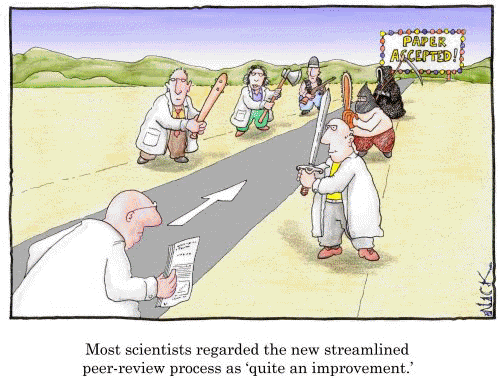
For those who aren't savvy, particle accelerators work by more or less swinging tiny bits of mass around in a circle and smacking them into each other at near-light speed so that we can see what happens. With a little bit of know-how and a whole lot of math, superheroes called "physicists" then decipher the results in research papers which must then withstand peer review. If you think that the superheroic designation is at all hyperbolic, then you clearly don't understand just how grueling peer review is.

For a little bit of perspective, there's enough energy at work in the LHC's twin beams to melt about a ton of copper. That's not a very rough estimate: "According to CERN LHC accelerator physicist Rüdiger Schmidt, who is in charge of machine protection systems, each unimpeded beam [of which there are two - D] is capable of melting a 500-kilogram block of copper." An exposure to such a beam just eighty-six millionths of a second long will bore a hole forty meters into a block of solid copper! So how do they stop it from doing just that?

Carbon, that's how.

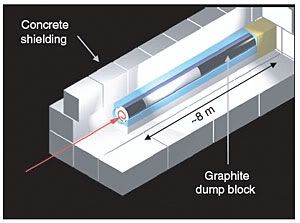
After colliding for a while, the particle beams are shunted off into a straight 700-meter "runway" where they are spread out to be more like shotgun fire and less like machine-gun fire (the beam is magnetically widened from .2mm to 1.5mm). Then they're scanned like a CRT image onto a ten-ton graphite cylinder (or "dump") 8m long and .7m wide, housed in a thousand tons of concrete. These guys seriously aren't fucking around:
The upside is that this system is completely reusable. Though the beams need to be refreshed from time to time (increased usage makes them unstable), the dump cools off in a couple of hours and only needs to be used once every ten hours (which is how often the proton beams are purged per failsafe protocols). Without diffusing the beam or scanning it onto the dump, however, direct exposure would melt the graphite as well.

Bottom line: physics is hot.

Saturday, October 10, 2009

Poison for Your Brain: Skull-Fucking History with a Crucifix

So Garou turned me on to this Atheist News post (now I have to start catching up on Joe's newscasts? Glee! And sigh...), concerning this well-executed piece of shit (fair use relevance-fighting alternate link here).

My friend Craig, the Lead Cultist of Nyarlathotep, showed me something of a response to that image (backup here in case that ever goes down). Ia! Ia! Cthulhu ftaghn!

Arguing on the Internet: Turd-Juggling, the Philosopher's Way!

So while I was researching some stuff for IBD, a post from the blog He Lives came up. Apparently, I was able to do some good for his 'net relevance, 'cuz there are more comments in that one thread than the guy's had in all of September combined (except for this other post from early September - yes, I counted)!

Anyway, I fired what I wanted to be a parting shot (the amiable kind, not the insulting kind), and ended up putting my foot right the fuck in my mouth. What follows is my response to that, since I'm kinda-sorta done with that conversation over there (I apologized for my faux pas, though). As such, it's mainly written "to" a couple of individuals, namely Wandering Internet Commentator and Neil B (with whom I shall be talking some modal realism this weekend). Ultimately, I just couldn't say no to utility calculus (Finally, a chance to use my degree!).

That said, let's take a step back for a second, because I think this moment right here is useful. Let's stick with this "I'm the villain" thing and see where it goes. Did I just make a hate speech? I can tell you that I meant to be inflammatory, but I didn't mean to hurt anyone's feelings. I mean, there was no "hate" involved on my part, so even if whatever definition of "hate speech" you choose applies, I think the term is misleading because I'm just not hateful. I meant to rattle cages just a little, not to poke at what I now see as something more like an exposed nerve; I meant to be irreverent, not sadistic. I was trying to follow the internet maxim: be a douche-nozzle, not a douche-bag. I can't control anyone's reactions, of course, but I truly didn't mean for anyone to react as a parent of an autistic person probably would upon reading my comment. (I just so happened to be missing a key piece of information, namely: that our erstwhile host is one such parent.)

Even here, I'm having trouble trying to draw the line between "participating in the conversation" and "analyzing the conversation," the latter leading me to stick to my guns in what could be seen as the worst possible way of not changing how I was doing the former. I'm really trying to say here, "Look, I'm really sorry about that, because I didn't mean to hurt your feelings in this conversation about feelings. But let's put all that aside for the moment and look at what just happened, because it pertains to that very conversation."

WIC, yes that was Neil B on little old ladies, not you. My bad, and thanks for the correction! I guess that's what I get for posting surreptitiously from work. Neil, you wrote, "I don't see a big difference in terms of probability expectation value, between something clearly wrong might happen to someone, v. something maybe wrong will clearly happen to someone." I can show you what I'm trying to do with math! Hooray! Two caveats: this is not a new argument, it's a translation of my same old argument in the hope that this new perspective will help; second, this is not a mathematical proof, it's just an explanatory model which could be presented just as validly but in a completely different way, should a competing perspective be adopted. My argument, in other words, is that "this is the 'proper' way to look at it."

First off, let's just assign "maybe" a probability value of 0.5, and "wrong were done" gets the arbitrary variable "W," for whatever reason you like. Certainty is C (because we want to see explicitly where our certainty is), and events are E. I think what you're saying could be expressed as, "CW*0.5E=0.5W*CE," or "Certain wrong maybe eventualizing is just as bad as maybe wrong certainly eventualizing." Or, to re-phrase your original in the terms of this ad-hoc utility calculus, "The expected return of a certain-wrong maybe-occurring is equivalent to that of a maybe-wrong certainly-occurring." So far, so good?

Any junior high kid could see that that's a true equivalence for any particular values of W & E (C=1, and is only shown for clarity) because we're just multiplying everything together. However, that "maybe" of 0.5 can change, as the probability of "wrong were done" occurring is affected by attitudes, cultures, proximity, and a million other things. As different cultures (made of different individuals with different attitudes) come together in an orgy of elbow-rubbing, I think it uncontroversial to propose that the probability of "wrong were done" occurring will rise*: actual harm (physical, emotional, financial, etc.) will be done by way of sectarian violence, or bigoted violence, or whatever you want to call it when someone says, "Hey, they're different, so let's get 'em," and then goes and "gets 'em." The left side of our equation has increased in magnitude as that coefficient next to the E has gone up, tipping the scales. And so, says I, we are justified in criminalizing those certain wrongs in order to curb them (though they are not completely eliminated).

Meanwhile, what does the right side look like? Remember that we're talking about something that's "maybe wrong" (i.e. "offense" as opposed to "harm/violence"). And that capacity for offense is a certainty, it's always there. The uncertainty, our matter of chance, is as to whether or not this offense is "wrong" (the open question is not whether "you was offended," but whether "wrong were done"). As an easy example, we have Cory's assumption that I have a penis; whether I do or not is immaterial, I can be offended that he made the assumption at all. As it happens, wouldn't you know it, I decided not to let it bother me (partly 'cuz I'm a steely bitch, partly 'cuz it truly doesn't matter). I had a knee-jerk reaction, but I see that knee-jerk as my problem, and the decision of whether to "merely go with it" and be offended or "rein it in" and not be offended as my decision.

Everyone has the chance to make this decision every time they have a knee-jerk reaction of any kind: do you go with it, or do you rein it in? The knee-jerk reactions themselves are beyond control: you cannot control whether you (or anyone else) will ever have a knee-jerk reaction, and the only way to make sure that knee-jerk reactions don't ever happen is to ensure that people receive no stimulus whatsoever; the only way to do this, in turn, is to shut everyone up and kill them all, so we'll discard knee-jerk reactions as irrelevant to our discussion. They truly cannot be helped, and we're talking about what can be helped (I think). And anyway, nobody self-identifies as an unthinking, inexorable force of nature; feelings are not tornadoes to be avoided (or ignored at one's peril); every part of a person is subject to change. This includes habits, behaviors, thoughts, words, and feelings. And if a person ever asserts that feelings are like tornadoes, then the message is clear: "I cannot be controlled, so when I Hulk out and wreck shit, everyone else better get the Hell away." Such persons have abdicated the realm of douche-nozzlery (and everyone is a douche-nozzle from time to time) and entered the realm of douche-baggery. Be a douche-nozzle, not a douche-bag.

So, given the fact that knee-jerk reactions will always occur no matter what we do, and that people are able to realize that their knee-jerk reactions may or may not be the best way to continue reacting to something, what is accomplished either way? Well, being offended certainly may spur some to action, and that action may be either productive, unproductive, or counterproductive. In either case, our person-in-question will be better-equipped to predict the value of whatever action they're about to take if s/he is calm. And it may even be the case that feigning offense is the best way to accomplish one's goals! Certainly, if one could reap the benefits of perceived offense without actually experiencing the maybe-harm of genuine offense, that would be a productive (though dishonest) move to make. But regardless, the point is that in all cases, you do yourself a disservice by choosing to let others have the power to offend you, and you can reduce your own personal right side of the equation to near-zero simply by changing your mind and deciding not to take offense.

Therefore, everyone should change their mind and decide not to take offense, because no matter what your goals are, zero good is accomplished by getting worked up over an insult. What good does it do merely to be offended? What good could come from offense, but could not be accomplished by another means that bypasses the "offense" process entirely? Zero, and zero, respectively. You create no good by getting offended, and any good that could come after being offended could also be created without that offense ever actually happening (inevitable, unpredictable, irrelevant knee-jerk reactions excluded). In other words, whether a person is trying to push your buttons or not, you do yourself zero help by letting your buttons be pushed. Even if we all adopt the view that I'm being childish by participating in IBD, what does it say about any group that lets themselves be upset by a child? I'd say they need to grow a collective spine, or they will find themselves upset out of all proportion over a whole lot of nothing, and not getting any work done in service of any of their actual causes.

What's more, we can actually do some good by giving people opportunities to practice at not taking offense. Whether people realize it or not, the existence of IBD prepares people for it. They have the opportunity to think, "Gee, IBD is coming up, I better get ready to do whatever it is that I'm going to do for it," whichever side of the fence they're on. The turd is on the table, it won't go away, and we can ignore it, get mad at it, or play with it. I say we play with it, we throw it back and forth, and we laugh while we do it - in the name of Jesus, or Allah, or Kali, or Poseidon, or just plain old good-natured ribbing. It's all turd-juggling, anyway; we may as well have fun while we're doing it. Or, as my friend Rebecca once said to me, "Learn to laugh at your problems, and you will never run out of things to laugh about." IBD is a day of play, not a day of work; but play is good for you, too.

Does that make at least a little more sense?

* - OK, fine, the folks who beat up gays (or slander blacks, or refuse to insure trannies) might just find someone else to beat up for some other equally preposterous reason. But now you're talking individuals, and some bigots meeting some gays/blacks/trannies might also come to realize that they're people, too. The fact remains that different cultures/attitudes/people, by virtue of existing, create more opportunities for culture/attitude/person-based violence, because now a bigot has one more reason to hate someone different. Point is, though it admittedly gets more complicated and isn't "just a wash," we need actual data (not a merely possible counterexample) to not treat it like "just a wash" as I do here. Got data? OK, I'll re-do the whole utility calculus when it comes up.

Thursday, October 8, 2009

Sort-Of Reviews in Not-Really Stereo: "Here Comes Science" and "Act II: The Father of Death"

I finally got my meat-space copy of Act II: The Father of Death by the Protomen (I also got their bag, finally replacing my Air Force surplus carry-all of ten years) and have had time to digest it. I've been sitting on Here Comes Science for a while, since they came out in the same week, so I gave myself some time to think about that one as well.

Here Comes Science makes me laugh because a friend of mine (the philosopher who was instrumental in getting my sorry ass out of Objectivism) made a mix CD of They Might Be Giants and Sesame Street to test a professor's claim that the two are indistinguishable. So here they are with deliberate children's educational music, which I imagined would be even less distinct from Sesame Street, and... well, the answer turned out to be both yes and no.

Meet the Elements and The Bloodmobile are early-on examples of songs that I could see right at home on Sesame Street. But then there are songs like Science is Real and I Am a Paleontologist which cast scientists in a rock-star sort of light, which I fuckin' dig. Mainly, though, I find the album to be a breath of fresh air, giving some straight dope on science to kids in ways that they can appreciate and understand. For example, Put It to the Test carries a line that I almost want to get tattooed on my forehead: a fact is just a fantasy unless it can be checked.

But even better than the CD itself is the companion DVD that comes with it, containing music videos for all eighteen tracks (Here Comes Science, the song, doesn't count) strung together with contextualizing shorts narrated by John & John. Kids will laugh and be tricked into learning, but the educated viewer/listener will catch some covert lessons on falsifiability, the tentative nature of science, the importance of technical distinctions, and the place of humanity in the cosmos and on Earth. Even the liner notes are crammed with neat little things like a timeline of the Universe's life and the history of science (including the first articulation of the scientific method in 1021 by Abu Ali al-Hasan Ibn al-Haytham - a new one on me!).

So I recommend this album to everyone without reservation. If you're not a child, just imbibe your intoxicant of choice and check out the music videos, it will be perhaps the most erudite stupid-fun you could possibly have. My friend Melissa called it "a big fuck-you to religion," and the Hell of it is, she's right (more on this in later posts).

My feelings on Act II are rather thoroughly mixed. Let me first compare my experience of The Protomen (or "Act I," if you prefer) to this second album. I listened to it many times before ever seeing the liner notes, and it took a few play-throughs to grow on me. In particular, Unrest in the House of Light struck me as disorganized and sloppy until I adopted the idea that the whole song is a crescendo to the last line: You cannot win. I didn't like Vengeance until I had gotten over my falling-out with punk rock. I'm going through the same thing with Act II: even though I really like that they "turned the horns up to eleven" (as one of my friends put it), Keep Quiet and Light Up the Night are pretty eighties-tastic and rubbed me the wrong way at first, while the middle of the album drags a little to me. Compare this to the Morricone-esque opening tracks, and I think a little bit of alienation is to be expected on my part. Also, if you know off the top of your head who Ennio Morricone is, please let me know because I just might love you.

Then there's the matter of extra-lyrical narration. Both albums have narration in the liner notes which is in no way communicated in the songs themselves, and in both cases, these extra narrations are married rather happily to instrumental bits devoid of lyrical content. The upshot is that the reader/listener can read along without interrupting the experience at all (I used my internal narrator rather than reading as quickly as I could), and I think it's awesome that this stylistic device was preserved.

Switching gears, I don't like that the Protomen seem to have relied on this device more in their second album than in the first. Throughout The Protomen, the action was always clearly communicated through lyrics and music, so that one could get a "good enough" picture of what was happening and who was speaking just by listening. In Act II, this is impossible; the exile of Dr. Light could easily be confused with a train ride to imprisonment, as it is unclear from listening alone whether Light is convicted or acquitted (which matter alone says quite a bit about the state of that world!). After this ambiguous event (and a curiously suggestive instrumental number), the next speaking role is given to Joe, who simply starts singing Breaking Out without ever being introduced.

That's my only substantial complaint about the album: as a rock opera, their storytelling is a bit sloppy when compared to the directness and clarity of their first release. Or maybe they're just being more economical with their units of storytelling, I don't know. It also bears mentioning that the major character developments of the first album are not mirrored by similar developments here: the action is all about how Wily completely ruins Light's life. This is very much a prequel which sets the stage for the released-first-but-chronologically-second part of the story, and for that, I think the lack of profound character development can be forgiven.

Everything else is either improved or just as good: the thematic unity is preserved, but presented in the form of smooth transitions from song to song rather than the variations on a central chord progression that ran throughout Act I. While the "genre pallette" is not as broad, the level of musicianship is about as high, and some of the production values are cleaned up (they even start distorting the sound at the end, which makes me think they're meant to be played in chronological order). At the end of the day, you'll probably like The Father of Death if you liked The Protomen, and I recommend listening to Act II first if you ever listen to both albums in one sitting.

Wednesday, October 7, 2009

101 Interesting Things, part twenty-five: Irreducible complexity evolved in the laboratory.

TL;DR version: ATTN Creatards & IDiots: Science wins at everything forever. Even disproving your own unnecessary-to-disprove bullshit.

I can't stop smiling. There are victories, there are triumphs, and then there is the work done with Escherichia coli by Dr. Richard Lenski and his team of bacterium-wranglin' heroes. This was brought to my attention by Silver Garou, who in turn got it from Richard Dawkins' The Greatest Show on Earth: The Evidence for Evolution (chapter five, "Before Our Very Eyes"), in case you've got the book and want to play along at home.

This is pretty much what happened: Team Lenski put twelve as-identical-as-possible strains of E. coli each in its own test tube, then put less-than-a-day's-worth of glucose in each tube and let them sit overnight (in a shaking incubator, to keep them warm and mixed). The following day, a small sample of each "ancestral tube" was used to seed a "descendant tube" and the ancestral tube was frozen. Lather, rinse, and repeat every single day since 1988. I mean, holy balls, these docs are tough!

Dr. Dawkins carefully explains all the relevant bits which lead to one inescapable conclusion: E. coli, in Team Lenski's lab, evolved completely de novo two separate mutations which allow for the digestion of citrate. Each of these mutations amounts to a distinct step in the metabolic pathway, and neither "does anything" of interest without the other. In fact, what Team Lenski has discovered (thanks in large part to the beyond-Herculean efforts of one Zachary Blount) is that these two mutations were produced independently and thousands of generations apart.

The alert reader will notice that this is irreducible complexity. The Good Doctor's words here surpass me both in clarity and brevity, so I shall give him the stage:
There is a comic sequel to this triumphant tale of scientific endeavour. Creationists hate it. Not only does it show evolution in action; not only does it show new information entering genomes without the intervention of a designer, which is something they have all been told to deny is possible ('told to' because most of them don't understand what 'information' means [ask one of them to distinguish data, information, and knowledge, if you doubt this - D]); not only does it demonstrate the power of natural selection to put together combinations of genes that, by the naive calculations so beloved of creationists, should be tantamount to impossible; it also undermines their central dogma of 'irreducible complexity.' So it is no wonder they are disconcerted by the Lenski research, and eager to find fault with it.
Dawkins goes on to explain that Andrew Schlafly of Conservapedia has been making a stink about this (of course!), and PZ Myers lays out the whole sordid tale right here.

OK, time to talk myself down a bit. This is, at the end of the day, just another (rather large) nail in the goddamned coffin. I mean, people to this day deny that Elvis is dead or that the Holocaust ever happened, but they've been appropriately sidelined as the brainless twits they are, and this is another step in that process. Creationism/ID has been dead for years, the caricature of a cadaver trotted out by Ham, Gish, and Comfort at regular intervals for a viewing and a reading, no more a scientific account than a funeral sermon is a life. Perhaps now we can give it a proper burial. Or an improper one, for that matter. I don't care either way, so long as the ghoulish monstrosity is left as far behind us as we can manage.

Monday, October 5, 2009

101 Interesting Things, part twenty-four: Matt Steven

Matt Steven isn't your average basketball player. He mainly stands around shooting free throws during practice, and he's the designated shooter for his high school team. He makes about half of his free throws, which is Hella better than I've ever done.

Oh, he's also blind.

Yep, a blind kid has won games for his ball team by shooting free throws, and everybody loves him. Matt's brother taps his cane on the back of the rim for him, and that's how Matt orients himself. I'm not a big sports nut (a shitty coach kinda ruined things for me in high school), but this guy is my hero.

There's really not a lot more to this one, except that a blind kid is winning basketball games by shooting free throws. Think about that one for a minute. So cool!

Sunday, October 4, 2009

Faith needs protection. No joke.

Kid gloves: off. Rant: on.

So there's a bunch on the 'tubes about atheist advertisements being complained into censorship, about atheists being vilified for trouncing others' beliefs, about the insensitivity of all us modern folk for criticizing each others' faiths, about the problem of everyone rubbing elbows while we disagree so vehemently on matters metaphysical, and a bunch of other nonsense that amounts to children whining that they don't want to hear this or that. "Boo-hoo, I don't wanna hear that stuff, wahh-wahh, why can't you just be quiet back-stage while I'm loud and in the spotlight?"

Let's get this straight, right off the bat: if you complain that something offends you, then you are whining. Offense is not harm. If you complain that something harms you, then your complaint is legitimate. And if something offends you and is harmful to you, then confine your complaint to the actual harm (as opposed to the pretend harm) or you will be seen as a whiner and the legitimate component of your complaint will probably be drowned out.

As Thomas "I owned slaves but still had relatively progressive values for my time" Jefferson said, "The legitimate powers of government extend to such acts only as are injurious to others. But it does me no injury for my neighbor to say there are twenty gods, or no God. It neither picks my pocket nor breaks my leg." Tru Fax, right there - the very truest. There is a piece of the puzzle that is missing from the public discourse, one that makes sense of the whole debacle, and that piece is simply this: only stupid ideas need protection.

That sounds flippant, but I'm being perfectly serious here. And also flippant. Good ideas are backed by evidence and/or argumentation, and they get a foothold in the meme pool based on those merits. While they may not be as infectious, prolific, or enduring as others of their kin, these merits are all that good ideas need. Furthermore, it is these merits which cannot be taken from good ideas and cannot be conferred upon stupid ideas, and this is why faith needs protection. Faith does not have redeeming qualities as a rational idea or as an empirically supported idea, it only has the memetic merits of being infectious and communicable. These flaws make faith vulnerable to rational and empirically supported ideas, and acknowledging these facts in public discourse is anathema to the maintenance of faith in practice because cognitive dissonance is a bitch.

"Faith" is a great many things to a great many people. Let's take a quick tour along the continuum: faith is the hope of things unseen; faith is believing what you know ain't so (thank you, Samuel Clemens); faith is believing without or despite reason and/or evidence; faith is trust; faith is patience; faith is kindness. Atheists, skeptics, and humanists may all "argue in good faith," and this is not a problem for us faithless heathens, for "to argue in good faith" is to trust in one's argumentative partner. Same letters, different idea. I, as a humanist, place faith in the goodness of humanity, insofar as I expect us to do all the good that it is in us to do (though we often fall far short, I still have that faith as an expected standard - this is called "optimism" by some). I have faith in my brother, insofar as I believe that he will find happiness in his life; though I also recognize that he may in fact fall short of this. Faith, like all words, has multiple meanings.

I'm talking about one kind of faith here: belief without or despite reason and/or evidence. "Faith" is shorter, but you can replace every use of "faith" with "belief without or despite reason and/or evidence" if you ever find yourself confused as to what exactly I'm yelling about here (except, of course, for the last paragraph). That's the kind of faith that is stupid, and that's the kind of faith that needs protection. Faith is frail and weak; evidence and reason are enduring and powerful. Faith must be shielded from evidence and reason, for those things erode faith. Believers are humans, though, and humans have psychological needs, some of which include:
  • To maintain an image of oneself as consistent.
  • To maintain an image of oneself as rational.
  • To maintain an image of oneself as intelligent.
These are all directly opposed to faith - it is not consistent, it is not rational, and it is not intelligent to believe something without reason or evidence. We require reason and evidence in all other areas of our lives: whether we're poking around on Snopes or looking up the latest health scare, we typically follow evidence and reason to form our beliefs. Nobody drives by faith, writes a grocery list by faith, balances their checkbook by faith, or does bids on e-bay by faith. In all of those activities, the overwhelming majority of people behave in a mostly-rational fashion for the overwhelming majority of the time (at least as far as the whole "forming beliefs about the way things are" activity is concerned). So faith is not consistent with our day-to-day lives.

Neither is faith rational, as a matter of definition. While I am defining my way to victory on this point (and deliberately confining my tirade to faith that does in fact lack or defy evidence and/or reason), I am not merely defining my way to victory here. This is a pertinent point for the simple reason that many people do in fact believe things without or despite reason and/or evidence, yet most people do have a psychological need to consider themselves as rational beings. We're complicated, you see. This kind of faith - which many people actually have - is directly opposed to this deep-seated bit of human nature. This matters, in other words, and no amount of cultural apologetics can fix it. Y'know, just in case there's anyone out there who cares to point out that there's no rule saying we have to be rational, or that humans aren't rational all the time; sure, the former point is true and the latter point is true, but faith is still a problem for this reason.

Last, faith is not intelligent. It's just not smart to believe something with all your heart but without or despite reason and/or evidence, The End. There are many different forms of intelligence, and trying to come up with a universally acceptable one is a fool's errand. Just the same, I challenge anyone to propose a workable definition of "intelligent" that allows for the behavior of "adopting a belief without reason or evidence and deliberately ignoring obvious questions that would undermine said belief." Pro Tip: This can't be done without special pleading or begging the question (or flat-out arbitration, I suppose). Conversely, I'll bet we could all come up with three definitions each of "stupid" that would cover such a behavior. Here's one: "failing, deliberately or otherwise, to adhere to rationality and general thoughtfulness; absent-minded or flighty in one's conscious thought processes." We're all guilty of stupidity from time to time (especially under this definition), and I'll be the first to admit that I have some pretty epic bouts of The Stupid. Here, watch: "I'm the first to admit having an epic bout of The Stupid! Neener-neener!" But that's part and parcel of the homo sapiens gig: we all make mistakes, and we don't stop until we die. Faith is still stupid, though.

And so we see that, because faith is a dumb idea, it needs protection from the good ideas that would otherwise supplant it. Faith needs tricks to keep itself in place. Faith can't survive on its own in a truly free marketplace of ideas. Faith is a crutch for when we lack explanation or authority but want it anyway, and when a real explanation or an actual authority is found, faith evaporates like dew in the morning sun. When the crutch is no longer needed, the patient needs to learn to walk unaided; for some, this will be a very painful and awkward process; for others, it can be easy. But there are those who wish to walk around with their crutch as a permanent fixture, they get so attached to the crutch that it seems an essential part of their sense of self, and they'll fight anyone who tries to take the crutch away or even say that they don't need it. To take the metaphor to its appropriately awkward conclusion, some of these folks even get upset at the very idea that some people live entirely crutch-less lives, it's so ingrained into their way of life.

So how does faith get the protection it so desperately needs? It's called "social proof," and it's one of the bigger foibles of this whole brain-having business. I would argue that it's the main reason that most faithful aren't formally diagnosed with a delusional disorder: it's just not practical to classify most of a population as "delusional," even if one person alone would be so-classified, and so religion gets a special exemption. You see, when we come under the impression that a lot of other people think something, we tend to see that something as "correct," or at least "legitimate." It's that same old line, "Ten million screaming Elvis fans can't be wrong," but wearing a psychologist's hat and nodding sagely from a leather armchair while you talk about your childhood. It's also one of the reasons that Kitty Genovese died - contrary to popular belief, it is not urban depersonalization that made it possible for her assailant to repeatedly attack her in view of an entire apartment complex. Nor did all those onlookers simply assume that "someone else" would take care of things1. The truth is more subtle and less satisfying.

Kitty Genovese died also because a large number of individuals saw a group doing nothing, and therefore assumed that "nothing" was the right thing to do2. Absent a telepathic time machine, that's the best reconstruction we can get of the situation. This has been tested over and over, and it's why advertisers continuously show people using the advertised product: they're trying to hack your decision-making process by showing you, true or not, that other people do the thing that they want you to do.

Social proof is one of the biggest protections that faith has had in place for the last several thousand years running. The publicly acknowledged existence of happy, moral atheists is a direct and imminent threat to that. This is why the faithful can't stand to see a bus sign that even acknowledges that there are those who don't believe in God. This is why the faithful go into conniptions when they see atheistic displays during the holidays. This is why the faithful tell atheists to sit down, shut up, and keep their unbelief to themselves: our existence is a threat to their way of life, insofar as their way of life includes building up that wall of social proof around the useless bauble of faith. And soon, we shall see this power harnessed for good or for awesome as it gives Bill Donohue a pants-shitting heart attack, hopefully on live television.

This is also why the faithful oppose stem cell research, or evolution, or reproductive rights, or gay marriage, or anything that threatens their worldview: scientific and cultural progress of any kind erodes the protections they've built for their faith, because results are undeniable (and cognitive dissonance is a bitch). This is also why the faithful tend to accept the comforts of civilization they grew up with (thanks, science!), while decrying the imaginary iniquities of further-civilizing efforts: change for the better implies that there was a "worse" to come from, and that undermines faith. But the advances they grew up with are familiar, so those are seen as non-threatening. Did you catch that? Even though the "new and threatening" innovations are a natural outgrowth of the same principles that fueled the development of the "old and safe" innovations, they don't see scientific progress that way because they don't think about it enough (usually). It only goes as far as "new and threatening" versus "old and safe" for quite a lot of them. But public misunderstanding of science is another topic for another day.

In closing: Faith (as a belief held without or despite reason and/or evidence) really needs protection, not as a deontological maxim, but because it can't stand on its own. Social proof has historically been brought to bear in service to this task, but social justice and free speech and generally being civilized persons gets directly in the way of the social proof which the faithful so desperately crave. And so of course we shall be met with shrieking opposition every step of the way, because the better the situation gets for us, the worse it gets for the faithful, as their social proof collapses and exposes their frail faith to the better ideas that undermine it. They see this as "bad." It would be better termed as "growth." And, barring another Dark Age, it is inevitable.

Fuckin' hooray!

Notes:
1. This phenomenon has been identified and has nothing to do with urban environments (as opposed to rural environments), but rather large groups (as opposed to small groups), and it's called "diffusion of responsibility." From the Wikipedia article: "Diffusion of responsibility is a social phenomenon which tends to occur in groups of people above a certain critical size when responsibility is not explicitly assigned. This phenomenon rarely ever occurs in small groups. In tests, groups of three or fewer, everyone in the group took action as opposed to groups of over ten where in almost every test, no one took action." And for clarity, though the Wikipedia article states that diffusion of responsibility can manifest in a bystander effect, the bystander effect page lists diffusion of responsibility as just one of its multifarious causes. Hooray for overlap!
2. Yeah, OK, it's still more complicated than that. I know. But in Influence: The Psychology of Persuasion, Cialdini argues pretty much this idea in chapter four ("Social Proof: Truths Are Us"). He goes on, he lays out a great case, but the point is that this bystander effect is huge and not a lot of people really understood it until the studies were done. It's not just diffusion of responsibility.

Saturday, October 3, 2009

Out of the Frying Pan, Into Objectivism: Further down the crazy-hole

Before we get started, I want to say that I am equal parts amused, ashamed, and embarrassed (with half a scoop of nostalgia) by all of this; and also that in all quotes, my changes are in [brackets], and my comments are signed in [bracketed italics - D], with all other emphasis and parentheticals preserved.

So there I was, young, high-strung, and full of the dumb, having just shaken off the shackles of Christianity. And who had brought me out but the cantankerous Ayn Rand, priestess of capitalism, founder of Objectivism, the Commie-Hater Supreme herself. As a side note, one of my philosopher friends told me of a study that showed psychoactive drugs tend to reduce one's religious inclinations (through some mechanism or other, I can't remember and was never able to find the study myself), and so wasn't it fascinating that the latest religions - Mormonism, Scientology, and Objectivism - were all very anti-drug? So go smoke a bowl for atheism, if you're so inclined. And if you're not, well... that's OK too, I guess. You can smoke a bowl just 'cuz.

Anyway, the thing is, Objectivism actually has a lot going for it! I could probably write a book extolling the genuine virtues of Objectivism, but I won't - I'll simply point out a couple of examples and then move on to what got me talked out of it:
According to [the idea that there is an inherent clash between the moral and the practical], every man faces a basic alternative: to dedicate himself to the good, the right the noble, to be an "idealist," in which case he must be unworldly, unrealistic, doomed to defeat - or to pursue success, prudence, that which works, to be a "realist," in which case he must dispense with ideals, absolutes, moral principles. (In philosophy, Platonism recommends the first of these choices, pragmatism recommends the second.) The alternative is: be good without earthly purpose, or seek ends while ignoring the necessary means. In other words: commit yourself to virtues or to values - to causes or effects - to ethics or to life.

Objectivism rejects this dichotomy completely.
- Leonard Peikoff, "Virtue as Practical," from Objectivism: The Philosophy of Ayn Rand
I mean, c'mon, that's just hot! Sure, those are straw-men, but he gives them such a thrashing, he does! I mean, it's a fun oversimplification of a rather complex and ongoing thing (viz. Western philosophy, but I'm sure I could be accused of doing worse to religion), I just like the way he says it. I also love the primacy of existence:
From the outset, consciousness presents itself as something specific - as a faculty of perceiving an object, not of creating or changing it. For instance, a child may hate the food set in front of him and refuse even to look at it. But his inner state does not erase his dinner. Leaving aside physical action, the food is impervious; it is unaffected by a process of consciousness as such. It is unaffected by anyone's perception or nonperception, memory or fantasy, desire or fury - just as a book refuses to roll despite anyone's tantrums, or a pillow to rattle, or a block to float.

The basic fact implicit in such observations is that consciousness, like every other kind of entity, acts in a certain way and only in that way. In adult, philosophic terms, we refer to this fact as the "primacy of existence," a principle that is fundamental to the metaphysics of Objectivism. Existence, this principle declares, comes first.
- "Existence as Possessing Primacy Over Consciousness," Ibid.
Then there's Philosophy: Who Needs It? (answer: everyone), a great lecture which is well-summarized in the Wikipedia article on the book bearing its same title, and you can listen to the whole thing here. (Couldn't find full text online, sorry.) I also love smoking exactly because of Ayn Rand, and I love her for it, despite the addiction:
"I like cigarettes, Miss Taggart. I like to think of fire held in a man's hand. Fire, a dangerous force, tamed at his fingertips. I often wonder about the hours when a man sits alone, watching the smoke of a cigarette, thinking. I wonder what great things have come from such hours. When a man thinks, there is a spot of fire alive in his mind - and it is proper that he should have the burning point of a cigarette as his one expression."
- Ayn Rand, Atlas Shrugged (1992 Signet edition, paperback), p. 64
Another great one is the law of non-contradiction, which can be found in lots of places and is simply stated: "Contradictions do not exist. Whenever you think you are facing a contradiction, check your premises. You will find that one of them is wrong." Well, OK, or your argument is invalid (but yes, the argument is unsound, at any rate, unless it's a proof by contradiction but I guess that's the point). Finally, there's Objectivism: TL;DR version.

So that's pretty much how I got taken in. Like my Bible-thumping days, I was counting hits and ignoring misses; there were just more and better hits to count with Objectivism. I had read Anthem in junior high for an essay contest (never wrote for it, but I do have participation awards for Optimist's Club essay contests!), and I liked it, so I started reading The Fountainhead, and that led to Atlas Shrugged, and by the time I was twenty I had We the Living and Peikoff's Objectivism: The Philosophy of Ayn Rand under my belt as well. Even in those early days, the seeds of doubt were already being planted: my father, who has some familiarity with Rand's work and philosophy, said something to the effect that Objectivism would be great if only we could truly be objective; a high-school English teacher of mine had said that The Fountainhead was his favorite book, but when we talked more about it, he said that Gail Wynand was the only "real person" in the story (everyone else is absurd caricatures, and it took me a while to appreciate that). A friend once told me, when we first met, that he didn't like Robert Pirsig's Lila as much as Zen and the Art of Motorcycle Maintenance because it was "a little too Atlas Shrugged" for him, which fascinated me because he had read all of these books like I had but had completely different opinions on pretty much everything about them. These criticisms stuck with me throughout my entire Objectivist phase, and I apologized them away. It was OK, I thought, they just didn't get it.

For context, I was still reading Atlas Shrugged during my first year of college (I was on scholarship, which I lost), then I finished that and read all of Peikoff's Objectivism during the next year, which I had taken off of school to decide "what I wanted to do with my life." I was in love with Ms. Rand for this entire time, and all my friends were in different towns for college. I also went to work for The Man and took a swift dive down into Business Ethics Hell, but that's yet another story (though it was very, very instructive). In fall '04, I had decided to enroll for spring in a local community college with my major changed from physics to philosophy. My courses over the next few semesters included an introductory psych course, a course in ethics, a course in logic and a course in world religions from the same instructor, and a tandem course in theatre and psychology (which was awesome). In short, these three courses laid the groundwork for my falling out with Rand, because they taught me that life is complicated: people are complicated, governance is complicated, social dynamics are complicated, the economy is complicated, it's all a huge fucking mess and Objectivism flatly fails, fails, fails to make sense of it.

The medium-length version is that, while I can't really say that this or that thing "clinched it" for me, there were three "main themes" that continuously pecked away at the underpinnings of my Objectivist leanings:
  • Objectivism fails at recognizing intersubjectivity (I didn't know the term back then, though this caused friction in arguments when trying to agree to definitions).
  • Objectivism ignores the fact of luck entirely. Or just calls it "virtue 'cuz results."
  • Objectivism is incompatible with human nature (both our psychology and our limitations).
I didn't know those things back then, so there I would be in class, spouting my Objectivist nonsense, and honing my arguments against my "opponents" (the instructor and anyone who disagreed with me). The particular debates are tedious and embarrassing, so I'm going to skip them, except to say that one hinged upon a rather crucial misunderstanding of the word "arbitrary1." The professor actually said, "I don't think that word means what you think it means," and was right. I mean, jeez.

Anyway, seeing the vigorous disagreement in ethics initially disgusted me, but ultimately eroded my Objectivist ethos, as I began to see that it is possible for equivalently intelligent and informed persons to rationally disagree on things like, oh, the meaning of "good." Learning about how languages evolve, and how they shape (and are shaped by) our minds, eroded my confidence in humanity's ability to be absolutely objective with language. And my aforementioned philosopher friend explained some history to me, chiefly concerning Objectivism as a movement (check this story) and Rand's affair with Nathaniel Branden in particular, which eroded my confidence in both the character of Objectivists and the ability of Objectivism to improve upon a person. And so the journey was another long, smooth transition, much like my deconversion from Christianity. Medium length version: done.

Enough broad strokes, it's time to get down to brass tacks. Hoo-boy, real-time update: as I'm writing this, I just cracked open Peikoff's Objectivism for the first time in years, and apparently I took notes during my deconversion (there was "a second reading," you see...). The margins are full of "WTF retarded," "Wow... just wow," "MORON," and "BS!" Lots of underlining. Yeesh. I'm not gonna lie, I could spend years trying to pick the best points to refute, so I'm just going to pick three at random.

1. From "Knowledge as Hierarchical":
As an example [of context-dropping], I will quote from a recent skeptic, who asks: "How can I be sure that, every time I believe something, such as that there are rocks, I am not deceived into so believing by... a mad scientist who, by means of electrodes implanted in my brain, manipulates my beliefs?" According to this approach, we cannot be sure that there are rocks; such a belief is regarded as a complex matter open to doubt and discussion. But what we can properly take as our starting point in considering the matter and explaining our doubt is: there are scientists, there are electrodes, men have brains, scientists can go mad, electrodes can affect brain function. All of this, it seems, is self-evident information, which anyone can invoke whenever he feels like it. How is it possible to know such sophisticated facts, yet not know that there are rocks?
How about if you grew up on a space station, douchebag?! And it misses the point, even if nobody ever grows up on a space station. The point is this: what if we're being deceived in a way that we cannot discover? Well, then we're being deceived in a way that we can't discover. That's all. Peikoff seems to have a problem with this idea, though, and instead argues that since we can't possibly know if it is the case, then we know for sure that it's not. WTF.

2. From "Loyalty to Rational Principles":
[T]he good has to be an issue of "all or nothing," "black or white," and [...] evil has to be partial, occasional, "gray." Observe that a "liar" in common parlance is not a man who always, conscientiously, tells falsehoods [and so on...].

To be evil "only sometimes" is to be evil. To be good is to be good all of the time, i.e., as a matter of consistent, unbreached principle.

The above is the full reason why Objectivism condemns as vicious today's cult of compromise. [...] Evil is delighted to compromise - for it, such a deal is total victory, the only kind of victory it can ever achieve: the victory of plundering, subverting, and ultimately destroying the good.
Yeah, so I guess we're all evil forever, then. Sorry, pal, but "good" is a word, words are categorically made-up, and you're an idiot. Well, OK, I'll give him a B for effort (points off for absolutism), mainly out of sympathy because ethics is such a splintered subject. Anyway, one more from the big book, this time from Chapter 11: Capitalism (they're defiantly not superstitious!). It starts pretty well, and then takes a turn for The Stupid:
The economic value of goods and services is their price (this term subsumes all forms of price, including wages, rents, and interest rates); and prices on a free market are determined by the law of supply and demand [... which are] two perspectives on a single fact: a man's supply is his demand; it is his only means of demanding another man's supply [I swear to Dennis Miller, there's a joke in there! - D]. The market price of a product is determined by the conjunction of two evaluations, i.e., by the voluntary agreement of sellers and buyers. If sellers decide to charge a thousand dollars for a barrel of flour because they feel "greed," there will be no buyers; if buyers decide to pay only a nickel a barrel because they feel "need," there will be no sellers and no flour. The market price is based not on arbitrary wishes, but on a definite mechanism: it is at once the highest price sellers can command and the lowest price buyers can find.

Economic value thus determined is objective. [And not dialectical?! - D]

[...] It is essential here to grasp Ayn Rand's distinction between two forms of the objective: the philosophically objective and the socially objective. [...] The philosophically objective value of a product is the evaluation reached by the men with the best grasp of reality (in a specific category and context), regardless of whether or not they are involved in buying and selling the product [armchair philosophers = economic conscience of the nation - D]. The socially objective value is the evaluation reached by the actual buyers and sellers. These two evaluations are not necessarily the same [for obvious reasons, blah, blah, blah].
Marginal utility, Ockham's razor, GTFO. Done. No need to posit stupidly unnecessary "objective monetary values of objects and services" (except the uninterestingly tautological "objective fact of a unit price paid"). I suppose Peikoff might like to backpedal and say, "Wait! Marginal utility is part of this whole 'context' thing!" OK, fine. Now explain how to choose whether to make the same profit $x by selling at high price to few customers or at low price to many customers, or somewhere in between, and how the unit prices thus obtained are in any way objective instead of arbitrary. Also, "socially objective" is "intersubjective" in a funny hat (in other words, not objective at all). And that "philosophically objective" idea is just a mess - you try defining "best grasp of reality" and stack-ranking people along a linear continuum. (You know a lawyer's gonna need that some day!)

Atlas Shrugged and The Fountainhead are still great fiction, to my mind, and the bit about Wyatt's Torch still makes me tingle. But this is getting tedious. A couple of quickies before I wrap this up:
The rules of Chess are arbitrary. And they're intersubjectively true, if you get them from Wikipedia. They are neither objectively anything (besides arbitrary), nor entirely subjective (though they are of course violable). According to Peikoff, "The arbitrary, if a man indulges in it, assaults his cognitive faculty; it wipes out or makes impossible in his mind the concept of rational cognition and thus entrenches his inner chaos for life." Chess: corrupting the intellect of humanity at least since 600 AD. Did I mention that language is pretty arbitrary, too?
Luck happens, you steely bitch. Sometimes people get dicked and need a hand up. Charity can be seen as an investment in the human capacity to turn one's life around, and institutionalized charity (such as welfare) is nothing if not insurance against one big screw-up ruining one's life. Sure, some people abuse the system, and they suck. But that comes with the territory. Besides, it would just be irrational to object to welfare-as-insurance, because that one big screw-up could happen to anyone, and "anyone" includes "you" (it's only short-sighted teenage invincibility that disagrees).
Objectivism is at best a conspiracy of doves, and at worst guilty of contradiction. This is what opposes it to human nature. It's like this: perfect people need no governance, but imperfect people can neither govern perfectly, nor perfectly be governed. Look, OK, if everyone lived out Objectivist values, then people would always be honest, kind, intelligent, and hard-working. But that's what every utopia looks like! And really, one guy can pretty much ruin the whole thing, as long as he's clever enough, and at some point there will be that one guy for whom the temptation is just too great.

But you know what's worse? Intelligent, rational people are not all Objectivists, but they should be, if it is indeed "true" or whatever:
  • Assumption: Intelligent, rational people have read and understood Rand's work.
  • Assumption: Objectivism is true.
  • If Objectivism is true, then A) those who read it should be able to perceive its truth, B) living as an Objectivist is the rational thing for them to do, and C) one should act rationally.
  • Therefore, if Objectivism is true, then intelligent, rational people should agree with it upon understanding it, and then do the rational thing and live as Objectivists. (Ethics from pure reason? How deliciously Kantian!)
But this isn't what we see, is it? So let's check our premises: either Objectivism is not true, or not all the intelligent, rational people who've read it are able to understand it (so for her to say that Objectivism is true, she at least implicitly says that being unconvinced is stupid). But, to continue the very first quote I mentioned above:
The moral man's concept of the good, we hold, is his fundamental standard of practicality. Such a man experiences no conflict between what he thinks he ought to pursue (self-preservation) and what he wants to pursue. He defines all of his goals, fundamental and derivative alike, by reference to reality. As a result, he pursues only objects that are attainable by man, consistent with one another, and possible to him; he uses his mind to discover the means (including the principles) necessary to reach these objects; and he applies his knowledge in action, refusing to evade what he knows, to drift purposelessly, or to sacrifice his interests. This, in Ayn Rand's view, is the description of human nobility. What other policies could practicality require?
I couldn't agree more. That's why I'm a Humanist.

Note:
1. OK, I can't resist. I quote Peikoff's Objectivism, "The Arbitrary as Neither True Nor False":
An arbitrary claim is one for which there is no evidence, either perceptual or conceptual. It is a brazen assertion, based neither on direct observation nor on any attempted logical inference therefrom. For example, a man tells you that the soul survives the death of the body; or that your fate will be determined by your birth on the cusp of Capricorn and Aquarius; or [blah, blah, blah]. If you ask him "Why?" he offers no argument. "I can't prove any of these statements," he admits - "but you can't disprove them, either."
In the first place, that last description more appropriately refers to unfalsifiable statements. And, uhh, I wrote "Take THAT, Hume!" in the margin (apparently I took notes the first time through, too), because I thought this somehow solved the problem of induction at some point (the actual refutation, later on in the book, is... significantly less inappropriate than this). Anyway, in my logic class (the one with the Protestant-turned-Catholic instructor and the Catholic-turned-Protestant student), we were discussing the liar's paradox. I responded that since the statement could neither be resolved as true nor as false, and since there was no outside evidence that could possibly decide the question, that it must therefore be arbitrary and thus unworthy of our consideration. Umm... that didn't work. Like, at all. But I did listen to what the professor had to say, and I learned from the experience, and he conceded a point when I retreated to, "Well, OK, how about we say that the liar's paradox is just nonsense, like speaking of a square triangle?" This was pretty much the "formal start" of my deconversion.