Now to argue with the internet!
Wednesday, July 22, 2009
Catastrophe averted!
OK, so the bus thing didn't come through, but I did get into an attendance situation at one of my jobs, which gave me pause for thought. Basically, I was having trouble showing up and doing well at both places, so I decided to do one job well instead of two jobs poorly. I now receive standard human sleep dosage, and have time to blog again. Polyphasic self-experimentation is over.


Thursday, July 9, 2009
Catastrophe looms!
Not really. But I got off my sleep schedule and can't get back on, and trying has made me late for both jobs. Gallavantin' about on the innernets, fun as it is, really shouldn't be my priority at this point. So: hiatus!
I applied for a job as a bus driver, which would earn me just under what I get for both my current jobs. I should know whether I'll get the job some time next week; if I do, there will be more content. If not, I'll have to shut up and work. Wish me luck!
I applied for a job as a bus driver, which would earn me just under what I get for both my current jobs. I should know whether I'll get the job some time next week; if I do, there will be more content. If not, I'll have to shut up and work. Wish me luck!
Friday, July 3, 2009
Ethical Cornerstones
"If the moral law is just a side effect of evolution, then there is no such thing as good or evil. It's all an illusion. We've been hoodwinked. Are any of us, especially the strong atheists, really prepared to live our lives within that worldview?"
- Francis Collins, 2008 lecture at UC Berkeley
A common complaint leveraged by theists is that atheism provides no foundation for morality, and fair enough at that: the mere lack of belief in a deity is metaethically inert. But so too is the active belief in such, so whatever. Theists sometimes go one step farther and insist that, even if we atheists managed to set up a solid foundation for morality, our general lack of belief in an afterlife destroys any sense of "ultimate accountability" or what-have-you, taking all the "oomph" out of whatever ethical system we'd care to imagine. Fine and dandy: religion cannot be used as a cudgel to beat us into good behavior, since we've inoculated ourselves against it. But theists must also acknowledge that the cudgel doesn't even work on their own: time and time again we hear news stories about prominent theists who are just as prone to error as the rest of us (some of them even moreso), and demographic studies continue to support the conclusion that, whatever the effects of atheism are on a populace, they are certainly not bad by any measure.
Today I'm going to crack open the vault of highly-guarded, mission-critical atheist secrets and admit that there is no objective basis for morality. Not just for atheists, mind you: no truly objective ethical system is even possible. Period. To do this, I'm going to have to get down to the Serious Business of defining what "truly objective ethical system" means, outlining the conditions for such a thing existing, showing that reality is not like that, demonstrating that normative ethical theories fail to bridge any gap left, and positing a basis for Humanist morality in the aftermath. Probably not in that exact order, though.
Morality is fundamentally descriptive and prescriptive: any system of ethics worth its salt must tell you, respectively, what it is and why you should care. In other words, descriptivity defines what the good is, and prescriptivity is where the "should" comes from. These two demands cannot be meshed in a consistent, coherent, non-arbitrary fashion under any system of ethics. As soon as you meet the descriptive requirement and hash out just what the good is, anyone is free to shrug and ask, "So?" But if you start at the other end, meeting the prescriptive requirement and trying to work back to the descriptive requirement, you'll run into a quagmire of inconsistent motivations, cultural relativism, and other such philosophical boogeymen that have plagued ethicists for centuries.
Immanuel Kant recognized this problem and tried to address it directly by showing that rationality entails morality: if one is a rational being, then one will be compelled to care about morality - and we all want to be rational, right? Were this to ever be conclusively demonstrated, it would be a genuinely exciting development in the field of ethics! However, Kant failed. Don't get me wrong - I like Kant's idea very much, I just think he has the bad fortune of being flat-out wrong. Philippa Foot, author of the famous trolley problem, shows in Morality as a System of Hypothetical Imperatives that morality, like etiquette, only holds sway over a person if that person already wants to be moral. In other words, no categorical imperative can have any "oomph" unless you already buy into it - the "oomph" comes from within you, not from the imperative itself. Moreover, deontological theories of ethics fail categorically by their very nature, in that they are by definition duty-based: no matter what set of duties you come up with, the question of "why" can never be finally answered; i.e. deontological theories are always arbitrary at root.
Virtue (or "Areteic," from the Greek word arete, usually translated as "excellence") theories of ethics cannot bridge this gap, either. Aristotle's characterization of Man as the anima rationale is perhaps an anticipation of Kant's attempt to marry rationality and morality, but virtue theories are categorically arbitrary as well because they rely on contingent facts about human nature and individuals. "This is what it means to be a good person," says the virtue theorist, then adding under-the-breath, "With respect to various contingent factors related to your rather circumstantial existence." Why these factors and not those? Well, these are the ones we have to work with because they're the case (for us, at the moment), but others could be just as easily, and were it so, that would change morality - making it inconsistent between possibilities. As an example, Aristotle states that "courage" is a virtue between the vices of cowardice and recklessness. How courageous one should be, however, depends not only on one's own strength, but also the strength of the opposition and how these facts compare. Arnold Schwarzenegger ought to be more courageous than Woody Allen. But Audie Murphy is a goddamned hero. When trying to explain things like this, it's easy to give in to the temptation to ascribe "moral luck" to some people - Audie Murphy's heroic actions, independent of his small stature, could easily have gotten anyone killed and so shouldn't be considered to be generally advisable to anyone. He's just lucky that it happened to work out for him. But then Arnold is just lucky that he's capable of a higher degree of courage than Woody is, and Woody is conversely lucky that less courage is required of him. But what of people who are naturally cowardly? Their moral luck seems to have handed them a bum deal. What use is it to come up with these virtues when they seem to vary so wildly between individuals, and the exemplars can go so far beyond the reach of most "normal" people?
Consequentialist ethical frameworks tend to be better at consistently and coherently meeting descriptive requirements, but only arbitrarily so - and the prescriptivity is just as lacking as in deontology, for similar reasons. The reason that any consequentialist theory (which seeks to maximize "the good" as actualized via consequences of actions) must fail at identifying a non-arbitrary starting point for morality is that consequentialism assumes that "the good" is something "out there in the world," which is simply not the case. For the good to be out there in the world, for it to be a "thing" that is able to be maximized, there must be a moral substance, otherwise we could not point at it and say "That is what is meant by 'the good.'" The term "substance" is used loosely here, for "happiness" also counts as a "moral substance" if that is what's meant by the good: "happiness" may be analyzed in terms of brain states of living beings, it is an objective and quantifiable thing that we can point at out in the world. But the question of how, why, and whether the good is happiness has yet to be answered in any rigorous manner.
All three of these objections apply equally to all three ethical frameworks, because they are fundamentally interchangeable. By this I mean simply that any one of them could be stated perfectly well in terms of any other:
Not even divine command theories can escape this. So God says this is good? Why does that count? The Euthyphro problem shows handily that the relationship between God and morality is an open question at best (and, when taken seriously, it shows that God has no power over moral facts). And while using Heaven and Hell as motivators can certainly set up a hypothetical imperative that is convincing to some, the power to reward or punish simply is not an argument, cannot tell us what is right or wrong, and does not constitute a foundation for an ethical system; it is merely a brute fact about the world, The End. The presence or absence of any gods quite simply has no bearing whatsoever on moral facts, whether they exist or not.
All of this is corollary to the fact that when we talk about "the good," we are not talking about something out in the world, we are talking about ideas in our own heads. Without a moral substance to point at and say, "That is the stuff from which goodness is made," there can be no such thing as objective morality: because morality is only in our heads, and objectivity refers to a quality that is not merely in our heads, the two concepts "objective" and "morality" are intrinsically opposed to one another. Not even God - any god at all - can get around this. Under a divine command system of ethics, God simply projects his own ideas of good and bad onto the world, rewarding and punishing according to his own ideas. Without God, we project just the same, but with "jail" instead of "Hell" for a cudgel to threaten those who fall too far out of line.
So what's a Humanist to do? Well, if morality isn't written into the world, then by the stars that died to make us, we'll write it in ourselves. So what if we can only project our ideas of good and bad on to the world? We'll just continue to refine our ideas and continue to project them on to the world. "But if there's no objective standard for morality," comes the cry, along with much hand-wringing and general whining, "Then, then, umm... then there's no objective standard for morality!" So? What do you want, a score? The Universe does not give a shit if you rape a pile of babies or not, which means that we mortals must be all the more vigilant against such things if we don't want them to happen. Morality simply is Foot's hypothetical imperatives, it is the emotivist's gut reactions, it is the non-cognitivist's covert commands, and we need to take these facts on board and work from there to create the kind of society we want.
What kind of society do we want, anyhow? Well, I can only speak for myself, but I want a liberal, progressive, permissive society that values individual liberties and freedom of conscience as well as social cohesion, that discourages meddlesome bullshit and reprimands unprovoked violence. I want a society where people really take to heart the idea that it's more important to get along than to get your way all the time. To make this kind of society, some rules will be useful and some will be stupid. "Live and let live" is a good start, but it lacks punch. "If you don't approve of what informed and consenting adults do to themselves and each other in the privacy of their own homes, then leave them to it and live your own damn life according to your own damn principles" is a bit closer. "Don't do drugs for fun," on the other hand, strikes me as a stupid rule. "Don't do drugs to the point that you neglect your responsibilities," by contrast, is a useful rule of thumb. Hell, I'll even go one better: "Don't do anything to the point that you neglect your responsibilities." Ooh, even better: "The key to all things is moderation, and that includes moderation." Golly, this is almost starting to sound like Buddhism's Middle Way... which in turn sounds an awful lot like the Aristotelian mean... which can also be phrased in consequentialist or deontological terms... look, I'm sure you can see where this is going by now. We can't get to morality from nothing, but we can get to hypothetical imperatives from existing values, and then as long as you play by your own rules, it doesn't matter which normative framework you use: all roads lead to Rome.
Just as there is no possibility of externally justifying induction, there is also no possibility of externally justifying morality. You can't get to "therefore induction works" unless you already buy into a system that gets you to "therefores," and you can't get a "you should do x" unless you already buy into a system that generates "shoulds" in the first place. But this isn't a problem - in fact, trying to work around this non-problem has generated a plethora of rather ingenious tools: the veil of ignorance, the social contract, the second formulation of the categorical imperative, the utility calculus, these are all useful tools for helping us figure out how to get what we want once we've identified what it is that we want. Similarly, a variety of strategies/moves are available to help one win at chess, should one desire to do so. Most people, I'd wager, just want to live their lives in peace, find some form of employment that's meaningful to them, and have some fun on the side. Great! Some people want to make sure that nobody else "sticks it in the naughty place," though, and they're meddlesome haters. Fuck the haters, and fuck their meddlesome, hand-wringing bullshit.
OK, so what does all this have to do with Humanism? Well, how about the fact that we're human? Humans come in all sorts of shapes, sizes, and flavors, and if we want to make a society where everyone can live their lives in peace, find some form of employment that's meaningful to them, and have some fun on the side, then we need to accommodate as many of these shapes, sizes, and flavors as possible. This involves being permissive and inclusive, and having a general cultural outlook of "fuck the haters and fuck their meddlesome bullshit." We should also try to fix rapists, murderers, thieves, and other such criminals who actually harm people, and lock them up if we can't. The morality we project onto the world, if we want to create a Humanist society, should be a morality appropriate to humans. It should deliver goals that humans can meet, it should prohibit only those actions as are harmful to others, and it should permit just about everything else. These kinds of rules will be conducive to a Humanist society, no matter whether there's a single objective moral fact in the world or not.
At the end of the day, it well and truly does not matter that there's no moral substance, because we still have values. If we want to see those values realized - and we surely do, for that's what makes them "values" - then we ought to live them, to act as our own ethical cornerstones. That's the basis of a Humanist morality. That's the only practical basis possible for any morality.
- Francis Collins, 2008 lecture at UC Berkeley
A common complaint leveraged by theists is that atheism provides no foundation for morality, and fair enough at that: the mere lack of belief in a deity is metaethically inert. But so too is the active belief in such, so whatever. Theists sometimes go one step farther and insist that, even if we atheists managed to set up a solid foundation for morality, our general lack of belief in an afterlife destroys any sense of "ultimate accountability" or what-have-you, taking all the "oomph" out of whatever ethical system we'd care to imagine. Fine and dandy: religion cannot be used as a cudgel to beat us into good behavior, since we've inoculated ourselves against it. But theists must also acknowledge that the cudgel doesn't even work on their own: time and time again we hear news stories about prominent theists who are just as prone to error as the rest of us (some of them even moreso), and demographic studies continue to support the conclusion that, whatever the effects of atheism are on a populace, they are certainly not bad by any measure.
Today I'm going to crack open the vault of highly-guarded, mission-critical atheist secrets and admit that there is no objective basis for morality. Not just for atheists, mind you: no truly objective ethical system is even possible. Period. To do this, I'm going to have to get down to the Serious Business of defining what "truly objective ethical system" means, outlining the conditions for such a thing existing, showing that reality is not like that, demonstrating that normative ethical theories fail to bridge any gap left, and positing a basis for Humanist morality in the aftermath. Probably not in that exact order, though.
Morality is fundamentally descriptive and prescriptive: any system of ethics worth its salt must tell you, respectively, what it is and why you should care. In other words, descriptivity defines what the good is, and prescriptivity is where the "should" comes from. These two demands cannot be meshed in a consistent, coherent, non-arbitrary fashion under any system of ethics. As soon as you meet the descriptive requirement and hash out just what the good is, anyone is free to shrug and ask, "So?" But if you start at the other end, meeting the prescriptive requirement and trying to work back to the descriptive requirement, you'll run into a quagmire of inconsistent motivations, cultural relativism, and other such philosophical boogeymen that have plagued ethicists for centuries.
Immanuel Kant recognized this problem and tried to address it directly by showing that rationality entails morality: if one is a rational being, then one will be compelled to care about morality - and we all want to be rational, right? Were this to ever be conclusively demonstrated, it would be a genuinely exciting development in the field of ethics! However, Kant failed. Don't get me wrong - I like Kant's idea very much, I just think he has the bad fortune of being flat-out wrong. Philippa Foot, author of the famous trolley problem, shows in Morality as a System of Hypothetical Imperatives that morality, like etiquette, only holds sway over a person if that person already wants to be moral. In other words, no categorical imperative can have any "oomph" unless you already buy into it - the "oomph" comes from within you, not from the imperative itself. Moreover, deontological theories of ethics fail categorically by their very nature, in that they are by definition duty-based: no matter what set of duties you come up with, the question of "why" can never be finally answered; i.e. deontological theories are always arbitrary at root.
Virtue (or "Areteic," from the Greek word arete, usually translated as "excellence") theories of ethics cannot bridge this gap, either. Aristotle's characterization of Man as the anima rationale is perhaps an anticipation of Kant's attempt to marry rationality and morality, but virtue theories are categorically arbitrary as well because they rely on contingent facts about human nature and individuals. "This is what it means to be a good person," says the virtue theorist, then adding under-the-breath, "With respect to various contingent factors related to your rather circumstantial existence." Why these factors and not those? Well, these are the ones we have to work with because they're the case (for us, at the moment), but others could be just as easily, and were it so, that would change morality - making it inconsistent between possibilities. As an example, Aristotle states that "courage" is a virtue between the vices of cowardice and recklessness. How courageous one should be, however, depends not only on one's own strength, but also the strength of the opposition and how these facts compare. Arnold Schwarzenegger ought to be more courageous than Woody Allen. But Audie Murphy is a goddamned hero. When trying to explain things like this, it's easy to give in to the temptation to ascribe "moral luck" to some people - Audie Murphy's heroic actions, independent of his small stature, could easily have gotten anyone killed and so shouldn't be considered to be generally advisable to anyone. He's just lucky that it happened to work out for him. But then Arnold is just lucky that he's capable of a higher degree of courage than Woody is, and Woody is conversely lucky that less courage is required of him. But what of people who are naturally cowardly? Their moral luck seems to have handed them a bum deal. What use is it to come up with these virtues when they seem to vary so wildly between individuals, and the exemplars can go so far beyond the reach of most "normal" people?
Consequentialist ethical frameworks tend to be better at consistently and coherently meeting descriptive requirements, but only arbitrarily so - and the prescriptivity is just as lacking as in deontology, for similar reasons. The reason that any consequentialist theory (which seeks to maximize "the good" as actualized via consequences of actions) must fail at identifying a non-arbitrary starting point for morality is that consequentialism assumes that "the good" is something "out there in the world," which is simply not the case. For the good to be out there in the world, for it to be a "thing" that is able to be maximized, there must be a moral substance, otherwise we could not point at it and say "That is what is meant by 'the good.'" The term "substance" is used loosely here, for "happiness" also counts as a "moral substance" if that is what's meant by the good: "happiness" may be analyzed in terms of brain states of living beings, it is an objective and quantifiable thing that we can point at out in the world. But the question of how, why, and whether the good is happiness has yet to be answered in any rigorous manner.
All three of these objections apply equally to all three ethical frameworks, because they are fundamentally interchangeable. By this I mean simply that any one of them could be stated perfectly well in terms of any other:
Consequentialism wearing a Deontological hat: We have a duty to act in a way that maximizes good consequences.Because each of these general frameworks may be phrased in terms of the others, any objection to one theory applies with equal weight to all of them. Ultimately, normative ethics as a whole could be summed up in the statement, "Maximizing the good is a duty that morally good people perform." Specific formulations of this maxim differ only in the placement of emphasis, and they all fail to conclusively answer the questions of what the good is, why it's a duty to maximize it, and how it ought to be done; in other words, any normative theory of ethics may be objected to with a simple "Says who?"
Deontology wearing a Consequentialist hat: The consequences we must seek to maximize involve people satisfying their duties.
Consequentialism wearing an Areteic hat: Good people act in such a way as to maximize the best consequences, and we should act as they do.
Virtue Ethics wearing a Consequentialist hat: The consequences we must seek to maximize involve people obtaining the best sets of characteristics.
Virtue Ethics wearing a Deontological hat: We have a duty to behave as our role models behave.
Deontology wearing an Areteic hat: Good people act in such a way as to satisfy their duties, and we should act like good people.
Not even divine command theories can escape this. So God says this is good? Why does that count? The Euthyphro problem shows handily that the relationship between God and morality is an open question at best (and, when taken seriously, it shows that God has no power over moral facts). And while using Heaven and Hell as motivators can certainly set up a hypothetical imperative that is convincing to some, the power to reward or punish simply is not an argument, cannot tell us what is right or wrong, and does not constitute a foundation for an ethical system; it is merely a brute fact about the world, The End. The presence or absence of any gods quite simply has no bearing whatsoever on moral facts, whether they exist or not.
All of this is corollary to the fact that when we talk about "the good," we are not talking about something out in the world, we are talking about ideas in our own heads. Without a moral substance to point at and say, "That is the stuff from which goodness is made," there can be no such thing as objective morality: because morality is only in our heads, and objectivity refers to a quality that is not merely in our heads, the two concepts "objective" and "morality" are intrinsically opposed to one another. Not even God - any god at all - can get around this. Under a divine command system of ethics, God simply projects his own ideas of good and bad onto the world, rewarding and punishing according to his own ideas. Without God, we project just the same, but with "jail" instead of "Hell" for a cudgel to threaten those who fall too far out of line.
So what's a Humanist to do? Well, if morality isn't written into the world, then by the stars that died to make us, we'll write it in ourselves. So what if we can only project our ideas of good and bad on to the world? We'll just continue to refine our ideas and continue to project them on to the world. "But if there's no objective standard for morality," comes the cry, along with much hand-wringing and general whining, "Then, then, umm... then there's no objective standard for morality!" So? What do you want, a score? The Universe does not give a shit if you rape a pile of babies or not, which means that we mortals must be all the more vigilant against such things if we don't want them to happen. Morality simply is Foot's hypothetical imperatives, it is the emotivist's gut reactions, it is the non-cognitivist's covert commands, and we need to take these facts on board and work from there to create the kind of society we want.
What kind of society do we want, anyhow? Well, I can only speak for myself, but I want a liberal, progressive, permissive society that values individual liberties and freedom of conscience as well as social cohesion, that discourages meddlesome bullshit and reprimands unprovoked violence. I want a society where people really take to heart the idea that it's more important to get along than to get your way all the time. To make this kind of society, some rules will be useful and some will be stupid. "Live and let live" is a good start, but it lacks punch. "If you don't approve of what informed and consenting adults do to themselves and each other in the privacy of their own homes, then leave them to it and live your own damn life according to your own damn principles" is a bit closer. "Don't do drugs for fun," on the other hand, strikes me as a stupid rule. "Don't do drugs to the point that you neglect your responsibilities," by contrast, is a useful rule of thumb. Hell, I'll even go one better: "Don't do anything to the point that you neglect your responsibilities." Ooh, even better: "The key to all things is moderation, and that includes moderation." Golly, this is almost starting to sound like Buddhism's Middle Way... which in turn sounds an awful lot like the Aristotelian mean... which can also be phrased in consequentialist or deontological terms... look, I'm sure you can see where this is going by now. We can't get to morality from nothing, but we can get to hypothetical imperatives from existing values, and then as long as you play by your own rules, it doesn't matter which normative framework you use: all roads lead to Rome.
Just as there is no possibility of externally justifying induction, there is also no possibility of externally justifying morality. You can't get to "therefore induction works" unless you already buy into a system that gets you to "therefores," and you can't get a "you should do x" unless you already buy into a system that generates "shoulds" in the first place. But this isn't a problem - in fact, trying to work around this non-problem has generated a plethora of rather ingenious tools: the veil of ignorance, the social contract, the second formulation of the categorical imperative, the utility calculus, these are all useful tools for helping us figure out how to get what we want once we've identified what it is that we want. Similarly, a variety of strategies/moves are available to help one win at chess, should one desire to do so. Most people, I'd wager, just want to live their lives in peace, find some form of employment that's meaningful to them, and have some fun on the side. Great! Some people want to make sure that nobody else "sticks it in the naughty place," though, and they're meddlesome haters. Fuck the haters, and fuck their meddlesome, hand-wringing bullshit.
OK, so what does all this have to do with Humanism? Well, how about the fact that we're human? Humans come in all sorts of shapes, sizes, and flavors, and if we want to make a society where everyone can live their lives in peace, find some form of employment that's meaningful to them, and have some fun on the side, then we need to accommodate as many of these shapes, sizes, and flavors as possible. This involves being permissive and inclusive, and having a general cultural outlook of "fuck the haters and fuck their meddlesome bullshit." We should also try to fix rapists, murderers, thieves, and other such criminals who actually harm people, and lock them up if we can't. The morality we project onto the world, if we want to create a Humanist society, should be a morality appropriate to humans. It should deliver goals that humans can meet, it should prohibit only those actions as are harmful to others, and it should permit just about everything else. These kinds of rules will be conducive to a Humanist society, no matter whether there's a single objective moral fact in the world or not.
At the end of the day, it well and truly does not matter that there's no moral substance, because we still have values. If we want to see those values realized - and we surely do, for that's what makes them "values" - then we ought to live them, to act as our own ethical cornerstones. That's the basis of a Humanist morality. That's the only practical basis possible for any morality.
This post was featured in the 39th Humanist Symposium.
Friday, June 26, 2009
101 Interesting Things, part nineteen: The Monty Hall problem
So a while ago, someone in my space game brought up the Monty Hall problem in corporate e-mail. There was some argumentation, but I remembered that it had just recently been discussed at Philosophy Club (recently in terms of meetings, not days) as an example of our intuitions leading us astray. I thought I'd bring it up here as one of my hundred-and-one interesting things.
The Wikipedia page (linked above) goes into great detail about how it's one of the most misunderstood problems in history. As cognitive psychologist Massimo Piatelli-Palmarini says, "...no other statistical puzzle comes so close to fooling all the people all the time... even Nobel physicists systematically give the wrong answer, and ... insist on it, and they are ready to berate in print those who propose the right answer." This is a prime example of an extremely common failure to reason correctly, and a lesson that I think anyone could stand to learn from. Hell, I got it wrong at first, and was very resistant to having my mind changed until it was shown in excruciating detail just where I went wrong.
So, to the point! For those who did not click the link or don't know about Monty Hall, the problem is: you're on a game show and have advanced to the final round. Before you are three doors, behind one of which is a car, and behind the other two of which are goats. You pick a door, and before opening it, the host stops and opens one of the remaining doors, revealing a goat. He then asks, "Do you want to keep what you've got behind door x? Or risk it all to see what's behind door y?" What should you do to maximize your chance of winning the car? Should you stand pat? Should you switch? Does it even matter?
Most people think it doesn't matter - a goat has been eliminated, meaning that of the two doors left, one has the car, the other has a goat, so it's 50/50. It will not make a difference whether you stand pat or switch, they say. This is incorrect, and in a big way. In truth, standing (as a strategy) will only win you the car 1/3 of the time, whereas switching will win you the car 2/3 of the time. Exploiting this common failure to reason correctly, and exacerbating the problem with some suggestive phrasing, Monty Hall saved his show a lot of money by handing out a lot fewer prizes than they otherwise might have.
The reason it is this way is that when you make your initial choice, you only have a 1/3 chance of selecting the car (the "right" door), and this probability does not change when one of your choices is eliminated. Standing, as a strategy, stakes your bet on picking the right door of three. Since there is a 2/3 chance that you picked the wrong door, there's a 2/3 chance that the car is behind a door you did not pick, and thus Monty actually does you a favor by eliminating a goat - which ought to make your choice all the more obvious.
Another way of looking at it is that there's (statistically) a 1/3 chance behind each door, and when you make your choice, you eliminate that door from the "opening pool," fixing its probability (since Monty will never open the door you pick). Since Monty will also never eliminate the car, but there's a 2/3 chance that it's behind the group of un-picked doors, eliminating one door "consolidates" the odds behind the un-picked and unopened door.
One of our corporation members proposed an apt re-phrasing of the problem which I will outright steal (with a little change). Suppose there are a billion doors (and still only one car), so picking the right one off the bat is only a one-in-a-billion chance. You pick one anyway, and then Monty opens all the remaining doors but one, showing goats behind all of them. The odds are overwhelmingly likely that you picked a wrong door, and the car is behind one of the other nine-hundred ninety-nine million, nine-hundred ninety-nine thousand, nine-hundred ninety-nine doors (the number is more impressive when written out, I promise). When you are given your second chance, it's obvious you should switch, since Monty's done most of the work for you. The same reasoning applies to the three-door scenario, it's just scaled down a bit and thus not so obvious, since only one door is picked by you and only one door is opened by Monty.
As an interesting side note, a less-obvious rephrasing could be that he eliminates one of the remaining doors instead of all but one, which just so happens to pan out as an identical behavior in the three-door scenario. Let's say there are four doors, so you have a 25% chance of picking correctly right off the bat. The remaining 75% is distributed evenly among the other three doors, until one is opened, at which point it's distributed among the two unopened and un-picked doors. Since we have no means by which to distinguish them, they're even, and both get half of the opened door's quarter, putting them at 37.5% each, so you should still switch. A five-door scenario, by these rules, yields a 20% chance for standing, and 26.7% behind each of three doors. As the number of doors rises, the margin of advantage to switching shrinks, but it's still non-zero and higher, thus making it always better to switch. The trend happens to have its peak in the three-door scenario.
I feel like this should be wrapped up somehow, but now all I can think of is other interesting problems in game theory, which is like the coolest thing ever.
The Wikipedia page (linked above) goes into great detail about how it's one of the most misunderstood problems in history. As cognitive psychologist Massimo Piatelli-Palmarini says, "...no other statistical puzzle comes so close to fooling all the people all the time... even Nobel physicists systematically give the wrong answer, and ... insist on it, and they are ready to berate in print those who propose the right answer." This is a prime example of an extremely common failure to reason correctly, and a lesson that I think anyone could stand to learn from. Hell, I got it wrong at first, and was very resistant to having my mind changed until it was shown in excruciating detail just where I went wrong.
So, to the point! For those who did not click the link or don't know about Monty Hall, the problem is: you're on a game show and have advanced to the final round. Before you are three doors, behind one of which is a car, and behind the other two of which are goats. You pick a door, and before opening it, the host stops and opens one of the remaining doors, revealing a goat. He then asks, "Do you want to keep what you've got behind door x? Or risk it all to see what's behind door y?" What should you do to maximize your chance of winning the car? Should you stand pat? Should you switch? Does it even matter?
Most people think it doesn't matter - a goat has been eliminated, meaning that of the two doors left, one has the car, the other has a goat, so it's 50/50. It will not make a difference whether you stand pat or switch, they say. This is incorrect, and in a big way. In truth, standing (as a strategy) will only win you the car 1/3 of the time, whereas switching will win you the car 2/3 of the time. Exploiting this common failure to reason correctly, and exacerbating the problem with some suggestive phrasing, Monty Hall saved his show a lot of money by handing out a lot fewer prizes than they otherwise might have.
The reason it is this way is that when you make your initial choice, you only have a 1/3 chance of selecting the car (the "right" door), and this probability does not change when one of your choices is eliminated. Standing, as a strategy, stakes your bet on picking the right door of three. Since there is a 2/3 chance that you picked the wrong door, there's a 2/3 chance that the car is behind a door you did not pick, and thus Monty actually does you a favor by eliminating a goat - which ought to make your choice all the more obvious.
Another way of looking at it is that there's (statistically) a 1/3 chance behind each door, and when you make your choice, you eliminate that door from the "opening pool," fixing its probability (since Monty will never open the door you pick). Since Monty will also never eliminate the car, but there's a 2/3 chance that it's behind the group of un-picked doors, eliminating one door "consolidates" the odds behind the un-picked and unopened door.
One of our corporation members proposed an apt re-phrasing of the problem which I will outright steal (with a little change). Suppose there are a billion doors (and still only one car), so picking the right one off the bat is only a one-in-a-billion chance. You pick one anyway, and then Monty opens all the remaining doors but one, showing goats behind all of them. The odds are overwhelmingly likely that you picked a wrong door, and the car is behind one of the other nine-hundred ninety-nine million, nine-hundred ninety-nine thousand, nine-hundred ninety-nine doors (the number is more impressive when written out, I promise). When you are given your second chance, it's obvious you should switch, since Monty's done most of the work for you. The same reasoning applies to the three-door scenario, it's just scaled down a bit and thus not so obvious, since only one door is picked by you and only one door is opened by Monty.
As an interesting side note, a less-obvious rephrasing could be that he eliminates one of the remaining doors instead of all but one, which just so happens to pan out as an identical behavior in the three-door scenario. Let's say there are four doors, so you have a 25% chance of picking correctly right off the bat. The remaining 75% is distributed evenly among the other three doors, until one is opened, at which point it's distributed among the two unopened and un-picked doors. Since we have no means by which to distinguish them, they're even, and both get half of the opened door's quarter, putting them at 37.5% each, so you should still switch. A five-door scenario, by these rules, yields a 20% chance for standing, and 26.7% behind each of three doors. As the number of doors rises, the margin of advantage to switching shrinks, but it's still non-zero and higher, thus making it always better to switch. The trend happens to have its peak in the three-door scenario.
I feel like this should be wrapped up somehow, but now all I can think of is other interesting problems in game theory, which is like the coolest thing ever.
Thursday, June 25, 2009
101 Interesting Things, part eighteen: Hailstone Sequences
The field of mathematics is chock-full of interesting things, but most of these are only of interest to physicists and mathematicians as they involve concepts or methods well beyond the education of most. Some examples of these include the Riemann hypothesis, which involves the distribution of prime numbers in a way that almost requires higher education to even understand, and is really only interesting to cryptographers; or Goldbach's conjecture, unsolved since the 1700s and seemingly demanding of a simple solution, which states merely that every even number may be expressed as the sum of two prime numbers. Sure, it's simple - but you try proving it! Any aspiring mathematicians who want to have their dreams crushed are welcome to peruse the CMI Millennium Prize problems - open problems in mathematics which have collectively stymied the experts for probably a million man-years.
At the other end of the spectrum are problems within every layman's grasp, such as the Monty Hall problem (which shall get its own post in short order, now that I've thought of it). The one I want to talk about today is the problem of hailstone sequences. As the linked page explains, these are called "hailstone sequences" because the sequences generated by the following algorithm go up and down like a hailstone in a cloud. Take any number - for the sake of the cited article, we'll call it n - and follow these steps:
1a. If n is even, divide it by two. n/2=n'1b. If n is odd, multiply it by three and add one. 3n+1=n'2. Repeat step 1 with n'. Lather, rinse, repeat ad infinitum.
OK, now eventually, your sequence is going to end up repeating at 4, 2, 1, 4, 2, 1... Go ahead, try it. I've got time. There's even a little applet on the page linked above.
All right, satisfied? Now I've got two propositions that I'm just going to lay out there:
1. Every number put through these steps will end up repeating at 4, 2, 1, 4, 2, 1...2. There is at least one number that does not end up at 4, 2, 1, 4, 2, 1...
Nobody - not one single person - has been able to prove either of these contradictory propositions. But one of them must be true! The common-sense approach is that any time you end up at a power of two (2, 4, 8, 16, 32, 64, 128, 256, 512, 1024, etc.), it's Game Over, and you're eventually going to hit on a power of two, so there. This is also true of powers of two multiplied by any power of ten, since it will end up at a power of ten which all fall into the same old trap (though for slightly more subtle reasons). In fact, you could conceivably show that all non-prime numbers end up at 4, 2, 1, etc., though I'm a bit fuzzy on the how of the matter. You'd probably want to start by showing that all multiples of three will do it, then all multiples of five, then six, seven, eight, nine, etc. (1, 2, and 4 are skipped for what should be obvious reasons), until you identified a general solution. But that still leaves the problem of primes, and prime numbers are ipso facto numbers that don't fit any pattern - the sieve of Eratosthenes (which eliminates all non-prime or "composite" numbers until the square of the next prime) demonstrates this by eliminating all numbers generated by regular patterns, leaving you what's left: the primes. Because of this, a general solution to prove proposition 1 (above) may well be impossible.
Frustratingly, it may be an insoluble problem - proposition 1 may be true but unprovable, meaning that proposition 2 can never be proven and the question shall always remain open. This possibility could itself be proven by showing that proposition 1 can never be verified in a way that neither confirms nor refutes proposition 2. Whether this can even be done is also an open question, though.
So scratch your head in wonder at this interesting emergent property of numbers, and then have a beer. I'm sure going to!
Monday, June 22, 2009
This is about as close to the Platonic form of Keyboard as you can get.
That is, without invoking the way-futuristic modular holographic keyboards they have in all those sci-fi movies. Look, the Optimus Maximus keyboard is a geek's wet dream. Take a look:
Yeah, all those little images on the left? Those aren't fancily-printed labels. They're teeny-tiny OLED screens. That's right: this keyboard is made up of 113 little display screens that can do pretty much anything you'd care to have them do. Letter displays are context-sensitive depending on whether you're holding Shift or Alt, you can set icons to be displayed representing whatever function you've hotkeyed to it, individual keys can even display Yahoo! widgets with the weather/date & time/currently playing song/etc. Check out the video:
In other news, I'm still reevaluating this whole polyphasic sleep thing. On the one hand, I like having free time, and fun is non-negotiable for me. On the other hand, falling asleep at my desk and waking up four hours later in bed with no idea how I got there is kind of annoying. I still enjoy writing this blog, so I'm going to keep it up - I guess I just need to budget my time better, and discipline myself to get up when my alarm goes off instead of hitting snooze or whatever. Also, I need to take my naps when I need them no matter what. People always want me to do something when I should be putting my head down for half an hour, and while it's nice to have an active social calendar, I have to stick to this schedule if it's going to work at all. Maybe I should try including a core sleep segment, while still taking naps at work, to the end that I'll still be getting reasonable amounts of total sleep but also freeing up chunks of time to do what I like at home. We'll see.
Friday, June 19, 2009
Pardon our dust, we are experiencing technical difficulties, etc.
I'm fucking up my sleep schedule something awful. I need to reevaluate. There will be a real post again on Monday, I just didn't want to go a whole week without doing anything at all.
Argh. This would be so much easier if I had real super-powers, instead of pretend ones.
Sunday, June 14, 2009
Cross-Post: Green fairies are just as imaginary as any other color
A victim of urban myth = me. I learned this weekend that absinthe tastes like butt and evil. And, according to that Wikipedia article, it's not even hallucinogenic:
I came across the stuff Friday night at Friar Tuck's Booze Emporium (known to the rest of the world simply as "Friar Tuck"), when I had planned to buy a fifth of Captain Morgan Private Stock, tastiest of the Captain Morgan brand rums. At checkout, though, the guy who had previously turned me on to Distinguido tequila (a good, inexpensive tequila, which is valuable to me now that I'm out of the Mexican stuff) mentioned that they had one bottle of absinthe left. I inquired further and he mentioned that it was recently legalized. I took a look at the bottle, and it said it was made according to traditional French methods, with a full measure of Grande Wormwood, and gave rather detailed preparation instructios. Also, had the stuff recently been legalized, I found it plausible that there might be some, uh, "incentive" for the media to be rather quiet about it, which would explain why I hadn't heard the news. It looked authentic, and this guy had done well by me in the past, so I took a gamble. Anyway, the bottle cost $50, so I'm not tossing the stuff. If anyone wants to try it, you can fairly help yourselves - I wouldn't dare charge anyone for this. I've got like half the bottle left.
How this stuff ever became so popular is beyond me. It tastes terrible - I'd rather drink grain alcohol. It's like super-Jager, in that it has more licorice flavor in a shot than is present in a whole bag of licorice whips, and could probably be used as an industrial-strength solvent (and it has actually been used to disinfect contaminated water in the past). I tried two of the mixed-drink versions, wherein the absinthe is diluted to about the potency of wine, and was quite unimpressed. Doing a shot of it, however, was like having a licorice fireball tear through my esophagus.
I decided to do some homework and find out just what I was getting myself into, so I read a couple articles: one on the origin of Lucid, the absinthe in question, and another on T.A. Breaux, a chemist playing a major role in the modern absinthe revival. This is the guy most directly responsible for getting Lucid approved, as he discovered that his own absinthe (produced with authentic equipment, ingredients, and procedures), as well as the pre-ban vintage absinthe he had acquired, had very nearly no thujone in them at all - making it trivially easy to bypass the thujone concentration rule which allows "refined" absinthe (strong liquor without wormwood) to be sold. Breaux is like an absinthe connoisseur or something, which leads me to believe that either there's more to it than I have come to expect, or there are far darker corners of the human heart than I dare imagine.
It turns out that absinthe isn't supposed to taste like Satan's asshole. Magically, I guess. The stuff came into popularity during a rather devastating wine shortage in France, and so if it was used as a wine substitute, I suppose it ought to be sipped rather than gulped or shot - and this could make a rather major difference, as it would with whisky or cognac. I'm going to lock myself in a room and try science to see if I can get this stuff to work right. You know, make it taste like herbs and flowers rather than suck and fail. However, my optimism remains cautious, for I know that there are those who drink moonshine and other noxious toxins straight from a jug. I'll let you know if something exciting happens, but otherwise, you would all do well to stay behind the safety glass.
Additionally, the stuff technically wasn't "legalized" because the consumption and possession of it aren't illegal in the first place (though it can be seized with a warrant, oddly enough), just importation and sale without FDA/TTB approval, which involves thujone concentration and almost no other factor - if it's an alcoholic product, then it cannot contain wormwood, and for legal purposes this means coming in under the aforementioned 10mg/L thujone concentration. Other thujone-containing substances, such as sage, are completely unregulated. So, it turns out, authentic absinthe doesn't legally contain the substance thought to be the active ingredient in... authentic absinthe. Since no laws had to be changed, it simply had to get approved by the FDA, which was just a matter of putting in the time and paying the lawyers. Another major detail, I guess, since getting something approved is probably a far lesser legal ordeal than trying to repeal a ban on a particular substance. The moral of the story is that thujone - as well as wormwood, from which it is derived - aren't controlled substances. The Lucid website has an FAQ which also corroborates this information, as well as providing me ideas for my experiments.
Absinthe has long been believed to be hallucinogenic, but no evidence supports this. ... Today it is known that absinthe does not cause hallucinations, especially those described in the old studies. Thujone, the supposed active chemical in absinthe, is a GABA antagonist and while it can produce muscle spasms in large doses there is no evidence it causes hallucinations.GABA (gamma-aminobutyric acid) inhibits nerve impulses, so giving it the day off will allow your nerves to fire too easily (hence, spasms). This is not a hallucination, more like a seizure. Furthermore, this stuff has to pass TTB (Alcohol and Tobacco Tax & Trade Bureau) testing, which means it's got less than 10mg/L thujone in it anyway (not large doses). Being 62% alcohol by volume, I have no qualms about chalking up these hallucinatory claims to the placebo effect. Further complicating this issue is the fact that some modern absinthe concoctions contain additional hallucinogenic ingredients, the goal being not to drink absinthe as it was drunk "back in the day," but to get the high attributed to it. Which, I mean, that's cool & all, but let's please not fool ourselves into thinking it's because of the absinthe. That's just backwards.
I came across the stuff Friday night at Friar Tuck's Booze Emporium (known to the rest of the world simply as "Friar Tuck"), when I had planned to buy a fifth of Captain Morgan Private Stock, tastiest of the Captain Morgan brand rums. At checkout, though, the guy who had previously turned me on to Distinguido tequila (a good, inexpensive tequila, which is valuable to me now that I'm out of the Mexican stuff) mentioned that they had one bottle of absinthe left. I inquired further and he mentioned that it was recently legalized. I took a look at the bottle, and it said it was made according to traditional French methods, with a full measure of Grande Wormwood, and gave rather detailed preparation instructios. Also, had the stuff recently been legalized, I found it plausible that there might be some, uh, "incentive" for the media to be rather quiet about it, which would explain why I hadn't heard the news. It looked authentic, and this guy had done well by me in the past, so I took a gamble. Anyway, the bottle cost $50, so I'm not tossing the stuff. If anyone wants to try it, you can fairly help yourselves - I wouldn't dare charge anyone for this. I've got like half the bottle left.
How this stuff ever became so popular is beyond me. It tastes terrible - I'd rather drink grain alcohol. It's like super-Jager, in that it has more licorice flavor in a shot than is present in a whole bag of licorice whips, and could probably be used as an industrial-strength solvent (and it has actually been used to disinfect contaminated water in the past). I tried two of the mixed-drink versions, wherein the absinthe is diluted to about the potency of wine, and was quite unimpressed. Doing a shot of it, however, was like having a licorice fireball tear through my esophagus.
I decided to do some homework and find out just what I was getting myself into, so I read a couple articles: one on the origin of Lucid, the absinthe in question, and another on T.A. Breaux, a chemist playing a major role in the modern absinthe revival. This is the guy most directly responsible for getting Lucid approved, as he discovered that his own absinthe (produced with authentic equipment, ingredients, and procedures), as well as the pre-ban vintage absinthe he had acquired, had very nearly no thujone in them at all - making it trivially easy to bypass the thujone concentration rule which allows "refined" absinthe (strong liquor without wormwood) to be sold. Breaux is like an absinthe connoisseur or something, which leads me to believe that either there's more to it than I have come to expect, or there are far darker corners of the human heart than I dare imagine.
It turns out that absinthe isn't supposed to taste like Satan's asshole. Magically, I guess. The stuff came into popularity during a rather devastating wine shortage in France, and so if it was used as a wine substitute, I suppose it ought to be sipped rather than gulped or shot - and this could make a rather major difference, as it would with whisky or cognac. I'm going to lock myself in a room and try science to see if I can get this stuff to work right. You know, make it taste like herbs and flowers rather than suck and fail. However, my optimism remains cautious, for I know that there are those who drink moonshine and other noxious toxins straight from a jug. I'll let you know if something exciting happens, but otherwise, you would all do well to stay behind the safety glass.
Additionally, the stuff technically wasn't "legalized" because the consumption and possession of it aren't illegal in the first place (though it can be seized with a warrant, oddly enough), just importation and sale without FDA/TTB approval, which involves thujone concentration and almost no other factor - if it's an alcoholic product, then it cannot contain wormwood, and for legal purposes this means coming in under the aforementioned 10mg/L thujone concentration. Other thujone-containing substances, such as sage, are completely unregulated. So, it turns out, authentic absinthe doesn't legally contain the substance thought to be the active ingredient in... authentic absinthe. Since no laws had to be changed, it simply had to get approved by the FDA, which was just a matter of putting in the time and paying the lawyers. Another major detail, I guess, since getting something approved is probably a far lesser legal ordeal than trying to repeal a ban on a particular substance. The moral of the story is that thujone - as well as wormwood, from which it is derived - aren't controlled substances. The Lucid website has an FAQ which also corroborates this information, as well as providing me ideas for my experiments.
Saturday, June 13, 2009
Cross-Post: I Love the Internet
Note: Back on my Playskool blog, I had a few posts which I thought were rather good in principle, but I didn't really develop or revise them. I want to fix that here on my grown-up blog, so I'm starting a Cross-Post section. While looking for material, I came across this, which I could not resist sharing. Without further ado:
So I had this great song stuck in my head all day, and I had only heard it once, so I tried to figure out what the words must have been... and I failed hard. Unable to proceed in that direction, I decided, "Fuck it! I'm making my own song! Now what, motherfuckers?!"
I think it turned out pretty well.
I Love the Internet
Inspired by this commercial and this comic. Words by me.
Second note: I don't actually like "the scary parts," just so we're clear. But it's part & parcel of the whole internet gig - if something can be great, then it can also be awful, and you can either take the bad with the good or throw it all. As my friend Jack is fond of saying, "Highs & lows, no status quos." Or as I like to say, "Being able to feel means that you will feel like shit sometimes - deal with it." I view the "dark side" of the internet in much the same way.
So I had this great song stuck in my head all day, and I had only heard it once, so I tried to figure out what the words must have been... and I failed hard. Unable to proceed in that direction, I decided, "Fuck it! I'm making my own song! Now what, motherfuckers?!"
I think it turned out pretty well.
I Love the Internet
Inspired by this commercial and this comic. Words by me.
I love to Google thingsThank you! Thank you very much!
I love pornography
I love to Facebook stalk
I love astronomy
I love the internet
And how it shrinks the world
Boom de yada, boom de yada
Boom de yada, boom de yada
I love Weebl's stuff
It brings me happiness
I love the newsy sites
With all their truthiness
I love the internet
And all its silly shit
Boom de yada, boom de yada
Boom de yada, boom de yada
I love neutrality
And cell phone media
I love banality
And Wikipedia
I love the internet
And all its dramedy
Boom de yada, boom de yada
Boom de yada, boom de yada
I love Pharyngula
And I love peer review
I love free browser games
And NaNoWriMo, too
I love the internet
Even the scary parts
Boom de yada, boom de yada
Boom de yada, boom de yada
I love Anonymous
And how they yell at jerks
I love xkcd
And all his silly quirks
I love the internet
Except for emo fags
Boom de yada, boom de yada
Boom de yada, boom de yada

Second note: I don't actually like "the scary parts," just so we're clear. But it's part & parcel of the whole internet gig - if something can be great, then it can also be awful, and you can either take the bad with the good or throw it all. As my friend Jack is fond of saying, "Highs & lows, no status quos." Or as I like to say, "Being able to feel means that you will feel like shit sometimes - deal with it." I view the "dark side" of the internet in much the same way.
Thursday, June 11, 2009
Look, everybody! It's a Pip-Boy!
I really have no idea what else LG thought everyone was going to make of this. Unless it shoots lasers, does your laundry, and/or dresses your children, everyone's going to call it a Pip-Boy. I guarantee. Let's do a quick side-by-side:

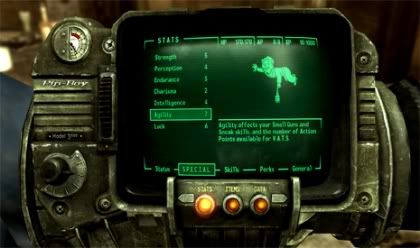 I mean, for cryin' out loud, the screen of LG's device is even dominated by green. Don't get me wrong, I want one. I'm just saying.
In other news, since I really can't justify making a whole post about a video game that I'm only kinda-sorta anticipating, Halo 3: ODST = sandbox?! With stealth, health, and the triumphant return of the pistol? Well, OK. Maybe I'm anticipating it a bit more now. We'll see what September brings.
Tuesday, June 9, 2009
101 Interesting Things, part seventeen: Prehistoric Booze!
Talk about getting back to your roots: Discover Magazine tells the story of Chateau Jiahu, an interestingly-named alcoholic beverage with an even more interesting composition:
Scientific American has a similar (though much more concise) article about several other similarly-themed ancient brews, you should check it out if you're the drinking type. I'd drink one just to say I'm getting drunk on proof that creationists are wrong.
For the past few years McGovern has been analyzing scraps of pottery excavated from a site in central China. Last year he announced that he had detected traces of the oldest alcoholic beverage yet discovered, a Stone Age brew dating back 9,000 years. When I visited McGovern's basement laboratory the day before, he handed me a plastic bag containing one of the shards. I could not get my mind around the stretch of human culture it embodied—a time period twice the span from the pyramids of Egypt to the pyramids of Las Vegas; Christianity rising four and a half times. Nonetheless, with this meager evidence, McGovern and the brewers at Dogfish have found their mission: to coax an ancient brew back to life.
Our ancestors were getting fucked up on this stuff in China around nine-thousand years ago. That's right: we've been boozing it up since before some people think the Universe even existed. Here's to the human race, getting wasted on whatever's handy since time immemorial!
Scientific American has a similar (though much more concise) article about several other similarly-themed ancient brews, you should check it out if you're the drinking type. I'd drink one just to say I'm getting drunk on proof that creationists are wrong.
Monday, June 8, 2009
101 Interesting Things, part one follow-up
My initial post on 101 Interesting Things dealt with the Antenna Galaxies. I saw an image today that tells another interesting story about space: the Earth is a very small place in a very large Universe.
The Earth is shown, to scale, first next to other bodies in our solar system. Then the Earth vanishes to invisibility as our Sun is compared to other stars, and the Sun then vanishes itself as yet larger stars are shown. Finally, the Sun is shown as a pale cluster of pixels, to scale, next to the largest star known. To still have the Sun register, only about twenty-five degrees of arc length of the larger star can be displayed.
Next, the Hubble deep field image is explained. For those who may not be savvy, the Hubble deep field image is a picture that was assembled from very small, very sensitive images taken over a period of ten days by the Hubble telescope, gathering every single photon it could from a very, very small section of the night sky. About the width of a dime, held at seventy-five feet (or, if you're metrically-inclined, a 65-mm tennis ball held at 100m). Nobody thought we would see much of anything in there, but almost unbelievably, this oh-so-tiny section of sky held galaxies beyond counting, many over 13 billion light years away. Some of them are so far away, the light that is now reaching our eyes was formed by stellar fusion when the Universe was only 800 million years old, and has travelled for almost the entire Universe's lifetime just to reach us. After so long a time, there is precious little evidence of what was going on at the time, and extracting that from amid all the noise surrounding our planet is painstaking - but what we are able to find in even that is rich.
The fact that we are able to do this tells me something both very simple, and very important: the Universe is truly amazing. There are those who think that atheism - a purely scientific world view insofar as it asserts only that we must learn from the Universe by looking at it - lacks vitality, inspiration, or wonder. I know that some of them think this, and I once thought it myself; yet I can't help but ask in response to that, "Isn't reality enough?"
Subscribe to:
Posts (Atom)