On Wednesday, the California Supreme Court decided that the citezenry's passage of Proposition 8 was a legal maneuver. Fair play to them - the challenge was based on whether or not such a change to the state's constitution could be made by a general vote, or whether it had to be done by the legislature, so we kind of have to give it to them. I need to stress here that the judges were not voting on whether or not Prop 8 was good, but whether its enactment was done in proper legal fashion. Proposition 8's supporters - or, if we wish not to mince words, anti-gay bigots - had a few choice words to say about it. There is so much that is horribly wrong with this:
At 1:22 in the above video, one Nadia Chayka said, "I want my children to know that there is a mom - a woman - and there is a man - a father - and that's where children come from, from that union. And I don't want them to be confused about where children come from." That's right: this dumb shit is glad that the rights of millions are being held back so that her children can learn a biology lesson.
Shame on you, Nadia. You have missed the point entirely. You simpleton. You fool. You loathsome, disgraceful, unthinking twit. I don't care what your IQ or level of education is, you are an idiot for being unable to see past your own prejudice on such a clear-cut moral issue, and for allowing such thin rationalizations to gain any foothold upon your mind.
First of all, if this is what Nadia wants her kids to think, then she can damn well explain it to them. You don't need the state to uphold your prejudice in order for your children to learn about the birds and the bees. Additionally, if what she means is that she wants to pass on her bigotry to her kids, then that's an entirely different matter and her children are quite frankly able to make up their own minds on that.
Furthermore, the lumping together of these two things, marriage and sexuality, is nothing but an artifact of the lingering confusion that marriage is "about" hetero sex or "about" making babies. Marriage isn't about sex any more than a cell phone contract is about talking to your friends. Sure, it's something you do within the scope of the contract, but lots of people were doing it before they signed their contracts and that's OK, too. I don't even understand why religious ideas are even brought to the table here, because marriage isn't even a religious practice! Sure, plenty of religions have marriage rituals, but that doesn't make marriage into a religious issue any more than books are religious just because religions have those. And if marriage were about children, as it's been said countless times before, then infertile persons would not be allowed to marry, either. They clearly can, so it's clearly not.
And don't even bother trying to tell me that sterile couples are capable of having children in principle - I know that, and you know that, and we both also know that for the "in principle" to become "in reality," you'd have to mess about with the plumbing of at least one of those persons. But any two persons could reproduce sexually if you only messed about with their plumbing, so this distinction is meaningless, as there's no principled way of deciding upon a privileged method of messing about with a hetero couple's plumbing that could not also be applied to homo couples for the same results. (Pro tip: it's because excluding homosexual couples is always an arbitrary choice, since you must rely at some level on personal, cultural, or religious prejudice in order to have any reason to do so in the first place.)
This is kind of a weird thing to say, maybe, so I want to offer a proof of concept: imagine a woman who, for whatever reason you like, has had her uterus and ovaries compromised; her entire reproductive tract is shot and needs to be wholly replaced to restore her fertility. Maybe she was born that way, maybe she developed cancer at a young age and had the organs in question removed. In order to become a good Christian baby factory, all she needs is a set of functioning organs, right? Except there's an immune complication - she can't accept transplants. Again, the specific reason is unimportant, but the result is that all potential donor organs will certainly be rejected. She cannot be made fertile due to contingent circumstances, though she could be in principle. If she can marry a man (and good luck finding someone to say she couldn't - she's still a woman), then so can any man, and here's why. If you could somehow get a functioning set of organs inside her body, then she could bear children; and the same goes for every male on the planet. Men wouldn't even need a birth canal, since in vitro fertilization and caesarean sections are common procedures. Therefore, all men are capable of reproducing in principle in exactly the same way as our hypothetical woman who would be allowed to marry men, too. Therefore, because infertile couples are allowed to marry and some infertile couples could only be fertile in principle by means which could also make homosexual couples capable of reproduction, marriage being "about" reproduction completely and utterly fails to exclude homosexuals, except on the basis of preexisting irrational prejudice. I win!
Prohibiting same-sex marriage is legalized bigotry, plain and simple. Every argument against gay marriage that holds any logical water is dependent upon unfair prejudice to do so, and therefore inadmissible in our theoretically egalitarian society. The End. Now grow the fuck up and come join us in the twenty-first century - the mere fact of other people doing the things you do in ways that you personally don't like to do them in no way prevents you from continuing to do them the way you've always done. Homosexuals have become the Trix rabbit - yearning so desperately for such a simple thing, but denied it at every turn by childish reactionaries who take that very same thing for granted and continue to withhold it for no good goddamned reason.
Imagine any other social privilege, and any other demographic ("children" don't count, because everyone starts out that way and grows out of it in the exact same sixteen, eighteen, or twenty-one years, depending on the privilege in question), and see how abjectly horrifying these statements are: [Group X] can't do [activity Y], because [activity Y] is about [non-group X] getting [benefit Z which has nothing to do with whether you're a part of X or Y]. Blacks can't drive, because driving is about white people going places. Jews can't live in apartments, because apartments are about gentiles finding affordable rental properties. Women can't watch porn, because porn is about men getting their rocks off. Six-fingered people can't be taught to read, since literacy is about five-fingered people learning things. Atheists can't hold public office, because public offices are about pandering to the masses. Oh, wait, that last one's actually true (in the USA, anyway). But now see that the statement, "Gays can't marry, because marriage is about straights contractualizing their love or whatever," and somehow people aren't as shocked and revolted as they would be by the other statements.
Why? Why?! I can't understand this for the life of me. Are "normal" people so impervious to cognitive dissonance that they can truly hold in the same frame of mind the two thoughts, "I oppose gays being able to marry," and, "I am a decent human being?" Or do they just not think, not even consider the ramifications of their ideas, not even doubt the justice of their actions, before trampling so deliberately and callously over the dreams of other human beings? And which of the two alternatives is worse?
The point, Nadia, is not that these specific statements are discriminatory and obviously awful, but that this entire class of statements should be seen as equally disgusting and barbaric and backwards and just plain wrong. So fuck you, and fuck anyone who thinks like you, you atavistic inhuman slime.
Thursday, May 28, 2009


Monday, May 25, 2009
Twexchnology Throwesd a Tewmpwer Tantrum
My kewyboarsd hasd throwen a fit ansd nowe rwefusdwesd to weork propwerly. No jokwe. WEhwenwevwer I typwe onew of thwe followeing lwettwersd, thwe ewnsduing xcharaxctwer xcombination isd sdisdplaywesd:
- Typing "S" or "D" rwesdultsd in "SD"
- Typing "W" or "E" rwesdultsd in "WE"
- Typing "X" or "C" rwesdultsd in "XC"
- Typing "2" or "3" rwesdultsd in "23"
Dammit, thisd weasd kinsd of intwerwesdting, but nowe I rweally havwe to ficx my kweyboarsd. WEisdh mwe luxck!
EDIT: Fixed at last! And I learned a bunch of stuff about how keyboards work, too! Double-win!
Sunday, May 24, 2009
The 37th Humanist Symposium - Brought to you by the Internet
Hello, everyone, and welcome to the 37th edition of the Humanist Symposium! We've got a lot of good reading for the evening, ranging from the informative to the contemplative, vitriolic to humorous, historical to speculative. Rather than attempt to unite these by a thematic thread, I want to tie things together tonight with some thoughts on the wonderful mechanism that makes this type of gathering possible: the internet.
But first, a man who needs no introduction: Ebonmuse of Daylight Atheism sends in the latest entry in his ongoing series "The Contributions of Freethinkers," recounting the life and times of Abner Kneeland, the last person in America to be jailed for the imaginary crime of blasphemy:
Kneeland argued, unsuccessfully, in court that he was not an atheist but a pantheist. The prosecuting attorney, meanwhile, argued that if he were not punished for his opinions, "marriages [will be] dissolved, prostitution made easy and safe, moral and religious restraints removed, property invaded, and the foundations of society broken up". (See any parallels?) In 1838, he was found guilty and sentenced to sixty days in jail.
With the possible exception of the ecosystem as a whole, the internet could be seen as the single largest network on the planet. I say "possible exception" because some may consider it cheating to allow the planet Earth itself to be considered a network contained within itself. As my roommate once remarked, after playing video games with some friends in Ireland, "Man, the internet is so awesome! I've just been talking with two guys in Ireland, a quarter of the world away, as if they were in the same room with me." I think the internet's ubiquity has detracted somewhat from the marvel of it - we take it for granted because we see it, use it, and talk about it every day (or almost every day), the sheer achievement of it drowned out by routine use.
Next, we have news from the field of medicine. Andrew Bernardin of The Evolving Mind tells of Christianity's failure to deal with depressing events by irrationally blaming them on others in Medicated Out of Hell:
...I heard a Christian football coach explain to the sad/distraught female interviewer why her friend had died of cancer. Adam. It was Adam’s fault. We now live in a fallen world and bad stuff happens to good people because of it.
If you ask me, that guy is delusional. But because he is not personally suffering, or an obvious danger to himself of others, and because his relationships are intact . . . . the state won’t involuntarily institutionalize him.
Mike of Brain Stimulant discusses possible mechanisms for a spirituality-boosting drug in Religious Pill:
Does a selective drug exist that could increase a person's spirituality and religiosity? Are there pills available that would allow a person to suffuse their perceptual consciousness with a feeling of the presence of an otherworldy supreme being? Will the very same drug increase feelings of serenity, peace and magic? I mentioned previously about a British psychiatrist who argued that we could use drugs to enhance specific traits of humanity. What does neuroscience have to say about human spirituality?
Like a good scientist, he sticks to the facts without getting too deep into the ethics. Like a good philosopher, I would love to talk about the ethics at great length over several beers. As if in answer, we have a piece from Colin Timberlake, born of just such a bar-style discussion, entitled Suicide and Organ Donation: A System to Save Lives?
The idea sounds difficult to stomach at first. But if we, as a society, have the potential to save lives - quite possibly the lives of children in desperate need of organs - then it is immoral not to explore such an option merely because it seems…icky.
The internet is not exactly a "new" thing, however. In a lot of ways, it is simply a logical outgrowth of that which came before it. Phone lines connected the world before the internet piggy-backed on top of them; before that, electrical grids powered cities, every house a node that connected to the nexus of the local power plant; before that, indoor plumbing connected everyone to water towers and sewer systems. What's "new" about the internet is that it is an informational network, not simply a power delivery system or a combination water delivery/waste disposal system like its aforementioned predecessors. The information one can find on the internet was previously stored, not in computers accessible from home terminals, but in libraries private and public, places you would have to travel to in person to find the information you sought*.
Next, from frontiers literary, we have two book reviews. The DC Secularism Examiner, Paul Fidalgo, reviews Eric Maisel's The Atheist's Way: Living Well Without Gods, in 'The Atheist's Way' is a crucial message in a light tome:
This book offers a vital message that I think any nonreligious person needs to hear, even if they don't realize they need to hear it: There is no inherent "meaning of life," existence really is a random, pointless phenomenon, and any meaning for which we may pine must be created by ourselves. Maisel levels with the reader, and insists that we establish our own parameters and values based on our consciences and intelligence, and encourages us to live these to our best ability.
GrrlScientist of Living the Scientific Life provides us with an in-depth and insightful review of Jerry Coyne's Why Evolution is True, reminding me that I need to buy it:
Even though Coyne's initial motivation to write this book stemmed from his annoyance with those who claim that intelligent design is science, he doesn't attack religion. Instead, as demonstrated in some of the passages I've quoted here, he does what scientists do best: he makes predictions. In this case, he makes predictions that naturally arise from evolutionary theory as well as from creationism and "intelligent design" and details how actual scientific data conflict with religious beliefs.
Even the networks of phone lines, electrical power grids, and indoor plumbing may be seen as natural out-growths of the human societies in which they were invented. These societies, too, though anticipated by other social animals (and inferior to those of social insects until we got into some serious technology) are but natural outgrowths of the networks that preceded them: tribes, families, brains, organs, even the most basic multicellular organisms are networks of eukaryotic cells, themselves in turn networks of prokaryotic conglomerates that merged for mutual benefit some time in the vast uncertain chapters of history.
Next on the hit list is our meditative group, led by Moody of verywide.net with a humanistically spiritual rumination on the Tree of Æons, opened with a sentence the length and poetry of which would make Dickens blush:
From so humble a beginning as the blind dance of chemicals may represent, from out of the depths of unconscious ages in life’s Ultima Thule, the Tree of Life arose from the primordial chaos, sui generis, to grow through countless ages, to diversify its fruits, to send tendrils of spiral DNA, winding and raveling, into every niche, every nook and cranny of exploitable space, to thrive even in the face of massive threats to its very existence, to return from setbacks on scales that in their enormity beggar the imagination, to reach in its endless adaptations this age, this milestone, where we—but a part of its neverending, ever wending growth—may gaze upon it and perceive, however dimly, the ground from whence it rose up, while still not finished, and as yet remaining all but blind to the future of its existence.
Greta Christina poses a properly philosophical question, What does it mean to believe in something? I found her answer both illuminating and satisfying, as she spots a critical conflation of two distinct meanings of the term, "to believe in":
A while back (I was still calling myself an agnostic, which gives you an idea of how long ago it was), I wrote a piece pointing out that the question, "Why are we here?" has two very different meanings. It can mean, "What caused us to be here?", or it can mean, "What is our purpose?" And I pointed out that religious belief tends to conflate these two meanings -- the answer to both questions is, "God" -- but that, for non-believers, those two questions have completely different answers. What caused us to be here is the process of evolution and the physical laws of cause and effect; our purpose is whatever we decide our purpose is.
I want to make a similar argument about what it means to believe in something.
Julian Sanchez makes use of some demographic research and capitalizes on the fact that, for any finite data set, infinite interpretations are available, in outlining A "God-Shaped-Hole" Shaped Hole in his life:
It looks like we have some data here, in the form of the Pew survey (and the ensuing New York Times op-ed) to which Stuttaford is responding. That poll found that while the “unaffiliated” are the fastest growing “religious” group, children raised without an affiliation are more likely to end up with one than those raised within a faith are to switch religions (or abandon it altogether). The problem is, “unaffiliated” isn’t all that helpful a category—it’s easy to conflate with “secular,” but a closer look makes clear that this isn’t the case: Lots of people who lack affiliation to any particular church hold religious, or at least “spiritual” beliefs, and even attend religious services at least sporadically.
And VJack at Atheist Revolution has some words to say on the way that categories work and being out with one's beliefs, in Coming to Terms with One's Atheism:
Do you believe in any sort of god(s)? If your response was anything other than an affirmative one, you are an atheist. Yes, you.
Depending on how far back we wish to go, and how fast & loose we like to play with our labels, we can see networks dating back to before even the Earth itself was formed. What are galaxies, after all, if not vast networks of stars connected by invisible threads of gravity? These galaxies themselves sometimes collide, showing that even these most vast of superstructures are still connected in networks, and through them, all the universe is connected to itself.
Our penultimate category waxes humorous, and to avoid spoiling any jokes, I'll be sparing the introductions:
Debbie Goddard of the Center for Inquiry writes of awkward party conversations in "What's your sign?" When Good Conversation Goes Woo.
Cubik's Rube lets fly a Grade-A rant (the "A" is for "atheist") in More than we can handle. OK, it's probably not deliberately humorous, but I've been in this type of situation before and his rant really makes me smile, so I'm including it here.
Jennifurret the Blag Hag regales us with a consideration of just what exactly An uncontroversial atheist ad would look like.
Looking into the past, when there was nothing but stars connected by nothing but light and gravity, I think the future of the internet may not be too much different. Things are becoming increasingly wireless, and I would not be surprised at all to find our ever-changing information network consisting simply of some form of broadcast node (whether a tower or a satellite), metaphorically orbited by satellite devices (both servers and terminals) with no wires involved at any step of the way. At any rate, I think it's fantastic that people from around the world can sit in the comfort of their own homes and share ideas both in real-time and at length (by AIM, Skype, e-mail, or blog) because of something our civilization has built.
Speaking of the future, our last category has but a lone entrant, who also happens to be the host of the very next symposium on June 14th: Viktor Nagornyy writes a future-based historical fiction piece entitled 2121: the age of reason. Viktor's short story speaks for itself, so I'll leave him to it.
So that's that for the 37th Humanist Symposium; I hope you've enjoyed your visit! Please direct any questions, comments, or death threats to the comments below. Y'all have a good night, and a pleasant holiday tomorrow!
* - Yes, yes, I'm aware that I'm ignoring all the chaff on the internet, but that's OK. There's a lot of chaff in libraries, too: just look in their metaphysics, new age, or religion sections. Also, on networks in general, I kind of ignored post offices. I didn't realize this until I had only a paragraph to go, though, and couldn't really find a nice place to fit them in, so I'll just skip them (but for this brief acknowledgment, of course).
Saturday, May 23, 2009
Call Ripley! Bionic commandos are just an upgrade away
This really has to be seen to be believed:
OK, so I just Googled the i-LIMB to find out more, and here's an even better looking one:
This is just awesome! Seriously, though, as fantastic as these prosthetics are right now, there's still a ton of potential. Back in 2004, I read a story (I forget where) about this game called "Mind Balance" where you look at cubes on a screen to balance a tightrope walker. The "controller" (by which I mean, "the mechanism by which the player interacts with the program") is a piece of headgear which more or less reads your mind by using EEG to determine which cube is being looked at: look at the left one to lean left, look at the right one to lean right. I found the story today in an archived issue of Computor Edge magazine (see page 20). In that article are other applications of similar technologies (like using thoughts to browse the internet), and opposite applications of other technologies (such as using ultrasonic pulses to induce sensory experiences).
Visit msnbc.com for Breaking News, World News, and News about the Economy
OK, so I just Googled the i-LIMB to find out more, and here's an even better looking one:
This is just awesome! Seriously, though, as fantastic as these prosthetics are right now, there's still a ton of potential. Back in 2004, I read a story (I forget where) about this game called "Mind Balance" where you look at cubes on a screen to balance a tightrope walker. The "controller" (by which I mean, "the mechanism by which the player interacts with the program") is a piece of headgear which more or less reads your mind by using EEG to determine which cube is being looked at: look at the left one to lean left, look at the right one to lean right. I found the story today in an archived issue of Computor Edge magazine (see page 20). In that article are other applications of similar technologies (like using thoughts to browse the internet), and opposite applications of other technologies (such as using ultrasonic pulses to induce sensory experiences).
Fast-forward to 2007, and Australia-based Emotiv has actually built a "helmet" that can play even more sophisticated games by reading brain waves (video demonstration). Mattel has even made the technology into a child's toy with Mind Flex. And just in case you aren't already aware, Raytheon Sarcos has already built a prototype exoskeleton called the XOS which monitors the human wearer's movements 200 times per second, can move at human speed, and reduces the perceived weight of lifts by 95% - it makes you stronger without slowing you down (video here, just skip to 1:15 to see the machine in action). All we need to do is to refine and integrate these technologies, and soon we'll have cyborgs and remote-controlled robots running all over the place!
OK, maybe not, but this is still really, really exciting!
Friday, May 22, 2009
Messiness as both Virtue and Vice: Thoughts on "Terminator Salvation"
I watched Terminator Salvation Thursday night, and it was about what I had expected/hoped for: a good action movie that was more like Terminator 2: Judgment Day than Terminator 3: Rise of the Machines. It has some flaws, to be sure - there's something of a plot hole and a couple scenes didn't seem like good fits - but by and large, I enjoyed the experience.
OK, so the Terminator series has never been too philosophically driven - at best, it could be said that the movies are character-driven pieces about hope and the human spirit. But they do play with philosophy sometimes, whether in an attempt to justify whatever major thing is going on, or to try saying something substantial in a summer shoot-'em-up. That said, there's plenty of philosophical material to be drawn from the series, which in itself isn't quite so special (you can find philosophy anywhere you look, after all), but the Terminator movies do give some interesting opportunities.
For example, Sarah Connor faces a formidable epistemological dilemma, not unlike a Cassandra complex, in that she is dead-sure of some very important facts about the future but cannot convince anyone that she is correct. How ought she to behave in order to best influence future events? How can she continue to perform checks upon her own sanity and provide herself with some assurance that she hasn't gone off the deep end? Given that the events of the movies happened as they did (what with the time travel and all that), what does that say about how "fate" works in that world? Since the war started because SkyNet considered human beings a threat, what could be done to reconcile humanity and AI so that they might live in peace? Since humanity is winning the war by the time Kyle Reese is an adult, how much of the future must SkyNet be aware of for its first strike to become an irrational action?
In Terminator Salvation, John Connor asks people to disobey direct orders from Resistance Command on the grounds that Command is asking them to carry out calculated but inhumane orders - to behave like machines - and if they're going to do that, then what's the point of surviving? This is what we in the industry call a "theory-laden question," or a "loaded question" in the common parlance. There's quite a bit of meaning packed into the question, and the most important parts are not explicitly outlined in the question itself. This can cause confusion and disagreement, as every respondent will color in the ambiguous but necessary values that give meaning to the question, but each respondent may have different values. Until these are explicitly drawn out, apparent disagreement can cause people to spend a lot of time talking past each other.
Or maybe I'm reading too much into it, and Connor was just taking the lead from the bottom up. After all, a leader doesn't always have to tell his followers what's true, he tells them what they need to hear. Maybe they just needed to hear some emotionally-charged mumbo-jumbo to do what he wanted them to do, in which case Connor was just using a dirty trick to "hack" their decision-making processes. And if that's the case, then he's full of shit and the humans already are no different from the machines, so whatever.
SPOILER ALERT! (It does not end!)
OK, so the Terminator series has never been too philosophically driven - at best, it could be said that the movies are character-driven pieces about hope and the human spirit. But they do play with philosophy sometimes, whether in an attempt to justify whatever major thing is going on, or to try saying something substantial in a summer shoot-'em-up. That said, there's plenty of philosophical material to be drawn from the series, which in itself isn't quite so special (you can find philosophy anywhere you look, after all), but the Terminator movies do give some interesting opportunities.
For example, Sarah Connor faces a formidable epistemological dilemma, not unlike a Cassandra complex, in that she is dead-sure of some very important facts about the future but cannot convince anyone that she is correct. How ought she to behave in order to best influence future events? How can she continue to perform checks upon her own sanity and provide herself with some assurance that she hasn't gone off the deep end? Given that the events of the movies happened as they did (what with the time travel and all that), what does that say about how "fate" works in that world? Since the war started because SkyNet considered human beings a threat, what could be done to reconcile humanity and AI so that they might live in peace? Since humanity is winning the war by the time Kyle Reese is an adult, how much of the future must SkyNet be aware of for its first strike to become an irrational action?
In Terminator Salvation, John Connor asks people to disobey direct orders from Resistance Command on the grounds that Command is asking them to carry out calculated but inhumane orders - to behave like machines - and if they're going to do that, then what's the point of surviving? This is what we in the industry call a "theory-laden question," or a "loaded question" in the common parlance. There's quite a bit of meaning packed into the question, and the most important parts are not explicitly outlined in the question itself. This can cause confusion and disagreement, as every respondent will color in the ambiguous but necessary values that give meaning to the question, but each respondent may have different values. Until these are explicitly drawn out, apparent disagreement can cause people to spend a lot of time talking past each other.
Human beings are machines, just very messy ones. As my friend Zach once put it, "I am a machine for turning meat into ideas!" (EDIT: As Zach points out in the comments below, the quote is actually from Dinosaur Comics, which comes highly recommended by everyone who reads it.) Our brains are crude, ad-hoc learning computers which store, access, and run various programs throughout our lives: etiquette programs, problem-solving programs, math programs, architecture programs, science programs, religion programs. Most of the time, we aren't consciously aware that these programs are running, we just get on with our lives and tell ourselves stories about the mystical "I" at the helm of consciousness.
The distinction between man and machine cannot be merely a functional one, for it does not hold up to scrutiny. We simply fit into the category all too well at some fundamental levels. No, the distinction that John Connor wishes to make must be a moral one - so what are the values that would inform such a moral system? We can't tell much, but in the context of the scene, we can tell that what Connor disvalues is the rigid, non-negotiable adherence to procedure. Within this system, a military chain of command, there is no flexibility to allow perceived errors in judgment to be addressed before mistakes are made. This is the problem that John Connor is running into, but it is a flaw that comes as a cost of what is typically a strength: a rigid chain of command, with experienced individuals giving direction from the top down, ought to result in rational decisions being carried out in the field by those who lack such experience but are able to take advantage of it by virtue of that very chain of command. Though individual soldiers may not benefit directly from this system all the time, the soldiers as a group are better off with this system than without it. The system provides organization and a clear structure of power, without which a military outfit would have a hard time functioning.
But what happens when the system breaks down? Due to the very nature of the power structure, mistakes at the top cannot be addressed in real-time. Only after they have been proven to be mistakes by direct experience can they be addressed, and by then it is too late to avoid the consequences of that mistake. All that can be done is to try to design a better system (or at least learn a valuable lesson) so that similar mistakes will not be made in similar situations. Unfortunately, Connor does not have the time for this - this particular mistake will ruin everything! It's one of those "end of the world" scenarios that simply doesn't happen in real life, but is excellent fuel for thought experiments. We can see, by Connor's course of actions, what it is that he values more than the system that has failed him.
For lack of a better term, I will call it "messiness." Human beings, in a lot of important ways, are messier than the machines which seek to exterminate them. This messiness can be a liability, like the way that our bodies must grow from infancy to adulthood instead of being assembled in a factory, which puts constraints on our basic body plan as well as opening the door to all sorts of developmental mishaps and genetic defects. But, if harnessed correctly, it can also be a virtue: brains are not rationality machines or truth detectors, and so humans who possess them are by necessity fallible. If we recognize this fallibility, then we are able to doubt ourselves, and we can give the benefit of this doubt to others. While such good will may be taken advantage of (and it often is), it can also lead us to behave more humanely towards one another, to trust one another, and to get along with one another even when we aren't getting our way.
John Connor is appealing to the humanity of those who receive his transmission insofar as he is asking them to embrace their messiness: to doubt themselves and the system that has kept them alive thus far, to doubt enough to trust him and do something which they are told does not make sense by people who really ought to know so.
Or maybe I'm reading too much into it, and Connor was just taking the lead from the bottom up. After all, a leader doesn't always have to tell his followers what's true, he tells them what they need to hear. Maybe they just needed to hear some emotionally-charged mumbo-jumbo to do what he wanted them to do, in which case Connor was just using a dirty trick to "hack" their decision-making processes. And if that's the case, then he's full of shit and the humans already are no different from the machines, so whatever.
Monday, May 18, 2009
Go directly to grey goo; do not pass Go; do not create post-scarcity economy.
Sylvain Martel of Canada's École Polytechnique de Montréal has led a team of scientists in creating functioning nanobots. I don't simply mean neat proof-of-concept tricks (like the glowing kittens which demonstrate that we can successfully modify genes) - though they did that, too, when they managed to navigate blood vessels with MRI-guided bacteria last year.
Martel and his team have done it again, and this time, they mean business. Now the crazy Canucks have created solar-powered robots only 300 microns (about one hundredth of an inch) on a side which are capable of directing swarms of bacteria with tiny EMPs. Seriously, watch this video. Yeah, the number-crunching is still mainly done on an external computer, but all that needs to be done is to develop aggregate parallel processing, and then even without genuine AI, we've got the makings of a grey goo scenario on our hands.
All kidding aside, this has tremendous potential for targeting otherwise inoperable things like tumors and what-not. The danger of things getting out of hand is real, of course, as it always is with science that operates at the very edge of our ken - but I don't see this as any more dangerous than testing nuclear fusion, starting up the LHC, or putting satellites in space.
OK, back to humor:
Sunday, May 17, 2009
101 Interesting Things, part fifteen: Slime Moulds
The following is taken from The Ancestor's Tale: A Pilgrimage to the Dawn of Evolution, by Richard Dawkins. Much like Southland Tales, the life cyle of dictyostelids starts off just a little weird, and then gets increasingly crazy. The text speaks for itself, so I'll let the good doctor do his thing:
Of the amoebozoan [slime moulds], the best known are the cellular slime moulds or dictyostelids. They have been the life work of the distinguished American biologist J. T. Bonner, and what follows is largely drawn from his scientific memoir Life Cycles.- Richard Dawkins, The Ancestor's Tale, p. 504
Cellular slime moulds are social amoebas. They literally blur the distinction between a social group of individuals and a single multicellular individual. In part of their life cycle, separate amoebas creep through the soil, feeding on bacteria and reproducing, as amoebas will, by dividing in two, feeding some more, then dividing again. Then, rather abruptly, the amoebas switch into 'social mode.' They converge on aggregation centres, from which chemical attractants radiate outwards. As more and more amoebas stream in on an attraction centre, the more attractive it becomes, because more of the beacon chemical is released. It is a bit liike the way planets form from aggregating debris. The more debris acumulates in a given attraction centre, the more its gravitational attraction. So after a while, only a few attraction centres remain, and they become planets. Eventually the amoebas in each major attraction centre unite their bodies to form a single multicellular mass, which then elongates into a multicellular 'slug.' About a millimetre long, it even moves like a slug, with a definite front and back end, and is capable of steering in a coherent direction - for example towards light. The amoebas have suppressed their individuality to forge a whole organism.
After crawling around for a while, the slug initiates the final phase of its life cycle, the erection of a mushroom-like 'fruiting body.' It begins the process by standing on its 'head' (the front end as defined by its crawling direction), which becomes the 'stalk' of the miniature mushroom. The inner core of the stalk becomes a hollow tube made of swollen cellulose carcasses of dead cells. Now cells around the top of the tube pour into the tube like, in Bonner's simile, a fountain flowing in reverse. The result is that the tip of the stalk rises into the air, with the originally posterior end of the stalk at the top. Each of the amoebas in the originally posterior end now becomes a spore encased in a thick protective coat. Like the spores of a mushroom, they are now shed, each one bursting out of its coat a free-living, bacteria-devouring amoeba, and the life cycle begins again.
Friday, May 15, 2009
And now for something completely different: "Tea Party"
You sip your tea as I sip my wine
And your tea tastes good so you feel just fine
And your cup's never empty
No, it's almost always full
And my wine runs out and you think I look a fool
Now I'm feeling kinda tipsy
But it feels pretty nice
Then I grab a cold beer
From the chest piled high with ice
So you sip your tea as I sip my beer
And you see me getting drunk while your vision's still clear
And your cup's still full
While my beer has run out
I wonder briefly what's next - you've never known that doubt
Now I wanna sober up
So I get myself a cola
And my drinks are always new
While your tea is getting older
But you sip your tea and I sip my soda
And we talk about our drinks while relaxing on the sofa
Now my soda's run out
So I get another drink
And you sit by yourself, but you never stop to think
That from time to time
You'd like to try something different
No, your tea is just fine
So you're gonna stick with it
'Cause the unfamiliar's scary
You don't know what's 'round the corner
And you never want to look
'Cause your tea party might be over
Now I have hot buttered rum
And that's kind of like tea
So you ask me for some
And I share it happily
But you spit it right out
And that makes me kinda sad
Because that's one of the best drinks
That I think I've ever had
But then you offer me some tea
That's been in your cup all night
And I've had some tea before
And it was good and so I try it
But it's bitter and it's bland
And you're so fucking happy with it
I just can't understand
Why you'll try nothing else
('Cause you've known nothing else)
Why you want nothing else
('Cause you've known nothing else)
Why you think of nothing more
('Cause you've known nothing else)
Why you have nothing more
('Cause you've known nothing else)
It's just the same old tea from when you were raised
But you're drinking it day after day (after day after day...)
Now you're leaving the party
'Cause I told you what to drink
But I really didn't mean to
I just wanted you to try a change... for a change
- - -
The above was written due to a flash of inspiration I had after reading the following passage:
There's an old analogy to a cup of tea. If you want to drink new tea you have to get rid of the old tea that's in your cup, otherwise your cup just overflows and you get a wet mess. Your head is like that cup. It has a limited capacity and if you want to learn something about the world you should keep your head empty in order to learn it. It's very easy to spend your whole life swishing old tea around in your cup thinking it's great stuff because you've never really tried anything new, because you could never get it in, because the old stuff prevented its entry because you were so sure the old stuff was so good, because you never really tried anything new... on and on in an endless circular pattern.
- Robert Pirsig, Lila, p. 25
I'd like to hear it set to music some day (I thought of it as a song, but ran out of interesting sounding music to put to the different parts), but I thought I'd share it now because I simply may never write the music for it. Somewhat related: Alienation, Consequentialism, and the Demands of Morality, by Peter Railton.
Thursday, May 14, 2009
Bullshit Pulpit: The Danger of First Premises
Many apologists will argue that, were God to make his presence a verifiable fact, that would violate the free will of humans to freely believe or disbelieve in him, which God cannot do. In syllogistic format, the argument goes:
1. Forcing awareness of God's existence upon persons is a violation of their free will.
2. God does not violate the free will of persons.
3. Therefore, God will not prove his existence to persons.
I am defining "person" as "a rational agent possessing moral worth" as a bare minimum to which I think we can all agree. Whatever else a person may be, a person at least is a rational agent possessing moral worth.
Let's forget for a moment that God proved his existence beyond all reasonable (and even most unreasonable) doubt to all manner of people in the Bible. I want to talk specifically about the book of Exodus and God's interactions with Pharaoh in the downtime between the ten plagues. Here are some more premises:
4. God forcibly changed Pharaoh's mind in the book of Exodus.
5. Forcibly changing the mind of a person is a violation of that person's free will.
This seems to create a conflict with 2 above. Hmm. Here are the available conclusions, as far as I can see them:
6. God violates the free will of persons from time to time. Capriciously, or perhaps arbitrarily.7. The Bible is wrong on at least one count.8. The Pharaoh was not a person.
Obviously, 6 is out - we know this from 2. We can also reject 7, because God wouldn't allow the Bible to contain falsehoods. Otherwise we would not be able to use it as the handy guide to the One Truth of the Universe that it is. That leaves us with 8, which means that God's chosen people were in long-term slavery to some manner of philosophical zombie.
Now, I know this may seem odd, but think about how many problems are neatly swept under the rug by this new information! All those poor souls who never heard of Jesus and would be consigned to an eternity in Hell? They're just soulless zombies. The Canaanite civilizations which the Israelites raped, pillaged, and razed to the ground? Nothing but zombies. Starving villages in Africa? More zombies. Spontaneously aborted embryos? Zombies!
The apologetic necessity of philosophical zombies, as it turns out, resolves the problem of evil at one stroke! It also eases the mathematical strain of reconciling the fact that only 144,000 Jews are going to Heaven with the fact that there are more than 144,000 members in damn near every sect of Judaism. Now all of us Good Christians can rest easy in the knowledge that no person is really suffering in the world that God made for us. In fact, I'd bet my soul that this is really the One Truth of the Universe right here: that almost all of humanity is really just philosophical zombies, extras on the set for God's big scene.
We can go further with this, too. For the real humanity to avoid the struggle that has characterized almost all life on Earth, they'd have to be living in first-world nations. I bet they're rich and white, too. And so God's special 144,000 spots have really only recently been opened up to the public - get your tickets now! Only the first 144,000 humans to realize this divine truth will have true personhood bestowed upon them, and then Jesus is going to come blow up the world once Heaven's sold out!
See what happens when you have totally inflexible first premises and then you come across, like, facts? I'm reminded of the story of the logic professor explaining conditional ("if-then") statements: he stated that a false premise validly implies any other premise. One student demanded, "OK, show how 2=1 implies that you're the pope." The professor responded that, since two is the same as one, and there are the two entities of himself and the pope, then those two entities are actually one and the same entity. Therefore, 'two equals one' implies 'the professor is the pope.' Damn, now I want to do this stuff on a regular basis!
Wednesday, May 13, 2009
101 Interesting Things, part fourteen: Carbon
The "meat" of today's post is taken from Robert Pirsig's Lila. For those who may not have heard of Mr. Pirsig, he is also the author of Zen and the Art of Motorcycle Maintenance. Also, he's kind of crazy: he thinks that Quality (yes, with a capital Q) is the fundamental stuff of reality. That's not to say that his books are insane ramblings - far from it! They're wondrous for finding new perspectives, for sitting and thinking, for getting a new twist on an old favorite, for seeing familiar things in a different way. But I first read this stuff back when I hadn't quite lost my faith, and I was more or less sold on Pirsig's Metaphysics of Quality, and then I tried to piece "everything" together with it (what's this "hubris" I keep hearing about?), and then I started to go kind of crazy myself.
At any rate, thar be spoilers aboot, though I doubt that's an issue on an eighteen-year-old book. For a little bit of background, what I'm talking about today is a way of looking at life through the Metaphysics of Quality, which philosophical lens was developed in order to more clearly articulate what Pirsig was trying to get at when he talked about Quality in Zen and the Art of Motorcycle Maintenance. He saw traditional Western metaphysics as subject/object oriented (or "substance-centered"), which left no room for Quality, because Quality does not inhere either in subjects or in objects (neither does it inhere in substances). Rather, Quality is in the relationship between subject and object, and there Pirsig decides to start his metaphysics: by taking the Quality of those relationships as a primary and working from there.
Pirsig then divides the Universe of Quality into two main categories: static and dynamic. Static quality is stable patterns that tend to stagnate over time; dynamic quality is new stuff which may be good or bad but is usually transitory. Static quality can't improve, dynamic quality can't persist. As applied to life, Pirsig writes, "In traditional, substance-centered metaphysics, life isn't evolving toward anything. Life's just an extension of the properties of atoms, nothing more. It has to be that because atoms and varying forms of energy are all there is. But in the Metaphysics of Quality, what is evolving isn't patterns of atoms. What's evolving is static patterns of value, and while that doesn't change the data of evolution it completely up-ends the interpretation that can be given to evolution." After discussing an article in which Ernst Mayr shoots down teleological evolutionary theories as a category, Pirsig continues: "Mayr certainly seemed to consider the matter settled and this attitude, no doubt, reflected a consensus among everyone except antievolutionists. But after reading it Phaedrus wrote on one of his slips, 'It seems clear that no mechanistic pattern exists toward which life is heading, but has the question been taken up of whether life is heading away from mechanistic patterns?'" For those of you playing at home, "away from mechanistic patterns" means "towards Dynamic Quality," which is properly Zen-like in being undefinable and not really an end-state anyway, but whatever.
This brings us to carbon, more or less. Whether you agree with Pirsig's metaphysics or not, I think it's safe to say that carbon is damned interesting, and with that I'll duck out and let Mr. Pirsig speak for himself:
Pirsig goes on about static and Dynamic patterns for a while, ultimately describing (without ever explicitly saying) how the pursuit of science is the Universe examining itself in order to do what it likes, but that's where the bit about carbon ends. For further reading, check out the WebElements page on carbon.
The explanation of life as a "migration of static patterns toward Dynamic Quality" not only fitted the known facts of evolution, it allowed new ways of interpreting them.
Biological evolution can be seen as a process by which weak Dynamic forces at a subatomic level discover stratagems for overcoming huge static inorganic forces at a superatomic level. They do this by selecting superatomic mechanisms in which a number of options are so evenly balanced that a weak Dynamic force can tip the balance one way or another.
The particular atom that the weak Dynamic subatomic forces have seized as their primary vehicle is carbon. All life contains carbon yet a study of properties of the carbon atom shows that except for the extreme hardness of one of its crystalline forms there is not much unusual about it. In terms of other physical constants of melting point, conductivity, ionization, and so on it does just about what its position on the periodic table of the elements suggests it might do. Certainly there's no hint of any miraculous powers waiting to spring chemistry professors upon a lifeless planet.
One physical characteristic that makes carbon unique is that it is the lightest and most active of the group IV atoms whose chemical bonding characteristics are ambiguous. Usually the positively valanced metals in groups I through III combine chemically with negatively valanced nonmetals in groups V through VII and not with other members of their own group. But the group containing carbon is halfway between the metals and nonmetals, so that sometimes carbon combines with metals and sometimes with nonmetals, and sometimes it just sits there and doesn't combine with anything, and sometimes it combines with itself in long chains and branched trees and rings.
Phaedrus thought this ambiguity of carbon's bonding preferences was the situation the weak Dynamic subatomic forces needed. Carbon bonding was a balanced mechanism they could take over. It was a vehicle they could steer to all sorts of freedom by selecting first one bonding preference and then another in an almost unlimited variety of ways.
And what a variety has been chosen. Today there are more than two million known compounds of carbon, roughly twenty times as many as all the other known chemical compounds in the world. The chemistry of life is the chemistry of carbon. What distinguishes all the species of plants and animals is, in the final analysis, differences in the way carbon atoms choose to bond.
- Robert Pirsig, Lila, p. 167-168
Monday, May 11, 2009
Polyphasic Self-Experimentation: Day Four
OK, so it's day four of my "official" polyphasic sleep schedule, though I've been napping throughout the day and getting small amounts of sleep at night for months already (not unlike the "Everyman" pattern, just not as regular). All I've really done differently, now that I think about it, is to cut out the core sleep and schedule my naps more rigidly.
I've been napping polyphasically for four days now, with one brief backslide two days ago where I slept for about three hours because I made the mistake of thinking I could just lay down for half an hour in bed. Turns out, I can't really do that thing, because it turns into another thing while I can't control my actions (translation: I sleep through my alarms). I seem to have adjusted rather swiftly, though - I'm getting REM sleep during each nap now, and falling asleep is becoming progressively easier as the days go by.
One interesting thing I've noticed is that I'm zoning out more often, which may be this "microsleep" thing I keep hearing about (probably not, though, as microsleep is only supposed to last for a few seconds and these space-outs last for minutes at a stretch). It's nice at work, because most of the tasks I do are repetitive, but I'm able to maintain my focus whenever I'm doing something new or different. It is very disorienting, however, to lose a stretch of time and snap back into reality to find that a bunch of crap got done. I also have a feeling that it could be dangerous on my bicycle - the other day, I set out from work and lit a cigarette, then came to as I was crossing a four-lane street with the cigarette nearly gone. I vaguely remembered doing all the things that got me there, it just felt like I didn't actually experience the events first-hand. Weird.
From an entirely subjective standpoint, I feel like I'm less tired throughout the day than when I slept monophasically. I'm extremely tired after getting up from my naps, so it looks like I have some adjusting to do yet on the back end of my REM cycles. I still feel like I've slept for at least a couple hours, though, and within another ten to fifteen minutes or so, I'm alert and focused again.
My eating habits are also starting to change. It's kind of hard to eat "regular" meals when my day simply doesn't fit that pattern - I'm either famished in a couple hours, or I find that I've overeaten and I get a stomach-ache. Between my roommate and myself, though, we've got a bunch of vitamin and mineral supplements lying about the house, which has proven convenient: I've started taking the supplements to make sure I'm not depriving myself of any key nutrients, and eating small amounts of food whenever I'm hungry. We'll see how that goes.
Anyway, that's my update so far - I'll keep posting any interesting developments. In the meantime, I'm going to continue turning myself into a zombie. I should probably also read those submissions for the Humanist Symposium before they start to pile up.
I've been napping polyphasically for four days now, with one brief backslide two days ago where I slept for about three hours because I made the mistake of thinking I could just lay down for half an hour in bed. Turns out, I can't really do that thing, because it turns into another thing while I can't control my actions (translation: I sleep through my alarms). I seem to have adjusted rather swiftly, though - I'm getting REM sleep during each nap now, and falling asleep is becoming progressively easier as the days go by.
One interesting thing I've noticed is that I'm zoning out more often, which may be this "microsleep" thing I keep hearing about (probably not, though, as microsleep is only supposed to last for a few seconds and these space-outs last for minutes at a stretch). It's nice at work, because most of the tasks I do are repetitive, but I'm able to maintain my focus whenever I'm doing something new or different. It is very disorienting, however, to lose a stretch of time and snap back into reality to find that a bunch of crap got done. I also have a feeling that it could be dangerous on my bicycle - the other day, I set out from work and lit a cigarette, then came to as I was crossing a four-lane street with the cigarette nearly gone. I vaguely remembered doing all the things that got me there, it just felt like I didn't actually experience the events first-hand. Weird.
From an entirely subjective standpoint, I feel like I'm less tired throughout the day than when I slept monophasically. I'm extremely tired after getting up from my naps, so it looks like I have some adjusting to do yet on the back end of my REM cycles. I still feel like I've slept for at least a couple hours, though, and within another ten to fifteen minutes or so, I'm alert and focused again.
My eating habits are also starting to change. It's kind of hard to eat "regular" meals when my day simply doesn't fit that pattern - I'm either famished in a couple hours, or I find that I've overeaten and I get a stomach-ache. Between my roommate and myself, though, we've got a bunch of vitamin and mineral supplements lying about the house, which has proven convenient: I've started taking the supplements to make sure I'm not depriving myself of any key nutrients, and eating small amounts of food whenever I'm hungry. We'll see how that goes.
Anyway, that's my update so far - I'll keep posting any interesting developments. In the meantime, I'm going to continue turning myself into a zombie. I should probably also read those submissions for the Humanist Symposium before they start to pile up.
Saturday, May 9, 2009
101 Interesting Things, part thirteen: Ice
If you had been living under a rock in the tropics for the last three hundred years or so, then you might have no idea what ice is. No, not Immigration and Customs Enforcement, but plain old crystalline H2O. I imagine that absolutely everyone who is able to read this blog is familiar with ice, yet I'd wager that the Wikipedia page on ice, in true knowledge repository fashion, holds more than a couple surprises for just about anyone. For instance, did you know that there is no widespread agreement as to why ice is slippery? I just found that out. Isn't that interesting?
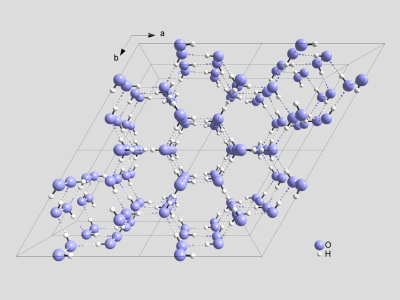

It gets better, though! My main reason for writing this entry is that ice can form physically distinct crystalline structures at different temperatures and pressures, and the results can be surprising. Water's status as the universal solvent is due to its molecular structure: the oxygen atom's valence electrons, taken from the two hydrogen atoms, are in the first and relatively close-orbiting p-shells, and the ratio of electrons to protons (5:4) results in a strong negative charge for something that size. The hydrogen atoms, on the other hand, are almost entirely stripped of their electrons (due to the oxygen nucleus' proximity to the surface of its valence shells), leaving them as more or less exposed protons. This powerful polarity means that, at around one atmosphere of pressure and in temperatures normally encountered on Earth's surface, water crystallizes in a highly-structured fashion. In other words, the way that ice "fits together" leaves a lot to be desired in terms of packing efficiency. This is why water, unlike nearly any other substance, is less dense as a solid (as we would usually encounter it) than as a liquid, reaching its maximum density at about 4°C.
OK, down to brass tacks! The various ways that water can freeze are so different that a bunch of scientists decided that it was a good idea to call them different names, starting with ice Ih (pronounced "ice one H" - the H is for hexagonal) & ice Ic ("ice one C," with a C for Cookie Cubic), all the way up through ice XIV. Ice XV has been predicted, but has not yet been produced. Ice Ih is the technical and highly-scientific name for the kind of ice you would find in your freezer, and if you could see individual molecules, then it would look like this:
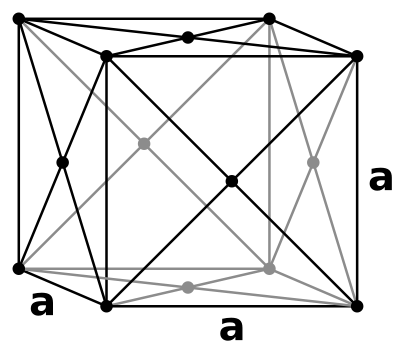
However, between 150°-170°K, water freezes in a face-centered cubic crystalline lattice:
This last one's a bit tougher to visualize; the oxygen atoms are arranged in the face-centered cubic lattice, which looks like this on its own:
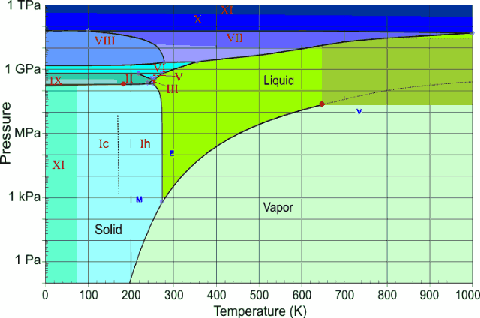
At any rate, the different phases of ice have some interesting properties. Ice VII "has the widest stability field," its pressure tolerance owing to its disordered hydrogen arrangement. Ice XI is ferroelectric! I've heard that Ice VIII is actually red, though I can't find a source to corroborate that. Many of the phases of ice can only be formed at pressures measured in mega- and giga-Pascals, and if you look at the phase diagram for water (complete with mouse-over notes at Water Structure and Science), you can see that we Earthlings don't really get into the environments conducive to other phases, hovering as we do around 250°-350°K and 1KPa:
OK, that's enough about ice for one day. I could go on for ages about this stuff, but I need to start looking through a couple books I have for a nifty bit on carbon for the next post in the series.
Subscribe to:
Posts (Atom)