Update Schedule

This blog updates irregularly.

Saturday, May 8, 2010

101 Interesting Things, part forty-two: Musical Roads

So you know how when you're driving along the highway doing a hundred and ten miles an hour at two in the morning on maybe ninety minutes of sleep after drinking all weekend, and you nod off for a second and you're probably going to run off the road, but then you hear this obnoxious BZZRRRT sound as you cross into the shoulder? You can relate to that, right? No?

Well, OK, you'll just have to trust me that that's how it works. They're called "rumble strips," and some guy figured out that closer grooves in the pavement produce higher pitches and farther grooves produce lower pitches. Pick your speed, and you can make music:
It's called a musical road, and they've got 'em in Denmark, Japan, South Korea, and the USA. Here's another:
So yeah. There's not a whole lot to this, except that roads can be used as musical instruments. Which is awesome, don't get me wrong - I'm just saying, once you've explained the principle, there's not really a whole lot more you can say about it. I could get into the human angle, but I'm more fond of robots. So here's a robot playing a violin, which I think is also way cool:

Sunday, May 2, 2010

Free Trip to Heaven! Details Inside.

I saw the above on a church sign on my way to work the other day. In this town, you can't throw a rock without busting a church window - or at least I can't. There are churches every three to five blocks along the main thoroughfares, and every single one of them has a sign proclaiming this or that trite religious message. But occasionally there's something that brightens my day, such as this imaginary conversation fuel.

Of course, my first thought on seeing this was that I needed to go in and ask someone about this "free trip," acting like I was negotiating a business deal and completely ignoring the religion aspect. In the first place, what exactly is meant by "free"? I hear that you need to promise your soul to the right magical man in the sky, and souls are hot commodities! But if I could get into Heaven on the free, then I don't need to worry about my soul - I can keep it available for all kinds of other shady deals later on down the line, and still get through the pearly gates at the end of it all.

But even if this is one of those cases where "free" doesn't mean "no cost," but rather means "no monetary cost," then I've still got questions. Like, what about that whole "ten percent of your income for life" thing? That's, like, the complete opposite of any definition of "free" I've ever heard! But if I can get into Heaven and still keep all my money, then I suppose a soul or two isn't such a high price to pay after all.

Then again, all this haggling makes me a little suspicious of the whole operation. After all, there are all kinds of "free" deals where the thing you get is a piece of shit, more of a Lucky Strike Extra than something you actually want. Lots of people seem to be under the impression that Heaven is the Best Thing Ever, which sounds good at first; but when you read the fine print, it turns out that Heaven is actually more like Church Forever, which sounds about as boring as Hell to me. Even if that's not true, there are a million ways that Heaven might disappoint me, and only a relatively small number of ways that it might make me happy. For instance, say I enjoy illegal drugs and sex with multiple partners* - what does Heaven have to offer me in this department? Not a whole lot, it would seem.

This leads rather naturally to my last question: what kind of satisfaction guarantee do I get with this deal? I may not like Heaven, after all, so I'd like to keep my options open and know what else is available, or at least recoup some portion of my investment. I'd expect that the preacher (or whoever would listen to me this far) would tell me that the Bible is the guarantee, to which I would counter that the Bible is the offer - and offers aren't their own guarantees. What I'm after is something I'm promised in case the deal goes sour. What do I get if the offer falls through? This is where things ultimately get too shifty, even for me. I mean, I can't talk face-to-face with anybody else who has used this product, I can't try before I buy, there's no "double your money back" offer (or anything even remotely close) - in fact, I've got nothing whatsoever to suggest that this offer is even legit in the first place!

Maybe I'm in the wrong business. You know what? This gives me an idea for a business proposal of my own. How about you send me your money and prayers, and then I'll work with Satan to get roller coasters and water slides in Hell. The fastest-growing religion says God isn't too fond of bikinis, so I doubt that Heaven is likely to clear my building permits. But I'll bet that if I can bring in enough converts, Old Nick could be persuaded to let everyone party down. I've got the offer details somewhere around all these rolling papers, spoons, and hundred dollar bills... give me a minute...

* - Saying this to a preacher with a straight face would, by the way, be at once the most difficult and most rewarding part of the whole process, assuming I even got that far.

Wednesday, April 28, 2010

Video Games as Art

As I said earlier, I'm breaking my "weekends only" rule to talk about aesthetics for a little bit. I don't talk about aesthetics a whole lot, mainly because it's almost entirely subjective, and I've been told I have a rather Vitruvian sense of beauty. Probably a relic of my Objectivist days. Anyway.

Roger Ebert says, and I'm quoting here, "I remain convinced that in principle, video games cannot be art." Horse-shit, says I. To his credit, Ebert goes on to say, "Perhaps it is foolish of me to say 'never,' because never, as Rick Wakeman informs us, is a long, long time. Let me just say that no video gamer now living will survive long enough to experience the medium as an art form." Still horse-shit, says I. Ebert's entire argument seems to consist of two scoops of snobbery, a dash of bluster, and his statement, "No one in or out of the field has ever been able to cite a game worthy of comparison with the great poets, filmmakers, novelists and poets." Apparently, poetry is doubly artistic to Ebert. Also, by this line of reasoning, cooking can never be an art form because I have never eaten a steak that tastes as good as watching The Shawshank Redemption*.

PZ got in on the action, too, and pretty much everyone seemed to jump down his throat for agreeing with Ebert; I said what I wanted to say over there, so I'm going to say something different here. I could trot out my nihilistic "art is just a word and words are made up" routine, tearing down the enterprise of art so that any action could fit in - it would work, too, because art is a word and words are made up, and whatever you can do with a book/movie/canvas/rock can also be done with ones and zeroes on microchips. Not joking. But instead, I'd rather make a positive case for the game Braid, because everything in that game is done artfully, i.e. fuckin' full of art.

Below is the trailer for Braid, a nifty little number which I like to call "Mario with time powers." That's what it is. Ebert says of the game, "You can go back in time and correct your mistakes. In chess, this is known as taking back a move, and negates the whole discipline of the game." Way to completely miss the point:
"Taking back your moves" is the point in Braid; one of the first bits of text you encounter says,
Tim is off on a search to rescue the Princess. She has been snatched by a horrible and evil monster. This happened because Tim made a mistake.

Not just one. He made many mistakes during the time they spent together, all those years ago. Memories of their relationship have become muddled, replaced wholesale, but one remains clear: the princess turning sharply away, her braid lashing at him with contempt.

He knows she tried to be forgiving, but who can just shrug away a guilty lie, a stab in the back? Such a mistake will change a relationship irreversibly, even if we have learned from the mistake and would never repeat it. The princess's eyes grew narrower. She became more distant.

Our world, with its rules of causality, has trained us to be miserly with forgiveness. By forgiving too readily, we can be badly hurt. But if we've learned from a mistake and became better for it, shouldn't we be rewarded for the learning, rather than punished for the mistake?

What if our world worked differently? Suppose we could tell her: "I didn't mean what I just said," and she would say: "It's okay, I understand," and she would not turn away, and life would really proceed as though we had never said that thing? We could remove the damage but still be wiser for the experience.

Tim and the Princess lounge in the castle garden, laughing together, giving names to the colorful birds. Their mistakes are hidden from each other, tucked away between the folds of time, safe.
In fact, all the game mechanics are similarly justified. The game does quite a bit of mucking about with the flow of time (Cracked parodied it with Time Travel Understander): the "time shadow" is about being able to pursue multiple courses of action at once in pursuit of a goal; the ring, which slows time as you near it, represents the burden of commitment; and so on and so forth. One may, of course, play the game only for the puzzles; one may also watch movies only for the action sequences. What is artful about Braid is that it incorporates its mechanics into the story, and at the end, turns the tables on the player:
After getting used to manipulating the flow of time, the player learns that Tim "lives backwards" from other people, kind of like Merlin. The end of the story shows the full meaning of this, when the player rewinds the entire level and sees that the princess has not been helping Tim, but running desperately to escape him. It's about the tremendous difference perspective can make, about communication breakdown, about the pain of regret and being unable to "fix it all." It's also, in a rather literal sense, about a bomb.

What I think is artful about this is that these ideas are encoded as metaphors into the game mechanics. The player's ability to solve the puzzles is taken for granted, the point is what the mechanics mean as a part of Tim's life. This is the art of Braid as a game: it is not an imitation of real life, but a way to experience someone else's life. It is a distillation of experience (Tim's) in which we may find parallels to our own lives, and this enables us to identify with the protagonist. Mashing buttons to get a man on the screen to move from A to B is how this idea is conveyed, but that is no more to the point than it is to say that ink stains on a bunch of paper stitched together are what make up every single book - in philosophical circles, this is known as the fallacy of composition (more specifically, the fallacy of mediocrity).

With that established, the rest is a piece of cake: the visuals are simple and elegant, the backgrounds are like watercolor in motion; the music is lovely, and becomes increasingly haunting throughout the game; and the story, while by no means completely original, is a good blend of homage to the hero's journey and literary puzzle (by which I mean you're not spoon-fed the answers, you need to piece it together yourself - making it far superior to most of the literature available today, to my mind). It's artful. It's artistic. It's art.

Ebert doesn't like it, and that's fine. He can stick to his pictures on a screen with accompanying soundtrack. Not every art form needs to be moving to every critic. But I think it's rather telling that Ebert closes his missive with a snipe at Kellee Santiago's acknowledgment that art requires patronage. I can think of no more powerful metaphor to illustrate the concept of an established snob trying to keep out the whippersnappers trying to break into his establishment.

* - I had several candidates for this statement, and I'd like to share them with you, The Reader, now:
  • Architecture will never be art because no building has moved me like a symphony.
  • Sculpture will never be art because no statue can capture the fluid grace of dance.
  • Photography can never be art because it cannot express the unlimited imagination like painting can.
  • Humor can never be art because it doesn't have the enduring resonance of tragedy.
I could go on comparing apples and lawn mowers all night, or at least find some humorous way to meaninglessly compare knitting and carpentry, but I'm sure you get the point.

Monday, April 26, 2010

Busy Weekend

So my little sister CJ turned nine yesterday, and I was up in the Frigid Northlands all weekend to see her and my twelve-year-old brother each perform in musicals, too. What this comes to is that I was way too busy to actually write anything, because any time not spent playing with the kids was spent drinking with the adults.

Saturday night, my mom was fretting about all the stuff she's got to do for CJ's birthday. I use the present tense because the "party" party is next weekend. Now, to be sure, my mom's got a lot on her plate: it's an Alice in Wonderland theme party, so there's a lot of decorating to do, and a whole bunch of nine-year-olds to take care of, and she'll need a bunch of inside activities in case it rains, and did I mention that the kids are both in musicals? I reminded her that CJ was going to wake up in the morning to see her father putting the finishing touches on a playhouse he built from scratch in the back yard, her entire family is in town to see her and her brother perform and celebrate her birthday, and the following weekend she's having a Wonderland party with all her friends where they will be using red fabric paint to color white fabric roses which come with the invitations. To a nine-year-old, this is fucking magical. That's kind of what makes the whole thing worth it.

And yet, my mom is still worried that CJ will figure out that there's no Santa Claus before this coming Christmas. Argh. I keep trying to explain that we can still have family togetherness and wonderful surprises and Christmas Cheer without an all-seeing father figure who doles out rewards and punishments, but it just doesn't seem to stick. Oh, well.

Anyway, there's this whole kerfuffle about how Roger Ebert thinks video games can never be art. I plan to argue on Wednesday that video games are a medium and media are vehicles by which art may be conveyed, The End. Erm, that's way shorter than it's going to end up, but yeah, that's pretty much the gist of it.

Sunday, April 18, 2010

101 Interesting Things, part forty-one: Real-Life Ghost Ships!

I was reading Dino Comics at work the other day - which I highly recommend, by the way (Dino Comics, that is, not wasting time at work with pixellated fun in Courier font - I must not have fun. Fun is the time-killer.) - when...

Wait. Let me start over.

This Dino Comics strip taught me about the Baychimo, allegedly the very best of boats. After looking into the matter, I agree. But I also found out about a bunch of other crazy ghost ship stories in the process, and today I am going to share them with you. We'll start with the Baychimo.

In 1931, Baychimo became trapped in ice, and shed her crew because they were holding her back. She broke free in two days, only to be boarded again by her once-and-future taskmasters, and so she got stuck again within the week (a little passive-aggressive for a boat, don't you think?). Most of the crew gave up and went home in planes, their flighty temperaments no match for Baychimo's determination. The fifteen who remained lasted about a month longer, at which point Baychimo - I'm not making this up - escaped under cover of blizzard. You go, boat!

Baychimo was spotted days later and boarded for the purpose of taking her most valuable cargo, then abandoned in the frigid sea to presumably die of exposure. But after seventeen bitter years of servitude to the Hudson's Bay Company, Baychimo decided to make the most of her newfound freedom and roamed the seas for thirty-eight years, despite repeated boardings from unprepared yahoos who didn't know what to do with her (or didn't have the equipment even if they did, anyhow). Techinically, that should be "thirty-eight years and counting," since she is only presumed sunk. I prefer to think that she drifted all the way to the Moon and is now renovating the abandoned dinosaur cities on its dark side. If you don't believe me, you're welcome to check, just let me know when you're going so I can also buy a ticket.

Next, we go back in time to 1872 to discuss the Mary Celeste. On the night of November 4th, Captain Benjamin Briggs (of the Mary Celeste) met with his friend Captain David Morehouse (of the Dei Gratia) for dinner with their wives in New York. Both ships were headed for the Mediterranean, as it turned out, though Morehouse didn't leave for another week. But on December 4th, the Dei Gratia spotted Mary Celeste about six hundred miles West of Portugal. Nobody was on deck, there was no distres signal. After two hours of staring at the empty ship, she was boarded and explored, with perplexing results:
Oliver Deveau, chief mate of the Dei Gratia, boarded the Mary Celeste. He reported he did not find anyone on board, and said that "the whole ship was a thoroughly wet mess". There was only one operational pump, two apparently having been disassembled, with a lot of water between decks and three and a half feet (1.1 m) of water in the hold. However, the ship was not sinking and was still seaworthy.

All of the ship's papers were missing, except for the captain's logbook. The forehatch and the lazarette were both open, athough the main hatch was sealed. The ship's clock was not functioning, and the compass was destroyed; the sextant and marine chronometer were missing. The only lifeboat on the Mary Celeste, a yawl located above the main hatch, was also missing. The peak halyard, used to hoist the main sail, had disappeared. A rope, perhaps the peak halyard, was found tied to the ship very strongly and the other end, very frayed, was trailing in the water behind the ship.

- Wikipedia on the Mary Celeste
Piracy, foul play on the part of Dei Gratia's crew, mutiny, and insurance fraud are all silly explanations, as many very valuable things were left intact, the captains of both ships were good friends, there was no sign of any kind of struggle, and the insurance payoff wouldn't have been worth the planning. Likely of importance was Mary Celeste's cargo: 1,701 barrels of commercial alcohol. Briggs was not a fan of such dangerous cargo, and the possibility of an explosion may have motivated him to evacuate the ship with his wife, daughter, and crew at a sign of trouble. A brief fire from alcoholic fumes might not have left any scorch marks on the ship, and could explain the hasty evacuation. If Mary Celeste ran into a waterspout (tornadoes of the sea!), "Lower air pressure resulting from a waterspout might have thrown off measurements of how deep the water level was in the ship's hull. A dipstick-like device was used to monitor water levels in the bilge. Low pressure could pull water up the tube around the stick, creating the impression of a sinking vessel." (Wikipedia again.) In either case, it's likely that the evacuating crew tied their lifeboat to the rope that was found frayed and trailing the ship.

Finally, we conclude our journey through ghost ship history in 2007 with the Kaz II, a catamaran which bore three men to mysterious watery doom. On April 18th, Kaz II was spotted drifting by a chopper near the Great Barrier Reef. Once boarded, the Queensland Emergency Management Office found everything to be perfectly normal: the equipment was all intact (save one torn sail), the engine was running, a laptop was on, no life jackets had been used, and food was set out on the table (spooky!). There were just no people. Footage recovered from the ship, timestamped the morning of the ship's departure, showed a 360-degree view of surrounding scenery which allowed investigators to pinpoint Kaz II's location, as well as various other details which had been altered by the time of the ship's discovery, aiding efforts to piece together the story. The official report is, to my mind, a good piece of reasoning which incorporates all the evidence:
"On Sunday, April 15, 2007, at 10:05 A.M., the Kaz II was sailing in the vicinity of George Point. Up to that moment everything was going as planned but, in the following hour, their situation changed dramatically. The men hauled in the white rope that was trailing behind the boat and bundled it up on the foredeck, possibly to dry, next to the locker it was normally kept in. For unknown reasons, James Tunstead then took off his T-shirt and glasses and placed them on the backseat. The report says that since the men's fishing lure was found entangled in the ship's port side rudder, an obvious explanation would be that one of them tried to free the lure and fell overboard while doing so. Standing on the boat's 'sugar scoop' platform (a platform at the back of the ship close to the waterline) while the boat is moving is perilous and falling in the water is easy, but getting back aboard almost impossible. One of the other men then came to the rescue of his friend, while Batten, still on board, started the motor and realized he had to drop the sails before he could go back for his friends."

As he left the helm to drop the sails, a deviation of the ship's course or wind direction could have easily caused a jibe, swinging the boom across the deck and knocking Batten overboard. This could even have happened before Batten was able to untie and throw out the life ring to his friends. A blue coffee mug found near the life ring may support this. Since the boat was travelling before wind and at a speed of 15 knots, it would be out of reach of the men within seconds. The report states: "From that point, the end would have been swift. None of them was a good swimmer, the seas were choppy; the men would have quickly become exhausted and sunk beneath the waves."
But perhaps spookiest of all, the comic strip which started this all cannot be found! No, seriously, I'm glad I e-mailed myself the link, because searching for ghost ship or Baychimo with OhNoRobot doesn't turn it up (try it!). Oooh. Poor ghost ships, they wouldn't be so lonely if they weren't so hard to find...

Saturday, April 10, 2010

Tsujigiri, by any other name...

If you're a US citizen, then you're obligated to be aware of this (I had to hear about it from Pharyngula).

The news should be all over this - by the stars, that's what journalism is for - and yet we hear not a peep. The below video is probably not for the faint of heart. I watched it, and you'll get much more gruesome scenes out of Hollywood, but the problem is that it's real here, and what it shows is US troops firing on unarmed civilians including children:
For those who declined to desensitize themselves a bit more, here's the skinny: on the 12th of July 2007, a couple of Reuters reporters and about half a dozen other civilians were walking through town. Then, out of nowhere, gunships opened fire on them for no reason at all. Apparently, these boys never saw the training video on distinguishing cameras from AKs & RPGs. When guys in a van with kids showed up to help one of the wounded escape, the troops fired upon the van. Afterwards, as the children were being carried from the scene, someone remarked, "Well, it's their fault for bringing their kids into a battle." Way to blame the victim.

In the New York Times, Lt-Col Scott Bleichwehl said, "There is no question that coalition forces were clearly engaged in combat operations against a hostile force." This is beyond lying and beneath contempt - this was not combat, it was cold-blooded murder. Aside from "coalition forces", every single word of that statement is misleading euphemism or blatant falsehood. Let me fix it for you, Scott, since you're apparently truth-impaired: "There is no question that men with guns were clearly engaged in reckless homicide against unarmed civilians."

Back in feudal Japan, samurai did something called tsujigiri, which was explained as a test of the samurai's sword. A warrior's life depends largely on his weapon (more on his skill and cunning, but still), so this is an understandable practice. Oh, except for the part where they test their swords on civilians in the street. That makes it ruthless savagery, plain and simple.

Monday, April 5, 2010

Epistemology and Spiders: This is how it should be done

OK, so assessing and revising the contents and standards of one's knowledge has nothing to do with Mindless Self-Indulgence - if anything, it's mindful self-restraint. But one of my recent forays into the world of Science Blogs handed me a case-in-point so neat and pat that I just had to share.

A bit of background: there's this wonderful little program called Before the Dinosaurs: Walking with Monsters (buy!) which goes through the history of life from Anomalocaris to Lystrosaurus. It's just awesome, and you should watch it. One of my favorite parts of that program was the puppy-sized spider, mesothelae, which lived at a time of eagle-sized dragonflies because the atmosphere was so oxygen-rich that giant bugs could get away with enormous bodies and simple respiratory apparatus.

Now, I love spiders. I really do. They're nature's ninjas, out-ninjered only by certain species of squid and octopus (ninjas of the sea). So a spider the size of a small dog is, like, my new favorite fantasy pet. Excluding giant spider-steed, of course (what it loses in ninjery, it more than gains in bad-assitude). OK, now we're good. My point is that I was very fucking excited to hear about this mesothelae, so excited that I went around telling people about it for weeks.

Fast-forward to last week, and I see this Laelaps headline link while catching up on Pharyngula: Megarachne, the Giant Spider That Wasn't. My first thought: "Ooh, spiders!" Second thought: "Aww, fake spiders?" So I click through and read the whole thing, and as it turns out, Before the Dinosaurs was originally slated to include megarachne, but during production it was discovered that the giant spider wasn't a giant spider, but a sea scorpion. Well, shit on toast! But the show must go on, and so the BBC just re-cast mesothelae in the role that megarachne had been written to play and fudged a couple details (bah, details!).

If you're like me, then right about now you've got to have a tangled web in your head involving sense, reference, justification, and a couple theories of truth, all wrapped up in a package labeled, "D's beliefs about carboniferous arthropods". OK, now that I put it that way, you're probably not like me. But that's what was going through my head as I processed this article. Of course, sorting out that Gordian knot would be like trying to diagram one of Nathaniel Hawthorne's third-of-a-page sentences, so I took the Alexandrian solution:

"Huh. Looks like I was wrong."

Because at the end of the day, it doesn't really matter that a bleeding-edge breakthrough in paleobiology took a backseat to a deadline, it doesn't really matter that there was still a kernel of truth in it, it doesn't really matter how much I love the idea of giant spiders, and it doesn't really matter exactly what labels or confidence levels I had for this or that bit of belief. What matters is that I became aware of one instance wherein my picture of the world failed to match up with the best our investigations have to offer. So I fixed it, The End. As Carl Sagan wrote,
Science thrives on errors, cutting them away one by one. False conclusions are drawn all the time, but they are drawn tentatively. Hypotheses are framed so they are capable of being disproved. A succession of alternative hypotheses is confronted by experiment and observation. Science gropes and staggers toward improved understanding. Proprietary feelings are of course offended when a scientific hypothesis is disproved, but such disproofs are recognized as central to the scientific enterprise.
(The Demon-Haunted World, page 20)
So I was reading about this Jesus fellow the other day... or was it Krishna? Or Mithras? Wait, Horus! Or maybe even Moses... look, you see where this is going.

Tuesday, March 30, 2010

I don't think that argument suggests what you think it suggests.

Alvin Plantinga recently made an appearance roundabout my neck of the woods. My good friend came out from grad school to see him, so I kind of had to go as well. I mean, catching up with a buddy in grad school and picking on a 77-year-old theist? How could I miss out?

I pick on Alvin because I like him. He's a lively and affable guy in person, and really quite bright - even if he thinks that entities can be defined into existence. I just happen to think he's sadly misguided, and in an innocent enough way to justify paraphrasing The Princess Bride. Anyway, the good doctor's talk was on his evolutionary argument against naturalism, a pretty decent piece of reasoning that just so happens to cut against him in the particulars. If you don't feel like clicking through, here's the Fucking Short Version:
1. The probability that human cognitive faculties are reliable1, given naturalism and evolution, is low2.
2. If we accept both naturalism and evolution, and understand premise 1, then we have a defeater for the idea that our cognitive faculties are reliable.
3. If we have a defeater for the idea that our cognitive faculties are reliable, then we have a defeater for any belief we may come to hold with those cognitive faculties (including a belief that naturalism and evolution are true).
4. Therefore, we should not believe that naturalism and evolution are true, because they are self-defeating.
Conclusion: Therefore, fucking magic!

Notes:
1 - Weasel word!
2 - So what?! The Universe is a big place and rare things happen all the time.
OK, we've some unpacking to do here. As for that first premise, Plantinga leans on a quote from Patricia Churchland on the utility of truth for evolved animals: "Boiled down to essentials, a nervous system enables the organism to succeed in the four Fs: feeding, fleeing, fighting, and reproducing. ... Truth, whatever that is, definitely takes the hindmost." Plantinga uses this to develop his point by saying that natural selection can only work on behavior, not on beliefs (nevermind the fact that beliefs often inform behavior - seriously, don't mind this for now!), and therefore the truth value of this or that belief is irrelevant next to how adaptive or maladaptive the organism's behavior is.

This is, well, true. Natural selection simply can't act on what you believe independent of everything else. Plantinga goes to great pains to make this point. All other things being equal (which they never are, but still, we're ignoring that for now), the truth value of a belief is in fact irrelevant to the evolutionary process. To put his argument in more Cartesian terms,
"My evolved brain is not perfect, therefore it screws up. Because it's all I've got to work with, I might not be able to know whether it's screwing up at any given moment, because it might be screwing up right the fuck now. Therefore, I can never be 100% certain that I'm in my right mind."
I want to press Pause to let everybody know that I am with him so far. Really and truly (I just conclude that we must live with "less than 100% certainty"). Here's where things start to get real funny, though:
"Since I can never be 100% certain that I'm in my right mind, I might even be wrong about that. Because this uncertainty is self-effacing, I ought not to buy it. Therefore, I shouldn't buy the reasoning that brought me to this conclusion. Theists don't have this problem because we believe that our brains were purpose-built by God, so we can trust them."
Not joking! He says, "If my brain is evolved (i.e. not built by God), then I shouldn't trust it, even when it tells me that my brain is evolved; so I'll go with a belief system that ignores the problem of self-doubt instead." I mean, Alvin Plantinga wouldn't say that he's ignoring the problem, but that's what he does. Look, just because cars can break down doesn't mean that my car is broken down right now, and anyway you don't need to believe in Platonic Devices to avoid the uncomfortable possibility that your car might break down tomorrow. You can in fact believe something with 95% certainty and accept that one time in twenty, you'll be surprised. I mean, holy shit.

Enough cussing for the moment. I'm going to go right for premise 1 by granting it: given naturalism (i.e. not supernaturalism) and evolution (i.e. not IDiocy), the probability that my cognitive faculties are "reliable" in any strong sense is fairly low. Now, neither Plantinga nor I wish to speak of perfect reliability here; he even gives the example in his talk that if you ask five different witnesses about a car crash, you'll get five different stories (he says that their reliability is in the overwhelming agreement upon background beliefs that make their stories possible: the crash occurred on Earth and not Mars; the crash involved cars and not boats; cars drive on roads and not rainbows; blah blah blah). However, in order to achieve survivability, some reliability is necessary: bees need to apprehend reality to a degree in order to dance out directions to their cohorts, for example. So we're talking about a gradient of reliability here, really. He granted this during the Q&A session.

But then, that really gives it up, from his end. When we speak of the probability (P) of a degree of reliability (R) occurring in nature, given no supernatural input and a competitive environment, we no longer need to speak in terms of absolutes. Rather, we have freed ourselves to talk in terms of how reliable we need to be, how long we have to get there, and how lucky we're allowed to get along the way. Early on, the demand for R will be low, raising P (since lower Rs are more achievable). As time goes on, R can be refined, and in a competitive environment this will bring about ever-stricter requirements for higher Rs - so larger timescales also improve our P. Now I, for one, was born a piss-poor thinker, and I had to be educated rather heavily in the proper use of my gray matter - this education, in turn, was based on a long history of competitive educational systems in a world of scarce funding, and informed by a long tradition based on accumulating and revising knowledge.

So really, to get the R which I enjoy this very day, I only had to be born with enough R to be worked upon by something that was more or less evolved in its own right to do just that. And looking back before that in history, I mean, wow! People were nuts! They believed all sorts of crazy shit; Hell, we still do! Even within humanity, we see wild variance for R, from scientifically literate skeptics at one end to mental patients and uneducated children at the other. The reliability of our cognitive faculties is a fluid thing which can be honed or stunted; it can improve or atrophy over time.

Now comes the question, "How lucky are we allowed to get?" After all, homo sapiens is but one species among many on this teensy little rock of ours. Would it not stand to reason that at least one organism, with enough time, would develop enough cognitive reliability to improve upon it more or less exactly as we humans have in fact done? Plantinga's response was to ask, "Well, who's to say that it would be us?" Argh. I pointed out that whichever species did that would be the one to have these sorts of conversations, and then Plantinga said, "Well, maybe it's dolphins and they have the good sense not to argue about such things." Thank you, doctor. By this point, I had pretty much asked three questions, and things needed to be moved along. Ah, well. It was fun while it lasted.

This post was featured in the 52nd Humanist Symposium.

Saturday, March 20, 2010

101 Interesting Things, part forty: Cnidocytes

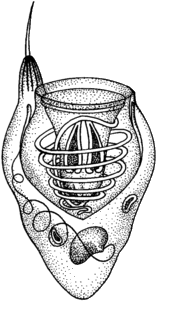
The C is silent, which may ease pronunciation. Cnidocytes are basically nature's single-use, single-cell harpoon guns. Not joking. Here, just look at this diagram:
OK, so yeah, that hair-trigger thing is called a cnidocil, and what it triggers is a load of calcium ions to surge into the main body of the cell. Then, thanks to the magic of osmotic pressure, water rushes into the cell from outside, turning the folded-in cell inside-out and propelling a tiny barb on a string into the offending organism at upwards of forty-thousand Gs. As you can imagine, these things don't come cheap: they're something of a pain to make, and so cnidarians (which, whaddaya know, are the things that have cnidocytes) also use chemoreceptors to detect whether or not they're dealing with a prey organism and then fire their cnidocytes in batches.

This is rather like a forward reconnaissance group determining that, yes, the enemy is here, and then a battery of artillery guns firing on the enemy position. Except that the forward-recon-group-slash-chemoreceptors are tasting the target to determine that they're the enemy. And the artillery-guns-slash-cnidocytes are hucking threaded needles full of poison really, really fast at the targets. Oh, and the gunners die after firing one shot. So it's really not like it at all, but now you should be picturing guys in camo licking their enemies, then a bunch of other guys in camo behind them hucking poisonous needles at the other side as they explode in death and organs (this may or may not be what I think of the army). Behold the power of imagery, and how I wield that power with something that might be like panache!

The point is that while we homo sapiens have refined the process a bit, jellyfish and anemones have been doing this shit for ages. Like, literally. Now I need to find something interesting that's not biology, before this turns into "Mother Nature Did it First: The Blog" while I'm not looking.

Sunday, March 14, 2010

101 Interesting Things, part thirty-nine: Taste

In philosophical circles, the "what it's like" of this or that experience is called its qualia, or if you prefer large and impressive words to small and difficult words, its phenomenology. Philosophers have rather admirably tackled this issue, with some of the famous (read: "familiar to me") examples including Nagel's What Is it Like to Be a Bat? and Jackson's Epiphenomenal Qualia. Much has been made of the importance of qualia in philosophy, case in point being Jackson's paper where he uses the very subjectivity of experience to argue for epiphenomenalism. Thankfully, he seems to have come to his senses, though I'm not quite sure how he missed the problem with "epiphenomena exert no causal effects; qualia are epiphenomenal; Mary's quale of red causes her to say 'wow'." Whatever, I used to think that a man dying and coming back to life in three days was a noble sacrifice instead of a stunt; I can't really judge this guy for missing the glaringly obvious.

Speaking of the obvious, I think there's a rather easy example available to dispense with the weighty implications attributed to qualia - in terms of both what qualia might imply, and what we might disagree on when speaking of qualia. The Alert Reader will have guessed by now that this easy example is the sense of taste. And speaking of abrupt transitions, it's time for a biology lesson! We begin with the Wikipedia article, because it is clear and concise, and I doubt my ability to abstain from plagiarizing it anyhow:
Taste (or, more formally, gustation) is a form of direct chemoreception and is one of the traditional five senses. It refers to the ability to detect the flavor of substances such as food, certain minerals, and poisons. In humans and many other vertebrate animals the sense of taste partners with the less direct sense of smell, in the brain's perception of flavor.
I want to make it clear here that we are talking about chemoreception, the sensing of chemicals. Not flavors. Flavors are the product of your brain, and they do not inhere in chemicals, but are rather the result of complex interactions between your neurology and what you put in your face. The quick & dirty breakdown is that your taste buds detect the molecular shapes of the things you eat (such as sugars, proteins, or alkaloids) or the presence of dissolved ions (acids are sour, salts are salty); then, nerve impulses are transmitted to your brain to tell it what's going on; then, you react to whatever it is that just happened.

This is what makes things like artificial sweeteners possible. You see, certain chemicals which do not occur in nature commonly (or at all) can trick your tongue into thinking that something is there which might not actually be there, just because they're similarly shaped in this or that way to the sort of thing that abounded in our evolutionary history. Case in point: aspartame. While the body still metabolizes it, aspartame is experienced by the body to be about two-hundred times sweeter than sucrose (though of a somewhat different taste, depending on who you ask), making its caloric content negligible for about the same amount of sweetness. Models of how sweetness works have grown in sophistication over time, the current model describing some eight reception sites and culminating in the development of lugduname, which is estimated to be some two-hundred-thousand times sweeter than sucrose.

Just in case we're not clear yet, let me say this in a different way: your taste buds are shape detectors and ion detectors which react with certain chemicals to send nervous impulses to your brain. The "taste" of this or that thing is the product of what your tongue tells your brain it is shaped like (or its pH value/alkali ion content). Seriously. Isn't that fucking weird?! And even weirder, there are substances called sweetness modifiers which temporarily but fundamentally alter the way sweetness is perceived, such as lactisole (which inhibits the taste of sweetness) and miraculin (which makes sour things taste sweet instead). I mean, whoah!

We were talking about qualia earlier, and now it's time to get back to that. I think that taste is perhaps the most vivid demonstration of the crowbar separation (thank you, Eddie Izzard) between reality and how we perceive it. Once again: shapes can be delicious, WTF. With touch, it's pretty easy to imagine sensations of pressure, wetness, or roughness being at least somewhat related to what's going on (with the possible exception of temperature - I mean, c'mon, rapidly vibrating molecules equals hot? Who comes up with this shit?). Same with perceptions of the visible wavelengths of light, or the audible wavelengths of sound. But taste? Give me a break! There just has to be some subjectivity going on here, because the "what it's like" is nothing like the "what it is"!

This also makes some of the debate about qualia seem rather silly. I'll briefly discuss two examples, first the analogical relationship between color-blindness and supertasting, then the inverted spectrum argument. I'll close with a quick Take That! directed at proponents of intelligent design, and a little treat for sticking it out through this interdisciplinary ramble.

First off, when we consider whether qualia are "the same" among different people, of course they're not. Nobody ever said they were, but when you consider that the colorblind see rainbows in a completely different way than most other people do, and that some people experience taste way more intensely than most other people do, then I think it becomes trivially easy to imagine that no two people experience the world in the same way. Even Epictetus was able to point out that two people can have wildly differing experiences of the same situation, and so it is not necessarily the world itself that causes us joy or suffering, but our attitudes toward it - what I would add is that a person may be just as powerless to change his or attitudes as to change his or her taste buds. Sometimes this can happen for no apparent reason, as with my early disgust and later love for mushrooms. Sometimes it happens due to experience, as with my aversion to light beer. Sometimes it doesn't happen no matter how hard you try: I will never be able to enjoy a resin spurge sandwich, because resiniferatoxin is so much more potent than capsaicin, it's not even hot any more (you just go into anaphylaxis and die).

With that in mind, the inverted spectrum argument is even easier to de-fang. For those who didn't click through (and I throw potholes all over the place, so I really don't blame you), the argument goes as follows:
1. Metaphysical identity holds of necessity
2. If something is possibly false, it is not necessary
3. It is conceivable that qualia could have a different relationship to physical brain-states
4. If it is conceivable, then it is possible
5. Since it is possible for qualia to have a different relationship with physical brain-states, they cannot be identical to brain states (by 1).
6. Therefore, qualia are non-physical.
Now, is it just me, or is the question simply beggared in premise three? I mean, if qualia could have a different relationship to one and the same physical brain-states, then of course they're not physical! Fuckin' duh! But this is exactly what is at issue. We see over and over again in the literature (Just look! Like, anywhere!) that when you change the sensory apparatus, you change the qualia. To a person who is relatively up on the neuroscience, while taste and sight vary greatly across the spectrum of human experience, the conceivability of two possible qualia X & Y for the same brain state Z is somewhere on the order of that for two possible diameters A & B for the same circle C. It's just that no two physiologies are perfectly identical (not even the same physiology at different points in time), so of course subjective experiences vary.

As for the IDiots, well, I'm just going to come out and say that ethylene glycol tastes sweet and is very toxic. So that's a poison detection failure right there. But let's not forget that to supertasters, a wide variety of totally healthy foods taste absolutely repulsive; and to non-tasters, a wide variety of potentially fatal substances taste perfectly fine. Oh, and how about the fact that the sense of taste is based primarily on superficial characteristics of molecular compounds, and is therefore rather easy to hack?

OK, so I'm done tying loose threads together for the night. Seriously, I got way too sidetracked while writing this post. I leave you all with the following cookie, as promised. This one tastes like tough decisions:
Click it!

Tuesday, March 9, 2010

You should read The Slumgullion!

My friend Jack works in Navy SIGINT, which is fucking impressive. He's also a great writer and a gamer who thinks a lot (or thinks a little, but very well). He combined those interests at his old blog, Philosophy of Games, which had been up on my sidebar for a while.

Well, he's got a new blog now, called The Slumgullion. If you enjoy wordplay and randomness, then you should head on over and check it out! I'm a fan of his ghastly little tales, in particular.

Saturday, March 6, 2010

Arguing on the Internet: Is there intelligent life on Earth? No, really - is there?

The following is an elaboration on a conversation I've been having with paradoctor over on Daylight Atheism. This whole mess started with a rather scholarly discussion of the conceptual failings of IDiocy, segued smoothly into talk of abandoned dinosaur cities on the Moon, and so far has come to paradoctor asking me if I think there's intelligent life on Earth (whether seriously or facetiously, I cannot tell). Then I thought of the following.
There are days when I would be inclined to say, "No, intelligent life does not exist on Earth." But of course this is absurd, and I am not typically interested in advocating for absurd positions. Although I do freely admit that reality is absurd, I think the only positions worth taking are non-absurd ones - I agree with absurdists on a lot of things, in other words, I'm just not one.

In all seriousness, in my experience, what many people mean by "intelligent" is something along the lines of "has first-person experiences". However, we can't test for this directly, by the same line of reasoning that I can never "really know" what it's like to be a bat because I am not a bat. So we instead come up with things like the Turing test, which of course works for determining whether our candidate is able to do the things an intelligent agent is also able to do, but leaves the rather glaring problem that a Turing-complete philosophical zombie is absolutely indistinguishable from its genuinely "first-person experience-having" counterpart. Then comes Daniel Dennett to the rescue, "We are the zimboes," and blah blah blah.

As Dennett himself explains the idea, "Zimboes thinkZ they are conscious, thinkZ they have qualia, thinkZ they suffer pains – they are just 'wrong' (according to this lamentable tradition), in ways that neither they nor we could ever discover!" His point is that there is no meaningful difference between thinking and thinkingZ, therefore zimboes are no different from persons as we ordinarily think of them - le sigh... or thinkZ of them - and if there's no difference between two things then they're the same. Of course, this leaves the problem of whether things we might not even consider to have first-person experiences are zimboes just like ourselves. We have no reason to think so, of course, but the whole point is what if we're wrong? Pascal's Wager of animism, in other words, with a weird line-drawing problem that seems to center around nervous systems or perhaps circuits (we'll get to this line-drawing later).

The other main camp I've encountered means by "intelligent", "can demonstrate learning", conveniently bypassing the p-zombie problem. Of course, on this analysis, dogs and mice are intelligent for being able to learn non-instinctive behaviors and solve problems - which is generally unproblematic, as they are cute and fuzzy to most people, most of the time. But even pigeons have been shown to form superstitious behaviors, which to me would indicate both an ability to learn and a high probability of first-person experience. The problem here is one of principled interpretation: we say that a mouse has "solved" a maze by reaching its end, having been motivated to do so by the conditions of the experiment; could we not then say that the elements in the Miller-Urey experiment "solved" their situation by forming amino acids, having been motivated to do so by the conditions of their experiment? Both cases involve watching the behavior of particular configurations of mass-energy in an artificial environment. While it might be unproblematic to attribute (admittedly limited) intelligence to insects, for they still have brains, even amoebas engage in what looks like hunting, and they're just single cells! In both experiments, the things being experimented upon merely behaved in whatever ways they could, and I see no principled reason to attribute one with intellect and not the other (given the smooth gradations that can be made at every step of the way in between). Could not we humans, for all our scientific endeavors, be seen as a mere means in reality's effort to understand itself? A sort of cosmic navel-gazing, if you will, in which introspection on things like "purpose" is itself our very "purpose"!

While such wildly irresponsible speculation may make philosophers feel good about themselves, the slippery slope cuts both ways here: we can show that many organisms which "demonstrate intelligence" are completely uncommunicative in ways that we are able to recognize, so who's to say that other things don't simply possess lesser and lesser degrees of intelligence, whether or not they have first-person experiences? I mean, sure, we can draw a line somewhere between fish and rocks, but precisely where we draw it will make a difference (I promise, we're getting there!). Cutting back, when we say that a thing "acts as if" it has a higher level of intelligence than can be reasonably attributed to it, what's to say that purportedly intelligent things almost certainly possessed of first-person experiences aren't merely "acting as if" they have intelligence? The mystical "I" at the helm of consciousness is, after all, a story that the brain tells itself, ret-conning and confabulating memories will-ye, nil-ye.

Dennett argues (very persuasively, I think) that consciousness is more like fame than like being on television, insofar as it happens distributively and by degrees rather than in a strict "on or off" sense. The degree to which we are aware of the calculations performed by our brains is, to my mind, rendered irrelevant - the parts of our brains that execute whatever steps they have learned to execute are no more intelligent than the components of a computer running an installed program (and no less!). Or as Edsger Dijkstra put it, "The question of whether a computer can think is no more interesting than the question of whether a submarine can swim." But at the same time, any matter could be said to be "running" whatever "program" would perfectly describe whatever it is that it does. In fact, a biophysicist named Gregory Engels has discovered that plants accomplish photosynthesis at their level of efficiency by exploiting principles of quantum mechanics. The Scientific American version actually credits them with performing the computations, but my point is, what's the meaningful difference? (I suppose the "daffyrance" would be that the SciAm folks have never heard of pareidolia.)

So in one sense, "intelligent" is a word and words are made-up, so of course there's no intelligent life on Earth. In a more pragmatic sense, of course there's intelligent life on Earth, but the interesting question is how much of it can we call intelligent? Between these two extremes - nihilism and treating the matter as a necessarily open question - lies just a mess that relies on presuppositions and other motivations to get a clear answer. In short, the only clear answer is a semantically bizarre yet unequivocal No; Yes answers are by their very nature unclear and open to debate (which is awesome!). Of course, this won't stop a bunch of really sexy heroes sporting labcoats and degrees from pointing out which arbitrarily-arranged distinctions have this or that pragmatic value, and this is perfectly fine. But I have neither a labcoat nor a degree, I am instead interested in understanding the whole problem, and what this understanding tells me is that on the one hand there's nothing, on the other hand there's everything, and in between is just a mess. Viva la mess!

OK, finally. This all matters because a computer-based Synthetic Intelligence (there's nothing artificial about the Turing-complete sort of intelligence we're talking about here) would seem to warrant all the rights and responsibilities of any other person. And why not? If you were to upload your complete brain state to a sufficiently advanced computer to "run" you past the expiration of your organic body, would you not then be one such Turing-complete computer-based SI? Would you not want the termination or erasure of your process to be regarded as a murder? Anyone would! Including an SI "born" on a hard drive with no biological precursor. But how can you murder something that's not alive to begin with? And what about copies that modify themselves or blend with each other to the point of no longer being the same "person"? Do we need to count any form of intelligence as "alive"? Or can we simply regard the extinguishing of an intellect as "murder"? This would seem to handily resolve difficulties with people in persistent vegetative states, as well as the abortion of fetuses lacking brain tissues (at the very least). But eating meat would now well and truly be murder, unless we either genetically engineer brainless animals (which doesn't sound all that bad to me), or only eat animals that die of natural causes (which has problems of its own). We can push the problem back a bit by talking about legalistic "citizenship" rather than philosophical "personhood", but the issue remains that we want to make our in-group as wide as possible while still leaving the "stupid mass-energy" open to the sort of resource exploitation that we won't perform upon our persons/citizens/what-have-you. Double trouble if we assign intelligence to rocks, for "running" their "rock programs". (Then PETA changes their name to People for the Ethical Treatment of Mass-Energy, PETME, and comes up with new slogans: "Mining is murder!" "Minerals are people, too!" "Rocks are not ours to skip across the ocean waves or keep as pets in our homes!")

So to answer paradoctor's question, at long-winded last: there is intelligence on Earth in every way that counts; there is also life on Earth in every way that counts; but these do not always "go together". You can have unintelligent life, and intelligent non-life, depending on your definitions. In order to meaningfully answer the question, we need a more robust understanding of the problem with respect to which the question is being asked - it matters what else will be at stake. Or we could keep our answers provisional and revise them as new issues come up. I mean, it's not like we're codifying a religion here or anything.