I can't do this right now. I thought I could, and if I just jumped in feet-first then I could power my way through it and clean it up in post; but no. Tabula Rasa is officially scrapped for now (again), because as I try to iron out how I want everything to go, I'm realizing that it's just not workable in its current iteration. Reasons below the cut (they're all spoilers, so beware - it's mainly a list of reminders to myself of "Problems I Need to Fix Before I Can Actually Write This Shit").
Sunday, September 2, 2012


Thursday, August 23, 2012
How to Imagine a Billion
Carp on a tarp, who would've thought a book about how we know things could be so research-intensive to write? The problem I'm running into now is that every time I'm like, "Wait a minute, I should look this up," I end up going on a wiki walk where I kinda-sorta get my question answered but find way more interesting things along the way. So, OK, now I know how ejection seats work, and I have a reasonable guess as to where the USS Eisenhower was in the spring of 2000, but I'm also finding out all kinds of things I don't really need like stuff about the new robot we put on Mars and how plots of various movies could have been solved in minutes (or would have been solved if the main characters did nothing).
Anyway.
I was talking about space & stuff with a friend, and we were going on and on about how so many people have a really poor grasp of just how astronomically large astronomical distances are. At one point, it was alleged that humans can't even conceive of a million, let alone the billions and trillions required to understand space. I thought about that for a while, and as it turns out, yes I can so too imagine a billion - and so can you! Here, let me teach you how.
First, a teaching tool. Did you ever use these little yellow blocks to count when you were in gradeschool? I did, at least in the fifth and sixth grades (I went to different schools every year before that, so I don't know how far back they use these).

Anyway.
I was talking about space & stuff with a friend, and we were going on and on about how so many people have a really poor grasp of just how astronomically large astronomical distances are. At one point, it was alleged that humans can't even conceive of a million, let alone the billions and trillions required to understand space. I thought about that for a while, and as it turns out, yes I can so too imagine a billion - and so can you! Here, let me teach you how.
First, a teaching tool. Did you ever use these little yellow blocks to count when you were in gradeschool? I did, at least in the fifth and sixth grades (I went to different schools every year before that, so I don't know how far back they use these).
Wait, you mean tiny yellow cubes a centimeter on a side are chokeable?
Thursday, August 16, 2012
Tabula Rasa, Chapter One
Chapter One
Friday, May 5th, 2000. 8:15 AM, Eastern Time.
Samantha opens her eyes.
She blinks spastically, disoriented by the light. Incoherent shapes and unfamiliar colors cloud
her vision. Noise fills her ears, her
skin prickles, and her breath comes in awkward gasps. After a few moments of abject confusion, she
recognizes the color dominating her vision: white. A few moments more, and she grasps the
purpose of that white shape: ceiling. Her head jerks about to take in her
surroundings: she is in a room, laying
upon a bed. So far, so good. She takes a moment to breathe and collect herself.
Samantha sits up, rubs her eyes, rolls her head around on
her neck and then stretches her arms upwards, interlocking her fingers and popping
her knuckles, elbows, shoulders. She
lowers her arms and breathes deep, smelling dust and something herbal-oily and
a little bit of sweat. The noise in her ears gradually resolves into birdsong
and the occasional breeze rustling through the trees outside. Her right knee feels funny, a little loose,
like it needs to be adjusted. She flexes
her leg back and forth, back and forth, hears a muted pop and feels a brief
pang followed by relief. The walls
around her are covered in brightly colored patterns, but near the ceiling is a
procession of strange shapes in black and white, wrapping around the whole
room. Samantha looks at them carefully: they are at once intensely familiar, yet
utterly alien. Names for the shapes
slowly well up from she knows not where: Aa
Bb Cc Dd...
Painfully slow, Samantha recites the alphabet in her head
with the aid of the childish frieze. Sounds
for the letters tug at her mind, though they are many and varied. She is dimly aware that the words “white”,
“ceiling”, “window”, and “birdsong” now have spellings and are no longer
floating abstractions in her stream of consciousness. As she repeats the alphabet in her mind, she
hums a simple tune, and the tune makes her think of the night sky, twinkling
and jeweled. She looks around at the
objects in the room, not quite sure what to make of them. One shape stands out to her: a rectangle, with smaller rectangles running
lengthwise across it, and little circles at each end. Samantha has no word for it, but it's got
clothes in it, and she is suddenly aware that she is wearing a white tank top. She pulls back the blanket from across her
knees and sees that she is wearing pajama pants with a splotchy pattern of
greens, browns, and near-blacks. Blaze
orange letters run across the amorphous shapes, and Samantha slowly sounds out
the words: “YOU CAN'T SEE ME.” She reads
the words again, uncomprehending – she most certainly can see them!
Monday, August 13, 2012
Tabula Rasa
Friday, May 5th, 2000. 6:54 AM, Central Time.
Glory’s left arm twitches, once, twice. She immediately leans left toward a chair at the
dining table, falling roughly into it as her eyelids begin to flutter. She knows what’s coming next.
Her legs hang crooked to her right, her arms splayed out
across the table. As she stares out at
the world, mute and paralyzed, Glory is surprised to see that her few remaining
party guests are having troubles of their own.
Clutching their heads and staggering, Len and Hannah lean on each other
behind the island in the open kitchen; the lights flicker, and Keith takes a
knee in the middle of the rug. Someone
on the couch, at the edge of Glory’s vision, has her head between her knees.
It passes.
Glory rubs a clammy palm over her forehead, absently straightens
her hair. That was short, thank the stars.
She sets her feet in front of her to stand, sets her hands on the table,
and rises to her feet. Her left arm
trembles again, and it’s back – staring at the table now, she can’t see her
surroundings. The lights are suddenly
much brighter to her, she hears the microwave running, the ceiling fan’s motor whum-whum-whums in a quickening
crescendo. Seconds go by, and it eases
enough for her to sit in her chair, but does not pass. The lights dim, everything’s quiet, someone
gasps. As Glory raises her head, it
comes on again in a slow wave, brightening the lights once more. She can definitely
hear the microwave running. That’s not right. It’s never like this. Alarms sound, the shrill beeps of smoke and
carbon monoxide detectors. A dull thump
as someone falls to the ground. One by
one, lights begin to pop and flare, her stereo screams a burst of static and
dies, the detectors drop out, and Glory registers one brief moment of silence
as she slips away.
Sunday, August 12, 2012
Back from the brink of death!
Ugh. Martian Death Flu is no fun.
The first & second of August, I thought I was just having my seasonal allergy attack rather later than normal. But then I was full-on sick, and even had to take a couple days off of work. I'm also reading The Stand, so I couldn't shake the irrational thought that Captain Trips was coming for me. The next few days I was possibly too sick to work, but definitely too poor to not work, so I toughed it out. I seemed to get better like three days ago, but then had mad allergy symptoms once again that came to a peak last night.
And now I'm perfectly fine!
So I guess I'm officially caught up on my quota of illness for the last two years. I was missing some, you see. This would be a perfect time to dust off that bit I've been saving up on the immune system... but I don't feel like writing about the immune system. In fact, all I wanna do now is write Tabula Rasa. Somewhere along the line, the plans for Tabula Rasa got mixed up with my plans to re-write Rendezvous into Breath to Breath, so I think I'll just go with it because it seems like a good idea (mainly because it takes elements from a story I like and transposes them from a setting I no longer like [horror] into a better one [adventure]). It's also been marinating for over a year, which is a good indication that it's a worthwhile idea and not going anywhere.
In all honesty, I never really tried to set it down, it just kinda slipped through my fingers and fell to the wayside. But I have been working through the major issues I had with it - mainly how to get from one plot point to another, since it was conceived (like all my stories) as a flotilla of vignettes and not a single coherent narrative - and I think it's in a state where I can drop all of Chekov's Guns without needing to backtrack preposterously through a bunch of established story. I've also been reading apocalyptic fiction (I mentioned Lucifer's Hammer and The Stand) to give me some grounding in the genre and see what else is out there. Mainly what I've noticed is that authors can get away with quite a bit of stereotyping as long as there's sufficient characterization to balance it out, and that Stephen King's editor needs a finer-toothed comb. I mean, I can't tell Stephen King what to do, but when I read something like, "He shivered a little, and the wind danced a spiral of fire out of the fire and up toward the black starshot sky" (p. 439 in my edition), I can't help but think, "You don't need the word 'fire' twice in such close proximity. Use 'flame' the first time, or 'blaze' the second, or fucking anything else."
Anyway, that's that. I've got some stuff written up already, just not the first part, so I'm gonna finish that. But I open tomorrow, so I need to get to bed at a reasonable hour, and I doubt I'll get through it all tonight. So that's tomorrow, and then I've got the next part written already, and then it's just a matter of putting the vignettes in place and stitching them together with something approaching skill and aplomb (I'd sure like to write it all in order, but even so, I'll probably end up with Un-Deleted Scenes like in The Quantum Mechanic). Wish me luck!
The first & second of August, I thought I was just having my seasonal allergy attack rather later than normal. But then I was full-on sick, and even had to take a couple days off of work. I'm also reading The Stand, so I couldn't shake the irrational thought that Captain Trips was coming for me. The next few days I was possibly too sick to work, but definitely too poor to not work, so I toughed it out. I seemed to get better like three days ago, but then had mad allergy symptoms once again that came to a peak last night.
And now I'm perfectly fine!
So I guess I'm officially caught up on my quota of illness for the last two years. I was missing some, you see. This would be a perfect time to dust off that bit I've been saving up on the immune system... but I don't feel like writing about the immune system. In fact, all I wanna do now is write Tabula Rasa. Somewhere along the line, the plans for Tabula Rasa got mixed up with my plans to re-write Rendezvous into Breath to Breath, so I think I'll just go with it because it seems like a good idea (mainly because it takes elements from a story I like and transposes them from a setting I no longer like [horror] into a better one [adventure]). It's also been marinating for over a year, which is a good indication that it's a worthwhile idea and not going anywhere.
In all honesty, I never really tried to set it down, it just kinda slipped through my fingers and fell to the wayside. But I have been working through the major issues I had with it - mainly how to get from one plot point to another, since it was conceived (like all my stories) as a flotilla of vignettes and not a single coherent narrative - and I think it's in a state where I can drop all of Chekov's Guns without needing to backtrack preposterously through a bunch of established story. I've also been reading apocalyptic fiction (I mentioned Lucifer's Hammer and The Stand) to give me some grounding in the genre and see what else is out there. Mainly what I've noticed is that authors can get away with quite a bit of stereotyping as long as there's sufficient characterization to balance it out, and that Stephen King's editor needs a finer-toothed comb. I mean, I can't tell Stephen King what to do, but when I read something like, "He shivered a little, and the wind danced a spiral of fire out of the fire and up toward the black starshot sky" (p. 439 in my edition), I can't help but think, "You don't need the word 'fire' twice in such close proximity. Use 'flame' the first time, or 'blaze' the second, or fucking anything else."
Anyway, that's that. I've got some stuff written up already, just not the first part, so I'm gonna finish that. But I open tomorrow, so I need to get to bed at a reasonable hour, and I doubt I'll get through it all tonight. So that's tomorrow, and then I've got the next part written already, and then it's just a matter of putting the vignettes in place and stitching them together with something approaching skill and aplomb (I'd sure like to write it all in order, but even so, I'll probably end up with Un-Deleted Scenes like in The Quantum Mechanic). Wish me luck!
Friday, August 3, 2012
Stupid Rhinovirus...
I am super-ill. :p
Can't breathe. Can't think. Can't sleep. Just so everybody knows.
Can't breathe. Can't think. Can't sleep. Just so everybody knows.
Tuesday, July 31, 2012
101 Interesting Things, part forty-eight: Pyura chilensis
Let's have ourselves a little climb up the family tree. In the kingdom Animalia, phylum Chordata, you'll find the class Ascidiacea. Ascidians are the sea squirts, immobile filter feeders who sit in one place and just process whatever floats by. You know your sea squirts, right?


Saturday, July 28, 2012
How Can Science Be Objective?
This is a paper I wrote in my philosophy of science class. The instructor told us that the class would be "one long argument," and at this late point in the course, our task was to summarize and synthesize the material presented thus far, and evaluate it. The question was, "Can science be objective? And if so, how?" We were given six pages to answer (my bibliography was page seven). This is another paper that I'm pretty proud of, so here it is for your enjoyment. Links to the cited articles are given at the end, except for two which I couldn't track down (I'm not counting Locke, I only used him for a money quote at the end). They're all good reads, so feel free to take a walk on the web if you're unclear on a point and want it in the author's own words.
Much ink has been spilled in the attempt to characterize science, both its process and its products, in a way that both is accurate and preserves at least some of our notions of what science is “supposed” to be about. Logical positivism has been rendered untenable by the ubiquity of underdetermination and the nature of observation as fundamentally theory-laden. Is there any way for science to be objective in this light, or is it just a highly political free-for-all? This depends on what we mean by “objective,” for some definitions of the term shall certainly fail. Yet there is an important way in which science can be seen as objective, and in a satisfyingly progressive way.
Much ink has been spilled in the attempt to characterize science, both its process and its products, in a way that both is accurate and preserves at least some of our notions of what science is “supposed” to be about. Logical positivism has been rendered untenable by the ubiquity of underdetermination and the nature of observation as fundamentally theory-laden. Is there any way for science to be objective in this light, or is it just a highly political free-for-all? This depends on what we mean by “objective,” for some definitions of the term shall certainly fail. Yet there is an important way in which science can be seen as objective, and in a satisfyingly progressive way.
Thursday, July 26, 2012
On Formlessness
When I took advanced US history in high school, our instructor walked up to the blackboard on the first day and wrote a bunch of words on the board:
"According to what," someone asked. It might have been me, but I don't remember and it's not important.
"Not my problem," he answered with a shrug. "Just organize them however you want." I put them in alphabetical order: apple Bill blue cat climb dog fish green horse Jane jump orange ox pear run swiftly. Done. Our instructor asked us how we organized them - one person had organized them into parts of speech, with "fish" going under both the Noun and Verb headings, "orange" being both a Noun and an Adjective, and "Jane" and "Bill" under the Proper Names subheading of Nouns. Another student had divided them into Domesticated Animals and Other. We had hit all the obvious ones, and then the instructor put some others on the overhead and had us try to guess what they were.
dog cat horse ox run jump climb fish green blue orange apple pear swiftly Jane Bill
Those probably aren't the actual words, but that doesn't matter. He then told us, "Organize these.""According to what," someone asked. It might have been me, but I don't remember and it's not important.
"Not my problem," he answered with a shrug. "Just organize them however you want." I put them in alphabetical order: apple Bill blue cat climb dog fish green horse Jane jump orange ox pear run swiftly. Done. Our instructor asked us how we organized them - one person had organized them into parts of speech, with "fish" going under both the Noun and Verb headings, "orange" being both a Noun and an Adjective, and "Jane" and "Bill" under the Proper Names subheading of Nouns. Another student had divided them into Domesticated Animals and Other. We had hit all the obvious ones, and then the instructor put some others on the overhead and had us try to guess what they were.
Tuesday, July 24, 2012
On Faithlessness
There's this YouTube guy, Philhellenes, he's made some sweet videos like a scientifically accurate rewrite of Genesis and an account of science saving his soul. One of his other videos is on admitting error, and it's also really great:
It got me to thinking about walking in doubt, a phrase I use from time to time when I need to establish that the brand of atheism I practice is not in fact another kind of faith. I have a lot of beliefs, but no faith, because I've spent a great many years doubting everything systematically, like René Descartes. What I've ended up with is a bunch of things I endorse as facts with varying levels of confidence, and a whole bunch of inferences between them of varying strengths, which is rather difficult to keep track of. It's not perfect, by any means, and I still screw up from time to time, which keeps me humble - but beneath it is an attitude of readiness to admit error. I try not to think, "What do I know for certain," but instead, "How much doubt am I dealing with here?" If I'm ever not dealing with an amount of doubt, then I've got certainty, and certainty is dangerous.
Why does he need the contrast so high? Is he in a library's
after hours? He must be The Phantom of the Library!
It got me to thinking about walking in doubt, a phrase I use from time to time when I need to establish that the brand of atheism I practice is not in fact another kind of faith. I have a lot of beliefs, but no faith, because I've spent a great many years doubting everything systematically, like René Descartes. What I've ended up with is a bunch of things I endorse as facts with varying levels of confidence, and a whole bunch of inferences between them of varying strengths, which is rather difficult to keep track of. It's not perfect, by any means, and I still screw up from time to time, which keeps me humble - but beneath it is an attitude of readiness to admit error. I try not to think, "What do I know for certain," but instead, "How much doubt am I dealing with here?" If I'm ever not dealing with an amount of doubt, then I've got certainty, and certainty is dangerous.
Saturday, July 21, 2012
On Cognition
Last spring, I took a class in the Interdisciplinary department on cognitive science - we covered philosophy of mind, computer science, and neuroscience, and it was awesome. I gained a reputation in the class for hedging my answers very carefully, admitting when I didn't know things, but knowing quite a lot, and refusing to engage in wild speculation (unless I was explicitly asked to do so). I was also the only philosophy major in the class, and I think I did a good job of representing the department rather well. But then again, I also had at least five years on each of the other dozen or so students, and I had spent those years educating myself and arguing on the internet in my free time, so you could say I was a bit over-prepared.
The prompt for our final was, "What is the nature of human cognition?" and we were given six double-spaced pages to answer. I think I did a rad job, and the material I brought together (almost all of which had been covered in class) was tremendously interesting, so I thought I'd share it with you, Dear Reader. Enjoy!
What is the nature of human cognition? At the very least, we may say that it is complicated. My own personal conjecture is that the first-person nature of consciousness is essentially a “story” that the brain “tells” to itself, after a fashion; but we humans have been using our minds to ponder our minds for millennia, and I probably stand very little chance of successfully advancing a new theory of mind in a six-page paper for an introductory course in cognitive science. Three broad avenues of approach have been quite productive, however: studying brains, attempting to manufacture consciousness “from scratch” (as it were), and inquiring as to what precisely we might mean when we talk about our minds. Respectively, these may be called the empirical approach, the engineering approach, and the philosophical approach. Each of these approaches has something to say on the three issues of brain brittleness, mental models, and the “directionality” of consciousness. What I intend to show is that while each of the various answers proposed to the question, “What is consciousness?” contains at least a kernel of truth, no present account delivers the whole story and so we ought not to endorse one or the other as “essentially right.”
The prompt for our final was, "What is the nature of human cognition?" and we were given six double-spaced pages to answer. I think I did a rad job, and the material I brought together (almost all of which had been covered in class) was tremendously interesting, so I thought I'd share it with you, Dear Reader. Enjoy!
Is Consciousness This Way or That Way? A Robust Yes and No.
What is the nature of human cognition? At the very least, we may say that it is complicated. My own personal conjecture is that the first-person nature of consciousness is essentially a “story” that the brain “tells” to itself, after a fashion; but we humans have been using our minds to ponder our minds for millennia, and I probably stand very little chance of successfully advancing a new theory of mind in a six-page paper for an introductory course in cognitive science. Three broad avenues of approach have been quite productive, however: studying brains, attempting to manufacture consciousness “from scratch” (as it were), and inquiring as to what precisely we might mean when we talk about our minds. Respectively, these may be called the empirical approach, the engineering approach, and the philosophical approach. Each of these approaches has something to say on the three issues of brain brittleness, mental models, and the “directionality” of consciousness. What I intend to show is that while each of the various answers proposed to the question, “What is consciousness?” contains at least a kernel of truth, no present account delivers the whole story and so we ought not to endorse one or the other as “essentially right.”
Friday, July 20, 2012
Follow-up Quickies: Bosons and ninjas!
OK, so my last post was kind of bullshit. Here are a couple other interesting things to jam between yesterday and tomorrow.
National Geographic tackles Ninjutsu, hiring Glen Levy to put his skills to the test. Please try to ignore his introductory banter; it pains me to listen to it, and I can all but guarantee that he was somehow contractually obligated to say that "journey to your own destruction" crap. Pay attention to the bit on the vagus nerve, though, and check out the force he's able to deliver with a single punch:
In case you skipped it, I'll give you the TL;DR version: this man is able to punch with the force of a shotgun. No joke. OK, it's a police shotgun firing a rubber bullet, but still. You'd be hard-pressed to hit that hard with a baseball bat. Yes, you. Yes, baseball bat. Glen Levy hits harder.
As for bosons, there was a reason I didn't trot out any of the goofy analogies that other writers have given for the Higgs field: they don't explain where the mass comes from. Passing through a sheet of molasses, and the molasses sticks to you? Fine, but why is the molasses massive? Walking through a crowded room and all your fans flock to you? Fine, but why are the groupies massive? Minute Physics to the rescue:
The TL;DR version here is that the mass is more or less resistance that comes from moving through the Higgs field all the time always. In a kinda-sorta way, but it's closer. Still don't get it? OK, it's time to talk about the shape of the Universe.
It's been said that the Universe is "saddle-shaped." Like if you took a square sheet of paper, and folded one set of opposite corners up, and the other set down. Like so:

Except - and here's the kicker - instead of starting with a flat thing and curving it around, you start with a tiny curled-up thing and blow it up so big it just looks flat. Bam! Now I bet you'll have a better understanding of this article, and this key image:

All the "extra" dimensions are like that: tiny and curled up, but existing at every point in spacetime. Incidentally, this is also why I have never ever made fun of anyone for proposing that time is circular - because, son of a bitch, it's actually kinda-sorta plausible. Now do that over and over until you get all the dimensions, and bam! There you have it. Is the Lorentz factor making a little more sense now?
National Geographic tackles Ninjutsu, hiring Glen Levy to put his skills to the test. Please try to ignore his introductory banter; it pains me to listen to it, and I can all but guarantee that he was somehow contractually obligated to say that "journey to your own destruction" crap. Pay attention to the bit on the vagus nerve, though, and check out the force he's able to deliver with a single punch:
That dummy needs shorts 'cuz it can't decide
whether to pitch a tent or crap itself.
In case you skipped it, I'll give you the TL;DR version: this man is able to punch with the force of a shotgun. No joke. OK, it's a police shotgun firing a rubber bullet, but still. You'd be hard-pressed to hit that hard with a baseball bat. Yes, you. Yes, baseball bat. Glen Levy hits harder.
As for bosons, there was a reason I didn't trot out any of the goofy analogies that other writers have given for the Higgs field: they don't explain where the mass comes from. Passing through a sheet of molasses, and the molasses sticks to you? Fine, but why is the molasses massive? Walking through a crowded room and all your fans flock to you? Fine, but why are the groupies massive? Minute Physics to the rescue:
Physics in a minute. Fifty-eight videos. You could watch all his
stuff in an hour, and experience at least six flavors of enlightenment.
The TL;DR version here is that the mass is more or less resistance that comes from moving through the Higgs field all the time always. In a kinda-sorta way, but it's closer. Still don't get it? OK, it's time to talk about the shape of the Universe.
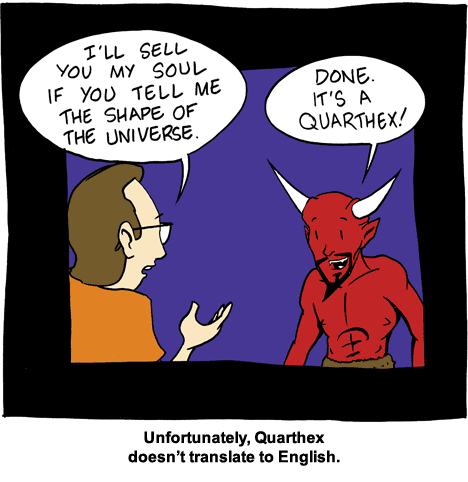
Fortunately, Quarthex does translate to math, and souls don't exist.
It's been said that the Universe is "saddle-shaped." Like if you took a square sheet of paper, and folded one set of opposite corners up, and the other set down. Like so:

See? Like a saddle on a fucked up horse! (Is it weird that
I draw the shape of the Universe better than a horsey?)
Except - and here's the kicker - instead of starting with a flat thing and curving it around, you start with a tiny curled-up thing and blow it up so big it just looks flat. Bam! Now I bet you'll have a better understanding of this article, and this key image:
All of those circles, at every point of everywhere, are one other dimension.
All the "extra" dimensions are like that: tiny and curled up, but existing at every point in spacetime. Incidentally, this is also why I have never ever made fun of anyone for proposing that time is circular - because, son of a bitch, it's actually kinda-sorta plausible. Now do that over and over until you get all the dimensions, and bam! There you have it. Is the Lorentz factor making a little more sense now?
Subscribe to:
Posts (Atom)