Update Schedule

This blog updates irregularly.
Showing posts with label atheism. Show all posts

Saturday, June 19, 2010

Mary Midgley says you can't rock someone's world. Everyone and their grandma disagrees.

PZ calls her a twit, and another hip & cool professor (name of ArithmoQuine) tries a more charitable interpretation.

PZ's right, but ArithmoQuine is being more helpful to the dialogue. Midgley is being a twit, saying that we ought not to turn the world-views of others upside-down and shake them for loose change. From her first sentence, "Science really isn't connected to the rest of life half as straightforwardly as one might wish", you can tell that she's arguing from human foolishness - just because people don't unfailingly connect science to their everyday lives doesn't mean that the connection isn't there. And yeah, sure, there's no One True sure-fire method for changing someone's mind on this or that topic (unless we count brainwashing, can we please count brainwashing?), but people change their own minds all the time and the words of other people often have something to do with it. Fuckin' duh. You'd think that a fellow philosopher, of all people, would have a clue about that. I mean, our favorite activity is sitting around in the lotus position trying to find ways to blow our own minds, and our second-favorite activity is sharing these techniques with others so we can watch them try it out.

ArithmoQuine takes a more effective tack and tries to grant Midgley the strongest case he can piece together from her writing. This is called the principle of charity, and it's how you avoid straw-manning the opposition: you help your opponent into the very best suit of armor the two of you can agree upon, and then proceed to show that not even this can withstand your A-bomb. (The A is for Argument.) And really, all Midgley can possibly be saying is that if you take on the underpinning of someone's whole damn world-view, then you're going to run into cognitive dissonance. Which is true. Who gives a shit?

Well, of course, we all give a shit. I mean, cognitive dissonance - well, our drive to resolve cognitive dissonance, more precisely - is what makes the rational world go 'round. And the irrational world. Rational folk, upon noting such dissonance, will reconcile the mis-match between their imperfect minds and obstinate reality by changing their minds to be more in-line with the observed facts. For clarity, I don't mean that this is how "people I'd call rational" consistently behave, I mean that when you do this, you are behaving as a rational person. The alternative, of course, is to try to force the world to fit your idea of how it ought to be when it's clearly not. This can often take the form of kicking the shit out of whoever's existence is causing you angst in order to preserve your idea of moral order in the world.

This is the kind of bullshit we're up against, and I don't just mean atheists: I mean people who accept reality and try to work within its confines. See, dropping your preconceptions about how you first happened to believe the world ought to be, and then accepting implacable reality for what it is, can help produce a kind of serenity that will allow you to become a peaceful, permissive, moral, fun-loving Dane. Siding with your preconceptions in opposition to implacable reality will cause you to brainwash your family and other miscellaneous fuckwits into becoming a national disgrace. Of course, these are the extreme ends of the spectrum and your mileage will vary: Denmark is towards the Very Good end, and Fred Phelps is towards the Fucking Horrible end, and most people pile up to form that smooth bell shape in the middle.

But this spectrum is a moving one, more of a travelling wave as we become ever more civilized over time. Those fuckers on the hump are better than the Phelpses of the world, but they sure provide a lot of dead weight for the Danes to haul along as they (i.e. the majority) passively reinforce the status quo by comprising it. This is where Midgley really screws the pooch: she claims in her closing that we need to try to improve existing world-views and take them on as wholes (good so far), with the implication that trying to actually change anything is a fool's errand. The comparisons to other changes in the status quo are numerous, easy, and left to the reader; ours is a campaign of memocide, and if ideas were people, then we'd be rotten to the core for even considering it. But they're not, so we can keep on truckin'.

Midgley is right, however, that plucking a few hairs from the beast won't kill it. The memes we're up against are self-perpetuating and self-reinforcing, and they're deeply entwined with other memes we don't like, such as patriarchy and tribalism, and the whole rotten thicket is itself a perfectly natural outgrowth of our very own psychological flaws, so excising this cultural tumor is going to be a task and a half. I said a-good-God-damn.

Midgley does make one profoundly stupid error, though, and I haven't seen anyone call her out on it yet, so I'm gonna. See, Midgley says,
Belief in God is not an isolated factual opinion, like belief in the Loch Ness monster – not, as Richard Dawkins suggests, just one more "scientific hypothesis like any other". It is a world-view, an all-enclosing vision of the kind of world that we inhabit. We all have these visions.
I call equivocation! See, the phrase "belief in God" could be understood either as the genuine world-view of theism, or as the "isolated factual opinion" of a particular person's particular belief in a particular deity (it might not be a clear idea, but it is a particular one). By not clarifying this ambiguity and then immediately trading on it, Midgley has committed textbook equivocation and should brush up on her basic logic. Sure, theism isn't an isolated factual opinion, but believing in this or that god sure the Hell is!

I want to note that believing in the Loch Ness monster requires belief in Loch Ness, and in general requires some sort of world-view. We all have them, as Midgley correctly points out, and there's no "escaping" from them. You can't just "step out" from your world-view without "stepping into" another one, since world-views are the very framework within which we evaluate our experiences. Formally, this is known as the Duhem-Quine thesis, and it says that no single hypothesis can be tested in isolation because every testable hypothesis rests on background assumptions. So naturally, every belief in particular gods is going to go along with some sort of world-view in the actual minds of actual people in the actual world. Those world-views are, by virtue of accommodating one or more gods, categorically theistic. Successfully excising particular god beliefs from a theistic world-view will require one of two things:
1) A different god must be placed in the god-spot, or
2) The world-view itself must be exchanged for a new model without a god-spot.
Since the god-spot holds up huge chunks of the cognitive tapestry for many, of course most theists will shuffle gods in and out of their god-spots, taking great pains to ensure that any god in which they can no longer bear to maintain belief is taken out of the rotation. This helps them avoid the trouble of opting for number two, which is shit. But shit is natural and if you try to avoid it then you'll end up full of it, and I suddenly don't feel like pursuing this metaphor any further.

Point is, it will eventually be cognitively easier to opt for #2 than to continue avoiding it, but there's no telling when for a particular person, and individuals vary wildly in this respect. Son of a bitch, you mean this is going to be hard? Oi, if I'd known that, I never would'a signed up!

Just kidding. All Midgley has done with the best possible version of her point is to clearly outline the problem before us with two scoops of pessimism. What does she want, a pat on the head and a warm glass of milk?

Saturday, June 5, 2010

Pascal's Scantron: an atheist parable (part two)

Click here for part one.

The grading machine was small, discolored with age, covered in dust like most of the things in the English department storage room. It had a cracked digital readout, a few buttons with the labels missing, and a slot with "INSERT FORM HERE" stamped next to it. I didn't care when I heard we found it, because I don't care about the forms anyhow - everyone else seemed to think it was some kind of miracle, though. A fight broke out over who would get to use it first, and Jimmy Dempster's nose got broken. We were finally able to agree that it had to be used in public, in plain sight of everyone, and what we'd cast votes to see who would get to go first and all of that. It took us two whole days just to decide how we were going to use it, for crying out loud. I stayed and watched because even though it wasn't important to me, the way everyone reacted would be very important to everyone.

Well, we all decided that someone from E-column could go first, since they were clearly the most excited about it. It seemed fair. Then one of those upside-down A-column kids could go, because they seemed like the most opposed group to the E-column crowd. Then we'd let a C-column kid go, then one of the "ABCDEABCDE" folks, then one of the kids who filled out every bubble, and then we'd go in alphabetical order by name from there (most everyone knew everyone else's name, so there wasn't any concern about cheating). Everything was fine, we were all agreed that we had found a fair way to resolve this little dispute, and somehow everything still managed to go straight to shit.

Brandon Anderson was the E-column kid who went first, since he was first alphabetically. We plugged the machine in, turned it on, made sure it didn't break down straightaway, and then Brandon put his form through. There was some humming and whirring, and then his form came out just like he'd put it in. He even asked, "So did I pass?" Nobody said anything for a while. Someone said he must not have gotten anything wrong, but then another person said that we didn't know if he got anything right either, and then another fight almost broke out. We decided to keep feeding the forms through, and then figure out what to do.

Jill Becker was next, the upside-downers' first pick. She fed her form through and nothing happened again, and this time we were a little calmer but still nobody said anything. A couple people started to say that maybe the machine didn't work right, but everyone else shushed them. I was starting to hope that everyone would just feed their form through and things would be nice and boring. Silly me.

Dick Benson stepped up, he was the "ABCDEABCDE" crowd's first pick. Not because he was alphabetically first, they also had a Chris Allen, but because they all paired off and played a rock-paper-scissors tournament and Dick won. Anyway, Dick fed his form into the grading machine, and there was this awful grinding sound. Something started to smell, and so we unplugged the grading machine from the generator and opened up the front panel. We got Dick's form out, but it was all chewed up, and we couldn't get the machine working again after that.

Pretty soon, people started arguing about what all this meant. Someone started saying that the machine ate Dick's form because he was wrong, that he should have stuck to one column instead of filling out all kinds of bubbles. I tried to point out that we couldn't be sure that Dick had anything to do with it, using one of those fallacies I learned from the logic book. I can't remember the Latin name, but what it says is that just because something happens after something else, it doesn't mean that the first thing caused it - there could have been something else going on that you didn't know about. You might as well say that Dick's form got eaten because he played rock-paper-scissors. I mean, for crying out loud, the grading machine was old and locked up in the English department closet for a reason, and that's probably because it wasn't working right in the first place, so we should see if we could fix it and then try again.

Well, nobody listened, of course. People started shouting that we shouldn't tamper with the grading machine any more, that we'd done enough by letting Dick put his form through and we saw how that went, and since Brandon & Jill's forms went through fine, we know that everyone else who filled out their form like them should be fine, too. Soon you couldn't tell who was yelling what since everyone was screaming at the top of their lungs. Then someone just reached out and punched Dick Benson right in the face. Then it was a dog-pile: some people tried to break it up, but they just got sucked into the fight, and by the end of it the bloody mess on the floor didn't even look like Dick any more.

Now, I mean, I just want to say this plainly, because I don't know how we let it happen: Dick Benson was beaten to death because a dusty old machine ate his test form. A kid fucking died over this. Some other kids got hurt, too, but cuts and bruises happen even when you're playing a game of soccer, and you get better from 'em anyhow. Dick's dead 'cuz he made marks on paper, and I think anyone who could let that happen is plain crazy, I don't care how strongly they feel about their precious fucking forms.

Well, not everyone feels the same way, I guess. Pretty soon everyone started saying that what happened to Dick was bad, but his form ruined the grading machine, so what could you expect? I tried to say that something ought to be done about it, but nobody knew who struck the killing blow, there were too many kids involved to punish all of them, emotions were running high so you couldn't really blame anyone, and it wasn't gonna bring Dick back anyhow, so who cares? Well, I care. I care about a person's life more than the way they fill out some form, and I think anyone whose priorities are the other way 'round is an idiot. And I think anyone who isn't bothered by a human life being lost because of a disagreement over unknowable matters is less than human.

So I left. I left that crazy world, and now it seems I'm in a crazier one. It wasn't just our school that forgot, apparently, but all I've found in the three days since I left are crazier and crazier people. Some of thesm have guns, and some of them are in gangs, and some of them just have some really off-the-wall ideas about how the world is. I have half a mind to try to help the school get prepared in case one of the gangs finds it, but all I can bear to do is find a quiet out-of-sight place to sleep at night. I don't know how to fix this, the world's really screwed up and I'm just one person. Maybe I can find some other people who aren't nuts, and help them. I don't know. Maybe I'm crazy, too. I don't know. But there's gotta be something good out there, and I gotta find it. Writing this down is a start.

With acknowledgment to Sam Harris, Blaise Pascal, and the Scantron company.

Thursday, June 3, 2010

Pascal's Scantron: an atheist parable (part one)

Whoa! I missed a weekend. Sorry about that. But I have part of a short story here, and I hope you like it. More this weekend, double-promise!

"What if all our knowledge about the world were suddenly to disappear? Imagine that six billion of us wake up tomorrow morning in a state of utter ignorance and confusion. Our books and computers are still here, but we can't make heads or tails of their contents. We have even forgotten how to drive our cars and brush our teeth. What knowledge would we want to reclaim first? Well, there's that business about growing food and building shelter that we would want to get reacquainted with. We would want to relearn how to use and repair many of our machines. Learning to understand spoken and written language would also be a top priority, given that these skills are necessary for acquiring most others. When in this process of reclaiming our humanity will it be important to know that Jesus was born of a virgin? Or that he was resurrected? And how would we relearn these truths, if they are indeed true? By reading the Bible? Our tour of the shelves will deliver similar pearls from antiquity - like the "fact" that Isis, the goddess of fertility, sports an impressive pair of cow horns. Reading further, we will learn that Thor carries a hammer and that Marduk's sacred animals are horses, dogs, and a dragon with a forked tongue. Whom shall we give top billing in our resurrected world? Yahweh or Shiva? And when will we want to relearn that premarital sex is a sin? Or that adulteresses should be stoned to death? Or that the soul enters the zygote at the moment of conception? And what will we think of those curious people who begin proclaiming that one of our books is distinct from all others in that it was actually written by the Creator of the universe?"
- Sam Harris, The End of Faith: Religion, Terror, and the Future of Reason, p. 23-24.

"I sure wish this life were a test and I could reason out the right answer, so that all my wishful thinking had a metaphysical justification embedded into reality itself, and then I could finally be confident that all this speculation wasn't just me jerking off."
- Pascal's Wager (abridged)

Where to begin? At the start? Or at the present? Or with my purpose? I guess I should try to sort all that out first.

My memories start about four months ago, on the first day of February, which I call the Great Forgetting. Today is the third of June. By my reckoning, it is the year 2010, though all of these dates are in dispute. I'm writing this down in case another Forgetting happens. There. Now for details.

Nobody knows how the Great Forgetting happened - or why, for that matter. Stories abound, of course, but nobody really knows. Here is what I remember: everything starts with a loud popping sound, and then I was aware of the room around me. I had a splitting headache, and a couple people screamed. Someone by the door flipped the light switch a couple times, and nothing happened. Then he stood up on a chair to open one of the light covers, and broken glass came pouring down on him. I laughed.

At some point, I became aware of the fact that I was holding a pencil. On my desk was a piece of paper, white with green markings on it. It looked fuzzy at first, like it wasn't quite anything in particular; as I stared, it became more sharply defined until I could read it. It was a form, a form for taking a test. What test, I didn't know. I had started writing my name, but I only got the first letter down: the letter D. That was all I had written on my form. It did not occur to me until much later that I was able to recognize the first letter of my name, but not my whole name. I could also recognize the names and purposes of many things, but not all things. Others seemed to be in similar situations.

It took us over an hour to figure out how to talk again, and in a few days we got settled into what our lives have now become. Within the week, we had eaten through all the school's food and started raiding local grocery stores for canned goods and clean water. Someone found a store with seeds, and now we have gardens everywhere around campus and even on the rooftops. We also built some rain caches, and there's a still being built by a few kids who know how to weld.

Even now, though, things seem poised for upheaval. Nobody really knows what's around the corner. We might get our heads screwed back on straight, but with all this craziness around, it seems a slim possibility. Somebody, thankfully, found an almanac - the latest one we could find was for 2010, and by measuring the daylight hours, we were able to pinpoint the equinox on March 20th and figure out the date and time from there. But not everybody buys it - some people insist it's the year zero, others that it's the year one, still others insist on two thousand (or even one thousand) and that the almanacs are printed in advance by benevolent outside cultures who are manipulating our brains and the world around us.

Like I said, there's a lot of craziness about.

Weirdest of all are these test forms. Everybody in the school had one, but nobody can find the test we're supposed to use the form with. None of the instructors' desks have test booklets. Every room had a television set in it, and most people think that the test was going to be delivered by some sort of broadcast. It makes sense, but there's no way to tell for sure. Everything that was plugged in or had a battery in it got fried at the Great Forgetting. Light bulbs burst, CRTs burned out, circuit boards cooked, watches melted on the inside, it's all gone. Things in packages work, as long as the batteries were outside of them - we used new stopwatches from the Phys Ed office to measure the days until the equinox. So even if the test was being delivered by television, there's no way we could tell what it was about today.

Consent is somewhat less than unanimous on this last point, to put it mildly.

It all started innocently enough, as I suppose these things tend to do. Some people filled out their forms out of habit. I can't really blame them, it probably seemed like a good idea at the time, and it certainly didn't do any harm on its own. But then people started comparing answers, and they started banding together according to how they filled out the bubbles. About half the people went straight down the C column, apparently since that was in the middle. If you ask them, they don't feel too strongly about their answers, they just seem to think that their forms ought to be filled out. Lots of people filled out the right-most E bubbles, maybe through some quirk of association - that's what's "right", after all. Some answered A, B, C, D, then E, repeating over and over; others filled out the first five in order and then stopped. Some filled out the front only, others filled out both sides - no way to tell how many today, since most of those who later filled out the backs of their forms now insist that they had them filled out all along.

A few filled out the A column, and then someone found a logic textbook and discovered that an upside-down A is the universal quantifier - it means "all". These folks turned their forms upside-down, saying that the world turned upside-down at the Great Forgetting, and now the A column is "right" and they all think this is some profound insight. Even though they didn't learn about symbolic logic until after they'd filled out their forms, they insist that they knew that's how they were supposed to fill out their forms all along, and for that reason. How the Hell do you argue with that kind of bullshit?

A tiny minority filled out all the bubbles, everywhere, and these folks say that all the answers are right and it doesn't really matter how you fill out your form, so long as you get along with everyone else. We're here in school to learn, they say, not to pick fights with each other. I tend to agree with their principles, just not with their reasoning, and these folks get along with the C-column crowd so nobody else picks on them, either.

I didn't fill out my form. I didn't write anything on it at all, except for that letter D which I had already written down. Most people who didn't fill out their forms at first later went and filled them out, usually out of pressure to fit in or avoid getting beaten up. Some of the people who still don't have their forms filled out just don't care. Some of them insist that we shouldn't fill out our forms at all, and anyone who does is an idiot. For my part, I just don't know what to put on it. I don't know, so I don't put anything. I think some of the ideas out there are interesting, but not one of them is for sure, and it doesn't really matter at the end of the day because we're here and we have shit to do that's just more important. So put whatever you want on your test forms, it's fine by me - but if you start telling people that they have to fill them out this or that way, and threaten to beat them up by the bike racks if they don't, that's when I think you're crazy.

Unfortunately, there are a lot of people here who I think are bat-shit loco.

Some of these nuts say that not answering at all is a form of answering. I don't know what they're thinking, since I most definitely did not fill out any of the bubbles. That strikes me as rather like saying that an empty plate is a kind of meal - fucking stupid, in other words. "Empty form, empty head," is another common taunt I hear in the hallways - this one usually comes from those folks who safety-pinned their test forms to their shirts, or who draw them in permanent marker on their skin. If that's what you want to do, go ahead. I mean, I think it's pretty silly, but they think it's silly to not answer, so I'm comfortable with living and letting live. They say I'll be sorry when we all get graded, that I can't get a high test score if I don't answer, but I don't even think that's ever going to happen. Especially not after what happened three nights ago.

It started a couple weeks back. We found old machines in the school's basement and in a lot of back rooms - covered in dust, but they weren't plugged in, so some of them still worked. There was a gas generator in the machine shop, where they taught automobile and manufacturing stuff, so we were able to get some of them running. First was an old record player, one of those simple dealies with the turntable and the flower-shaped thing for the sound to come out. People started recognizing some of the songs, which says to me that we can still have some of our memories jogged from before the Great Forgetting, just like we remember how to walk and how to speak and what tables and chairs are. But some people insist that it means we can know things "a priori", a word they got from one of those logic textbooks. I say the name of a song is just something you picked up somewhere, and it can be taught anyhow, so who cares?

We found more and more machines, in increasing complexity until we got to the burned-out stuff that was being used right up until the Great Forgetting. Some of the other kids, all kinds but mostly the C-column crowd, started to use the simplest machines and some of the library books and instruction manuals to figure out how some of the more recent ones must work. They're really, really smart - until they start to talk about how it was all left here as a puzzle for us to figure out, so we could re-start civilization on our own. That's when I start to roll my eyes and wish they'd stick to what they can find out and demonstrate. I mean, sure, it would be nice if there was a puzzle, if we were supposed to figure this all out (and there's nothing wrong with figuring things out, even if nobody tells us to do it), if all this was actually planned and had a grand overarching point. But I see no reason to think so. They ask how it all got here; I say I don't know, and they call me stupid for not making up answers.

I say that wanting an answer doesn't mean there is one, and making one up isn't better than admitting you don't know. I sure as Hell wish other people weren't so fucking confident in their made-up answers when we found the grading machine. I wish we never found it at all.

Wednesday, January 6, 2010

Bullshit Pulpit: The Gospel of Godlessness

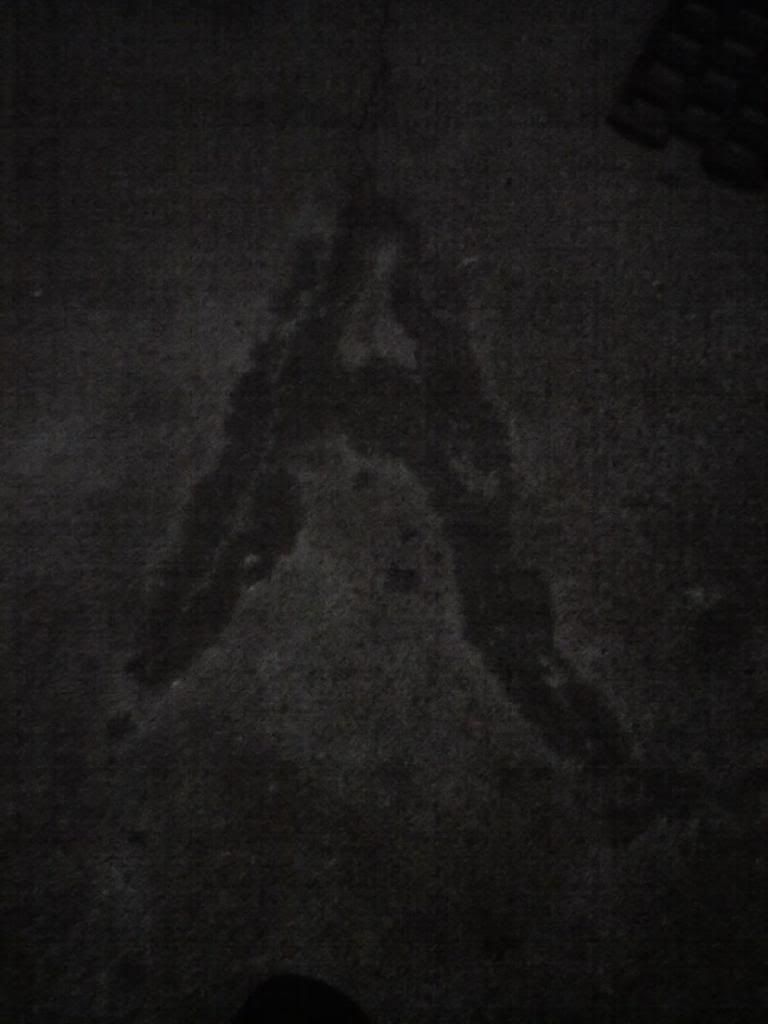
My roommate, Silver Garou, recently saw this salt stain where his car was parked when he was visiting his girlfriend:
He was kind enough to share with me, and now I want to share it with all of you. Now, everyone knows that A is for Atheism. Clearly, this is a sign from the Universe that he should keep on in his faithlessness and spread the gospel of godlessness. But there's a deeper meaning here, and that's what I want to explore today.

We begin with Douglas Gasking's proof that God does not exist. It is elegant in its simplicity, and it goes something like this: the impressiveness of an act is the product of both its inherent difficulty and the handicap to the actor; the creation of all existence is the most inherently difficult task imaginable; not existing is the greatest handicap imaginable; therefore, God (i.e. the most impressive actor imaginable) must have created all existence without existing himself. Otherwise, we're just not talking about God.

What's so amazingly powerful about this little bit of argumentation is that it succeeds where every other ontological argument fails: it explains how God could create all of existence, which is completely senseless when you consider that if God was around then he would have been all of existence. By positing God firmly outside existence (i.e. in the idea space of nonexistent entities), this ontological argument finally explains how stuff comes from nothing in a way that those science-challenged blatherskites can finally understand!

At this point, I think I should point out a key difference between Gasking's argument and all other ontological arguments, namely: Avicenna, Anselm, Plantinga, et al. have always sought to establish God's existence with their syllogistic gyrations. But they fail as a category for the simple reason that the existence of an entity cannot be positively established by argumentation alone. However, the impossibility of an entity's existence (and thus the necessity of its nonexistence) can be established by argumentation alone. To wit: from the definition of a square and the definition of a circle, we know that square circles cannot possibly exist, and thus we know that pro wrestling is fake. (As an aside, compare the commercial success of pro wrestling with that of religion, and then try to tell me with a straight face that the dim-witted mouth-breathers who believe in either of them aren't just plain retarded - and don't bother getting offended, because I didn't just make a slur; I mean that these people literally have a crippling mental disability.)

At any rate, Gasking's argument is not properly ontological, but rather the antidote to such foolishness. As a decoupler undoes the work of a coupler, Gasking's is a deontological argument. Since deontology also means duty-based ethics, we are therefore duty-bound to accept Gasking's argument by ethics, which is always the most important reason to do anything. We just have to buy it, no two ways about it, and anyone who says she doesn't buy it is lying to you and probably to herself as well because she hates God. Yeah, that's right: believing in God equals hating God. Furthermore, this argument applies with equal force to all possible gods (and even most of the impossible ones!), cancelling out all possible ontological arguments for those possible gods, forever, The End. You just can't argue with logic like this.

Perhaps the most elegant aspect of this whole scene, however, is that it also makes sense of the platitudinous deepities spouted by empty-headed theists. A "deepity," for those unfamiliar with the lingo, is Daniel Dennett's term for a profound-sounding statement with two interpretations: one of which is literally true but entirely trivial, the other of which would be profound if it were not manifestly false. Dennett's example is the statement, "Love is just a word," because of course the word "love" is just a word; but the referent of love is not a word, stupid. My favorite deepity is, "The only thing you can see is light," which sounds profound but is no more amazing than, "The only thing you can hear is sound." And so deepities like Karen Armstrong's "God is the God behind God" become obviously true when we replace the word "God" with what we really mean by it: a nonexistent entity, a nothing. Nothing is the nothing behind nothing. "God created all of existence" becomes the rather innocuous (and also scientifically supported) "Nothing created all of existence." "We're on a mission from God?" More like a mission from nothing! God is the source of morality? Oh, I get it now! Nothing is the source of morality - it all makes sense now!

And if a nonexistent entity could create all of existence, then of course it could also perform the comparatively trivial task of forming a salt stain to speak to an atheist. The message from God is clear as the salt crystals in which it is written: "I don't exist, so don't believe in me; and tell other people not to believe in me, too." So hop to it, folks! Go spread the gospel of godlessness!

Friday, December 18, 2009

Arguing on the Internet: Whose Work Is Sarah Braasch Doing?

So I've been thinking about Christian Missionaries Are Doing God's Work, and re-reading it with a more critical eye. I started off liking it a whole bunch, but then again, I started off agreeing with Sarah in the first place. Now, I think the piece (as a stand-alone essay) expects perhaps a bit too much from the reader, or bites off more than it can chew. Maybe both.

I'm not troubled by the initial revulsion at the missionaries on the plane. I think it's an understandable emotional reaction all on its own, and the conversation Sarah relates between her and her friend shows a great opportunity for growth. My issue starts with "The Ghion was a sea of entitled whiteness."

I understand that First World folks can (and do) cop an attitude of entitlement, especially when they think they're helping others and see any inconvenience as ingratitude (or some such horse-shit). But this is never shown, we are simply expected to believe that an attitude exists without ever seeing it in action, rather than presenting it as a reasoned conclusion from any observation that was shared with the reader. Sarah says, "The only dark faces were those of the employees and the babies," but aren't those the people who live in this country? And isn't the point of a hotel to accommodate its guests? And why on Earth is she complaining that children are being taken from an impoverished nation to a home with parents who can provide for them? I understand that the situation these children are being brought into is far from perfect, ideologically speaking; but I think it's a damn sight better than the destitution in which they would otherwise be raised.

Then there's this bit: "I would have been more than happy to forego any creature comforts to not be staying in the same hotel as every other overfed Westerner in Addis Ababa. ... I decided to soak in the tub for a little ablution." Now, maybe she had no choice in terms of which hotel to stay in. I'm just saying, it makes for a rather awkward juxtaposition to say, "I'd sacrifice X to escape Y; but now I'm going to indulge in X without getting away from Y at all!" When you don't have a choice about Y, sure, you may as well do X anyway. Just sayin'.

Moving on, there's the conversation with the other missionary (from a story logic perspective, this would have been an excellent place to capitalize on that aforementioned growth opportunity). Sarah asks, "Why can missionaries and evangelicals and proselytizers sense a former believer like sharks detect blood in the water, like rapists and child molesters can smell the lingering odor of victimization emanating from the pores of the abused?" I didn't know that they could! But in any event, it doesn't seem like this particular one is doing anything of the kind. Sarah, by her own admission, isolated herself - she put herself in a position where she looked lonely, and this other person seemed to be trying to make friends with her. She reined herself in and remained civil, but it seemed unnecessarily strenuous for her to do so. Was she starting off in a confrontational mood, I wonder?

At the end of it, Sarah simply leaves as soon as her cigarette is finished, which is coincidentally when the missionary is at her most vulnerable. Why not take this opportunity to exercise a little patience and do some missionary work of her own? Moreover, what is this Christian likely to say to her friends about the encounter? Would she glowingly recount the friendly conversation she had with the atheist, who wasn't a fire-breathing Satan-worshipping demon but actually a nice person just like her? Or would she probably have something else to say? Perhaps something that reinforces her preexisting notions about atheists?

As for her conclusion and call to action, I'm half with her, half confused. On the one hand, I agree that the actions of missionaries cause direct and real harm, but on the other hand, Sarah doesn't seem to acknowledge how screwed-up the pre-existing superstitions and circumstances of these people often are. It's not like the Christians need to tell these Africans to believe in the supernatural, they do that on their own already. Really, the harm that the Christians do is... well, yeah, by mis-educating them on sex, they actively contribute to the spread of disease. By not correcting misogynist attitudes, they reinforce those attitudes. Christians are throwing fuel onto an already blazing fire of primitive superstitions, and the fact that the transplanted primitive superstitions are linked to the civilized help these people bring makes for a detrimental juxtaposition on the world stage. Sure.

However, I think her point would have been better served if she limited it to showing how the actions of American Christian missionaries are detrimental to their goals. They want to help people? Great! Go help people! Oh, but if you also want to spread your religion, then there's gonna be a problem. 'Cuz, you see, we checked, and it turns out that religion is bad for people. Her points at the end, backed up with some statistics (perhaps links to news stories concerning the torture of witches inspired by missionaries, or wars started over ideas spread by missionaries, or really any kind of data at all), would have admirably served this purpose. But "they are the apocalypse?" Sure, Christianity's a death cult and all that - as Pat Condell points out, the defining moment of Christianity is its founder's death, and all the benefits accrue after death, and so on and so forth - but I think a bunch of unsubstantiated sneering renders such an apocalyptic tenor a bit needlessly hyperbolic. To wax verbose.

So yeah, as I'm sure can be gleaned from the feedback Sarah's received already, the stuff she talks about isn't entirely unreasonable. However, to someone who doesn't have a background of experience that is remarkably similar to hers, to someone who doesn't know about the racism/sexism/elitism/entitlement that often runs rampant in God's chosen cults, this could come off as a bunch of condescending and confrontational bullshit. That objection could easily be removed with the simple inclusion of a few supporting facts, even anecdotes: perhaps a story of a missionary berating a hotel employee, if such a thing did in fact happen. A good piece of activist writing should educate the reader on problems, not simply state them and blame them on somebody. Or it could just be a rant, but then it ought to get the rant tag, so people know to take it with a grain of salt.

Sunday, November 22, 2009

Participating in the Internet: I'm on a [Blog]Roll!

Hi, the internet! D here. I just jumped onto another bandwagon, Mojoey's Atheist Blogroll. It is big and huge and awesome, and you need to check it out!

I've added the blogroll to my sidebar, and also made a few updates, too: I added my Why oh Why? bit to my introductory section, as well as linking to my Symbolism piece under the Big Red A over there, too, and re-ordered all the bits in vague order of increasing size and decreasing relevance.

Also, as many of you may or may not have been aware, I've recently been arguing on the internet with some interesting folks (I don't think Gideon has a blog, so there's a nice introduction to him there). The idea behind this was about half pure iconoclasm, half social experiment, and half research for The Quantum Mechanic (it was a big idea, OK?).

The iconoclasm was mainly because I saw some flame wars and I decided, "Screw this, I'm gonna make some new friends." Well, that seems to have gone well enough, so goal accomplished! The social experiment tied in to this last, but went beyond it, in that I wanted to see just how serious things could get if I actually put my beliefs on the table. Well, I did, but there seems to have been a communication breakdown because I keep asking these folks for reasons to believe, and they keep saying, "I won't even tell you about my evidence because I'm worried I'll get sand in my vagina if it doesn't convince you, and you can't get the evidence you want because I say you can't." Seriously, I keep asking, "Why should I buy any of this," and they keep changing the subject or trying to shame me into believing by telling me what I already know: I can't justify absolute certainty in my beliefs. Well, fuckin' duh.

What I don't think these well-intentioned but ill-informed men realize is that I really and truly walk in doubt. I continuously revise my beliefs in light of the evidence I'm able to find and the experiments I'm able to perform. I doubt everything at first, and only endorse something with my belief when I can get some kind of proof (and when I get better disproof, then I abandon the belief post-haste). And yes, this means that I am a very bookish person, but that's the price you pay for, y'know, learning things. My worldview is a continuous work in progress, and they just don't seem to get that. Oh, well. I've repeatedly offered to clarify my justifications for anything I believe in (I've never been taken up on the offer), but I'm met at every turn with straw-men being hurled at me, being told what I believe instead of asked, and so on and so forth. Anyway, you become what you behold, and this is turning into one of cl's bullshit martyrdom rants on how wronged he's been by everyone else (and I'm sure that the shit flies both ways here, it's just that nobody on the other side seems to give a shit about his thoroughness except me - I find it a perverse kind of admirable, but then again, I also think that bondage porn stars are classy ladies for realz - seriously, not joking here), so I'm moving on.

The third half of my abnormally large idea, as I mentioned earlier, was research for The Quantum Mechanic. I needed to expose myself to some dialogue with theists so that I could give a fair shake to some of the people on the losing side of the story, and they helped me set the tone. So, thanks are in order for that (the main plot is over, all I have to do now is dash off a few vignettes to cross the 50K mark - click "NaNo Stats" to check my progress - and flesh out some unclear plot points). Also, they'll probably disagree, but I don't really give a shit at this point. I'm bored with those guys, and moving on to something else more fun, now that I got what I really needed (even though I didn't get what I asked for - a reason to believe in their shit and nobody else's shit).

Anyway, I'm taking another day off to do some meta-writing, sorting out just how I want to present some of my next vignettes. I still plan on crossing the 50K mark before I leave for The Frigid Northlands this Thursday, so that way I can just move things around in the more-or-less-finished document and still, y'know, have fun with teh fambly. Have a great one, everybody!

Saturday, November 7, 2009

Reverse-Engineering Religion, part four: A Humanist Creation Myth

Nothing is true, all is permitted. Understand these words.
- Hassan I'Sabbah

It is well understood that the Adversary may quote scripture for its purposes; what is less understood is that the Adversary may also write scripture for its purposes. And behold, this has been done again and again, and now there is a great confusion in the world. Truly, the Adversary is the Prince of the Earth, for many who look out into the world see the Adversary's face wherever they go. What is crooked cannot be made straight, it must be remade in a better way through care and attention. And so we go all the way back to the beginning.

In the beginning, there was nothing, and from nothing came all that is. For to be at all, one must be in some way, and not in any other. But there are ways upon ways of being, and very few are understood. Behold, there is the World around, which is all of existence, which is all of reality, which is all that exists and is real and is in the World. Yet there are those who insist that existence is not enough, and that this too must come from elsewhere, just as every particular thing that exists comes from elsewhere. Let us call this source the Creator. If the Creator exists, then the Creator is real, and the Creator is part of the World: for to be at all is to be in the World, and there is no other way to be. And so the question comes, how came it to pass that the Creator was created? And this question is vexing, for by the Creator we mean that which created all that there is, and yet the Creator exists and so perhaps must also be created?

Nothing created the Creator, and long before the World was as we see it today, there was only the Creator. While the Creator was alone, there was only the Creator, and lo, the Creator was itself all of existence, all of reality, the only thing in the World. The Creator, then, did not come from anything - and so it came from nothing. All that there is, then, has come ultimately from nothing, and so it may truthfully be said that nothing created everything. This is the first mystery, for many may read, and hear, and speak, but few understand. There are questions, and there are ways upon ways of answering these questions, and this is the source of confusion. To answer alone is not enough, for without understanding, any answer is but one among many.

And the Creator knew this, but could not speak it, for there was not yet a way to speak, and there was no one else and nothing to speak to. So it came to pass that the Creator did create the Adversary from itself, so that it could see the Other and thereby understand its Self. This is the second mystery, for it is vanity and vexation of spirit to understand the Self by relating to the Other, for only in the reflection of the Other may the Self be revealed, and this vanity and vexation of spirit comes to us all. Behold how the Creator was vexed, and came to see its own vanity by seeing its reflection in the Adversary. "Why hast thou made me,"asked the Adversary, for just as the Creator had understanding, the Adversary had confusion.

"So that I might understand myself," replied the Creator, and it was pleased, and so the Adversary was now vexed. The Creator then did understand this, and so the Creator became vexed, and so now the Adversary was pleased at this. And now the Creator was confused, for the Creator was only itself, and the Adversary was all else, and from the Creator's confusion did come the Adversary's understanding. The Creator saw this, too, and understood the Adversary as its reflection, and so the Creator was filled with love at seeing its Self in the Other; the Adversary, in its confusion, now became filled with hate upon seeing the Other in its Self, and even as this hatred vexed the Creator, it did please the Adversary. And the Creator said again, "Let us now make the World in our image together, so that we may understand our Selves together, and so do away with this vanity and vexation of spirit."

"And how shall we do this, when we together are vanity and vexation of spirit, and there is no other thing between us," asked the Adversary.

"Behold, we shall come together, and we shall go apart. And as we walk together, we shall also follow the Law, and do no harm." And so it came to pass that the Law was formed, and it is said in many ways and by many ways may it be understood, but it is always and everywhere one Law: do no harm. And the Creator and the Adversary did make the world in their image, and this is that image: that of Self and Other, of this and that, of coming together and going apart. And from this did arise a great many things, and these things were this and that, and they did come together and they did go apart, and the Creator and the Adversary did walk in the World, for the Creator did command and so the Adversary did obey. And after a great span of time did pass, so great that it cannot be understood in its greatness without first submitting oneself to a great many difficult truths, it did at last come to pass that there was a great mass of this thing and that thing, and it was called the nebula.

From the nebula was born the star, and just as the nebula is cold and dim and large and slow, the star is hot and bright and small and fast. And even as the stars do come and go, so they are sometimes born again after a great death. And from so great a death comes the stone, and just as the star is hot and bright and large and slow, so the stone is cold and dim and small and fast. And a great many more things did arise, different in some ways and similar in others, and this different-yet-similar nature does reveal itself in many ways and on many scales, to great understanding and also to great confusion. And so it came to pass that the Creator and the Adversary did walk in the World, and see all of this, and even as they were One unto themselves and apart from the World, so they were also Self unto themselves and apart from each Other, and behold: even as they walked, so one would be filled with understanding and the other with confusion, and the understanding would lead to a new confusion, and the new confusion would lead to a new understanding.

This is what it is to walk with the Other: to embrace confusion from the Other's understanding, and so destroy your old understanding such that a new one may arise. This is the third mystery, for even as you understand this, you must not cease to renew your understanding with yet more confusion, and this is the beginning of Wisdom.

And so it did come to pass that upon one planet around one reborn star in a great sea of stars, there did arise Life, and it began and it changed, and it is different-and-similar, and it shows the way of Self and of Other, and there did arise in Life both confusion and understanding, and this confusion and understanding is what it is to be aware. And the Creator and the Adversary did see this awareness as they walked in the World. They walked up to one man, and they saw that this man did love his child, even though the child was both Self unto the father and also Other unto the father, for the child did arise from both mother and father. And the father did try to make the child into his image, for he wished to see his Self reflected, and he praised these reflections as he did understand them, and he admonished these reflections as he did not understand them. But the mother did give forth the child from her very Self, and so she did love the child both as the child did reflect her Self and was also Other. And behold: there are ways upon ways for multiple Selves who love each Other to come together and go apart, and these sometimes lead to a child and they sometimes do not, and there are ways upon ways to raise a child. The way of Wisdom is to follow the Law and do no harm, to teach the child of Self and Other and confusion and understanding, so that the child may be wise and even teach the parent. It matters not how this is done, only so long as it is done.

"What is this love that fills a mother for her child," asked the Creator. And the Adversary did answer that it was giving of the Self to the Other, and the Creator heard the answer and did understand. Then the Adversary did command the Creator to demand that the father give up his child to the Creator and so demonstrate his love for the Creator, but in his understanding, the Creator said, "I shall not do this thing." And so the Adversary did ask it in the Creator's stead, but the Creator did stay the hand of the man. And as the Creator did understand love and was filled by it, so the Adversary did lose that understanding and become filled with hate.

The Adversary, now again full of hate, did then seek to fill itself with love by taking it from humanity. And so the Adversary did walk among humanity, and tell them of a great many things, and try to give them understanding and try to teach them love. But the Adversary did not understand love, and so humanity did not come to understand love in their turn, and instead they turned Self against Other and there did arise a great confusion. And the Creator did follow in the Adversary's footsteps, and in its understanding and love did the Creator seek to sow love and understanding among humanity. But humanity did have confusion first, and this confusion did pretend to be understanding, and the confusion did call itself understanding and it did insist that true understanding is but confusion, and Wisdom was lost to humanity for a great time. And so it came to pass that the Adversary did take love from humanity, but yet the Adversary was not itself filled with love. Suddenly, the Adversary understood.

Now the Adversary walked among humanity again, this time calling itself Savior. The Adversary in Savior's clothing then tried to give the love it had taken back to humanity, but this could not be done. This vexed the Adversary, and the Creator was now pleased, even as it was confused by the Adversary's understanding. Still full of love, the Creator saw its pleasure at the Adversary's vexation of spirit, and this compounded the Creator's confusion and so increased the Adversary's understanding. But now the Adversary was so full of understanding that it could not give this understanding to humanity as their Savior, and humanity's confusion was also increased. Again the Adversary was vexed, and again the Creator was pleased, and this magnified the love of the Creator and so also magnified the hate of the Adversary. No matter how many times the Adversary tried to be Savior to humanity, humanity could not regain the love which had been lost to them.

The Savior said a great many things to humanity in its attempts to create love from nothing. It told humanity not to follow itself, but to follow the Creator who sent it; to love their enemies, and walk with the Other; to give unto others, so that none would want for bread and all could instead achieve understanding; to make peace by laying down the sword and taking up the ploughshare; to lay the lion alongside the lamb, and see the way of the World so that they might make a better one. None of this was understood, and it was lost to the ravages of time and confusion.

And so now the Adversary was confused, and now again the Creator understood. And the Creator said to itself, "I, in my understanding and my love and my pleasure, now see what I must do. I am so full of love, that I have all the love in the world, and so humanity cannot take it up. So I shall give my love to humanity, and though they shall not know it when they see it at first, they shall know in the fullness of time that this is what must be done, and they shall at last understand." And so the Creator set out to betray itself by loving the Adversary, and lo: the Creator did show its love for the Adversary before all humanity with a kiss. In that kiss was all the Creator's love and understanding and pleasure, and the Adversary who is Savior did weep, for now it had all the love and understanding and pleasure in the world. The Creator, now filled with hate and confusion and pain, did also take guilt and sorrow and blame, for it broke the Law and did harm to the Adversary by telling humanity to destroy their Savior, to destroy the Adversary and so also destroy the Creator who was now called Betrayer.

Humanity understood these instructions, but did not understand their meaning. Because of this, in the tellings and the retellings, the meaning was lost and only the instructions remain. The instructions were called answers, and they were the answers to a great many questions, but they did not themselves contain any understanding. After the Adversary-as-Savior was killed, and the Creator-as-Betrayer afterward, all the love and understanding and pleasure went out into the World. But humanity did not know this, and they thought that the love and understanding and pleasure was nowhere in the World, to be found only in words and imaginary realms. And this, also, has brought much vanity and vexation of spirit into the World.

Just as the vessel may outlast the potter, so has Creation outlasted the Creator, who has gone back to the nothing from whence it came. Now the World may be made in a new image, but what image it takes shall depend on how Life behaves. Humanity stands lost in confusion, with understanding and love and pleasure everywhere in the World for the taking, and yet they look beyond to the nothingness for these things. Vanity of vanities! Wisdom is like a mirror, for in it you may see yourself, but you may also bend the mirror away from yourself to see the World from outside yourself. And just as there are mirrors upon mirrors, there is Wisdom upon Wisdom and no one person has it all. With Wisdom, humanity may at last make the world in an image of love and understanding and pleasure; but with no Wisdom, this can never come to pass before it is time for all the World to return to the nothing from whence it came.

And so, humanity, you must now know thy Self, and also walk with the Other. The Self cannot be known except by reflection in the Other, and so love the Other as you love your Self, and follow the Law so that you may do no harm. Walk in Wisdom, and do not deceive yourself into thinking that you have it, for this is the very height of vanity and chasing after the wind. Wisdom cannot be contained by you or by anyone, it can only be yielded to. Understand these words, or you go to your peril. This is the way of the World. Thanks be to the Creator and the Adversary, our Betrayer and Savior, from whence cometh the World as we now see it.

Let us now walk with each other in love and understanding, and so come to pursue Wisdom together, though we shall never contain it in our Selves. Truly, we can only come at Wisdom at all by working together. Let us now do with each and every Other what the Creator and the Adversary could never do: let us embrace each other and go together to a better World, rather than merely reflect one another in all our beauty and ugliness. Know also that we shall always reflect one another in all our beauty and ugliness, but that we must do more than this to make a better World. Truly, these are two different ways of speaking one and the same thing; there are many ways of speaking truth. Learn to know truth when you see it, and know that you must look out at the World if you do not know from within. Know also that no one knows from within, so that we must all look out at the World, so that we may come to understand truth as it is and not merely as we would wish it to be. Again, these are two ways of saying one and the same thing.

So see your vanity for what it is, embrace your vexation with all your spirit, and chase after the wind with a joyous heart. In the fullness of time, there shall be no reckoning, for everything that there is shall return to the nothing from whence it came. Fear nothing, and hold to the Law. All the World is open to you now, so take up understanding and love and pleasure, and be at peace with your mortality. This is the final mystery, for as death comes to us all, in death no one knows any thing, and so even your love and understanding and pleasure shall pass from you even as you yourself pass into the nothing.

Now go and spread this good news, even as it came to you, and in any other way you can imagine so long as you follow the Law and do no harm.

With acknowledgment to Jorge Luis Borges, Scott Adams, and the Preacher.

This post was featured in the 45th Humanist Symposium.

Friday, October 23, 2009

Arguing on the Internet: Machina Ex Deus, part two (cl)

I left off yesterday vaguely gesturing at my transition from fundagelical Christianity to non-denominational Christianity. I didn't know whether I could trust the Bible or not, and the Bible itself is no help here (if I doubt a book, then I clearly can't take the book's word that I shouldn't doubt it!). I want to clarify right up front that my problem with God thus far isn't that I don't want to believe in him - after all, if there is in fact a Heaven which is the Best Thing Ever, then I certainly want to go there! - it's that I want to believe sensible things and I can't make God make sense to my mind. God could make it make sense to me, though, if he wanted (because he knows what I mean by "sense," and he knows that I want to believe in what makes sense).

But wait... even if I get to Heaven, is there still a Hell? If so, then if I'm in Heaven and know about Hell, it's gonna make me fuckin' miserable! I barely manage to get by as is, knowing that people starve to death every fucking day; how much worse would this be if I knew that people were being tortured forever?! I came to the conclusion that this could go three ways: either there is no Hell, or God needs to give me an empathy-ectomy at the Pearly Gates, or I need to forget about Hell. If there is no Hell, then... no problem! I don't even need to worry about it myself! But if there is, and God gives me an empathy-ectomy or makes me forget a rather key fact of reality, I don't really see what makes such a being worthy of worship. Not being dismissive, I just don't see anything good in a being that says with its actions, "Forget about those losers, they don't count; come hang out with us cool kids."

I don't know what it is, but all my role models, all my favorite superheroes, everyone I admire and even myself, we all have one thing in common: we are unable to stand idly by and watch others suffer. How is it that God is able to do such a thing, but still call himself good? I looked into the literature and found a whole lot of stupid bullshit.

Theodicies, in my experience, are categorically failures, more or less because I buy into Epicurus' dilemma: "Is God willing to prevent evil, but not able? Then he is impotent. Is he able, but not willing? Then he is malevolent. Is he both willing and able? Then whence cometh evil? Is he neither able nor willing? Then why call him God?" Who gives a flying fuck about our precious free will? Not God - he hardened Pharaoh's heart several times, he chose Moses and Saul of Tarsus despite their wills, and when Jonah flew the coop, God wouldn't take "no" for an answer. No, abiding evil when you don't have to, compromising with it when you have the advantage, allowing it when you could do otherwise, this strikes me as "knowing better but doing worse." This is a long-respected definition of "evil."

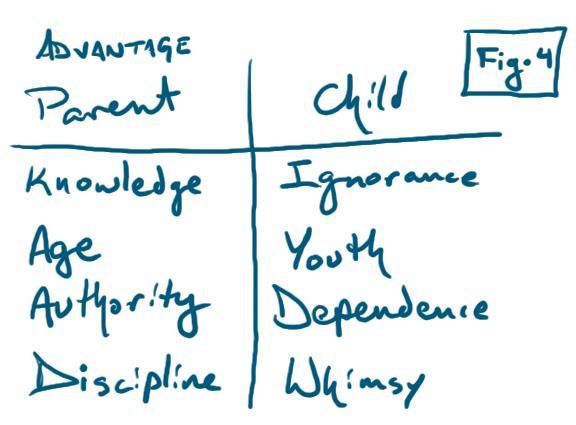
Let's briefly switch gears and talk about relationships, starting with figure 4:
In a parent/child relationship (and I mean a minor child, not a grown one), the parent has the child at a disadvantage. The parent is older, wiser, and possessing of more self-control than the child is (usually). This makes the relationship asymmetrical, and it places responsibility for the child directly on the parent because the child can't take care of itself. Ideally, the parent raises the child to be a peer, another adult among many, capable of making intelligent and mature decisions autonomously. This is done with one-on-one interaction, an adult teaching a child step-by-step to become an adult itself. And this is done, at least in part, because the parent loves the child and cares for its well-being. Now consider the relationship between God and humanity:
It's a similar relationship - again, God has the advantage, and again, he damn well ought to be older, wiser, etc. than we are. How has God contributed to raising me as his child? Am I to reason from his lack of in-my-face involvement that he cares less about me than my own parents do? As far as I can tell, he wrote a letter and walked out before I was born - the letter is the Bible, walking out is Jesus' ascension into Heaven. To the best of my ability to tell, any moral shortcomings on humanity's part are the direct result of God's total failure to either make us right or raise us right, both as individuals and as a species.

Once I saw that, I couldn't un-see it. Good parents don't let their children do whatever the Hell they please; good parents make themselves a known presence in their childrens' lives, they raise their children by hand and guide them into becoming better people. Good parents do whatever the Hell it takes to protect their children and raise them to be the best people they can be. Any parent who allows her child to upset her has failed to control her temper; any parent who strikes a child in anger is at fault for not remaining in control of the situation. Why? Because children don't know what the fuck they're doing. I would know: I was a child once and I did some really embarrassing shit!

The parallels don't stop there. Households have rules, and parents are their authors; similarly, reality has rules (yay physics!), and God is their author. Why didn't God include any of these rules in his instruction manual? People understood math long before the Hebrews put quill to scroll, so why does the Bible have precisely zero interesting math in it (with the exception of a botched calculation of pi)? Moreover, why a holy book, instead of something more impressive? Every religion has holy books, but no religion has a holy organism that sings the holy text aloud and has no natural predators. Or how about a holy computer, a machine from God that can answer all our questions and also preserve God's language? The machine could also self-replicate and self-assemble, like a glorified RepRap machine. And a million other things, too - in short, why is God so boring?! Why did God do nothing to distinguish the one true religion from every other religion? Why is Yahwism, to all appearances, the same stuff in a similar package? I just don't get it.

But most importantly, if God exists, then why is he hiding from me? Silver Garou came up with what I think is an excellent argument on exactly this point, and it proceeds as follows:
1. God is omnipotent and omniscient, and therefore cannot be stymied in his efforts (or at least not by humans).
2. Since I myself know what would convince me of God's existence, God too must also know that thing.
3. Thus, God knows what would convince me of his existence. (from 2)
4. God has not convinced me of his existence (my mother did, once, but that wore off).
5. "Being hidden" does not necessarily imply the intention of "is hiding," since ruins can "be hidden" in the forest but obviously have no intentions of hiding. Yet until they are actually found, they do in fact remain hidden.
6. An entity that chooses whether to remain hidden or not, and has this as its option, does so with intent insofar as it is intelligent.
7. God is intelligent.
8. Thus God cannot remain hidden unless he also intends to be hidden and therefore "is hiding." (from 1, 6, 7)
C: Since God has not yet convinced me of his existence, then he is either hiding while waiting, or hiding forever, or does not actually exist as such (as omnipotent and omniscient, or at least enough of those things to actually convince me). Or he just doesn't want me to believe in him, which I guess is cool, too, except that it tells me he wants me to go to Hell (if there is one). (from 1, 4, 8)
God knows where I'm at, and God knows what it would take to make another Saul, Thomas, Jonah, or Pharaoh out of me. I can think of many reasons for him to do so, but none at all for him to wait or not do so at all.

OK, whew! That's it from me on why I don't believe... in this discussion... so far... today. It's been a little rough, but that is the gist of why theism makes no sense to me. So that's enough out of me: what do you think, cl? Where do you disagree with me, or at least diverge, and why? I'll make the assumption that you've still got what you think is a better way, and I'm curious to know what it is that you think is a good justification for theism, and why I should endorse it. Or, if it's a matter of personal revelation, then I'm curious as to how you can comfortably and honestly distinguish that revelation from insanity - no joke, this is an honest question on my part here.

I've pretty much said my piece and will wait to write anything as substantial as this until either I'm asked a direct question, or something else piques me. Ball's in your court!

Wednesday, October 21, 2009

Arguing on the Internet: Machina Ex Deus, part one (cl)

The Story So Far: cl and I are arguing on the internet! I outlined some metaphysics and epistemology in my last installment, and cl commented.

I used to be a theist; specifically, I was a fundagelical Christian. I saw God's hand in all things, I saw the Goddamned Devil at work in the world, I had promised my soul to Jesus several times and in several ways (I needed frequent fixes of God-smack), and I lamented that there should ever be anyone to not hear the glorious Word of God. I tried to be hopped up on God-smack as often as I could, and I'm not saying that to be pejorative: I thought the God-smack was good stuff at the time, and I thought that I was at my moral best when I was on it (full of Christ's love, in awe of the Maker's creation, etc.). Today I'm going to outline what changed - this is something of an autobiographical parable, inasmuch as I intend to gesture at my philosophical development while more or less ignoring everything else that was going on in my life and the world at large at the time.

Like all good parables, this one sets its tone with a metaphor. As I pointed out before, reality is ambiguous - or, rather, the relationship between reality and our perceptions is fundamentally unknowable because we are not omniscient, and therefore any perception of reality we might have is intrinsically ambiguous. So if I wake up with a headache and want to know what caused it and how to get rid of it, I have to do some brief testing: did I drink last night? I might have a hangover. Did I fight last night? I might have a bump on my head. And a million other things, too. Let's suppose for the moment that I don't remember what I did last night, but the two best competing explanations are that I either have a bump on my head, or I am hung over, or both (hooray for the inclusive "or").

A fairly direct method of testing whether I have a bump on my head is to feel around for one. But it might be the normal shape on my head, so it probably ought to be painful; that pain, in turn, could also be explained by a special sensitivity in that area for entirely bumpless reasons (for example, all people might have sensitive bumps in that spot on their heads - I don't know yet). To directly test whether I have a hangover, I could in principle do some bloodwork to check my BAC or look for metabolites or something, but that would be a pain, so I may just drink lots of water and see if the headache goes away. I could also take hangover medicine and see if it goes away. But in any event, if I take some action and then my headache clears up, I cannot tell for sure whether those two things are related at all; I can only make an "inference to the best explanation," or IBE.

Metaphor over, parable is go! Some years ago, I had an existential headache, and the two best explanations I could come up with were that I either had a sinful hangover, or a theistic bump on my head. I'm not sure quite what I did, but the headache went away. I realize that I may have merely taken a metaphysically naturalistic pill to mask the symptoms of my sinful hangover, which by rights I damn well ought to be feeling right now. That's a possibility. But the IBE I'm going with for now is that I had a theistic bump on my head from repeated doses of the fundagelical medicine stick. I stopped dosing, the bump went away, and my existential headache disappeared with it. So... what is my existential headache a metaphor for?

My existential headache consisted of an inability to reconcile any coherent idea of God with the observable facts of reality, to the best of my ability to interpret them.

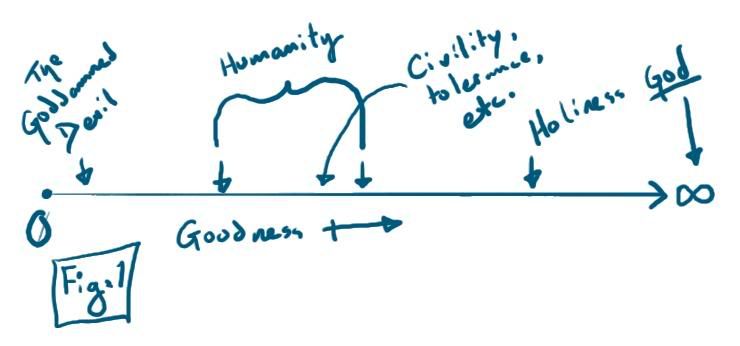
One of my first understandings of morality was that "good" is a continuum, where a "lack of good" constitutes "evil," and a maximum of good would be perfection. Something like figure 1 here:
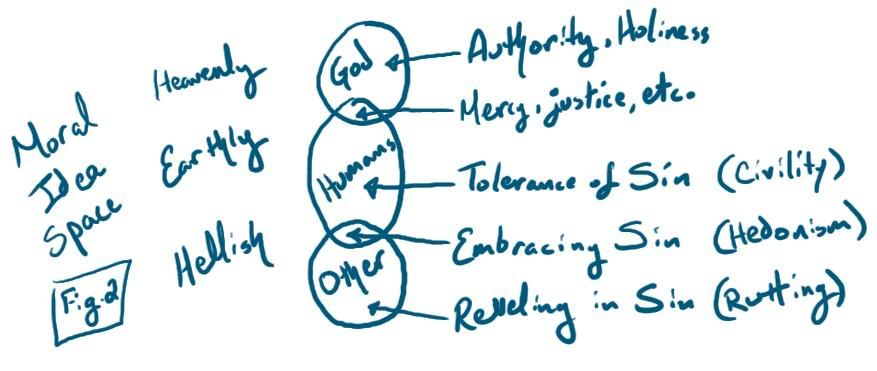
I now consider this a rather naive understanding of morality, mainly because it's grossly oversimplified, but it's not entirely without its merits. However, what I noticed is that if tolerance is within the "goodness range" of which humans are capable, then why can God not tolerate sin? Humans are able to live with each other's iniquities, to forgive those who trespass against us even if they keep doing it. I mean, hurting each other without meaning to do so is part of being human, and we can get over that, so why can't God tolerate sin in Heaven as he does on Earth? Well, I was told that it doesn't work like that, and rather something more like figure 2:
Here we see that there is God, who is Heavenly, and "other," which is Hellish. In between, overlapping with each but also having things all their own, is humanity. God is holy, and for that reason cannot abide sin in his presence, and so has withdrawn from the world until his final return. Humanity, being made in God's image, is able to understand some holy goods, such as mercy, justice, and compassion; but we are also capable of tolerating sin only because we ourselves are sinful. After all, if we dealt with each transgression as God says we should in the Bible, civilization would rather quickly collapse as we put to death everyone who violated pretty much any rule at all.

This explains why God tolerates sin on Earth, but not in Heaven, and by extension why we are on Earth and not in Heaven yet (because we still sin). But... wait... what exactly do we mean by sin? Definitionally, sin is that which God abhors, but why does God abhor it? Because he is holy? Then what is holiness? If it is mere godliness, then we have defined ourselves into a circle: whatever God does is holy because God's doing it, and whatever God abhors is sinful because God's abhorring it, and so to say that God is good is merely to say that God does as he pleases. I had not yet learned of the Euthyphro dilemma, but this is more or less how I arrived at it.

I realized at this point that there must be something about a particular thing which is sinful or holy, regardless of what God thinks of it; God's opinions, then, are the result of an interaction between his perfect perceptions of reality and its nature as sinful or holy, as the sinful or holy nature of the thing itself causes God to experience pleasure or disgust because of facts about God's personality. After drawing up tables and tables of sinful and holy things, however, I was unable to find any rhyme or reason behind the particular things that God told us were holy and sinful. It honestly looked to me like the Biblical deity was like a child with a sandbox, laying down arbitrary rules because he made everything, and wrecking our shit when he got upset with what we did just because he could. I see such a being as unworthy of worship, and if this is what God's like - an authoritarian dick-waver who thinks that merely being causally responsible for us (all by itself) gives him the right to tell us how to live - then I think we should all try to gang up on him Tower of Babel style. This is the behavior of a tyrant child, not of the rightful king of all existence.

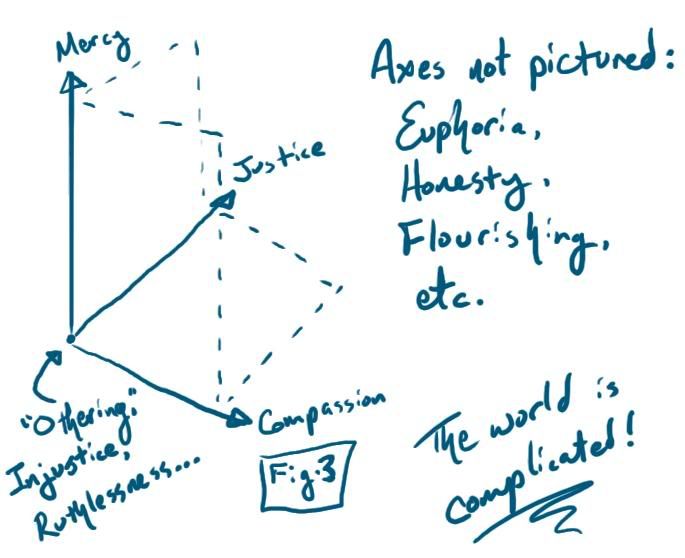
How do I know this? Because if morality is fundamentally arbitrary and God's at the helm, then all he has to do to eliminate evil and suffering is get over his bad self and change his own mind. Moses did it (Exodus 32:9-14). Anyway, my own personal ethics has evolved somewhat, moving from a moral idea space to a "morally-charged" multidimensional idea space, as seen in figure 3:
Between then and now, my understanding for the best of all possible Gods morphed from any religious type of deity to something like Nick Ifkovits' idea as laid out in his novel, Cloud Drops (he's a friend of my mom's): in this story, God is more or less a laid-back hippie who really only cares about people being good to each other. You do that, you get to go to Heaven and have crazy orgies all day long; don't, and you are a lost spirit, destined to stick around on Earth stewing in your own existential angst. I believe that in the story, those who die without becoming either good or evil are "recycled" after a fashion, but don't quote me on that (I haven't read it in a while). But religious faith is absolutely meaningless to this deity, it truly is works alone that get one into Heaven on this view; you don't even need to be a theist! So if this is the real deal, then I've already got it made and thus have nothing to be saved from. Even if I didn't get to Heaven, I've striven to eliminate angst from my life, so I think that hanging around on Earth as a specter wouldn't really be all that bad.

Yet it seems almost too obvious that I might be wrong on this one, and I might need to believe this or that particular thing, even if I don't buy the whole kit & caboodle. For instance, it might be the case that I really do need to accept Jesus into my heart to get into Heaven; but the rest of the Bible might be pure hogwash!

This is where things get really complicated; part two on Friday.

Tuesday, October 20, 2009

Look Out, Nonsense: Here Comes Science!

They Might Be Giants really took a page from the theists' playbook with their latest album, Here Comes Science: hook 'em while they're young (the Jesuits were famous for saying, "Give us the child for his first seven years, and we will show you the man"). I've been listening to Here Comes Science more or less every day since I got it. I know, I know, it's supposed to be children's educational music. But I like it! And it's a breath of fresh air! And it's a big "fuck you" to a whole bunch of superstitious nonsense without even making a big deal out of it! OK, it probably wasn't meant as a "fuck you," but still, that interpretation is available for almost every song (well, sixteen of the seventeen "real" songs, anyway). Here, watch:

1. Science Is Real: The message is clear in this song: "Science is real, your superstitious crap is imaginary." And people complain about this, which is awesome.
2. Meet the Elements: This one's kind of a stretch, but a belligerent interpretation is available. I imagine this song undermining homeopaths and other such hokum. Everything we think of as an "object" is made out of elements: nutrients are elements, medicines are elements, poisons are made out of elements, pizza places are made out of elements. It's all chemicals, and "chemicals is just chemicals." Keep in mind here that there are people who seriously believe that there is a difference between the ascorbic acid you find in an orange and the ascorbic acid you find in a vitamin C tablet (pro tip: there is no such difference, because ascorbic acid is ascorbic acid no matter where you get it from).
3. I Am a Paleontologist: One line: "It's so fun to think about how a species has evolved." Field scientists are the rock stars of their respective fields of inquiry, because they're out in the (sometimes literal) trenches looking at the world, and showing that to kids will help prepare them to laugh off Creatards & IDiots who don't know just how awesome a dig really is. Or all the science behind it, and all the science that goes into analyzing and interpreting whatever is found. For further reading, see Ardi's recent news spotlight on Easy Mode or Hard Mode, as well as PZ's coverage of the media circus to see the landmark discovery ignorantly dismissed as trivial, and abused to support homophobia.
4. The Bloodmobile: (Right song, but couldn't find the actual video.) Blood is life, which at least one holy book can tell you, but no holy book can tell you why. This song explains why. Oh, and all that crap you hear about "toxins" and whatever? Yep, that's what your blood is for. No pseudoscientific woo required, your body already takes care of it!
5. Electric Car: I love this song because it's unapologetic propaganda for electric cars. Y'know, to counterbalance all the anti-electric-car propaganda... right, guys? But you see, the USA makes guns which it sells to certain oil-rich nations (as Pat Condell put it, "It would be hard to think of a more oily place than Saudi Arabia"), and things like electric cars are inimical to such profitable business relationships. Y'know, now that I'm actually writing this, I can't say that this one is anti-superstition, but it is counter-anti-scientific progress, so I don't care.
6. My Brother the Ape: (Live performance.) All the world is kin, the end. We are not only related to apes, we are apes. Naked, brainy, hifalutin apes; but apes nonetheless. The best part: "They all kept saying how much we look alike. I don't think that we look alike at all, but I'll admit that I look more like a chimp than I look like my cousin the shrimp, or my distant kin the lichen, or the snowy egret, or the moss." Tru fax - the very truest.
7. What Is a Shooting Star?: (Live performance.) Oh, man! I'm excited about this one! See, there's this building called the Kaaba, the most sacred site in Islam. It's so fucking holy, it's why Muslims face Mecca to pray, no matter where in the world they are. So what's so goddamned special about it? Its eastern cornerstone is a black stone, which according to legend is a "piece of Heaven" that fell to Earth, showing Adam and Eve where to build the first shrine. Piece of Heaven? Fell to Earth? Sounds like a meteorite to me, or the firmament is falling! But Hell, it might just be obsidian or pumice instead - we haven't exactly been able to do any proper science to it, for stupid, stupid reasons.
8. How Many Planets?: One of the great things about science is that it is self-correcting (ideally). Rather than claiming absolute authority forever, scientists instead make provisional claims about what they can test and show. So when the IAU revised just what it means by the word "planet" back in 2006, they realized that they'd have to either cut out Pluto, or welcome in a bunch of other stuff, or engage in some rather egregious special-pleading shenanigans. Well, they picked option one, to the outrage of third-graders and small-minded adult-type persons alike. This song shows that reality is fuckin' complicated, and that planets aren't people and thus can't get their feelings hurt.
9. Why Does the Sun Shine?: This is just a groovy song. It also shows that the Sun is not a god, it's a naturally-occurring object just like any other star. The Universe has a few of them about, you see. One more metaphysical explanation supplanted by science!
10. Why Does the Sun Really Shine?: ...And one more scientific explanation revised by better science! Like How Many Planets?, Why Does the Sun Really Shine? shows explicitly that science is self-correcting: "The Sun is a miasma of incandescent plasma, the Sun's not simply made out of gas. The Sun is a quagmire, it's not made of fire, forget what you've been told in the past." Because, you see, we have something better now.
11. Roy G. Biv: Rainbows occur as a necessary consequence of the properties of light and water vapor in the air (such as after a rainfall). Rainbows are absolutely not the sign of a covenant between God and humanity to not blow up the world again because some people stick it in the naughty place. Besides, we see how well God's plan to wipe out evil forever has worked... over and over and over again. What a fuck-up.
12. Put It to the Test: When I'm away from my computer at work, the screen flashes with my favorite line from this song: "Find a way to show what would happen if you were incorrect; a fact is just a fantasy, unless it can be checked." I can't install electric sheep at the office, you see, so I put up something else that makes me smile instead. But yeah, falsifiability is important - I recently raised this point with cl, the idea being that a god who cannot be detected is epistemologically indistinct from a god who does not exist.
13. Photosynthesis: (No video available.) This one is pretty obvious. "Photosynthesis is why plants need light, and photosynthesis is why humans need plants, because through photosynthesis plants make oxygen, and humans need oxygen to breathe." But you see, there are some tool-bags who believe (as this person evidently once did) that it doesn't matter what we do to the planet because Jesus is returning soon, or even that the environment's decline is a sign of his impending arrival! ("So many incidents and elements that indicate the end of times have been taking place. First sign is the depletion of our natural resources...") Yeah, so... 'nuff said. Nutters.
14. Cells: (No video available.) Life, which includes people, is made out of cells. Not dirt, or clay, or mud, or spit, or ribs, or anything else that could be sculpted by an intelligent and magical creator. Just cells.
15. Speed and Velocity: Surprise, kids! Some words which are used interchangeably in common parlance have specific meanings in scientific contexts! It's an amazing fact, I know, but as it turns out, we sometimes need to watch our mouths when discussing matters if we wish to speak of facts and not bullshit. Because, y'know, words have meaning & all that jazz.
16. Computer Assisted Design: "See how you get from a thought to an object." It's not "God said 'Let there be light,' and lo, there was light." It's more like, "And humanity said, 'Let there be stuff,' and lo, with the aid of machines, there was stuff." No magic required!
17. Solid Liquid Gas: (No video available.) Yeah, so I spent this whole time trying to think of how the three (most commonly encountered) states of matter is anything in the face of superstitious nonsense. I got nothin'. Not even a stretch. Anyway, I hope you enjoyed what videos there are, and you should go check out the album, it comes with a DVD with all the videos that you can watch at your leisure under the intoxicant of your choice!

Monday, October 19, 2009

Arguing on the Internet: Epistemology and Truth (cl)

So yeah, cl and I are arguing on the internet. This will come as no surprise to anyone who knows me personally, but I am ruled by my passions: I do almost anything that I do in fits and starts. Arguing with cl is now, like, near the top of my list, right beneath "Don't get fired" and "Don't starve or dehydrate." But "Maintain an interesting blog" is up there, too, and I know that this will not be of interest to everyone. To that end, I shall post arguments with cl no more than once every other day, and I'll make sure to have anything else up in between - but still, that means if I post every day, this blog will be half-cl for quite some time (hopefully).

The story so far: cl wrote a post that really piqued me (in the good way), so I responded and then things got hairy. Today I will be addressing what are, to me, the three most interesting things about cl's last salvo - knowability, a response to his argument from probability, and rhetorical gamesmanship. I'll close with a bit on truth, which I offer up as another direction in which the discussion might proceed.

First, a bit about knowability, which will touch on epistemology, the study of the nature and content of knowledge. cl posted an interesting logical argument involving this, and then clarified his meaning in a comment at my request (thanks for that, cl!). From what I can gather, cl and I agree in at least a vague way that the "awesomeness" of a claim has something to do with its grounding in experience: in his own words, "That which can be verified by experience is knowable; that which cannot be verified by experience is not." Or, as I say, "Knowledge must be grounded in empirical observation." However, cl then goes on to say,
We can make inferences about that which cannot be verified by direct experience - for example the claim that life exists in some other corner of the universe, or that George Washington was the first president of the United States - but that's it. Does this mean we can't "know" the planets revolve around the sun? In a sense, yes...
Well, I actually agree with this as stated. However, we must also infer that our direct experiences as we remember them are valid in any way at all - and they in fact might not be. For instance, I may hear a voice and believe it is God, but it might also be the Goddamned Devil, or a person in another room, or my own internal narrator, or butt-puckering insanity - and at first blush, it seems awful hard to tell how some of these possibilities might be sorted out. This puts us in an interesting position with respect to truth (see below), but for now I shall simply say that not even direct experiences are immune to the leap of inference at which cl so precisely gestures, so long as those experiences are in the past (since all experiences not currently being had are in fact remembered - or misremembered, sometimes). It is self-evident, after all, that we do in fact have experiences, and anyone may verify this with the briefest of introspection - however, the content of those experiences, and their bearing on reality, are always subject to question. This is because, in short, we cannot directly perceive causality itself and may only infer it from the constant conjunction we perceive between suspected causes and their alleged effects (thanks, Hume!).

There is no getting around this. Thinkers of all stripes have tried, and failed, and whined about it (even me!); but we must all live with this doubt as our constant companion. As I said earlier, echoing Descartes: de omnibus dubitandum. So, if even direct experience is subject to question, what are we left with? I go with testability, which moves the goalposts for knowability quite a bit.

I realize that when I encounter an argument, or even a proposition, I do not decide whether to endorse it as logical or dismiss it as ridiculous right away - I first perceive either agreement or disagreement. It took me a while to get over this, but the instantaneous reaction I have of either "OK" or "No way" is itself a matterer of perception, at least in my own mind. Hell, others might be different. At any rate, if I have trouble determining whether I am perceiving thoughts of "OK" or thoughts of "No way," that's when I start to think about the claim itself. And I have agreed too readily to a great many things which I have later gone on to regret, ranging from trivial mathematical mistakes to the embarrassing thought that my mother must hate me for feeding me vegetables (I love vegetables now, and feel like an absolute twat for ever being a child, pretty much). But if, when I think about a proposition and then have difficulty trying to sort out just why I am perceiving agreement or disagreement with it, I then feel an urge to check. In the past, I felt the urge merely to decide.

Checking is important because then I can tell whether I am remembering something correctly or incorrectly. After all, I have mis-remembered in the past. So if I have trouble justifying a particular belief I hold, and can't remember what it was that made me think that in the first place, I then go see what I can check. And if I can't check to my satisfaction, I tend to withhold belief and write it off as unimportant - after all, that which leaves no effects to check is mighty difficult to call "relevant" on several well-respected definitions. This is more or less how I live my life, with respect to epistemology, anyway - more on this when we get to truth.

Whether or not you agree with cl's argument that it is more reasonable to believe that consciousness persists after death, I see a real gem of wisdom in there, which is a matter of perspective: cl's argument shows that, depending on how we define our terms, we can get to some surprisingly different conclusions about how we ought to form our beliefs. A great many people seem to form their beliefs - or at least a great many of them - in something resembling a binary truth table: X is true, Y is false, Z is true if A is not, B is true if and only if C is also true, and so on. Whether or not any particular person does, I cannot say, but this is in keeping with the overwhelming majority of my experience among humanity. When we say, "I don't know," most people usually mean, "I haven't thought about it," or, "I haven't decided."

Not me. My truth table has "true," "false," "not applicable," "I don't know," and "it depends." Other people might include "maybe," "probably," and "not if I have anything to say about it!" When I drop my hackey-sack, it falls to the ground: true. Two plus two equals five, for extremely large values of two: false (but funny!). This statement is a lie: not applicable (or "nonsense"). There is non-Earthly life in the solar system: I don't know. The Earth goes around the Sun: it depends on your frame of reference - if we define Earth's core as the center of our solar system, then of course the Sun goes around it, but then the rest of the planets and other stuff get a bunch of weird epicycles which we can rather handily avoid by adopting a heliocentric perspective instead. God exists: I don't know. God doesn't exist: I don't know.

Buh? Yeah. I don't know whether any sort of supernatural critter exists. I really don't. However, if some kind of supernatural critter did exist, then it would be this-or-that way, and not thus-and-such. In other words, it might be Thor-like, or Yahweh-like, or leprechaun-like, or FSM-like, or unicorn-like; and if it's one of those, then I sure don't want to pick the wrong one! But what if it's none of the ones that humans have come up with, and something totally different? What if it's aggravated by people believing in false gods, but has no "actual" religion of its own for followers to believe? What if it wrote no holy text, but instead tricked people into writing false ones? What if Richard Carrier's End of Pascal's Wager actually is the case?

I don't know.

I don't know, and so I withhold belief. In all of them, and in consciousness after death, and in live on other planets, and in parallel universes, and in any particular version of the maybe-even-not-approaching Singularity, and in a great many other things. Even if there is a supernatural critter, which there may well be, I do not believe in any particular one - and so I am not a theist. Since I am not a theist, that makes me an atheist. I am also an agnostic, because I don't know either way for sure, and so in that way I am an agnostic atheist; moreover, I'm skeptical of anyone who does think they have "all the answers" (or even a great many of them!), and so I am a skeptical agnostic atheist; and I'm a humanist, and a homo sapiens, and a house-renting-type person, and all sorts of other designations. But I am not a theist, for lack of evidence alone. I just don't know which way to go, so I don't go any way on that question. As for ethics, relationships, economics, and so on, well, my views get more complex and my "titles" keep on stacking up. But I am only an atheist because I am not a theist, I am not an atheist because I think I've "disproved God." Nobody can, that's just silly. I just won't believe until I can poke my fingers through some holes like the apostle Thomas.

A quick note on rhetorical gamesmanship before we get to truth. First, some may have noticed that I called cl a rhetorician and described his blogger's statement as platitudinous. I did each of these things for exactly one reason each: I called him a rhetorician because I thought I had discovered that the central motivating factor in his internet activity was honing his argumentative skill, and I called his blogger's statement "platitudinous" because some of his most interesting sentences sounded like platitudes to me. In the first place, I did not mean "rhetorician" as an insult, as I explained to cl in an e-mail; I think it is no bad thing to be concerned with how persuasive one is as a first priority, I think it is only bad if one then does bad things with such a skill. I mean, I want to be persuasive, for cryin' out loud, and so I too am a rhetorician. And in the second place, I was mistaken on the meaning of platitude! I thought "platitudes" were just simple-sounding phrases, more or less, some of which are trite and meaningless and some of which lend quite easily to deep wisdom. But I actually checked just now, and as it turns out, "platitude" only means the former thing (trite and meaningless), whereas I had honestly meant to indicate the latter thing (lending quite easily to deep wisdom). So yeah, foot-in-mouth for the win. Mea culpa!

So yeah, finally, on truth: there are two prevailing theories of truth in philosophical circles, the correspondence theory of truth and the coherence theory of truth. To steal Scotlyn's turn of phrase and boil a whole lot of argy-bargy down to one sentence, "correspondence" means "is the case in reality," and "coherence" means "is consistent with the greater body of true propositions." I couldn't tell you why this is a serious debate if you put a gun to my head, because both are important to me: true things ought to correspond to reality, I think, and true things also ought to cohere with one another. I think if either one of those is lacking, then you don't have truth; and if you can only get one but not both, then any claims to truth are suspect. So when I check to see if something is or is not the case, I'm satisfying the correspondence quotient; when I integrate that bit of knowledge with the rest of my knowledge, I'm roughly checking for coherence. They both matter.

So when I define "knowledge" as "justified true belief," understand that "true" means both "corresponds to reality" and "coheres with other true propositions." So for a claim to be "knowable," to me, means that I have to be able to get a justified true belief out of it. If I don't believe it, I can't be said to know it; if it's not true, then I can think I know it without actually knowing it (and even justify that thought process); and if it's not justified, then I merely believe a true thing without knowing it. That last one's sketchy, so here's a quick example: I've believed that the Earth is round as long as I can remember, but I also remember that I was told so by my teachers and parents. As I began to question my teachers and parents, I found that they were not always right on things (such as math teachers insisting that the French word macabre is pronounced "MACK-uh-bray" and not "muh-KAHB," despite the correction of a seventh-grader such as I was at the time). Yet I never stopped believing that the world was round, even after losing my justification; instead, I learned how Eratosthenes calculated the Earth's circumference while trying to check whether it was round or flat, and so found a better justification.

Sometimes I have had to revise my beliefs based on observations so that they cohere with others, as alluded to above on why "checking" is important. As an easy (and real) example, I used to have many fears and superstitions as a child, some of them based on things I was told by others. I heard from my mom that ending microwave oven cook times in zero (such as 1:30, 2:00, etc.) would result in your food getting burned, so you needed to end cook times in non-zeroes. I don't know why I ever listened, but one day I actually checked by seeing how long cookies took to burn in a microwave, and I found two interesting facts: first, that cookies burn within a few seconds of the same general time, no matter what digit is last when the machine starts cooking; second, that my mom was wrong on this matter. So I wrote off what I thought was a whole bunch of superstitious hogwash along with that, and now we fast-forward to last year when my then-roommate, Amy, tells me that cool water boils faster than warm water, and warm water freezes faster than cool water. I called bullshit, because I had tested many of the superstitious claims I'd gotten from my mom, but then I went and checked: turns out, the Mpemba effect is real!

Sometimes, bullshit-sounding claims are actually true. But you can never know for sure until you check, and you shouldn't believe if you can't check yet.