So I try to keep up on the various social media platforms, but I inevitably stick around on a few of them and don't... really... do much. That's what Tumblr has been for me, except then I gradually started getting more involved. Over the past couple of weeks, I got into it with a couple of transphobes. We touched on a variety of topics that I have been wanting to write posts on, so I was unusually well-prepared for this internet debate (or at least this iNtErNeT dEbAtE), but this will serve as a sort of bookmark for now.
It's a bit long, though, so I'll mainly stick to screenies & transcripts, and keep the commentary to a minimum.
Showing posts with label arguing on the internet. Show all posts
Showing posts with label arguing on the internet. Show all posts
Tuesday, December 17, 2019


Tuesday, March 26, 2019
Transgender Tuesday: Reviewing "Dreadnought" by April Daniels
I just discovered Smart Bitches, Trashy Books, which is like my new favorite website. Naturally, I’m going to immediately complain about it, starting with the review of my new favorite book, Dreadnought by April Daniels.

Also I love the low-key trans pride colors in the
background! (Image swiped from GoodReads).
background! (Image swiped from GoodReads).
Dreadnought is an #OwnVoices story about Danny, a transgender teen who stumbles into superpowers - one aspect of which instantaneously gives her a body she thinks of as ideal (yes, that’s problematic; yes, that’s addressed; yes, it’s handled tastefully and not overdone). She then encounters a bunch of bullshit as a result of this immediate transition, as well as a bunch of more “mundane” problems (i.e. problems not resulting from her transness) clustered around taking on the mantle of the superhero Dreadnought whose powers she has inherited. SBTB reviewed Dreadnought and found it lacking, but I found the review to be lacking, so that’s what I’m writing about today. I’ll be taking a Good/Bad/Ugly approach, and also citing textual evidence for my arguments, so: SPOILERS AHOY!
The Good:
Merits of the SBTB Review
I’ll start with what’s good about the review: the author, Carrie S, cites textual evidence for her best claims and picks up on some subtle themes, as well as making appropriate concessions for cultural necessity vis-a-vis her second-to-last paragraph on how Some Anvils Need To Be Dropped. She acknowledges that Danny’s trans-related issues are faced by real-life trans folks, and deserve to be brought to light. She also demonstrates genre savvy by expressing desire for themes and events that are developed in the second book, Sovereign, which is available now (Daniels is currently writing the third book). She openly accepts that some of the bad decision-making on the protagonists’ part is due to their adolescence, and lets it go at that, finding it believable.
Moreover, Carrie correctly points out that the support from Calamity and Doctor Impossible does more for Danny’s character development than her actual superpowers. This is a nod to the thoroughgoing realism (despite being a superhero comic in literary form) reflecting that we are social creatures who need love and support to flourish, as much as we need proper nutrition. It also alludes to the fait accompli motif, only mentioned twice in the book but implicitly elaborated all over, that Danny suddenly looks female and everyone else just has to deal with it - which they often do in ugly ways, which again with the realism. Having one’s transition over in a snap is, for lots of trans folks, the ideal fantasy: “Transitioning is hard, and if I could just snap my fingers and wake up in the right body, my life would be so much better.” But Daniels shows that this instant transition absolutely does not solve any problems aside from the need to transition and the difficulty of transitioning: most of trans people’s problems, it turns out, are caused by living in a society with strong undercurrents and dense pockets of transphobia, despite our growing acceptance. While Carrie doesn’t discuss this motif as much as I’d like, neither does she flat-out ignore it.
The bottom line for me is this: I wish her concessions, understanding, and savvy were brought to bear in her treatment of the trans-related issues as experienced by Danny in the book. They are not, and what’s more, Carrie straight-up ignores a good deal of textual evidence, to the point that she makes claims in her review that are demonstrably untrue.
The Bad:
Dreadnought’s Flaws
I don’t want to give the impression that Dreadnought is flawless, or even that I think it is flawless. I am obviously and understandably ecstatic at having a superhero story about someone who’s trans just like me, but that does not blind me to the book’s flaws, which exist and shall be enumerated by me presently (perfect segue!).
In the first place, this book is praised on the jacket copy as having “the most exciting new superheroes in decades,” and it simply does not. There are four interesting superpowered characters: Dreadnought herself, Calamity, Doctor Impossible, and Utopia. I’ll briefly outline each of their interestingnesses before getting into why the rest of the superpowered characters are boring:
- Dreadnought is trans and her mundane struggles are frontlined, but as a superhero per se, she’s a more interesting Superman. She has the Flying Brick powers, but with limitations that are creatively explored through “the lattice,” which I very much liked because it’s similar to (but much more limited than) my own superhero’s power over (and perception of) quantum probabilities.
- Calamity has Captain America’s powers, but a mirrored backstory: she is a person of color born into both her powers and poverty, whose grandfather was a Captain America of color who was discarded after he outlived his usefulness - but far from superheroes of color being a progressive element in this world, the super-serum has a 50% mortality rate, and so PoC were used unwillingly, explicitly for their “disposability” to the dominant culture. This gives Calamity perspective and motivations that are realistically portrayed and make her a much more nuanced character than The Other Boy Scout. Additionally, caping at such a young age has given her visible PTSD, which affects both her personality and her relationships.
- Doctor Impossible is a mad scientist (and un-stretchy Reed Richards), the gynoid daughter of Malice/Utopia, whose struggle with her own nature provides funhouse-mirror juxtapository insight into Danny’s own struggle with her transness. To make herself “more human,” she chooses flaws for herself: an addiction to nicotine and to only use one of her three available bodies at a time. To me, this reads as a very believably robotic “Check, Done!” way of “humanizing” herself, and this oversimplification has consequences on both her emotions and her effectiveness that she then has to deal with. Excellent showing as opposed to telling!
- Utopia is a half-reformed Dr. Doom, having once been Malice, the first major supervillain and the greatest-ever in history. Her defeat caused self-reflection that resulted in an actual change to her approach, though she’s still trying to be Prime Intellect (and in fairness, Prime Intellect also thought it was doing the right thing). But she is driven by a threat that only she takes seriously at this point in the story, which gives her a very humanizing motivation and makes her actions more understandable (though still misguided).
That done, let’s look at the others, in no particular order: Magma is just The Incredible Hulk minus Bruce Banner; Bosco is a non-metamorphic Colossus; Chlorophyll is gay male Poison Ivy, and his sister Aloe is original flavor but also a reformed villain; Carapace is Iron Man (or possibly War Machine); Valkyrja is Thor (though that changes in Sovereign); Red Steel is Superman in Red Son; The Artificer is Forge; Charlie is an apprentice mage who plays the plot role of Magical Negro (though this is fixed in Sovereign); and Graywytch, while a more developed character, is Scarlet Witch and/or Raven. The Legion Pacifica (Magma, Chlorophyll, Valkyrja, Graywytch, Carapace, and Dr. Impossible) is basically just The Avengers (with some key Avengers West Coast elements), and the Five Man Band of antagonists in the penultimate battle are more or less incels but about powers instead of sex. That’s ten derivative superpowered folks (six of whom make up a highly-derivative team) to four interesting and developed superpowered folks.
I’m going to immediately waffle and say this is both a good thing and useful to the plot, because the similarity of the side and bit characters acts as convenient shorthand: these are Expy characters, so savvy readers can immediately identify them without further ado. Making the characters more original would have taken more time and detracted from the short-and-punchy format, which is a major selling point to me: this and the highly-visual storytelling make it more like a comic, and easier for cis readers to pick up for its short length. My point is that anyone calling these “the most exciting new superheroes in decades” simply isn’t that familiar with the past several decades of superheroes.
On a lore note, I would have liked to see the two superheroing manuals given to Danny by the Legion explained more. We really only get a couple points of each, and only in the very moment that it’s relevant to the plot - but Danny is a good student and superhero fangirl, so this is a missed opportunity for significant worldbuilding and foreshadowing.
Danny’s struggle with insecurity is also poorly handled in some ways. The best portrayal is how she makes some progress when she’s away from her father, gaining conviction and confidence, only to immediately backslide with just a look or a breath from her abuser - then the cycle repeats, with her regaining the conviction and confidence from another angle, only to immediately lose it again. Having some abuse trauma of my own, I can say firsthand that this is an accurate portrayal: I can’t count the number of times I resolved something in private, only to immediately fold when confronted by my abuser. But what’s missing from this picture is the scaffolded experimentation and growth: I also did try things in order to hold on to that progress I had made, and even though I lost the little battles, I felt like I was still gaining experience and making progress, which culminated in me finally winning the war. We don’t really see any of this with Danny, she just comes bravely and abruptly out of the closet at the very end of the book - which is a fantastic and powerful beat, but she’s more or less cornered into it so that she can stay ahead of the media. I would rather have seen it be the culmination of various failed attempts to stand up to her father (whereas she doesn’t even really properly attempt it except for two times). To be concrete, if two more of Danny’s immediate folds were turned into successive approximations of standing up for herself, then I’d feel much better about how the struggle was handled.
The Ugly:
Fisking the SBTB Review
This will be the longest section because I’m going to go through Carrie’s claims point by point, more or less in order. She characterizes Danny’s trans-centric arc as a “parade of wretchedness,” which I think is a complaint but I’m not certain; so I’ll simply mention that it’s Truth in Television and leave it at that.
Her next complaint is more serious: that Danny doesn’t avail herself of any QUILTBAG-friendly organizations. This is thoroughly justified, however, because Danny is still in the closet until the very last page - every nudge out she gets is forced upon her, and the shame and self-loathing she has internalized (from both her father’s abuse and society’s transphobia) prevent her from reaching out for more support than she gets from her ally friends. She even feels unworthy of that much, at points! Attending a support group, therefore, would be unthinkable - perhaps this could have been lampshaded, but I find it supremely believable without even a mention.
Carrie states explicitly that “Danny doesn’t have any hobbies or interests beyond being transgender until she is forced to add being a superhero to her list of interests.” This is plain wrong: Danny is a responsible student who plays online games with her friend David and is an avid reader and superhero fangirl. She doesn’t have any social meatspace hobbies that bring her face-to-face with others, but this is entirely believable due to her closetedness - which she also hobbifies, vis-a-vis painting her toenails when she can find the time and space to do so. I had a whole pile of hobbies in high school, but I wasn’t a responsible student for most of my life; when I finally became one, I only had time to read the occasional online article in my downtime and play games with my friends a few hours a week. My interests and hobbies had to be sidelined because of how much time it takes to be a responsible student, and I see this realistically portrayed in Danny’s life. To say that she has no interests or hobbies is to ignore textual evidence throughout the book; we don’t see her spend a lot of time on these interests and hobbies, but who cares? That is definitely The Most Boring Thing in her life right now, so leaving them with an occasional mention is perfectly in order for keeping the book short & punchy.
Carrie also complains that Danny’s parents are flat characters, and while I can see this criticism more than the last, it is also demonstrably false and with an in-Universe justification for appearing to be so. Again, speaking from firsthand experience, abusers tend to flatten both themselves and everyone around them: they flatten their own perceptions in the eyes of others, and they flatten the victims who they turn into doormats. As Dreadnought is told from Danny’s first-person perspective (and not by a Fly on the Wall that happens to mostly follow her around), the apparent flatness is completely justified: her father’s abusive nature dominates her perception of him, and minimizes the authentic interactions between Danny and her mother. But even with this justification, an entire flattening is still thoroughly averted: we see, through Danny’s eyes, that her dad has been going through some hard job times and is taking it out on his family. Both the job situation and having an “effeminate son” are emasculating to his toxic masculine personality, which oozes through even the positive interactions like his efforts to “care” for Danny’s “problem” and the “man hugs” he gives her, and also completely explains why he is doubling down on the toxic masculinity. And at several points, such as the doctor visits and the Bad Guy Bar, we see him struggle to come to terms with reality and square that with his toxic masculinity: while he starts and ends as an abusive transphobe, he still changes and develops during the story, just not in the ways we want. His arc is tragic, as every action he takes causes (or at least is followed by) things getting even worse (from his perspective): this is change and development, though it’s a blend of tragic/toxic/bad, and while it’s a little bit one-note, this is also in keeping with how toxic masculinity flattens actual men in real life to one-note Dudebros (making it Truth in Television once again).
Danny’s mom is similarly nuanced, which we see explicitly in Danny’s observations of her, but also implicitly in the events as described but on which Danny does not comment. Yes, she is a doormat who has been pounded flat by her abusive husband, but she also tries to be supportive to Danny in whatever way she can. This starts with shopping, but that becomes twisted into apologetic bribes, poisoning their relationship. Her arc is also tragic: when faced with the choice to side with her daughter and stand up to the abuser, or double down on trying to preserve or restore a hopeless status quo, she chooses the latter. Notably, this is after a long period of fence-riding which makes things even worse, and she is forced to make a choice - she chooses wrong, but she still develops and makes a choice, working within the narrow range of agency she has as a result of her internalized victimhood. As a child of a violently abusive mother and codependent doormat father (don’t worry, it got loads better), I can attest to the verisimilitude of this portrayal. It’s nuanced and implicit, but it’s there, and Carrie either doesn’t notice it or flat-out ignores it - and as with the aforementioned discount superheroes, I don’t think that frontlining this theme would have improved the story. It simply would have been so much dwelling on the nature of trauma and abuse, whereas I think the story is more effective for showing the trauma and its effects instead of taking more time and losing more pacing to tell us explicitly about them.
Carrie also calls Graywytch “almost a parody” figure because “her only characteristic is her transphobia.” This one is not plain false, just mostly false, and is justified in-Universe (to the extent that it’s true at all) with more Truth in Television. Danny is outed to Graywytch before they even meet, and Graywytch is a TERF (or gendercrit, if you prefer) - while Carapace and Chlorophyll harbor some amount of transphobia, Carapace is trying to sweep the issue under the rug and Chlorophyll is blatantly pro-trans-inclusion. Add to this the fact that Magma, Doctor Impossible, and Valkyrja are all clearly pro-trans, and Graywytch is outnumbered. But she behaves in true TERF fashion and vehemently stands her ground, unwilling or unable to capitulate or compromise in the slightest degree. This is the only way in which she is willing to engage with or about Danny: first and foremost, she is driven to establish that Danny is not female, and she is unable to move on to any other matter without getting her way on this. While she does go on one rant at the confrontation outside Danny’s home, the rant consists entirely of real-life TERF rhetoric, not some silly strawman. Graywytch says what TERFs actually believe, with the possible exception of the bit on how the priests killed the Goddess - which I kinda wanna see more developed, because it’s an in-Universe justification for her hatred, but I really wanna know what happened and see if she’s misinterpreting something or if some part of this world’s history legitimates the TERF perspective. And because of her hatred, she is absolutely opposed to seeing the mantle of Dreadnought be carried by a trans woman, as she thinks this would taint his legacy: a perfectly reasonable position justified by a premise that is simply false. Graywytch’s behavior, in short, is entirely representative of and in keeping with the real-world people who she represents. Many times, I found myself wanting to argue back with her, wanting another character to step in and tell her what’s what, wanting her to be proven wrong; this is a sign of good writing in fiction, because Danny is a teenager and the others aren’t super-educated on trans issues, so while Graywytch is wrong on these issues, she’s still the most prepared to speak on and about them, which creates tension.
I need to quote Carrie here, because I can’t paraphrase her, because I’m not sure what it is she’s trying to say with this: “Without nuance, the book sometimes reads less like a well-developed story and more like a Very Special Episode About How Transphobia Is Bad. Transphobia is bad, but when all the transphobia is presented in such extreme terms it’s no challenge to the reader to come to that conclusion.” Now, I will concede that the Very Special Episode perception is entirely valid, because this book is about two things: being a superhero, and being a trans girl. For the sake of pacing, whenever Danny isn’t dealing with some superhero shit, she’s dealing with some trans shit; and fully half of trans shit is transphobia, meaning that a full quarter of the book ought to be explicitly about transphobia. But this makes the non-phobic trans parts stand out as a counterpoint to the transphobia, and the superheroing half be a reprieve from the hammering on trans issues - so I can see that perception.
But here’s the thing: the transphobia as portrayed isn’t “extreme” in the slightest, it’s 100% real. The slurs and abuse from her dad, the shitty looks and gossip at school, Graywytch’s TERFy bullshit; it’s all true to life. I can’t go on any social media and get trans-related content without it, because every trans-adjacent social media account - even the ones explicitly dedicated to positivity - has to engage with transphobia, even if only to debunk it. It’s “no challenge to the reader to come to that conclusion” because transphobia is obviously bad. Yes, Danny says at the end that she’s a transgender lesbian and unashamed, and this is a Crowning Moment of Awesome for her, especially in light of the last sentence (“And I think maybe I could be a good person.”). But as previously mentioned, she’s cornered into this, which irrevocably taints the moment with the very shame and self-loathing she is overcoming to make the statement. But - and I can’t stress this enough - this is life for trans people, and an appropriate and proportionate portrayal of it, at that.
Finally, Carrie mentions that there’s no romance, which I’m not even sure is a complaint as opposed to a mere observation. Again, this is true to life, because dealing with trans issues sidelined my own romantic pursuits for about a decade while I was sorting out my bullshit. I don’t want to harp on this too much, though, because again, I’m not even sure this is a criticism. So I’ll close by simply saying: Carrie S, if you’re reading this, then you should definitely read Sovereign.
Thursday, September 27, 2018
Transphobia Busting #3: Isn't it deceptive? and, Isn't it homophobic?

No, on both counts. From Assigned Male Comics.
These two are being combined, because they are both short and related. They're also probably the most straightforward of the two, as I don't have to get into our changing understanding of biological sex or the politics of lesbian dating, as in the first two of this series. In fact, if you've been reading along so far, you can probably answer the titular questions for yourself - but I wouldn't be a very good blogger if I left the bulk of my post as an exercise for the reader, so here we are.
Thursday, September 20, 2018
Transphobia Busting #2: I wouldn't date a trans person

Feeling's mutual, buddy. From Assigned Male Comics.
The Cotton Ceiling is a fuckin' minefield. Bearing that in mind, I want to get a few action items ticked off right away. First and foremost, just so we're 100% clear, NOBODY IS EVER REQUIRED TO DATE OR FUCK ANYONE THEY DON'T WANT TO DATE OR FUCK. MOREOVER, NOBODY SHOULD EVER PRESSURE ANYONE ELSE INTO DATING OR SEX: RELENTING IS NOT CONSENTING. OK, is that good enough? Does anybody not understand that?
Thursday, September 13, 2018
Transphobia Busting #0: Grand Central Station
Being a good Social Justice Warrior, I occasionally wade out into the trenches of the intertubes to do battle with small minds and big, uhh, bigots alike. I mostly try to fight my own battles (women, LGBT, atheism, etc.), though I do occasionally call-in those I know for problematic statements out of my field, and recently I did a whole bunch of Arguing on the Internet over a transgender greeting card.

I found myself trotting out the same handful of arguments against the same handful of misconceptions, so I thought it would be useful for future arguments to have a series of posts I can link instead of boiling copypasta from previous comments. Handily, I also ran into the following comic at about the same time.

I shared it to the Faceborg and found myself arguing all over again, so I'm going to tackle the following transphobic tropes in a short series of posts:

The... offending? card. From Ladyfingers Letterpress.
I found myself trotting out the same handful of arguments against the same handful of misconceptions, so I thought it would be useful for future arguments to have a series of posts I can link instead of boiling copypasta from previous comments. Handily, I also ran into the following comic at about the same time.

been updated (see link), but this is what I shared and what I'm arguing, so there.
I shared it to the Faceborg and found myself arguing all over again, so I'm going to tackle the following transphobic tropes in a short series of posts:
Links to follow as the posts are complete. Wish me luck!
EDIT: We are wrapped up and all done! Links are updated, and if you're reading this in the next hour, the final post will drop just before midnight. I may or may not update this later with new installments in the event of other trans-related controversies, we'll see. Cheers!
EDIT: We are wrapped up and all done! Links are updated, and if you're reading this in the next hour, the final post will drop just before midnight. I may or may not update this later with new installments in the event of other trans-related controversies, we'll see. Cheers!
Monday, December 21, 2009
Arguing on the Internet: Writer's Remorse
I've been re-reading my response to Sarah Braasch, both in light of the comments left there (and in the DA thread), and because I re-read things often to try to get a different perspective on them. Well, now I've got a different perspective on my own words, and I feel compelled to say something about it. Here I go!
The more I read what I wrote, the more it comes off as a couple pages of "I don't like your style, young lady!" It strikes me more and more as finger-wagging nonsense, and I always get pissed when people do that to me, so why would I do it to anyone else? As both Sarah and Ebonmuse have said, the criticisms are valid ones - but what was I criticizing? Well, Sarah didn't genuflect before the facts in a manner suitable to my tastes - she didn't cite sources when making points. Why did that stick in my craw so much? Because... because... because facts matter, dammit, and if you don't keep track of where you get them from, then you might be wrong and then... and then... well, you'd be wrong.
But was Sarah wrong in anything she said? Umm... no. As Ebonmuse was kind enough to point out, the facts are on Sarah's side here - while her apocalyptic tenor* may indeed have been hyperbolic, I think such hyperbole is justified by the facts in this case. And ultimately, the availability of that justification is what matters to me, not whether it's laid out right the Hell then and there. Missionaries do in fact bring their death cult with them and tie it to what comforts of civilization they also offer, and their death cult is in fact anti-civilization, anti-health, and anti-sanity. How better to bring about the end of the world than by poisoning all that is best in it, both in practice when giving aid to people, and in the public mind by causing the disease to be consistently linked with the cure? Oh, and for clarity, disease=unevidenced superstition (but I repeat myself!), cure=secular civilization (oh, I repeat myself again!).
To be fair, nobody goes all the damn way to Africa just to ruin a bunch of strangers' lives. These missionaries, of course, have nothing but the best of intentions in their heart of hearts, I'm sure of it - but who's always saying that the road to Hell is paved with good intentions? Must be someone who believes in Hell...
Anyway, I think I got a little carried away with my academic desire for citation. But this ain't Wikipedia, it's not even college, and so picking nits over something like that just seems inappropriate now that I've had a couple days to think about what I wrote. My first reaction to her piece was that it was moving and well-written, and while that admittedly does rely on the sort of background that she and I share (i.e. growing up amid religious insanity), we do in fact share that background, and I think appealing to that is no bad thing. As Sarah said, this is not academic writing, so my criticisms are at least a bit out of place.
I guess what I'm getting at is that everyone's an asshole from time to time, and I think I just took my turn. Sorry about that. I should have thought about what I was saying before I said it, and then I might not have gone off on a tangent about... nothing at all, really.
* - I try to use the phrase "apocalyptic tenor" at every available opportunity, because I read it here and it's awesome (it's also awesome here). But am I the only one who thinks of a giant Luciano Pavarotti destroying Italy when this phrase is mentioned? That would be quite an "apocalyptic tenor" indeed! Man, now I want to see giant Luciano Pavarotti wreck the Vatican... that would be awesome, too! Also, today's Dinosaur Comics is pretty awesome, too (fortune cookie moment).
The more I read what I wrote, the more it comes off as a couple pages of "I don't like your style, young lady!" It strikes me more and more as finger-wagging nonsense, and I always get pissed when people do that to me, so why would I do it to anyone else? As both Sarah and Ebonmuse have said, the criticisms are valid ones - but what was I criticizing? Well, Sarah didn't genuflect before the facts in a manner suitable to my tastes - she didn't cite sources when making points. Why did that stick in my craw so much? Because... because... because facts matter, dammit, and if you don't keep track of where you get them from, then you might be wrong and then... and then... well, you'd be wrong.
But was Sarah wrong in anything she said? Umm... no. As Ebonmuse was kind enough to point out, the facts are on Sarah's side here - while her apocalyptic tenor* may indeed have been hyperbolic, I think such hyperbole is justified by the facts in this case. And ultimately, the availability of that justification is what matters to me, not whether it's laid out right the Hell then and there. Missionaries do in fact bring their death cult with them and tie it to what comforts of civilization they also offer, and their death cult is in fact anti-civilization, anti-health, and anti-sanity. How better to bring about the end of the world than by poisoning all that is best in it, both in practice when giving aid to people, and in the public mind by causing the disease to be consistently linked with the cure? Oh, and for clarity, disease=unevidenced superstition (but I repeat myself!), cure=secular civilization (oh, I repeat myself again!).
To be fair, nobody goes all the damn way to Africa just to ruin a bunch of strangers' lives. These missionaries, of course, have nothing but the best of intentions in their heart of hearts, I'm sure of it - but who's always saying that the road to Hell is paved with good intentions? Must be someone who believes in Hell...
Anyway, I think I got a little carried away with my academic desire for citation. But this ain't Wikipedia, it's not even college, and so picking nits over something like that just seems inappropriate now that I've had a couple days to think about what I wrote. My first reaction to her piece was that it was moving and well-written, and while that admittedly does rely on the sort of background that she and I share (i.e. growing up amid religious insanity), we do in fact share that background, and I think appealing to that is no bad thing. As Sarah said, this is not academic writing, so my criticisms are at least a bit out of place.
I guess what I'm getting at is that everyone's an asshole from time to time, and I think I just took my turn. Sorry about that. I should have thought about what I was saying before I said it, and then I might not have gone off on a tangent about... nothing at all, really.
* - I try to use the phrase "apocalyptic tenor" at every available opportunity, because I read it here and it's awesome (it's also awesome here). But am I the only one who thinks of a giant Luciano Pavarotti destroying Italy when this phrase is mentioned? That would be quite an "apocalyptic tenor" indeed! Man, now I want to see giant Luciano Pavarotti wreck the Vatican... that would be awesome, too! Also, today's Dinosaur Comics is pretty awesome, too (fortune cookie moment).
Friday, December 18, 2009
Arguing on the Internet: Whose Work Is Sarah Braasch Doing?
So I've been thinking about Christian Missionaries Are Doing God's Work, and re-reading it with a more critical eye. I started off liking it a whole bunch, but then again, I started off agreeing with Sarah in the first place. Now, I think the piece (as a stand-alone essay) expects perhaps a bit too much from the reader, or bites off more than it can chew. Maybe both.
I'm not troubled by the initial revulsion at the missionaries on the plane. I think it's an understandable emotional reaction all on its own, and the conversation Sarah relates between her and her friend shows a great opportunity for growth. My issue starts with "The Ghion was a sea of entitled whiteness."
I understand that First World folks can (and do) cop an attitude of entitlement, especially when they think they're helping others and see any inconvenience as ingratitude (or some such horse-shit). But this is never shown, we are simply expected to believe that an attitude exists without ever seeing it in action, rather than presenting it as a reasoned conclusion from any observation that was shared with the reader. Sarah says, "The only dark faces were those of the employees and the babies," but aren't those the people who live in this country? And isn't the point of a hotel to accommodate its guests? And why on Earth is she complaining that children are being taken from an impoverished nation to a home with parents who can provide for them? I understand that the situation these children are being brought into is far from perfect, ideologically speaking; but I think it's a damn sight better than the destitution in which they would otherwise be raised.
Then there's this bit: "I would have been more than happy to forego any creature comforts to not be staying in the same hotel as every other overfed Westerner in Addis Ababa. ... I decided to soak in the tub for a little ablution." Now, maybe she had no choice in terms of which hotel to stay in. I'm just saying, it makes for a rather awkward juxtaposition to say, "I'd sacrifice X to escape Y; but now I'm going to indulge in X without getting away from Y at all!" When you don't have a choice about Y, sure, you may as well do X anyway. Just sayin'.
Moving on, there's the conversation with the other missionary (from a story logic perspective, this would have been an excellent place to capitalize on that aforementioned growth opportunity). Sarah asks, "Why can missionaries and evangelicals and proselytizers sense a former believer like sharks detect blood in the water, like rapists and child molesters can smell the lingering odor of victimization emanating from the pores of the abused?" I didn't know that they could! But in any event, it doesn't seem like this particular one is doing anything of the kind. Sarah, by her own admission, isolated herself - she put herself in a position where she looked lonely, and this other person seemed to be trying to make friends with her. She reined herself in and remained civil, but it seemed unnecessarily strenuous for her to do so. Was she starting off in a confrontational mood, I wonder?
At the end of it, Sarah simply leaves as soon as her cigarette is finished, which is coincidentally when the missionary is at her most vulnerable. Why not take this opportunity to exercise a little patience and do some missionary work of her own? Moreover, what is this Christian likely to say to her friends about the encounter? Would she glowingly recount the friendly conversation she had with the atheist, who wasn't a fire-breathing Satan-worshipping demon but actually a nice person just like her? Or would she probably have something else to say? Perhaps something that reinforces her preexisting notions about atheists?
As for her conclusion and call to action, I'm half with her, half confused. On the one hand, I agree that the actions of missionaries cause direct and real harm, but on the other hand, Sarah doesn't seem to acknowledge how screwed-up the pre-existing superstitions and circumstances of these people often are. It's not like the Christians need to tell these Africans to believe in the supernatural, they do that on their own already. Really, the harm that the Christians do is... well, yeah, by mis-educating them on sex, they actively contribute to the spread of disease. By not correcting misogynist attitudes, they reinforce those attitudes. Christians are throwing fuel onto an already blazing fire of primitive superstitions, and the fact that the transplanted primitive superstitions are linked to the civilized help these people bring makes for a detrimental juxtaposition on the world stage. Sure.
However, I think her point would have been better served if she limited it to showing how the actions of American Christian missionaries are detrimental to their goals. They want to help people? Great! Go help people! Oh, but if you also want to spread your religion, then there's gonna be a problem. 'Cuz, you see, we checked, and it turns out that religion is bad for people. Her points at the end, backed up with some statistics (perhaps links to news stories concerning the torture of witches inspired by missionaries, or wars started over ideas spread by missionaries, or really any kind of data at all), would have admirably served this purpose. But "they are the apocalypse?" Sure, Christianity's a death cult and all that - as Pat Condell points out, the defining moment of Christianity is its founder's death, and all the benefits accrue after death, and so on and so forth - but I think a bunch of unsubstantiated sneering renders such an apocalyptic tenor a bit needlessly hyperbolic. To wax verbose.
So yeah, as I'm sure can be gleaned from the feedback Sarah's received already, the stuff she talks about isn't entirely unreasonable. However, to someone who doesn't have a background of experience that is remarkably similar to hers, to someone who doesn't know about the racism/sexism/elitism/entitlement that often runs rampant in God's chosen cults, this could come off as a bunch of condescending and confrontational bullshit. That objection could easily be removed with the simple inclusion of a few supporting facts, even anecdotes: perhaps a story of a missionary berating a hotel employee, if such a thing did in fact happen. A good piece of activist writing should educate the reader on problems, not simply state them and blame them on somebody. Or it could just be a rant, but then it ought to get the rant tag, so people know to take it with a grain of salt.
I understand that First World folks can (and do) cop an attitude of entitlement, especially when they think they're helping others and see any inconvenience as ingratitude (or some such horse-shit). But this is never shown, we are simply expected to believe that an attitude exists without ever seeing it in action, rather than presenting it as a reasoned conclusion from any observation that was shared with the reader. Sarah says, "The only dark faces were those of the employees and the babies," but aren't those the people who live in this country? And isn't the point of a hotel to accommodate its guests? And why on Earth is she complaining that children are being taken from an impoverished nation to a home with parents who can provide for them? I understand that the situation these children are being brought into is far from perfect, ideologically speaking; but I think it's a damn sight better than the destitution in which they would otherwise be raised.
Then there's this bit: "I would have been more than happy to forego any creature comforts to not be staying in the same hotel as every other overfed Westerner in Addis Ababa. ... I decided to soak in the tub for a little ablution." Now, maybe she had no choice in terms of which hotel to stay in. I'm just saying, it makes for a rather awkward juxtaposition to say, "I'd sacrifice X to escape Y; but now I'm going to indulge in X without getting away from Y at all!" When you don't have a choice about Y, sure, you may as well do X anyway. Just sayin'.
Moving on, there's the conversation with the other missionary (from a story logic perspective, this would have been an excellent place to capitalize on that aforementioned growth opportunity). Sarah asks, "Why can missionaries and evangelicals and proselytizers sense a former believer like sharks detect blood in the water, like rapists and child molesters can smell the lingering odor of victimization emanating from the pores of the abused?" I didn't know that they could! But in any event, it doesn't seem like this particular one is doing anything of the kind. Sarah, by her own admission, isolated herself - she put herself in a position where she looked lonely, and this other person seemed to be trying to make friends with her. She reined herself in and remained civil, but it seemed unnecessarily strenuous for her to do so. Was she starting off in a confrontational mood, I wonder?
At the end of it, Sarah simply leaves as soon as her cigarette is finished, which is coincidentally when the missionary is at her most vulnerable. Why not take this opportunity to exercise a little patience and do some missionary work of her own? Moreover, what is this Christian likely to say to her friends about the encounter? Would she glowingly recount the friendly conversation she had with the atheist, who wasn't a fire-breathing Satan-worshipping demon but actually a nice person just like her? Or would she probably have something else to say? Perhaps something that reinforces her preexisting notions about atheists?
As for her conclusion and call to action, I'm half with her, half confused. On the one hand, I agree that the actions of missionaries cause direct and real harm, but on the other hand, Sarah doesn't seem to acknowledge how screwed-up the pre-existing superstitions and circumstances of these people often are. It's not like the Christians need to tell these Africans to believe in the supernatural, they do that on their own already. Really, the harm that the Christians do is... well, yeah, by mis-educating them on sex, they actively contribute to the spread of disease. By not correcting misogynist attitudes, they reinforce those attitudes. Christians are throwing fuel onto an already blazing fire of primitive superstitions, and the fact that the transplanted primitive superstitions are linked to the civilized help these people bring makes for a detrimental juxtaposition on the world stage. Sure.
However, I think her point would have been better served if she limited it to showing how the actions of American Christian missionaries are detrimental to their goals. They want to help people? Great! Go help people! Oh, but if you also want to spread your religion, then there's gonna be a problem. 'Cuz, you see, we checked, and it turns out that religion is bad for people. Her points at the end, backed up with some statistics (perhaps links to news stories concerning the torture of witches inspired by missionaries, or wars started over ideas spread by missionaries, or really any kind of data at all), would have admirably served this purpose. But "they are the apocalypse?" Sure, Christianity's a death cult and all that - as Pat Condell points out, the defining moment of Christianity is its founder's death, and all the benefits accrue after death, and so on and so forth - but I think a bunch of unsubstantiated sneering renders such an apocalyptic tenor a bit needlessly hyperbolic. To wax verbose.
So yeah, as I'm sure can be gleaned from the feedback Sarah's received already, the stuff she talks about isn't entirely unreasonable. However, to someone who doesn't have a background of experience that is remarkably similar to hers, to someone who doesn't know about the racism/sexism/elitism/entitlement that often runs rampant in God's chosen cults, this could come off as a bunch of condescending and confrontational bullshit. That objection could easily be removed with the simple inclusion of a few supporting facts, even anecdotes: perhaps a story of a missionary berating a hotel employee, if such a thing did in fact happen. A good piece of activist writing should educate the reader on problems, not simply state them and blame them on somebody. Or it could just be a rant, but then it ought to get the rant tag, so people know to take it with a grain of salt.
Friday, October 23, 2009
Arguing on the Internet: Machina Ex Deus, part two (cl)
I left off yesterday vaguely gesturing at my transition from fundagelical Christianity to non-denominational Christianity. I didn't know whether I could trust the Bible or not, and the Bible itself is no help here (if I doubt a book, then I clearly can't take the book's word that I shouldn't doubt it!). I want to clarify right up front that my problem with God thus far isn't that I don't want to believe in him - after all, if there is in fact a Heaven which is the Best Thing Ever, then I certainly want to go there! - it's that I want to believe sensible things and I can't make God make sense to my mind. God could make it make sense to me, though, if he wanted (because he knows what I mean by "sense," and he knows that I want to believe in what makes sense).
But wait... even if I get to Heaven, is there still a Hell? If so, then if I'm in Heaven and know about Hell, it's gonna make me fuckin' miserable! I barely manage to get by as is, knowing that people starve to death every fucking day; how much worse would this be if I knew that people were being tortured forever?! I came to the conclusion that this could go three ways: either there is no Hell, or God needs to give me an empathy-ectomy at the Pearly Gates, or I need to forget about Hell. If there is no Hell, then... no problem! I don't even need to worry about it myself! But if there is, and God gives me an empathy-ectomy or makes me forget a rather key fact of reality, I don't really see what makes such a being worthy of worship. Not being dismissive, I just don't see anything good in a being that says with its actions, "Forget about those losers, they don't count; come hang out with us cool kids."
I don't know what it is, but all my role models, all my favorite superheroes, everyone I admire and even myself, we all have one thing in common: we are unable to stand idly by and watch others suffer. How is it that God is able to do such a thing, but still call himself good? I looked into the literature and found a whole lot of stupid bullshit.
Theodicies, in my experience, are categorically failures, more or less because I buy into Epicurus' dilemma: "Is God willing to prevent evil, but not able? Then he is impotent. Is he able, but not willing? Then he is malevolent. Is he both willing and able? Then whence cometh evil? Is he neither able nor willing? Then why call him God?" Who gives a flying fuck about our precious free will? Not God - he hardened Pharaoh's heart several times, he chose Moses and Saul of Tarsus despite their wills, and when Jonah flew the coop, God wouldn't take "no" for an answer. No, abiding evil when you don't have to, compromising with it when you have the advantage, allowing it when you could do otherwise, this strikes me as "knowing better but doing worse." This is a long-respected definition of "evil."
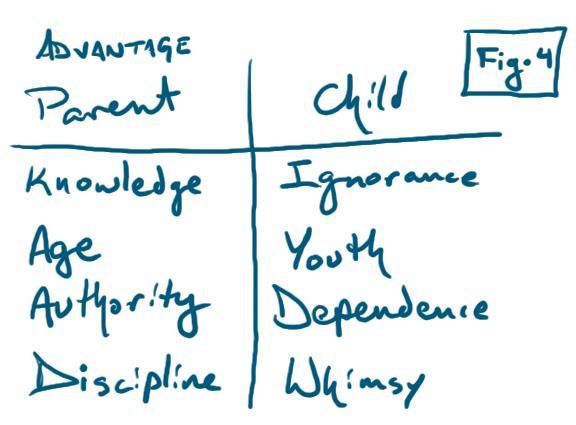
Let's briefly switch gears and talk about relationships, starting with figure 4: In a parent/child relationship (and I mean a minor child, not a grown one), the parent has the child at a disadvantage. The parent is older, wiser, and possessing of more self-control than the child is (usually). This makes the relationship asymmetrical, and it places responsibility for the child directly on the parent because the child can't take care of itself. Ideally, the parent raises the child to be a peer, another adult among many, capable of making intelligent and mature decisions autonomously. This is done with one-on-one interaction, an adult teaching a child step-by-step to become an adult itself. And this is done, at least in part, because the parent loves the child and cares for its well-being. Now consider the relationship between God and humanity:
 It's a similar relationship - again, God has the advantage, and again, he damn well ought to be older, wiser, etc. than we are. How has God contributed to raising me as his child? Am I to reason from his lack of in-my-face involvement that he cares less about me than my own parents do? As far as I can tell, he wrote a letter and walked out before I was born - the letter is the Bible, walking out is Jesus' ascension into Heaven. To the best of my ability to tell, any moral shortcomings on humanity's part are the direct result of God's total failure to either make us right or raise us right, both as individuals and as a species.
Once I saw that, I couldn't un-see it. Good parents don't let their children do whatever the Hell they please; good parents make themselves a known presence in their childrens' lives, they raise their children by hand and guide them into becoming better people. Good parents do whatever the Hell it takes to protect their children and raise them to be the best people they can be. Any parent who allows her child to upset her has failed to control her temper; any parent who strikes a child in anger is at fault for not remaining in control of the situation. Why? Because children don't know what the fuck they're doing. I would know: I was a child once and I did some really embarrassing shit!
The parallels don't stop there. Households have rules, and parents are their authors; similarly, reality has rules (yay physics!), and God is their author. Why didn't God include any of these rules in his instruction manual? People understood math long before the Hebrews put quill to scroll, so why does the Bible have precisely zero interesting math in it (with the exception of a botched calculation of pi)? Moreover, why a holy book, instead of something more impressive? Every religion has holy books, but no religion has a holy organism that sings the holy text aloud and has no natural predators. Or how about a holy computer, a machine from God that can answer all our questions and also preserve God's language? The machine could also self-replicate and self-assemble, like a glorified RepRap machine. And a million other things, too - in short, why is God so boring?! Why did God do nothing to distinguish the one true religion from every other religion? Why is Yahwism, to all appearances, the same stuff in a similar package? I just don't get it.
But most importantly, if God exists, then why is he hiding from me? Silver Garou came up with what I think is an excellent argument on exactly this point, and it proceeds as follows:
OK, whew! That's it from me on why I don't believe... in this discussion... so far... today. It's been a little rough, but that is the gist of why theism makes no sense to me. So that's enough out of me: what do you think, cl? Where do you disagree with me, or at least diverge, and why? I'll make the assumption that you've still got what you think is a better way, and I'm curious to know what it is that you think is a good justification for theism, and why I should endorse it. Or, if it's a matter of personal revelation, then I'm curious as to how you can comfortably and honestly distinguish that revelation from insanity - no joke, this is an honest question on my part here.
I've pretty much said my piece and will wait to write anything as substantial as this until either I'm asked a direct question, or something else piques me. Ball's in your court!
But wait... even if I get to Heaven, is there still a Hell? If so, then if I'm in Heaven and know about Hell, it's gonna make me fuckin' miserable! I barely manage to get by as is, knowing that people starve to death every fucking day; how much worse would this be if I knew that people were being tortured forever?! I came to the conclusion that this could go three ways: either there is no Hell, or God needs to give me an empathy-ectomy at the Pearly Gates, or I need to forget about Hell. If there is no Hell, then... no problem! I don't even need to worry about it myself! But if there is, and God gives me an empathy-ectomy or makes me forget a rather key fact of reality, I don't really see what makes such a being worthy of worship. Not being dismissive, I just don't see anything good in a being that says with its actions, "Forget about those losers, they don't count; come hang out with us cool kids."
I don't know what it is, but all my role models, all my favorite superheroes, everyone I admire and even myself, we all have one thing in common: we are unable to stand idly by and watch others suffer. How is it that God is able to do such a thing, but still call himself good? I looked into the literature and found a whole lot of stupid bullshit.
Theodicies, in my experience, are categorically failures, more or less because I buy into Epicurus' dilemma: "Is God willing to prevent evil, but not able? Then he is impotent. Is he able, but not willing? Then he is malevolent. Is he both willing and able? Then whence cometh evil? Is he neither able nor willing? Then why call him God?" Who gives a flying fuck about our precious free will? Not God - he hardened Pharaoh's heart several times, he chose Moses and Saul of Tarsus despite their wills, and when Jonah flew the coop, God wouldn't take "no" for an answer. No, abiding evil when you don't have to, compromising with it when you have the advantage, allowing it when you could do otherwise, this strikes me as "knowing better but doing worse." This is a long-respected definition of "evil."
Let's briefly switch gears and talk about relationships, starting with figure 4:

Once I saw that, I couldn't un-see it. Good parents don't let their children do whatever the Hell they please; good parents make themselves a known presence in their childrens' lives, they raise their children by hand and guide them into becoming better people. Good parents do whatever the Hell it takes to protect their children and raise them to be the best people they can be. Any parent who allows her child to upset her has failed to control her temper; any parent who strikes a child in anger is at fault for not remaining in control of the situation. Why? Because children don't know what the fuck they're doing. I would know: I was a child once and I did some really embarrassing shit!
The parallels don't stop there. Households have rules, and parents are their authors; similarly, reality has rules (yay physics!), and God is their author. Why didn't God include any of these rules in his instruction manual? People understood math long before the Hebrews put quill to scroll, so why does the Bible have precisely zero interesting math in it (with the exception of a botched calculation of pi)? Moreover, why a holy book, instead of something more impressive? Every religion has holy books, but no religion has a holy organism that sings the holy text aloud and has no natural predators. Or how about a holy computer, a machine from God that can answer all our questions and also preserve God's language? The machine could also self-replicate and self-assemble, like a glorified RepRap machine. And a million other things, too - in short, why is God so boring?! Why did God do nothing to distinguish the one true religion from every other religion? Why is Yahwism, to all appearances, the same stuff in a similar package? I just don't get it.
But most importantly, if God exists, then why is he hiding from me? Silver Garou came up with what I think is an excellent argument on exactly this point, and it proceeds as follows:
1. God is omnipotent and omniscient, and therefore cannot be stymied in his efforts (or at least not by humans).God knows where I'm at, and God knows what it would take to make another Saul, Thomas, Jonah, or Pharaoh out of me. I can think of many reasons for him to do so, but none at all for him to wait or not do so at all.
2. Since I myself know what would convince me of God's existence, God too must also know that thing.
3. Thus, God knows what would convince me of his existence. (from 2)
4. God has not convinced me of his existence (my mother did, once, but that wore off).
5. "Being hidden" does not necessarily imply the intention of "is hiding," since ruins can "be hidden" in the forest but obviously have no intentions of hiding. Yet until they are actually found, they do in fact remain hidden.
6. An entity that chooses whether to remain hidden or not, and has this as its option, does so with intent insofar as it is intelligent.
7. God is intelligent.
8. Thus God cannot remain hidden unless he also intends to be hidden and therefore "is hiding." (from 1, 6, 7)
C: Since God has not yet convinced me of his existence, then he is either hiding while waiting, or hiding forever, or does not actually exist as such (as omnipotent and omniscient, or at least enough of those things to actually convince me). Or he just doesn't want me to believe in him, which I guess is cool, too, except that it tells me he wants me to go to Hell (if there is one). (from 1, 4, 8)
OK, whew! That's it from me on why I don't believe... in this discussion... so far... today. It's been a little rough, but that is the gist of why theism makes no sense to me. So that's enough out of me: what do you think, cl? Where do you disagree with me, or at least diverge, and why? I'll make the assumption that you've still got what you think is a better way, and I'm curious to know what it is that you think is a good justification for theism, and why I should endorse it. Or, if it's a matter of personal revelation, then I'm curious as to how you can comfortably and honestly distinguish that revelation from insanity - no joke, this is an honest question on my part here.
I've pretty much said my piece and will wait to write anything as substantial as this until either I'm asked a direct question, or something else piques me. Ball's in your court!
Wednesday, October 21, 2009
Arguing on the Internet: Machina Ex Deus, part one (cl)
The Story So Far: cl and I are arguing on the internet! I outlined some metaphysics and epistemology in my last installment, and cl commented.
I used to be a theist; specifically, I was a fundagelical Christian. I saw God's hand in all things, I saw the Goddamned Devil at work in the world, I had promised my soul to Jesus several times and in several ways (I needed frequent fixes of God-smack), and I lamented that there should ever be anyone to not hear the glorious Word of God. I tried to be hopped up on God-smack as often as I could, and I'm not saying that to be pejorative: I thought the God-smack was good stuff at the time, and I thought that I was at my moral best when I was on it (full of Christ's love, in awe of the Maker's creation, etc.). Today I'm going to outline what changed - this is something of an autobiographical parable, inasmuch as I intend to gesture at my philosophical development while more or less ignoring everything else that was going on in my life and the world at large at the time.
Like all good parables, this one sets its tone with a metaphor. As I pointed out before, reality is ambiguous - or, rather, the relationship between reality and our perceptions is fundamentally unknowable because we are not omniscient, and therefore any perception of reality we might have is intrinsically ambiguous. So if I wake up with a headache and want to know what caused it and how to get rid of it, I have to do some brief testing: did I drink last night? I might have a hangover. Did I fight last night? I might have a bump on my head. And a million other things, too. Let's suppose for the moment that I don't remember what I did last night, but the two best competing explanations are that I either have a bump on my head, or I am hung over, or both (hooray for the inclusive "or").
A fairly direct method of testing whether I have a bump on my head is to feel around for one. But it might be the normal shape on my head, so it probably ought to be painful; that pain, in turn, could also be explained by a special sensitivity in that area for entirely bumpless reasons (for example, all people might have sensitive bumps in that spot on their heads - I don't know yet). To directly test whether I have a hangover, I could in principle do some bloodwork to check my BAC or look for metabolites or something, but that would be a pain, so I may just drink lots of water and see if the headache goes away. I could also take hangover medicine and see if it goes away. But in any event, if I take some action and then my headache clears up, I cannot tell for sure whether those two things are related at all; I can only make an "inference to the best explanation," or IBE.
Metaphor over, parable is go! Some years ago, I had an existential headache, and the two best explanations I could come up with were that I either had a sinful hangover, or a theistic bump on my head. I'm not sure quite what I did, but the headache went away. I realize that I may have merely taken a metaphysically naturalistic pill to mask the symptoms of my sinful hangover, which by rights I damn well ought to be feeling right now. That's a possibility. But the IBE I'm going with for now is that I had a theistic bump on my head from repeated doses of the fundagelical medicine stick. I stopped dosing, the bump went away, and my existential headache disappeared with it. So... what is my existential headache a metaphor for?
My existential headache consisted of an inability to reconcile any coherent idea of God with the observable facts of reality, to the best of my ability to interpret them.
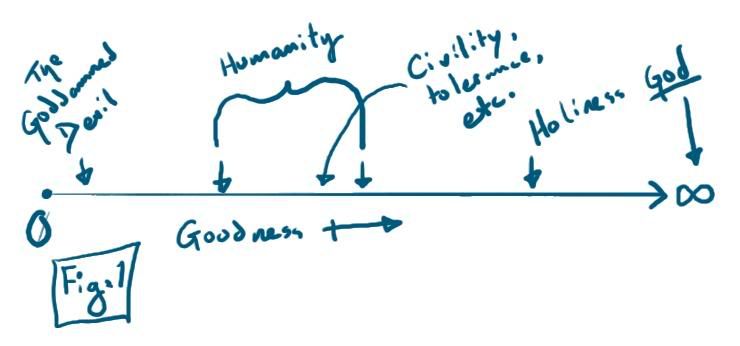
One of my first understandings of morality was that "good" is a continuum, where a "lack of good" constitutes "evil," and a maximum of good would be perfection. Something like figure 1 here: I now consider this a rather naive understanding of morality, mainly because it's grossly oversimplified, but it's not entirely without its merits. However, what I noticed is that if tolerance is within the "goodness range" of which humans are capable, then why can God not tolerate sin? Humans are able to live with each other's iniquities, to forgive those who trespass against us even if they keep doing it. I mean, hurting each other without meaning to do so is part of being human, and we can get over that, so why can't God tolerate sin in Heaven as he does on Earth? Well, I was told that it doesn't work like that, and rather something more like figure 2:
 Here we see that there is God, who is Heavenly, and "other," which is Hellish. In between, overlapping with each but also having things all their own, is humanity. God is holy, and for that reason cannot abide sin in his presence, and so has withdrawn from the world until his final return. Humanity, being made in God's image, is able to understand some holy goods, such as mercy, justice, and compassion; but we are also capable of tolerating sin only because we ourselves are sinful. After all, if we dealt with each transgression as God says we should in the Bible, civilization would rather quickly collapse as we put to death everyone who violated pretty much any rule at all.
This explains why God tolerates sin on Earth, but not in Heaven, and by extension why we are on Earth and not in Heaven yet (because we still sin). But... wait... what exactly do we mean by sin? Definitionally, sin is that which God abhors, but why does God abhor it? Because he is holy? Then what is holiness? If it is mere godliness, then we have defined ourselves into a circle: whatever God does is holy because God's doing it, and whatever God abhors is sinful because God's abhorring it, and so to say that God is good is merely to say that God does as he pleases. I had not yet learned of the Euthyphro dilemma, but this is more or less how I arrived at it.
I realized at this point that there must be something about a particular thing which is sinful or holy, regardless of what God thinks of it; God's opinions, then, are the result of an interaction between his perfect perceptions of reality and its nature as sinful or holy, as the sinful or holy nature of the thing itself causes God to experience pleasure or disgust because of facts about God's personality. After drawing up tables and tables of sinful and holy things, however, I was unable to find any rhyme or reason behind the particular things that God told us were holy and sinful. It honestly looked to me like the Biblical deity was like a child with a sandbox, laying down arbitrary rules because he made everything, and wrecking our shit when he got upset with what we did just because he could. I see such a being as unworthy of worship, and if this is what God's like - an authoritarian dick-waver who thinks that merely being causally responsible for us (all by itself) gives him the right to tell us how to live - then I think we should all try to gang up on him Tower of Babel style. This is the behavior of a tyrant child, not of the rightful king of all existence.
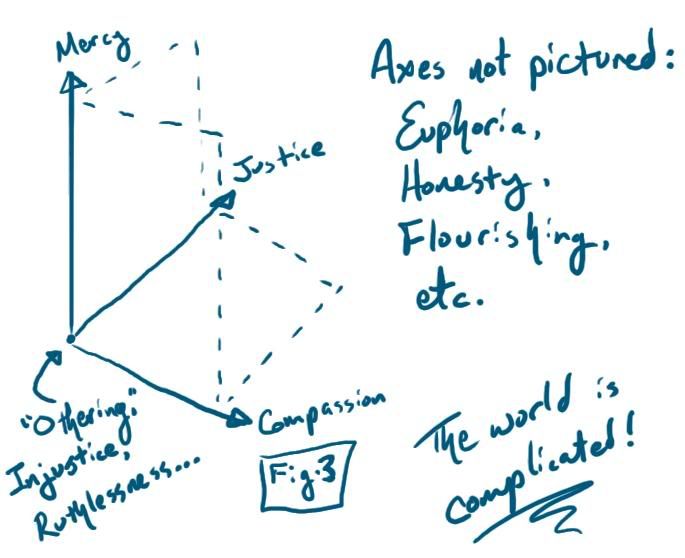
How do I know this? Because if morality is fundamentally arbitrary and God's at the helm, then all he has to do to eliminate evil and suffering is get over his bad self and change his own mind. Moses did it (Exodus 32:9-14). Anyway, my own personal ethics has evolved somewhat, moving from a moral idea space to a "morally-charged" multidimensional idea space, as seen in figure 3: Between then and now, my understanding for the best of all possible Gods morphed from any religious type of deity to something like Nick Ifkovits' idea as laid out in his novel, Cloud Drops (he's a friend of my mom's): in this story, God is more or less a laid-back hippie who really only cares about people being good to each other. You do that, you get to go to Heaven and have crazy orgies all day long; don't, and you are a lost spirit, destined to stick around on Earth stewing in your own existential angst. I believe that in the story, those who die without becoming either good or evil are "recycled" after a fashion, but don't quote me on that (I haven't read it in a while). But religious faith is absolutely meaningless to this deity, it truly is works alone that get one into Heaven on this view; you don't even need to be a theist! So if this is the real deal, then I've already got it made and thus have nothing to be saved from. Even if I didn't get to Heaven, I've striven to eliminate angst from my life, so I think that hanging around on Earth as a specter wouldn't really be all that bad.
Yet it seems almost too obvious that I might be wrong on this one, and I might need to believe this or that particular thing, even if I don't buy the whole kit & caboodle. For instance, it might be the case that I really do need to accept Jesus into my heart to get into Heaven; but the rest of the Bible might be pure hogwash!
This is where things get really complicated; part two on Friday.
I used to be a theist; specifically, I was a fundagelical Christian. I saw God's hand in all things, I saw the Goddamned Devil at work in the world, I had promised my soul to Jesus several times and in several ways (I needed frequent fixes of God-smack), and I lamented that there should ever be anyone to not hear the glorious Word of God. I tried to be hopped up on God-smack as often as I could, and I'm not saying that to be pejorative: I thought the God-smack was good stuff at the time, and I thought that I was at my moral best when I was on it (full of Christ's love, in awe of the Maker's creation, etc.). Today I'm going to outline what changed - this is something of an autobiographical parable, inasmuch as I intend to gesture at my philosophical development while more or less ignoring everything else that was going on in my life and the world at large at the time.
Like all good parables, this one sets its tone with a metaphor. As I pointed out before, reality is ambiguous - or, rather, the relationship between reality and our perceptions is fundamentally unknowable because we are not omniscient, and therefore any perception of reality we might have is intrinsically ambiguous. So if I wake up with a headache and want to know what caused it and how to get rid of it, I have to do some brief testing: did I drink last night? I might have a hangover. Did I fight last night? I might have a bump on my head. And a million other things, too. Let's suppose for the moment that I don't remember what I did last night, but the two best competing explanations are that I either have a bump on my head, or I am hung over, or both (hooray for the inclusive "or").
A fairly direct method of testing whether I have a bump on my head is to feel around for one. But it might be the normal shape on my head, so it probably ought to be painful; that pain, in turn, could also be explained by a special sensitivity in that area for entirely bumpless reasons (for example, all people might have sensitive bumps in that spot on their heads - I don't know yet). To directly test whether I have a hangover, I could in principle do some bloodwork to check my BAC or look for metabolites or something, but that would be a pain, so I may just drink lots of water and see if the headache goes away. I could also take hangover medicine and see if it goes away. But in any event, if I take some action and then my headache clears up, I cannot tell for sure whether those two things are related at all; I can only make an "inference to the best explanation," or IBE.
Metaphor over, parable is go! Some years ago, I had an existential headache, and the two best explanations I could come up with were that I either had a sinful hangover, or a theistic bump on my head. I'm not sure quite what I did, but the headache went away. I realize that I may have merely taken a metaphysically naturalistic pill to mask the symptoms of my sinful hangover, which by rights I damn well ought to be feeling right now. That's a possibility. But the IBE I'm going with for now is that I had a theistic bump on my head from repeated doses of the fundagelical medicine stick. I stopped dosing, the bump went away, and my existential headache disappeared with it. So... what is my existential headache a metaphor for?
My existential headache consisted of an inability to reconcile any coherent idea of God with the observable facts of reality, to the best of my ability to interpret them.
One of my first understandings of morality was that "good" is a continuum, where a "lack of good" constitutes "evil," and a maximum of good would be perfection. Something like figure 1 here:
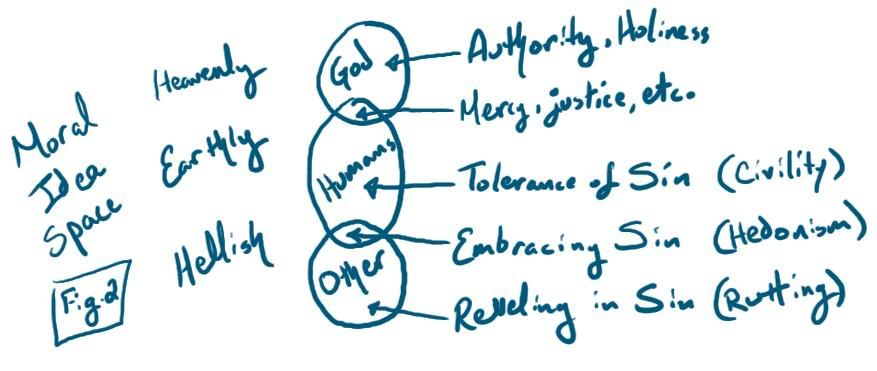
This explains why God tolerates sin on Earth, but not in Heaven, and by extension why we are on Earth and not in Heaven yet (because we still sin). But... wait... what exactly do we mean by sin? Definitionally, sin is that which God abhors, but why does God abhor it? Because he is holy? Then what is holiness? If it is mere godliness, then we have defined ourselves into a circle: whatever God does is holy because God's doing it, and whatever God abhors is sinful because God's abhorring it, and so to say that God is good is merely to say that God does as he pleases. I had not yet learned of the Euthyphro dilemma, but this is more or less how I arrived at it.
I realized at this point that there must be something about a particular thing which is sinful or holy, regardless of what God thinks of it; God's opinions, then, are the result of an interaction between his perfect perceptions of reality and its nature as sinful or holy, as the sinful or holy nature of the thing itself causes God to experience pleasure or disgust because of facts about God's personality. After drawing up tables and tables of sinful and holy things, however, I was unable to find any rhyme or reason behind the particular things that God told us were holy and sinful. It honestly looked to me like the Biblical deity was like a child with a sandbox, laying down arbitrary rules because he made everything, and wrecking our shit when he got upset with what we did just because he could. I see such a being as unworthy of worship, and if this is what God's like - an authoritarian dick-waver who thinks that merely being causally responsible for us (all by itself) gives him the right to tell us how to live - then I think we should all try to gang up on him Tower of Babel style. This is the behavior of a tyrant child, not of the rightful king of all existence.
How do I know this? Because if morality is fundamentally arbitrary and God's at the helm, then all he has to do to eliminate evil and suffering is get over his bad self and change his own mind. Moses did it (Exodus 32:9-14). Anyway, my own personal ethics has evolved somewhat, moving from a moral idea space to a "morally-charged" multidimensional idea space, as seen in figure 3:
Yet it seems almost too obvious that I might be wrong on this one, and I might need to believe this or that particular thing, even if I don't buy the whole kit & caboodle. For instance, it might be the case that I really do need to accept Jesus into my heart to get into Heaven; but the rest of the Bible might be pure hogwash!
This is where things get really complicated; part two on Friday.
Monday, October 19, 2009
Arguing on the Internet: Epistemology and Truth (cl)
So yeah, cl and I are arguing on the internet. This will come as no surprise to anyone who knows me personally, but I am ruled by my passions: I do almost anything that I do in fits and starts. Arguing with cl is now, like, near the top of my list, right beneath "Don't get fired" and "Don't starve or dehydrate." But "Maintain an interesting blog" is up there, too, and I know that this will not be of interest to everyone. To that end, I shall post arguments with cl no more than once every other day, and I'll make sure to have anything else up in between - but still, that means if I post every day, this blog will be half-cl for quite some time (hopefully).
The story so far: cl wrote a post that really piqued me (in the good way), so I responded and then things got hairy. Today I will be addressing what are, to me, the three most interesting things about cl's last salvo - knowability, a response to his argument from probability, and rhetorical gamesmanship. I'll close with a bit on truth, which I offer up as another direction in which the discussion might proceed.
First, a bit about knowability, which will touch on epistemology, the study of the nature and content of knowledge. cl posted an interesting logical argument involving this, and then clarified his meaning in a comment at my request (thanks for that, cl!). From what I can gather, cl and I agree in at least a vague way that the "awesomeness" of a claim has something to do with its grounding in experience: in his own words, "That which can be verified by experience is knowable; that which cannot be verified by experience is not." Or, as I say, "Knowledge must be grounded in empirical observation." However, cl then goes on to say,
We can make inferences about that which cannot be verified by direct experience - for example the claim that life exists in some other corner of the universe, or that George Washington was the first president of the United States - but that's it. Does this mean we can't "know" the planets revolve around the sun? In a sense, yes...Well, I actually agree with this as stated. However, we must also infer that our direct experiences as we remember them are valid in any way at all - and they in fact might not be. For instance, I may hear a voice and believe it is God, but it might also be the Goddamned Devil, or a person in another room, or my own internal narrator, or butt-puckering insanity - and at first blush, it seems awful hard to tell how some of these possibilities might be sorted out. This puts us in an interesting position with respect to truth (see below), but for now I shall simply say that not even direct experiences are immune to the leap of inference at which cl so precisely gestures, so long as those experiences are in the past (since all experiences not currently being had are in fact remembered - or misremembered, sometimes). It is self-evident, after all, that we do in fact have experiences, and anyone may verify this with the briefest of introspection - however, the content of those experiences, and their bearing on reality, are always subject to question. This is because, in short, we cannot directly perceive causality itself and may only infer it from the constant conjunction we perceive between suspected causes and their alleged effects (thanks, Hume!).
There is no getting around this. Thinkers of all stripes have tried, and failed, and whined about it (even me!); but we must all live with this doubt as our constant companion. As I said earlier, echoing Descartes: de omnibus dubitandum. So, if even direct experience is subject to question, what are we left with? I go with testability, which moves the goalposts for knowability quite a bit.
I realize that when I encounter an argument, or even a proposition, I do not decide whether to endorse it as logical or dismiss it as ridiculous right away - I first perceive either agreement or disagreement. It took me a while to get over this, but the instantaneous reaction I have of either "OK" or "No way" is itself a matterer of perception, at least in my own mind. Hell, others might be different. At any rate, if I have trouble determining whether I am perceiving thoughts of "OK" or thoughts of "No way," that's when I start to think about the claim itself. And I have agreed too readily to a great many things which I have later gone on to regret, ranging from trivial mathematical mistakes to the embarrassing thought that my mother must hate me for feeding me vegetables (I love vegetables now, and feel like an absolute twat for ever being a child, pretty much). But if, when I think about a proposition and then have difficulty trying to sort out just why I am perceiving agreement or disagreement with it, I then feel an urge to check. In the past, I felt the urge merely to decide.
Checking is important because then I can tell whether I am remembering something correctly or incorrectly. After all, I have mis-remembered in the past. So if I have trouble justifying a particular belief I hold, and can't remember what it was that made me think that in the first place, I then go see what I can check. And if I can't check to my satisfaction, I tend to withhold belief and write it off as unimportant - after all, that which leaves no effects to check is mighty difficult to call "relevant" on several well-respected definitions. This is more or less how I live my life, with respect to epistemology, anyway - more on this when we get to truth.
Whether or not you agree with cl's argument that it is more reasonable to believe that consciousness persists after death, I see a real gem of wisdom in there, which is a matter of perspective: cl's argument shows that, depending on how we define our terms, we can get to some surprisingly different conclusions about how we ought to form our beliefs. A great many people seem to form their beliefs - or at least a great many of them - in something resembling a binary truth table: X is true, Y is false, Z is true if A is not, B is true if and only if C is also true, and so on. Whether or not any particular person does, I cannot say, but this is in keeping with the overwhelming majority of my experience among humanity. When we say, "I don't know," most people usually mean, "I haven't thought about it," or, "I haven't decided."
Not me. My truth table has "true," "false," "not applicable," "I don't know," and "it depends." Other people might include "maybe," "probably," and "not if I have anything to say about it!" When I drop my hackey-sack, it falls to the ground: true. Two plus two equals five, for extremely large values of two: false (but funny!). This statement is a lie: not applicable (or "nonsense"). There is non-Earthly life in the solar system: I don't know. The Earth goes around the Sun: it depends on your frame of reference - if we define Earth's core as the center of our solar system, then of course the Sun goes around it, but then the rest of the planets and other stuff get a bunch of weird epicycles which we can rather handily avoid by adopting a heliocentric perspective instead. God exists: I don't know. God doesn't exist: I don't know.
Buh? Yeah. I don't know whether any sort of supernatural critter exists. I really don't. However, if some kind of supernatural critter did exist, then it would be this-or-that way, and not thus-and-such. In other words, it might be Thor-like, or Yahweh-like, or leprechaun-like, or FSM-like, or unicorn-like; and if it's one of those, then I sure don't want to pick the wrong one! But what if it's none of the ones that humans have come up with, and something totally different? What if it's aggravated by people believing in false gods, but has no "actual" religion of its own for followers to believe? What if it wrote no holy text, but instead tricked people into writing false ones? What if Richard Carrier's End of Pascal's Wager actually is the case?
I don't know.
I don't know, and so I withhold belief. In all of them, and in consciousness after death, and in live on other planets, and in parallel universes, and in any particular version of the maybe-even-not-approaching Singularity, and in a great many other things. Even if there is a supernatural critter, which there may well be, I do not believe in any particular one - and so I am not a theist. Since I am not a theist, that makes me an atheist. I am also an agnostic, because I don't know either way for sure, and so in that way I am an agnostic atheist; moreover, I'm skeptical of anyone who does think they have "all the answers" (or even a great many of them!), and so I am a skeptical agnostic atheist; and I'm a humanist, and a homo sapiens, and a house-renting-type person, and all sorts of other designations. But I am not a theist, for lack of evidence alone. I just don't know which way to go, so I don't go any way on that question. As for ethics, relationships, economics, and so on, well, my views get more complex and my "titles" keep on stacking up. But I am only an atheist because I am not a theist, I am not an atheist because I think I've "disproved God." Nobody can, that's just silly. I just won't believe until I can poke my fingers through some holes like the apostle Thomas.
A quick note on rhetorical gamesmanship before we get to truth. First, some may have noticed that I called cl a rhetorician and described his blogger's statement as platitudinous. I did each of these things for exactly one reason each: I called him a rhetorician because I thought I had discovered that the central motivating factor in his internet activity was honing his argumentative skill, and I called his blogger's statement "platitudinous" because some of his most interesting sentences sounded like platitudes to me. In the first place, I did not mean "rhetorician" as an insult, as I explained to cl in an e-mail; I think it is no bad thing to be concerned with how persuasive one is as a first priority, I think it is only bad if one then does bad things with such a skill. I mean, I want to be persuasive, for cryin' out loud, and so I too am a rhetorician. And in the second place, I was mistaken on the meaning of platitude! I thought "platitudes" were just simple-sounding phrases, more or less, some of which are trite and meaningless and some of which lend quite easily to deep wisdom. But I actually checked just now, and as it turns out, "platitude" only means the former thing (trite and meaningless), whereas I had honestly meant to indicate the latter thing (lending quite easily to deep wisdom). So yeah, foot-in-mouth for the win. Mea culpa!
So yeah, finally, on truth: there are two prevailing theories of truth in philosophical circles, the correspondence theory of truth and the coherence theory of truth. To steal Scotlyn's turn of phrase and boil a whole lot of argy-bargy down to one sentence, "correspondence" means "is the case in reality," and "coherence" means "is consistent with the greater body of true propositions." I couldn't tell you why this is a serious debate if you put a gun to my head, because both are important to me: true things ought to correspond to reality, I think, and true things also ought to cohere with one another. I think if either one of those is lacking, then you don't have truth; and if you can only get one but not both, then any claims to truth are suspect. So when I check to see if something is or is not the case, I'm satisfying the correspondence quotient; when I integrate that bit of knowledge with the rest of my knowledge, I'm roughly checking for coherence. They both matter.
So when I define "knowledge" as "justified true belief," understand that "true" means both "corresponds to reality" and "coheres with other true propositions." So for a claim to be "knowable," to me, means that I have to be able to get a justified true belief out of it. If I don't believe it, I can't be said to know it; if it's not true, then I can think I know it without actually knowing it (and even justify that thought process); and if it's not justified, then I merely believe a true thing without knowing it. That last one's sketchy, so here's a quick example: I've believed that the Earth is round as long as I can remember, but I also remember that I was told so by my teachers and parents. As I began to question my teachers and parents, I found that they were not always right on things (such as math teachers insisting that the French word macabre is pronounced "MACK-uh-bray" and not "muh-KAHB," despite the correction of a seventh-grader such as I was at the time). Yet I never stopped believing that the world was round, even after losing my justification; instead, I learned how Eratosthenes calculated the Earth's circumference while trying to check whether it was round or flat, and so found a better justification.
Sometimes I have had to revise my beliefs based on observations so that they cohere with others, as alluded to above on why "checking" is important. As an easy (and real) example, I used to have many fears and superstitions as a child, some of them based on things I was told by others. I heard from my mom that ending microwave oven cook times in zero (such as 1:30, 2:00, etc.) would result in your food getting burned, so you needed to end cook times in non-zeroes. I don't know why I ever listened, but one day I actually checked by seeing how long cookies took to burn in a microwave, and I found two interesting facts: first, that cookies burn within a few seconds of the same general time, no matter what digit is last when the machine starts cooking; second, that my mom was wrong on this matter. So I wrote off what I thought was a whole bunch of superstitious hogwash along with that, and now we fast-forward to last year when my then-roommate, Amy, tells me that cool water boils faster than warm water, and warm water freezes faster than cool water. I called bullshit, because I had tested many of the superstitious claims I'd gotten from my mom, but then I went and checked: turns out, the Mpemba effect is real!
Sometimes, bullshit-sounding claims are actually true. But you can never know for sure until you check, and you shouldn't believe if you can't check yet.
Subscribe to:
Posts (Atom)